Ho ho how is it December already?! Welcome to the end of another week, and another roundup of stories that caught our eye in the realm of transport, urbanism, and opportunities to make our little city that little bit greater…
This week’s header image (taken by Jolisa) shows the city after Wednesday’s storm, as seen from Coyle Park, in a Christmassy colour scheme.
This Week in Greater Auckland
- On Monday, Matt covered the announcement that the CRL opening is delayed until the second half of 2026
- On Tuesday, we re-published Connor’s excellent op-ed on the value of cycleways for everyone
- On Wednesday, we broke the news that the Infrastructure Commission/ Te Waihanga had endorsed Connor’s proposal of reviving rapid transit for the Auckland isthmus, securing the idea a slot in the national Infrastructure Priorities Programme.
- On Thursday, we ran a throwback post looking at the huge wider economic benefits of the CRL.
This roundup, like all our work, is brought to you by the Greater Auckland crew and made possible by generous donations from our readers and fans. If you’d like to support our work – and, what better time of year to make a gift for a better world? – you can join our circle of supporters here, or support us on Substack.
IKEA-mageddon?
Despite extensive predictions of traffic-mageddon around the Thursday opening of New Zealand’s first IKEA, traffic-mageddon didn’t eventuate, at least not to the degree predicted.
Which is good, but doesn’t mean it won’t happen this weekend, the first really rainy day, or every other day from now until forever, etc. And once the rail closures kick in over summer, all bets are off.
This does suggest a new VKT reduction strategy, however: you can just tell people the roads will be horribly busy at a certain time of day, and they’ll avoid driving in droves??
Anyway, Hayden Donnell was on the case for The Spinoff:
We’ve had signs up on the sides of our motorways for days forecasting traffic chaos. I interviewed a visiting American yesterday and he described the array of warnings he got about Ikea between the airport and his hotel. “It did make it seem like this is not a real country,” he said.
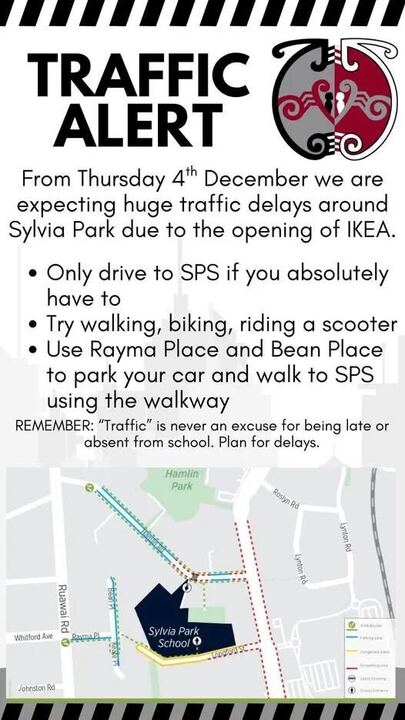
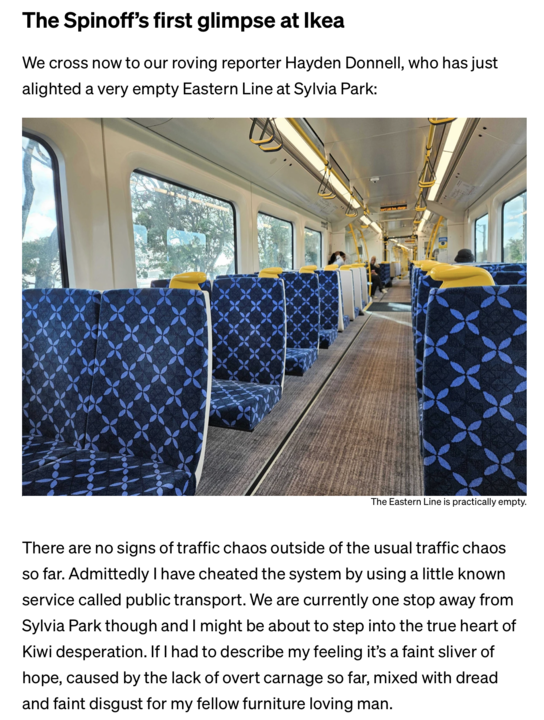 Arguably, the lack of “carnage” on Day One was testimony to the value of copious advance communication about how to avoid it. This included a local school advising kids to walk and bike if possible.
If you squint, this looks exactly like a classic Streets for People project… exactly the kind of sensible travel-demand planning that the current government seems weirdly bent on stamping out.
Speaking of walking, biking, and riding a scooter: Bike Auckland highlighted another key access issue. While IKEA itself has thoughtfully installed a bunch of bike parking (and IKEA’s local market manager has expressed enthusiasm for biking to work), despite years of advance notice, Auckland Transport has utterly failed to supply the necessary Scandi-safe bike routes. Or indeed, any bike routes nearby.
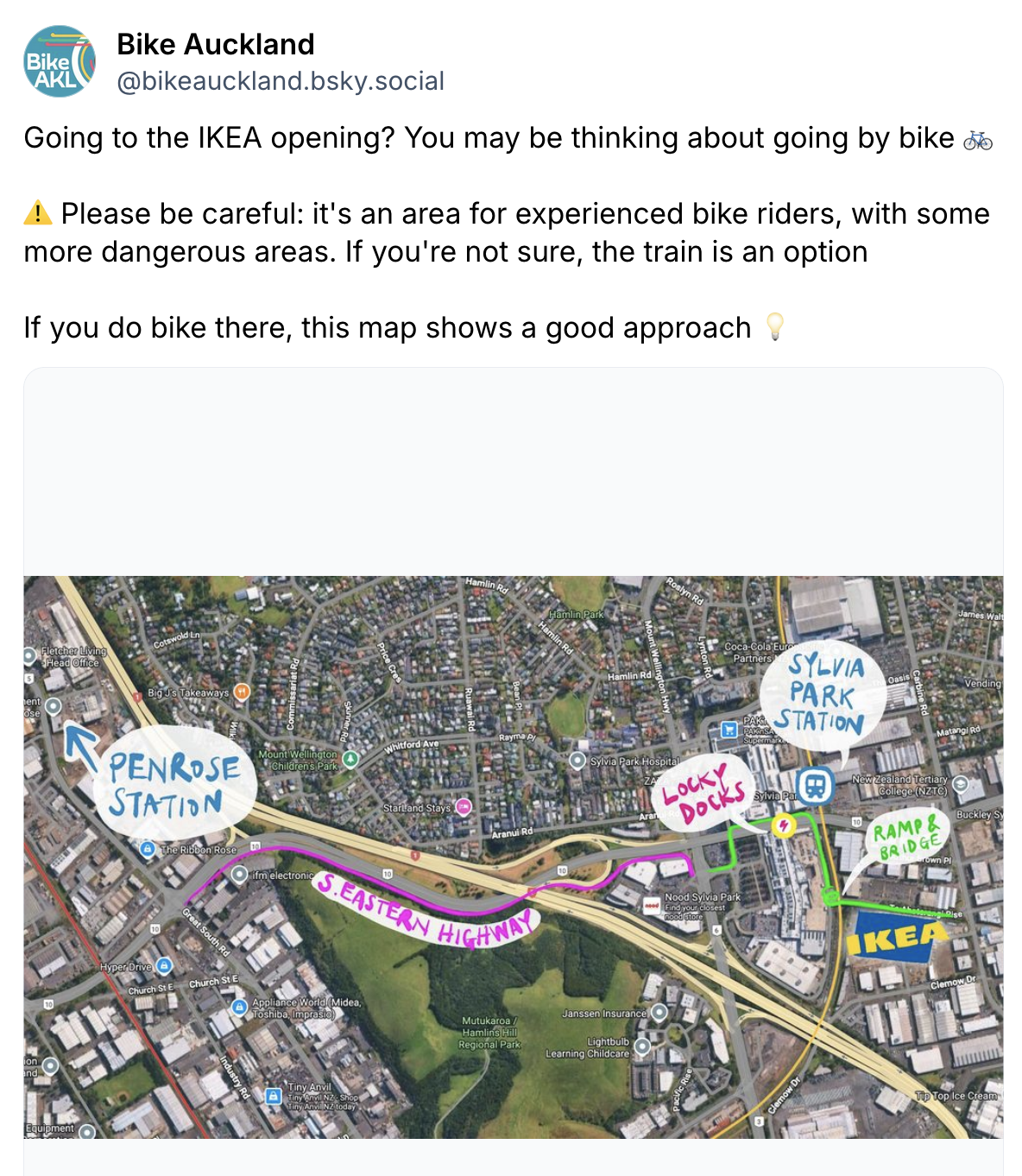 Will this week’s fervent focus on transport issues lead to a rapid rethink and redesign, enabling safe and reliable all-modes access to this critical new piece of our shopping landscape? What do you think?

IKEA icon Blåhaj on a bike. Image via Reddit’s r/BLAHAJ forum (original source post).
Happy birthday to Te Ara i Whiti!
A certain hot pink local icon turned ten this week. Hard to believe it’s been around that long! Look how excited everyone was when it was launched, a very short ten months after being announced. Where can we get some of that electric enthusiasm and aspirational alacrity these days?
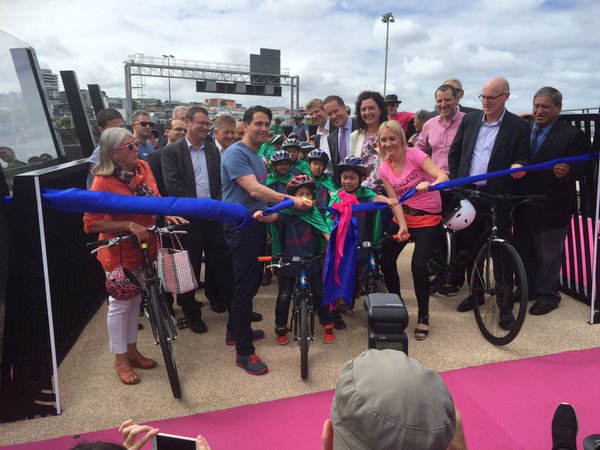
Ribbon-cutting for Lightpath, 3 December 2015. Image via Pippa Coom, source unclear.

Nikki Kaye, Sion Bridges, Chris Darby, Patrick Reynolds. Image: Our Auckland
Speaking of aspirational alacrity (and the obvious question, what’s next?), it seems the bike ramp for better access to Sydney’s Harbour Bridge is nearly there. Some envy-provoking pictures here:
https://bsky.app/profile/strategic-cities.com/post/3m6y5h5cxms2i
And doesn’t that connecting bridge shape look awfully familiar?
https://bsky.app/profile/strategic-cities.com/post/3m6y5mdwlwk2i
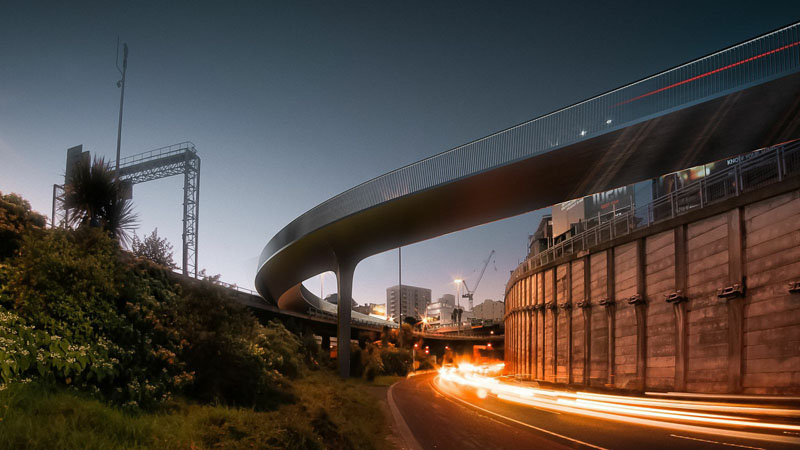
A little Lightpath flashback: the February 2015 artist’s impression of the Canada St connection to Te Ara i Whiti… which we were riding on a mere ten months later. Those were the days, how about we bring ’em back!
Time for more aspirational storytelling for Auckland
An op-ed in the NZ Herald this week by Rupert Hodson (Executive Director of the Committee for Auckalnd) asks: where’s the good storytelling about where we’re heading?
After 15 years as a Super City, the recent State of the City report, supported by Deloitte and Auckland Council, benchmarked our progress. It found enduring strengths in liveability, culture and resilience, alongside persistent challenges in productivity, skills and infrastructure. Net migration to Auckland has rebounded strongly. The City Rail Link will soon transform urban mobility and mode shift. Major investments in film, technology and data infrastructure are injecting new energy into our economy and Auckland’s innovation and tech ecosystem is emerging as a genuine growth engine.
The findings are clear: Auckland’s future success depends on a long-term agenda anchored in collaboration and ambition and fuelled by a bold narrative that builds confidence, belief and momentum.
Not to toot our own horn, but: is this where we come in? Especially in 2026…
Meanwhile: more housing for Carrington Road
The NZ Herald reported this week on more housing incoming for the former Unitec land along Carrington Road. This location is being developed by three rōpū (along with the Crown, via Te Tūāpapa Kura Kāinga Ministry of Housing and Urban Development):
- Marutūāhu: joined Ockham Residential to build the new Toi and Whetū apartment blocks, which opened in September
- Ngāti Whātua: about to start the first 51 of 350 homes at Te Punga
- Waiohua-Tāmaki and project partners
The article is paywalled, but here’s a snippet:
Construction is about to begin on the first 51 townhouses at Ngāti Whātua Ōrākei Properties’ land at Ōwāiraka Mt Albert, as part of a wider 4000-home residential development.
Ngāti Whātua Ōrākei Trust deputy chairman Ngarimu Blair said that entity would develop 350 new homes at Te Kukūnga Waka precinct.
Cottee Parker architects designed the first 51 places, which G.J. Gardner is now starting to build, he said.
Those will be two-, three- and four-bedroom townhouses around a pocket park, all called Te Punga, which Blair said evoked the anchor of voyaging traditions because punga means anchor.
The first townhouses are expected to be sold later next year.
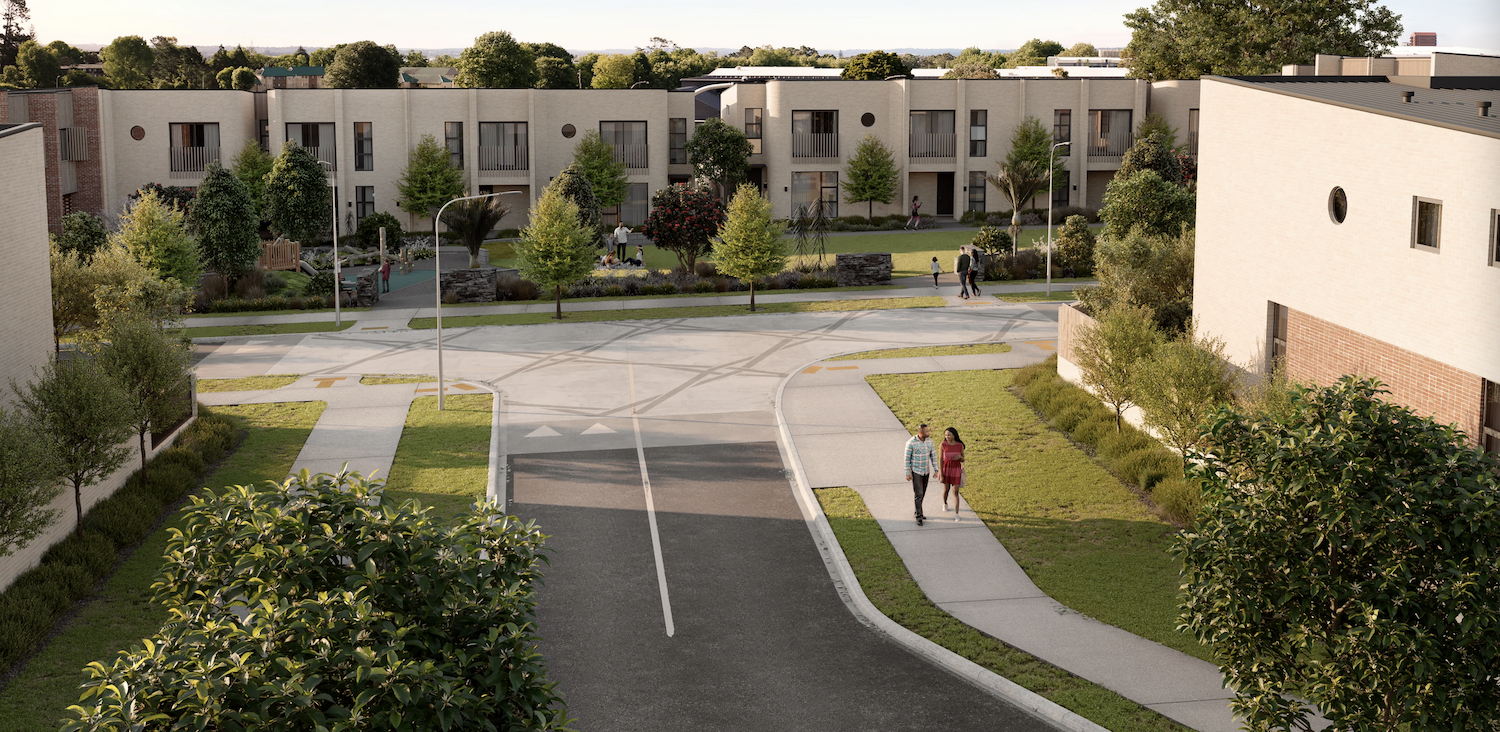
Te Punga townhouses, coming soon. Image: Ngāti Whātua Properties
Poignantly, on another corner of the Carrington site, a historic building was abruptly demolished this week – despite intense last-ditch efforts to forge a creative agreement that might conserve the building as a cultural landmark. (See The Spinoff and this Newsroom article for more of the story.)
The house, known as Grey Lodge, was where the prolific, brilliant and troubled author Robin Hyde wrote much of her most important work, including coverage of the government’s attempted expulsion of Māori from Ōrakei. Hyde’s writing will endure, and the space that was occupied by Grey Lodge will – under the auspices of Waiohua-Tāmaki and their construction partners – foster more housing for more people.
Speaking of more housing
Auckland Council recently released an insights paper on the potential inherent in Plan Change 120, titled More room to grow in good locations. It’s a quick read and includes the handy graph below, highlighting the forecast change in new homes over 10 years under PC120, relative to PC78.
Looking ahead: feels like a great time for Council to appoint a housing czar, and set up a department of excellence, streamlining processing, benchmarking best practices, maybe some pattern books, annual awards, and design competitions?
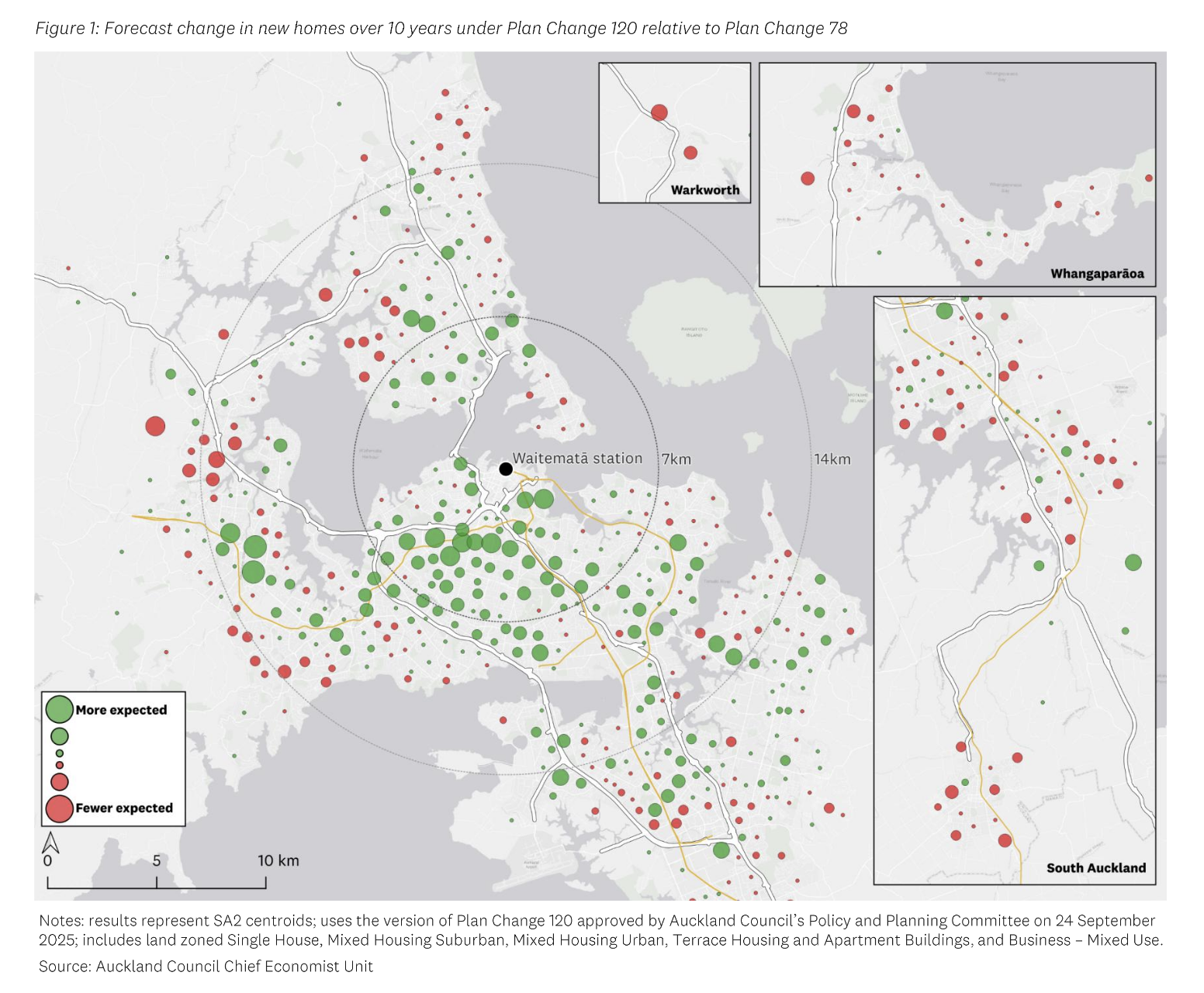
Forecast change in new homes over 10 years under PC 120 relative to PC 78. From “More room to grow in good locations Implications of Plan Change 120 for Auckland“
Legs vs City Link bus
The sequel to Part 1 we shared recently…
More cool books for your Christmas stockings
We’ve already mentioned the new book Wellington Architecture: A Walking Guide by John Walsh, with photos by our very own Patrick Reynolds (check out the sweet review on NZ Book Lovers). But did you know there’s also Auckland Architecture: A Walking Guide?
Another capital treat (see what we did there): Mr Ward’s Map (Massey University Press) by historian Elizabeth Cox, who digs into an incredibly detailed map of early settler Wellington. RNZ review/ interview here, a peek inside the book here, and more about the book here. As the publishers note:
Over two and a half years Ward had walked every street of the city, drawing the outline of every single building. These included garden sheds and outhouses, but excluded hen-houses.
[The map] includes details such as the number of bedrooms to a house, the building materials used, and every street light in the city… It’s a kind of Victorian version of Google streetview.
Another one from Massey University Press, The Collector: Thomas Cheeseman and the making of the Auckland Museum by Andrew McKay and Richard Wolfe, tells the story of the fella who grew the museum from “not much more than a shed of curiosities… into one of New Zealand’s leading museums and scientific institutions.”
And don’t forget the Auckland Libraries anthology Tāmaki Makaurau 2025: Essays on Life in Auckland, which does exactly what it says on the tin.
Upcoming events
Party on the Path (Māngere/ Māngere Bridge edition!) on Sunday 7 December, 11-3, a local celebration and exploration of the new cycleway along Bader Drive, from Māngere Bridge School to Moyle Park.
And in Wellington on Tuesday 9 September from 5pm, the Urbanerds are goingintercity:
To round off 2025 and celebrate New Zealand’s first-ever Urbanerd mayor, our gathering this month is in Upper Hutt / Te Awakairangi ki Uta – a hotbed of urbanism!
We’ll jump on the train in Wellington and take a relaxing and scenic trip north. The mighty HVL will carry us for 45 minutes (or less for the expresses).
From there it’s a short, flat, well-lit walk (10-15 minutes) to join the new Mayor and fellow nerds at Te Aro Brewing (Brewtown).
Try to get there by 6.15 for the welcome (so catch the 5.15 train or the 5.22 train from WLG). Get on the tail-end carriage of whichever train you catch and if you don’t recognise anyone, try asking fellow passengers “are you an Urbanerd?”

Some videos to check out
A few things from the socials!
Music section at Farmers Department Store, Auckland, 1970sPhotographer unknown; www.aucklandmuseum.com/discover/col…
— Michael Brown (@jingajik.bsky.social) 2025-12-03T23:18:07.274Z
Much of Waitematā Station Plaza now open. The mahi toi in the image (beamed down saucer-like from the skies) is a multi-tonne concrete lid designed by iwi artist Graham Tipene-the place where Te Waihorotiu meets Te Waitematā and celebrates the life that flowsLooking fine!#loveablecity #citycentre
— Akl City Centre Residents' Group (@ccrg.bsky.social) 2025-12-04T05:02:36.502Z
That’s it from us this week, hope everyone enjoys their weekend!

 Processing...
Great photo, Jolisa.
No mention of climate? I recommend Bernard Hickey’s episode today:
“The Weekly Hoon: Govt’s climate change mask drops” on https://thekaka.substack.com/
which he’s made public (presumably due to its importance).
Bernard Hickey has recently come out as anti-immigration, so big no from me
I’ll never forget writing a guest blog here defending immigration and the sheer toxicity in the comments!
No offence, but this is the problem with the left across the globe, they’d rather fight each other over who is the most righteous than work together to take on the right. Really needs to change..
If I recall correctly, Bernard has expressed his preference for a population strategy & discussion with his preference being for a larger population (i.e. 10 million down the line).
Im not anti immigration, but it is worth talking about. The strategy of high immigration with no infrastructure or houses being built wasn’t a good plan, something needs to change.
Perhaps it isn’t popular.
Government planing is all based on 2% population growth forever. The total fertility rate is only 1.6 births per woman. So immigration is required just to maintain current population. The question needs to be asked how much immigration is needed, and what population growth can be tolerated? We have struggled badly with housing the covid bubble, and have barely had enough electricty to keep the lights on.
It is a serious subject that the establishment and the media are actively suppressing.
High immigration leads to higher housing and living costs; delaying the point in time where the existing population can afford to start a family (not to mention, driving many offshore) and therefore encouraging officials to further increase immigration; fanning the problem even further.
It wouldn’t be such a problem if the incoming populations were similar in culture to those that we’re leaving; however its increasingly obvious that this isn’t the case (for a tip-of-the-iceberg example; just look at the wide-spread contempt for our rules and for our safety held by 459 migrant bus drivers and the number of Uber drivers regularly before the court on charges relating to the molestation of drunk passengers).
Watch this space when the Coalition wave through the impending ‘Free’ Trade Deal with India (featuring, as it almost certainly will, the requirement that we unquestionably accept the validity of bogus accreditations and the necessity of God knows how many ‘student’ visas).
This is all just getting started.
DS – maintaining a static population isn’t going to help with living costs and infrastructure. An ageing demographic will ensure more money goes towards pensions and healthcare and not tax payers back pockets or infrastructure.
“It did make it seem like this is not a real country,” lolol. A good introduction, then.
Given the expected impacts are not “less than minor” (in any referral sense of the term) why isn’t there a resource consent condition for a soft transport landing?
Imagine a planned approach. Eg, that whenever a store like IKEA opens, the first two weeks are for customers who use active and public transport only. So, the car park is shut (or reserved for people with disability permits only, or proceed at $50) while KEA pays for free public transport and enforcement of local parking.
Sounds nice, but they do have stuff to sell and staff to pay. What makes your think their opening wasn’t planned under Resource Consent to ensure it could be managed efficiently? Not even RMA could keep some of the local notables away, doing their family shopping (bus to Panmure and train to Sylvia Park might have worked for them).
It is a pity the town houses at Carrington are not four-storey, rather than just two.
part of that is the fault of the building regulatory system
four story buildings are outside the scope of all of the relevant building structure standards and the B1-AS1 acceptable solution under the building code – the deemed-to-comply pathway for proving your building meets the structural performance requirements – that incorporates them.
currently there are no real deemed-to-comply pathways for buildings over three stories, so you have to prove compliance with the building code from first principles (probably involving a bunch of engineers doing maths). This bespoke approach gets a lot more expensive very quickly, which makes it harder for 4 storey townhouses to pencil.
Do like this local case of kick the habit, don’t get lost in consultancy land things get done
https://www.stuff.co.nz/nz-news/360908538/house-bridge-build-saves-money-kaikoura-council
Re: the council housing report. Directionally, probably roughly correct. But I suspect there will be quite a bit less central, and quite a bit more less central, intensification than what they predict.
Mainly due to affordability constraints (ie. ability to pay)
Admin: That Party On The Path: Māngere & Māngere Bridge is Sunday not Saturday.
Oops fixed it! Thanks haha
“Time for more aspirational storytelling for Auckland”
I take issue with this line of thinking – assuming as it does that the people of Auckland are such a danger to themselves, that they should be tricked into ignoring the ongoing degeneration of their quality of life and the ongoing attacks against Auckland’s amenability as a City.
We need to be told – plainly – why we’re aiming for 2,000,000 Aucklanders and we need to be told – honestly – about who these people will likely be and what the impact will be on the lives and senses of identity of the people who already live here.
We also need to be told why there are no plans to alleviate the predictable consequences of this mad intensification – where are the parks to compensate for the lack of gardens, where are the schools to alleviate overcrowding and where are the civic institutions that are necessary for people of widely different cultural backgrounds to live against each other peacefully?
Of course, if this was all plainly spoken about, it would become obvious that New Zealand’s powerbrokers hold values and convictions which are totally antithetical to the interests of the citizenry.
Just look at the establishment’s antipathy to Grey Lodge – a building with ties to our cultural and built heritage.
That insiders think that this can be disguised by fairy tales highlights their disgust for ordinary New Zealanders and their contempt for our intelligence. They need to stop talking and start listening.
I went to Ikea yesterday to see the terrible crowds and was largely disappointed. I did, however, wait thirty or forty minutes for a hot dog, so I got a taste of it, I suppose.
I will note:
1. that the overpass to Ikea is too narrow if there are ever huge crowds. I would assume yesterday will turn out to be busier than a usual operating day despite the absence of Ikea-geddon and it was busy enough to experience congestion at… I can’t remember when I arrived, 1:30-ish?
2. there were plenty of people departing with Ikea shopping bags when I arrived so there was certainly some level of train usage by people who actually got more than just food from Ikea
When people realise that IKEA sells the same low quality tat that The Warehouse does, excess demand will quickly die off.
The quality isn’t remotely comparable. And thats not to champion IKEA.
And if you think the popularity will eventually die off, I can only assume you have never visited one overseas. Its death, taxes and IKEA’s god-like status.
I live about 10km from one and have membership. It’s the furniture shop of last resort. Mostly fibreboard rubbish. Give me decent oak furniture anytime.
TBF Minister Brown did claim to have taken the train back from Ikea:
https://www.facebook.com/SimeonBrownMP/photos/catching-the-train-into-the-cbd-following-the-official-opening-of-ikea-at-sylvia/1384510259942568/