This is a guest post by Darren Davis. It originally appeared on his excellent blog, Adventures in Transitland, which we encourage you to check out. It is shared by kind permission.
The bad old days
To get a full appreciation of just how big a transformation Auckland’s bus network has undergone, you have to look back to the bad old days. Frankly Auckland’s public transport network, if you can in fact call the motley mix of modes and services back then a network, was so shit as to insult the word shit.
A case in point was Rānui. It was served by the Western rail line during weekday daytime periods only. It’s main market was good catholic boys heading to St Peters College by Boston Road Station, which in fact had be built in the 1960s for exactly that purpose. During the day trains were roughly two-hourly. The last service from the city centre involved taking the 5:18pm bus from K Road and Queen Street, connecting to the 5:40pm Papakura train and transferring at Newmarket to the last Waitakere train at 5:50pm.
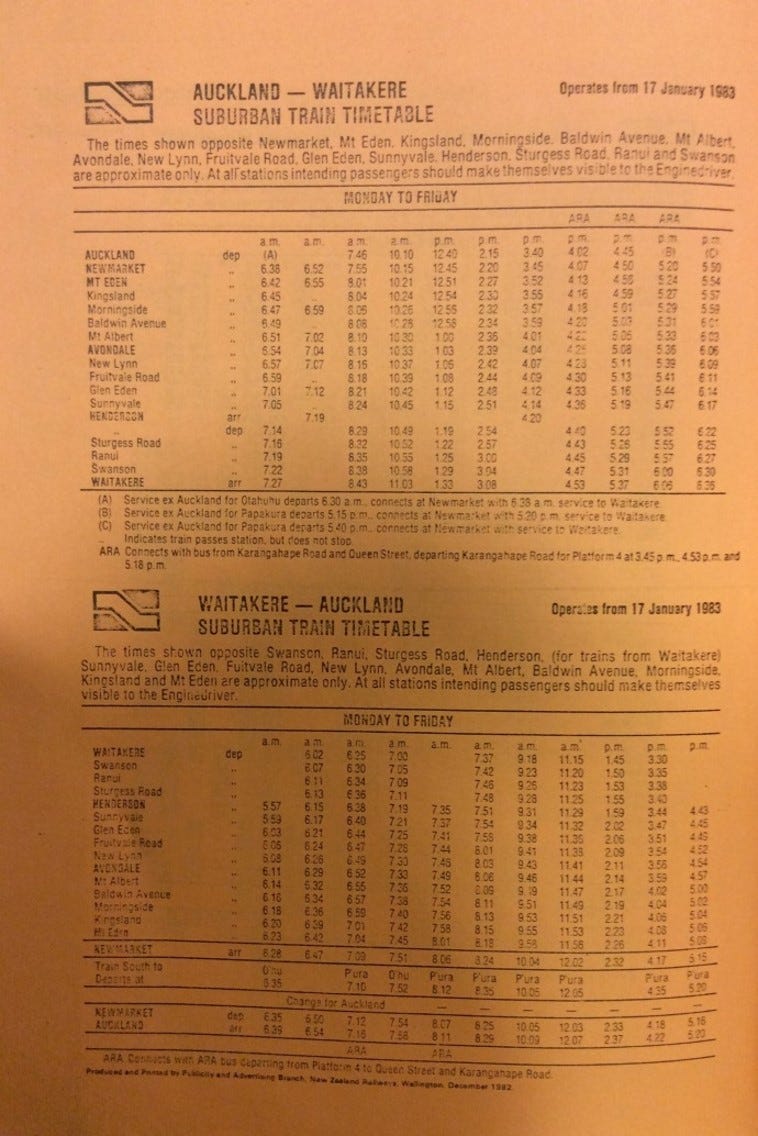
The entire Western Line train timetable from 1983 to 1993.
Bus was barely any better. But at least there was some evening and weekend service. There were 11 trips to Rānui on Saturdays and five on Sunday with the last bus leaving Auckland city centre at 4:40pm.
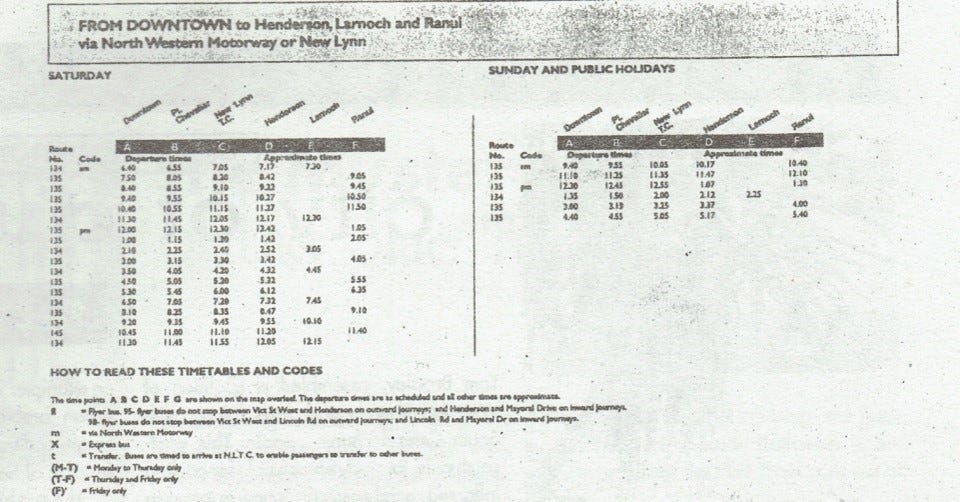
Rānui weekend bus timetable, early 1990s
And for anyone who romanticises publicly-owned public transport operators, bus and train services were both operated, completely independent of each other, by publicly-owned operators. As with anything, it’s the quality of the service provided rather than who provides them that matters. This is not a defence of privatisation of public assets, which I strongly oppose, merely acknowledgement that whoever operates a service needs to be driven by providing a good service. And that democratically elected public authorities need to have a strong hand in ensuring that whomsoever operates public transport, public or private, is driven by strong public transport service values.
The slow path back
The deregulation of public transport in 1991 sent Auckland’s public transport into a tailspin, accelerating a long-standing decline in patronage. In 1993, Auckland public transport patronage reached its nadir at around 32 million annual trips. Things were so bad that most weekend public transport on the western side of the North Shore was operated by maxitaxis.
Things started to turn around in 1995 with the first round of post-deregulation service retendering of non-commercial services, generally night and weekend services. Saturday frequencies were improved to match weekday interpeak frequencies and Sunday evening service was restored. Auckland City Council’s bus priority programme delivered bus lanes on Dominion and Mt Eden roads in 1998, Sandringham Road in 1999 and Great North Road in 2000. The first iteration of the Inner Link bus was launched around the same time. Bus and train fares were made consistent but there was no fare integration between operators.
But it’s fair to say that weekday services, largely commercially registered and operated without public funding except for concessionary fare support, were frozen in time. The irony was that the private operators of commercial services were reluctant to innovate and even more reluctant to compete with each other, leaving the pre-deregulation service provider patchwork, each with its own ticketing system, in place.
The first game changer
Things stayed in a state of incremental innovation and improvement in non-commercial services until the implementation of the Public Transport Operating Model in the early 2010s. This meant the end of commercial services with all services being planned by the public sector. This enabled the planning and implementation of the New Network, based around a core of permanent frequent service running at least every 15 minutes, every day of the week. Implemented in phases between 2016 and 2018, this vastly expanded the network of frequent services beyond a few central isthmus bus services to a region-wide network, meaning that outer suburban areas of Auckland have more frequent service than just about any other city in Australasia.
There are many people to thank for this from Jarrett Walker through to MRCagney. But the biggest thanks goes to the Auckland Transport staff, led by Anthony Cross, who shepherded this transformation in Auckland’s public transport through Auckland Transport. This organisation, in spite of its name, has struggled at a senior leadership level to understand that public transport is about more than getting themselves to and from work in the weekday peak.
The all-day, every day frequent network probably doesn’t get the kudos it deserves because it is about unsexy public transport services getting people to the place they want to go without long waits. Shiny bauble syndrome is alive and well in Aotearoa as evidenced by the current government’s obsession with the RONPS (Roads of National Party Significance). But with public transport, the infrastructure is just a means to an end, with the service provided being the end.
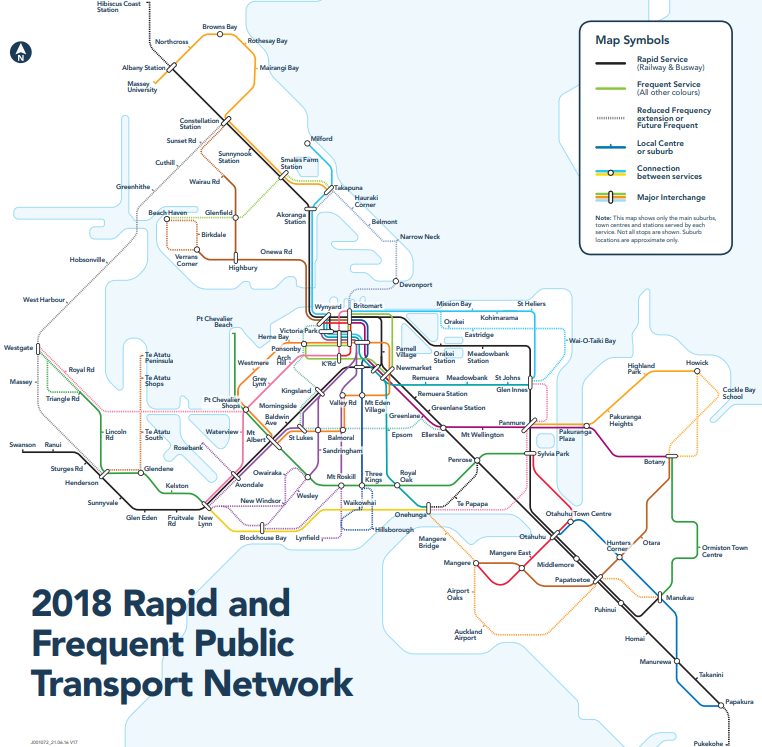
Auckland rapid and frequent bus network 2018. Image credit: Auckland Transport.
The map above shows, in solid lines, frequent service operating at least every 15 minutes 7-7-7 but worthy of note is that most of the dotted lines of future frequent routes have since been implemented.
The second game changer
The world is littered with strategic documents redolent with high-sounding 30-year vision statements and graphics of wonderful networks connecting people-oriented spaces. But cold hard cash as well as political will, perseverance and fortitude is needed in order to turn vision into reality. And Auckland’s second game changer is the Climate Action Transport Targeted Rate.
In 2022, Auckland Council implemented the Climate Action Transport Targeted Rate (CATTR) providing $573 million. When combined with Central government co-funding of $344 million and fare revenue, it will see a $1.045 billion investment in buses, ferries, walking and cycling. Vision meets cold hard cash and political will.
The Climate Action Transport Targeted Rate provides for:
- significant bus network enhancements including 10 new frequent bus routes and 67 other bus routes significantly improved, many to frequent service.
- faster electrification of the public transport fleet
- walking and cycling improvements across Auckland
This means that, on top of earlier improvements and the opening of City Rail Link next year, 2026 will be an exciting year for public transport in Tāmaki Makaurau.
New frequent bus services in 2026
- Route 15: Henderson to New Lynn via Henderson Valley Road and West Coast Road (new route)
- Route 17: Glen Eden to New Lynn via Titirangi (upgraded 172 to frequent)
- Route 37: Manurewa to Highbrook via Weymouth Road, Roscommon Road, Puhinui Station and Preston Road (new route)
- Route 39: Manurewa to Ōtara via Clendon, Homai, Manukau and Tui Road (upgraded 361 to frequent)
- Route 42: Paerata Loop – one-way loop around Paerata Rise to and from Paerata Station (new route)
There’s also a range of evening service improvements and new (non-frequent) routes serving Clark’s Beach, Maraetai and Ihumātao, expanding access to areas that previously had limited public transport options.
The Westgate Bus Station will open, supporting the highly successful Western Express (WX1) service along the Northwestern Motorway. This station will become a key hub for the growing northwest region, integrating local routes with express services to the city centre.
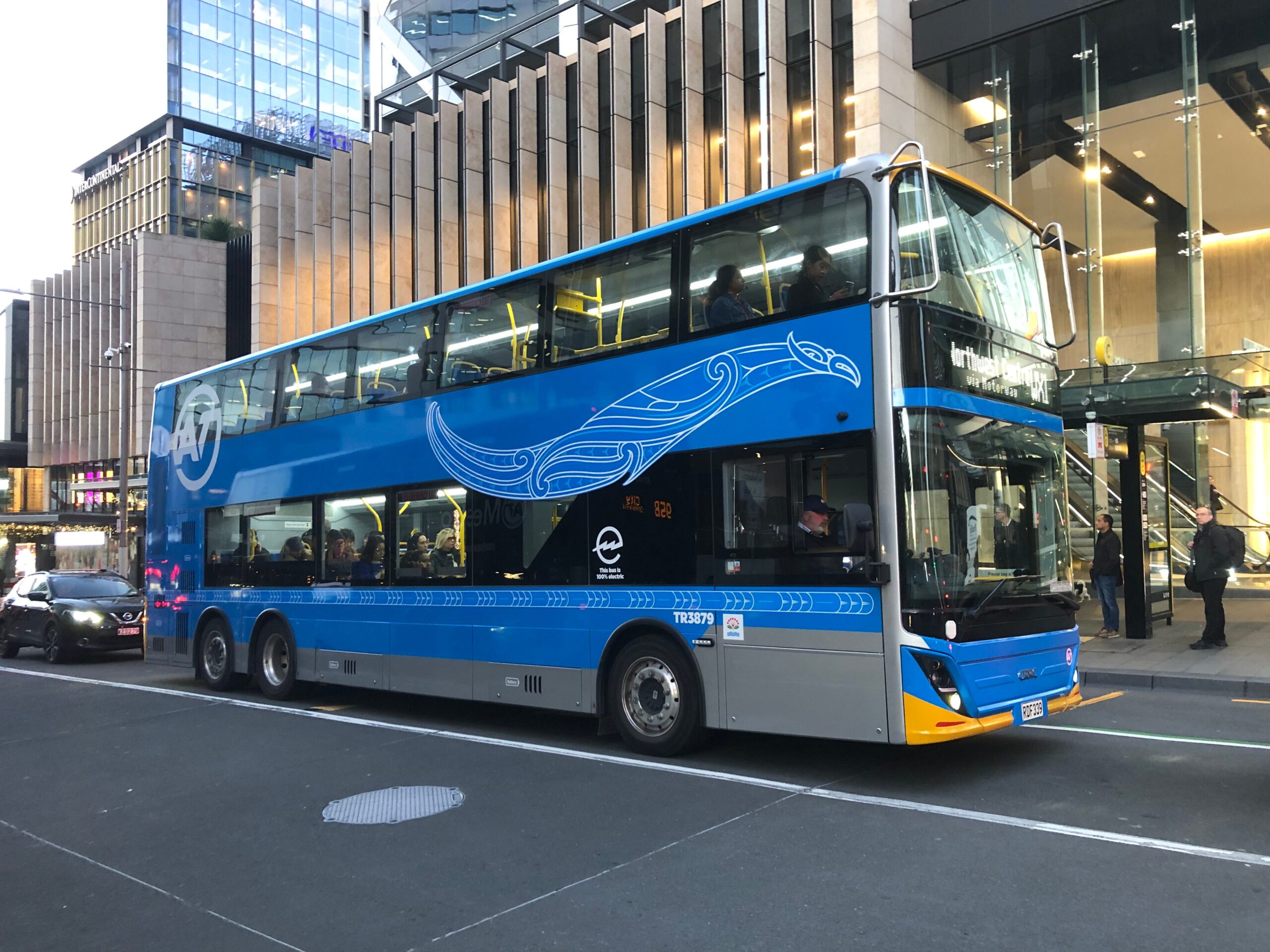
Western Express WX1 bus in Lower Albert Street. Photo credit: E James Bowman, CC BY-SA 4.0
With new contracts coming in, Aucklanders can also expect over 100 new electric buses as part of major bus contract renewals, helping deliver a quieter, cleaner, and more sustainable network.
[Thanks to Malcolm McCracken of Better things are possible for this content. Subscribe to his Substack if you don’t already. It’s great!]
One key point about the 2026 improvements is that the two new southern growth areas railway stations opening in 2026, Drury and Paerātā, will have frequent bus service connecting to frequent train service from opening day. This is in areas that are still in the early stages of development, so it sets public transport up for success by having it already in new communities as they are being developed, not many years later when car-based travel patterns are firmly entrenched in those communities.
And 2026 will be the year that we finally get frequent all-day, all-week train service in Auckland. Currently frequent buses running every 15 minutes often connect to trains running every 20 minutes which obviously doesn’t add up. It will be great when the rail network is frequent at least during the day.
What it all looks like in 2026 can be seen in the excellent map by MRCagney below. Note that this map was prepared around the launch of the CATTR in 2022 and a few things have moved on since then. But the overall message remains of a vastly better frequent network compared to just a decade ago.

MRCagney Auckland Frequent Transit Network Map. Image credit: MRCagney
Final thought
Just one final thought this time. Auckland’s frequent bus (and soon rail) network is one of the best out there. It delivers high quality service to all of Auckland including the more deprived communities of the south and west of the city. As a connective network, it works both bus and rail modes to their respective strengths. Rail for longer line-haul journeys and buses for local frequent service connecting to rail often at major town and subregional centres.
City Rail Link’s improved connectivity, faster travel times and frequent rail service will enable the frequent bus network to further flourish as turn-up-and-go cross regional connectivity becomes even easier.
To give you a sense of the scale of the change, 10 years ago there were around 10 frequent bus routes. Auckland currently has 40 frequent bus routes and this number will have increased to 45 frequent bus routes by the end of next year, four-and-a-half times as many as from the bad old days of just a decade ago.
Kia kaha Tāmaki Makaurau!
This post, like all our work, is brought to you by the Greater Auckland crew and made possible by generous donations from our readers and fans. If you’d like to support our work, you can join our circle of supporters here, or support us on Substack.
And check out Darren’s Substack here.

 Processing...
Just missing the core rapid transit spine that frequent buses can be built around
NW Rapid Transit
Botany to Airport
The Isthmus Spine Roads
Something from Albany through Glenfield/Birkenhead/Northcote
Then all of a sudden we have a world class network
Upgrading the 917 to a frequent route (91?) seems like a no-brainer. It’s already as busy as several other frequent bus routes (the 31, 32, 36, 64, 65 and 94) and is well patronised at all hours of the day with decent loadings in the midday interpeak.
95B should be extended to Constellation in the short-mid term, I have no idea why it’s only being run as a one-way anticlockwise loop around Bayview, but that suburb is glaringly missing any connection to a northern busway station unless ppl are prepared for a half hour, hilly walk to catch the 901 on Albany Hwy.
Needs a sh20 motorway bus from manukau to motat/zoo with stops at massey road, walmsley, hillsbourough road, dominion road, maioro road.
Same for buses in south auckland to central suburbs. We lost most serivce Since the new network, it went backwards for us
Good they have got the frequency sorted. Now they just need to sort out the ‘rapid’ part.
Any plans to put the 3rd main to use with express services? How about speeding up the timetable to actually match the performance the trains are capable of?
And of course more bus priority is a no brainer.
Agree, the frequency is no longer the problem (not that its perfect). But both the trains and the buses are way too slow. They’ve fixed the aspect that just needed money thrown at it (frequency), but the politically difficult aspects (short dwell times, less bus stops, all door boarding, 24×7 bus lanes, etc) seem to be in the too hard basket.
Also, there needs to be a ‘safe’ bit.
Safe – for independent children to walk (and people requiring mobility aids to wheel) to the bus stops, and to make the transfers. Without having to cross traffic hellscapes.
Agree, connections to the WX really need priority – Lincoln and Te Atatu rds road are very bad and certainly don’t meet the “rapid’ handle.
Particularly the Te Atatū Rd bit is disappointing. Originally AT consulted on the motorway-bound T2 lane in Te Atatū Sth being operational both in the morning and the afternoon peak, but when they implemented it – it ended up mornings only. That stuff up 13 pretty bad in the afternoons.
My humble opinion is that they can start with Westgate connections.
The ‘failure lines’, 111, 112 and 114 do not connect to WX very well. The 112 for example, serving the expanding Hobsonville Area is scheduled to arrive 2 minutes after WX departs. Not a great way to increase connections.
The wise people of Hobsonville have voted with their feet and you don’t see them connecting on WX, instead they have to travel via Constellation ST and the NX buses (a pricier journey but one that doesn’t guarantee a 13 minute wait exposed to the elements).
In general, whoever designed West Aucklands network seem to struggle with the concept of a network where the small routes feed onto the express routes. Maybe they are left from the staff that worked in West Auckland during the dark days described above?
you can’t connect from the 12 to the WX1 either, which is a glaring oversight. the 12 stops in Westgate South, and the WX1 starts over on the North side of Fred Thomas Dr.
if someone wants to change from the 12 to a citybound bus without a 5 minute walk, the 11T and 11W are the two options
The “rapid” part could be sorted on many routes with just enough will. I think the original plan AT had was to put bus priority (i.e. T2 or better) on every arterial that had 6+ buses an hour (which would cover all the double-digit routes). I suspect that now that the decision-making is moved to the “council” part we’ll see less of that. There’d be significant pushback on getting the bus (or even T2) lanes on most arterials now, and politically that’s not going to be palatable to many.
Even less rapid today than 40 years ago – 43 minutes Ranui to Auckland station versus 53 minutes to Waitemata station. Admittedly you save the 15 minute walk to Queens St, but still…
Interesting to see the 90’s bus timetable – I don’t think Larnoch is used as a suburb name at all anymore? I’d certainly never heard of it.
I’m presuming it would have been somewhere near Larnoch Rd, which we’d just consider Henderson today.
134 Larnoch service, turned left from Universal Dr into Swanson Rd, and returned to the Swanson depot just beyond Larnoch Rd. While part of the suburb of Henderson, that was already in the timetable for the town centre, and while the nearby school was called Henderson North, that would also have been confusing.
135 Ranui service, turned right from Universal Dr into Don Buck Rd, then wound its way through Ranui to end up at the railway station on Pooks Rd.
That’s all very lovely. But for my wife to get from Smales Farm to the HBC Station is still a pain in the arse. Too many NX1&2s terminate at Albany.
A number of emails to AT have generated zero response.
“Too many NX1&2s terminate at Albany.”
Yes. And the buses that do go further are often jammed with people. There’s clearly ridership available to provide more frequency.
This has a big impact on journeys that need transfers at Hibiscus Coast.
Congratulations are due to the visionaries who promoted and then implemented an integrated network as the basis of a functioning public transport system.
This was achieved against resistance from certain prominent national and National politicians. Most likely because public transport growth came at an equivalent
cost to private transport provision. Car and roading provision sales.
When I arrived in Auckland Crown Ministers were peddling how deregulation encouraged competition between modes, rail, bus, private transport, as if that was a benifit.
The same Ministers when faced with unexpected tremendous success of the initial stage of the Auckland busway successfully delayed subsequent stages. Ministerial decisions delayed a similar NW busway for decades, and probably, also the Eastern Busway.
Ministerial interference even attempted to sabotage the introduction of the transferable hop card by facilitating installing the dumb card Snapper readers on many Auckland buses.
So we have to thank the considerable determination of some Aucklanders to get to where we are against considerable Central Government resistance.
So good to see a solid mid-level AT bureaucrat named and credited.
Doesn’t happen very often.
Anthony Cross, you gave pretty much everything you had in the tank to making this Auckland new network a reality. You didn’t get much thanks for it. But boy you made a difference. Great work.
I agree wholeheartedly.
The steady growth of the frequent bus network and better integration with rail is very encouraging. But I am concerned about the vulnerability of the PT system’s funding as it is underpinned by hundreds of millions of subsidies (not sure of level but heading towards $1 billion per year).
About 45-50 years ago the ARA (Auckland Regional Authority) was taken over by a bunch of conservative mayors led by Keith Hay who slashed bus subsidies as part of their populist drive to cut costs to ratepayers. This causied a sharp spike in fares and sharply reducied PT patronage. This had a lasting impact – making the Auckland region even more car dependent.
Unless you’re willing to pump up the fares by 2 or 3 times, then you’re never going to get around having a significant subsidy from local government. Not sure there are any alternatives other than reducing the level of service (which will reduce the size of subsidy, but will likely increase the subsidy %)
I see two options:
1. Increase ridership by improving trip speed
2. Create new revenue by developing airspace over transport stations
Or implement congestion charging and use that to subsidise public transport (all talk at the moment). What’s the bet the money will just disappear into the councils coffers and not be used for that.
To improve frequentisation & speed of public transport in Auckland we need more busways by AT. Investing more in the network improvements by Central & Local Government will attract more users that can minimize price rises for affordability.
Plus:
* fewer bus stops
* fewer level crossings
* all door boarding
* external hop card swiping at busy stops
* more articulated buses and fewer double deckers
* automatic door opening on trains with ramp extension only on request
All bus stops on arterial roads need to have an adjacent pedestrian crossing as most journeys are paired inbound and outbound journeys
Return journeys if you like. So without an adjacent pedestrian crossing one of those journeys will require crossing the road, either to, from, the bus stop.
Thank you Darren. It’s a source of frustration to me that so many non-PT users deride Auckland for its poor public transport. As you point out, the changes over the last decade have been absolutely dramatic. As a regular user of the network over the entire region, I can truly say that it has changed my life. And the opening of the CRL will be another step change to my PT-mobility. Good to see Anthony Cross also getting the respect he’s due – to my mind he’s one of transport’s unsung heroes.
Yes, I agree. I have enjoyed the improvements offered by the implementation of each tranche of the New Network in real time, as well as the subsequent improvements.
Life-changing is correct. If “travel time savings” were actually a reasonable way to decide on investment priorities, and if we prioritised that mobility which doesn’t clutter the network with private cars, our city would be focused on extending and enhancing the New Network (as well as the safe active networks that complement it).
Great post. Yes, we have a come a long way. Looking forward to more frequency and improvements to PT.
All door boarding would certainly speed things up, but one of the big hurdles to it is that the bus driver is legally responsible for not carrying more people than the loading cert allows. So if you open all the doors and 20 more people than allowed cram in because it’s a wet peak and damn waiting for the next bus, the driver will get the ticket for overloading if anyone counts.
back in 2017 the 881 route from the shore into uni regularly had so many people on board in morning rush hour that even the front doorway was jammed with people standing well past the “do not stand past this point” line. i have no idea how the driver was able to see to his left.
and somehow these peak services always ended up getting the on-their-last-legs buses from the late 90s-early 2000s with all the paint worn off the poles and no A/C
I’m not convinced that all-door boarding would speed up buses markedly. Has there ever been a study comparing all-door boarding in real-life situations with an “in at the front only and out at the rear only” system, which would maintain a one-directional flow through the bus? In the current situation, people are competing to get on and off through the same door (at the front) and would also compete (if all-door boarding were introduced) at the rear? Instinct suggests this isn’t efficient, but all-door boarding does have a lot of support. Have I missed something?
the WMATA (Washington DC) says that all-door boarding is between 12% and 20% faster, and the LA Metro reported a 50% reduction of boarding time on a Wilshire Bvd frequent bus route with both all-door boarding and off-line fare payment.
San Francisco reported not just improved boarding times but a *reduction* in fare evasion with all-door boarding. https://sf.streetsblog.org/2014/12/03/all-door-muni-boarding-still-means-quicker-buses-less-fare-evasion
I’m just back from San Francisco and used a few buses. On one of these transport officers came onboard and did some checks – they picked up some fare evaders, so still an issue over there.
I’ve been a very heavy bus user in Auckland for the last 30 plus years. When I first moved here I was in St Johns and worked in the downtown area. Buses worked better for me back then, as I could do it in one trip without a transfer. The expectation now is that you change from a bus to a train in Newmarket, then do the reverse in the evening. In the morning it generally works okay, but in the evening it can be a nightmare as connecting buses don’t always turn up at the quoted frequency, sometimes full or with large gaps between them. With people I speak to, their interest in taking public transport drops off when a transfer is required as I’m not the only one that has experienced these issues. After too many issues I gave up and drove to Newmarket and caught the train. Thankfully I’m in a job now that means I can bus door to door with no transfers required.
The bus shelters are generally a lot worse these days, with less shelter from the wind and rain – I stood under one in heavy rain this morning and still got wet. Too many stops have no or insufficient seating, and I have a disability and struggle to stand for long. This is an issue when there are delays or buses don’t turn up.
While there have been improvements in some things, there is still a lot to do! I’ll be house hunting in a few years, and hopefully the city rail link means some further much needed improvements.
A lot of people deride the POTM, but things were really bad before, and have got a lot better post its implementation. I’m sure there was silly stuff in there, but generally it worked out quite well for the end users.
Yes, it’s improving (overall)
Though still need to transfer twice getting from St Johns to East Tamaki Industrial (Area suffers from woeful congestion of single occupant cars, particularly during peak)
Couldn’t they route a one of the East Tamaki services to better connect with the TMK, 75 and 65 bus services at Glen Innes?
For me the biggest step change was the Hop Card. This was the first big change instigated by AT that could not have happened pre-amalgamation. And also could not have happened other than by AT being a standalone entity.
Thank goodness AT achieved it and we are used to it, as we continue to see NZTA burn through hundreds of millions of $$ trying to get their cardless system going over a decade.
We can kiss much of this progress good bye with the move to giving control to elected officials rather than transport experts. Good PT needs good traffic and parking controls to support it. But the bill going through now is going to split this into different places maybe 23 different places. So no chance of coordination there if a local board member chasing car driving voters gets to interfere