What great weather we’re having right now, though it’s hard to believe it’s already November. Here’s some stories that we found interesting this week.
This Week in Greater Auckland
- On Monday Matt found agreement with Wayne Brown that Auckland needs to become an efficient green city – with less sprawl.
- On Wednesday, we had a guest post from Kasey McDonnell on buying a home in a warming world.
- On Thursday, Connor looked at what this government’s legacy for transport in Auckland actually will be – with a few timely updates involving the Reeves Road flyover.
This roundup, like all our work, is brought to you by the Greater Auckland crew and made possible by generous donations from our readers and fans. If you’d like to support our work, you can join our circle of supporters here, or support us on Substack.
The cost of RoNs
Matt was on The Detail this week discussing the unaffordable cost of the Northland Expressway.
There is an argument that it’s Northland’s time for some road security, but advocates such as Greater Auckland director Matt Lowrie says it’s a lot to pay for a road that will carry less traffic than most of Auckland’s arterial roads.
“We simply can’t afford to be spending $15 to $20 billion on a single road that carries on average 10-15,000 vehicles a day,” he says.
“We need to find solutions that can provide improved quality service … but should it be straight to a large four-laned highway or should we look at other options first? That includes easing corners, putting safety measures in place, putting more passing lanes in place. Those are the types of things we used to do quite regularly along large parts of our network.”
In other unaffordable expressway news…
Transmission Gully has been in the news (again), with some not-so-good updates (yet again) regarding the need for $32m more from NZTA to fix issues with the road. As this op-ed puts it:
Trying to make the situation sound like business as usual, Waka Kotahi says that “every year we undertake a large road renewal programme to maintain and improve state highways across the country. This year that includes a significant amount of resurfacing and drainage work in Transmission Gully”.
Wait a minute – didn’t we just buy the bloody thing brand new for $1.25 billion a few years ago? I expect a bit of “renewal” on my dunga of a car I bought over a decade ago, but if I’d paid top dollar for a brand new one just a few years ago, I’d be furious that it needed “significant” maintenance. Under the Consumer Guarantees Act, I’d probably have the right to get the car replaced or at least refunded.
Inside the Canadian apartments redefining indigenous housing
Lovely long write up in The Spinoff by Joel MacManus about his visit to the First Nations-led Sen̓áḵw development in Vancouver. It’s a fascinating read, and perhaps has lessons for New Zealand for iwi-led development.
Sen̓áḵw (pronounced seh-nauq) is being built on a federally-recognised First Nations reserve with several millennia of history. Under Canadian law, reserves are exempt from city zoning bylaws, meaning the tribal authority of Sḵwx̱wú7mesh Úxwumixw (Squamish Nation) decides for itself what can be built there. And they set their sights sky high.
These three towers will eventually become 11, containing 6,000 apartments and at least 9,000 residents. When it’s complete, it will be the most densely populated new development in North America; the population of Morrinsville in a land area smaller than five rugby fields. The tallest tower will be 171 metres tall, the same height as the Vero Centre in central Auckland. It’ll be a massive influx of housing in a city that desperately needs it – and an enormous monument to indigenous ambition in the modern age.
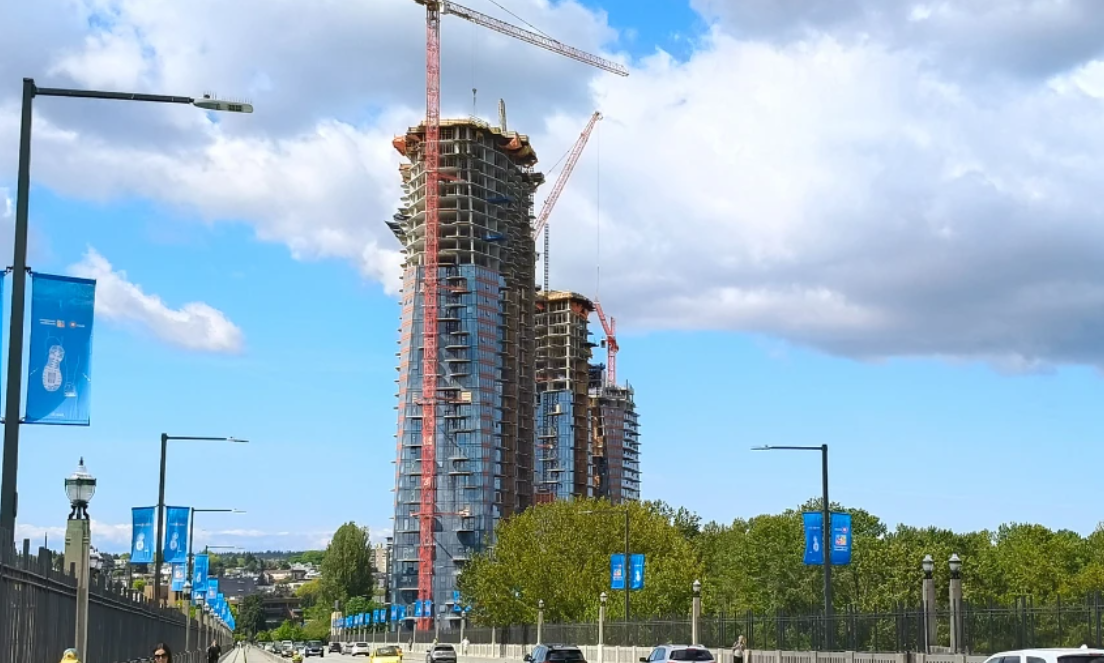
Sen̓áḵw viewed from the Burrard Street Bridge. Photo: Joel MacManus
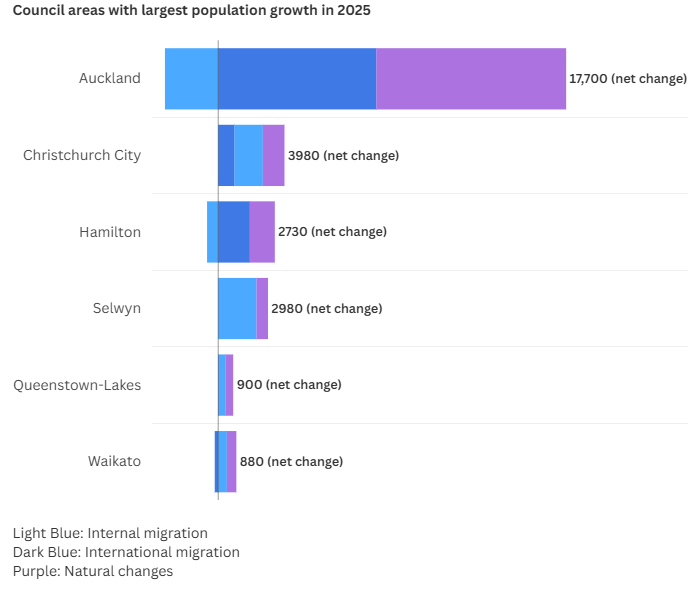
Joel also has this interesting article looking at some recent data on how (and where) our population has been growing.
Well, it’s a bit unclear. The five fastest-growing council areas by total population are Auckland, Christchurch, Hamilton, Selwyn and Waikato. But the way that growth is happening is completely inconsistent. Auckland and Hamilton have negative internal migration, meaning people are leaving those cities for other parts of the country; their growth is driven by international migration and a high birth rate. Meanwhile, Selwyn and Waikato have negligible international migrants and are booming due to internal shifts: people are moving there from other regions of New Zealand. Christchurch is a rare example of a city that is succeeding at all three forms of growth.
…..
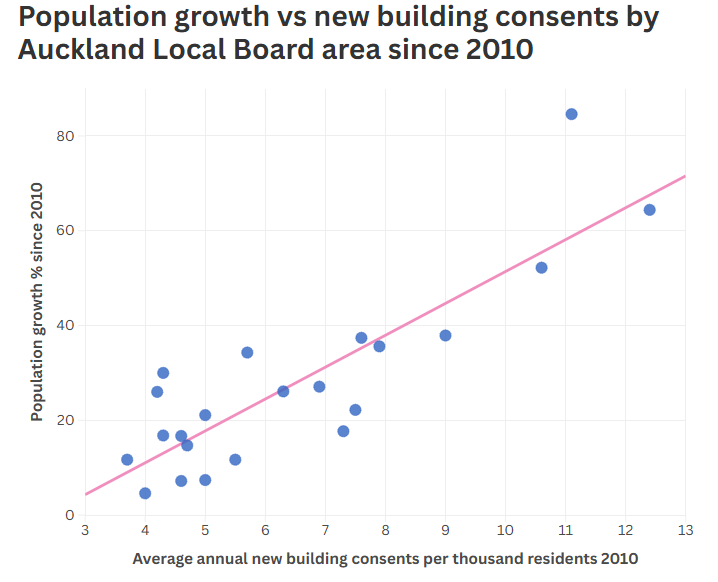
While Auckland is one of the fastest-growing cities, when you split it out into local board areas, you get a more complex story. Howick, Papakura, Henderson-Massey, Maungakiekie and Whau are all in the 10 fastest-growing council areas nationally, but Waitematā, which covers the city centre and inner-city suburbs like Ponsonby and Parnell, and Ōrākei, which covers inner eastern suburbs like Remuera and Saint Heliers, are the second and third worst-performing areas in the country, behind only Wellington City.
…..
And just in case there could be some city-specific factors at play, here are the numbers for each of the Auckland local boards since the creation of the Supercity in 2010.
Making room for urban rivers
Also in The Spinoff, a great piece by Shanti Mathias on the tricky trade-offs in making room for rivers in the city.
Christchurch is a city of three rivers: the Ōpāwaho (Heathcote), winding around the hills, the Ōtākaro (Avon), threaded through the central city, and the oft forgotten Pūharakekenui (Styx) in the north of the city. Each of these rivers has stream tributaries, too, but for the most part, they’re underground, channelled into pipes and culverts.
“This is one of the most polluted waterways in the city,” says Nick Moody, who was recently elected onto Environment Canterbury, the regional council. He’s looking at Hayton’s Stream, a waterway he’s very familiar with – as a pollution officer at ECan, he spent three years working with this stream, trying to reduce its pollution.
Today, it’s cloudy and grey, the product of recent rains. “There will be lots of sediment washed off the road, probably some of it bound to zinc from car tyres,” says Moody. He looks at the mouth of the pipe the stream is emerging from. “This is an industrial area, so there will be some contamination coming from the factories, from people cleaning their cars.”
Potential Christmas gift? Mr Ward’s Map
Intriguing book coming out next week by Elizabeth Cox on the detailed maps of Wellington made by Thomas Ward in the late 19th Century.
In 1891, a remarkable map of Wellington was made by surveyor Thomas Ward. It recorded the footprint of every building, from Thorndon in the north and across the teeming, inner-city slums of Te Aro to Berhampore in the south.
Updated regularly over the next 10 years, it detailed hotels, theatres, oyster saloons, brothels, shops, stables, Parliament, the remnants of Māori kāinga, the Town Belt, the prisons, the ‘lunatic asylum’, the hospital and much more, in detail so particular that it went right down to the level of the street lights.
Is a city stroll as good for you as a nature walk?
Lovely piece in Stuff on some recent research regarding the benefits of urban walks.
Walking in nature has been shown to boost physical and mental health, lowering stress and restoring attention. But researchers are finding plenty of mental-health benefits to walking in urban areas, too.
You just have to find the right path and pay attention to your surroundings.
What is the right path? Well for one, it needs green.
“Look at the green,” said Whitney Fleming, an environmental psychology researcher at Bangor University in Wales. “Most cities have greenery. No matter where you are, you can find a nice tree.”

One lively plaza of our own – Te Komititanga
The quietly successful approach of CoHaus
OurAuckland released an interesting article yesterday taking a look at the sustainable CoHaus development in Grey Lynn.
Cohaus, a 20-unit resident-led development on Surrey Crescent, shows what happens when architecture, community, and sustainability come together.
Grey Lynn is no stranger to tension between its historic villas and demand for new housing. Yet Cohaus has proven that intensification can be beautiful, respectful, and enriching. Its’ understated street presence conceals an inner world of courtyards, communal gardens, and light-filled apartments. The original villa on the site was retained and refurbished, anchoring the development in heritage while welcoming new life.
Architect and co-founder Thom Gill says this development is exactly what Auckland needs.
“Density doesn’t need to mean compromise. With the right design, we can add homes without losing the character people cherish. Cohaus proves that medium-density housing can lift a neighbourhood.”
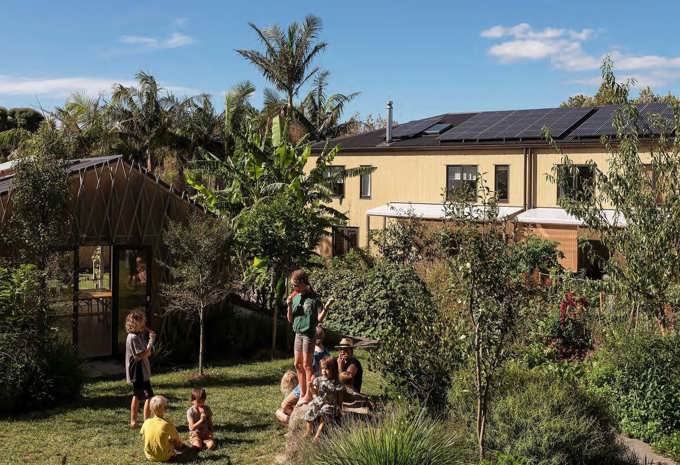
Community garden shared by residents of the Cohaus development in Grey Lynn
Meanwhile, the Government quietly announced weaker climate rules…
As Henry Cooke reported these changes were put out quietly on Tuesday, despite their major ramifications…
The Government quietly announced a huge shift in climate policy on Tuesday evening, including a 25-year delay to a public sector climate goal and the de-linking of the Emissions Trading Scheme from the Paris climate pact.
The changes were included at the bottom of a press release put out at 8pm on a Government website but not emailed to all political journalists, as ministerial press releases generally are.
Overall the changes to the Climate Change Response Act loosen the rules that prior governments have set in order to force future emission reductions.
The Govt quietly announced a loosening of climate rules at 8pm last night:- Decoupling the ETS from Paris- Shifting ETS resets to every 2 years – Delaying the public sector target by 25 years- Removing CCC advice from *before* emission reductions plans:www.thepost.co.nz/politics/360…
— henry cooke (@henrycooke.bsky.social) 2025-11-04T22:26:53.485Z
Get your crash framing right, media…
There has been some shocking reporting the last few weeks on a number of incidents involving electric buses in Auckland. This piece by Emma Ricketts was quite good in clarifying the facts:
Sutcliffe has analysed footage of all three Auckland incidents and said at least two had nothing to do with the batteries.
As above, FENZ has confirmed that in the Tāmaki Drive crash, it was the fuel-powered car that caught fire. The fire then spread to the bus.
In the train station incident, witnesses reported seeing smoke after the bus crashed into a shelter. Sutcliffe said this could have been caused by any number of things.“When people describe seeing smoke at a crash scene, it can actually be anything from glass shattering to air bags deploying. There was nothing there to indicate that the batteries caught fire or were damaged in any way.”
Inquiries into the latest incident, involving the overpass, are still ongoing.
“From the images, we can see that the battery pack was obviously damaged. But we cannot see what we call ‘thermal runaway’,” Sutcliffe said.
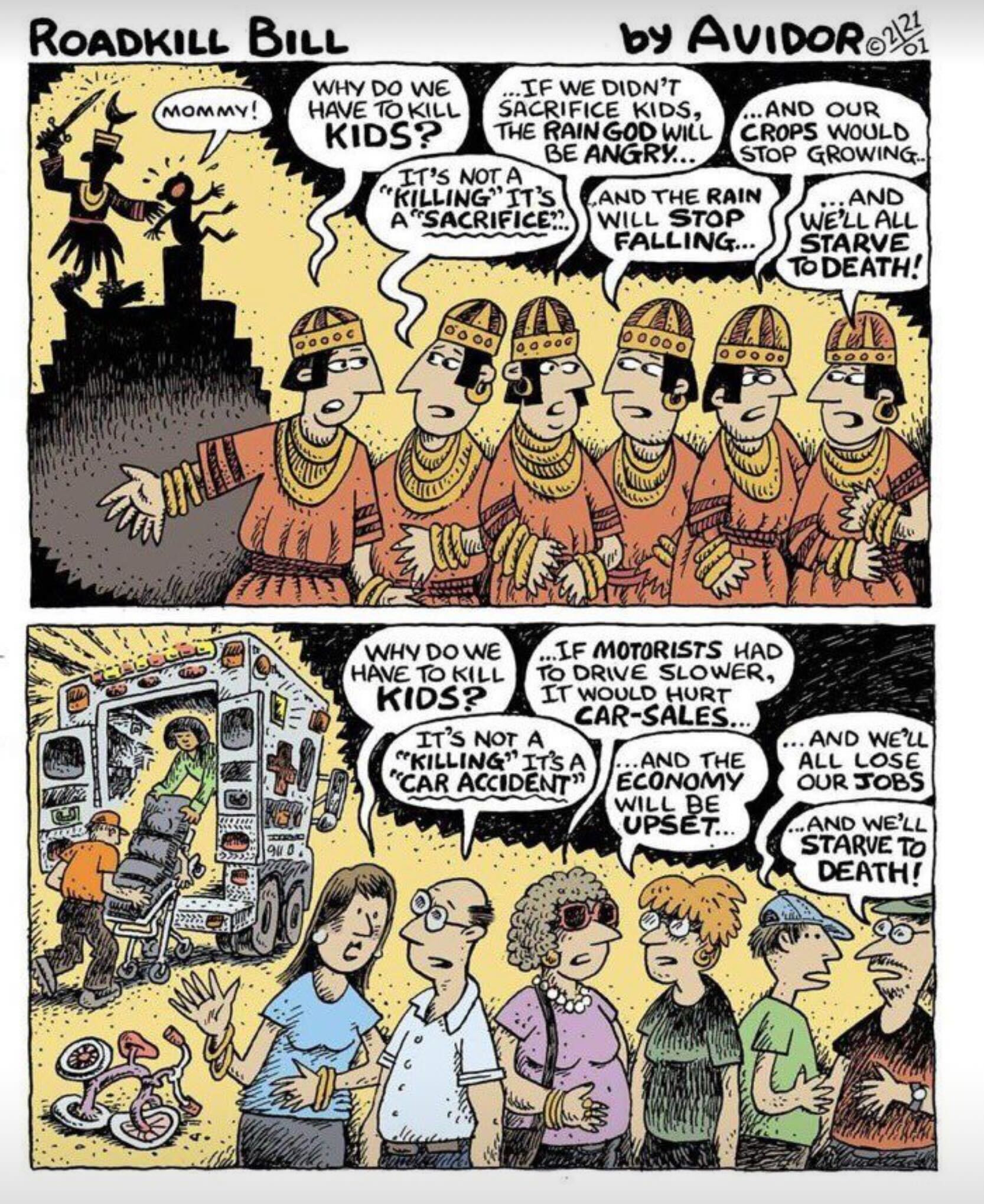
Unfortunately, it’s a lot easier to stoke fear and misinformation than it is to correct misapprehensions. And this reflects a longstanding issue with reporting on crashes, which tends to downplay the role of vehicles (and their drivers) in causing entirely preventable harm. (And based on recent reporting, it seems the ones powered by fossil fuels get special treatment…).
Fixing the New Old Hutt Road Path
Cycle Wellington is calling for improvements to a shared path on Old Hutt Road.
Cycle Wellington is calling on Wellington City Council, Waka Kotahi and KiwiRail to improve the shared path on Old Hutt Road. People who will be using the soon to open Te Ara Tupua coastal path need a safe and attractive continuation of this soon to be iconic seaside path. This section needs to complement the quality and vision of the Great Harbour Way linear park around our beautiful harbour environment.
They have a few suggestions.
Videos to view!
A good speech on the value of the arts
Check out this video touring London’s Low Traffic Neighbourhoods:
And here’s the acceptance speech by New York City’s energetic new mayor, Zohran Mamdani (or read the transcript here). Mamdani’s enthusiastically positive style of campaigning – and communication of what policies actually mean for people – has a lot to recommend it, and will be compulsory viewing for anyone involved in upcoming elections here, and everywhere.
Everything from us this week, enjoy your weekend!

 Processing...
CoHaus is wonderful, but the density isn’t very high at all once you factor in the large areas of open space. Low end of medium density.
Still great, though!
Some of you simply want to build slums.
?
Highlight of the week has to be the Doobie Brothers Tiny Desk concert. It is relevant here because they are still Takin’ it to the Streets’.
https://www.youtube.com/watch?v=jrkOQuRYCIQ
When Simeon’s office gets bowled for a 10-storey retail/apartment block, he’ll appreciate his constituents being able to cross a narrower Pakuranga Road with about one third* of the original car traffic needing to go past it. And he could cycle quickly to the office if he wanted to keep fit.
* He could have just asked for the transport forecasts.
The low traffic area depicted around The Angel in Islington is pretty nice, however there is a lot of cyclist-driven conflict with pedestrians along the towpath of the Islington Canal.
We witnessed a very low speed interaction between a pedestrian and cyclist here, that resulted in a dunking of the cyclist and her bike.
When somebody stepped in front of the cycle at a pinch point, under a bridge the cyclist was unable to extract her feet in time from the toe clips to prevent her fall. She tried to berate the pedestrian, for misfortune. “I was ringing my bell” Apart from concern for her well being, sympathy was absent.
There was always a problem with fly boats overtaking slow barges with horses needing to pass on the towpaths of canals. Need more lanes to deal with congestion, eh Simeon?
I think Simeon Brown like Maurice Williamson, and other Nats before him, suffer from Howick Derangement.
According to them the only cure is more lanes from Howick to everywhere they want drive to.
Having dealt with dozens of bell-clanging half-wits on the same stretch, your story warms my heart.
Howick Derangement Syndrome stems from the small person envy of the residents who know in their hearts that their suburb, having an English place name means it will never attain the vain heights of places like Orakei and Remuera! It should have been left as Owairoa.
That book is right at the top of my list!
Zohran Mamdani like mayor for Auckland or anywhere else around the world, is bad for society, safety, way-of-life! It’s shameful that Greater Aucklander is even promoting a cause which isn’t about positive change! What he’s brings is about autonomy, de-empowerment, aggression, violence, division, idealogue desperation, unhinged ideologies. A large majority of his policies won’t work or all of them won’t work at all, due to no real based factual evidence or practical investigations, just based on ideologies and delusion! Zohran Mamdani as mayor of NYC will be prime example of what’s to come to Auckland in future if both Labour-National don’t work with current Mayor of Auckland to provide policies which alleviate ‘Cost of Living’!
NYC has similar issues to Auckland too. A lot of issues that Zohran Mamdani has pointed has large similarities to what we face in Auckland! The government of NZ has got to act swiftly, if they don’t want a Zohran Mamdani figure like running as mayor here in Auckland! The biggest issue Zohran Mamdani pointed out was Housing & Transport. Auckland solely needs to fix this issue fast! A lot of young, ethnic people in Auckland feel mentally, physically exhausted day to day currently from work. They would like more ‘fast rapid transits’ and closer to work housing (rentals). Exactly what New Yorkers voted for in their city! The distance from work & home vice versa has impacted on people’s lives these days. Also the commute times can be in-total for 1-3 hrs each day for one workday for any-person which takes up their own personal life here in Auckland and NYC. Commute times for traveling from home to work needs to improve here in Auckland cause A lot of young, ethnic people feel mentally, physically exhausted day to day currently from work, cause of commute times and PT bus services not fast enough cause they’re road sharing with general traffic and don’t have rail to commute to work! A lot of young, ethnic people in Auckland are desperate for change, need Mayor of Auckland and central government working together otherwise what we’ll see is a Zohran Mamdani as mayor of Auckland which is bad for Auckland!
What Auckland needs right now is more ‘Fast Rapid Transits’ and more central Auckland high density complexes so we don’t get Zohran Mamdani figure here in Auckland!
oh my god anon’s trying to make Mamdami’s election about their heavy rail fetish. this is hilarious.
also “ethnic people” lol anon way to give away that you’re an archaic old coot. aside from, y’know, falling for misinformation about heavy rail, light rail and busways like old people fall for AI generated videos and images on facebook
I’m sick of every political conversation turning American, especially transport infrastructure since America is one of the worst case studies for building effective mass rapid transit networks.
One of the worst case studies, aside from Aotearoa that is, so maybe it is an apt comparison
+1
-1
=0