Stopping sprawl and turning Auckland into an efficient, green city? Sign us up, Mayor Wayne Brown!
On Friday 31 October, the Mayor and councillors were officially sworn in, and the Mayor made a speech outlining his priorities for the coming term. Notably, this included what might even be considered a bit of a vision for the city – something that was lacking three years ago, when his focus was far more pointed at the council’s budget.
From the Herald:
Auckland must change from the world’s largest suburb to a global city, Mayor Wayne Brown said at his inauguration speech this evening.
…..
After being elected in 2022 on five policies – stop wasting money, finish big infrastructure projects, take back control of council organisations, speed up traffic and get more from the harbour – Brown outlined five new policies for his second, and final, term.
They are:
- Upgrading transport in Auckland from appalling to quite good.
- Getting consensus on a new intensification plan for the city and stopping the building of homes on floodplains.
- A sharper focus on economic growth for Auckland.
- Making the city centre more inviting for business and leisure activities.
- Getting a “city deal” across the line with the Government.
Brown said this last policy was an opportunity for the Government to start treating Auckland with the respect it is due.
The mayor delivered several pointed messages to the Government, noting the upcoming general election and urging the Government to recognise Auckland’s strategic importance.
“The Government is pushing us to have more greenfields, but, other than Drury, that’s not going to happen.
“We must change Auckland from the world’s largest suburb to a global city. It’s already embarrassingly known as the city of sprawl. It’s not economical and it’s not environmental. I want an efficient, green city,” Brown said.
An efficient, green city is getting close to former Mayor Len Brown’s vision of “the world’s most liveable city”.
Mayor Wayne Brown is right that sprawl is neither economical nor environmental. Those greenfield areas need a lot of infrastructure – such as transport links, parks, three waters and community facilities – to support the residents who would live in them. And that doesn’t come cheap to build or maintain, especially not these days.
Back in 2019, the estimated cost for just the transport infrastructure alone was expected to top $10 billion, with the actual figure likely working out at over $100,000 per new home. Given the cost inflation we’ve seen recently, the bill could easily be more than double that now – and developers have baulked at the proposals by the Council to cover some of that with increased development contributions.
All that cash is investment that could instead be used to enable more development and more homes within the existing urban area, with the additional benefit of also improving the lives of existing residents. More neighbours, more services, more commerce, more lively shopping areas, and so on.
In 2023, the council’s Future Development Strategy looked at different options for growing the city, including one that included expansive greenfield growth options (Scenario D).
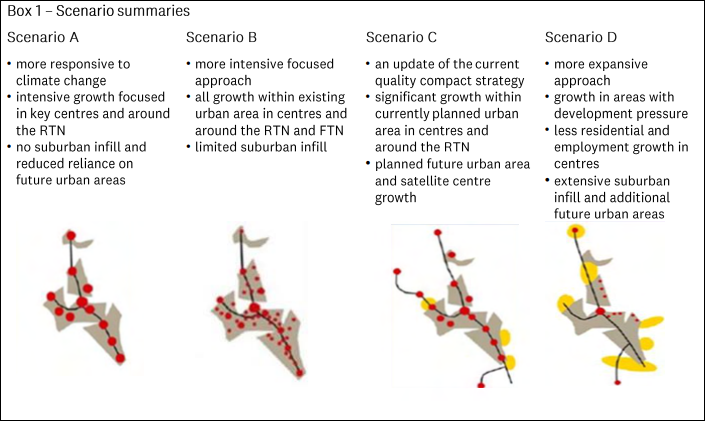
There’s a lot of detailed work assessing these options, but among the key themes from that assessment as summarised in the main report you’ll find:
Land use and infrastructure integration, particularly transport, is fundamental to spatial outcomes
- Scenarios that focused growth within the existing urban area and specifically within the walkable catchments of the planned RTN/FTN performed better against transport criteria specifically but also environmental, social, cultural and economic criteria.
- Compact urban forms perform better in terms of least monetary cost of infrastructure over time, as they result in more efficient use of existing services and new infrastructure. More expansive urban forms require the greatest amount of new infrastructure with the most significant costs.
Locating homes and jobs in close proximity is important
- Generally, the more intensive scenarios, with a mix of uses around transport nodes, performed better in relation to reducing the need to travel (to employment, education services etc) and therefore reducing carbon emissions and the cost of travelling.
Despite all this and other evidence, Auckland Council does still allow for more sprawl (see Drury, currently under way) – and now the government is champing at the bit to allow even more of it.
Just last week, the government (in the form of Chris Bishop, Minister of Housing, Infrastructure, RMA Reform, and Transport, also Associate Finance Minister) issued a formal statement of expectation for the panel reviewing the new plan change, that they “test the appropriate distribution of housing capacity (including greenfield development)“.
This would appear to double down on the Minister’s previous scorn regarding what he called Auckland Council’s “weird aversion to new greenfield housing” (aka sprawl), while nonetheless insisting he’s “returning decision-making to locals”:
“I am confident the PC120 process will ensure local voices are at the centre of decisions on Auckland’s growth, while creating more housing options, making the most of the City Rail Link, and setting the city up for the future.”
I imagine that both the mayor and government will be keen to secure their points of view in any city deal they arrive at. And the mayor himself seems to be hoping that central government elections next year will help him in winning the argument, with the incumbent government needing to woo and win Auckland.
As well as the election, I also think that the City Rail Link might play a part in getting the city deal over the line. As CRL gets closer to opening, both the government and council will be keen to answer the question of “what next” – and the government in particular will need to show they’re doing something.
What else could be in that city deal?
PS As of this morning, Plan Change 120 (PC120: Housing Intensification and Resilience) is now open for consultation, through to 5pm Friday 19 December. We’ll have more coverage of this in coming weeks.

 Processing...
Thanks, Matt, for a more balanced report on the Mayor’s speech. Everything I’d read prior focused on “Getting a “city deal” across the line with the Government” or the “including greenfield development“ statement.
It’s all rather refreshing. Hopefully the Council will get behind him and make the better bits happen.
That’s good news. A shame nevertheless that no other credible person offered themselves up for the role of mayor this year.
I’d like to see the mayor challenge Watercare on its business model of making profit over delivering quality assets and maintaining its sewer network. Their current charter is to operate assets to failure, and we can see how foolish that is with the 2023 orakei sewer collapse.
Plus the recent Watercare debacle in Warkworth where a system failure went ‘unnoticed’ for many hours near ruining downstream water users.
I am hoping the global city part is bullshit to try and sound good rather than an actual goal. Every global city got there after squeezing out the poorer people.
As someone who grew up in an impoverished situation in London, I don’t agree. Indeed, London had famous poverty as it became perhaps the world’s first global city. And now, as an ‘Alpha++’ global city, comparable only with New York (Wikipedia tells me), it still has many areas which are classified ‘most deprived’: https://www.gov.uk/government/statistics/english-indices-of-deprivation-2025/english-indices-of-deprivation-2025-statistical-release
All of the traditionally poor areas have been squeezed further out. London does have some LADS in the most deprived but still doesn’t compare to Birmingham, Liverpool, Bradford or Blackpool. https://deprivation.communities.gov.uk/maps?type=imd&geog=lsoa#9.67/51.4983/-0.3512
Tower Hamlets, Hackney, Islington and Southwark are not further out. Old Kent Road (first stop on the Monopoly board) is still dirt poor. My friend lived on an estate there. Sketchy as.
More importantly, London provides more opportunities for the poor people who live there to get out of poverty and succeed: https://www.suttontrust.com/news-opinion/all-news-opinion/london-miles-ahead-of-other-regions-in-providing-best-opportunities-for-the-poorest-young-people/.
“and developers have baulked at the proposals by the Council to cover some of that with increased development contributions”
– it we want to stop sprawl:
a) Ideally developers would pay the full cost (user pays rather than ratepayer pays) of their greenfield development (excluding networkwide transport effects). This would make brownfield development and densification relatively cheaper
b) Networkwide transport effects would be handled via congestion tolls or time of day charging. This would make PT and alternative modes relatively more attractive & free up network capacity for freight.
The only thing left to do would be to remove density limitations and put in place a set of national environmental/urban standards that dealt with the adverse effects.
A promising vision statement. So, given the central and powerful role transport plays in everything, not least connecting us to each other and to all the things of daily life…
… surely the Mayor and his newly-transport-decision-making-empowered Council will immediately pick up the TERP (Transport Emissions Reduction Pathway) and run like hell with it?
https://www.greaterauckland.org.nz/2022/08/16/sustainable-access-for-a-thriving-future/
https://www.greaterauckland.org.nz/2021/08/16/turbo-charging-the-terp/
https://www.greaterauckland.org.nz/2023/06/12/pick-up-the-ball-and-run-at/
It’s never too late to do the right thing!
Not to mention, following the TERP to the letter will also rapidly achieve the Mayor’s other goal of moving transport in Auckland from ‘appalling’ to ‘quite good’.
Jolisa references the newly-transport-decision-making empowered Council which is a commonly held mis-perception. Once the AT reform legislation is in place (probably early next year) Council will get to make decisions now made by AT. But the Minister of Transport will not only have direct representation on the new Auckland Regional Transport Committee (3 out of 7 voting members) he will also get a say in choosing the “independent Chair”. Before the ARTC then begins work on drawing up the Long Term Plan for Auckland Transport they “must seek direction from the Minister of Transport” and the LTP only becomes “effective after it has been approved by the Minister”. So not content with its ability to frame Auckland’s future transport planning and development through the GPS (which the ARTC is required to “take into account”) Government is giving itself power to intervene in the decision-making process. This also extends to the transport budget, as the LTP will determine which kinds of projects get well funded and which ones are poorly funded or not funded at all. So while Council will in theory be in control, they will be limited to projects and programmes which are explicitly included in the LTP or consistent with it. So if we have a MOT like Simeon we are likely to see arterial road widening and new motorways prioritised over public transport and “active modes” (walking and cycling).
When the trains are running I think public transport is already “quite good”.
How would you describe the bus and train services and the downtown bus station and railway stations 30 or more years ago?
Quite good in some areas…
Derelict. Kingsland station was an unlit shed.
The downtown bus station used to be quite frightening when I was a young person walking through it. My parent’s office was on Customs St for several years so I can remember walking through it with and without parents from about 9-14 years old.
I don’t miss it.
When the trains work and line up with the buses it’s pretty good. I did door to door Howick to office in Queen Street in 48 minutes. Needs a bit more bus lane priority but it’s entirely acceptable.
Still a problem of “ghost” services esp off peak where they just disappear from the timetable and don’t run. We should be proud of the progress over the last 15 years
Yeah, nah
Mediocre at best
It is impossible to both incentivise sprawl and improve productivity. These are antithetical.
Incentivise more sprawl and our already weak productivity will worsen, as increasing numbers of people sit in cars for ever increasing lengths of time between ever further flung locations, achieving little but getting fatter and more depressed.
Ever increasing sums on fiddling with urban highways cannot counteract this, as is well understood, through the iron law of induced demand. This is just doubling down on inefficiency.
An alternative however has never been more available. Auckland is close to completing a viable RTN and is developing a world-class supporting next tier down bus network. Both now need smart but bold prioritisation and accelerated funding commitment. Especially if we can het PC120 right too, which also looks in reach.
Great speech Mayor Brown, all power to your elbow.
Good to see Brown questioning the cost of the Northland expressway in a recent herald article. It gives some hope the insane costs may finally be questioned by someone with a voice.
Yes! Lets do it.
Auckland should be held up internationally as a green city.
Ummm, but it is not. And probably, never will be, far too many cars.
Auckland can become greener, but it is not and never will be green…
Did Brown get a single concession from central government in his entire first term? He keeps on announcing things he wants and then not getting them, or losing battles like the petrol tax.
The only halfway-maybe thing I can think of is carving up control of AT, which is probably going to result in Wellington using the purse strings as a control mechanism.
Mark Todd has talked about the cost of connecting to utilities and services for brownfields, basically wants it to be cheaper depending on the true cost of connecting new buildings to existing services basically a subsidy and to be honest basically we have been subsidising sprawl for close to 70 years now and not high density in existing areas so if we want less sprawl might need to make brownfield development cheaper than greenfield because at the moment it mostly isn’t
Auckland Mayor is still wasting our taxpayer money on Traffic Management Companies Who do fuck all showing us their flashing lights and re directing traffic when no work is going on
Stop wasting money hire whenever necessary
I will also reduce my rent by a third since I am not home roughly 8 hours per day. Sure that will work out.
So they’re redirecting you away from the works, but you just know that there is no work going on…
I hope you can realise how stupid that is.
But then, if no one was repairing the roads or creating the capacity for your mobile pile of rusting debt, you’d also lose your mind and start griping about that.
And this is why petrol sniffers shouldn’t be taken seriously.
Calm down a bit Cinder it’s not uncommon to see traffic control and no one is actually doing anything the contractors know how to take us for a ride. Even if the commenter was wrong there’s no need for that response a simple kind disagreement would suffice. Remember the User Guidelines.
Here’s a better idea. If you don’t want to be called the village idiot, don’t stand in the town square with your pants around your ankles smearing dung on your face.
I pointed out the flaws in his “logic” and then you went and repeated the same nonsense without any actual evidence or citations.
Let’s apply your “logic” to some analogies:
I come to your workplace and there you are standing around waiting for a workmate. I’ve witnessed you doing nothing. You must be a work shy bludger wasting your bosses money.
In fact, I’ve only witnessed a tiny percentage of your working day.
There you are waiting for IT support staring at your phone. Workshy bludger.
My job requires a lot of very focused reading. If you observed me doing that task for a few minutes and knew nothing of my job – work shy bludger.
Those roads, motorways and parking buildings are basically deserted between 1am – 5am. What a waste of money.
Do you get it yet?
Speaking of citations, references and wasted money
https://www.stuff.co.nz/politics/360852097/each-call-road-cone-tipline-leads-fewer-one-cone-being-removed
I volunteer with the disabled community, many of whom cannot drive. They live with greater dignity, maturity and patience than motorised man babies like you.
Just because you self identify as a Ford Ranger doesn’t mean you’re a special boy who should never be inconvenienced by the State feeding your tarmac addiction.
And you can stop demonizing road workers too.
https://www.rnz.co.nz/news/national/576522/roadworkers-report-being-abused-verbally-and-physically-by-frustrated-drivers
Here’s an even better idea Cinder, you could follow the user guidelines for this blog and not be so agressive. Notice how my comment was calmly written but you’re trying to shut down debate right from the first comment. You called the commenter “stupid” which is not a nice thing to do and breaks a very clear rule of “no insults”. Anyway I utterly reject the premise of your comment. Many TTM contractors take the taxpayer for a ride and don’t even do their job properly setting it up after all that then some goon gets off a speeding ticket because they were too incompetent to set it up properly in the first place. Also because I’m a “motorised man baby” I better go and advocate for more roads! See this is why there can never be reasonable debate because someone like Cinder will fly off the rails and insult somone.
Mostly off-topic but this listing is too funny can the real estate magic word of character get this derelict manor that even the listing says might be demolished in the future rented out for $1,750 per week? I hope not
https://www.trademe.co.nz/a/property/residential/rent/auckland/north-shore-city/takapuna/listing/5592961348
I guess this is what we call managed decline.
If you go to central Auckland suburbs you see a lot of houses in visibly this sort of state.
Cut the sprawl and road building .If some one wants to do a development make them pay the full cost that will make them think twice .Do not spend another cent on new roads and invest in making walking and cycling safer .Use all empty plots of land inside the current boundaries of the city before opening up one single new subdivision .Boost public transport like there is no tomorrow and make it cheap to use ,get people out of cars and make it harder to find car parks so people choose to walk ,cycle or ride public transport .End result a great place to live .
Council needs to actively have abandoned vehicles left on the side of the road, or on pedestrian footpaths removed with urgency and professionalism.
Given Auckand Ratepayers keep having Council Rates increased its about time abandoned cars left on the road, and or footpaths or on the side of roads where they are vandalised abd often set fire to !
In his book “Strong Towns”, Charles Marohn argues that at some point towns are going to have to make the decision to cut off some of the remote low-density suburbs who only survive because their infrastructure is heavily subsidized by the more dense areas. It costs way too much to maintain and towns/cities can’t afford to do it forever. Either the people who choose to live in those areas need to pay their own way or move back to where infrastructure makes sense. More and more greenfield development just puts more strain on the city and ratepayers to them prop up.
Is there actually any structure for cities/towns to cut off their remote low density suburbs? Ones that cost a lot more to service then their rates income.
Just asking on behalf of the PM,and others, in relation to their Auckland City properties on the Gulf Islands, including Waiheke and Great Barrier Island.
This reminds me of back in the supercity amalgamation there were these groups on Waiheke and rural Rodney and Franklin wanting to be completely separate councils… I was like, good f’in luck chaps, fill your boots, you’ll find out real quick how much subisdy you get from the suburbs.