Much like Auckland, Wellington rail users have had a hard time of it recently with significant works being undertaken to upgrade the network. They had some great news yesterday with the announcement Alstom will be building 18 five-car battery electric multiple unit (BEMU) trains to for their regional services.
The first fleet of battery-electric trains in the Southern Hemisphere, co-funded by Greater Wellington and Horizons regional councils and the Government, will be constructed by Alstom, a global leader in sustainable rail transportation.
After a worldwide procurement process, Greater Wellington today entered into a Design, Build and Maintenance agreement with Alstom for the Lower North Island Rail Integrated Mobility (LNIRIM) programme.
Greater Wellington chair Daran Ponter says Wairarapa and Manawatū line passengers can look forward to quicker journeys and more frequent trains from 2030.
“From Palmerston North and Masterton to Wellington, the Tūhono fleet will double peak time trains, increase off-peak services and support regional growth,” Cr Ponter says.
“Designed for New Zealand conditions, the new trains switch to batteries on track without overhead power, using technology proven in countries like Japan and Germany.”
Approved by Mana Whenua, the name Tūhono symbolises how the trains will better connect urban centres and regional communities.
…..
The Tūhono fleet will be manufactured in India by Alstom and decorated with train livery featuring symbols by Māori owned company Indigenous Design and Innovation.
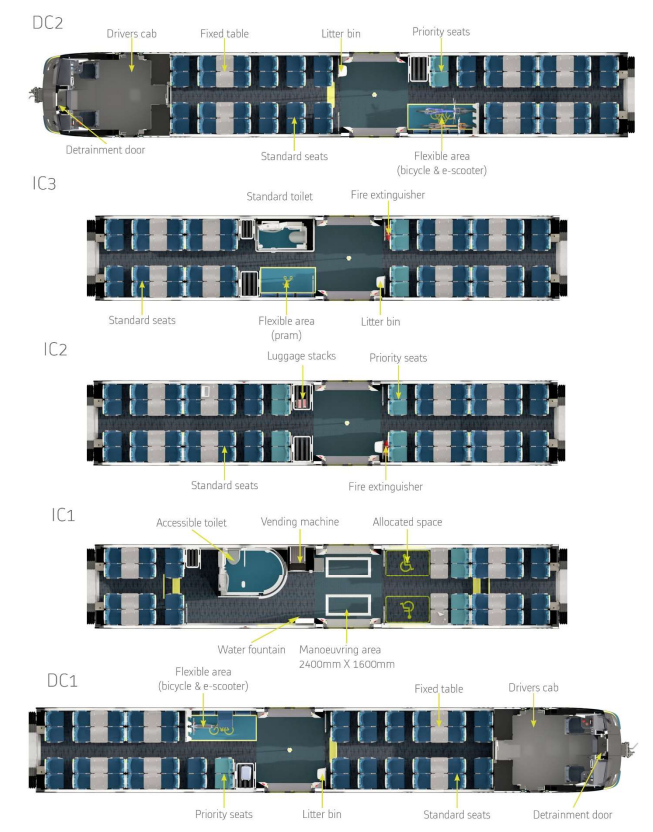
“Tūhono trains will provide climate friendly, comfortable and inclusive journeys, with wheelchair, bike, and pram facilities, as well as accessible toilets, vending machines and water dispensers,” says Pascal Dupond, Managing Director Alstom Australia and New Zealand.
The total contract is for 35 years and is valued at just over $1 billion, but that also includes maintenance over that period, a new depot in Masterton and driving simulator. The government are keen to point out that it is covering around 90% of the costs for these trains with the remaining coming from Greater Wellington and Horizons Regional councils. Alstom won out over Construcciones y Auxiliar de Ferrocarriles S.A. (CAF) and Stadler Bussnang AG. (Stadler)
The trains are based on Alstom’s Adessia (formerly known as X’trapolis) platform and say:
The Tūhono train will be largely based on the Irish Rail DART+ Battery Electric Multiple Unit with the following key differences:
- Adaptations to suit New Zealand’s narrow-gauge track
- Front detrainment door for evacuation in single bore tunnels
- Arrangement of Driver’s cab and crashworthiness features to suit New Zealand rail network requirements
- Additional battery capacity
- Regional seating configuration, including standard and universal toilets, food and drink vending machines and fresh water dispensers.
- Low floor areas for accessible near-level boarding in intermediate cars
- Culturally resonant interior and exterior design
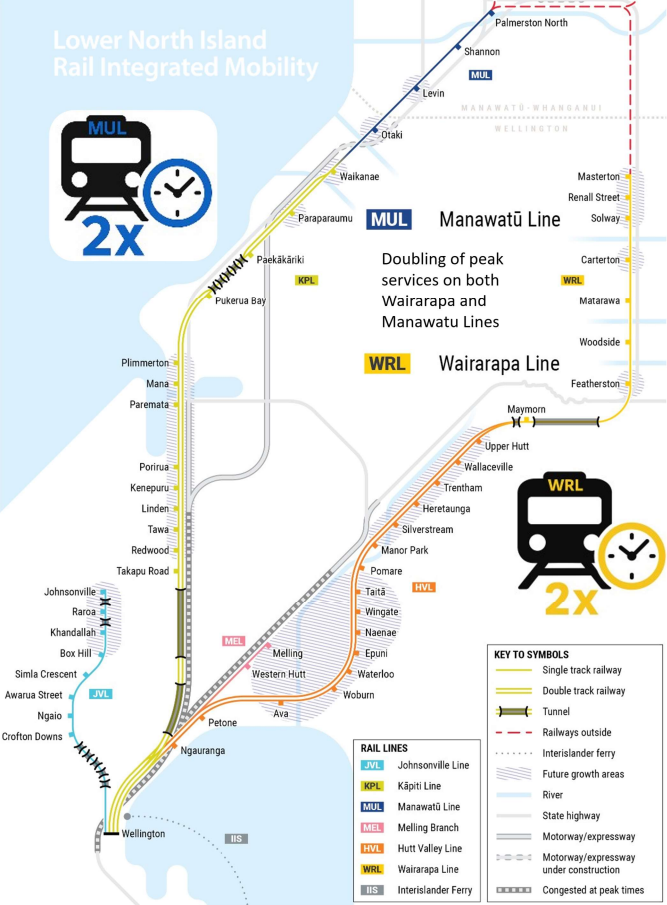
The trains will be used to double the number of peak time services – from 1 to 2 on the Manawatū Line and from 3 to 6 on the Wairarapa Line. The are also planned to be additional off-peak and weekend services. There are also expected to be travel time savings of around 15 mintues on a trip from Masterton – bringing it down to around 1.5 hours.
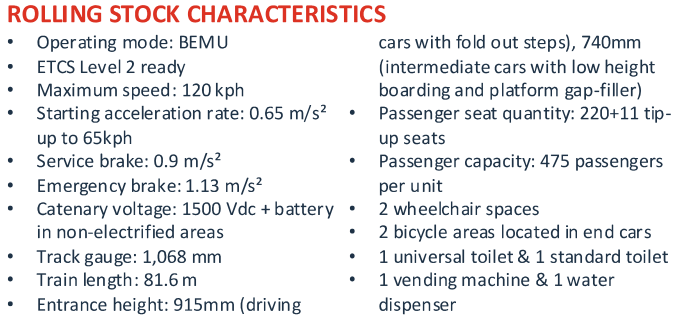
For those wanting stats on the trains themselves, Greater Wellington have a factsheet – there’s also additional information in this programme summary document.
It’s great that they’ve gone for a BEMU option and not the tri-mode option – with additional diesel generator – as initially planned, or with diesel units like former Transport Minister Simeon Brown suggested they consider.
That the BEMU option came out on top is in part because this design has started to become a lot more common and battery technology has improved enough that they can get sufficient range to service those non-electrified areas.
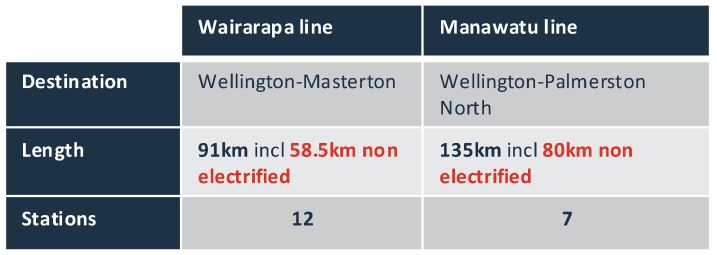
It is noted that the trains will use fast charging to recharge batteries in 20 minutes when they terminate in in Masterton or Palmerston North and will be slow-charged overnight.
The distance off-wire that these trains will be able to achieve is also significant for another reason, a version of these trains that are able to operate off AC would be ideal for the Te Huia service between Hamilton and Auckland. The 80km of non-electrified Manawatu Line is a similar distance to the distance from Pukekohe to Hamilton (87km).
On that I also note they say:
OPTIONS FOR ADDITIONAL BEMU’S
The agreement reached with Alstom means that GWRC have pre-priced options available to enable the following potential key changes to the contract:
- the installation of European Train Control System (ETCS) in the units,
- additional trains,
- Metro-specific variants.
The agreement also enables other New Zealand public transport authorities to enter into negotiations with Alstom for suitable BEMU’s to suit their needs.
Bring on 2030

 Processing...
Bring it on for Te Huia. I’ve always thought this was the longer term solution to intercity travel in the “golden triangle”. Auckland-Hamilton should have services every couple of hours; every hour during peaks. Ideally, you’d want a train that had a range of 200 km to cover Pukekohe to Frankton.
And (dare I suggest) they could also be useful in the unlikely event that AT ever reversed direction and extended trains to Huapai. Or even Helensville thinking in the longer term.
Interesting also that the agreement specifically anticipates other cities following suit – Christchurch too, perhaps?
We’d need some passing loops or an extra line for Huapai to become feasible, I think. I have read on this blog that the New Lynn trench (in particular) is a real obstacle.
On the bright side, we could speculate that trains like these might reduce the cost of doing so (you might not need to install extra overhead lines if you’re relying on partially battery powered locomotives).
you’d probably want a train with a short-range interior layout and to run a Swanson-Helensville shuttle service for any new Helensville train. i believe per the old timetable it was ~45-50 minutes between Helensville and Swanson, that would be enough for an hourly service using 2 multiple units with a 10-15 minute layover + charging at either end. passengers could change at Huapai for hypothetical extended WX1 services to get to the central city, or at Swanson for Western Line services.
More investment in sprawl. NZ seems to be very good at providing very good PT to those that choose to live miles from the city, and very slow buses to everyone else.
Taking PT from Silverdale to Britomart is quicker than from Mt Roskill to Britomart. How is this encouraging a compact city?
I agree. Those high cost stations at Pukekohe and Drury will get a small fraction of passengers that the Mt Roskill or Blockhouse Bay busses have. People living those areas will be spending 2 or 3 hours a day commuting at great cost and have less time for other activities.
While I agree about sprawl, inter-regional connections are also important.
Wellington has also had a long history of long distance commutes, mostly because the climate improves so dramatically when you head to either the Wairarapa or Kapiti Coast.
Not saying its a bad project, just saying that it is the only kind of project that gets funding.
The super city hasn’t helped. If we still had an Auckland City Council we would have had council investment in PT close to the city (in fact I think they were about to make big improvements to buses on Dominion Road prior to the super city). Instead all the money is tied up in the CRL, AMETI, NEX, A2B, etc. Imagine how different the city would be had all that money been spent on trams in the Isthmus, Auckland could be more Melbourne and less Los Angeles.
Agree, although trams on Dominion Rd have always been dependent on government funding and local support for a significant change to how Dominion Rd operates. I don’t think either would have happened without the Super City.
From memory the council were looking into central bus lanes on Dominion Road. It wouldn’t be a stretch to imagine them laying rail by now.
Had the council not spent $3 billion on the CRL they probably wouldn’t have needed the government to build LR lines. I’m not saying the CRL is a bad project, but I don’t think the super city have invested the money in the right places, they keep trying to solve Auckland’s current sprawl based problems instead of trying to create a compact city.
Both the old ACC and AT looked into options for Dominion Rd that would have been good for PT. But it’s a big stretch to say either would likely have happened (other than we know AT’s didn’t).
I think Christchurch is unfortunately going to run into similar issues with road space on Papanui and Riccarton Rds. Public resistance to big change is significant.
Dream on. Widening for bus lanes? Surface light rail? Underground? Every level of government from Auckland City Council on have failed to secure funding to progress with any of the concept or detailed designs for Do-minimum Road.
I say, let Dom Rd strangle itself to a standstill and then come back with options, all of which will be de-prioritising cars and their carparks.
Leverage.
It’s easy to beat up on the Super City but since it happened we got electrification and CRL.
Neither happened over decades of fragmented multiple borough and/orcouncil local govt. Goodness knows where our rail network would be now if we still had such a fragmented political scene in Auckland.
Anyone thinking how bad the Super City is, go and read the biography of Sir Dove Myer Robinson. You’ll be left thinking it was a miracle anything got done in Auckland!
If Labours light rail scheme had have started much smaller than what it opened with, it may have actually come into fruition.
The biggest issue for it as soon as it went to the airport, Winston Peters was going to be against it. So if they had have settled for Mt Roskil or something like that, Light Rail most likely would have got over the line.
Totally agree Jezza. This is not about sprawl. It’s about connecting with your regional hinterland. And as Te Huia has shown, regional services are about far more than just commuting!
Good, but why is it taking so long?
By comparison….
Irish Rail and Alstom sign BEMU contract
December 5, 2022
First train delivered arrived late 2024.
Why is the acceleration so slow at 0.65m/s. Most modern trains are nearer 1m/s.
My guess is the 1500VDC power supply is the limiting factor. Hopefully one day Wellington will be 25kV, and also hopefully its easy to swap these trains electrics to suit. Maybe the purchase of these new trains should have triggered the change?
Aucklands trains also accelerate and brake very slowly compared to overseas, so maybe there’s some Kiwirail or NZ standard that needs fixing too?
Yes if the trains go any faster the red button on the rear of the little green Hornby controller pops out and they have to wait a few minutes before pushing it back in.
This a relatively small order of regional trains. If Wellington was going to change it would be best when changing its much bigger metro fleet. Also in the paxt decade or so a lot of ole infra was updated. So the best time to have done it was before Matangis came in and ole renewal happened.
Could be a manufacturer capacity issue (or perhaps the Government’s current lack of liquid cash …)
The initial Dart + order was Dec 2021, with enter service of mid 2025, so 3-1/2 years order to service,
we are Sept 25 to mid 30 so 4-1/2 years,
I suspect because we are a small order, (18 sets) and bespoke narrow gauge (frontal doors etc) there is extra design time ( the front doors will require new driving cabin layouts – which are typically fully across the front of the drivers cab )
https://youtu.be/W-EGaW26pqA?t=431
December 2021: 19 x 5 car trains. They will begin to enter passenger service from mid-2025 onwards
December 2022: 18 x 5 car trains. They will begin to enter passenger service from 2026 onwards
https://www.irishrail.ie/en-ie/about-us/iarnrod-eireann-projects-and-investments/investment-new-trains
Dart+ first unit still not in service – due from 2026.
Tūhono BEMU first delvery due mid 2028, first in service mid 2029. All due in service by late 2030.
Just a great congratulations to Minister Bishop and to Horizons and Greater Wellington for investing cooperatively together for many decades.
Great result for everyone.
Despite his dubious employment records, Bishop seems to be shaping up as one of the country’s most promising MPs.
Bishop certainly appears to be less car focussed than his predecessor, perhaps growing up in an area where PT was normal has given him a better appreciation of a balanced transport policy.
That brings up the point that one area where Te Huia is still lacking is unity of support at both ends of the line. It was hard for central govt to dismiss this proposal biz case as it had strong support at both enďs of the line. In contrast, Auckland is still yet to get in behind and support Te Huia, politically and financially. The criticism, often entirely ignorant, by Mayor Brown has been quite disappointing.
If the Waikato and BoP ended up with these units, there would be no need to avoid Britomart. That would be a huge plus for Te Huia and any future rail services.
There is clearly a current of thought within National that isn’t totally opposed to rail investment, this alone should give (some) hope that we could incrementally start to expand passenger rail beyond the Lower North Island and Auckland.
From your keyboard to God’s ears, but I have my doubts that Chris Bishop not torpedoing a rail project that will probably aid his reelection chances in Wellington means he’s going to rush to fight the good fight anywhere else.
While swapping out the DC for AC would allow these sets to do the Te Huia run, and all the way into the soon to be spare Waitematā Station platforms, I do think the better options would be to wire up that gap, and order dedicated EMUs, using OHL the whole way.
This is a much busier core section of the nation’s transport networks.
Then electric locos could also do the whole Auckland to Palmy run, and, with a short section across the river, to Ruakura logistics hub too, all with the superior 25kV OHL technology.
So double-tracking and straightening the Whangamarino section, and adding stations at Te Kauwhata, Pōkeno and Ngāruawāhia, would make this a great regional development and housing support package.
This is now a short gap in an otherwise really useful network.
Agree, however if this meant that Te Huia could get modern units quicker it would be a good thing.
It would also allow the units to continue to places like Matamata with their batteries once the Pukekohe to Hamilton section is completed.
I’m assuming Hamilton to Tauranga return would be a bit far for a battery?
It might be possible.
The distance between Hamilton and Tauranga seems to be around 98km by rail.
While this is longer than both the un-DC-electrified portions of the Wairarapa / Manawatu routes (58.5 km and 80 km; respectively), similar-looking Stadler BEMU’s appear to be able to achieve battery-powered only ranges of up to 180km in Germany (probably on less challenging routes).
With the installation of charging facilities at the Tauranga terminus (such as are planned for Masterton and Palmy), perhaps AC versions of these Adessia BEMUs could make the journey?
Hamilton to Tauranga is fairly flat, increasing the range by 20km shouldn’t be too hard. If BEMUs were purchased for Te Huia, when Pukekohe-Hamilton is electrified, they are freed up for Tauranga.
Would be an interesting exercise to work out how many regional cities could be connected with a 100km range BEMU (e.g. Chch – Ashburton 85km, Chch – Waipara 70km)
Yes, we need forward planning for all this in any case. Get lines electrified, buying additional units for hybrid areas.
Those projects – assuming we embarked on them and embarked on them all at once – could still take longer than the time needed to manufacture AC BEMUs.
A stop-gap measure to cover investment is so much better than the managed decline we’ve been forced to accept.
Easy to reuse the AMA/P cars with a different interior, and design new middle trailer cars
Patrick, I would love to see Te Huia in at Waitemata Stn, but 1) will there be any slots, and 2) I was told that even for BEMUs with no diesel engines they still wouldn’t be allowed in by AT cos of the risk no matter how small of battery fire.
Simon, well that would be crazy.
The decision to only have a vending machine is an interesting one.
Very common to have only this or nothing on trains of similar distance overseas. However in many countries (e.g. UK, Europe, Japan) you’re allowed to bring you’re own beer/wine to consume on a train. Will this be the end of a Friday night drink on the train home from Wellington to Palmy?
Does everything in this country have to revolve around alcohol?
God forbid people enjoy themselves eh?
It’s the coffee I would miss. Riding on Norwegian regional trains in Jan 2019 it was great to have nice coffee machines onboard! I also saw the new v2.0 Austrian Railjet trainsets also have onboard coffee machines selling hot drinks as well.
The order for 18 battery/electric ‘Tūhono’ train sets to operate between Wellington, Masterton and Palmerston North, is the first step in re-introducing new generation of intra/inter regional passenger train services across New Zealand’s 12 regions that currently have rail connectivity. using a standardised fleet of bi power mode, bi-directional 5 carriage train sets across the country, using a DBFMO (design, build, finance, maintain, operate) public private partnership.
By using Alstom Adessia rolling stock platform modified for New Zealand operating conditions, creates a National Regional Passenger Rail specification for a national standardised fleet for maintenance, training and operational requirements and new jobs in the region’s where there will be regional stabling, over night and heavy maintenance facilities.
Fingers crossed.
“….the first step in re-introducing new generation of intra/inter regional passenger train services across New Zealand’s 12 regions that currently have rail connectivity.”
I hope you are right.
Yip, that’s exactly right. And that will be why Alstom went for this contract. Afterall, on its own this is a pretty small contract. But there is the promise of more down the road if these trains are done well and are successful. Also the work GWRC, Horizons, and the professional rail consultancy firm WSP who created the detailed biz case and then handled the tender, will be useful for other regional bodies if they look at doing their own purchase although I would really love a national order. Fingers crossed for the future.
If you compare Auckland with Wellington, you could imagine that the CRL is our BIG thing, while Wellington will receive some modern trains.
It is ridiculous how isolated Mangere and Mount Roskill are, as noted above in comparison to Albany.
As a born and raised isthmuser, and generally city centre resident, I spent a lot of time travelling around South Auckland a few years ago, and sometimes venture Mount Roskill way; with my ex and our kids residing in Hauraki I appreciate the Northern Express, but I have never understood how differently we treat each area of our city.
Obviously, we were lots of councils, all squashed together, but the pre-super city borders are still significant.
The biggest beneficiary of the Central Rail Link will be for those that reside on the Western Line, and I personally hope apartments will take over our city, particularly if we can oust some of the increasingly grumpy old people that occupy council seats.
Also can we finally be sensible about who can vote? Sixteen to Seventy Year Olds. No one younger, no one older; in that way you might restore some appearance of democracy.
Auckland’s election will no doubt be decided by the older generation, again, and with the Maori by-election bringing our 20% of voters, democracy is dead as we should understand it.
But for those of us who will never stop believing in suffrage, then even in my middle age I will continue to be noisy about younger people having more say in society, because the older generation have done their duty, they deserve a rest, concentrate on being grandparents and gardeners, let those who believe in progress, and a city where we can all live in apartments, safe from the rain, safe from the floods, safe from the earthquakes, instead of the leaky houses that dominate our city at present.
Shameful for a place that calls itself a city to only have forty thousand people living in its city centre.
bah humbug
One’s vote should count by the multiplied inverse of your age from 16 to infinity. Yes it’s ageism, and the right sort of ageism.
I would love to see the hoops CRs Lee & Fletcher would have to put themselves through to court votes from under 30s when even a just few of them voting would make a huge difference.
Question. Is there a track between masterton and palmerston north? ( the red dashed line on map) If so in theory could an inter regional train be added?
Answer…. Yes, but ….
a) I doubt there is much demand for the route, and
b) The purchased units would likely go flat getting there ( its 107km) and their range is 80km….
In addition to that, the track between Masterton and Pahiatua has been mothballed for years. KiwiRail had announced they would temporarily reopen it for log traffic while the Remutaka Tunnel was closed last summer, but then abandoned that plan, presumably because the cost of bringing the assets up to a bare minimum standard for freight trains that can tolerate extensive speed restrictions was more than the cost of trucking the logs over the hill.
Yeah I think they found one of the bridges would need some work on it so it got put in the too hard basket.
I think between Masterton and Palmy such is the small demand, there is just one Tranzit coachlines bus a day.
But thinking out of the box, maybe 1 of the services to/from Masterton eg say the second one of the morning peak bound for Wellington could start from Pahiatua instead, and the same for 1 of the evening return trains. At least that would give some connectivity north of Masterton. Just not sure how charging would work.
There is, yes, through the curiosity that is Woodville.
Trains could definitely transfer / interwork / loop if needed. None of the interim stations are operational however.
And of course the Woodville loop also enables a direct Napier journey too. Not that the battery would cover it!
I wonder if a few strategic 5-10 minute dwells for quick recharges would make a difference, eg at Featherston and again at Masterson. Probably not. But the good thing about battery tech is that batteries can be replaced as innovation sees them improve year on year.
There could be a case to electrify the Rimutaka tunnel on its own in the future if Kiwirail brought hydrid locos- the tunnel can’t be used until the diesel fumes disperse– (I dont know how long this takes) likewise the Kaimai tunnel.
This is the advantage of battery equiped sets, safer tunnel travel compared with the cost and disruption of electrifying single track tunnels with no alternative route. Kaimai Too.
Yes OHL is better, but hard to fund as well as new trains, which are needed in either case, and very disruptive.
Start with batter/OHL trains, build the case for full electrification in time.
There’s a vertical vent in the middle of the Remutaka tunnel but not in the Kaimai tunnel.
These units look great.
This is so exciting. I cannot wait for the actual benefits of the various works (throat, Trentham, Plimmerton, Wairarapa stations/doubling) to actually yield benefits and tangible improvements.
Having 3-4 trains per day to Palmy (vs very singular peak flighting) will be a game changer for the region and how people choose to get around. Assuming the vague off peak and weekend trains materialize.
And there is absolutely scope for more – Feilding, and into Manuwatu which still has flights.
Hoping the speed is competitive and the fares decent.
Seeing all these articles about the dip in Wellington ridership, this will have such a positive impact on how people think about rail.
Sure it will help tempt Wairarapa commuters from taking their car to town, but if you are still only in the office 3 days a week, WFH will still blow huge holes in your ridership forecasts…
Granted the WRL is a dog for reliability at the Mo, but peak friday ridership is 50% pre covid…
While true, I think WFH if anything has been a benefit for these longer distance services. It’s made it a lot more appealling to live in the Wairarapa and Manawatu if you only have to head to the office three times a week.
With more frequent services, Friday and Monday ridership might pick up from Wellingtonians weekending over the hill. Should be a boon for tourism in the Wairarapa.
I just want to say this as a WFH staff at one of NZ’s biggest corparates. While I and most of my team are still wfh, the business has changed its attitude to it and from the start of July most staff are now required back in the office 4 out of 5 days.
Last year when the union agreement was being renewed the biggest and most contentious issue wasn’t pay but that the company wanted us back in the office more. We managed to stall it but I think in 2 years the wfh contract staff will also face the inevitable.
I suspect the example of my company’s staff is not an exception and more people are finding themselves back in the office full-time or at least say 3 days a week.
So nice to have a good news story, hopefully they can roll straight into some additional units for Te Huia. While it makes sense to electricity Auckland to Hamilton in the meduim term, battery units will be a great stop gap and can service Tauranga, Matamata, Rotorua, or Cambridge in the future
Any harmonisation with the CRL units ?
Agree with Patrick, at some stage the lines will all be electrified, having some plug n play or swap around options would save NZ inc a whole lot of cash, and even speed up delivery times on NZ spec rolling stock…
Im guessing they ticked the [] slow dwell time option for passenger unloading/loading.
Agree with, Patrick. Battery units do HAM to AKL until line to Hamilton fully electrified. The those units then move to the HAM to TGA route until new ‘electrified’ Kaimai tunnel gets built.
I had no idea that Wellington’s metro did not run on standard 24 kV (althogh I should have guessed, this is common for underground/metro services), and just how much track mileage has no electrification. Speaking to the Hamilton-Auckland link, just how hard would it be to finish the electrification north of Hamilton that stalled decades ago and has never been completed? The battery electric traction sounds like a good compromise where necessary, but I can’t help but wonder whether it is more of a sticking plaster where addressing the root cause would ultimately be more effective. At the very least, it is good news that, one way or another, the commuter service is being improved.
Considering all the new Trains in Auckland and now Wellington, wouldn’t it has been a great idea to build facilities here , train the staff and make our own trains ? Sure the set up line any business would be expensive and the end of line cost of each unit would probably be dearer, so say the no Sayers. But …. Instead of supporting the populations of India and Spain we would be supporting our own economy, create jobs to New Zealand, people with income go and spend , good for our economy. Also on going maintenance, replacement builds and dear I say it maybe even build for other countries. I’m no expert but what the …. Another lost opportunity to create new industry and jobs lost or not considered. Go N Z
Some of the final assembly could be – but it requires an organization like CAF, not just a factory. It’s IP and innovation / product development first.
Also it’s 18 units, so not really that viable. Auckland should have similar, but sadly, both Auckland and Welly’s suburban stock has just been replaced, so there isn’t a huge scale to leverage.
That all said, it’s an admirable thing to work towards in theory and to build future industries, the NZ creative and economic ambition is a bit flat.
I wonder what the weight of the battery’s on these trains are? Did anyone look at the possibility of using hydrogen fuel ?
I know the hydrogen solution is a bit expensive but the cost and limitations of batteries and recharging ect is a factor that should be considered. Great that a decision has been made for regional rail maybe when they sort out the northern half of the island we could do it right. cheers
Hydrogen is a nonsense. It is made from gas, you that stuff we are rapidly running out of, and anyway is a climate changing and general pollutant.
Even if we did have a so much clean surplus electricity to make green H2 without gas, it is still ruinously expensive, wasteful, and entirely without any existing infrastructure.
Anyway, why turn electricity into a very difficult and dangerous gas, so it can be turned back into electricity to power trains? Cut out the wasteful middle process and just deliver electricity to power electric trains.
Is a fossil industry greenwash idea that is failing everywhere, except the corrupt USA, where Metrolink in LA is still pretending this is the way to decarbonise. Sadly.
Sadly the green hydrogen is spreading. HIF Global announced recently they have selected the Burnie, Tasmania pulp factory site to build an E-methanol plant with a capacity of 200K tonnes per year. An intermediate step is using electrolysis to produce hydrogen. The e-methanol can be used for shipping, or further processed into e-SAF for planes.
Hydrogen is a very light and small molecule. Which means you need to store it at very high pressure to get a useful density of fuel. Also means it leaks very easily.
Long story short, the tanks you need to store hydrogen need to be very strong and made of exotic materials, and end up very heavy and very expensive for the amount of energy they contain.