It’s Friday again so here’s some of the things that caught our attention this week.
This Week in Greater Auckland
- On Monday Connor looked at the new plans for the streets around the Mercury Lane entrance to Karanga-a-Hape station
- For Tuesday we had another guest post from Brendon Harre, looking at transport in Christchurch pre the 1930s
- On Wednesday Patrick covered the recently released report looking at the State of the City.
This post, like all our work, is brought to you by the Greater Auckland crew and made possible by generous donations from our readers and fans. If you’d like to support our work, you can join our circle of supporters here, or support us on Substack!
Project K Endorsed
As a follow on from Connor’s post on Monday, on Tuesday the Waitematā Local Board endorsed the Project K design and AT have confirmed it will be delivered.
Auckland Transport has found a way forward for plans to improve the area surrounding the new Karanga-a-Hape Station – a key part of the transformational City Rail Link project.
It will ensure the thousands of people expected to use the station each day will find the surrounding streets easy, safe and welcoming to move through, while also allowing for future growth and development.
The design of the Karanga-a-Hape Station Precinct Integration Project was revisited after an updated plan shared with the the Waitematā Local Board in April 2025 raised some concerns.
It led to calls by key stakeholders for AT to reverse proposed design amendments and reinstate certain features.
…..
“The changes more closely mirror an earlier Auckland Transport design which prioritises walking, cycling and pedestrianised areas, while still improving access for service and delivery – retaining loading spaces in areas where we’ve heard they are important.
“The best part about an engaged community is that we understand the full range of views. There have been a few compromises on some elements, such as keeping the one-way traffic lane on East Street, and on the approach to upper Mercury Lane.”
…..
The Waitematā Local Board has now accepted the recommendations which included:
- Mercury Lane: Upper Mercury Lane will operate as a pedestrian space with vehicle use only permitted for access to buildings on the lane (including e.g. emergency services, residents, maintenance/construction). This will be actioned as a pilot ‘traffic filter’ scheme for up to two years – with the opportunity for local input before being made permanent. Electronic bollards are being installed that can be lowered by authorised users.
- Cross Street: retaining the loading spaces required by local businesses but adding footpaths through a boardwalk design, adding further traffic calming at the Upper Queen Street entrance, adding more lighting, and replacing some paid parking spaces with loading spaces at the eastern end of the street.
- East Street: retaining the existing bi-directional cycleway and the single-lane northbound for vehicles, with devices to prevent vehicle use of the cycleway, and retaining the raised table pedestrian crossing linking to the new station access laneway.
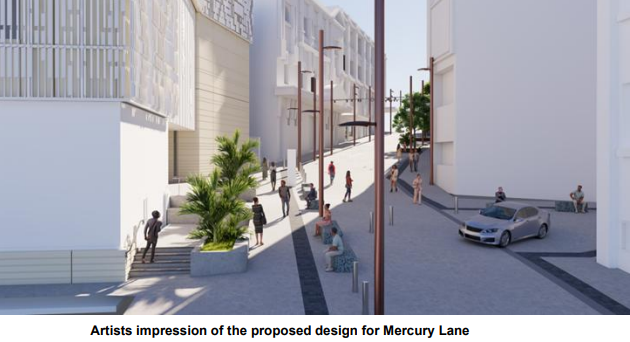 Our understanding is Chair Genevieve Sage and the three City Vision members on the board supported the design, with the C&R aligned candidates opposing the change with their strongest opposition being to bollards on Mercury Lane. The design was also opposed by Waitemata Councilor Mike Lee.
Also, thank you to everyone who emailed the local board members, as well as those who emailed AT to thank them for doing a good job fixing this. It certainly made a difference.
Public Transport Advertising
AT have, over multiple attempts, been looking to consolidate advertising on public transport into a single contract. They’ve now announced the results of that.
Auckland Transport (AT) has entered into a new partnership with MediaWorks that will help keep public transport affordable by unlocking the full potential of advertising assets across the transport network.
AT has awarded MediaWorks a ten-year contract to manage the full portfolio of about 2,000 advertising assets across AT’s network – ranging from bus shelters and bus wrap advertising to display screens at public transport stations.
“We are thrilled to announce our partnership with MediaWorks to manage what is New Zealand’s largest out-of-home asset portfolio, following a very competitive process,” says AT Chief Financial Officer Mark Laing.
“The out-of-home media industry is experiencing exciting growth and MediaWorks’ proposal demonstrated strong delivery capability and alignment with AT’s strategic objectives.”
Revenue boost to offset public transport costs
Mr Laing says the partnership with MediaWorks will deliver a substantial increase in advertising revenues and is an excellent outcome for ratepayers.
“Under the new agreement AT expects to receive a minimum of $220 million revenue over the next ten years. Revenue will be higher than this if the market continues to grow as forecast.”
AT currently receives around a quarter of the gross advertising revenue generated from its Out of Home media assets. Under this new partnership AT will receive more than half.
“Last year AT earned $7 million in advertising revenue. This coming year this will more than double,” says Mr Laing.
“Every additional dollar brought in through advertisements across the public transport network helps to offset the costs of operating our services and gets Auckland closer to meeting the Government’s ‘private share’ targets for public transport.
MediaWorks are already involved with advertising on public transport:
“MediaWorks has delivered numerous high profile client campaigns across our public transport assets over the past few years that have captured headlines and captivated our customers.
“Whether it’s the ‘Barbie bus’ or the fleet of Police recruitment buses and trains patrolling our city, unique advertising on our public transport network has created huge cut through and been a hit with our customers whilst bringing excitement to our public transport network,” Mr Soulsby says.

Could Fullers be sold?
There have been a lot of changes to ferries in Auckland recently, with AT taking over the ownership of the vessels and incorporating Devonport properly into the network, as opposed before where it was controlled by Fullers. Now it appears Fullers might be for sale:
It is being reported that Auckland’s main ferry provider could be sold.
The Australian is reporting the UK owner of Fullers 360 is considering selling the ferry company and that investment bank Cameron Partners would be handling the sale.
The company was bought by private equity firm Souter Investments in 2009 when it was Fullers Group Ltd.
Fullers 360 was formed in 2017 when Fullers Group Ltd merged with another ferry company, 360 Discovery Ltd.
In a statement to Stuff, the company was quick to dampen speculation around a possible sale, with a Fullers 360 spokesperson saying they “do not” comment on “market speculation” about the plans of their owner.
…..
The NBR has also reported that the company has faced a series of steep losses in recent years, including a $1.2m net loss for the year to March 2024 and a $4.3m loss for the prior year.
There has also been a concerted push, including by Auckland Central MP Chlöe Swarbrick, to remove the company’s exemption from the Public Transport Operating Model.
A Sunday run for Te Huia
The Te Huia train between Auckland and Hamilton is to finally add a Sunday service.
Te Huia’s long-anticipated Sunday rail service between Waikato and Auckland has received final approval and is officially set to begin later this month.
The first Sunday train will depart Hamilton’s Frankton station at 2.45pm on Sunday, July 27, arriving at Auckland’s central Strand station at 5.17pm.
The return journey will leave Auckland at 6.15pm, with passengers back in Hamilton by 8.37pm.
With the launch now confirmed, the Sunday service means Te Huia will offer seven-day-a-week rail travel between Hamilton and Auckland.
The addition of a Sunday service marks a milestone for the inter-regional rail connection, which is entering the final year of its trial.
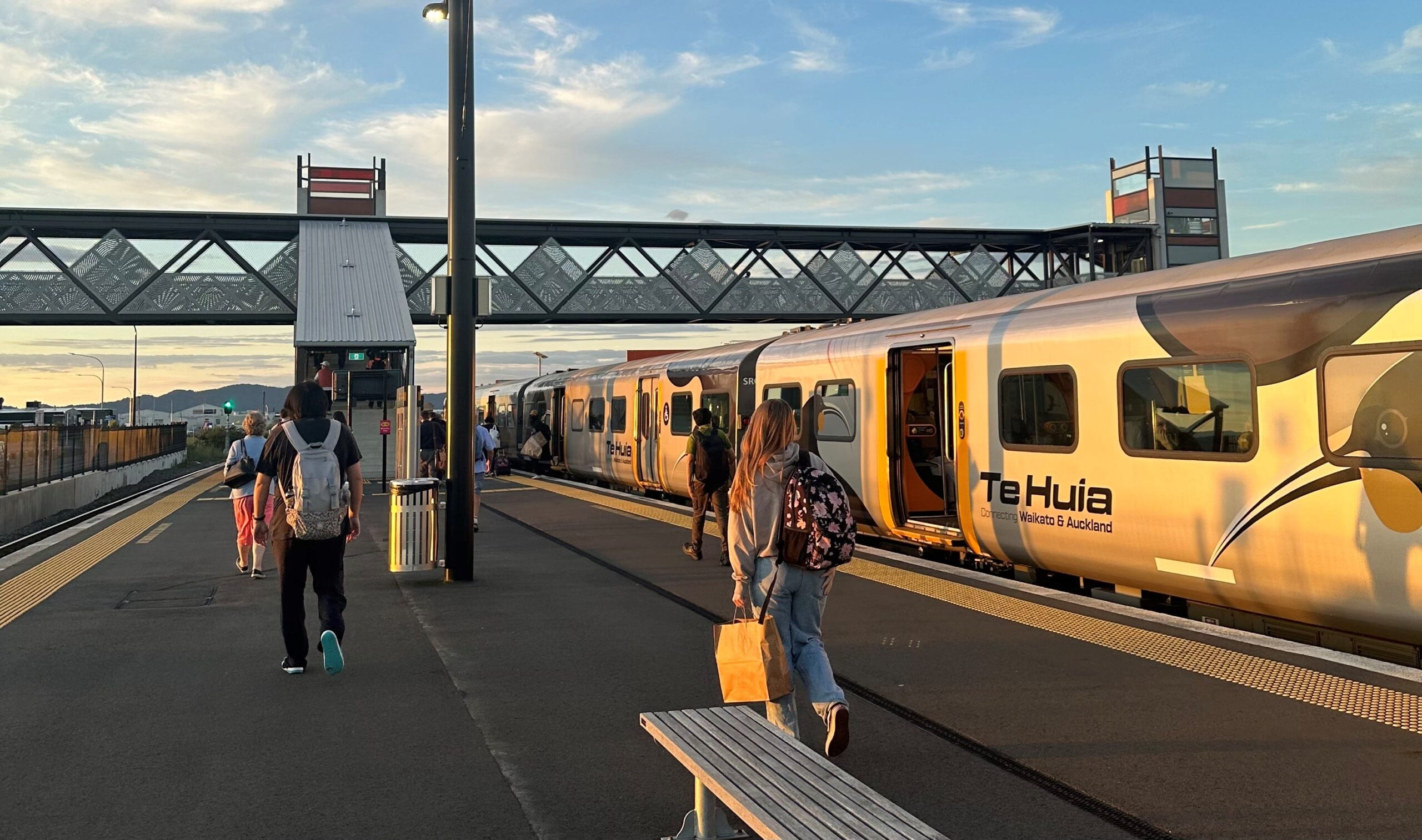
Te Huia at Rotokauri Station. Image credit Darren Davis
Great Gift Idea
This map uses AT’s real-time feed to create a map of the network to show where trains are.

Strong Towns in NZ
Charles Marohn from Strong Towns was in New Zealand recently to speak at the recent Looking Ahead Infrastructure Symposium which launched the Infrastructure Commission’s draft National Infrastructure Plan. He’s written about some observations he had and the conversation he didn’t expect to have here.
I came prepared to be curious. I expected to find a radically different place, shaped by its own geography, politics, and history. And in many ways, the parts of New Zealand I experienced were that. But the more I listened, the more I spoke with people, the more I realized: The problems they’re facing—the ones keeping local leaders awake at night—are strikingly, painfully familiar.
When I got up to speak, I opened with a disclaimer: “I’m going to talk about the United States because that’s the context I know. Please feel free to tell me afterward how different it is here.” And then I started talking about our struggles: cities that can’t maintain their roads, water systems failing in places big and small, development that doesn’t pay for itself yet is locked into place by outdated regulations that make adaptation nearly impossible, and the quiet bankruptcy creeping up on communities that built too much, too fast, without doing the math.
When I finished, people lined up to talk. Not to argue. But to say, “That’s us, too.”
More Trees Please
An article from earlier in the month highlighted a recent report on tree coverage in New Zealand towns and cities. The article is focused on Canterbury (and another article more specifically looks at Rolleston) but contains some useful information for other cities too.
Picton’s canopy is estimated to cover 58.9% of the town’s area, according to a new report by Professor Justin Morgenroth and Dr Ning Ye of the University of Canterbury’s School of Forestry.
Christchurch’s canopy was 13.6%, putting it the 57th largest by percentage in the country.
The lowest canopy percentage was found in Hāwera in Taranaki, at 7.5%.
Rolleston’s canopy cover was 7.9% (ranked 77th out of 78 cities and towns), Kaiapoi’s was 11.8% (66th), Rangiora 9.5% (74th) and Ashburton was 11.5% (69th).
…..
Research has shown that for every $1 invested in urban trees, they return $3.39 of benefits.
“Simply put, cities that invest in tree canopy cover provide residents and businesses with more benefits,” it said
The new report assessed 75 urban centres with some funding from Te Uru Rākau New Zealand Forest Service.
Christchurch, Wellington and Auckland were also included in the report, based on previously analysed data.
Wellington’s canopy covers 30.6%, the greatest of the three major centres, and ranking it 10th. Auckland has 18%, putting it 30th.
Planting more trees will have greater benefits than the government’s massive motorway building plan. Let’s get planting.
And how about an urban-focused version of this initiative?
Auckland Council says there was a large amount of interest for its first-ever sustainability-linked bond, which raised $250 million from institutional investors recently.
…..
In this case, the funding is linked to one million native trees across Auckland’s regional parks by the end of 2027, paid for with funding already put aside in the council’s 2021 long-term plan for 200 hectares of new ngahere (native bush or forest) on park land.
https://bsky.app/profile/jonburkeuk.bsky.social/post/3lttds43lkc25
A Chilling Effect
David Seymour’s Regulatory Standards Bill is in the news a lot recently with almost universal opposition to it from experts. An opinion piece about it this week from Jonathan Boston, emeritus professor of public policy at Victoria University of Wellington, included a transport angle.
Next, suppose you are a lawyer in the Ministry of Transport. Your minister has asked you whether there are any provisions in the Land Transport (Road User) Rule 2004 that are inconsistent with the principles in the Regulatory Standards Act. In response, you note that a key provision in this rule is for drivers to keep to the left: “A driver, when driving, must at all times drive as near as practicable to the left side of the roadway unless this rule otherwise provides.”
Unfortunately, this rule is probably inconsistent with the Regulatory Standards Act. For instance, it contains no principle to protect public safety or pursue the common good. Moreover, the act’s liberties principle severely constrains the justifiable grounds for state intervention. Hence, if the act’s provisions had legal force and were applied rigorously, road users would likely be free to drive on whichever side of the road they choose and at whatever speed. You advise the Minister of Transport that this might be unwise.
How about that weather
If you think it’s been an incredibly wet winter, you’re not wrong. After getting close to needing water restrictions again during the first quarter of the year, 2025 is now the fourth wettest year of the last decade.
2025 YTD compared to prev 10 Yr Annual totals.
— Allan Moyle (@allanmoyle.bsky.social) 2025-07-16T22:33:39.911Z
And so many records being broken, too:
https://bsky.app/profile/paullecomtephoto.nz/post/3lu4pogycbc2w
Low Traffic Neighbourhoods Save Lives
A study published this week has revealed that London’s LTNs have cut road injuries and deaths by more than a third within their boundaries in the last twelve years, without increasing casualties on nearby roads.
Academics compared road collision statistics between areas with LTNs and those without over time, and found that 600 road injuries, including 100 involving death or serious injury, could have been prevented if LTNs had been in place. That’s the equivalent of an entire year’s worth of road casualties in London.
The numbers speak for themselves: supporting LTNs isn’t anti-motorist, it’s pro-life.
The efficacy of the measure can no longer be credibly questioned, so it’s time we started implementing them across London and at pace. With so many lives at stake we cannot afford not to.
Real Estate: Fantastic Displacement Opportunity
Have a great weekend.

 Processing...
‘was also opposed by Waitemata Councilor Mike Lee’ elected for 3 years to literally just repeat the phrase ‘opposed’ whenever asked anything. Surely AI can do that, call it ‘NIMBOT’
Auckland Live Train Map – that is a neat thing and would be cool for a train fan to hang on the wall. But admittedly what would prevent me from buying it would be that inevitably, software or policy changes will prevent such Iot (Internet of Things) stuff from working, and then you have a brick(ed thing). Maybe if the inventor added a “offline mode” which just runs through the 2025 timetable over a day. Then it would, from that point onward, at least still be a nice display piece…
I actually see the producer is promising 10 years of support, which shows they did think of it, so that’s neat.
The cost of supporting this can’t be very high so you should be fairly safe. Not like Futurehome in Norway who are ransoming their service. People bought the equipment and now they are being told to pay a new subscription or they will be sent an update that bricks all the smart features.
Wow, I didn’t expect to see some of my own work on Greater Auckland 🙂
Yeah the cost of running the servers is 4USD per month and I have already set aside 480USD to keep the server running for aleast 10 years. And even after selling 30 train maps the server is averaging about 1% CPU usage with peaks up to 3% so I think that it will be able to support quite a few more.
I even went into AT’s office and had a chat with the techy people on Tuesday and the GTFS API that I am using for data isn’t going anywhere and they might start using it internaly for testing so I’m not worried about them pulling the API anytime soon.
Also if you are techy the backend server is open source so you can host it localy on Docker if want: https://github.com/CDFER/GTFS-Realtime-Cache-Server
Was looking t the Price $130.00
We were in Vancouver recently and used their public transport, and it’s journey planner extensively.
You enter the bus route number, and the desired direction of travel, and it displays the position of all the buses enroute. Magic.
I was interested that the No 5 and 6 trolley bus routes were operated as single loop, but with differnt numbers for the northern and southern sectors. At the Eastern and Western extremities the buses just changed route numbers. And there was no longer any provision for turning the buses around. Seemed to maintain spacing, even with the inability of trolley buses to leapfrog.
Here in NZ we used to have points on the trolleybus lines with passing loops at the main bus stops. So leapfrogging was possible.
It is neat!
At some stage my son should market his real-time board for all the nearby bus stops. We have one on our wall and it’s really useful for all is is, plus visitors.
Mind you, it’s a constant reminder that the 65 is now unworkable with the recent changes AT made to the service.
How to ruin a marvellous service overnight, for no good reason! Such a pity.
I’ll look into adding an offline mode, shouldn’t be too hard…
I don’t have a dog in the Regulatory Standards fight. But I keep reading stuff that has to be nonsense. In what way is a rule requiring people to drive on the left inconsistent? Seriously that type of argument just weakens any case against. The act can be repealed by a future government if they don’t like it, they can even do it under urgency and retrospectively remove any need for the repeal act to be assessed in terms of the RSA. So if the current government want to lock itself in to further rules then why not let them?
MORE trees please is on the money. Picking “the RIGHT trees please” is getting harder. Two things I would like developers, property owners and councils to considering when rushing in to plant more urban trees is the growth of roof top solar and planting for a warmer future.
Roof top solar works best with minimal shading so planting a 1.5m tree today that could be 10m in 30 to 50 yrs time means we either have to accept the ongoing costs of tree trimming & shaping or reduced solar generation, probably both.
The world is warming up and in 50yrs the natural southern limit for Kauri could be Wellington or even Christchurch. We should think about the climate 50yrs hence when selecting trees to plant today.
That shading to your roof will cut down your ‘cooling needs’ – in winter.
Probably better that you have the benefits of the tree and capture solar elsewhere, such as the school roof. The right type of installation might help to keep the rain out of the classrooms as well.
But people do need to think about the right tree close to houses. Fast-growing exotics like norfolk pine or eucalyptus may seem attractive for quick maturity, but eventually get cut down for threatening and overshadowing homes. Rimu, totara, pohutukawa, karaka, nikau and puriri planted by the original owner of my home are still our pleasant environment, not a threat.
Well done Waikato Regional council. The Capital Connection, by comparison, has been running for 34 years and is still only 1 trip each way, Monday to Friday.
In fairness it’s about to improve dramatically.
And the populations at each end are much lower
Why isnt the outbound train from Hamilton going in the morning?
KLK that is the time of day they do a lot work on the main line .
I don’t know, KLK, but it’s a good option for Aucklanders going to Hamilton for the weekend or for a Saturday night event. Currently the option of coming back on Monday morning works for some but a Sunday offering is nice.
And for the Hamiltonian’s who have invested in this, they get to have a Sunday evening return service that makes a weekend in Auckland work well.
Agree, Zippo. Well done, Wellington Regional Council.
Sorry, I don’t know how this became “Wellington” instead of “Waikato”. Brain had already moved into something else and fingers weren’t keeping up, or a swipo, not sure.
Yes, was Itching to make a comment about the weekend time / Sat overnight in Hamilton or Auckland but I see Heidi covered it. Of course for Monday to Friday workers this is exceptionally better.
An item from 7sharp last night on the CRL and also showing their train simulator
https://www.youtube.com/watch?v=aSX5zltuxpY
Re Project K:
“… the C&R aligned candidates opposing the change with their strongest opposition being to bollards on Mercury Lane. The design was also opposed by Waitemata Councilor Mike Lee”
Seriously, wtf is wrong with these people?
it’s sad to see the old generation of public transport advocates who achieved good things 10-20 years ago turning into dullards still wedded to car dependency and a dated view of mass transit
Not only the old generation sadly. One of the local board C&R members is Allan Matson, who bikes everywhere yet votes against every damn thing. He and Sarah Trotman are a tag team who seem to hate the city. Jeez I hope they get voted out.
Yee, it’s all about saving rates and that’s all.
Do we think AT’s Mark Laing has ensured that Mediaworks will only advertise content on our public transport system that is consistent with meeting our climate targets?
No aviation. No cars… I’m sure it’s top of his mind.
This is what ‘mainstreaming the climate targets’ involves… And mainstreaming the climate targets using all tools available is part of the C40 leadership standards.
Where’s the accountability pathway?
Yes I remember when our local bus stop had an advert for car sales which essentially denounced PT as rubbish. I mentioned it to AT’s comms and marketing team but they didn’t see an issue.
Hmmm yes perhaps they ban that now we hope. My biggest concern is if they increase the advertising so that every bus you get on you can’t see out the window or train or bus stop. But it’s good to see some figures out on that. I never had any idea how much all the AT advertising was bringing in, $7/14 million no small fee.
And there is more talk on Passenger Rail to Huapi/Kumeu ;-
ttps://www.rnz.co.nz/news/national/567136/over-1000-sign-petition-calling-for-passenger-trains-to-auckland-s-huapai-suburb?fbclid=IwY2xjawLmqQpleHRuA2FlbQIxMQABHnenT7RXwSPjIvHdhneSBc7kusSnRe6YVmEL5Ycl4HQEylVYwWRJTbp3dPQr_aem_z5amAiaJTEsa5f6r36ERDA
here is again ;-
https://www.rnz.co.nz/news/national/567136/over-1000-sign-petition-calling-for-passenger-trains-to-auckland-s-huapai-suburb?fbclid=IwY2xjawLmqQpleHRuA2FlbQIxMQABHnenT7RXwSPjIvHdhneSBc7kusSnRe6YVmEL5Ycl4HQEylVYwWRJTbp3dPQr_aem_z5amAiaJTEsa5f6r36ERDA
You can exclude everything from the ? On with links and it works, test it out. Lol my phone on Siri had to read that all out twice.
It’s an excellent week and perfect week to be mentioning. The State of the City Auckland Report, exactly highlighting the real need of Auckland’er’s! Firstly if Auckland is to keep up with modern times, its needs to invest and actually get on with construction! Public transport projects for sure will be key to winning the next election next year for sure! Most residents of Auckland would like bottlenecked main corridors to be fixed, with closer residential living in closer city suburbs with fast rapid transits in suburbs closer to city! Enabling high density apartments on Eastern line & Southern Line station catchments will be needed! But in 10 years time, where do we go from there?! This government isn’t thinking the ‘long-term’ strategy for growing more housing in Auckland! Only a’short-term’ strategy and band-aiding them! There’s definitely going to be the need for other rapid transit routes heading into the CBD and have stations with high density apartments in catchments in 15 years time cause West-Eastern & Southern line stations catchments over capacity! No other area for high density apartments to be built! Whichever government who is the most satisfying will definitely will win big in Auckland for sure!
There’s definitely the need for government to intervene and invest in project around Auckland which is dire.need to be built otherwise Auckland won’t build ‘key infrastructure’ that’ll lift productivity rates and solve ‘bottleneck issues’. If this current government ‘National’ thinks they’re going to win the next election by doing just ‘road projects’ after ‘road projects’ like second harbour crossing without rail underneath road tunnel as example. That definitely won’t win you the next election for sure! Guarantee it! Second harbour crossing will unlock housing growth from further distances in Dairy Flat, Hibiscus Coast and Warkworth area but won’t translate into freeing up more buses for North Shore suburbs(Takapuna, Milford, Birkenhead) to City (Britomart, Midtown & Newmarket) during peak in mornings vice versa travelling back into North Shore in early evenings!
It defiantly won’t enable more high density apartments to be built cause people living in high density apartments rely on public transport to commute to work since most don’t have garage or enough car parking space for all living in high density apartments! Even if you extended the current Northern Busway to Fanshawe St, in 10 years time it’ll be over 100% congested and not have capability to handle more buses. Also the city wouldn’t have space to accommodate more carparks in Auckland CBD if second harbour crossing went ahead! Commuters will be forced onto over capacity buses on Northern Busway and other routes that commute to CBD. North Shore definitely in need of a Heavy Rail line underneath the Waitemata to North Shore and starting from Britomart via Takapuna and end at Albany, with construction in seperate phases.
Another main corridor in dire need is Dominion RD! What are we doing about that?! And you say no to Heavy Rail due to it being “not nice”? You what’s not nice?! Having to be grid locked in traffic everyday of the week and when trips are taking you longer when a non-existent rapid transit would take you same speed as a car would in non-congested traffic. To include current bus corridor over capacity everyday commuters bus stops being skipped due to being over-capacity. Later after commuting from work to home being left with little but no time for ‘quality of life’! How nice is that you say?!
Dominion RD is definitely in-need of rapid transit(Heavy Rail) underneath! It’s nice & close to CBD! It’s a perfect corridor to construct high density apartments! The land nice and flat. Lack of valuable geological views, which makes it good area to construct high density apartments. If a rapid transit(Heavy Rail) existed, the main purpose of riding would be for work, events such as rugby and shopping at small businesses not big ones.
People in this country are leaving in droves due to lack of ‘quality of life’, commutes in Auckland compromises commuters daily lives and that’s why people are leaving for better ‘quality of life’! Which ever party improves ‘quality of life’ by investing in more rapid transits for sure will win the next election!
Heavy rail that runs at absurdly low frequencies with long wait times, takes capacity away from the rest of the network, has stations so far apart it can’t effectively replace the Dominion Rd bus route and so deep it takes 2-3 minutes to get from platform to the surface, and costs an absurd amount of money IS “not good.”
Light rail/modern trams every 4-5 minutes would move more people, have more stations, replace buses effectively and improve bus reliability on New North Rd, Sandringham Rd, and Mt Eden Rd, and be far cheaper ($1-2 billion). On top of that, they would not be that much slower than your heavy rail, running in a dedicated median with grassy green tracks, 18-20 minutes from downtown to Mt Roskill.
“takes capacity away from the rest of the network, has stations so far apart it can’t effectively replace the Dominion Rd bus route and so deep it takes 2-3 minutes to get from platform to the surface, and costs an absurd amount of money IS “not good.”
What bogus piece of misinformation is this?! Capacity of the network would be bigger since it Dominion would be replaced by 3 carriage train holding 373 (230 seated, 143 standing) while a bus holding less than 100 people, in a whole hour! Train defeats bus by capacity and bus duration by time sitting and commuting! Station depth underneath Dominion wouldn’t be issue for any commuter! Overall cost of the Dominion Heavy Rail corridor would near CRL cost of $5.5 Billion since Dominion RD is 4.5 KM long while CRL is 3.5 KM long. Whole Frequency thing you’re saying is highly overrated, Can’t wait for even for 10 mins at a station? Do you have ADHD symptoms or high blood pressure for highly grown person? Or you still kindy child?! Most seem’s like it! Can’t wait patiently at a station for a Heavy Rail to arrive at station like a normal person?!
You utter ninconpoop. Frequency is so important. Turn up and go is what gives public transport convenience to attract people out of cars. People don’t want to wait half an hour if they miss their train, or if it’s cancelled or delayed. The whole “appeal” of the car is the claimed freedom to go anywhere at any time of your choosing; therefore public transport must ALSO offer service where you can walk no more than 5 minutes from home and be guaranteed a wait no more than 10 minutes for the next bus, train, light metro, or tram. The best urban rail networks in the world run services just minutes apart; they reduce interlining and rely on transfers between these high frequency services.
A 400 passenger tram every 5 minutes will carry far more people than a 750 passenger train every 20 minutes . I’ve already shown you the math in other comment sections which you conveniently never choose to acknowledge.
And I suppose you believe people just magically teleport from the platform 40 metres underground to street level, then?
Leave this Winston Peter-aah heavy rail delusion in the past where it belongs.
How many underground stations will we have on Dom Rd, vs the two we have on the CRL? Dom Rd needs a surface level LR solution to provide regular frequncies, numerous stops, at a (relatively) affordable price. HR and the cost of underground stations will be eye watering and a reason no one has made a same proposal for it.
HR may still have its place in Auckland, but it won’t be on Dom Rd, Sandringham Rd, etc. Anon, I’d suggest you put your efforts into routes it actually makes sense; Mt Roskill Spur, Avondale-Southdown and (at a pinch) Onehung to the Airport. Thats probably it. Not sure I can ever see it going over the harbour, but Ligh Metro might have a chance.
KLK – careful, they’ll probably think Mt Roskill spur *is* their heavy rail tunnel idea and not the western half of the Avondale-Southdown line.
KLK, Heavy Rail will exist under Dominion & Sandringham RD! Dominion RD already at full bus capacity and road use capacity, yet the government isn’t doing anything to solve congestion issue! Only realistic way is to construct a Heavy Rail underneath Dominion. Nationals plan to implement an ‘Road user charge’ is an ineffective strategy to completely solving Dominion RD’s congestion issues! It’ll just divert traffic onto Mt Eden RD, Sandringham RD and New North RD since their ‘Road User Free’. By extending Parau ST to Mt Eden station would obviously require years of land acquisition. A really slow solution and isn’t a solution since bus users and road users rely on getting to CBD on that road from multiple suburbs across Auckland since road user choose roads based on choice and traffic flow. Road corridor that is free flowing without congestion, private vehicles pick! In this case, it ‘s not possible to add more vehicles, capacity for vehicle-use already reached capacity, with it bus capacity full, meaning one thing, in-need of investment in rapid transit system(Heavy Rail) underneath so private vehicles from outer suburbs not located in Dominion RD catchment can use the Dominion RD during peak & weekends. Its time for government to be investing in Heavy Rail underneath! If a land acquisition was intended to be done in one year, chances unlikely since residents pushback and is a long shot in the making! Only realistic option is to build Heavy Rail underneath Dominion RD with 4 stations.
you are making no reasonable argument against light rail.
a tram every 4-5 minutes with stations 800m to 1km apart will do far better replacing buses that run every 2-3 minutes with stops 400m or less apart than a deep underground heavy rail that runs every 20 minutes with stations over 1.5km apart for literally zero travel time advantage over light rail with a kerb protected ROW and traffic light preemption.
“you are making no reasonable argument against light rail.”
Your slow light tram 50km/h is an ineffective mode of PT in Auckland and a Heavy Rail would beat the speed of it triple the times of it arriving at terminating station! With it being street surfaced, doesn’t make suburbs look ‘nice’! The Dominion RD stations would be 800 m to 1 km spaced apart from each other. It same story for examples Remuera – Greenlane, Baldwin Ave – Mt Albert stations. Auckland current 373 capacity (230 seated, 143 standing), 3 carriage Heavy Rail would beat light tram by capacity instantly, even with attaching another 3 carriages with 6 carriages 746 (460 seated, 286 standing). and has ability to go 9 carriage 1119 capacity (690 seated, 429 standing). Commuters only care about speed of mode, mode capacity and direct travel access. Heavy Rail provides speed of mode, mode capacity and direct travel access.
Triple the speed but the same station spacings? hahahahahahaha, good one.
absolutely detached from reality, you are.
Your slow light tram 50km/h while Auckland’s Heavy Rail is 110 km/h. Slow light tram station would require 8 stations with 400 m to 500 m to include traffic light stops result in longer commute time intersecting Denbigh AVE, Mount Albert RD, Balmoral and Valley RD on Dominion RD. While Heavy Rail would only require 4 stations with 800 m to 1 km stations apart and completely avoids general traffic Not only that orbit the CBD(K Road, Midtown, Britomart & Newmarket) while Light tram can’t and means Heavy Rail travelling triple the speed of light tram! Yes Heavy Rail for Dominion RD it is a “good one”! .
still laughing my ass off. you are either a child or old and senile.
do you not understand how speed works? trains can’t use their maximum speed all of the time, and it takes time to accelerate and decelerate. read this article to understand. https://www.greaterauckland.org.nz/2018/04/30/impact-speed-transit-networks/
also you do not understand that underground stations cost a lot to build. That’s why Newton Station was deleted from the CRL plans; that is why the Auckland Light Rail plan only had 2 stations on the isthmus where buses needed replacing, which is why it wasn’t good at that. Good luck getting stations 800m apart.
Also, stations so close together mean YOU CAN’T USE THE TRAINS 110KM/H SPEED. the trains can only accelerate up to 70-80km/h before they have to start decelerating for the next station. That is empirical fact, sorry, your jon reeves ass delusions can’t change reality.
at best you’re going to get a 40km/h average speed, and a 6-7 minute travel time from Maungawhau to Mt Roskill. Add to that the CRL travel time and it is 15-17 minutes from Waitematā to Mt Roskill; though your bizarre “orbit” around the central city and Parnell would increase that time to 20-25 minutes for Waitematā to Mt Roskill via Parnell and Newmarket. Again, you forget the ~2 minutes it takes to get between the street and the underground platform at either end.
GreaterAuckland calculated the travel time of a tram from Britomart to Mt Roskill as 20 minutes in this article here: https://www.greaterauckland.org.nz/2018/05/08/calculating-travel-times/. It is possible with traffic light priority, a kerb-protected grass-tracked right of way so that cars can’t get in the light rail lanes.
Give it up, mate. Reality is not on your heavy rail side, no matter how childish simplicity or elderly senility you use to deny it. The only possible heavy rail option to serve Mt Roskill uses the surface alignment via Avondale; and that would also take 20 minutes from Waitematā to Mt Roskill.
Which will you choose? A tram that runs up to every 4-5 minutes at peak and can carry 5,400-6,750 people per hour each way (2x as many as the buses can right now), and takes 20 minutes from Mt Roskill to downtown? Or a train that only runs up to every 20 minutes, can only carry 2,250 to 3,375 people per hour each way (the same as buses can right now) and is barely any quicker (which is immediately cancelled out by the longer time to get from platform to destination)
“Which will you choose? A train that only runs up to every 20 minutes, can only carry 2,250 to 3,375 people per hour each way (the same as buses can right now) and is barely any quicker (which is immediately cancelled out by the longer time to get from platform to destination)”
Still pick Heavy Rail! During peak hrs all of our main Heavy Rail corridors Southern, Eastern and Western line run every 10 mins during peak hrs 5-9 am Evening 3-7 pm. It be the same for Dominion RD underground if existed right now! One Auckland Heavy Rail with 3 carriages is 373 (230 seated, 143 standing) with extra train connected as 6 carriages makes 746 (460 seated, 286 standing) running during peak every 10 mins in a whole hr makes 4476 (2760 seated, 1716). If we were still using 2022’s Heavy Rails timetable Heavy Rail during peak was every 5 mins meaning 12 TPH 8952 capacity (5520 seated, 3432). and normal hrs 6 TPH every 10 mins capacity 4476 (2760 seated, 1716).
Meaning Heavy Rail capacity would be more favoured over slow old light tram “A tram that runs up to every 4-5 minutes at peak and can carry 5,400-6,750 people per hour each way”! Since every Heavy Rail service was 5 mins was done back in 2022 for Heavy Rail during peak hrs and 10 mins for normal hrs, it definitely can work for Auckland and be done again!
https://at.govt.nz/media/1988731/southern-train-timetable_at-metro.pdf
Your slow light tram 50km/h is an ineffective mode of PT in Auckland and a Heavy Rail would beat the speed of it triple the times of it arriving at terminating station! With slow light tram being street surfaced, doesn’t make suburban areas look ‘nice’ or business friendly! The Dominion RD Heavy Rail stations would be 800 m to 1 km spaced apart from each other.
Heavy Rail in Auckland doesn’t experience any cancellations anymore, were not in Covid times where its was frequent! Generally all people care about is direct service, don’t care about TPH and capacity as long it got adequate capacity for everyone to ride and isn’t long commute from home to work without transferring onto multiple PT services!
Anon, where would the heavy rail trains go once they get to Mt Eden? The answer isn’t the CRL, all slots will be taken by trains on existing lines when it opens next year.
i literally disproved your “THRee TiMeS aS FaST” argument. what even is your reading comprehension.
Jezza, you reduce the Southern line 12TPH to 6 TPH and give Dominion RD TPH to do orbit satrting from Mt Eden going around Auckland CBD and join up with Southern line via Parnell.
So you are not improving network capacity but just shifting it for a few (probably like 10 or so) billion dollars? How does that make sense?
Cities all over the world have trams integrated in their street scapes. They are much quieter than the constant drone of traffic.
That sounds like a massive amount of money to spend for minimal total capacity increase, just an increase in service catchment.
Dominion RD underground if existed right now! Current Auckland Heavy Rail capacity with 3 carriages is 373 (230 seated, 143 standing) with extra train connected as 6 carriages makes 746 (460 seated, 286 standing) running during peak every 10 mins in a whole hr makes 4476 (2760 seated, 1716). If we were still using 2022’s Heavy Rails timetable Heavy Rail during peak was every 5 mins meaning 12 TPH 8952 capacity (5520 seated, 3432). and normal hrs 6 TPH every 10 mins capacity 4476 (2760 seated, 1716). You say that’s minimal increase?!
So you are not improving network capacity but just shifting it for a few (probably like 10 or so) billion dollars? How does that make sense?
No, less than $10 Billion, since Dominion Rd is 4.5 KM long and CRL $5.5 Billion for 3.45 KM long tunnel meaning similar cost. And yes are improving the network by making Southern line not do a 360 back onto Southern line to create 5 mins meaning 12 TPH from Remuera – Otahuhu while anything below Otahuhu gets less than 6 which doesn’t make any practical sense and have population catchment for that much frequency. But in-future should go back to 5 mins due to population increase in stations suburbs. Complete waste of frequent use when you can join it up with another Heavy Rail corridor!
You realise that the 5.5 billion dollar are based on old contracts and that we have had inflation in the meantime? This line would need 4 instead of 2 new underground stations (and the Maungawhau rebuild) plus 30% longer track.
I would be very surprised if this was less than 10 billion dollars in the end.
And all that so we re-allocate current capacity of the heavy rail network to include different catchments while not improving the total capacity of the inner stations and only offering limited walking access to the new stations as they are somewhat far apart and less accessible due to being underground?
“while not improving the total capacity of the inner stations and only offering limited“
There’s no need for Southern line between Remuera-Otahuhu to be operating northbound and southbound 12 TPH for 6 carriages during peak when CRL comes online, Not sustainable since there’s not huge enough catchment, not enough high density complexes along Southern line yet to maintain financing. Until that times and will happen eventually will need to increase TPH back to 12! It’s better off with joining up with Dominion RD since buses up to capacity and in-need of Heavy Rail by leaving Remuera-Otahuhu back to 6 TPH.
Anon, 2022’s train timetables did not have 5 minute frequencies on the Southern Line. I don’t know where you’re getting this complete nonsense from. It was always 10 minute frequencies at peak; the timetables you provide as “evidence” disprove your own claims.
All CRL operating plans have called for 4-5 minute frequencies (11-16TPH) between Newmarket and Penrose; whether that’s with the Southern Line looping back in on itself, or the old proposals of Western Line trains running through to Onehunga + crosstown line trains from Henderson to Otahuhu. The CRL has an initial capacity limit of 18TPH and it doesn’t look like they’re planning to increase that to 24TPH anymore until after the 2050s.
And again, your 4 stations would, aside from pushing the costs of your heavy rail tunnel line to ridiculous high prices above $10 billion, also completely wipe out any speed advantage. Stations 800m apart means that the heavy rail trains we have can only accelerate up to 70-80km/h before they need to decelerate for the next stop. Zero chance that 110km/h is possible. You would have a line a couple of minutes quicker than optimised surface light rail, and because it takes 1-2 minutes to get from platform level up to street level the total travel time for commuters would be the same if not longer than light rail.
What Auckland needs to see is ‘New Density Rules’ for high density apartment complexes to be built nearby the heavy rail corridors to be implemented on Eastern & Southern line suburbs. For Eastern line, Glen Innes, Panmure & Sylvia Park. For Southern line, Newmarket, Greenlane, Ellerslie & Otahuhu! With it have a bold 15 year long-term plan on building more rapid transits to accommodate more high density apartment complexes rules implemented so we don’t have more issues plaguing in-future!
Takapuna not going to see more high density residential complexes and become a Metropolitan anytime soon since its not convenient to commute or quick 15 mins commute via public transport from CBD and currently one bus only goes directly to Takapuna from Midtown, not from Britomart, Newmarket & K Road. Which makes residential investing in Takapuna undesirable due to lack of flexibility and direct options of PT routes for potential residential buyers to live/stay. Takapuna really in-need of a Rapid Transit (tunnelled Heavy Rail) from Britomart and temporarily terminating at Smales Farm! Takapuna won’t see growth of ‘high density apartment complexes’ due to constraint on roads heading Auckland CBD Same can be said for Milford and Birkenhead. Even if the second harbour crossing doesn’t include Heavy rail underneath roading tunnel, Takapuna would see no growth in high density apartment complexes since no increased capacity on public transport mode. Auckland CBD by bus is already constraint intaking more buses, only way to alleviate bus pressure to build more Heavy Rail lines heading to Auckland CBD!
Second harbour crossing without any Heavy Rail underneath would only grow housing further distances like Dairy Flat, Hibiscus Coast not closer distances like places like Takapuna which is a problem for Northern Busway! Whist leave places like Takapuna won’t see growth in high density apartment complexes since public transport modes are at over capacity and can’t handle more capacity. Would overflow NX1 & NX2 on Northern Busway, with buses skipping commuters from Sunnynook, Smales Farm, Akoranga, during peak if no Heavy Rail underneath Second harbour crossing! Second harbour crossing needs to include a Heavy Rail line underneath, to unlock constraint on high density apartment complexes, getting rid of bottleneck public transport capacity. Most apartments complexes don’t have enough car parking space for every unit or with don’t have car parking garage. With it CBD can’t handle more private vehicles for car parking during weekdays since no room for more carparks! An extended Northern Busway into Fanshawe isn’t going to cut it! It’ll be a waste of taxpayers money and band-aid fix! Extended Northern Busway would be overcapacity in less than 5 years time once second harbour crossing is built or less. If a North Shore Heavy Rail line existed, running into Akoranga & Smales Farm, it needs to run through Wynyard, Midtown, Auckland Hospital and into Newmarket joining up with the Southern line! Northern Busway will be demolished to make way for Heavy Rail. Wouldn’t make any sense to Extended the current Northern Busway to Fanshawe St. The current Northern Busway will be replaced by Heavy Rail in-future to create more capacity while Constellation-Smales Farm of Northern Busway would need to be kept for sure!
What voters in 2026 election will be looking out for is more housing growth/affordable residential’s and faster rapid transit commutes in & out of Auckland CBD will definitely will win the 2026 election for sure!
I’m lucky to live in an area blessed with hundreds of elegant Queen of Persia Trees (at least I think that this is one of their names).
When they flower for a few months in Spring they produce a lovely vanilla scent that makes evening walks a real treat.
While not Native, they really improve my enjoyment of the area.
Anon, I think your idea of the world regarding Takapuna is just wrong. We have just come back from visiting about 25 European cities. We travelled around those cities by using the networks – train, metro, tram and bus.
Takapuna is well served by buses that go down both sides of the suburb, Anzac and Esmonde. At peak the frequency is about every 8 minutes, so there is plenty of room for growth on the busway. There is even more opportunity if the 82 runs only to Akoranga. Passengers walk about 10m through the covered bus stop to travel either south or north. It’s no big deal. At least it seems unless you are an Aucklander.
Don’t wreck things by having a rail spur to Takapuna that will have much less frequency and far fewer stops. On both counts it will be a great step backwards.
For me, someone who isn’t particularly tech savvy, I can manage well taking a bus from Lake Road to Akoranga, and that opens up downtown and midcity.
Auckland will never make meaningful progress if we spend billions on one mega project rather than a few adequate projects. Surface trams would be a great start.
Better bus priority and amenity for Takapuna, yes.
Rail, no need.
Agree PT to Takapuna is already pretty good with the frequent 82, but patronage is very low. What Taka needs is more higher density residential growth, a Transit/bus lane EB on Esmonde Road and protected cycle lanes throughout. These are not expensive infrastructure projects…the challenge is in the politics.
“What Taka needs is more higher density residential growth”
Takapuna isn’t going to grow more high density complex apartment’s without rapid transit corridor! That’s the thing Brian! Takapuna already under constraint from building more since no direct fast rapid transit getting into Britomart, K RD and Newmarket. High density apartment residents rely on PT to CBD since car more expensive and more time consuming during peak. 82 doesn’t get you to everywhere in CBD area! Not enough to serve Takapuna!
“We have just come back from visiting about 25 European cities”
Auckland shouldn’t become like European cities! Should become like Asian cities with fast rapid transit like Tokyo, Seoul, Singapore and Hong Kong. Though only thing they lack is controlled unitary plan that restricts ‘high building structures’ I would criticise! But definitely should be turning into these cities and we do have the resources to invest in Heavy Rail projects! Auckland needs to focus on less arrogance. More focus on fast, convenient & accessible rapid transits!
Would have to disagree with you, high density complex apartment’s are currently under constraint in Takapuna due to no rapid transit present. If a rapid transit was already built, we’d be seeing more high density complex apartment’s!
“Lake Road to Akoranga, and that opens up downtown and midcity.”
Not helpful for those travelling during peak and weekends! NX1& NX2 isn’t good choice for those coming from Takapuna or Milford since buses during peak & weekends most of time now’er days don’t stop at Akoranga due to bus full to capacity as commuters watch their NX1& NX2 buses drive past station, as for commuters to hope they get on next arriving bus. As next arriving bus full to capacity too and wait even more longer. Most end up waiting for 30-40 mins. To add, NX1 & NX2 already over capacity in servicing Northern Busway. Only way to reduce capacity to cater more PT users is to build more Rapid Transits! Building a North Shore Heavy Rail line via Takapuna only way! Lake RD to Akoranga not even a solution!
lol, “european cities don’t have fast rapid transit.” Good one, Anon
do you have evidence of buses not stopping at Akoranga or “people waiting 30-40 minutes?’ i would expect this to be newsworthy, or at least complained about on reddit, if it were a regular occurrence.
and don’t be so dogged about heavy rail, there are always other solutions
1. acquire bi-articulated buses (150-180pax) to cover the shortfall in the short term with a 50% capacity increase over the current double deckers. meanwhile, add permanent bus lanes along the routes from Takapuna to both Smales Farm AND Akoranga and increase bus frequency on routes 801, 814 (81), 82, 83, 843, 845, 856, 871, 94, 941. This means a bus every 2.5 minutes between Takapuna and Smales Farm, and a bus every 2.5 minutes between Takapuna and Akoranga; a combined capacity of ~3,600 people per hour per direction between Takapuna and a busway station with the current single-decker buses.
2. light metro can easily match heavy rail for capacity, is cheaper to build since it’s not so heavy, and cheaper to operate without a driver, can climb gradients twice as steep as heavy rail. unless you are building an all new main line all the way to Warkworth and Wellsford there is no reason it “has” to be heavy rail.
also please explain what routing makes sense to stop right in the heart of Takapuna, or do you think a big squiggly curve from Akoranga to Takapuna then back to Smales Farm can somehow be taken by a heavy rail train at 110km/h?
Bi-articulated buses (150-180pax), Nah we don’t need that slow 50km/h moving contraption in Auckland! Huge waste on tax payers money and only a short lived idea! Would require tearing up the Northern Busway for Heavy Rail within 5 years of running anyway Bi-articulated buses would over capacity again! To add North shore isn’t like East, West & South where its attach together and not faced with obstacle of crossing the ocean. North Shore only has one harbour crossing and that’s the harbour bridge! Meaning all people from North Shore rely on over capacity Northern Busway to commute by NX1 & NX2. Also meaning it requires expanded capacity mode in serving North Shore, only mode capable is Heavy Rail since its reaches Newmarket, K RD, Midtown, Britomart directly a orbit without having to transfer to one place to another to wait!
Light metro won’t happen in Auckland! Not capable of reaching Newmarket, K RD, Midtown, Britomart directly in an orbit without having to transfer to one place to another to wait! Also not possible to accomplish due to Heavy Rail already exisiting orbiting CBD network! Heavy Rail would go all the way to Hibiscus Coast, Warkworth and Wellsford.
Britomart in-need of Heavy Rail to North Shore via Takapuna and temporarily terminating at Smales Farm. Later set year extend to Albany. Also another North Shore line would be required from Te Waihorotiu via Akoranga, and terminating at Smales Farm. Heavy Rail line would be done phase by phase just like current Northern Busway.
lmao
biartics can happily run at 80-90/h
light metro can climb 6% gradients, heavy rail can only climb 3% gradients
are you autistic or something? i think it’s only fair i ask since you accuse me of being adhd or a “kindie kid”. this is some above and beyond obsession with heavy rail and detachment from reality and evidence
Many false assumptions here, Anon.
1) A significant portion of the Shore (Birkenhead, Beach Haven, Glenfield, Northcote) does not use the NX1 and NX2 to get into town.
2) Many cities across the world have several modes running in parallel for some parts. For example, there could be a case for surface light rail up Queen Street and Dominion Road, duplicating the CRL at least in parts. That would also involve crossing K-Road, so you are already there.
3) You won’t get to use train top speeds if stations are only 1 km apart. That would be not energy efficient and would lead to nasty acceleration/braking processes, especially when people are standing.
4) You assume people are fine with waiting 20 minutes for trains but they are not ok with waiting 20 minutes for the NX. How come? Personally, I am absolutely fine with waiting 20 minutes for a train if it would take me to a destination 2-5 hours away. I don’t want to (regularly) wait 20 minutes on my way to work just because I decided to have an extra cup of coffee in the morning.
5) If the Dominion Road trains merge onto the other heavy rail tracks towards Newmarket, you would reduce capacity for the other lines using these tracks.
6) Ideally, this would be the first part of a tram network. You could have very easy surface-level transfer to different lines that take you to Newmarket, Onehunga. Building additional heavy rail capacity for these stops (except Onehunga via Avondale -> South) would be a nightmare.
” i think it’s only fair i ask since you accuse me of being adhd or a “kindie kid”. this is some above and beyond obsession with heavy rail and detachment from reality and evidence”
Yes, it’s fair to say you still are! Cause I have to reiterate the fact, Light metro can’t do orbit around Britomart, Newmarket, K Rd & Te Waihorotiu Station like Heavy Rail can do. Light metro not going to exist here in Auckland, be waste of taxpayers hard-earned dollars by ripping up to later convert to Heavy Rail costing in more taxpayers dollars so we have a fully connected rail network that’s versatile, direct service without transferring stations. Answer to Auckland problems, more Heavy Rail corridors so we don’t worry about annoying transfers and waits.
“can’t do orbit” what the hell do you mean by that? Your grammar is not very good. Te Waihorotiu station has been futureproofed for east-west platforms under Wellesley Street; a light metro line would run from Wynyard Quarter to Te Waihorotiu, then to the Universities; then could split to run around Grafton Gully to the Northwestern Motorway or continue under the Hospitals to Newmarket.
LMAO they aren’t going to need to convert light metro to heavy rail! Light metro can carry more people than heavy rail; 700 passengers per 80 metre train running 90 seconds apart (40TPH) equals 28,000 people per hour per direction. Heavy rail with 1125 passengers per 9 car train running 2.5 minutes apart (24TPH) equals 27,000 people per hour per direction; and that’s as good as it can ever possibly get through the CRL. Quite simply there is no need for heavy rail specifically unless demand exists for freight and long distance travel; and you WANT to keep suburban commuter trains on separate tracks from long distance passenger and freight, so you might as well build the international standard gauge, automated mode of transit that has lighter axle loads, 2x better hillclimbing ability, and is driverless from the outset for a similar cost.
Transfers when lines run every 10 minutes or better aren’t “annoying”; they are quick and convenient and you can timetable them, and have more options to go more places. And you are so hypocritical when you say that a 20 minute wait for a heavy rail train on your fantasy tunnelled Dominion Road line “won’t matter”, but somehow waiting 5 minutes for a transfer is the worst thing in the world.