Yesterday I went to the launch of the Committee for Auckland’s third The State of The City launch. It’s great they are doing this work, and the event was very interesting. You can read the report itself here.
There has been a lot of media coverage since, some of which you’ve no doubt seen, ranging from the sensationalist (Stuff) to the bored and dismissive (Auckland Now). Though to be fair to Ryan Bridge, while his cynical ‘nothing means anything’ editorialising mostly suggests he gave it almost no attention, I do agree the tendency in this industry to write indirect and waffly statements is infuriating. There’s a fair bit of tip-toeing around issues that are most sensitive to larger vested interests and/or the government. So those are the issues I’ll highlight here, in this quick and only partial report:
The Mayor of course cannot be accused of being indirect. And he was very good in his comments on these structural problems, and I have to say so were the new CfA CEO Rupert Hodson, a planner previously at BECA, and Kate Sutton from Deloittes.
Here’s a pretty lively example of the Mayor’s speech: “Silly, secret, unaffordable”
It is very heartening to have the key structural problems explicitly highlighted in this context. Especially sprawl and auto-dependency. The twin demons that undermine all other efforts to lift productivity and wellbeing. As I wrote recently about here.
One of the more perceptive writers about the report is Matthew Cockram, CEO of Cooper and Co, ie Britomart. Writing in his newsletter he rightly calls it a ‘call to action‘.
I would suggest that Auckland’s central city is already a good example of the benefits of agglomeration: Auckland’s central city GDP of $33 billion is 21% of Auckland’s total output, as the report notes, a figure that has tripled in the past 25 years. A huge amount of public and private money has already been invested in our central city – in cultural facilities, in office and residential buildings, and in streetscapes – and it makes sense to capitalise on this investment. Parts of the downtown waterfront area are very appealing, but the way in which Auckland has slipped down the rankings in terms of quality of place – the overall desirability and coherence of the city – shows the need for more focus on this important area. As the report says: “Despite prior momentum, Auckland is not as often visible as a leader on the agendas that liveable cities are increasingly appraised on, whether it is cohesion and participation, new technologies, or the pace of decarbonising.”
going on to note:
At the moment there is a lot of hope being placed in large investments that are finally close to being realised: the City Rail Link and the NZ International Convention Centre. And while I think both of these will bring significant benefits, it’s worth remembering (as Duncan Greive does in his piece in The Spinoff) that these investment decisions were made a decade ago and there is no pipeline of projects of similar scale being committed to now. The report notes recent major investments by comparative cities: Copenhagen has approved a nine-station metro line; Fukuoka has moved to give local founders on-site access to global investors in a big new startup hub; Vancouver has committed to a 10-year target of over 80,000 new homes and backed it with city-wide up-zoning and faster approvals. Auckland needs to be similarly ambitious and forward-looking.
Along with resting on urban infrastructure commitments made two governments ago, it is completely infuriating that for decarbonisation and sustainability we still only have the power sector investments made in the 1960s, our inherited hydro resource, for any sort of positive claim. Shameful. Meanwhile places starting from 100% fossil fuel grids, like South Australia, have over taken us.


Given this government’s complete abandonment of agricultural sector sustainability, it could at least try to balance that with a bold push in cities, where the trade-offs are so much easier, or even positive. But apparently not. Local Government and Energy Minister Simon Watts was also a speaker.
He speaks well when sticking to generalities, is genuinely impressive, but on specific actions there is often a disconnect. The need for simplicity, economy, and value for money for local government, but of course not for his government and their bloated highway programme, for example.
He is promising legislation to limit councils to spending only on what he describes as ‘core services’. Pipes and roads solely. This is miserablism, and a misconception of what society actually is (back to Thatcher’s wrongness). Sadly so visible in their disastrous vandalism of Kaianga Ora. All council services are core. Community cohesion and quality of life are as much core functions as water and access systems. Community supports the economy, ‘the economy’ is not a free-standing thing, it is within, and dependent on the environment, and within and enmeshed with society.
Broken or dysfunctional environment or society will make running the economy harder, adding huge costs and barriers to transactions and exchange. Both are super expensive. There is no reality to pretending we only live in an economy.
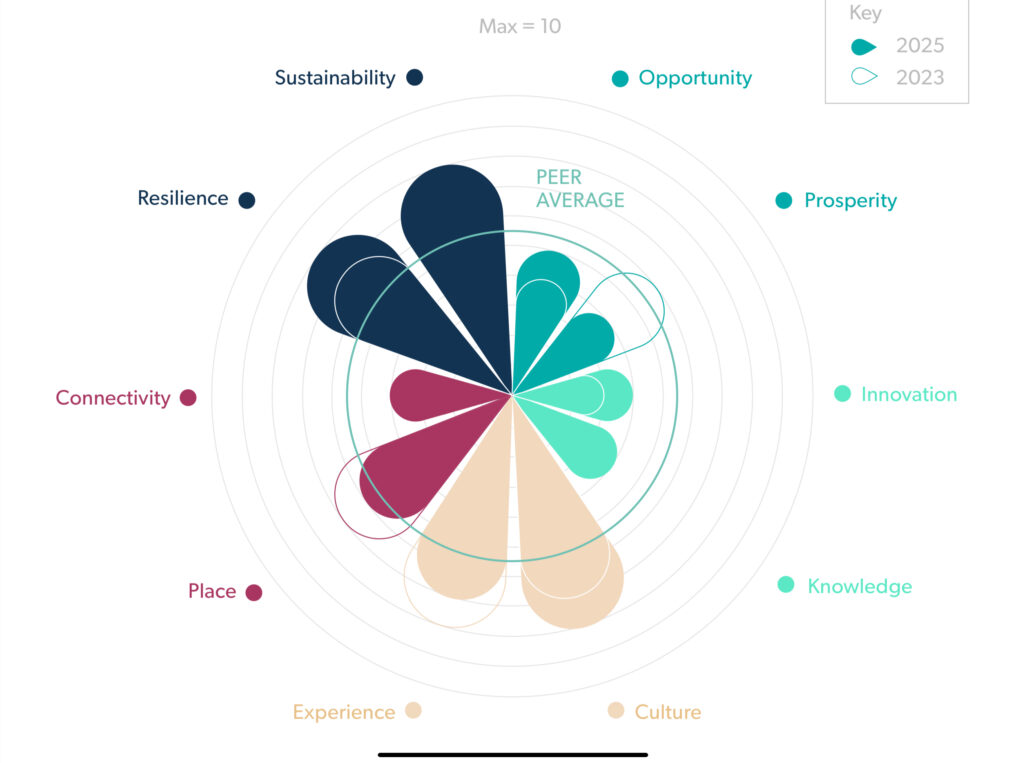
Then we come to place and urban form:

Bottom three for walkability. Walkability is an indicator for urban appeal, effectiveness and efficiency. This needs real attention.

This is of course related to continuing sprawl, which will push that good ‘access to nature’ count lower in time too:


It is very good that Committee for Auckland is doing this work, and in general that they are upping their output. These organisations have been very positive for Australian cities, most especially in Sydney.
Also I got to hang with one of our greatest ever local government representatives, deputy mayor in the CRL-push era, Penny Hulse:


 Processing...
“The city does somewhat better for both car-free and bike lane infrastructure, where it is fifth and seventh among peers (ITDP).”
What? Do they mean fifth and seventh from the bottom?
Also, @Patrick, they say “bottom third”, not “bottom three”.
Ta, I think there’s only 11 cities in their comparator list, so ends up much of a muchness.
I thought peers referred to the 84 cities which are (for some reason) called C40 but good to know.
Then it does not really mean anything really.
I mean, what is our car-free infrastructure? The regional parks and Silo Park?
Penny Hulse should’ve been our next mayor after Lenny. Instead of getting pushed out
Could not agree more. She would have been much better than Goff.
ngl read that as “punched out”
Thanks for these details, Patrick. I had done a cursory search yesterday to find the report, having read the news articles, but gave up, knowing GA would cover it. Nice I only had to wait a day.
Nice that the Mayor had some good comments to make….
But I don’t suppose he reflected on the appalling Walkability rating, and on his part in preventing improvements in that regard?
Is pretty clear that what walkability measures tell us is not understood by or valued by the main actors.
It seems like a foregone conclusion in Wellington that Andrew Little will get in as the next Mayor, hopefully ending a decade of devilishness in matters Mayoral. But what of Auckland? Is the Brown the only real contender? Is there anyone else in the offing? Because if Brown is the only colour in your rainbow, then I worry a little for your city. He may be wonderfully witty in his hackdowns of other politicians etc – but he seems like a remarkably unvisionary grumpy old man.
Unfortunately Wellington’s problems aren’t just limited to their terrible mayors. The council board itself is totally dysfunctional; being entirely composed of swivel-eyed radicals or political failures.
Andrew Little will probably be a decent Mayor, however he’ll be hamstrung by the fact that he’ll have to coax effective action out of the munters around him.
A jarring juxtaposition this week between the Committee for Auckland report and the Local Government conference and the legislation going through the House now to strip away the Wellbeing purposes of local goverment.
There’s no way New Zealand’s economic recovery can ever arrive if we just rely on rural commodities to somehow gradually push up the towns, and then in time the cities.
We desperately need government Ministers and Prime Ministers that don’t actively carpet-bomb cities and local government like they have Wellington, ridicule their leaders in public as they have to all their faces this week, and consistently take no accountability for the urban impact of their budget and infrastructure decisions.
Thanks for being at the event and posting your views! Great to see you.
This Auckland’s third The State of The City report is appalling and disappointing to read! If you’re somebody in their 20’s right now, report just blows the minds of current young people that the government and council isn’t stepping up to change the trend in direction!
From more Housing to rapid transits, government and council not promoting the idea of ‘working closer to home’ strategy! Not everybody can do, due to lack of housing nearer to Aucklands CBD. Lacks in multiple fast rapid transits that connects in & out of Aucklands CBD area(Britomart, Midtown, K Rd & Newmarket) thats accessible and convienient. Current Northern Busway over capacity, Dominion RD buses over capacity and needs extra capacity to accommodate more commuters. Same will be said for other roading corridors soon if government doesn’t invest in more rapid transits! Commuters will be forced to resort to ‘working from home’ and be restricted on amount of commutes going to & from CBD during peak! Best part about multiple fast rapid transits, that allows road users from further distance urban/suburban areas not be faced with longer commutes with longer distance congestion. Providing more fast rapid transits provides less congestion for those further distance urban/suburban areas!
Auckland Council needs to promote rapid transit ideas to government other than the Southdown-Avondale Heavy Rail project! Needs to promote Heavy Rail project to government to enable more housing and free up housing availability in closer Auckland CBD suburban areas! Otherwise Aucklands CBD suburban areas going to continue with same old congestion and no revived Auckland CBD area. No more ‘5 day weekday offices’ and more ‘Work from Home’ with more scenes of ‘For Lease’ signs in Auckland CBD.
Those who were born here and lived here when young for 20 years + moved overseas aren’t going to come back to NZ. They’ll continue to stay and live overseas until Auckland becomes a liveable city to live! Unfortunately these people won’t come back, we’ll become like the UK and rely on people who come from overseas and let our economy rot, become a ‘third-world economy’ cause foreigners choose to reside here will do the same as people who where born here and lived here when young for 20 years + by moving overseas to more liveable places since most of our industries are below Aucklands liveable salary. We can get back the ones born here and lived here when young for 20 years + by getting on with more ‘working closer to home’ rapid transits and housing cause it improves their ‘Quality of life’ and also revives Auckland CBD businesses! CRL not going to help revival of Auckland CBD businesses! If Government freed up a roading corridor during peak hour by building rapid transit, it brings in more commuters into the CBD to support Auckland CBD businesses! Young for 20-35 years + lives are eaten up by mainly length of commutes to & from work currently due to many bottleneck road corridors in Auckland and unsolved congestion which is getting worse by the year! No easing congestion being mitigated too!
dude give it a break. you’re just parroting stuff everything agrees with here, and then tacking on some PTUA crap about “only infrequent heavy rail is rapid transit” while never explaining how light rail or driverless light metro is “bad” in your book.
“dude give it a break.“
Lol never surrender! Not until PT issues is addressed!
Light rail or driverless light metro doesn’t provide all PT commuters versatility, flexibility and direct travel, while Heavy Rail does. We’d be wasting tax payers money over Light granny tram or driverless light metro! Light granny tram or driverless light metro won’t have capability of commuting to Newmarket, K RD and Midtown and Britomart all in one! Without needing to transfer and wait longer! It won’t be able to orbit around like Heavy Rail CRL!
As I’ve explained about frequency time and time again, frequency not an issue for Aucklanders! Only issue Aucklanders care about is commute time between home to work, not frequency, they don’t care about waiting for direct service to get you places and wait for 10-15 mins at a station as long get you to places direct without transfer and waiting longer for service.
how stupid are you? Frequency IS part of “time savings”
how would you like to waste 20 minutes waiting if you missed your train or if the train was too full to get on?
i guarantee you transfers between services running every 5 minutes would be quicker than this granny-minded “single seat ride” nonsense
“how would you like to waste 20 minutes waiting if you missed your train or if the train was too full to get on?”
Waiting 20 mins extra isn’t going to kill you. You got a phone to occupy yourself and entertain or work while waiting at station. If you’re heading to work on scheduled time, you need to start going to work earlier and organised yourself with proper routine!
oh you really are stupid… don’t you get it? waiting time IS part of the travel time. it is so so important to factor in waiting time get people out of cars and into public transport, because then you can mimic the accessibility of “going anytime i want”. you just rock on up to the bus stop, tram stop, metro or train station, wait no more than 10 minutes, and get on.
public transport has to be super easy to use; that is another reason why surface light rail is superior for Dominion Road because it runs at street level and has more stations. Someone can just walk from their home no more than 5 minutes, get to a station, and wait for the tram no more than a few minutes; ditto at their destination. A tunnelled heavy rail line adds an extra 2-3 minutes getting underground via lift, escalator or stairs, and has fewer stations therefore a smaller walking catchment. any travel time advantage from speed is cancelled out by the longer time to get to your destination
this obsession with just how fast the trains can go is bizarre and counterproductive to good mass transit and equitable outcomes for commuters.
To our future Auckland mayoral candidates, who are planing to be elected this year! This is your chance to change Auckland for the better and promote more new rapid transits(Heavy Rail, Busway corridors) in Auckland. Promote your case to central government once elected and do a project that isn’t Southdown-Avondale Heavy Rail, Botany-Airport Busway or Northwestern Busway! Now’s the time to be bringing in more new rapid transits(Heavy Rail, Busway corridors) at a time where congestion isn’t getting fixed properly. It’s getting worse for Aucklanders and stripping commuters ‘quality of life’. We need to be changing the unitary plan too, to cater for rapid transit catchments for high density complexes.
Also the current fares aren’t cheap for those who ride regularly. Fares would be cheaper if we built more rapid transits for Aucklanders. Most commuters only regularly ride PT for only one sole purpose, mostly for work and rarely use for social gathering or big events due to fares prices of commuting one-way or return. Car or online delivery for most folks will still end up being cheaper for doing shopping but does help bit terms of getting people out and about for things happening in Auckland!