This is a Guest Post by Dr Chris Teo–Sherrell from Living Streets Aotearoa
You’re driving along on your way to work or an appointment and all of a sudden there’s a truck blocking the road. It’s not clear what’s happening. Nobody’s there to explain what’s going on or to direct you safely around the truck or asking you to turn around and go another way. You were already pushed for time and now you’re going to be late. What a pain!
This is the sort of thing pedestrians face every day with cars, and the occasional truck, being parked over footpaths. In recent years, both our members and associates as well as councils have noticed a steady increase in it.
We have received over a thousand photos of it from all over the country from people out and about walking to school or work, the shops or the park, to meet friends, for exercise or social contact or even just to clear the cobwebs from their minds on a rainy day.
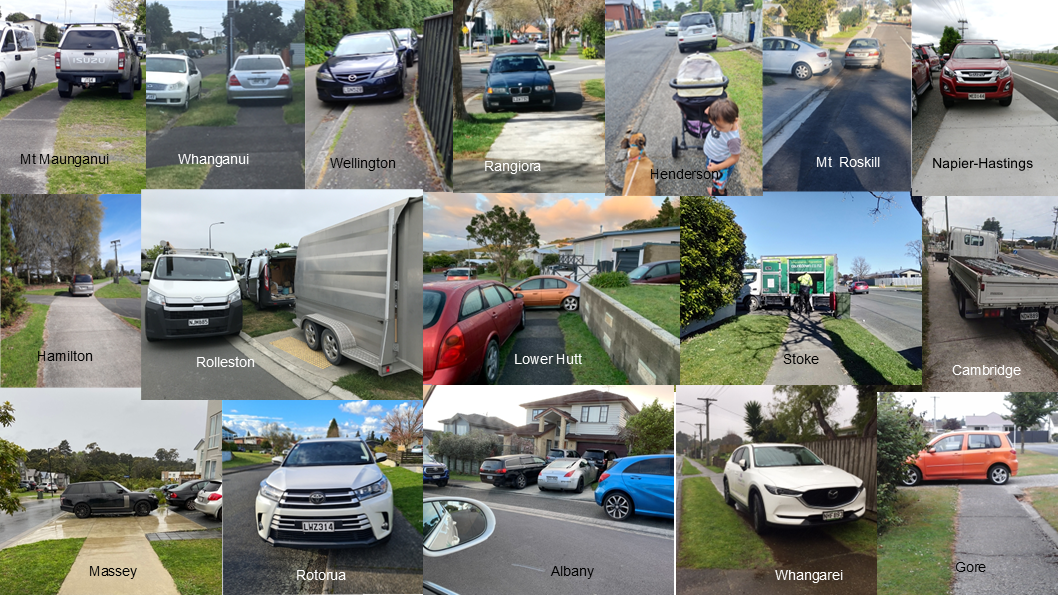
Montage of parking on footpaths via Living Streets Aotearoa
It’s bad enough having signs and scooters and rubbish bins and other things on the footpath but vehicles are an even greater obstacle, usually blocking the entire footpath or making it impassable for people in wheelchairs or on mobility scooters.
For able-bodied people it is often inconvenient having to go around a parked vehicle. It can also make pedestrians feel like they are not being respected which isn’t a positive feeling to create. For less able-bodied people it can be more than an inconvenience, even preventing them from making their own way to where they wanted to go, taking away their independence. It’s really inconsiderate of drivers to park their vehicles over footpaths.
In some cases the vehicle is parked in a way that means that the only way to get around it is to go onto the roadway. This is dangerous especially for children, vision-impaired people, those who have difficulty crossing gutters and those would be unstable on the rougher surface of the roadway. It certainly isn’t safe and people walking along the roadway is not something other drivers want to encounter.
In other cases, drivers seem to be trying to be considerate of pedestrians by parking with just two wheels on the footpath rather than completely blocking it. But even that can be sufficient to block people pushing prams and people in wheelchairs or on mobility scooters, many of which are heavy or have wheels unsuited to going on the adjacent grass, if there is any. This is especially the case when the ground is wet and soft, which can be at any time of year. Parking like this also makes it more difficult for blind people as it’s an obstacle that may be there one day but not the next so they can’t predict, or rely on remembering, the timing or location of it.
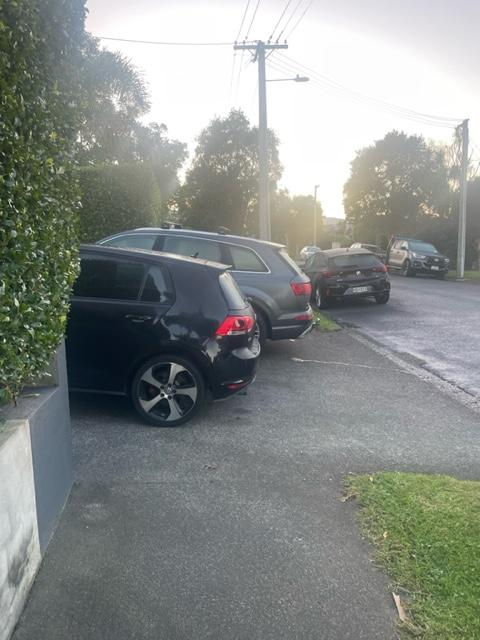
Footpath Parking Grey Lynn
Some people park over the footpath when they are picking up somebody or something. They think they’ll ‘just be a minute’ but they may have to wait for the person to come out of the building or it might take longer than expected to pick something up. And yet a pedestrian may come around the corner and walk or wheel along the footpath and be blocked by the vehicle being there. If the driver isn’t in the car the pedestrian will be inconvenienced or endangered or prevented from proceeding. That’s pretty inconsiderate. So even if you think you’re just going to be a minute, you shouldn’t park on the footpath. Park on the roadway (out of the traffic lane) and let the person in or out there or go right onto the private property instead.
Some people seem to think that their driveway goes all the way to the kerb but that isn’t the case. Driveways stop at the boundary of the private property adjacent to the road. The space between there and the kerb or edge of the roadway is public property intended for the placement of water, energy and communications infrastructure and street trees and for pedestrians to use – not for parking vehicles.
Other drivers sometimes park on the berm, the area of grass between the kerb or road edge and the footpath or between the footpath and the adjacent private property. If that enables the vehicle to be completely off the footpath that is a better thing to do. However, some councils don’t allow it because of damage it could cause to underground infrastructure, some of which may be quite shallowly buried such as pipes which take rainwater from adjacent properties to the roadside gutters.
Besides being inconsiderate, for the reasons explained above, parking on footpaths is actually illegal. The Land Transport (Road User) Rule 2004 clause 6.14 says:
(1) A driver or person in charge of a vehicle must not stop, stand, or park the vehicle on a footpath or on a cycle path.
This Rule applies even to parking ‘just a little bit’ or for ‘just a minute’ on the footpath just as much as it does to parking right across it. It also applies even when there is no parking available on the adjacent roadway because it is already occupied or is prohibited with yellow ‘no parking’ lines along it. It applies all the time. There’s no excuse. As of October 2024 the fine for breaking this rule is $70.
Mostly, local councils are responsible for enforcing this rule and their parking wardens are authorised to issue fines for parking over footpaths. So if you encounter vehicles parked on the footpath you should phone Auckland Transport (09-355-3553) immediately and report the property number and street name, the colour of the car and its registration number. The sooner the illegal parking is reported the sooner AT can send a warden out to deal with it.
Phoning Auckland Transport is the quickest way to get action but you could also take photos showing the vehicle parked over the footpath and its number plate and send those to AT afterwards via it’s online-form (reachable through the Parking tile at contact.at.govt.nz), via private social media message or via one of the phone apps available such as SnapSendSolve or Antenno.
Parking on footpaths is inconsiderate and illegal – you don’t have to put up with it. Report it.
But, if you’d rather take a purely persuasive approach in the first instance, Living Streets has some yellow feet which people can put on windshields of vehicles parked on footpaths. They are gentle reminders to the drivers that parking there inconveniences and endangers others. People can request small numbers of these yellow feet by emailing [email protected] .
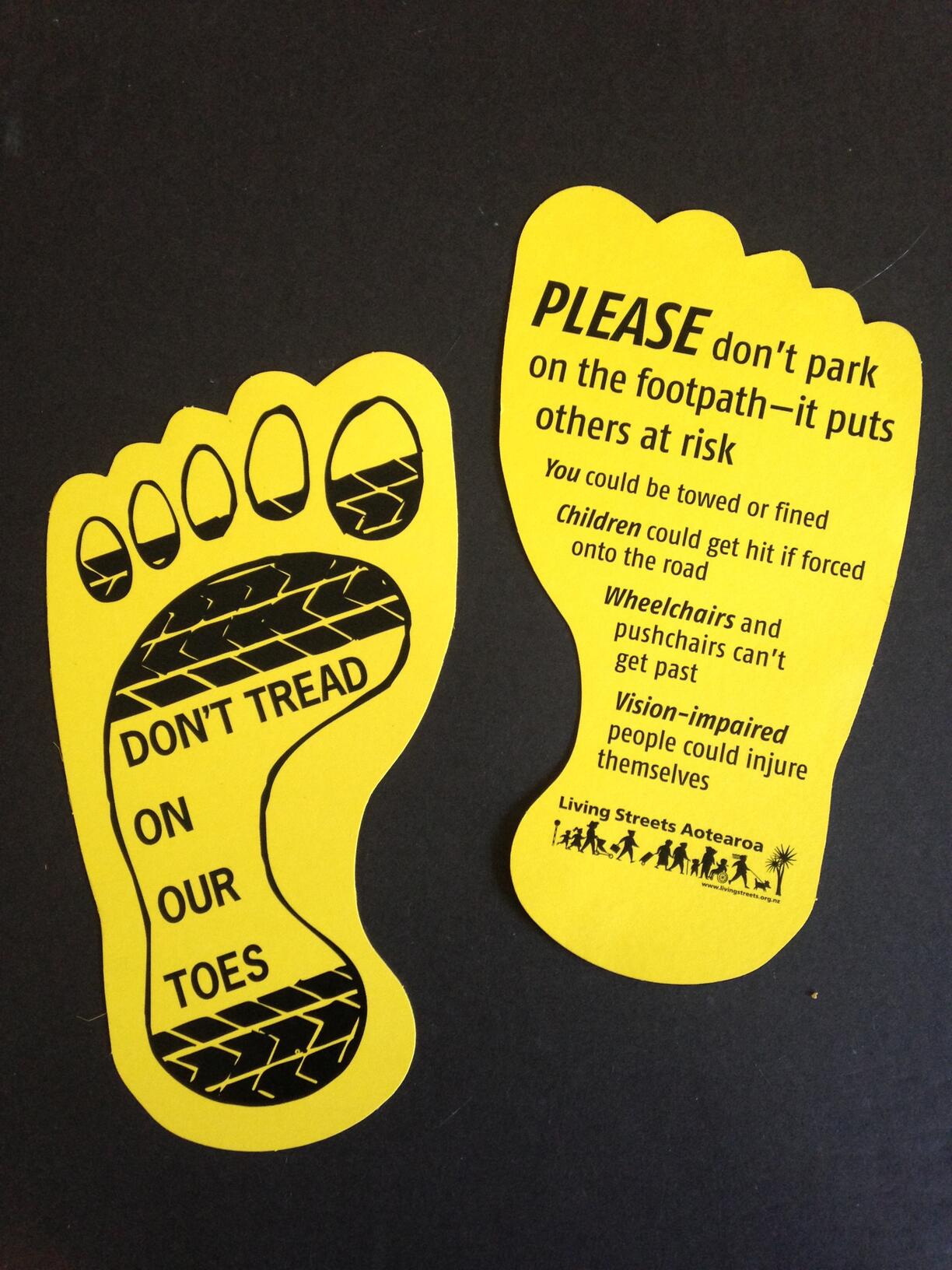
Living Streets Aotearoa is New Zealand’s pedestrian charity, working to improve conditions for pedestrians* so that more people, of every description and ability, choose to walk or wheel more often and further to get to or from work or school, to do errands, for exercise or leisure or just for the sheer pleasure of it.
This post, like all our work, is brought to you by the Greater Auckland crew and made possible by generous donations from our readers and fans. If you’d like to support our work, you can join our circle of supporters here, or support us on Substack!

 Processing...
Really good post. I live on a busy road that used to be SH1 (would prob fit the definition of a ‘stroad’ due to the way it is built for heavy traffic volumes, while also being a street with houses, shops, and schools) and near our house is a yellow line/no parking segment. Cars will regularly just park on the footpath rather than carry on 100m down the road, and without a berm it means pedestrians either try to squeeze between car and fence, or step out onto a double lane road full of cars and trucks to get past. Given how dangerous this is, it really frustrates me that there is essentially no enforcement, or in any case the fine is trivial.
I spend at least 5 mins every woke day reporting these to AT.
I get a great response from their social media team who monitor X during work hours.
I was the primary caregiver of a baby for a year and spent a lot of time pushing him round in a pram or pushchair in Grey Lynn, Ponsonby and other suburbs. I frequently had to use the road because of vehicles completely blocking the footpath. I had a supply of those flyers which I used but eventually got so frustrated I resorted to adjusting the mirrors or wipers of repeat offenders. These days I would be using snap send solve. The most annoying ones were those that could have parked parallel on the street or off the footpath but chose not to, properties where only half the vehicle fitted in the driveway and the households that had 3 vehicles and no offroad park
In New York it’s illegal for most vehicles to idle for more than three minutes, or more than one minute near a school. Citizens can record and report these violations through the NYC Department of Environmental Protection’s Citizens Air Complaint Program just by taking a video from their phone and submitting it.
If the complaint leads to a fine, the citizen reporter receives 25% of the collected fine. Why not do this for curb parking?
Yes, are any RCAs pursuing this technique?
On idling itself, that’s a selfish practice that has exploded over the last five years here as well.
I think RCAs should test their ability to ticket idlers on the basis of it being inconsiderate of other road users and therefore an offense under the Road User Rule. Yes, it would take a judge who understands the purpose of using appropriate but new interpretations of existing laws to pursue important outcomes, and we don’t seem to have any of those. But given fumes cause brain damage and miscarriages, amongst other effects, idling is definitely inconsiderate of other road users.
Getting AT to take action is pie in the sky. But perhaps Council could lead a campaign to stop idling drivers being so complacent filling the lungs of children coming out of school, and communities take action to ask them to stop?
In New York it is illegal for a vehicle to stop more than 30 seconds without someone shouting needlessly or honking continuously.
Some people may defend such parking and point to the fact that not many houses have the option to on-street parking. I definitely think that its a proper conversation to have but in most cases it deflects from the root cause of how we have built our cities. Over reliance of cars pushes problems like this, and because we are so apologetic to cars we let stuff like this happen and push the can down the into the lap of the pedestrians and others who can’t drive.
Hopefully the parking camera cars can capture this unpermitted parking ,in a drive by. The Council,AT should be viewing this as “easy money”,until the offenders change their behaviour.
This seems to be the best way to report in Auckland, the report illegal parking form. Note you can leave most of the fields blank and just need a number plate or a photo.
https://contact.at.govt.nz/?cid=f9702f4d-de10-ec11-b6e5-002248159985&pagenumber=2
In my experience, Auckland Council have been pretty responsive when i’ve reported vehicles blocking footpaths (or, as is more usual, my driveway).
This might be down to them having adopted more efficient means of ticketing (or simply be down to exposure bias on my part).
A way to get the point across is to use yr poster. Maybe have a scheme where smaller and portable hard copies can be obtained so that people encountering this problem can leave one in the offender’s window wiper as a reminder.
The Consumers Institute and some retail outlets [eg Resene paint retail outlets] give out ‘do not knock’ stickers which can be put onto front doors and letterboxes. Displaying one on their property is a legal warning that hawkers and junk mail is not welcome and adds legitimacy to a complaint. Displaying one of these signs on a front door or letterbox is very effective considering the change in regulations regarding door knocking activity.
Rather a long article, but, I agree with the points made and think there are a lot of drivers who are either unaware or have a sense of entitlement about where they park.
“The sooner the illegal parking is reported the sooner AT can send a warden out to deal with it.” Well, actually….
AT has guidelines for wardens that do not align with the law. For example, having two wheels up on the footpath is illegal, but AT’s guidelines require wardens to only ticket if the space left is under a certain width. (This also leads to less revenue per hour of warden time.)
There’s usually no point reporting a car that’s parked temporarily, eg half an hour, as AT will often take hours to get there. Outside of the city centre or on bus lanes, you’ll just end up wasting precious enforcement funding unless it’s a chronic issue (eg a car that’s being parked all day every day so you know it’ll be there in a few hours).
If you try to report a chronic issue, reporting the same car day after day so that the driver is actually fined often enough to change behaviour, AT stops taking action after the first or second complaint.
Where there is an acute problem, such as a sports event at Victoria Park, AT often decides not to send wardens, to protect the wardens.
When AT does attend an acute problem, with dozens of illegally parked cars, they will ticket only the one that you reported. This is another practice they follow that wastes the enforcement funding we pay them for.
Similarly, AT will only proactively enforce parking in the city centre and a few other locations. Everywhere else it’s only in response to a callout. Thus, there’s no efficiencies of scale by doing a whole suburb in one go… another way they waste our rates (and then claim they are underfunded to do parking enforcement properly.)
AT have done no business case to support the decision to enforce on a callout basis rather than on a proactive basis. It’s ideological.
And remember, the revised parking strategy puts most of the city into a category that can be summed up as “there’s no change required to parking management in this area, because there’s no problem. Nothing to see here.”
This is so true. I’ve literally watched a parking warden on proactive duty outside a school at pickup time walk past a line of cars parked half across the footpath. The latest driver to do that approached the warden to check it was OK, and was evidently assured the practice was fine (this in a road that was shortly going to have literally hundreds of primary school children walking home along it). It wasn’t until I approached the warden to complain that he accepted that the practice was illegal. When leading a walking school bus in the same road I regularly came across vehicles blocking our way – including on one occasion a large ute belonging to a tradie entirely blocking the footpath. My request that he move it into the road was quickly rebuffed on the basis it might get hit by traffic. When I pointed out the same could be said of the 20 kids with me who would need to walk in the road to get around, I was told they should “live dangerously”.
Calls to AT are generally redirected politely with sympathy from the call taker, but it’s usually so long before a warden attends that the vehicle has left. I’d love to see proactive, whole-suburb enforcement!
Election time. Ask the candidates what they will do about this chronic problem.
AT enforcement policy can be altered if demand is there, but it also needs public awareness. All media should be encouraged to promote strict safe parking to highlight the hazards.
I put it down to poor Early Childhood Education (in the past at least). Teaching kids to colour in between the lines might give people the skills to park in between the kerbs.
This is a problem I’ve encountered here so much more than anywhere else I’ve ever lived. Just another example of how carbrain in NZ rules all. People just feel like their car storage trumps anything else, whether its people walking, greenery, anything. Drivers feel entitled to put their car wherever they need, and nothing else matters in comparison. Very frustrating, and I’m able-bodied!
I am often walking places with my kids and our pram. I regularly encounter people blocking the footpath. I used to report this but have given up because AT never takes any action. Every report came back “officer attended, no action required”. I also used to query people about why they were parked illegally but stopped because of the abuse and threats of violence. Not ideal in front of my kids. Same thing happens in cycleways, Carlton Gore Road is a classic for it.
Good article. I’ve used Living Streets yellow feet in my neighbourhood and it seems to have a positive effect. For those that complain I’m sure they’d rather get one of these than a fine I’m sure.
AT staff have told me a few times that SnapSendSolve is not the right tool to use for parking reporting – always use the AT web tool or call them.
AT and AC staff will tell you that snap send solve is not the right route to report any issue at all, but it is much more user friendly than the council’s own system….
In the western/developed world I would agree; its just so prevalent here than anywhere else I have seen.
However, the double parking and parking on footpaths (right outside the restaurant because you refuse to walk any further than 10m) in SE Asia has to be seen to be believed.
Thats if they have footpaths….
If AT set up a camera to capture all the Uber drivers who park in the protected cycle lane on Symonds St between Khyber Pass and the top of Mt Eden Road, it would pay for itself in a couple of days.
$2k fine each, then it will stop
The Marlborough DC has a 4 page parking bylaw. Parking on berms and footpaths has been illegal for many years, at least 10. It is rarely enforced. As you can imagine in PICTON we have a lot of problems with trucks, especially when a ferry is delayed. Never seen anyone ticketed in all my time here.
A vivid marker usually ensures it’s not repeated behaviour
It’s becoming more and more difficult as a trades person executing a job with limited or even no parking at a property where a job needs to be done.
I always try to park in a way to ensure there is enough space. And my mobile number is on my trade vehicle, so I can be there in no time and move it.
Thanks for being aware. I’m sure that means the remaining pedestrians still brave enough to ask a driver to move the vehicle won’t get an ear bashing from you.
To shift practice into something actually acceptable to everyone, what you need is the client or project manager to organise a parking management plan from the outset. There are many options; renting driveway space nearby, using the available legal parks for drop off of tools, etc, along with a designated parking area at a distance, wheeled tool containers, etc.
Another biggie is changing the employment culture so big utes are not part of the package for tradies.
Along with enforcement, such forward planning could change practices swiftly.
It’d be great if you could start some conversations along those lines….?
I was told by a parking warden – They can only ticket the reported car at the reported location (So if original car moves and another car takes its place they cannot do anything) AND the cost recovered from ticketing is less than the cost to tow them #palmtoface
Now look through the legislation to see if this practice is supported by legislation.
It’s made up shit, and AT’s guidelines are full of it. Worse, bringing the discrepancies to their attention has achieved nothing; it’s an ideological, intentional refusal to serve the public.
Councils are partially to blame for this. More and more consents are approved for infill housing with no garaging or parking. Where are people going to park? On the roadside. What if streets are narrow? Then it’s partially on the footpath. I’m not condoning parking on the footpath, I walk most places and get really annoyed by it. All I’m saying is that Councils need to be aware of the implications of their actions as well.
Parking provision begets more parking demand, in the same way that wider roads induce traffic.
A compact urban form reduces the need for car ownership. What’s pushing the number of cars up is car dependent planning and regulations and above all, the lack of enforcement. This is why people don’t respect the commons, nor make more rational choices.
One thing Council should have done is made a requirement that if parking is put in to a new development at all, it should be consolidated, and at a distance of at least 300m walk. Research shows this reduces both car ownership and vehicle use… And remember, that means there’s less parking demand from those residents in all the places throughout the city that they would have otherwise driven in the course of their activities.
I always think its a bit of a weak argument, Jaffa.
All infill housing comes with at least one park. If you need more, you should be buying/renting to suit. And our cities are littered with homes where the garage has been converted to other uses so people park their cars on the street, which then gets full. Forcing people onto the footpaths and berms, if they didn’t already think it was their right.
Infill housing is a very small part of the problem. Mainly, its attitude.
Agree with the general thread here but not sure about ” all infil housing comes with at least one park” – check out 22 Yeovil Rd Te Atatu Peninsula as example.
Protecting on-street parking could help. Providing a clearly designated part of the street, shielded from other vehicles.
Many drivers are uninsured and won’t risk losing their motor to a hit and run.
Could driver self-interest could get the street calming that national policy has forbidden?
I live in Brown’s Bay and have reported this happening in our street many times. Nothing gets done . I have given up reporting for that reason and the problem has grown. It’s a narrow street with cars parked on both sides of the road and others exceeding the speed limit by up to double the legal signs. I have witnessed mobility scooter having to go onto the road on a blind corner to get past some of these selfish inconsiderate car owners.