In early 2016, Auckland Transport kicked off consultation for a network of connected bike routes linking the Inner West neighbourhoods to each other and to the wider network.
By August 2016, they had settled on this plan for the local network:
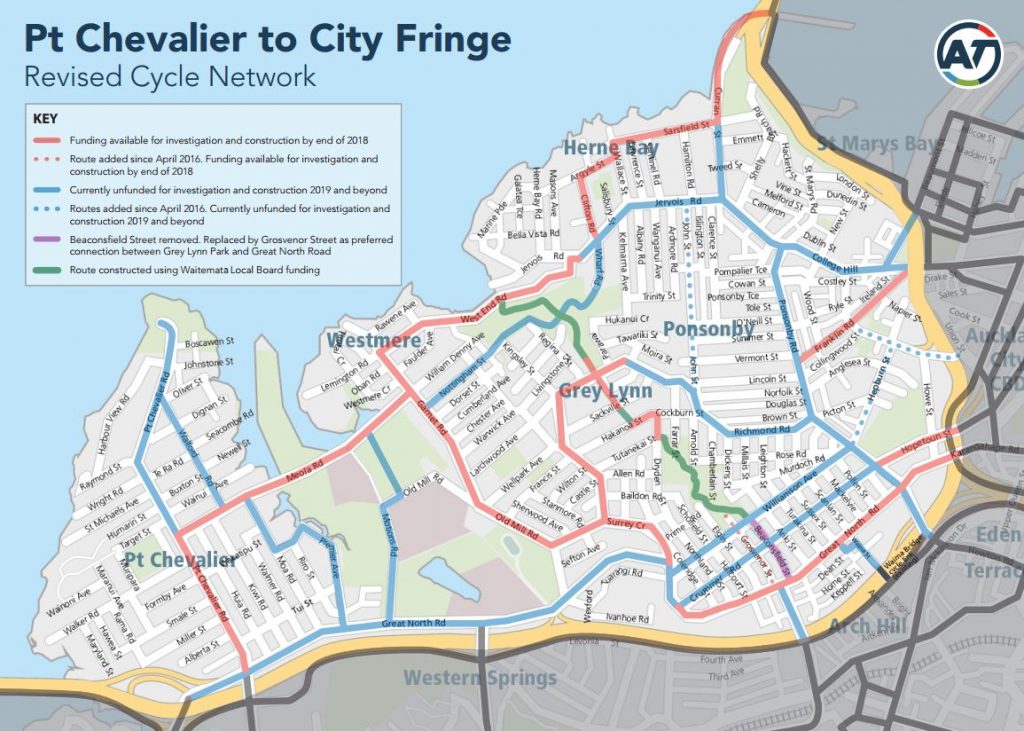
2016 Revised Network
The routes in pink had funding available for construction by the end of 2018, thanks to the Urban Cycleways Programme, kicked off under John Key’s National Government and then-Minister of Transport Simon Bridges.
The “network effect” underpinned the logic of focusing some of that early investment in this area:
- Boost the already measurable uptake of everyday cycling in these neighbourhoods, which on census counts have some of the highest bike to work and school rates in the city, even without safe infrastructrue.
- Leverage the existing network – which at the time included the Northwestern path, and new city-end connections like Lightpath/ Nelson St, Grafton Gully, Beach Road.
As a bonus, when people who live close to the city have plentiful options for short trips, that takes pressure off public transport – especially at peak. In other words, more room on buses and trains for those coming from further afield.
Speaking of trains, 2016 also saw the groundbreaking ceremony for another major network-enhancing project: the City Rail Link.
It is now 2026. Ten years, three mayors, and multiple Prime Ministers later, the City Rail Link project is finished.
But what of the Inner West bike network, originally slated to be finished in 2018?
It’s now known as the Inner West Connections, and as of this month it sits in the hands of Council rather than Auckland Transport.
A few small sections were completed in those first few years – the “greenway” linking Cox’s Bay and Grey Lynn Park; a section of off-road path along Old Mill Road. The rest got bogged down by delays, disappearing funding, and Auckland Transport back-pedalling in the face of sporadic shouting from a handful of oppositional voices.
Key sections from Point Chevalier to Westmere were finally completed in 2025, including a total rebuild of Meola Road – built on landfill, it had been sinking under the weight of heavy traffic. That full-depth upgrade included new footpaths and lighting, as well as a bidirectional bike path that’s seeing steady ridership, including a noticeable peak pattern for school trips.
All up, the daily median this spring has been around 1000 trips a day not made by people in cars. Not bad!
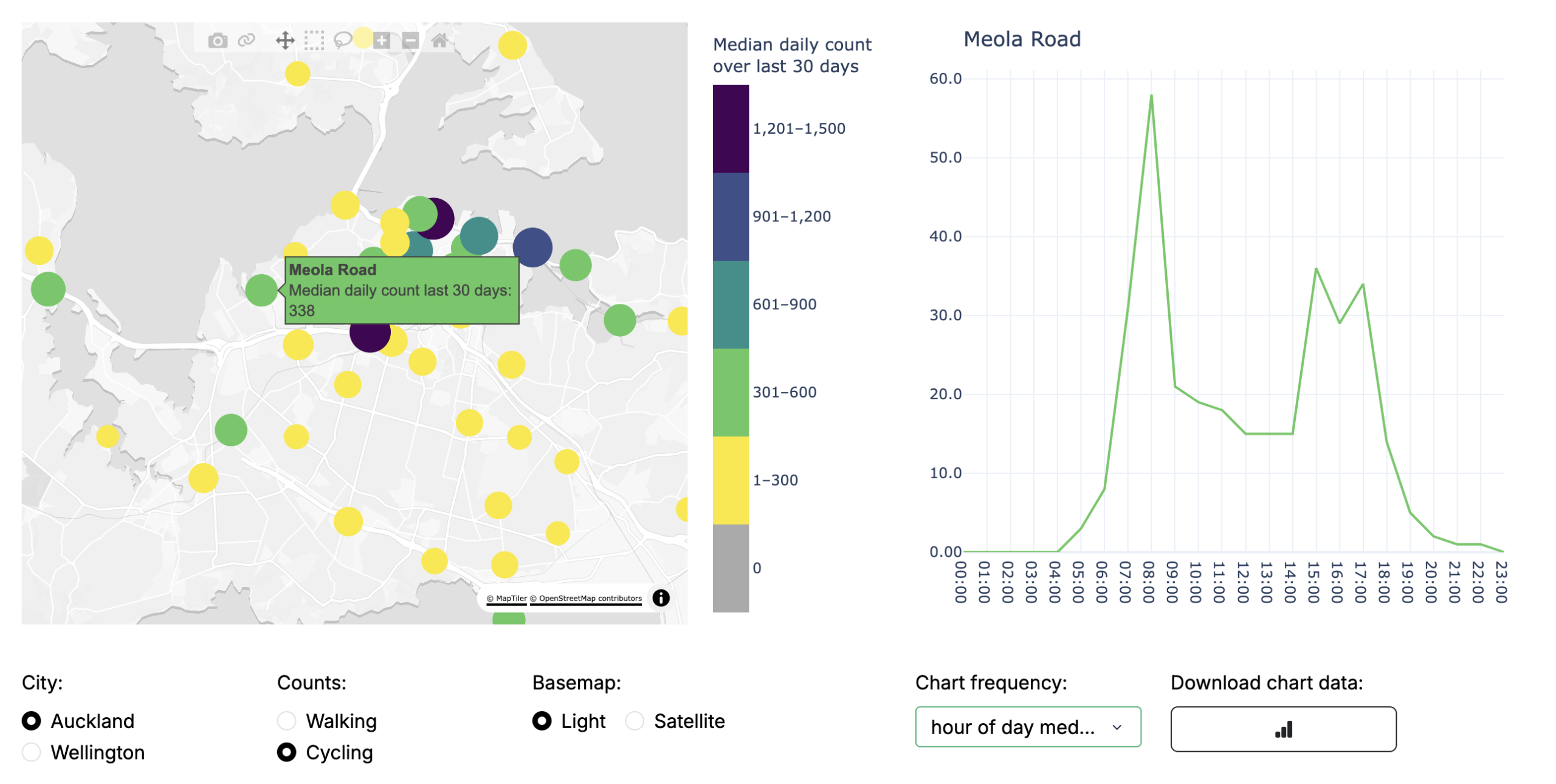
Meola Road cycling counts, showing the hour-of-day median. Spot the double evening peak, comprising school traffic and regular commuters. Data-vis by MRCagney.
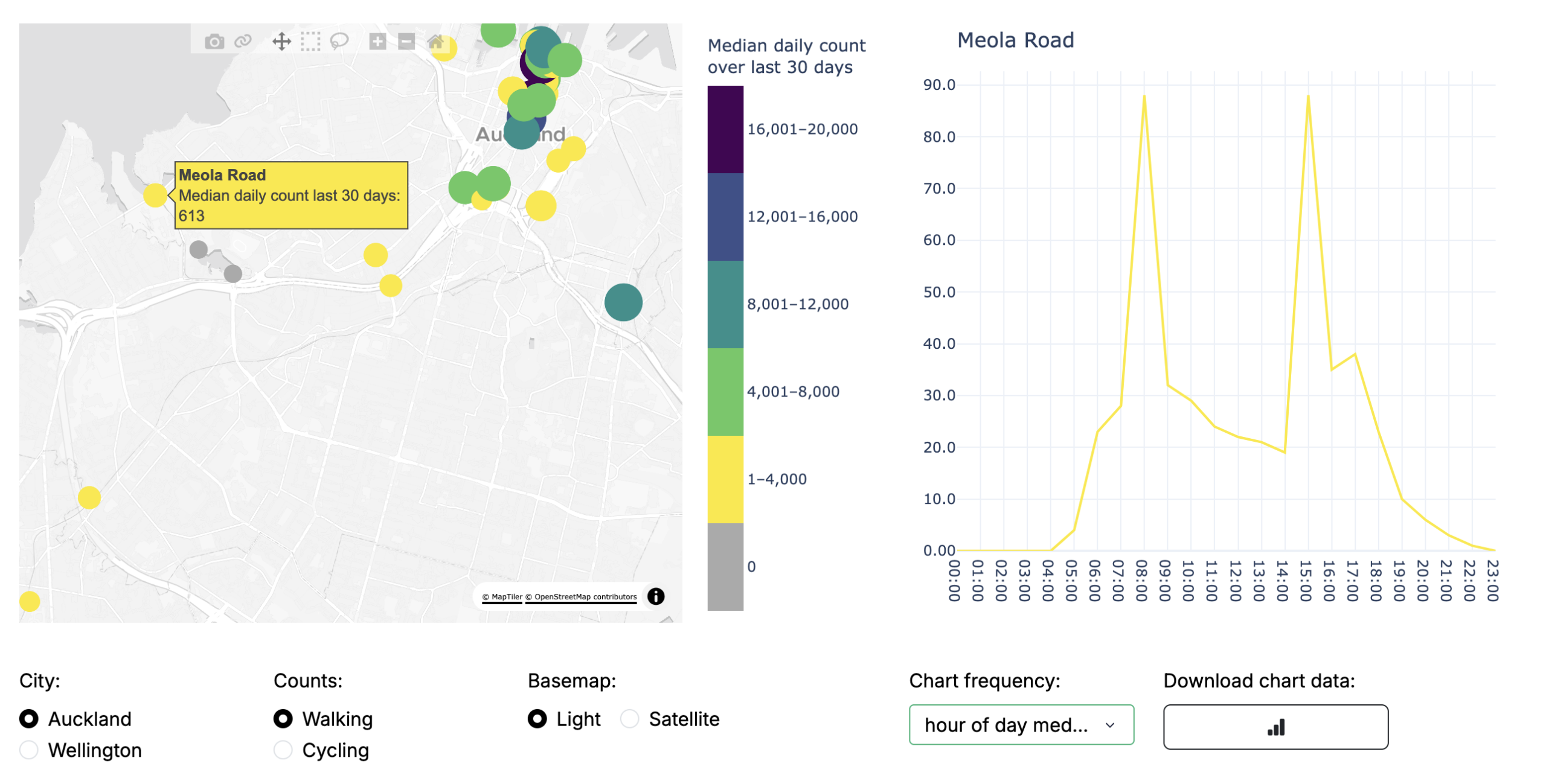
Meola Road walking counts, showing the hour-of-day median. The double evening peak is still there but slightly less pronounced. Data-vis by MRCagney.
Then in late 2025 – early 2026, Auckland Transport cleverly took advantage of a planned resurfacing of Surrey Crescent, to “dig once” – and deliver protected bike lanes, and new and safer crossings at key locations, including a school and a daycare.
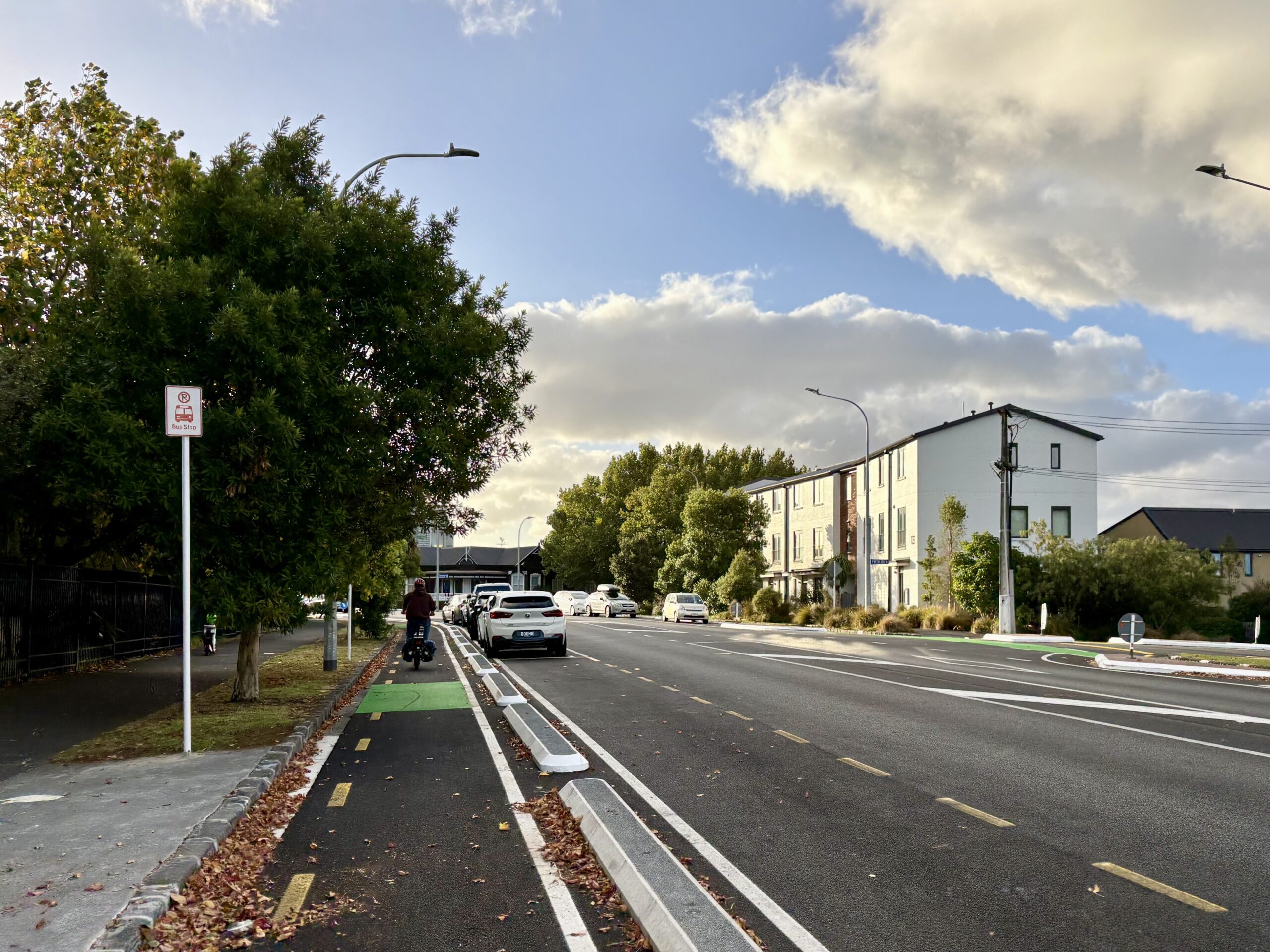
A section of the “dig once” quick-delivery protected bike lane on Surrey Crescent. Image: Jolisa Gracewood
There’s a gap at the Grey Lynn shops, but this helps fill in another gap linking to the Great North Road ridge, which has seen a significant leap in cycling numbers since protection was installed. But much of the original plan remains unfinished – with no plans for several critical sections. West End Road has dropped off the map, and the Grey Lynn shops remain a bike Bermuda triangle.
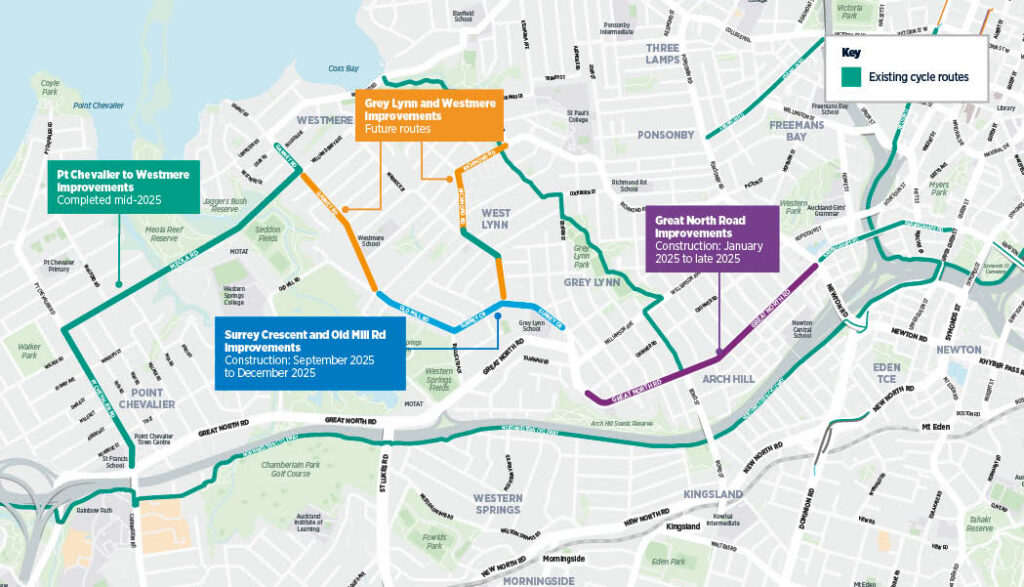
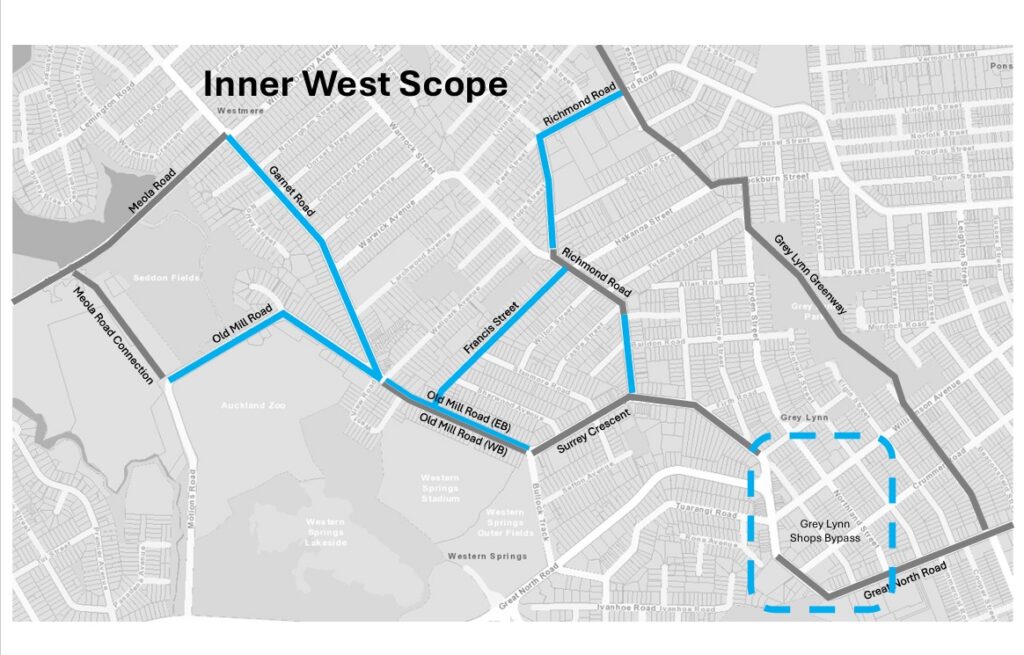
The currently planned projects are as shown. Garnet Road and Old Mill are crucial school routes. Richmond Road and Francis Street connect the (currently orphaned) lanes through West Lynn shopping village into the existing network. Surely we can at least see these sections delivered within a meaningful timeframe?
Public support is beyond question
How on earth can it take longer to build a few kilometres of local bike routes, than the nation’s largest infrastructure project undertaken in the 21st century?
As this Bike Auckland article explains, there has long been strong support for safer streets for cycling in the Inner West – and it has been continuous and growing ever since the first glimmer of funding in 2016 through the Urban Cycleway Programme.
To outline – and note, these are just from 2016 onwards: proposals and planning for several of these routes go back even further, to the turn of this century:
- Initial consultation in 2016: strongly supported separated cycleways
- 2016 consultation report on Surrey Crescent to Garnet Road (Route 1): 41-49% support, 950 responses through a Generation Zero survey with 98% support, Grey Lynn Residents Association, and Bike Grey Lynn largely in support, compared to 39-42% opposition.
- 2016 consultation on Richmond Road (Route 2) and other routes: majority supported separated cycleways
- 2019 consultation on Surrey Crescent to Garnet Road and Richmond Road: 70% support and 65% support respectively.
- 2022 post-pandemic fresh check-in with the public: 50 letters in support from within the community and wider stakeholders, and five opposed
- 2023: 38 organisations call for Inner West projects to be ‘unpaused‘
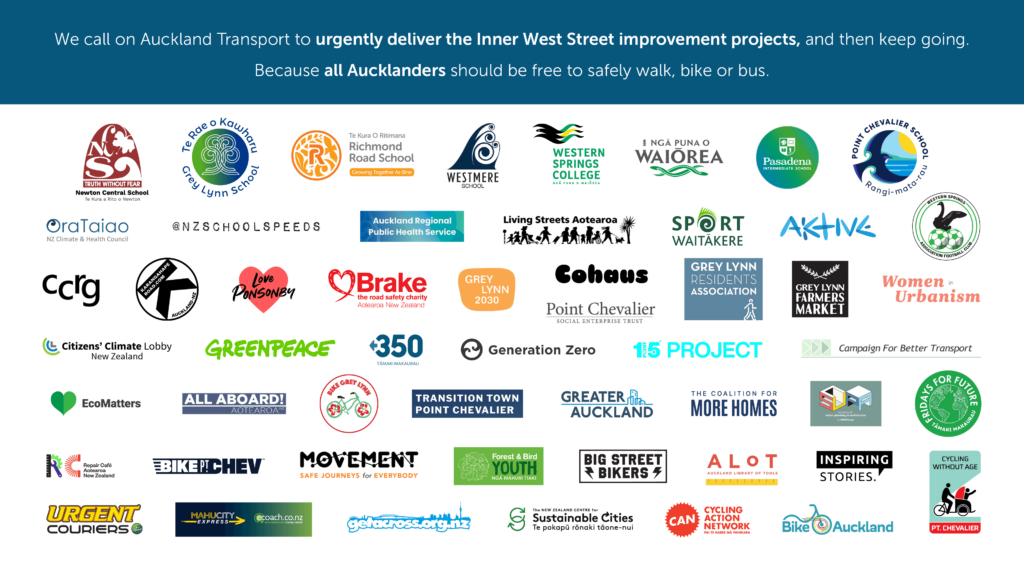
Organisations in support of the Inner West projects, 2023 – including all state schools along the route, businesses, community groups, residents’ associations and business associations.
So what’s stopping delivery?
At every turn, consultation after consultation has showed strong, steady support for safe, separated, on-road cycleways along these major routes.
And yet at every opportunity for action, Auckland Transport has systemically failed to get on with delivery.
Now, in 2026, with governance brought into Council, those making decisions about the Inner West Connections appear to be still delaying things, and seeking more consultation.
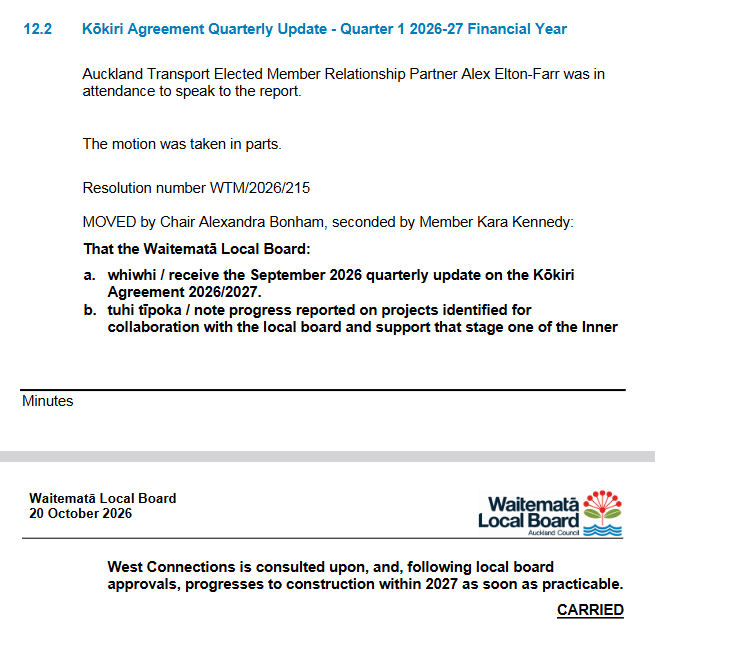
A recent presentation to the Waitematā Local Board on 27th October 2026 outlined the timeline of planned projects:
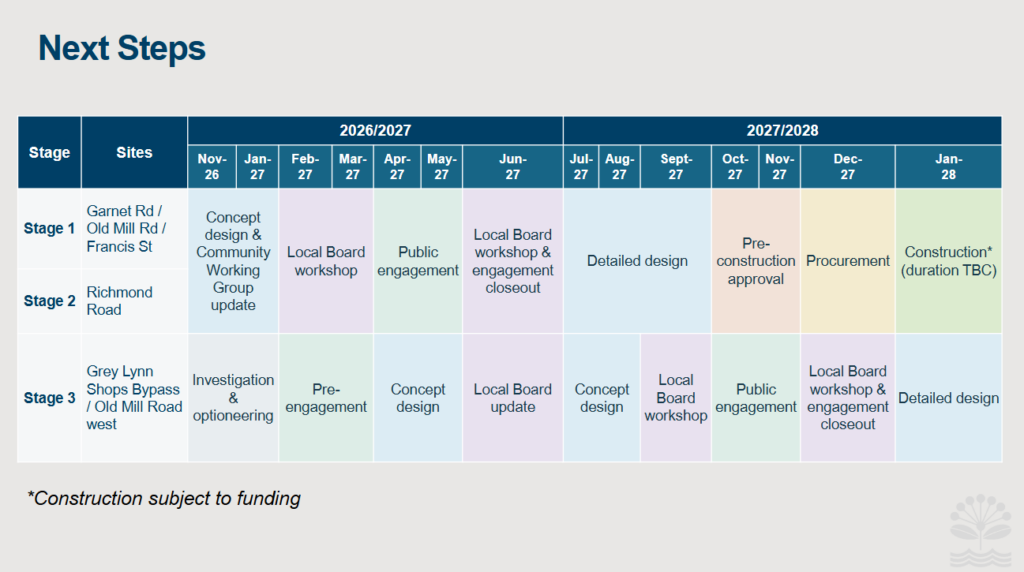
Squint, and there it is on the right: no shovels in the ground (or concrete tim-tams being gently lowered into position) until January 2028 (TBC).
Even though the Inner West network had funding available for design and construction by 2018, several major gaps – on Garnet Road, Old Mill Road, Richmond Road, and the Grey Lynn Shops – will maybe get going ten years after they were meant to be finished.
And a year and a half longer than the generational accomplishment of the City Rail Link.
With other key gaps yet to even have a start date.
I fundamentally do not understand how this is acceptable.
The proposed timeline is all the more galling, given that just a week earlier, the Waitematā Local Board had made crystal clear they wanted to see Stage 1 happen as soon as possible. That’s Garnet Road – which runs past a primary school, and will connect to the existing protected cycleways to the Westmere shops.
We should be clear: there are plenty of excellent people working on projects like this in organisations such as Auckland Transport and Auckland Council. They carry the weight of the delays, as does the community.
However, there are also clear systemic issues with the way decisions are made by this system, specifically when it comes to bike infrastructure.
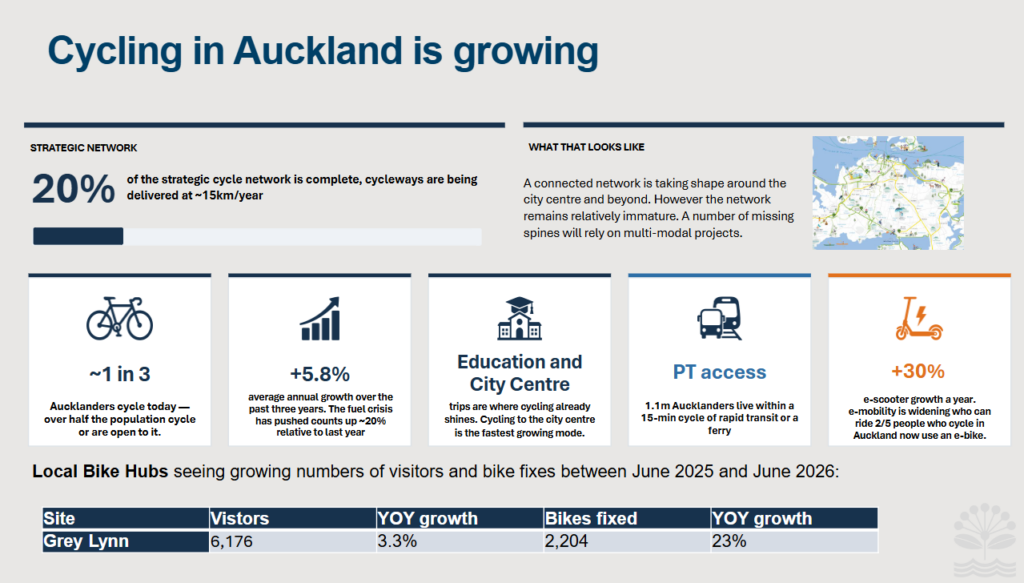
In the same presentation to the Waitematā Local Board, it is stated that the strategic network for cycling is currently being delivered at approx 15km/year. (Also, apparently it’s “20% complete” – an interesting claim, which we’ll come back to in a later post.)
Compare that modest target of 15km per year to the 483km of road renewals completed in the 2025/2026 financial year. Repaving roads (which is still being done “like-for-like”, missing the opportunity to “build back better”) is getting done approximately 32 times faster than delivering bike routes for children to get to school.
This is not to say that road renewals are not important. In fact, as the Surrey Crescent example proves, they’re one of the smartest and most affordable ways to rapidly roll out a decent bike network, and make streets safer and nicer for walking and rolling, too.
In fact, longtime readers will remember how a former CEO of Auckland Transport promised to leverage the road renewal programme to help rapidly deliver safety and connection for active modes and get best bang for buck. Which slots right in with the current Mayor’s emphasis on faster, cheaper, better.
How’s that going?
Questions in search of urgent answers
Will the transport governance reforms result in better, faster, more nimble delivery of the strategic bike network? It’s too early to judge, but first impressions aren’t great.
There seems to be a deep disconnect, still, between delivery rates for different modes – and a hesitation to do the smart thing: transform every road resealing into an opportunity to build back better and get bang for buck. Something Councillors have been begging AT to do for years.
Will Council’s transport leadership step up, and help the Waitematā Local Board get at least one part of their local bike network over the line – within the coming school year?
These (and other) questions about the slow delivery of bike infrastructure aren’t going to go away. In fact, they’re only going to become louder. Spot the fine print on the slide above:
The fuel crisis has pushed [cycling] counts up ~20% relative to last year.
This is headline-worthy stuff! It suggests Aucklanders are flocking to affordable transport options, seeking appealing alternatives to spending their diminishing dollars at the petrol pump, in a cost-of-living crisis.
So who’s leading the push, to make sure the governance reforms can be an opportunity for real change in delivering for active modes? Which, in case we need reminding, is central to Auckland’s Transport Emissions Reduction Pathway: “supercharging walking and cycling” is the cheapest, fastest way to reduce the outsize climate impact of transport in our city.
Someone needs to seize this opportunity to show Council can truly pick up the pace.
Otherwise we’ll still be asking another decade from now – why is it harder for Auckland to build a handful of basic local bike routes, than a $5.5 billion once-in-a-generation underground rail project?
Today’s header image shows the refreshed streetscape at the northern end of Garnet Road, which the planned projects would connect into – enabling even more customers to get to and from these shops by a variety of modes.

 Processing...
Not quite on subject, but if you were to add up all the reports for infrastructure throughout NZ in the last 10 years you might be looking at >1 billion in money spent and not one shovel in the ground.
We have NIMBYs, Councils, RMA, Regional Councils, Central Government, Iwi etc all obstructing progress.
Not one mention of this in the last month from any party.
Are we looking at another 10 years and more reports, scoping etc?
Good luck with railway electrification and a second harbour crossing both of which should have been completed years ago.
RoNS – Railways of National Significance.
I saw the headline for this article and figured it must be talking about the GI 2 Tamaki Drive cycleway, which is still unfinished over 10 years after construction started, putting aside everything that came before that point (and still with no start date for the Gowing Drive link, scheduled to be open in 2024, and with section 3 sinking into the Orakei Basin and half barricaded off for over a year now).
How disappointing then to be reminded once again that this is an Auckland- wide issue with cycleways!
Anyone who thought things would start happening faster and more efficiently once it moved from the semi-independent Auckland Transport to the more politically-controlled Auckland Council were kidding themselves all along.
Enjoy the new normal until we reverse course again in ~10-15 years.
Hopefully Steve Mutton can prove Steve M wrong? 😉
There has been a small group of shouty people with outsized influence over decisions because Auckland Transport grew increasingly fearful of public confrontation from the loonies.
Occupy Garnet, led by the Cowgirl and fuelled by her conspiracies, created a situation that was ridiculous. It’s time the council put its big person pants on and get on with it.