There have been a couple of pieces this week about a few parts of the Northland Motorway that show reality is starting to bubble up – but will it reach the surface in time?
On Monday there was an op-ed in the Northern Advocate, from Whangārei Mayor Ken Couper. It starts out fact- free and a bit hyperbolic about the Warkworth to Te Hana section of the expressway:
The future of connectivity of Northland is tied to one critical piece of infrastructure: a safe, reliable four-lane highway between Warkworth and Te Hana.
…..
There is no question the Warkworth to Te Hana highway is essential. It is Northland’s primary connection to Auckland, supporting access to employment, education, specialist health services, freight movement and our visitor economy.
This is not a discretionary route. I want to acknowledge and thank the Government for its commitment to delivering it. Northland has waited a long time for this investment, and it matters.
To be clear: saving 7-10 minutes (NZTA’s estimation of the travel time savings between Warkworth and Te Hana) is not going to move the needle on Northland’s future.
In fact, spending the potentially $4 billion on a range of safety, resilience and localised capacity upgrades all across Northland is bound to provide much better overall outcomes – especially if you used it to actually address the problematic parts of Northland’s connections, like the Brynderwyns.
But then Couper gets to the heart of the piece, which is about affordability:
What is genuinely eye-watering, however, is the total cost currently being discussed for building the Warkworth to Brynderwyn corridor.
That level of cost demands a constructive review of how major roads are planned, costed, and delivered in New Zealand.
NZ Transport Agency Waka Kotahi (NZTA) has a central role in this. The way business cases are developed, the time it takes projects to move from concept to construction, and the efficiency of delivery all directly influence the final pricetag.
We also need to ask whether we are striking the right balance between safety, resilience and cost. In some cases, there may be opportunities to deliver fit-for-purpose infrastructure more efficiently without compromising outcomes.
Time is money, and delays and inefficiencies inevitably drive up costs for communities and taxpayers alike.
This matters because the cost of building the road flows directly into how it is funded. If tolls are part of the solution, then getting the build cost right is essential.
Affordability matters at both ends. High construction costs place pressure on funding models, and that pressure flows through to tolls that Northland communities may struggle to absorb.
With no realistic alternative routes, tolling here is a necessity, and that reality must be reflected in how it is designed.
It seems reality is finally hitting home, that the whole Auckland-Whāngarei corridor looks set to cost as much as $22 billion.
The investment case shows that the various components of this “Road of National Significance” will be some of the most expensive projects New Zealand has ever built – and will have significant impact on our national infrastructure budget as a whole. Especially in the current situation.
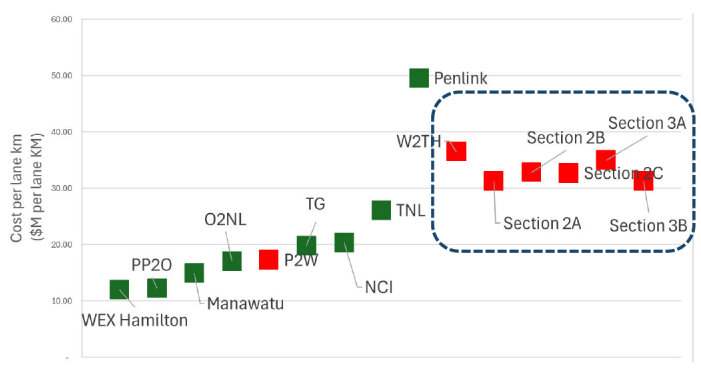
So here’s a question: how much cheaper would it have to be, for a four-lane road to be viable here. I also suspect a large chunk of the cost comes from requiring that this road be built completely off-line – i.e. a whole new road, essentially tripling the driving capacity to Northland.
Why not just upgrade the existing road?
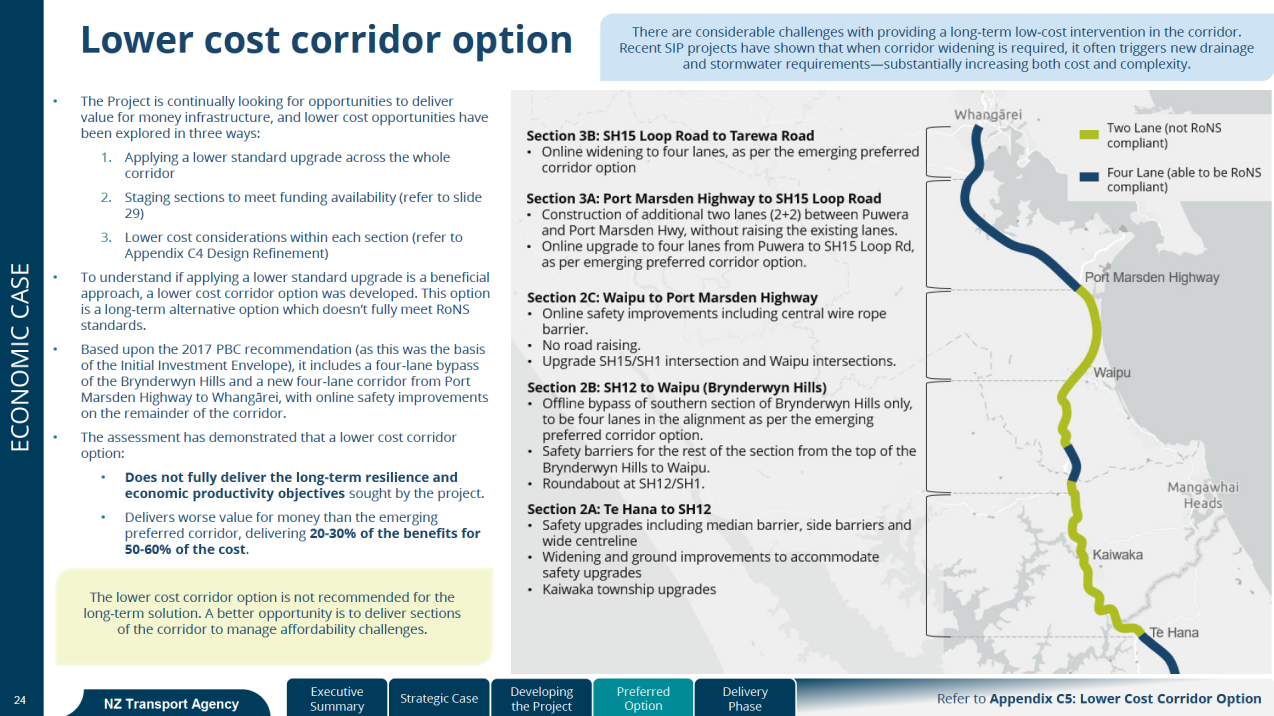
Then, yesterday Business Desk delved into some details of the proposed Public-Private Partnership (PPP) that would pay for the Warkworth to Te Hana section. It includes some of the key issues identified by Connor after OIA-ing the information provided to decision-makers.
The Treasury initially opposed a Crown contribution to the possibly $3 billion Warkworth to Te Hana motorway public-private partnership, which the transport agency was pushing for.
Briefings to Infrastructure Minister Chris Bishop and Finance Minister Nicola Willis obtained under the Official Information Act (OIA) show that Treasury officials argued against a Crown capital contribution because it would “unduly” compromise the risk transfer and incentives that would make a public-private partnership (PPP) a success.
But the Treasury relented once a lack of depth in New Zealand’s debt market was confirmed and a Crown contribution was deemed necessary for the NZ Transport Agency (NZTA) to receive three fully funded bids from private consortia.
…..
Crown to loan to NZTA
Bishop confirmed in March that the Government had committed to a Crown contribution to “bridge the gap in debt market capacity in the procurement of this project”.
A contribution was partly required because “peak debt” requirements for the PPP were “significantly larger in volume, and, with a tenure of 10 years, longer in tenure than any infrastructure financing in the New Zealand market to date”, according to officials in a previously reported Cabinet paper.
A 10-year loan would be provided to NZTA to fund this Crown contribution, the size of which has not been specified. The National Land Transport Fund (NLTF), funded by fuel excise duties and road user charges, among other levies, would be used to repay the loan to the Crown, with interest, over 10 years.
The loan drawdown was expected to occur in 2028/29.
“It’s not that the project is so expensive it needs a capital contribution – it’s that NZ’s debt market does not have capacity for this project three times over (three being the number of bidding consortia) because you can’t have the same debt providers across multiple bidders,” Bishop said at the time.
NZTA pushes for contribution
But a briefing to Bishop and Willis from February 2025 shows that NZTA initially sought Crown contributions for reasons other than a lack of capacity in the debt market.
Although NZTA confirmed that a Crown contribution was not needed to deliver the PPP, in a board-endorsed paper, the agency recommended that a capital contribution – the sum redacted – be paid during the second half of the expected eight-year construction of the road.
“NZTA’s recommendation is based around the benefits of achieving reduced whole-of-life financing costs while retaining significant PPP risk transfer, maintaining a size of project that is appealing to the market, and decreasing the risk transfer to design and construction contractors,” the Treasury briefing read.
A separate Ministry of Transport paper, proactively released, phrased the NZTA board’s interest in a capital contribution as being about “lowering the dependence on more expensive private sector debt”.
What a hot mess. Does this now make it a PPPP – a partial public-private partnership?
Those last two last sentences in particular are quite telling, with agencies acknowledging that this will be a more expensive way to pay for the project.
Why are we saddling ourselves and our kids with having to pay more for something, just because of an ideological commitment to building a particular highway a particular way? Is that responsible management?
Not to mention, this now feels a bit like Dad splashing out on a six figure sports car by taking out a payday loan, while the country as a whole is struggling to afford food and pay rent – and still mopping up from the latest climate disaster. Make it make sense.
Greater Auckland’s work is made possible by generous donations from our readers and fans. If you’d like to support our work you can join our circle of supporters here.

 Processing...
$22B is not far off 10% of our annual GDP… incredible that this project has even come this far along in discussions
It’s getting near the cost of an HR line up that way, surely.
Closer to 5% isn’t it? Still staggering though. I think we are around $250USD (and decreasing).
$250billionUSD
what is the annual revenue from Johnstones tunnel
Around $20 million
https://www.nzta.govt.nz/roads-and-rail/toll-roads/toll-road-information/toll-road-revenue-and-statistics
A few google street view drops onto the existing motorway to Warkworth, reveal vehicle counts of 15 to 20 in the view, that’s both directions. September 2025. Maybe off peak , but in no way justifies 4 lanes for the entire lenght.
Perhaps reviewing that sections projections vs reality , costs vs numbers of vehicles would be worthwhile.
An EIGHT year construction period for just 26km of road. There’s a big chunk of your cost, eight years of management reporting, PR, financial services, etc etc. No wonder the construction sector wants it, what a gravy train.
The design consultants who are paid to tell the government how much we NEED these roads are usually incentivised by having their design contracts roll over into the construction management contracts
“this now feels a bit like Dad splashing out on a six figure sports car by taking out a payday loan, while the country as a whole is struggling to afford food and pay rent” – great quote!
Reviews are pointless if you already have the answer you want..
Shiny new toll roads, but no oil/gas coming out of persia ?
Pretty sure the BCR of these projects took a tumble when crude >$100/barrel, but wasnt reflected in any project documentation. Finance cost increases also.
Gotta wonder the purpose of these lovely new toll roads in a post oil shock world.
Great work on the Public funded Private Profit Partnerships. How do i get mine approved.
Nothing related to this project makes any sense at all.
It seems the kinds of fantasy special interest project we’d expect from NZF, but aren’t ACT and National supposed to be financially prudent?
For anyone who believes National and Act are financially capable, well I have a four lane highway to sell you.
The idea is obviously to bankrupt the state to the point where the government will spend money only on the military, police/prisons and the fossil fuel industry (other than on debt of course). Education and health care will be privatized and other social spending reduced to basically zero. This is the ideal state for capitalist, right wingers and hence National and Act.
As our Auckland mayor says,
We have to stop the government in Wellington keep doing dumb things.
Madness, total madness. I used to drive the existing road back and forth quite a bit and it’s a lot more of an interesting drive left as is.
DonR – Stop central Govt from doing dumb things …. what like building the WORLDS most expense road per km, – aka Aucklands E – W link?
Have I missed the calculation of loss of amenity and productivity that this monstrous road will cause? Having been put through a mill and charged many dollars regarding how my house affects ‘visual amenity’, I wonder if any thought has been given to that and the loss of productive enterprises demolished for the road?
The opposition really need to be hammering the financial implications of this project otherwise people are just gonna go “great a nice easy road to drive up north on” and not worry about the fact that it’s going to suck up national budget for the next decade while so much other infrastructure languishes.
And yet this section of the supposed Northland Corridor does not even reach Northland, it ends 5km south of the Auckland – Northland boundary, and will largely be used by Auckland workers commuting from their house (having been priced out of central Auckland), lifestyle block, or land bankers awaiting road improvements before cashing in or creating housing estates. This road will rejoin the existing SH1, at Mangawhai Road.
While 22 billion is a hang of a lot of money it is a fraction of the per km cost of Auckland’s E – W link, which is set to be the most expensive roading project in the WORLD!!. A cost which is increasing all the time.
You mean the Jaffas that flock to Mangawhai every week end to go to the local saturday market and clog the roads .
Grant – Interesting … yes. also terrifying and with a extremely high per km road toll. RIP
Grant – Interesting … yes. also terrifying and with a extremely high per km road toll. May they RIP
Budget coming soon, with electioneering to start then. No time to reforecast costs for post oil-war costs or ‘benefits’.
Roads of Never-never Spending suggest the Emperor needs new tailors for his New Clothes.
The best time to ditch these high-cost options was after Covid. The next best time is now.
If the choice were between $22,000,000,000 towards Labour’s proposed boondoggle (which I think would have costed between $14.6 and $29 billion) and this one, I’d reluctantly side with Labour.
Minimum viable alternative that I can see:
Complete the planned Dome Valley section (but tone down the Warkworth interchange). This is difficult terrain and it won’t be easy to simply add another parallel carriageway later on, so may as well build the 4 lanes now. Or 3 lanes with alternating passing lane every 1km.
Dome Valley to Te Hana built as a realigned 2-lane road with 1km passing lanes spaced 4km apart.
Te Hana to S of Brynderwyn largely kept as-is but with a bit of corner easing, median barriers where possible, and a few extra passing lanes added. Maybe bypass Kaiwaka to the east with a big roundabout to connect with the road to Mangawhai. This area is going to grow with a lot more traffic whether we like it or not.
A new road to be built up the south side of the Brynderwyns, 2 lanes uphill and 1 lane down, to a similar standard as the already pretty good route up the north side. This connects to existing N route somewhere near the summit.
Road from Brynderwyn to Ruakaka roundabout left largely as is, a couple of extra passing lanes, maybe a bit of corner easement but this is already a pretty straight alignment. Intersection for Waipu replaced with a roundabout or even a grade separated interchange. We have two separate intersections only a km or so apart here, could it be condensed down into one?
Whangarei to Ruakaka/Marsden Point – as a tourist I have never figured out why this section was earmarked for motorway construction first, it doesnt seem too bad?
Also, every ‘old’ section of the road that is not replaced needs to be fully reconstructed and resealed with Hotmix not the god awful chip seal that peels off every time it rains or gets a little bit hot. TBH that would probably make a huge psychological difference to anyone who drives this route.
Anyway this whole thing would probably be 1/3 of the cost of a full expressway and still bring a lot of benefits for the foreseeable future, maybe in 30 years we will deserve a full expressway, but not now.
Whangarei to Marsden is the busiest section of road north of Warkworth, which is the main reason it has been earmarked for improvement 1st in some plans.
NZTA have become highwaymen (and women) in both senses of the word
The RoNS must die naturally.
This Coalition will, for a time, get away with destroying progress on climate, creating the conditions for more traffic trauma and death, keeping high carbon industries buoyant, and purposely undermining Crown-Maori relations (in defiance of the UN).
But they’ll have to cancel these boondoggles. The RoNS are just too expensive to survive.
“Creating traffic trauma and death” you mean something these roads can almost eliminate (if it weren’t for drug/distracted drivers). The reason why high carbon industries are buoyant is because this is what people are demanding, despite fuel costs LITERALLY DOUBLING people are still overwhelmingly choosing to drive and not use alternatives. Public transport is 50% subsidised even that is not enough to drive mode shift. People in New Zealand like to drive it’s comfortable and dry and despite driving being risky it feels safer than taking chances with dodgy people at the bus stations (looking at you New Lynn, yes I use the bus) I just understand that it’s not for everyone.
I agree with you climate change is real (NZ doing something about it is going to do nothing) but we all know people are getting fatigued with it all.
Heidi what do you propose instead you want to lower speed limits in line with best practice which is 70kmh maximum (but NZTA doesn’t do 70 so 60) the entire way to Whangarei slowing down to 30kmh through all the townships. Your plan sucks 60kmh crawling the whole way vs 110/120 the whole way. I know which option I would vote for.
(Note I’m not doing this to troll I’m just laying out what an average voter probably thinks about the road vs the alternative) I agree the thing is too much but as we know evidence is ignored when the voters want something and that’s all this government has to do is gain support.
One could be cynical and suggest the current Government should have proceeded with the South Korean iRex ferry order for routes like Whangarei to Auckland and other routes if the roads are to be washed out more frequently in storms. The iRex compatible Ports might have been less billions in the past perhaps than the future -to-be-built large wide roads, especially if the storms are to become worse from CC. Rail – the North Auckland Line had over $300 million spent since 2019 on upgrades and repairs. (The NAL was also down for 20 months)
Warkworth to Whangarei is around 100 kilometres. Warkworth to Te Hana is only 26 kilometres.
A sideline issue is the Kaipara District Council looking to form a new local government body with an area formerly the northern two thirds of the old Rodney District Council.
One data point shows 16300 AADT (10.9 percent heavy) south of Te Hana. (South of Wayby Station Road)
I saw a road freight route tonnage map for Australia recently (around the time the electric haul truck between Sydney and Melbourne was publicised) Has anyone made a current road freight (annual tonnes moved) map for NZ?
RoNS completely misses some beneficial projects that may have been given higher priority to.
Do complex PPPs make sure the next government can’t cancel them?
The Infrastructure Commission has already expressed reservations about the Roads of Notional Significance. Maybe giving the Commission more power will help tank those projects?
https://www.rnz.co.nz/news/political/593089/infrastructure-commission-to-oversee-major-projects-under-new-government-plan
Hopefully this gives National a path to backing out without losing too much face. This is a move championed by Bishop, who is not in favour of such a huge spend on one road, but then he is out of favour with Luxon.
Or will the RONs gravey train just roll on as the party gets further distracted in it’s current “leadership” issue?
Logically the Iran crisis should bring about a review of ALL government big spending commitments, but especially those heavily linked to fossil fuel use.
Appears I was too optimistic. “Unfortunately there’s a hole in the plans big enough to drive multiple trucks through.” says Matt: https://www.greaterauckland.org.nz/2026/04/23/better-scrutiny-but-a-rons-sized-loophole/
Well well! https://www.beehive.govt.nz/release/independent-oversight-infrastructure-investment “This means the Commission will look over major infrastructure proposals long before decisions are made, giving Ministers independent, expert advice on whether the investment meets a need, represents value for money and is deliverable. When it comes to the NZ Transport Agency, high-risk projects or those outside of the National Land Transport Fund, will be subject to this assurance” … does this mean “requiring funding from general taxation”?
Just do it the typical Kiwi way if you say you can’t afford it…half arsed, on the cheap and obsolete/broken within 10 years. The best option would be to contract any Asian roading company. They would build it over the weekend and deliver it under budget.
This was a complete cock up from day one .They had a stab in the dark at a figure which has more than doubled just for the first bit and will likeley double again before it is completed .
Much like the 20 billion they think will fix the water for the whole country when 5 years ago the experts said it would require 185 billion .
I bet Fletchers is a party in the project. They are greedy and aggressive and still can’t turn a profit.
Why can’t we get a Belt and Road play from China. It would likely be more cost effective and take a quarter of the time.
It seems that no-one that has commented on here, lives in Northland or travels north, or has a clue what they’re on about. If they did, they would realise how dangerous the existing road is, and how slow it is. A new road is 50 years overdue. Previous Govts have just kicked the can down the road. Cost shouldn’t come into it at all when it comes down to saving lives. That should be everyone’s utmost concern, not money. Think about it.
I take it you haven’t read the post. There are many options between leaving this road as it is and building a motorway. Many of these will cost a lot less but deliver most of the safety benefits.
That doesn’t fix the slow issue jezza does it. The current route is SLOWWWW, takes so long especially if stuck behind a truck. You’re talking about 120kmh modern motorway vs GAs dream of 80 the max and slowing down to 30 through all the towns. Sorry that doesn’t pass the sniff test for most voters and it will fail.
The slow issue can be solved with more passing lanes and a bypass of Wellsford. The safety issue can be solved with a median barrier, straightening out some corners and some roundabouts at key intersections.
The 120kmh motoway would be great but the reality is it will never be built. The section to Te Hana (not even in Northland) might get built in 10 years but the cost of paying off the PPP and need for spending in other parts of the country will mean the rest will be the same in 50 years time.
But jezza you also know that’ll never be built too. You’re not actually offering any of real improvement we know that the Warkworth to Te hana will be a motorway you didn’t even mention Dome Valley which adds a significant amount of time. The solution seems simple scrap the ETS take the 14c per litre and put it towards building this road problem solved. No political party is going to run a campaign on median barriers to the north when the political football of the Brynderwyns exist.
You’re probably right that neither will be built as we continue to dither between a high quality but completely unaffordable option, and the good quality but boring option.
If we’re going to reallocate the 18c litre from the ETS then is should be spread across the country as there are plenty of other regional connections that need work on them such as the Awakino Gorge, Waioeka Gorge and Blenhiem to Nelson.
Yeah jezza I tend to agree with you it SHOULD be spread across the country if we want to be fair, but remember our main parties are cynical and go for what wins the most votes. A road that Aucklanders use while going on holiday is always going to draw more votes than some critical regional connection for other regions. It always amazes me at all the posts on this blog explaining we should follow evidence/best practice when politicians only care about getting elected (aka gaining votes). I think we both know the outcome is going to be Warkworth to Te Hana gets built as a gold plated motorway the Brynderwyns gets a bypass and the left of the network is left to be a death trap. And to be fair I think many voters would be happy with that as most people (when the cameras and police aren’t prowling the Waipu straights) seem to happily cruise along at 110 from the Brynderwyns to Whangarei a motorway isn’t really going to have a huge benefit for that section in terms of travel time anyway.
Literally my only concern here is all it’ll take to have a woke transport minister that allows the Waipu straights to be lowered to 80kmh then I will be voting for whoever will build a motorway to save my mental health. (I’m not going to crawl along that section getting tooted at for not going faster) Other than that I’m quite happy to leave that section of road as it is and save a few billion $.
Mount Coolah, I’m interested in the sums around 14c p/L paying for this. From Bernard Hickey:
“The $14.20 per return trip toll proposed for the planned Warkworth to Te Hana four-lane section of the Northland Corridor Road of National Significance (RONS) would cover just 3% of the annual Public Private Partnership (PPP) fees.
That means a proper toll without a 97% subsidy from drivers and taxpayers outside Northland would be closer to $468. For each trip. For just that section.”
A correction we pay around 18 cents per litre in ETS per litre in fuel (Jesus that’s a scam) but let’s assume we rip that away from the ETS scam and put it towards a corridor for Northland that gives us 1.3 BILLION annually to use to pay for this, and scrap the ETS from other parts of the economy and we can use the funding to significantly expand our heavy rail network particularly for freight to help other parts of the country that won’t get the same road upgrade. Go around the country Northland pretty much has one of the worst main routes into it. (Note: climate change itself is real, but the ETS is just a plain scam pure and simple)
Imagine all the benefits they are endless Warkworth to Te Hana would be paid for in just 4 years just by scrapping some crappy ETS scheme no tolls needed we can get everyone off the old death trap and get the traffic FLOWING! I didn’t realise just how much we were paying into that scam if Nicola wants to balance the budget I’ll let her know when to look.
In engineering, there is no safest, fastest or cheapest.
We were told a solution is safest reasonably possible with a given budget and tiime frame. Fastest resonably possible with a given budget and time frame. A solution that costs more than is profitable is a bad solution. A solution that is slower than the client needs is bad. A correctly engineered solution gives the best safety, performance possible with the limited resource our client has. This $22B budget is clearly not the correctly engineered solution, unless one of the client requirements is a MASSIVE fee paid to indigenous and resilience [climate] interests.
Resilience is a new way of making projects cost 10 times what they should. this should be costing $20M to $200m per kilometer. current costing is $1000M per kilometer . BAD BAD BAD engineering solution