Or rather:
What We Should Do…
…about the maybe imminent – but always possible – imported liquid fuels crisis.
And by “we”, I mean the New Zealand Government, whose job this is.
First, and above all: we should think and act strategically, not just reactively. Let’s assume a full-blown imported liquid fuels crisis is upon us, which will make these products either significantly more expensive, or harder to obtain at all, or both. What are the most readily available and effective tools available to the government to reduce the negative impacts of such an event?
(Let us also assume all efforts are underway to secure supplies from our friends in the region. We will no doubt rely on our trusted relationships with the suppliers and refiners we usually deal with, foremost Singapore and South Korea, our usual sources of these products. And yes, it would be better if we hadn’t recently ripped up a major ship-building contract with one of these nations…)
Secondly, we should work rapidly to reduce demand. In a global supply crisis, the smaller the required quantities, the easier it will be to maintain sufficient supply, ensuring any shipments we can secure will last longer.
Thirdly, we should ensure an equitable path through the crisis. In times of higher fuel prices – with people already struggling with the cost of living – it will be crucial to enable as many people and businesses as possible to function effectively, on as small an amount of the product as we can manage. This means ensuring everyone has access to as many helpful alternatives as possible.
An oil shock is an everything shock
So many parts of our economy are dependent on liquid hydrocarbons – oil touches everything (agriculture, manufacturing, delivery), and so an “oil shock” is an inescapable “everything shock”. Our economy and society has a structural addiction to the polluting, inefficient, but useful stuff- but a far greater one than necessary. Let’s act.
Aviation is a particularly difficult one to shift; so let’s concentrate we we can have the most effect.
By far our largest use of liquid fuels is for road transport. And the good news is, this is the area where we can most easily get away from this vulnerability.
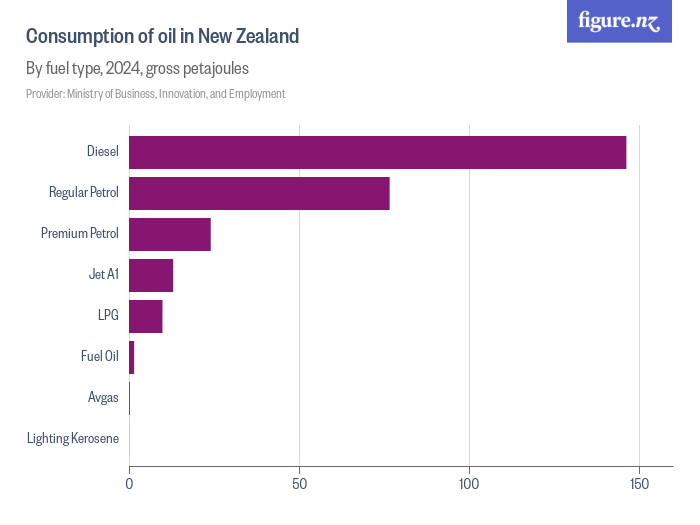
Chart via figure.nz, showing Consumption of oil in New Zealand, by fuel type (2024).
Yes, diesel and petrol, at the top of the chart, do have off-road uses. But road transport is the largest use case: 74% of diesel and 98% of petrol is used on-road. [2021 EECA report, see footnote]
The road to resilience
By volume, our biggest area of vulnerability is road transport – which includes private cars, trucks and vans, and other machines. As a country, we own a lot of cars and we drive a lot, not least because we have not invested well in alternatives, nor shaped land-use more smartly to make more productive less driving-dependent urban areas.
So, in the event of an oil shock, the question becomes – how can we help shift as much of this as possible, as quickly as possible, away from fossil-fuel dependency?
Every car, bus, truck, service vehicle, and train that runs on electricity is reducing that vulnerability. Kudos to councils up and down the motu who have been electrifying their bus fleets, we are doing pretty well, but need to accelerate this further. This has been a bright spot from Auckland Council (Climate Action Targeted Rate) and Auckland Transport. Both Auckland and Wellingtons trains are fully electrified, and so are significant amounts of their bus fleet, and both are beginning to work on their ferries, though Auckland has recently back-slid on this, frustratingly. How different this crisis would (will) be when we have 100% electric PT fleets!
The heavy road fleet is significantly behind on this. With so much time wasted and effort heading down the Hydrogen boondoggle. This sector needs a big hurry up, perhaps this crisis may be it? But unfortunately because of the slowness of this sector to transition we are all affected through supply chains. Sure I can ride my e-bike or drive my e-car to the supermarket, but what is there is still dependent on fossil fuel road freight having sufficient supply at a reasonable cost. China’s rapid transition to e-trucks is actually helping the global diesel shortage by significantly reducing demand, such is their scale. We are a technology taker, we have the opportunity to coattail on the pioneering efforts of other nations. If we are smart enough to change.
But here we are, so what to do?
The actions fall into two main categories:
- incentivising mode shift – i.e. encouraging alternatives for both people and freight.
- reducing wasteful use – so that any fossil fuel people do use, is used more efficiently.
Both are useful steps towards full transition from combustion of volatile molecules to electrification freedom.
We can also sort the actions into those that can be taken quickly, for immediate impact, and those that may take a few months to roll out.
Here’s the headline list, starting with the quickly achievable ones:
Short term – achievable within weeks
- reduce top speed limits [leaving aside the awkward question of allowing e-vehicles to still drive faster]
- drop fares for public transport
- improve priority for buses and road freight, in key locations
- expand public transport services, extending peak-hour timetables into the off-peak periods
- quick schemes to finance/ subsidise e-bikes
- set up incentives for sending freight by rail
- remove the perverse double-cab ute tax breaks (which have been incentivising people to buy bigger and thirstier vehicles, regardless of need)
- enable more work-from-home (can this be incentivised more than at present?)
Medium term – enduring actions
- e-truck financing scheme (all commercial vehicles and plant included here)
- “electrify the farm“: finance the farming sector to electrify their machines and vehicles, including with solar and batteries
- tighten Clean Car Standard (using real price signals to reduce fuel use on private vehicles)
- incentivise EV purchases – e.g. a return to the very successful feebate (with improved design)
- electrify the trains – fund or finance battery/overhead electric locomotives, for freight and intercity passengers (this sits with KiwiRail)
- quickly complete minimum viable safe bike networks in our cities, as was done in Seville.
What we shouldn’t do
- discount fuel taxes – exactly when we need price signals to function best is no time to undermine them. Way better to address equity issue by decisively improving all the alternatives.
- delay road pricing – another driving reducing price signal.
- invest in further infrastructure that commits us to the global fossil fuel system.
Let’s take a look at each of these actions in turn, to see what’s required and why they’re a good plan.
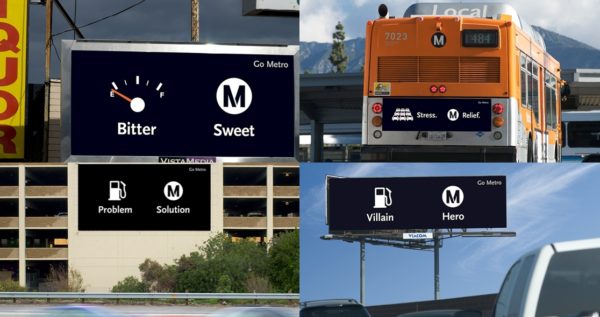
Los Angeles Metro Advertising Campagin 2008
Short Term Actions
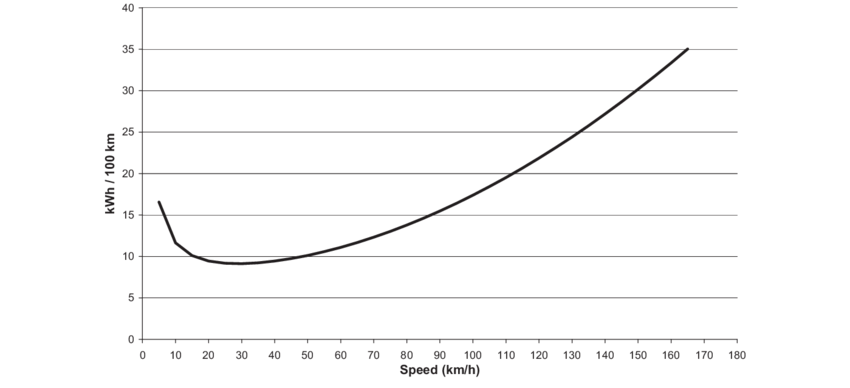
1. Drive slower. Yes, this saves energy, as well as reducing pollutants and lowering the risk of deaths and injuries. Sorry if any car-brained reckon-havers refuse to believe this, but it’s all true. Furthermore, reducing top speeds will not negatively impact economic productivity, either. In fact, in many instances, it will decrease journey times – due to steadier traffic flow, safer following distances, and fewer network disruptions from crashes. It’s just physics: due to drag, going 10 km/h faster, from 100 km/h to 110 km/h requires significantly more than a 10% rise in fuel use.
2. More affordable Public Transport. All over New Zealand, but especially in the main centres where most people live and work, public transport is already way better than you might realise, especially if you haven’t tried it for years.
Yes, of course it can keep improving – but it is already usable. It is however, relatively costly for daily use. So, reducing the cost barrier to meet this emergency is a quick and good idea.
What would that look like? Lots of options. Half-price fares across the board, as the previous government did. Or say a flat $1 fare per trip or per zone. Or even a more targeted option, like free for under 25s.
Whatever form it takes, some form of cost relief would be a quick and useful intervention – as long as it’s government-funded. This cost cannot be made to fall onto local authorities.
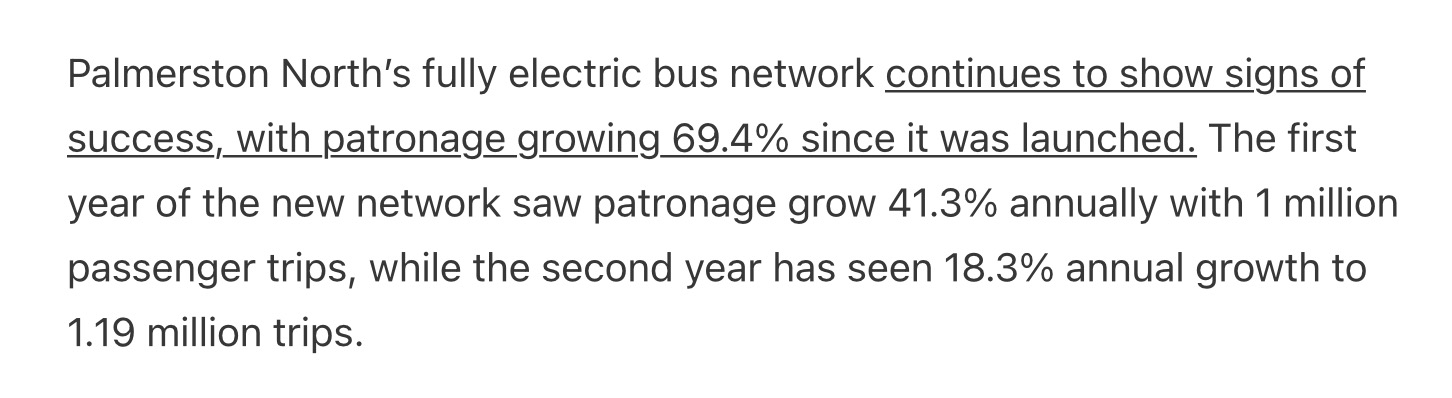
Of course, this will work at scale in our biggest cities. But it’s also a good option for our steadily improving provincial towns and smaller cities, which have made big strides with electrification and network redesign – e.g. Queenstown, Nelson, Whanganui, and Palmerston North:
3. Give better priority to buses and freight. Certainly in Auckland there are significant bus routes with, for whatever reason, key gaps where buses should have priority, like the Harbour Bridge, and along SH16.
Moreover, to keep deliveries running efficiently, freight lanes can be added to key routes, e.g. to ports.
4. More frequent Public Transport. Auckland’s bus network is pretty thorough for all sorts of journeys, and much more use could be made of it with the right incentives and available improvements.
We already have enough vehicles to run the peak timetable, where buses come more often. So, assuming driver availability, an easy way to increase the capacity and usefulness of our existing bus service is to extend those frequencies beyond the peak hours.
This would give people access to reliable “turn up and go” journeys as an alternative to jumping in the car, across more of the day.
It’s always surprising to reiterate, but most of the car trips we normally make aren’t traditional commuting trips anyway – they’re people running errands, visits, collecting children, and so on. Only around 20% of journeys are to and from work. So, during those “inter-peak” times of day, it’s just as important to have good, frequent public transport as an option.
Naturally, you’d extend the associated bus clearways as well, so the buses can run efficiently at all times.
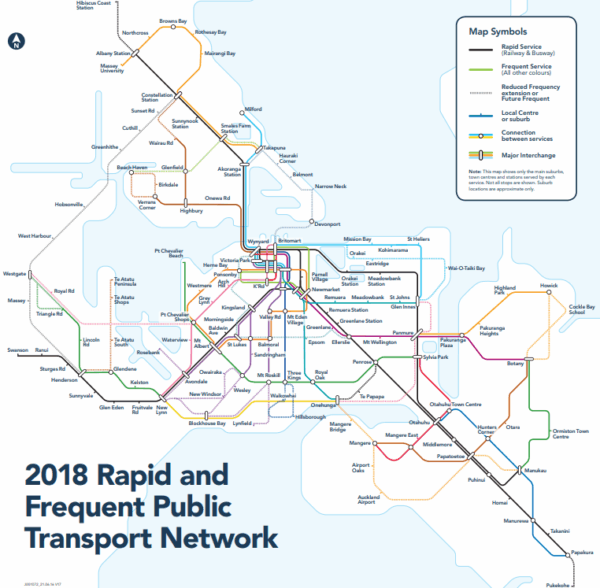
Auckland rapid and frequent bus network 2018. Image credit: Auckland Transport.
5. More access to E-bikes. Electric bikes are a viable substitute for many car journeys – one I use pretty much everyday. We know bike use for transport creates net gains for society, so on every level this is one to encourage.
Everywhere in the world where incentive schemes are in place, they’ve increased uptake. Additionally because e-bikes are very affordable car substitutes, they have an important equity role too – see this NZ research.
Cities may also want to talk to e-mobility providers about expanding their options and fleets. The shared-use e-bikes (Lime/ Flamingo() seem to have vanished from Auckland’s streets in favour of stand-up and sit-down e-scooters, whereas other cities have a range of options.
6. Empower the shift to rail freight. Rail freight, while still powered by diesel in New Zealand (even where there are live electrical wires overhead), is still significantly more fuel efficient than road freight. Let’s work with the industry to use pricing mechanisms to sweat those assets.
7. End the double-cab ute incentive. No Ponsonby accountant needs to be subsidised into a Ram Bomber, or whatever the latest vast planet-eating, kid-crushing, fuel-guzzling, frailty-compensating behemoth is called.
8. Let people WFH. Some love it, some hate it, we know PT trips are in many places still lower than before the pandemic, I am not aware of NZ evidence that driving has been significantly reduced through WFH. Please link in comments if you know of any.
Medium Term Actions
This is where we move from the reactive to the strategic. This is about structurally reducing our dependence on liquid fossil fuels, for the longer term. ur economy has a structural addiction to fossil fuels which is way larger than it needs to be. Regardless of the scale and duration current crisis we should be reducing this flaw as quickly and cleverly as possible. Pricing signals and regulation work, this has been proved here. Some incumbent players will have to change, and they will, so long as we are clear they need to.
As Shamubeel Eaqub puts it [here]:
Electrification is energy security
And of course there are endless co-benefits of reducing oil dependency and vulnerability. Reducing carbon emissions, fewer local pollutants and brake-pad particulates, noise reduction in neighbourhoods, fewer deaths and injuries on our roads, fewer deaths from transport pollution (remembering that the latter causes ten times as many deaths per year as road crashes do).
In as much as we achieve this through mode-shift in urban areas, then driving will be more efficient for those that choose to continue to do that, whatever the drive train of their vehicle.
We’d make more efficient use of existing resources by home-shoring our energy sector. Every substitution of locally generated electricity for imported stinky fuel helps support local jobs, and shores up the supply chain in the electricity sector.
A far healthier alternative to sending billions and billions of hard-won foreign exchange dollars offshore, year after year, to keep Middle Eastern princes in gold taps and bone-saws. We can and must do better with our common wealth.
To the list:
1. Electrify the truck fleet. E-trucks of all sizes are available, and deliver whole-of-life-savings to their operators, as well as all those social co-benefits listed above. But they are expensive. So the government can and should launch a low-interest long-run financing scheme to enable our trucking and service delivery operators to transition to home-grown fuel. Here is but one example
2. Electrify the farm. The same applies to the agriculture sector, which can and should electrify. We will all be richer when this key sector is running on its own source of power. Finance this transition! See Rewirering Aotearoa for all the math.
3. Accelerate the Clean Car Standard! We need a sector-level incentive for everyone to clean up their fleets. As it is, we risk becoming the dumping ground for poisonous, fossil-fuel-hungry vehicles as the rest of the world cleans up. Notably, Australia has just copied our original clean car scheme – sadly, one that’s already been weakened by the current government, which is even rumoured to be thinking of abandoning it altogether. Very very short-sighted, and we should expect better from our political leaders.
4. Incentivise EVs. Here’s where we need to get “back on track” to evidence-based policy. We have run a full-size test of a feebate scheme, and it worked:
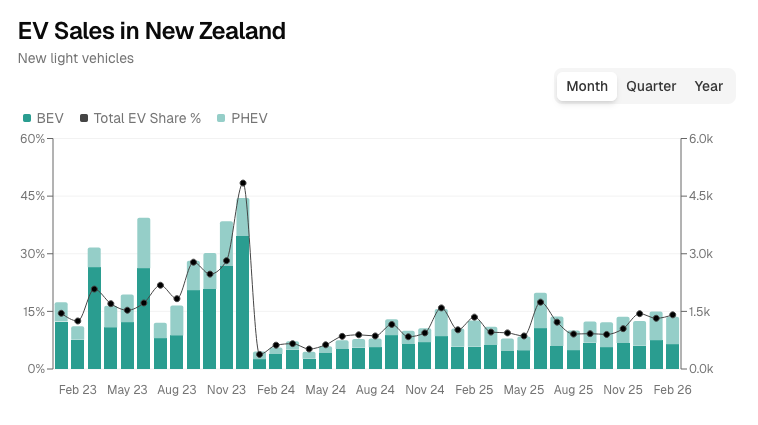 Every electrified vehicle in the country takes stress off the liquid fuel supply for all the remaining un-electrified ones. Any government that can’t see the vast economic opportunity here to lean in and accelerate this transition is simply not looking widely enough.
I am open to whatever model of incentive is preferred, but what I like about the feebate, or Clean Car Scheme, is that it included sticks as well as carrots, and was thus self-funding. Or certainly can be – the fees and rebates do need to be set to balance.
We’ll need some mature political conversation around this one, including a disavowal of the silly “ute tax” campaign lines from the last election, which as everyone can see (in very short hindsight!) served none of us well.
5. Electrify the trains. KiwiRail runs a lot of diesel freighters under wires in Auckland, Wellington, and on the North Island Main Trunk. There are a couple of ~80km gaps on the NIMT, and no wires at all on the busy East Coast Main. But also a lack of electric loco to use these assets. Very poor asset utilisation.
KiwiRail has a good plan to electrify their freight services with a combination of judicious new overhead lines and dual mode-battery electric locos. But even before this is in place, as noted above, rail freight is more fuel-efficient, so let’s maximise that benefit, as we further electro this important system.
Lastly.
Let’s treat this event as the wake-up it surely is.
Energy is life, it is the entire basis of our prosperity and well being. New Zealand is a net fossil fuel importer, and will remain so. This is not only a huge and recurring cost on everything we do, it is also a dangerous vulnerability. As well as causing many associated negative effects, particularly local and global pollution as a result of burning the stuff. It is clearly in our national interest to reduce this structural vulnerability as much as we possibly can. Up until this century, there were fewer opportunities to do so, especially in road transport. New and constantly improving and cheaper electrification technology now offers an affordable, scaleable and phase-able way out of this increasingly fraught bind. These facts hold whatever your politics.
Electrification is surely the ultimate cross-party strategy. With so many benefits. Here is Nick Smith, former National Party minister, now mayor of Nelson, urging people to make choices to avoid the fossil fuel use. We will all be better off when more New Zealanders have that choice as the best option in more of their daily life:
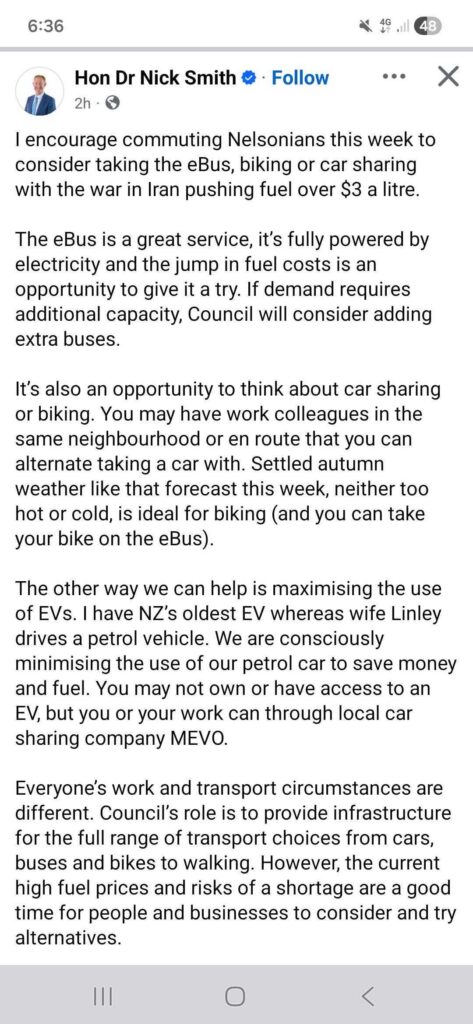
Onward, powered by lovely locally generated electrons. Combustion is so last century.
Footnotes
On the dominance of road transport as a use-case for diesel and petrol, see this 2021 report from EECA (Energy Efficiency and Conservation Authority):
In 2019, New Zealand used just over 6.9 billion litres of petrol and diesel (3.2 billion litres and 3.7 billion litres respectively). Although most of this fossil fuel is used on New Zealand roads, it is estimated that about 26% of diesel and 2% of petrol are used for off-road applications across various sectors. These off-road uses of liquid fossil fuels accounted for 6.6% of New Zealand’s Total Consumer Energy in 2019, and 9% of New Zealand’s energy sector greenhouse gas emissions in 2018. This represents 3.89 million tonnes of CO2-e per year.
Greater Auckland’s work is made possible by generous donations from our readers and fans. We’re now a registered charity, so your donations are tax-deductible. If you’d like to support our work you can join our circle of supporters here.

 Processing...
Good post.
Thank you Patrick.
It is also significant how actions by our current government have made implementing a lot of what should be quick mitigations, much harder.
These are not failures by mere inaction. They have been deliberate actions to retain fossil fuel dominance.
Council’s abilities to set speed lower speed limits very much impeded.
Council’s abilities to facilitate micromobility, cycling, impeded.
Auckland Council, loosing the ability to tax fossil fuel and use the money to enhance mode shifts away from fossil fueling.
Sadly just reads like a list of things that will never happen. There is very little hope of evidence based decision making happening over the past few years.
“With so much time wasted and effort heading down the Hydrogen boondoggle.” – how does Greater Auckland propose that we reduce Diesel use? Yes some freight could be moved to trains and yes they could be electrified, but I suspect a small percentage. The train doesn’t run from the farmer to my nearest supermarket for example. I thought Hydrogen had great promise in this area.
It does not.
https://medium.com/the-future-is-electric/hydrogens-death-march-accelerates-d7374bed8d54
According to AI:
Pros: Hydrogen fuel cell vehicles offer quick refueling times (similar to diesel) and long operating ranges of 800 km or more. They offer high payload capacity compared to battery trucks.
Challenges: The primary obstacle is infrastructure scarcity (refueling stations) and the high cost of producing green hydrogen, which is currently more expensive than diesel.
Future Outlook: Projections suggest hydrogen fuel prices could drop significantly within 5–10 years, potentially making them competitive with diesel.
Comparison: While batteries are winning for short/medium haul, hydrogen is deemed better suited for heavy-duty, long-haul trucking where weight and fast turnarounds are crucial.
Well AI is reading the PR of the subsidy-farmers from the Oil and Gas sector who are talking it up and defrauding governments for handouts via this nonsense. Note that it’s all about what might be the case in the future, battery and traditional overhead electric tech outcompetes these fantasies here and now.
The key facts are simply the physics and economics. Generating renewable energy, converting it into H2, storing, shipping and distributing it, then turning it back into electricity to provide motive power, is so wasteful and expensive that everywhere it is being out-competed by simply using electricity directly.
The other method is even more wasteful, costly, and non existent. Drilling for gas, with all the methane leakage etc of that, cracking the carbon molecules off at great expense to leave H2, storing that CO2 somehow for ever, then moving that very difficult molecule, etc, and eventually turning it into electricity for use. Can’t compete with just using electricity stored in batteries directly.
H2 has no advantage in land transport, none. These are the facts.
It has big advantages in terms of storage, such as a much higher energy density than batteries, and much quicker to refuel. The main disadvantage is that there is a lot more energy wastage, although because it can be transported that might not be an issue. For example we could use hydrogen produced cheaply from a nuclear reactor in the middle of nowhere in China.
I’m certainly not an expert in this area so I’ll shut up now.
No it’s an absolute nightmare to try to store or move. Remember it is the smallest and least dense molecule on the periodic table, it leaks from everywhere. It is not just a question of whacking H2 into existing gas or oil pipelines, no can do. It also goes boom quite easily. It needs a whole new extremely expensive infrastructure.
Fossil fuels are only competetive because of first mover advantage, there is an existing vast global system already built to support it. This does not exist for H2. Nowhere can it compete on cost.
Anyway both charging speed and range are entirely solved issues, plus were always exaggerated as problems. Current (not future) cars and trucks with megawatt charging can add 1000km range in minutes now. If it’s really needed.
Why waste about 25% of energy in conversion and a technology far from developed, when a wide range of heavy electric vehicles are already available – see for example https://etrucks.co.nz/december-2025-newsletter/ ?
A much higher energy density, but a very low mass.
That means you have to compress the hell out of it to have a meaningful tank of h2, like fifty times the pressure of an LPG tank.
The death blow to Hydrogen as a driving force occurred to me way back when the US President advocated for it – that is, President George Bush. I think it was the dumb, second one, with a W. He was pushing for Hydrogen way back in the 90s, and it got dismissed as a foolish concept then, and things haven’t really changed much 30+ years on. It is still a really dumb idea.
Do you think your previous role as director of NZTA has given you a bias toward supporting road-based transport over rail?
No.
Incredibly stupid, ill-informed comment from Anon. Do you know anything about Patrick? Do your homework buddy, and you will see just how wrong you really are.
I’m not your buddy, pal. Good job you’ve come along to add such an intelligent and well informed comment to make up for it
first the ‘Anon’ who was religiously insistent that the only modes of rapid transit were heavy rail and busways and smeared all light rail as “a 30km/h MOTAT tram”, now this ‘Anon’ of the same username who upholds early 20th century museum trams as equivalent to modern articulated light rail and treats busways and EVs as a black-and-white “bad” thing…
And how am I supposed to know that you’re the same Burrower commenting on last week’s posts?
Rational deduction and critical thinking skills.
The previous Anon’s writing style and opinions were diametrically opposite to yours – essay-length comments, disdain at the concept of light rail and a refusal to acknowledge that it wasn’t just “a slow vintage tram with stops every few hundred metres like a bus.” They also lauded busways, claimed that a 90km/h busway could be built at-grade through inner suburban Christchurch for cheap, and supported maintaining street parking for cars.
Jeez louise, sounds like I struck a nerve huh
i dunno, you seem more ticked off by people suggesting battery electric cars and buses are a net good compared with petrol/diesel vehicles
i’m just observing an interesting pattern of two commenters with the same name having opposite opinions
I mean yes you are correct, but my main source of annoyance is that I can’t work for the railways cause the idiotic government-consultant circlejerk insists that all fiscal spending on infrastructure must go to the roads and the airports
and your solution is… to ask rude and invasive questions of a fellow transit advocate while accusing them of being pro–road over rail?
Have you seen the state of our railways?
And —- the ferries? It’s clearly a big issue
what is your fixation on presenting the replacement of ICE buses and cars with EVs as a black-and-white binary that takes away from rail infrastructure improvement and upkeep?
How much does one (1) electric bus cost
And when are those illusive electric trucks due to arrive and save our road freight industry
okay so you’re just a conspiracist who’s not interested in having an evidence-based conversation about how lower operating costs offset the 30-50% increased purchase cost of a BEV bus. Not to mention benefits like reducing air pollution and the corresponding costs to the healthcare system
my gut instinct was right, just like the other Anon, you’re a rigid-minded mode dogmatist.
And the saddest thing is mentalities like yours are a big part of why there’s so much infighting in transit advocacy circles. Patrick’s own article shows he supports freight going by rail rather than road for long haul stuff, and the point about EV delivery trucks and vans is in context more likely for last-mile delivery services within urban areas. But you can’t see that because of your biases
Ok then, what is your opinion on why won’t the government spend any money on improving the railways, and why did Kiwirail get another 200m budget cut this year?
it’s a bad thing and I intend to vote for a political party who will reverse NACT’s anti-rail course in the next election
Question to you: how is making accusations at a person on a transit advocacy forum going to help? Do you think Patrick Reynolds is personally responsible for the neglect of railways?
If you read my comment again, I was asking a question not making an accusation
A hostile and insinuative question, then.
Speaking of questions: please answer mine.
Lots of questions asked, which ones specifically do you want answered
Q: “And your solution is… to ask rude and invasive questions of a fellow transit advocate while accusing them of being pro–road over rail?”
A: I am asking pointed questions about what I perceive to be a bias of Patrick’s, because as a previous director of NZTA he will have many government contacts with power to shape fiscal policy.
Q: “What is your fixation on presenting the replacement of ICE buses and cars with EVs as a black-and-white binary that takes away from rail infrastructure improvement and upkeep?”
A: The government’s infrastructure spending is not unlimited, and different priorities compete for funding. NZTA’s mandate is to build roads and manage compliance of the vehicles that use said roads. They compete with other government agencies (Kiwirail) for their slice of the transport funding bucket.
Q: Question to you: how is making accusations at a person on a transit advocacy forum going to help? Do you think Patrick Reynolds is personally responsible for the neglect of railways?
A: Nobody is solely responsible for anything in this world. I wanted to question Patrick’s biases as a former director of NZTA to help understand why this our government will not explicitly support investment in rail infrastructure.
I share your frustrations about the lack of priority and funding given to rail, Anon. I’d say many readers do. However, perceiving Patrick as being in any way anti-rail is bizarre, given his involvement with Greater Auckland at the time the Regional Rapid Rail was introduced: https://www.greaterauckland.org.nz/2017/08/17/introducing-regional-rapid-rail/ Patrick’s experience with WK – and the frustrations of decision-making in such a boardroom – undoubtedly informs his writing.
What prompted me to ask the question about whether he has a bias toward supporting road-based transport over rail is because in his list of recommendations in the article above, recommendations #1, 3 and 4 are for more road-based transport, and only recommendation #5 is for improvements to rail
which makes you look even more closed-minded because of the road-based ones, many of them are focused on giving priority to buses over privately owned cars, disincentivising the purchase of vanity utes, reducing speed limits for safety and fuel economy, and rolling out a bike lane network.
These are short and medium term suggestions. What do you suggest in the short and medium term to reduce fossil fuel usage that involves trains?
Patrick specifically mentions
– incentivising freight by rail over roads (short term)
– electrifying rail lines (medium term)
What else do you see?
Bring back the trams
But it’s all long-term considering the state of disrepair our rail network is in. We would also need to double track because current throughput isn’t enough and rebuild all the demolished regional passenger stations.
And by that I presume you still somehow believe that *modern light rail* should somehow cost as little as a museum tramway takes to build?
Don’t know how much it will cost, but in terms of energy security I think electric railways are a better investment than more roads with battery powered road vehicles
retrofitting existing roads to have bus lanes for battery-electric buses isn’t “moar roads” though.
But i guess you’re advocating for light rail as in a restoration of the old tram network to replace buses, rather than a second mass transit spine to complement the heavy rail network where it doesn’t go to Māngere, Huapai, and Hibiscus Coast
Yes, light rail and trams would be a great addition for cities. In an ideal world, we could even have both, cities like Berlin do. But that is definitely not a medium-term project.
Wrong, I’m trying to get Whanganui’s tram network reinstated
And again – you’re treating this as such a black and white thing
BEVs don’t require imported oil, they run on locally produced electricity; and the technology for the batteries themselves is improving apace. Recycling the batteries at the end of their lifespan is also an increasingly viable option.
On the transit front, BEV buses and bus lanes *have their place* in the public transport ecosystem. The focus on a modern light rail line running along Dominion Road to Mt Roskill, Onehunga, Māngere, and the Airport is a holistic one to do as much with solving bus capacity and crowding in the city centre as it does to bringing rapid transit to suburbs that don’t have it, being the least expensive and most flexible rail-based transit mode for the geography and locale, enabling transit-oriented intensification, reducing car dependancy by taking road space away from cars, the benefits of green tracking, etc. etc.
okay so why are you doing this on an Auckland-based transit blog? Are you trying to claim that electric buses in Auckland are a threat to a museum tramway operation in a different city?
Patrick R with a road bias? You must be new to the blog. Pedestrianisng Queen St, rail options to the airport from Otahuhu, heavily pushing LRT, the folly of car lanes over the AHB, etc etc. Just search his posts for about the last 10yrs, if not more.
NZTA is – or should be – more than just road focused and I am going to assume that’s why he joined the board.
More broadly, the quickest wins
in re-setting our transit/transport in the urban centers; get rid of parking on arterials and reallocate lanes. Implement buses, cycleways, or both.could have a few major wins by the end of the month.
I’m doing this on the Auckland blog because it’s a national problem not a local one, and the government is giving no priority to the railways so we need to make some noise about it – the squeaky wheel gets the grease. Also I’m on this blog because I previously lived in and worked on projects in Auckland so have an interest in that regard too
well, there are far better ways to communicate or have discourse about fiscal responsibility in transit spending
than passive-aggressive insinuations of pro-road bias, blinkered opposition to BEVs and electric buses (which, yes, while not as good as rail based public transit, are needed for reasons of realistic expectations. We can’t expect everyone to ditch cars tomorrow, or to reconstruct an isthmus-wide track network overnight. Enabling the replacement of the ICE vehicle fleet with BEVs in tandem with improvements to public transport and active mode infrastructure is the right evolutionary response to take.), and the foolhardy suggestions of connecting single-track museum tramways as the basis of a future light rail system isn’t exactly the best look or the basis of a constructive conversation
Prioritising investment in buses over passenger rail for public transport is how we’ve ended up with the North West busway business case, which is in essence a massive new motorway. NZ’s limited labour force being so focused on building roading and air travel infrastructure is the reason we aren’t building railways, just look at the funding split between NZTA and Kiwirail. And because the railways are so old and neglected they aren’t much good for freight or passenger transport. It’s a vicious cycle
…Patrick’s for electrification of the bus fleet also means the local bus fleet for connector routes and local routes, not solely for the Northwestern Busway or Northern Busway.
the problem is noone here i think would disagree with your concerns about the lack of spending on rail, or that the NW busway should have been either a rail based mode or should have been delivered with the 2012-2017 Northwestern Motorway works, or that we need a nationwide programme of rail works to improve track quality so that train speeds are only limited by the geometry and curvature of the tracks.
if not for your tantamount accusation that Patrick Reynolds is “biased towards roads” and your fixation with claiming that a modern urban light rail system should be built to the same standard as a museum tram line. You’re coming into this debate with a degree of hostility and dogmatism.
Yea well I’m frustrated because the local tram shed and rail operators get no support from government, who are more interested in reshuffling the local bus routes and pouring more money into the never ending money pit that is repairing the roads
then you have my condolences, but this isn’t the place for you to get a productive discussion or sympathy for that, especially if your blame game extends in an infighting way to fellow modes of public transport like buses.
No such thing as bad publicity
Thanks, Patrick. Timely post. As an EV driver l strongly support reducing the top speed limit to 80km/h NOW as the first in a series of steps that escalate NZs response as this crisis gets worse and sucks us all in. I do not think EVs or e-trucks should get a free pass on this one.
Don’t you think it woudl be a great incentive to use EVs if they could stay at present max speeds and fossil vehicles had to max at at 30km slower?
Tell me you don’t drive and EV without telling me you don’t drive an EV.
We don’t want to go faster than everyone else, it zaps the battery which costs us money.
Speak for yourself, i like going fast in my EV (when safe to do so, i.e. not on residential streets) – the electricity is dirt cheap on my plan.
Don’t you think it woudl be a great incentive to use EVs if they could stay at present max speeds and fossil vehicles had to max at at 30km slower?
No! Speed differentials promote unplanned interactions ie; accidents. Nice idea, but no way to implement safely.
” It’s just physics: due to drag, going 10 km/h faster, from 100 km/h to 110 km/h requires significantly more than a 10% rise in fuel use.”
It is physics but not so much drag. It’s due to the formula; energy = 0.5 × mass x velocity^2. The square of velocity means exponentially more energy is needed the faster you go. In saying that I believe most ICE cars engines are optimized to travel most efficiently at 80km/h. So lowering the limit to 80km/h would be great for efficiency!
But that is just the kinetic energy “stored” in the moving vehicle. As long as you don’t accelerate, this energy would remain constant if it wasn’t for tyre friction and air drag. Now, the drag equation (https://en.wikipedia.org/wiki/Drag_equation) also goes with u^2 (relative velocity of air and car).
Electric cars (and hybrids) will also be able to charge their batteries when braking, effectively converting the kinetic energy (0.5*m*v^2 ) into energy stored in the battery (with some loss when converting). The energy lost to (used to overcome) the drag is simply gone.
I have not seen the graph kw/100 km against km/hr before.
It shows what we already should know, and demonstrates the complete fallacy of the “my car is designed to be most efficient at 110kph” arguments
It, literally, graphically demonstrates, that their are two killers of fuel efficiency; Congestion (why otherwise would you motor at walking/running speeds?)
And higher speed motoring.
Mode shift would reduce congestion penalty. Less vehicles on the carriageway.
Speed limit reductions would reduce the friction penalties.
And importantly mode shift, would massively reduce the fuel penalties of the absurdities of using 1500kg vehicles, to move 1.2 x 70kg people.
If they reduced the average speed by 20% then we would need ~20% more truck drivers / couriers / etc to perform the same output. That would increase the cost of everything that is transported, and those extra people would also be consuming energy.
Given the speed limit for heavy vehicles is 90kmh, the average open road speed isn’t anywhere near 100kmh anyway and many transport journeys, especially couriers happen in urban areas I don’t think it would be remotely close to an extra 20 % of drivers needed.
BS.
You are failing to account for the loading unloading times and mandated and otherwise, non driving breaks.
And there is very little correlation with posted speed limits and average speeds attained. Average speeds are much more affected by the speed of the vehicle in front, and road conditions.
It sounds like the speed limit change wouldn’t make any difference then?
No Jimbo.
Lowered speed limits reduce peak speeds.
And peak speeds unduly influence overall fuel consumption.
Indeed, if the average speed reduces, then cost increases. No one suggested to decrease the average speed limit though. How would that even work? (Others pointed already out that the suggestion is to reduce the speed limit which is the max speed, which in general is reached only briefly and also has only a miniscule impact on the average speed).
Note that your argument work both ways. If we increase the average speed then cost decreases. So we should actually close all roads for private vehicles, so that transport vehicles have a higher average speed reducing cost (e.g. a bus has a much smaller roundtrip time, so one bus driver can do a lot more trips and the passengers are all faster at their destinations). That is btw one of the suggestions in the article though on a much more smaller scale (“improve priority for buses and road freight, in key locations”).
I am sure you will get it if you just do a little more of your own research.
I get it and yes it would save a small amount of fuel but not much. It would only save the small efficiency gains for the parts of a trip where people are driving over the new speed limit, and assuming we are only talking about the open road speed limit, that’s probably a fairly small proportion of journeys. If we have 50 days left, that might make it 50.5 days.
Closing all roads for private vehicles would obviously make a difference, but that is more in the desperation territory isn’t it?
The graph is for EVs because it is in kilowatt hours. I think the efficient point for ICEs occurs once you get into top gear. A speed reduction to 80 would still save fuel.
There is plenty of evidence that reduced speeds reduces accidents.
Enough evidence indeed for insurance companies to reduce premiums for drivers living in Wales because the blanket speed limit reductions there saved them money, by reducing accident payouts.
And accidents are a significant cause of congestion, and even significant extra mileage on detour driving as evidenced recently on accident induced closures of the Lindis Pass and Kaimai crossing roads. Entailing long detours.
The problem for the current government is that reimposing speed reductions would highlight how irrational their earlier raising of speed limits was, in a world of declining fuel security.
Populism, rather then rationality seems to be their defining trait.
Even as evidenced on this forum.
The depressing thing is that the government seems to be taking a ‘wait and see’ approach, if Nicola Willis’ comments on Q&A yesterday are any indication. They’ll only take action at the last possible moment, and by then it’ll be too late to mitigate the worst of the effects. It does seem like the citizenry are going to have to start taking preemptive action themselves.
Unfortunately the time to do anything about this was when they were elected. More fuel storage, more electric cars, etc.
I doubt any of the “achievable within weeks” will make any significant difference to the situation.
I think this govt is “taking a wait and see” approach as they are absolutely petrified of any blowback from perceived impositions on people’s freedom to drive whatever they want wherever they want at whatever speed. Such restrictions would smack of Labour’s covid response and they’ve spent years mocking that so won’t go there. Caught in the hubris of their own making.
Patrick you asked for “NZ evidence that driving has been significantly reduced through Working From Home ”
But surely what we know about induced driving is that any reduction in road congestion from people WFH (or using PT or biking) will be eaten up by attracting more people to drive. This is why we desperately need congestion charging and I would suggest more lanes dedicated to trade vehicles only (yes radical idea but other people in cars have options to their driving – most trade vehicle drivers don’t. – so not just heavy trucks but tradie vehicles) as well as bus lanes – in effect to keep the car lanes congested.
Reducing speeds isn’t just for the open road, either – safe speed areas can also reduce fuel use. A steady 30km/h is saner and safer than drivers alternately accelerating and braking, in a futile attempt to “flow” at 50kmh through neighbourhoods full of people, schools, shops, and traffic lights.
Hopefully Auckland Transport has all those old 30kmh signs stashed in a handy warehouse, ready for the inevitable return to evidence-based policies.
Would be interesting to see if there was a big spike in fuel use when they were removed…
Lets make New Zealand into one big urban metro integrated ‘tap’ and travel bus, passenger rail and local ferry (excluding Cook Strait ferry services) public transport network connecting communities across all 16 regions with a potential catchment of approximately 90% of the country’s population.
The infrastructure is in place, the Land Transport Management Act has been amended to allow regional councils to work together on inter-regional public transport project’s and the rollout of the national contactless ‘tap & travel’ payment system – Motu Move is under way.
So why aren’t we talking and promoting the concept.
I wonder if one of the factors inhibiting rail freight is the fact that it is run by a Government monopoly (by inclination risk adverse and – conversely – hampered by having too many functions on its plate).
This puts Kiwirail at odds with the trucking industry and surely limits opportunities for both rail and road modes of transport to complement each other.
It might be more efficient to open up the rails to private competition (whilst retaining Government ownership and management of the rails themselves).
This would allow trucking firms to get skin in the game by being able to exploit the possibilities of rail more directly (this may limit – or at least redirect – the impact of their lobbying wars which are to everyone’s detriment).
Many readers may reflexively be against privatisation of the railways and point to the UK as a particularly salient example. Its worth noting that these failure tend to be associated with privatised passenger services rather than freight (UK freight volumes continue to grow).
Doctors Spins – Don Braid Main Freight CEO made a comment on Q&A, he mentioned that Kiwirail needs to get their business up to speed.
Main Freight is one of Kiwirail major customer’s.
Kiwirail is running on a skeleton crew while the Government spends all of its infrastructure budget on their darlings NZTA and Air New Zealand, because the cost to repair our neglected rail network is a massive and scary number so they would prefer to keep ignoring the problem. Also, business no longer build rail sidings in NZ even when their business directly back onto a rail line.
My hope would be that there would be a more persuasive case for appropriate investment if the tracks were able to be utilised by private companies.
Anon – That is why the national rail network needs to be treated as the country’s second strategic, national ‘open access’ land transport infrastructure asset, to move more freight and people to communities in the 14 of the 16 regions (approximately 85% of the country’s population), that currently have active and mothballed rail connectivity, in a sustainable, environmentally friendly way,
Privatised Rail in NZ was a disaster for both passenger and rail freight.
Even the coal trains across the South Island very nearly ceased, placing the whole industry in jeopardy, not because of a lack of demand, but because the infrastructure was worn out with no private reinvestment
Well said.
The government bought Kiwirail back for $1 after the private sector owners ran the assets into the ground.
And then the government has continued to run the assets even further into the ground
The railways were already a disaster at the point of privatisation and had been poorly run (and run down) for decades.
The example of the farmer’s lost tractor in Richard Prebble’s “I’ve Been Thinking” is a classic example of how wasteful, cruel and unnecessarily bureacratic state-run industries can be (tendencies all exacerbated by Union interference).
With that said, I do agree that the infrustructure should have been kept in public hands (in much the same way as the United Kingdom does via Network Rail).
I think KR should be split into KR (for profit running trains) and Ontrack 2.0 – which essentially maintains/controls the tracks and manages access – not for profit. Then private companies/regional councils wanting to run local trains/whoever could run trains on an equal footing. Obviously most won’t, but you’d probably see Mainfreight/Fonterra and some of the mining companies run it if KR doesn’t shape up their services to them.
Thanks Patrick. Well written, but old news.
The solutions you proposed are nothing new and have all been discussed, debated forever and yet here we are. $3 petrol, and Gull stations with no fuel left. Inevitable.
Instead we get the following “solutions”. – Article from 5 March 2027
https://www.rnz.co.nz/news/political/588668/government-considering-scrapping-entire-clean-car-standard
Until Wellington and our political minders start seeing more than a few days ahead, we’re stuck in the more diesel (or LNG) time warp.
This is a transport blog. We cant have any proactive change if our voters are happy with status quo, or avoiding climate action, or expensive PT.
This is the problem that needs solving, before the lights go out.
*5 March 2026 – ha!
Wonder if we should lean into the ideology behind this coalition. Make one lane on every motorway/arterial a VIP lane for cars, all the other lanes for PT and walking and cycling users only.
Great post Patrick, thank you.
I do think WFH has led to less driving. Petrol for road transport fell 16% from 2019-2022 and has been steady since then, while diesel has risen steadily. The fall in petrol use is too big to be just EVs, improved fuel economy etc. (Since 2019 fuel economy in cars is –10%, fleet size +7%).
The ‘consumption of oil’ chart doesn’t include international aviation, which is another 60 PJ and is a sector very exposed to fuel prices.
The ‘drive slower’ chart I think is the one for EVs, not petrol vehicles. Petrol cars are generally most efficient at 60-80km. 80 to 100 adds another 10%, 100 to 110 another 10%.
The suggested actions are all terrific. The big thing missing from the government is leadership. Even a few words like those from Nick Smith would help.
It would depend whether that graph represented the kwh/100 km input power consumption, valid only for an electric vehicle, or engine output power consumption, in which kwh/100 km is an equally valid measure regardless of fuel type. Any ideas anybody?
If there is a significant difference in the curves between input and output measures, can anybody source similar output consumption curves for ICE vehicles?
I prefer debates with facts, over debates with reckons.
Answering my own questions here.
Yes Miffy you are correct.
The graph is for an electric car.
https://share.google/mhOrdpm7nLrsFf6KY
ICE vehicles are at their most economic when they can maintain a steady speed somewhere between 50-80kph
I came across an interesting NZTA report from way back in 2017 on the effects on travel time and fuel consumption by reducing the peak speeds in increments of 10kph on 6 NZ routes traversed a number of times in rental 2013 Toyota Corolla hatchbacks. Interesting for me because I drive virtually the same model.
https://www.nzta.govt.nz/assets/resources/research/reports/582/RR-582-Time-and-fuel-effects-of-different-travel-speeds.pdf
1x Auckland short Route
2 xWellington short routes
Hastings to Levin
Christchurch to Kaikoura
And
Auckland-Tauranga vs Hamilton Google time 2hrs 45min
Max speed 100kph 15trips
Max speed 90 kph 11 trips extra time 8 minutes +5% fuel use 0.9litre -7%
A fuel saving of 0.9 litre equalling a 7% saving.
Now if everybody did that every 2 3/4 hours of driving, that would give us a few more days of fuel security. And leave more money in our bank accounts to pay for increased prices on just about everything.
What figures do you have for how much WFH has contributed to aviation fuel use, Robert?
Also, this is not true in the real world of go-slow-go-stop-go driving, that is, in cities and towns (at the very least): “Petrol cars are generally most efficient at 60-80km.” On streets and congested city motorways, accelerating in an attempt to reach those speeds, only to have to brake soon after, is very inefficient.
I know you know this. I’m just commenting in the hope your comment isn’t taken out of context.
Thanks Patrick. Good article. Yet…
“Aviation is a particularly difficult one to shift; so let’s concentrate we we can have the most effect.”
To the contrary. Aviation is particularly easy to shift. Immediate flight taxes would have an immediate impact, reducing passenger volumes, flights and aviation fuel use.
They would also provide immediate revenue for funding the modeshift work in land transport you’ve correctly identified as needed.
And they are an obvious way to, “ensure an equitable path through the crisis.” Aviation is the most inequitable form of transport, with an outsized impact on the climate.
The sustainable future for aviation is, simply, far less aviation. We can bring that forward now.
Absolutely! Even removing the GST exemption for international flights would help level the playing field immediately and reduce wastage of oil.
It’s not an “exemption”; it’s a taxable but at 0% to reflect that consumption takes place (for the most part) outside of the country.
It’s consistent with GST principles and with how GST/VAT is applied to all international flights (regardless of carrier) around the world.
No reason to keep it that way, though.
However, if you think the 0% GST isn’t the place to start, let’s advocate for a dedicated flight tax. It needs to be much higher than 15% to effectively reduce volumes, in any case.
Bonus: each litre of fuel not burnt for aviation reduces climate damage roughly three times more than each litre of fuel not burnt for land transport.
There are plenty of reasons to keep it that way. Fairness with other providers of exported services, as an example.
A separate, targeted tax is a different matter.
Fairness? Can you explain the scenario you’re thinking of?
Groups have long been calling for the removing the exemption from GST for aviation fuel. For example, there’s a European Citizen’s Initiative: https://citizens-initiative.europa.eu/initiatives/details/2019/000009_en
It’s hard to see how the polluter pays principle doesn’t apply here. It is grossly unfair to have GST on fuel used at surface level but not that used at higher altitudes where the damage done is so much larger.
Absolutely the most ‘BS’ I have read regarding to this debacle of a topic.
• Electrical network infrastructure terrible.
• Train & bus network terrible.
• Short, medium & long term goals impossible.
You can’t have a 100+ year idea of going ‘New Zealand Fully Electric’ (NZFE), in a month.
We deserves this & the suffering.
No one is suggesting we can electrify everything in a month, where does it say that?
We can however reduce demand quickly through mode shift and structurally (ie over time) by accelerating electrification.
After all Days of Fuel supply = supply/rate of use.
Therefore every drop we don’t burn now helps keep adequate supply for all those who still rely on it.
Additionally both the power grid and much of our PT networks are not terrible. Should always be improved, for sure, but are useable and useful.
Not a good reason for doing nothing.
Dropping speed limits will save fuel, and have minimal effect on normal travel times. As a bonus the reduced accident rate will improve the reliability of travel times and mean far less hurt people. And, if like Wales, actually reduce insurance premiums.
Creating more bus priority will both reduce bus journey times and journey reliability. Reduced journey times means more trips can be accomplished with the same fleet.
GST is applicable to fuel used at high altitude in NZ – domestic only flights. GST is not applicable to international flights (including directly connecting domestic legs) because of where “supply” takes place; effectively outside of NZ. Its the same for exports of goods and other services. That’s the fairness – that a business making a supply outside of NZ does not charge GST irrespective of that supply. And this principle applies to other countries sending things to NZ.
If you want to change behavior by imposing a tax based on climate principles, sure. But the GST is a tax on consumption in NZ, and quite rightly it’s application should be (where possible) consistent.
This was a response to Heidi’s “fairness” query above.
Thanks, KLK. The original logic is to ensure the service is taxed in one place only. Yet how it’s applied actually means it’s taxed nowhere, which creates the actual unfairness with other industries. Or, some of the unfairness; the climate implications mean the unfairness introduced by the exemption is amplified.
There are a few legal myths surrounding the exemption. You might find this interesting: https://opportunitygreen.org/aviation/press-releases/legal-analysis-clearing-the-air-on-how-we-tax-aviation-fuels/
New Zealand can start taxing aviation fuel for international flights. I have not yet seen an argument against doing so that is logical or equitable.
Nope. No good reason for NZ to try and be a hero and buck international GST/VAT principles. Leave it consistent with how other countries apply consumption taxes on international flights.
If you want to tax them based on climate principles, do so. Have a separate levy. I don’t know why this is not the go to approach because you would see it there on the ticket price.
To clarify, I’m on board with aviation fuel taxes (as your article proposes), just against using GST for such purposes.
Good post. The government should be doing *way* more to electrify the whole transport network ie every mode. Ridiculously behind the times. Stupid “anti the prior govt” policy has ent us in the wrong direction.
When I was in high school, I bought a moped.
It cost me $1000 second hand. It had a 5 litre tank which seemed to last around 200 km before filling it up.
It didnt need a warrant of fitness, servicing cost peanuts, and i dont think i ever needed to change the tyres in my 10,000km of ownership.
It had storage under the seat for a helmet and a box on the back for my jacket.
I did not need to expend any energy pedalling it. If it was hot I could unzip my jacket and I wouldnt arrive at my destination sweaty.
If it was cold or raining, I could put on rain pants and close my visor and I would turn up warm and dry. If I needed to buy something on the way home I could store it under the seat or in the box on the back.
It would do 50 km/h easily including uphill and it accelerated fast enough to keep the impatient SUVs behind me happy.
There weren’t many e-bikes available back then, but regardless the moped was better than an E-bike in every way except the $10 per fortnight I needed to fill the gas tank.
Everyone talks about increasing the uptake of e-bikes, but I personally can’t see why a $3000-5000 motorised bicycle is a better option than a $2000-4000 scooter which seems a much more palatable option for people who we are trying to prize out of their cars. Yet the number of mopeds, scooters and motorbikes on the roads seem to be decreasing (at least in Auckland) every year.
If the $3/litre continues for much longer, I am 100% buying another moped, I wouldnt even consider an e-bike instead. I am surprised this option is not promoted more.
Well, each to their own, I like the exercise i get peddling along with my electric assist, but sure if that doesn’t appeal there are plenty of options out there. Especially super smart electric “Vespa” style scooters (not to be confused with stand-on scooters.
But why anyone would want a loud stinky and powerless FF moped is baffling to me. I sort of get why some might be attracted to the nostalgia of an actual Vespa, but a moped?!
E bikes are limited to 250 watts by EU laws (I know we are allowed 300 but we arent making them here so most are EU spec minus the 25 km/h limiter), and maybe they can peak at 750w from a standing start up a steep hill.
Whereas my old moped had about 5 kW, so nearly 7x the power. It could maintain 50 km/h up almost any hill in Auckland. Slow compared to a sports car but much much faster than an e-bike.
Note I am using the term ‘moped’ as NZTA uses it, a 50cc scooters, so not literally an old school moped with pedals (which combines the worst aspects of a bicycle and a motorcycle together).
Also nowadays there are a lot of electric moped-class scooters available which still pack a lot more power than an e-bike but actually cost less in many cases.
That’s just not true about e-bikes, mine is legal and limited to 45kph
The EU has 2 categories of electric bikes:
– the thing we just call e-bikes: up to 250W and up to 25km/h
– speed pedelecs, up to 45km/h. You need a license place and an AM license. (a scooter license, as opposed to a B license which allows you to drive cars). This is the same license as for mopeds and light scooters.
New Zealand doesn’t seem to have such categories, you would otherwise see those advertised in bicycle shops. I think we have a singular e-bike category and it is limited to 300W.
So the thing @Patrick is describing is an EU style speed pedelec and almost certainly not legal in NZ.
My current bike has a 250W motor so absolutely is legal. It is openly described as 45kph online at NZ stores.
45kph pedelecs are widely available in all bike shops to ride away as is. I didn’t modify or “unlock” my nor did i do that to any previous ones.
Standard and ubiquitous.
A remotely fit, able bodied adult can hold 100W for hours pretty easily with no assist, this gives equates to about 25km/h on the flat. A 250W electric assist gives them 350W total, similar power to a professional cyclist and easily topping 40km/h on the flat.
The average speed of cyclists is indeed defined by how much power you can comfortably push continuously. In countries where cycling is common that speed is only between 15 and 20 km/h. Bicycling this fast uses about the same power as walking. IIRC that is only 60W or so. You can go faster if you want of course, but not getting sweaty is often an important feature of a mode of transport.
And yeah for some stupid reason one of our electric bikes is actually limited to 25km/h even though it isn’t mandatory and I’m pretty sure there is a legit way for shops or manufacturers to switch that limit off. The other one isn’t but it isn’t powerful enough to go 40km/h. (it is probably limited by voltage rather than power though)
The problem in Auckland is hills. Going 5% uphill at 30 km/h requires an extra 300W or so of power. And I don’t have any streets around me with a slope of less than 5%. Performance figures for flat terrain are useless.
So speed pedelecs usually have more power. I think 600 or 750W are reasonably common. Gives you some extra push uphill or upwind.
And the underlying point is of course that having a *car* driver license as the ‘smallest’ license is stupid. There are a lot of people who can’t get a driver license but who can still ride scooters or bikes.
At the same time letting people ride bikes that go 45 km/h powered without any sort of license is quite sketchy. It doesn’t have to be a difficult to get license. In Europe you have to pass the theory test, and you have to do a small practical test demonstrating you can do things like stopping in the middle of a turn.
It is unfortunate that the CRL cannot be opened sooner.
I think what’s missing from your list of actions, Patrick, is done quick tactical road reallocation to bike lanes on key routes.
Reducing road capacity reduces traffic. Doing so while also providing a key link in the city’s bike network would enable mode shift.
‘Liberate the Lane’ on the Auckland Harbour Bridge should be delivered immediately because – it has already had significant planning work done on it. This project would quickly demonstrate to the public and politicians how an entire transport system benefits from road reallocation.
Bike lanes are a waste of money.
Hardly anybody uses them here in South Auckland.
Better to redirect the spend to bus lanes.
Note the phrase “on key routes”.
Completing a minimum viable protected bike network is in the medium term goals, and would be an absolute game changer.
AKL, CHCH, and WGTN, are all close to this, well at least the later two are. Cheap in terms of benefit. Seville is the obvious model for this.
But seriously all cities have network plans, and partial systems in place, it would not take much to complete the missing links and join up the existing. Just some vision, intelligence, and political courage.
This year Wellington will have its SkyPath open – its cross harbour connection, and so much of the harbour on all sides ringed with good routes. Really the easy stuff is what’s missing. Easy in terms of cost (road reallocation) but harder because of culture warriors. Wellington has especially nasty examples.
Auckland needs more because we’ve been slower, AT are still trying to water down their own plan. And NZTA is temporarily off line. They’ll be back.
I got unlucky, and the bike network around me is exactly the same as what it was 10 years ago. I.e. nothing. Mokia Road, Birkenhead has, right now, shoulder space that is unused, and we still don’t use it for bike lanes. And that is after Auckland Transport had it dug up for YEARS. The last bike lane that opened kind of nearby was the Northcote route which was finished 5 years ago already. Time flies. Your kid will go from year 1 to year 6 in that time.
And surprise surprise our bike mode share is so low that even the Census, as big as it is, can barely detect it.
Pleasing to see Shane Jones putting our money where his mouth is with “drill baby drill” for geothermal.
Kiwirail have been upgrading the EF electric loco fleet ( iirc 11 of 15 have been done), but they have still been preferring to use diesel locos to avoid a loco change at Hamilton. Perhaps the surging diesel price will encourage them to utilize the electric locos more. Wouldn’t do any harm for the shareholding Minister to have a word in their ear.