This is a guest post from Wellington-based Kasey McDonnell, which originally appeared on their blog Welly climate nerd (formerly threesixtysix). It is republished here with kind permission.
It’s a modest Monday morning in 2035. Derwent Street is glistening in the drizzle. You walk through your apartment block’s central courtyard and out towards the Parade in Island Bay. It’s time to catch the tram to work.
With a brisk pace, you get to your stop right as the tram to Johnsonville departs. No worries. The board says another tram will be here in just a few minutes.
The next tram arrives. Petone is the destination. People get right on – level entry has made boarding a breeze by foot or by wheelchair. The bell tolls and it slides away down steel lines embedded in the road.
The city is a fantastic backdrop as you read your book. Trees and apartment blocks dotting the streets. It’s almost a shame the trams aren’t a bit slower, because you love doing things and watching the world go by during your commute. Within 20 minutes, you’re at work. Since the tram upgrades, the streets of central Wellington feel alive again.
Trams are our future. These low carbon rides blend the best of buses and trains. When cities implement trams well, they can unlock astounding benefits for housing, streetscapes and quality of life, all while lowering transport pollution.
Light rail transit is resurgent across the world. Wellington was built by trams, and can be rebuilt by trams. By building a system that integrates our trains and trams, we could get most of the Wellington Region riding rail for work and play.
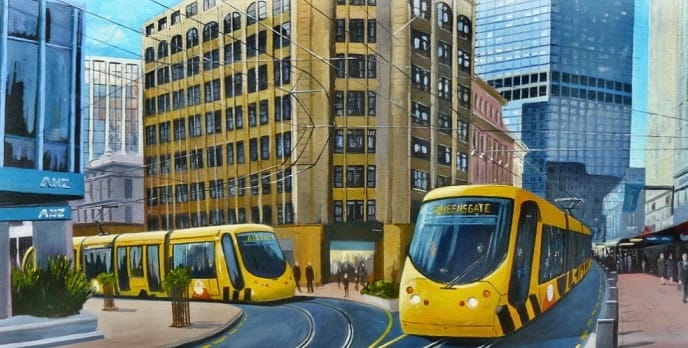
Artist’s impression (W.W. Trickett): Modern tram-trains in Wellington. Courtesy of TRAMS-ACTION.
Reimagining the city with rail
Trams transform streets and cities for the better. You can see what I mean when we compare Melbourne’s Bourke Street to Lambton Quay.
Melbourne’s tram system runs frequently through the pedestrian area, but that doesn’t dissuade tourists and locals from enjoying the streetscape. Buskers perform, people take photos, brunch groups dine outside. The tram lane feels like it’s blended into the civic space, rather than slicing through it.
Lambton Quay should attract people like Bourke Street, but the streetscape is holding it back.
Tens of thousands of people travel Lambton Quay each day on foot, but most of the street is dedicated to roads. Buses and cars pass through, polluting with noise and fumes. The road splits up the public space, whether there’s a bus going past or not.
Just imagine if Lambton Quay was cobblestoned and trams ran through instead. Wellington would have an abundance of bright, vibrant street space that everyone could use, while still moving many people.
The same goes for Manners Mall, which used to be a pedestrian mall. When public transport was diverted through it, walking space suffered to make way for a road. The Harbour Quays, Taranaki Street, Courtenay Place: trams can transform these areas into destinations worth enjoying, while carrying substantially more people.
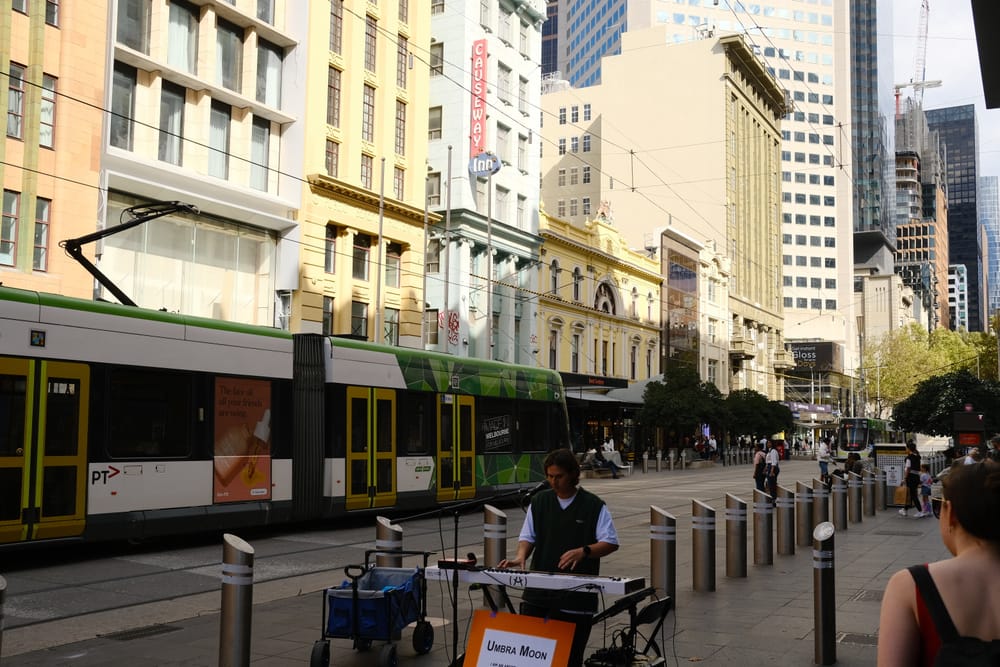
This is the future climate nerds want???
Because rapid transit like trams move so many people efficiently, it unlocks significantly more housing. Trams can carry twice the number of people per hour as a bus lane, and nine times what a car lane can. If people don’t need to store cars to get around, you can use more space in the city for modern, high-rise housing. Car parks become community spaces.
With trams, Wellington could easily host thousands more family apartment blocks in Mount Victoria and Island Bay. That level of housing growth in our city could make central city living far more affordable for families.
They are also more accessible for people with different abilities, and cause less motion sickness than buses. They cut noise pollution and tyre pollution on top of carbon pollution. The average tram in the UK emits 29g of pollution per kilometre, compared to 170 grams per petrol car and 97g for the average bus.
It’s no wonder that trams appear to have a higher cultural appeal than buses, too. Transport advocates have found a rail bonus, where the permanence and perceived quality of ride mean that trams attract more patrons than bus lines of similar speed and frequency.
Trams would be a serious upgrade to our central city. We’re already built the city around rail lines. In order to have more people living affordable, low carbon lives here in Wellington, we need the capacity and good vibes of a tram-based public transport network.
With good planning, they can even solve our regional congestion problem. Most car traffic comes from outside Wellington. Instead of spending billions to make driving more attractive to the detriment of public transport, we could be bold and connect our tram lines to train lines.

The tram-trains of Karlsruhe
Local advocates Brent Efford and Demetrius Christoforou from Trams Action introduced me to a German model that would turbocharge the effectiveness of future tram lines.
Karlsruhe, in southern Germany, is iconic for inventing the idea of a tram-train: a system where trams can travel on street tracks and regular train tracks.
Their city pioneered the model because their railway station only reached the city edge. Passengers needed to get out of trains and into something else to reach town. The inconvenience was preventing people from using public transport.
Sound familiar?
Faced with that challenge, Karlsruhe modernised its railways and redesigned the tram network so trains could run from the outskirts of town through the central city, without the expensive cost of tunnelling underground.
If we take inspiration from Karlsruhe, public transport would get a lot more attractive. Right now, if you live in Waterloo and work at Wellington Hospital, you take a train to the station, then a bus crawling through traffic. A tram-train could run door to door over rail, saving time and hassle.
The convenience of cutting a changeover matters. When Karlsruhe converted their lines to tram-trains, they saw the number of riders jump immediately. Their Bretten Line moved 2,000 people a day before tram-trains. Now, it moves 18,000 people a day. Having a truly transformative user experience will make a difference to our region’s congestion and pollution.
Tram-trains aren’t suitable for every kind of city, namely huge cities like Auckland. Integrating street and rail lines is technically complex and doesn’t offer the same high speed connection that a tunnelled train line can. Different places have different constraints, which is why Europe has implemented many kinds of tram systems.
Wellington is similar to Karlsruhe in population, and we face similar issues like an awkward railway placement and too small a population for tunnelled trains. If Works in Progress is anything to go by, Wellington could fit the bill for tram-trains. Our public transport needs a serious upgrade to meet the ambitious and necessary goals to cut the region’s transport pollution. An integrated regional and city rail system could be exactly the solution.
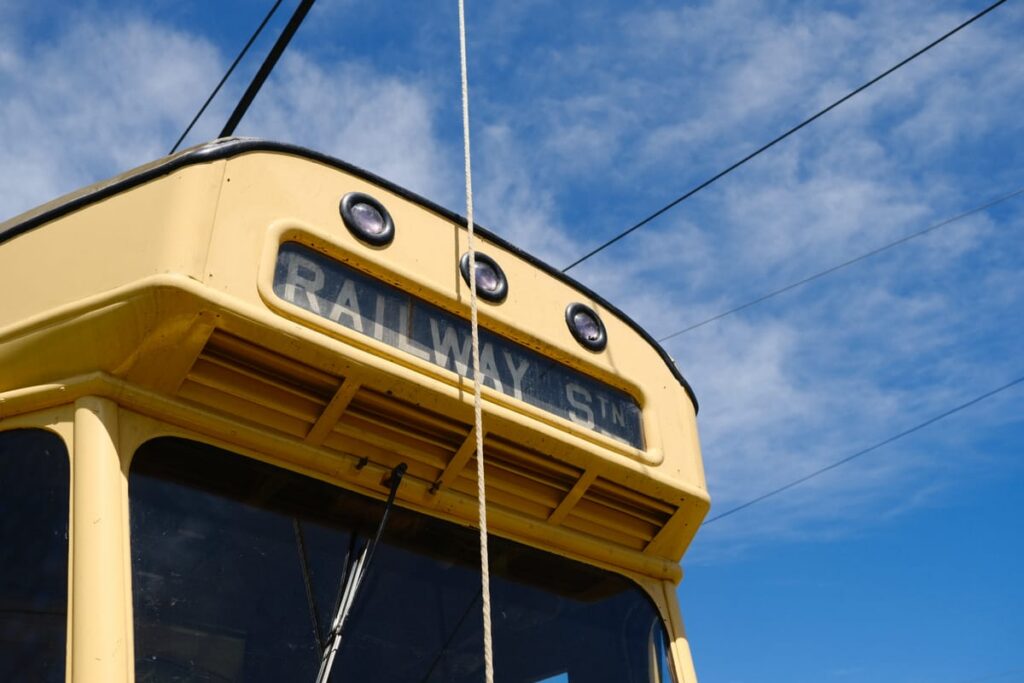
Let’s take inspiration from our historic trams, and build a better system fit for 21st Century Wellington.
Regardless of how we build trams, we have ample inspiration from across the world. While New Zealand bet the family silver on car-dominated transport, places like Germany and the Netherlands invested in rail. They’re leagues ahead.
Our transport system is begging to be redesigned to cut carbon and move more people than one more highway lane ever could. Personally, I love how tram-trains would offer a seamless commuter experience. For those currently using the motorway, it could relieve them of the eye-watering cost of car ownership.
To really deal with Wellington’s pollution, our city and national leaders need to offer transformative change to our streets. Trams can be that change.
Delightfully designed vehicles would free Lambton Quay and Courtenay Place to be vibrant public spaces, unlock tens of thousands of homes, and make for some sick souvenirs at Te Papa.
Investments like this are worth it. We shouldn’t be afraid to build infrastructure that cuts carbon across the region while increasing housing supply. A modern tramway system is that kind of infrastructure – one more lane on Vivian Street isn’t.
Anyone who has visited Melbourne or Amsterdam will know how much trams improve travel. I hope that Wellington is bold enough to transform itself around them.
In my third and last tram article, we’ll explore the political challenges. Sexy, I know.
Just three years ago Wellington was trying to build a tram-like system. When the Government changed, the project was promptly taken behind a woodshed and shot. Delays, uncertainty, and too many transport cooks in the kitchen doomed its existence.
To restore steel lines to our streets, we must finish our series with the hard political choices that must be made to make it real.
Greater Auckland’s work is made possible by generous donations from our readers and fans. We’re now a registered charity, so your donations are tax-deductible. If you’d like to support our work you can join our circle of supporters here.

 Processing...
.jpg?ref=wellyclimatenerd.net)
I really need a map, no matter how unrealistic it is
Its not going to happen. If it can’t be done in a city of 1.7 million, it definitely won’t in a city less then half a million.
I still feel like there has to be a good middle ground somewhere between buses and trams. Surely its possible to get most of the advantages of trams without having steel wheels. Large articulated electric buses with all door boarding and 24×7 bus lanes would offer most of the benefits for a fraction of the cost.
A few of the benefits of trams have over cars are:
– Low friction steel-on-steel wheels take much less energy to move a vehicle over than the rubber-road combo
– Rail takes up a lot less real estate than roads, can be a permeable surface, and can be retrofitted into existing roads
– They are typically electric vehicles which don’t need expensive and short-lived lithium-ion battery arrays, and don’t generate much noise pollution
Whanganui built its original network with a population of ~8000 people, why do we now need millions of people to justify building them?
“why do we now need millions of people to justify building them” – because they seem to cost billions these days. If 8000 people want to pay $125,000 each then they may be able to get a basic tram line.
Sounds like a skill issue
Also it was built in the early 1900’s, Wellington’s network even earlier. Surely places like Melbourne have improved technology/tools/equipment we could look at as an exemplar to make any new networks easier (therefore cheaper) to build?
The old model was:
– build a tram line
– sell the land you just opened up
– $$$$$
So it is not really a good comparison. I don’t know if there is a mechanism to capture the added benefit of that tram line now.
Also the added benefit isn’t anywhere near as high as it used to be as there is already road access.
I agree with that bus lanes and articulated electric buses (battery or wires) and especially with all door boarding would improve things a lot.
The big mystery to me is why are buses and trams are treated so differently? In many cities trams have all door boarding, but buses don’t (with few exceptions like cities in Germany, Austria or Switzerland). Also tram lines are frequent (every 10 minutes), whereas buses are often not. So here Auckland actually is doing quite well! However trams are on transit maps, whereas bus lines usually are not. If I visit a new city as a tourist, I usually end up using only metro or trams. And that is because buses are not on transit maps. For example apart from the BRT lines none of the frequent bus lines found its way on the map of the CFN2 on this page. So I am totally in favour of operating buses like trams.
On the other hand I live in Graz (Austria) a city with around 300 000 inhabitants, which has six tram lines and the network is growing. Construction costs should be fine as long as the lines are on street level. So why not convert busy bus lines to trams?
Greetings from Austria
The regular bus lines aren’t congestion free so they’re not on the congestion free network map.
The photo of the destination blind on a Wellington Fiducia Tram clearly shows the three lights above which by different colour and position combinations indicated the route through the city, (or was it just the destination?) I can only remember blue and white lights.
Something that could be seen from much further away then the destination blind in poor light conditions, especially the trams loading and departing departing in very quick succession from the railway station.
Anybody remember the combinations?
Good luck in your advocacy though, but the commerce/political dial will have to move considerably away from intentions to better provide for the motorcar, by providing a motorway to the airport. Instead, to better providing for people, just undertaking their necessary journeying for their everyday tasks. Such as getting them to, and from work, or school, and to and from, their afterwork or afterschool activities.
Here we go again with the “tram/train ” “twice the capacity of a bus route”
Only problem is that Wellington City’s population is falling, [Even before that National Govt] .
Between March 2018 and March 2023, during the height of the Labour Government’s LGWM plans and boatloads of money being poured into the public service, Wellington city was the only city in NZ to fall in Population,
Light rail to Island Bay was always a Huge boondoggle and the dream of multiple apartment blocks down there is just that, a dream.. If you look at where suburban apartments are being built, its Kilbirnie… Which is exactly the place “planners” said they shouldn’t built light rail to…
I thought Kilbirnie is one of the more vulnerable places for both seismic vulnerability and sea level rise?
That’s quite a disingenuous argument. Wellington population fell between 2013 and 2018 because the city council effectively banned new homes. OP is clearly also advocating for new suburban apartments, I.e. land use that supports population growth.
It is a realistic argument though, you see the same in Auckland. Inner ring suburbs are losing population.
There is an apartment complex being built on Carrington Road, about 5km out. That doesn’t sound like much but it is the difference between a 30% walk to work mode share and a 5 to 10% walk to work mode share, and a similarly higher car mode share. Really shows the severance effect of that Villa Belt.
It isn’t a realistic argument in Wellington. Their councilors had the courage to abolish the villa belt and allow apartments.
But the Heritage protection arguments don’t really hold a lot of water for Wellington, Kent and Cambridge Terrace and Adelaide Road to the Hospital have been high density zoned for years and only a couple of Blocks have ever ben built,
The Te aro flat has been fair game for apartment blocks for years, and the economics of more than 3-4 stories in the Suburbs will probably never stand up in the next 20 years ….
There are no apartments because nobody wants to live in them.
As the Carrington example already shows …
Spins, I don’t think the Carrington Rd development is apples for apples with building apartments in the villa belt. One is a (for now) isolated apartment block not that well connected, while the others are built in established and connected places.
I think you do have a point – however the market for apartments is not healthy.
My view is that it is currently almost impossible to build quality apartments at a price the market will bare.
One aspect of this problem is the availability of land – but another is the glut of poorly built accomodation (which resulted from an earlier and even more clumsy attempt to ease this problem via the MDRS).
Perhaps the success (or otherwise) of the next Ockham proposal in Ponsonby will shed more light on whether this remains the case.
Sadly you are right.
So, if Kiwirail can electrify our intercity lines, which benefits passengers and freight (less domestic flights would reduce our climate damage), and we remember that the 1950s was the time that we destroyed our rail networks, and built motorways (on the post war military industrialist reality) Last time I checked it is the 2020s. Many of those that inflicted motorways on us are now at the end of their lives, if not already extinguished. Why are their unevolved 1950s brains allowed to influence so much of our futuristic post modern existence?
bah humbug
Three of the four busiest domestic air routes are interisland, while the busiest regional routes AKL to Nelson and AKL to Napier have little scope to be replaced by trains.
The only route that has any real potential is AKL to Tauranga, it could be killed off by a good train service, but it doesn’t sit in the top 10 busiest routes.
I really like the advocacy work regarding lightrail / trams … whatever you want to call them.
It’s just a big shame the reality of them being implemented in any NZ city is so low. I don’t even see any local council’s advocating for them, let alone central govt money to build them.
The costs of greenfield expansion at the edges of the cities in NZ are eyewatering. It’s a shame there’s never the focus on public transport and active mode urban transport corridors and land use enabling planning.
This article – while well intentioned and clearly just aspirational – comes at an incovientant moment.
Millions of litres of raw sewerage are presently pouring into Llyal Bay – an event that is directly attributable to the Great Wellington Regional Council’s decision to spend hundreds of millions of dollars on cycle-ways at the expense of necessary wastewater infrastructure upgrades.
If the Capital can’t even construct a cycleway system without starving critical infrastructure of the resources necessary to simply function, then what chance does it have on providing a world-class light rail system?
Many thanks to Peter Basset of the ‘Breaking Views’ blog for revealing the chummy Omerta that characterises Establishment narratives of this debacle.
You mean the hundreds of millions for a seawall that protects both a State Highway and a rail line that happens to have a shared path on top?
I believe that 98% of the seawall’s funding came from the Land Transport Fund. So no – that is not what I mean 🙂
So 90% was funded from land transport, then how much did Wellington Regional Council contribute?
Greg – something like $5 or $7 million I think.
Doctor Spins – so the $5-7 million is no where near what you claim above with “Great Wellington Regional Council’s decision to spend hundreds of millions of dollars on cycle-ways at the expense of necessary wastewater infrastructure upgrades”
Money was provided from the transport fund for the project. Which was all in all a sea wall rather than a cycleway.
Yes water infrastructure is important, but your claims have no truth behind them.
I think we’re talking about two different things. You can check the WCC records for the meeting if you like (date: 27 May 2021)
2021-2024 NLTP, Urban Cycling Fund: ‘$179m in the Ngā Ūranga to Pito-one (Ngauranga to Petone) shared path to be built on the Wellington Harbour’s edge and connect Wellington City to the Hutt Valley.’
That’s just a smidge under the whole $190m funding commitment for *all* Auckland projects.
Yes, Land Transport Fund, but also earmarked as Urban Cycling Fund.
Oh, I found what you are referring to, Dr Spins. The meeting notes can be found here: https://wellington.govt.nz/-/media/your-council/meetings/committees/annual-plan-long-term-plan-committee/2021/may/27-may/2021-05-27-minutes-apltp.pdf
However, I couldn’t find anything regarding prioritizing cycle lanes over (waste) water.
Nobody seems to know Peter Basset, either.
https://www.thepost.co.nz/nz-news/360953420/wellingtons-mysterious-blogger-would-real-peter-bassett-please-stand
https://www.reddit.com/r/nzpolitics/comments/1rbxp55/nzcpr_author_on_tamatha_paul_cycleways_vs_water/
Hope you are really proud of this one.
Yep – it was a beat up.
https://www.brashandmitchell.com/post/sean-rush-in-defence-of-tamatha-paul
That said, i’m enjoying this series and am looking forward to the third installment discussing the political issues preventing the creation of a light rail network in Wellington (I don’t want to cut the author’s lunch, but perhaps the author could simply print the word ‘Wellingtonians’ as the central cause of civil dysfunction).
It’s always the cycleways, isn’t it….
It certainly was in this case.
At the meeting in question a late amendment from (now) Green MP Tamatha Paul (supported by now Labour party prez Robyn Day) increased cycleway funding to $226,000,000.
This was the same meeting where the Council decided against adopting the $391,000,000 plan to accelerate Wellington’s wastewater upgrade plan.
I hope that this is a Chernobyl moment for Wellington local governmance (it won’t be of course, the rate payers get the Council that they deserve).
Good that the wastewater plant failed so we could finally confirm that the government’s shit does indeed stink
And the 30yrs of low-rates pushes and deferral of key infrastructure builds before cycleways ever were a thing?
Or another way of looking at it.
Because the Wellington City Council has spent a few million on a cycleway to Island Bay it has obviated the need for a motorway connection south of The Basin Reserve, unlike the Eastern Suburbs where our current Government wants to spend absolutely billions of our taxpayers money a motorway.
That is certainly one way of looking at it Don.
See above.
Unlike Chernobyl, it didn’t happen. Or not in the way has been claimed.
oh my god you really do have lead in your brain from huffing petrol, don’t you. no wonder your singular brain cell is spinning.
Your comment is a salient demonstration of the importance of never cycling without a helmet.
What if we did a central interceptor for wellington, but also make it a metro? 2 birds one tunnel
Dr. Spins has a point, retrofitting a tram or cycle network is a big upfront spend.
Spread it out with small but useful sections or improvements during the normal road renewals, to a set of performance or design standards.
It would be slower, but it’s easier to swallow lots of baby rats than one chonky boi.
Maybe stop hurling money into fun new RoNS until the potholes in the last lot are tidied up.
We deserve more choice out of our roads, for the same money.
Driving is only essential without that choice.
Wellington’s political culture is hamstrung by a self-congratulatory culture better suited to amateur thespianism than civic improvement.
As a former resident of a neighbouring City, its both frustrating to see (I love Wellington as a place, love me Lions and love me Hurricanes; simple az) and kind of funny to see (many people and politicians from there have a very undeserved superiority complex with respect to the wider region and country as a whole).
I personally hope that it gets its act together.
Bourke St is much better than probably any main St in NZ. I gave up waiting for NZ cities to become more people friendly years ago and left. It was the right idea, NZ cities will still be car dependant backwaters when I die.
NZ’s problems are much worse than a lack of train sets for speccy railfans to Francis Bourgeois over.
Its a symptom of a wider problem. Too many people have been allowed in for the available infrastructure.
Paying for it all is making the net contributors poorer – the same thing is happening in Australia (although the problem isn’t as advanced as NZ’s).
Pouring billions into airport infrastructure makes it a lot easier for immigrants to enter the country, no? How about we re-allocate some of the labour force away from building international transport infrastructure to efficient regional transport infrastrucure (trains)? Win/win
That would harm our tourism sector – which (like it or not) we currently need.
The problem stems from our permissive immigration settings (and the dishonesty exhibited by NZ’s Establishment when discussing the effects of these settings).
https://www.rnz.co.nz/news/ldr/578546/new-zealand-s-population-growth-dips-by-tens-of-thousands
It’s actually really expensive to immigrate to NZ due to our massive ocean borders
That article says that migration induced population growth is continuing; just at a lower rate than previously.
That doesn’t at all address the impact that the last 20 years or so of migration is having on the capability of NZ to provide services, infrastructure and housing to its population.
Ok but are immigrants enough of a problem to bring them up in every second comment you post
“Its a symptom of a wider problem. Too many people have been allowed in for the available infrastructure.”
But the infrastructure was never going to be built. Central governments of the last 25yrs wouldn’t spend or go into debt (except for roads). And they kicked the can down to local government who face NIMBYs demanding rates caps or insufficient increases. So crucial infrastructure (under local government purview) got neglected or not built.
So regardless, I doubt we could have ever turned down or stopped immigration to any great degree, otherwise restaurants and fruit growers would go bust without an influx of cheap(er) labour. No government would allow that and for everyone who says that’s not the point is a business owner (and voter) who will tell you otherwise.
In short, the issue is a generation who wouldn’t pay it forward and the infrastructure deficit that resulted. The immigration levels could have been lower, but that comes with consequences too.
Of course NZ could have adjusted its immigration settings – it made deliberate efforts to set them where they currently are (its no accident that Brits and other Europeans stopped migrating in the same numbers that they used to – it was a policy choice).
The phenomena that your pointing to is just good old fashioned regulatory capture. Policy alternatives were (and are) politically and practically possible.
Thinking of your final line, I can almost forgive the ‘generation who wouldn’t pay it forward’ – who on earth are they paying it forward to? Migrants that are here today – and off to Australia to live tomorrow.
“who on earth are they paying it forward to?
The future NZ. Maybe not so many would be off to Australia.
Lets Get Wellington Moving 2.0
Its fair to ask what we can support with our geography and economy.
The infrastructure comes after.
We can’t afford nationwide racetracks for Clarkson wannabes playing out their midlife crisis in an Audi.
Right-sizing, not RoNS.
Yes, trams did allow Wellington city to grow with large amount of engineering projects like the Hataitai tram tunnel, tram lines up the Brooklyn and Wadestown hills to service the hill top suburbs of Brooklyn, Wadestown, Karori and Northland, the building of the Northland, Karori and Seaton tunnels for tram operations, etc.
The Wellington tram network was built around double single unit 37-39 seat trams which was suited for the city’s hilly topography.
Unfortunately a 5-7 segment standard gauge light rail vehicles are not suited for Wellington city topography due to disruptive engineering required for a 1, 2 or 3 line light rail system.
Using a mixture of single 34-44 seat single unit, ‘bendy’ and doubler deck buses using dedicate bus lanes with priority ‘bus’ traffic light phasing is the best option for public transport within Wellington city boundaries.
I am a Wellingtonian but haven’t lived there for a while. I say get basics tight first , like a proper functioning wastewater system.
Another thing I would say is that I feel my hometown is nowhere near conscious enough re ‘The Big One’. The city needs Japan-style awareness and preparation. But it’s so far from that it’s crazy.
Another thing I would put way above a tramline is spare hospital capacity. If the hospitals are at capacity now, what happens when the big one strikes???
I don’t understand why everyone keeps saying trams are too expensive, $3.2 million in funding was rejected for the Whanganui Tramways in the Council’s 2024-2034 LTP, yet we can justify spending $5 million on a 600m road out in the suburbs? https://www.whanganui.govt.nz/files/assets/public/v/2/consultations/ltp-2024-2034/supporting-documents/10-year-plan-2024-34-full-document-final-version-1.pdf
Nice idea but looking at Wellington’s current water and wastewater problems unless the fairy godmother comes along then there is no money for this. Shouldn’t have removed them in the 1960s