Earlier this week, Te Waihanga, The Infrastructure Commission, called for more transparency for infrastructure investment.
I thoroughly agree. A lack of transparency, especially in mega projects, has been a hallmark of the transport sector in New Zealand – and not only is it detrimental to the public interest, it also prevents improvements to how we do infrastructure as a country.
And nothing demonstrates that more than the Roads of National Significance (RoNS) programme.

Over the last couple of months, I’ve been trying to obtain information on the advice given to decision-makers about the RoNS.
I sent three Official Information requests – to the Infrastructure Commission, Waka Kotahi/New Zealand Transport Agency (NZTA), and the Ministry of Transport (MoT) – seeking any advice on the RoNS programme, and its affordability.
The vast majority of information was withheld.
NZTA refused to release any information – even redacting the title of the one document they decided was in scope. MoT would only release two heavily redacted documents, while holding three more back (including the titles). Te Waihanga only provided one email, but it was quite revealing, and I suspect it may have ironically revealed the title of a document MoT held back.
You can find the documents here:
When information is refused or redacted, it’s usually because it falls under a few specific areas of the Official Information Act, and these requests were no different. (Emphasis added below, to help highlight the key grounds for refusal and redaction).
9(2)(b)(ii) to protect information where the making available of the information would be likely unreasonably to prejudice the commercial position of the person who supplied or who is the subject of the information
9(2)(f)(iv) to maintain the constitutional conventions for the time being which protect the confidentiality of advice tendered by Ministers of the Crown and officials
9(2)(g)(i) to maintain the effective conduct of public affairs through the free and frank expression of opinions by or between or to Ministers of the Crown or members of an organisation or officers and employees of any public service agency or organisation in the course of their duty
9(2)(i) to enable a Minister of the Crown or any public service agency or organisation holding the information to carry out, without prejudice or disadvantage, commercial activities
9(2)(j) to enable a Minister of the Crown or any public service agency or organisation holding the information to carry on, without prejudice or disadvantage, negotiations (including commercial and industrial negotiations)
Decisions of whether or not to provide information also have to consider the ‘public interest‘ of providing the information.
On that point, I didn’t miss the fact that one of the only two documents I did receive from the Ministry of Transport said this:
The RoNS Programme will be the most complex and expensive infrastructure programme in New Zealand’s recent history. NZTA’s latest estimate indicates that the total cost to deliver the 17 new RoNS will likely be over $56 billion, and the individual RoNS projects have medium to low Benefit Cost Ratios (BCRs) (0.7 to 3.1). NZTA have also indicated that an additional $49 billion will be required to fully deliver the RoNS Programme.
To be clear, the RoNS Programme will be the most complex and expensive infrastructure programme in New Zealand’s recent history.
And yet somehow it isn’t in the public interest to know almost any key information about it?
It’s galling that so much information was refused and redacted, even the titles of documents themselves, when concerns about affordability are being raised by the Minister of Transport himself, Chris Bishop, after months of reporting from the mainstream media and others (like us), pointing out the numbers don’t stack up.
Regardless, here are a few things that did stick out to me in what was supplied. And I would strongly encourage anyone to have a look at the papers, in case I’ve missed something.
Ministry of Transport
The Ministry of Transport provided two documents, one from July 2025 and one from August 2025, while three documents were redacted in their entirety (including titles).
It is incredibly odd that even the titles of these latter documents are redacted. This is not a usual thing that happens – and I expect, based on the delays in responding, that this was a very intentional choice.
This is an excerpt from the first of the two documents, titled A3: Update on the Roads of National Significance with a higher level overview of the programme:
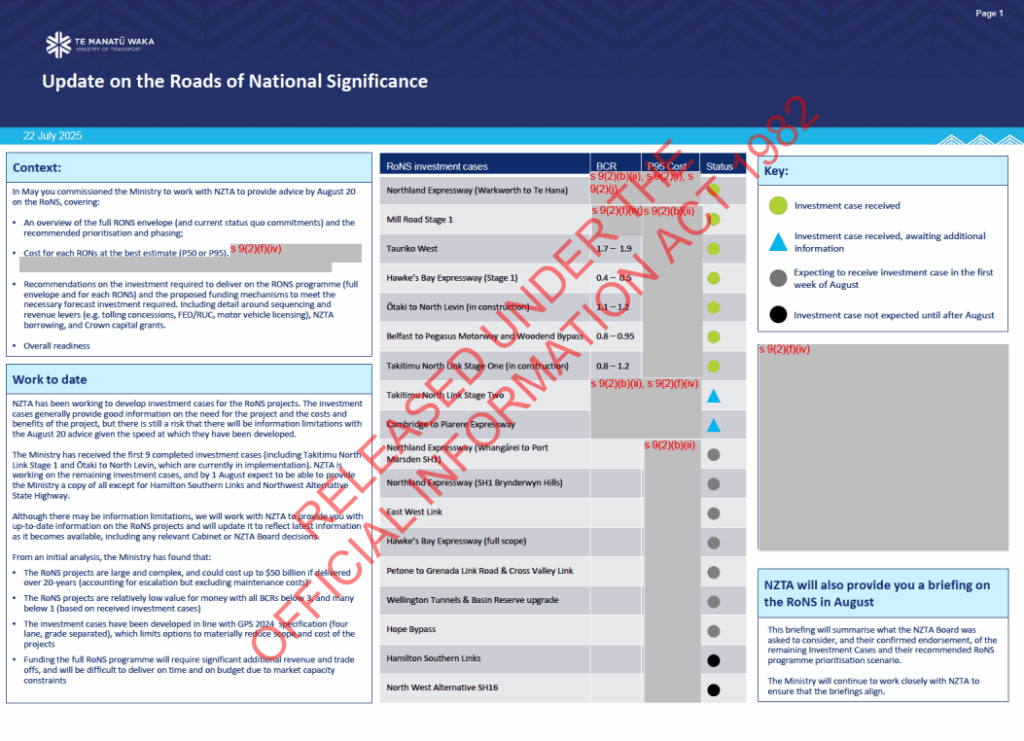
The box in the bottom left corner is most glaring, with big questions being raised on the cost, value (or rather lack of value), and capacity to even build these things.
But moving on to the more substantial briefing, from August of this year, titled Briefing: OC250681 Detailed Report Back on the Roads of National Significance (Rons) Programme.
You can see that large swathes of what was provided is redacted:
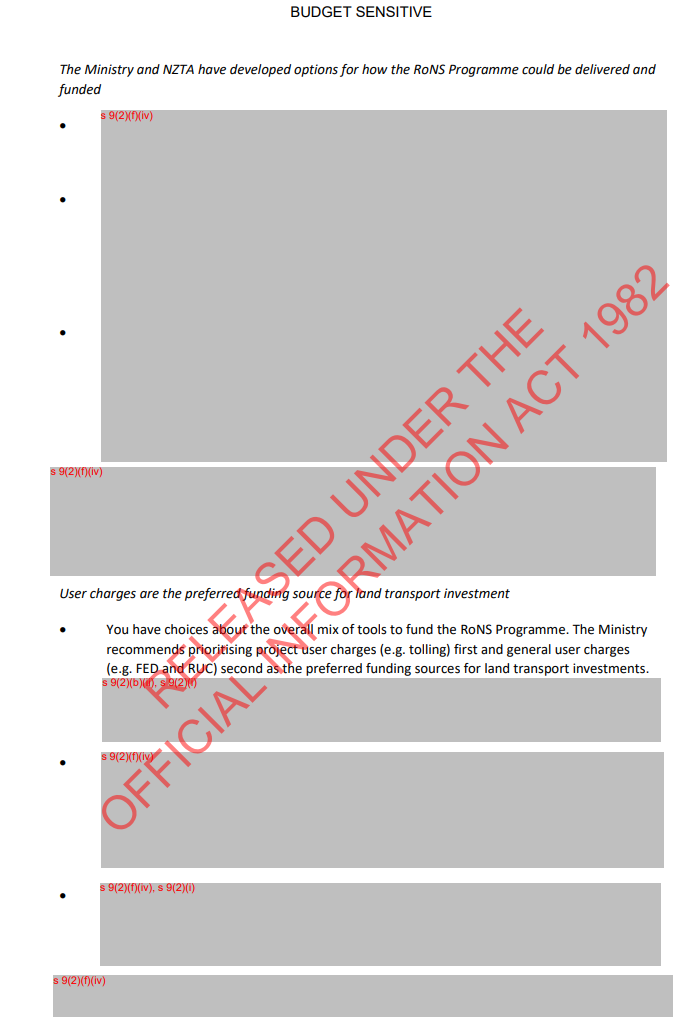
However, some of what remains in view is very interesting. Much of it speaks about the risk and cost of the programme:
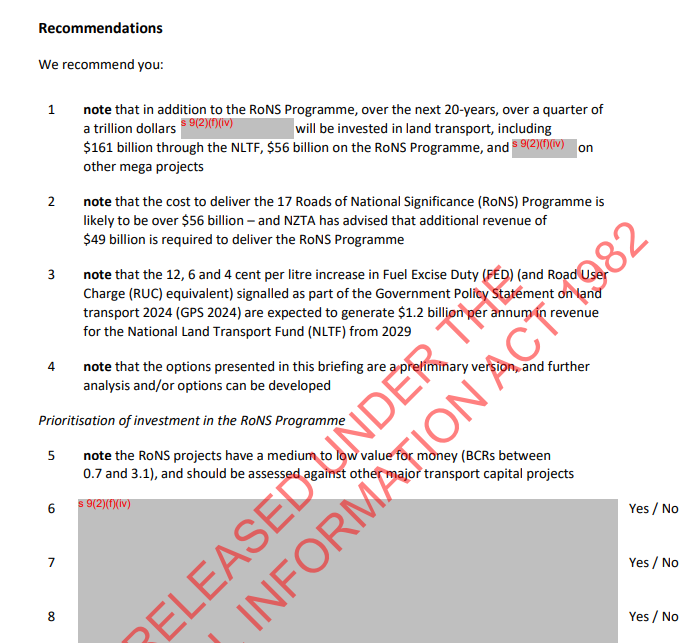
Note point number 2: to actually fund the RoNS programme, NZTA has said that $49 billion of additional revenue is needed.
And point number 3 suggests that even with increases to Fuel Excise Duty and Road User Charges, or tolling, the vast majority of this $49 billion would likely have to be directly provided from the Crown (competing with wider infrastructure priorities such as hospitals, schools, defence, etc).
The document also states that the BCR for these projects should not be used as an absolute value, and instead should be seen relative to other infrastructure projects (ie it should be used to compare the value of different choices).
MoT also state the other planned transport capital investments planned for delivery over the next 20 years, the Waitematā Harbour Crossing, Northwestern Busway, and unspecified metro and freight rail upgrades. Costs redacted of course.
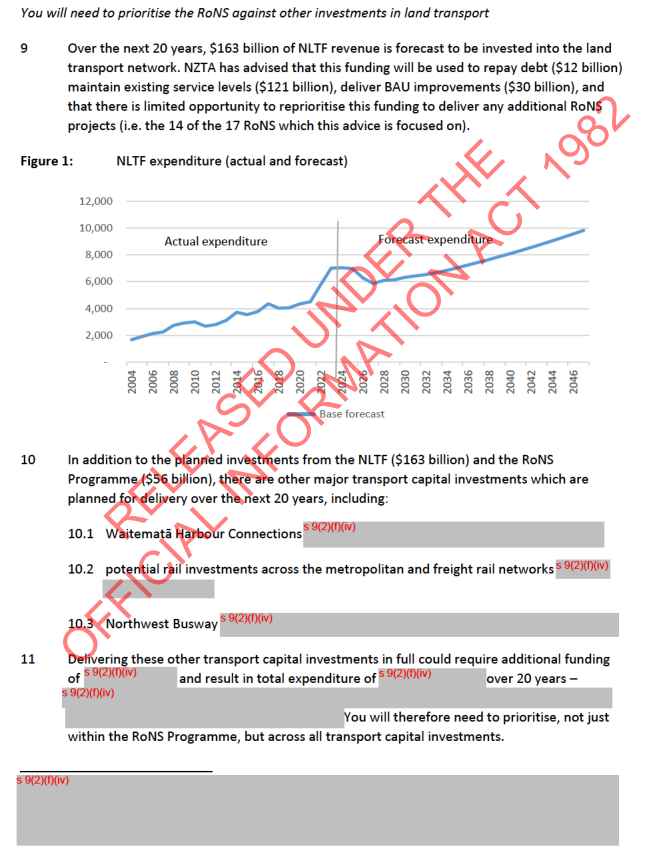
It also appears the prioritisation of the RoNS will be a key part of the next Government Policy Statement on Land Transport in 2027.
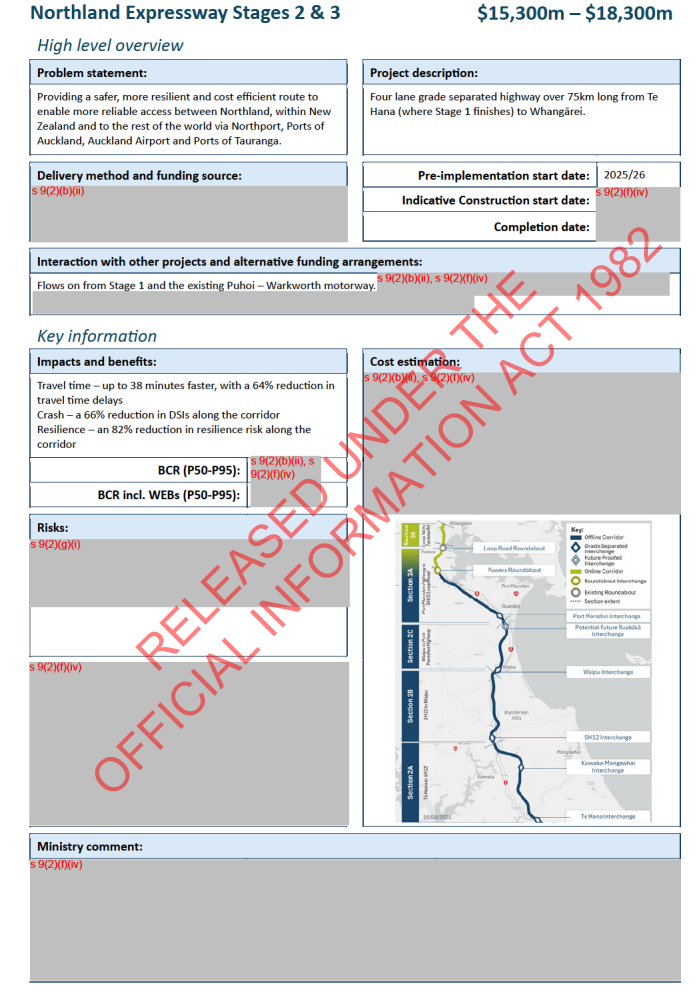
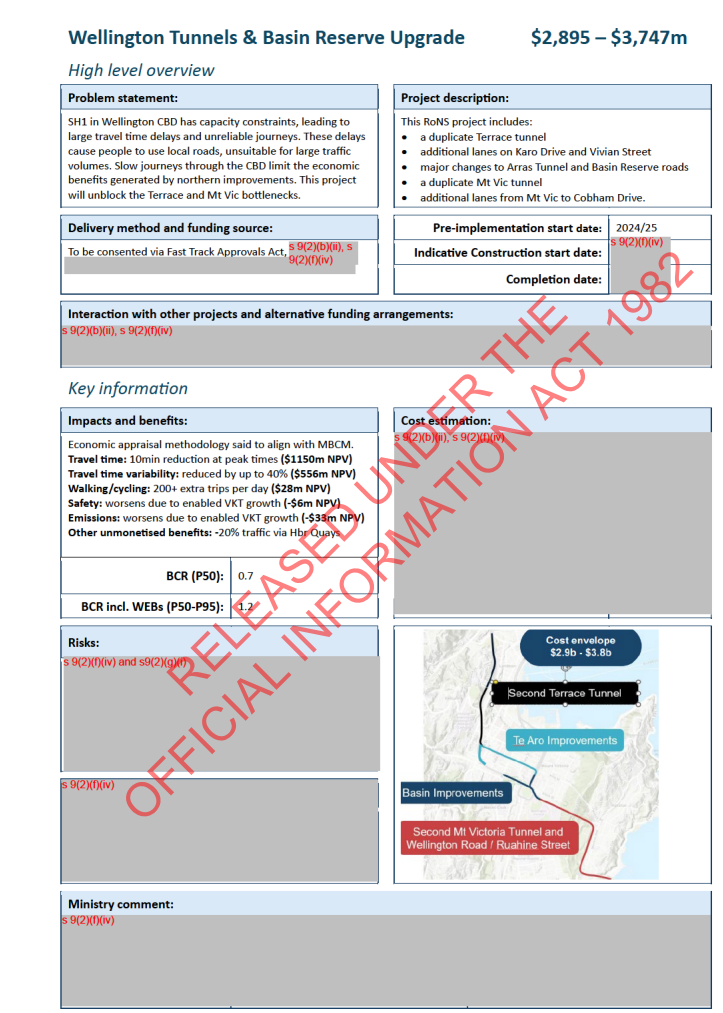
However, the rest of the document is largely redacted – including the recommended prioritisation of RoNS from both MoT and NZTA, although they did include a list of many of the RoNS, much of their details redacted. See a couple of examples below. Why so secretive?
While at the very least MoT supplied some information, where is the public conversation on what we actually need in the way of roads?
How can we know if the public is actually getting value for money from the billions of dollars proposed to be poured into this programme, when there’s no public transparency of information?
No comparison of different options. No discussion of whether other infrastructure projects are better value and/or more urgent. No insight into whether other modes such as Public Transport (whether rail or bus) would better meet objectives. And no word on whether the available funding is more needed in infrastructure for health or education.
And, while there are some tidbits discussing scope, there seems to be little upfront consideration of how big these projects are, or need to be (at least with what information is revealed). The Government promised four-lane expressways – mandating this in Simeon Brown’s 2024 GPS, regardless of evidence, benefits, or realistic assessment of what’s needed. And yet this is clearly both wildly impractical, not even necessarily suitable in every case, and completely unaffordable.
What is the public interest in hiding basic information about these billion-dollar projects from the public?
Te Waihanga/Infrastructure Commission
Te Waihanga sent just one email, which I found to be the most revealing of all.
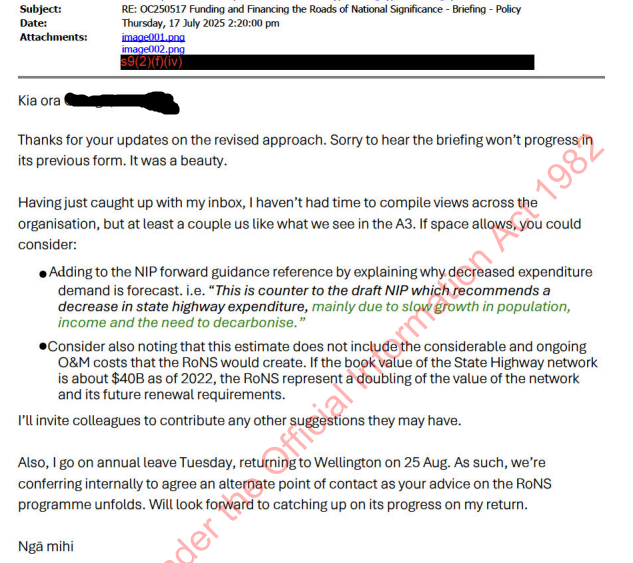
I would love to know the previous form of the July briefing the Infrastructure Commission referred to, given ‘it was a beauty‘. Mind you: does the subject line give away the title, “Funding and Financing the Roads of National Signficance”?
I also assume that the ‘A3’ being referred to, is the same as what MoT gave me.
The two considerations put forward in bullet points are worth noting:
First, that the RoNS are counter to the draft National Infrastructure Plan – which recommends a decrease in state highway spending ‘mainly due to slow growth in population, income, and the need to decarbonise‘. Essentially: the RoNS are not needed and will contribute to the climate burning.
Secondly, that if the RoNS were to be built, they would double the entire book value of the State Highway Network – and thus double the future cost of renewal requirements. In other words, not only would the RoNS cost an eye-watering amount to bring into existence, they would then suck up significant amounts of future national revenue, for operation and maintenance.
So yeah… great investment I’m sure.
Waka Kotahi/NZTA
I don’t really have much to say about NZTA, mostly due to the fact they gave me almost nothing. NZTA’s initial response to one of my requests was to say that investment cases for projects would be released publicly in due course, which some of them were.
However, when it came to my request for any advice provided to decision-makers, just one document was deemed in scope – but all of its contents were refused, including the title.
Needless to say, there’s now a complaint to the Ombudsman in the works. And feel free to share your own suggestions of what the mysteriously significant title might be, in the comments (along with the MoT ones).
A related note, while we’re talking about information that should be publicly available – the minutes of NZTA board meetings haven’t been published since the May 2025 meeting… what’s that about?
And we wonder why we suck at building things and balancing budgets…
All of this goes to the fundamental problem with major projects in this country, especially major highway projects – nothing is as transparent as it should be.
The Infrastructure Commission has talked about how New Zealand is one of highest spenders in the OECD on infrastructure, but one of the lowest in terms of value for money.
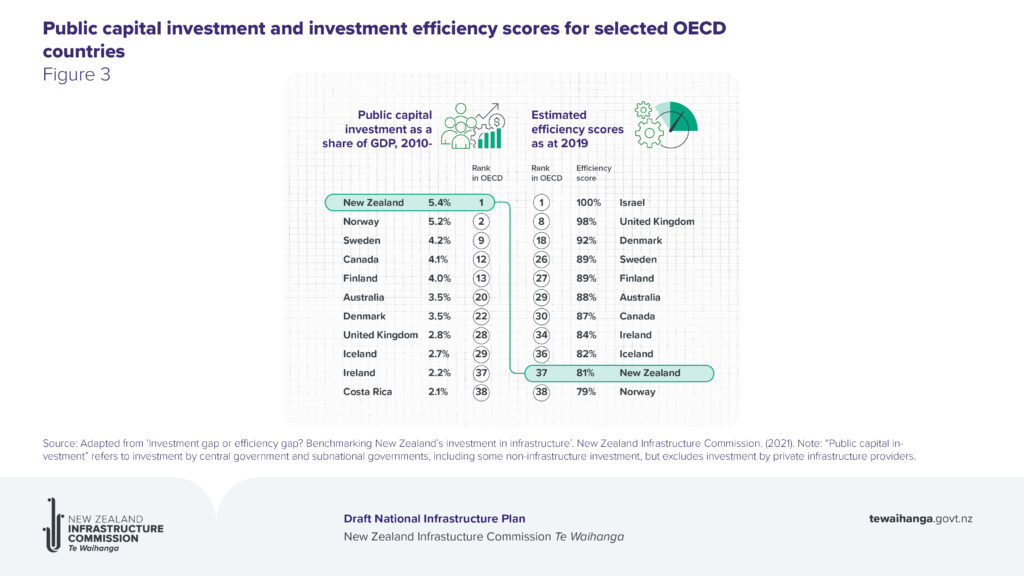
The RoNS are not the only time this happens (for example, everything about the Additional Waitematā Harbour Crossing is ringing the same alarm bells, and loudly), but they’re the most blatant example.
Remember, in the words of the Ministry of Transport, we are talking about the most complex and expensive infrastructure programme in New Zealand’s recent history – by definition, something of enormous public interest – and yet, everything about it remains shrouded in mystery.
Cooked-up numbers are floated around, barely clearing a BCR of 1, and we are allowed no visibility of how these projects actually stack up against other investments that are needed, in transport or otherwise (spoiler: these projects wouldn’t stack up).
How on earth is it in the public interest, to refuse the release of any information until after decisions are made about spending billions and billions of dollars – sucking resources away from other urgent needs and straitjacketing our whole country for the foreseeable future?
We deserve to know what’s in the RoNS files.
We’re now a registered charity, so your donations are tax-deductible. If you’d like to support our work – and, what better time of year to make a gift for a better world? – you can join our circle of supporters here, or support us on Substack.

 Processing...
OIAs I have received in recent times have been heavily redacted. It is especially worrying seeing the sections showing the advice of the public sector blacked out.
It reads like a comedy sketch. Similar to James Hacker and ‘the need to know’. I was cross about the Ministry of Education years ago so I asked for their report that resulted in their decision. It arrived with more black out than words. I laughed so much I got over it and just knowing some jerk had to go through and do that felt like punishment enough.
On the Wellington RoNS: “this will unlock the Mt Vic and Terrace tunnels bottlenecks”
True; it will speed traffic to form one even bigger bottleneck on city centre streets where this suddenly unfiltered traffic will be sent.
This will benefit neither the city, its businesses, nor drivers.
And so expensively, for that cost we could have light rail from the station to the hospital, or maybe even an elevated rail extension on that route.
Which would benefit everyone, as that is the big demand direction (not the airport), by enabling more people to choose not to drive (more driving = the bottlenecks) both within the city and from the wider region via the rail network.
This. The project is insane as it will have truly negative outcomes.
People wanting to cross these massive roads already wait an age, this will probably mean longer wait time. Wellington will also effectively have busses wanting corss the roads capped.
So for the cost of the CRL some Wellington car drivers might get 4 minutes faster trips to the airport while making the city much worse for everything else.
Not to mention it’ll turn the Basin Reserve into (even more of) an island surrounded by pseudo-highways. Just awful awful awful given how most other developed places are going.
The current Government are control freaks descending towards authoritarianism.
Even dictating to Councils that they have to raise speed limits on Council controlled roads after thorough local consultations have been overwhelmingly in favour of lowered speed limits, and compelling safety cases to do so have been presented.
We are still awaiting any economic case that could justify higher speeds.
Current economic evidence is that higher posted speeds, increase accident caused costs significantly, and accident caused disruption causes considerable degradation to journey time reliabilities.
Our very democracy is degraded when those in power, exercise massive control over what information is released to the voting public.
The cynics amongst us have good cause to believe that this Government’s economic priorities are heavily skewed towards protecting political party income from it’s donors and MP’s employability with lobbiests, post their parliamentary careers.
“We want to give more power back to local councils!*”
*(as long as they toe our party line and do what we want)
At a recent Hāpai Public (ex IPANZ) event, some long-time public servant pointed out that 15-20 years ago it was unheard-of for officials to seek input from a Minister’s office about responding to an OIA request. They would inform (for a “no surprises” approach), but make the decision themselves about how to respond to the request. Now, it’s apparently commonplace to ask the Minister’s office. Politicisation of the OIA process is the most blatant and most troubling trend for public service transparency.
I’ve found the office of the ombudsman great at resolving such things
I’ve been enjoying Deborah Te Kawa’s substack on “free and frank advice”, and would be interested in reading people’s applications of her ideas to what we’re witnessing in transport.
My mind is still boggling at the bit that says:
“note that in addition to the RoNS Programme, over the next 20 years, over a quarter of a trillion dollars (redacted) will be invested in land transport…”
Over a quarter of a trillion ?!?! Good grief!
And also, on the sole Wellington RoNS project, including the unnecessary 2nd Terrace Tunnel, under impacts and benefits, it says:
Travel time: 10 mi reduction at peak times… and
Safety: worsens due to enabled VKT growth
Emissions: worsens due to enabled VKT growth…
Great. Just great. What a waste of money. What a waste of a LOT of money.
What a waste of all the potential uses we could be putting that money to, as well. It’s beyond normal and beyond endurable. If we don’t get organised soon to turn this around, the next few decades will be full of new ways to resolve such deliberate intergenerational nastiness.
NZTA are demonstrating considerable expertise in voodoo economics as well as in Kremlinesque levels of secrecy, as this piece demonstrates so well.
A case study is the Wellington SH1 tunnels project, which will (apparently) increase economic growth. But digging through the published figures, the best-case BCR is 1 (i.e. zero net benefit), and the worst case 0.42 (i.e. destruction of $2.2b of national wealth). So much for the investment case!
It will also reduce traffic on local roads (apparently) but figures belatedly released by NZTA just before “engagement” closed show significant increases on traffic on key local roads – hardly surprising when the project induces 8% more traffic (a figure supplied orally – I haven’t seen it in any documentation).
But it must be the greenest, healthiest road project ever: the engagement documentation’s “potential impacts” do not mention any environmental, health, or climate change effects.
Public companies have annual reports that write about whether they achieved their goals in the past year, their financial statements and their goals for the current year.
At the annual general meeting shareholders can ask questions and explain why the company is heading in the right direction or not.
The share price will rise or fall if good decisions are made.
Surely in these times where productivity is an issue any politician would be rewarded for supporting projects that achieve the most for dollars spent. Whether to spend on schools, universities, walking tracks, bikeways, defence or roads.
It is clear to me that spending on more roads is a terrible mistake.
“The Infrastructure Commission has talked about how New Zealand is one of highest spenders in the OECD on infrastructure, but one of the lowest in terms of value for money.”
NZ has to get a lot smarter.
NZ Govts need to be driven by improving wellbeing per capita from if we going to achieve better value for money.
All infrastructure projects need to be compared and ranked.
There is plenty of room to tweak the RONs.
a) Staging of projects
b) Building as passing lanes with centre and side barriers initially
c) Building as alternating 2×1 initially or permanently
d) Delaying a full project until the BCR improves the project’s infrastructure ranking
e) Urban projects can be delayed with the use of congestion/time of day charging
These docs must contain Epstein level truth bombs.
Is there anyone from Auckland left here?
Comments about some tunnels in Wellington does show that the greater Auckland has been replaced by greater political apparatus that dislikes the current government and spends considerable time in Wellington.
Having lived in many successful countries, I am struggling to understand why numbers are of such importance. Numbers are wild projections and any statistician/economist can and will play around with them. They prove nothing, projections, estimations and assumptions of positive/ negative externalities does not help prove a point. And whats more, most successful developments started out poorly but proved a success over time, no matter projections saying A or B. Whats to say that wont be the case with say a motorway to Northland where demand todays feels sketchy. No one knows, we are all guessing and our guesses tends to be coloured by our political vision for New Zealand.
For those of us not fighting some ideological battles (Connor on the left and the old Minister f transport on the right), but wanting sound transport solutions for all of New Zealand we breath easier after seeing what the new Minister of Transport had to say.
After seeing the insane costs of the unrealistic RoNS promises, the current Minister for Transport shook his head and applied some common sense. Stating that this is a long time plan and this is the pipeline of projects that we plan to build going forward. This approach mirrors what this website has been requesting in regard to rail, a pipeline of future projects. Announcing a future pipeline of rail projects would allow the same industry that builds roads to make capex decisions for rail projects based on public declarations for rail. lets hope the current Minister for Transport, who seems to be the most common sense such since Simon Bridges announces some Rail of National Significance projects too. I presume the Auckland, Hamilton and Tauranga triangle should be included and probably something in Northland.
The old greater Auckland that was run but those for transport, not against all non active modes tended to drive he debate by skillfully pointing out realistic and very good visions for transport in our city, not discuss weather Wellington needs some tunnels or not since well, Wellington isn’t greater Auckland after all.
We should thus focus on weather the roads outlined in RoNS makes sense for Auckland. Do we need the east/west link? Based on a map yes it would build suitable connections and redundancy within the motorway network, but is that map approach mirrored in reality? Does our manufacturers need that road or is it OK for them to be idle for 5 minutes waiting for the Penrose traffic lights to allow them on to the motorways. I struggle to see that need, but it would be interesting to hear from the manufacturing companies in the south what they think etc. Maybe their future business model depends on it.
Put simply: yes, the number matters. Every dollar spent here is a dollar not spent elsewhere. Value is what counts, but we also need to know why this spending is necessary. Is the price justified? How can we judge, when they refuse to release even the most basic details or explain the reasoning behind it?
I agree that the words describing the numbers are more important. Although the numbers are elastic, the reasons shouldn’t be. Then judging whether the numbers support the reason can be debated, along with “what else instead”.
There is a need for Aucklanders to be talking about huge capital spends being promoted far away from the Triangle. Northland will be a nuanced discussion, as an extension of the Triangle.
There are also some people living the other side of the Cook Straight who may be a bit unhappy, with a BCR of 0.85 for one scheme and more Hope than Certainty for the other.
E-W might be more about getting freight on and off two motorways for Penrose than Pakuranga to Airport. A lot of the cost appears to be in tying into SH1 from the west, with more value in using flax weavers than road engineers, looking at the plans.
Of course numbers matter, and as anybody who has worked in a contracting industry knows, that getting cost estimates right is vital to just stay in business. Winning a tender is easy, and more often then not, is achieved by leaving something out, rather then being more efficient then the competitors.
But completing a project on time and on budget is hugely harder, but that is what contractors SHOULD have to do to stay in business.
Unfortunately the now prevalent shoddy scoping and design by purchasers, especially government agencies, and their consultant agents, means that contractors are now forced into heavily gaming the “extras” systems to provide for any profitability. This is very much the result of successive governments stripping he required in-house expertise to make informed purchasing choices. Instead outsourcing this to consultants. Consultants who in too many cases are much better at marketing their services to government then consistant delivery of projects to budget and on time.
Accurate scoping of projects will identify most of the risks, and employ countermeasures well before “turning the first spade” ceremonies.
It was in the realm of common knowledge that chip seal would be totally unsatisfactory for the traffic and gradients on Transmission Gulley and yet the Government accepted the proposal to use chip seal, failure of which is now causing so much grief and taxpayer extra expenditure.
Governments have got to get hugely better at deciding what to buy, with a lot more detail.
“Numbers don’t matter, what matters is vibes, trust me bro”
Possible names of the fully redacted documents:
As simply as possible: The 5 main reasons why RoNS are crazy stupid
Who is going to talk some sense into the Minister?
Does everyone realise it’s our credibility on the line as well as the Government’s?
Magical thinking: Can we report them to Dumbledore?
A hard time to be a public servant.
But also a pivotal moment in time; every public servant knows they’ll be looking back at this term of government, and feeling pride or regret at their own actions.
How things turn out depends on human decision-making. Public servants who do realise an abnormal situation demands non-conventional conduct deserve our support.
Dumbledore… I suppose plenty of experts have already castigated this government, but there are slimy reasons it’s like water off an oil slick-killed duck.
Sometimes it is just exhausting to live in what feels like a perpetual building site – speaking as someone who moves around the golden triangle regularly. We have just had 10 years of the expressway construction (then major resurfacing), the CRL, endless widening around south Auckland, etc etc.
In light of the news around the govt’s finances this week, I imagine most of these projects will be pushed out to the nebulous zone of 10+ years in the future. Think things like ‘Pest free 2030’ , ‘Smoke free 2025’ , or ‘Carbon neutral 2050.’
Among the oddities in transport infrastructure planning is what seems to be an ongoing confusion over the role of benefit cost ratios. They don’t tell you what to do, just how to do it reasonably efficiently. Deciding what to do is a political process, and that should be placed in context. First, how do RoNS or any other programme account for the need to reduce GHG emissions, adapt to climate change, and address ecological degradation. Then, how do they integrate with demographic projections, immigration policies, population distribution projections, and changing agricultural land use practices. Global trends need to be considered. Current projections suggest increasingly significant climate change impacts everywhere; how will that impact the NZ economy and infrastructure expenditure planning, as well as (more importantly) what infrastructure you actually need. There is little point having a four-lane highway delivering you to an underfunded hospital, or a community flooded out of existence, or farmland unable to support current land use practices. These priorities need to clearly integrate with, and regulate, infrastructure planning. The approach currently seems abstract and built on a set of opaque business-as-usual assumptions that will likely condemn the country to poor outcomes. Clarify the context and assumptions, then apply BCRs, remembering the B isn’t just efficiency.
Throughly agree, thank-you.
Good thinking, and there’s an awful long way to go. Taking the SH1 Wellington tunnels as an example (sorry, Exile!) the need to reduce emissions goes unmentioned in public documents (Connor’s OIA documents show that they will actually increase, and safety gets worse), similarly for climate change and environmental degradation; and the BCR (not given directly, but calculated from the separate mentions of benefit and cost ranges, on different pages) is best case 1, worst case 0.42. How are we ever going to make sense of a project like that?
The Government might have a report that nobody is allowed to read (or even know the title of) that says this.
Out of curiosity, if the unredacted version was accidentally leaked or obtained somehow, what would the legal status be on publishing the information?
in answer to your question: “What is the public interest in hiding basic information about these billion-dollar projects from the public?”
Very simple – to protect Simeon Brown for being more widely outed as the most incompetent Minister of Transport (possibly most incompetent Minister full stop) to have ever set foot in the beehive. Which would also reveal how incompetent Luxon and Willis were for appointing him.
This is straight up ministerial and political pressure on civil servants to hide politicians incompetence from the general public. It also helps that many of the senior civil servants stand to make a fortune once they leave NZTA and join the winning transport design and construction consultancies that will spend all that lovely taxpayer money.
Corruption in New Zealand is not in your face as some countries but it is alive and well in the transport sector.
When someone who has never had a job is suddenly put in
https://theonion.com/cia-realizes-its-been-using-black-highlighters-all-thes-1819568147/
Focusing on the Northland expressway, but with application to other projects under the RoNS umbrella: As a benefit-cost analysis (BCA) is an economic analysis from the national perspective rather than a financial investment appraisal, I’m not sure sure that refusing to release the BC analysis under section 9(2)(b)(ii) is justified. While the construction of the road may be a commercial figure, there are other costs, not least land purchase but also GHG emission costs, so releasing the aggregated cost figure would not reveal the commercial cost. Moreover, the commercial cost figure would be different from the economic construction cost from a national economic perspective as the commercial cost includes interest costs, depreciation etc, which are not included in a conventional BCA. It seems to me at least that using 9(2)(b)(ii) to refuse to release detailed benefit figures and their calculation is even more unjustified, as most of the benefits are not commercially sensitive. Re: The supposed benefit of time savings of up to 38 minutes for the Northland express way – as it only takes an average of about 60 minutes to drive from Whangarei to Te Hana now and about 90 minutes from Whangarei to Warkworth, the up to 38 minutes appears excessive – especially since there is now the Warkworth bypass. (I regularly drive from near Waipu to Auckland)
So how can we as voting New Zealanders and inhabitants in this alleged democracy stop these RoNS being built. As I type, construction contracts are being drawn up, people are being forcibly moved off/compulsory purchases being signed to move people off their properties/incomes/forever homes/generational businesses etc. Its our tax payers dollar that is being spent on projects that have sketchy justifications. It’s our lives being completely upended/destroyed (I am one), and all of tax paying NZ who will pay for many years to come for these rushed through projects. We have not been shown any alternatives or options.
Great information I tried to get information from them NZTA re options to Northland Corridor project abd got ignored