Kia ora and welcome to our regular roundup of stories that caught our eye this week.
Today’s header image (credit to Auckland Council) shows the Karanga Jump Platform in action, one of several Auckland projects recognised in last week’s national landscape architecture awards – read more below.
This Week in Greater Auckland
- On Monday we took a closer look at Mayor Wayne Brown’s pre-election Manifesto for Auckland as we await a new or returning Government to engage with the city and its challenges.
- And, if we’ve been a bit quiet on the posting front for the rest of this week, it’s because we’re working up to an announcement. Stay tuned!
Greater Auckland’s research and advocacy is powered by hundreds of hours of work each month, and your support helps keep us going! We warmly welcome your donations, and are always open to offers of guest posts, practical help, and pro-bono expertise.
Another great way to support the kaupapa is by purchasing and wearing our Greater Auckland merch. Allow a week for delivery – and remember these are print-on-demand (no returns), so double-check your sizing before ordering!
Time of use charging put to the public
Back in September we covered Council’s three shortlisted options for time of use pricing (aka, decongestion charging) in Auckland.
The expected public consultation opened this week, and the options being consulted on are more or less in line with what Matt analysed a couple of months back:
- Option A, a simple V-shaped city centre cordon;
- Option B, a wider U-shaped city fringe area also covering Ponsonby, Eden Terrace, Newmarket and Parnell; and
- Option C, a variation on either of the above that also adds charges for “core motorways” running through the city centre.
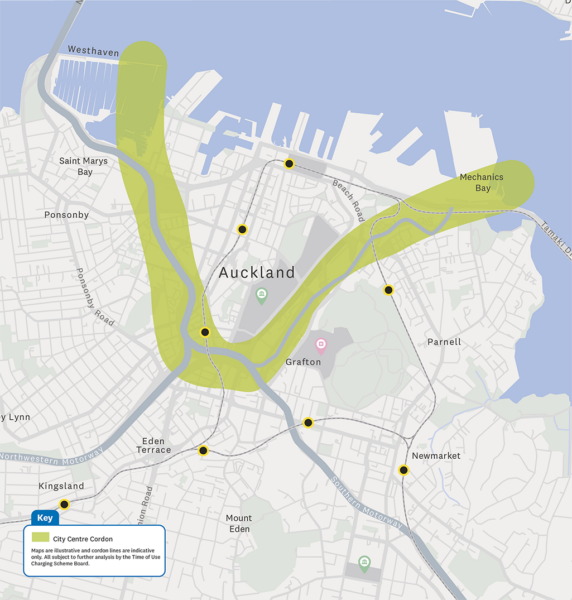
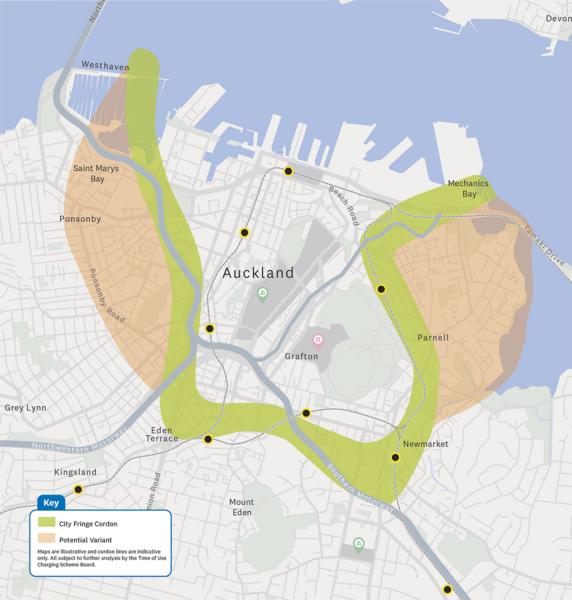
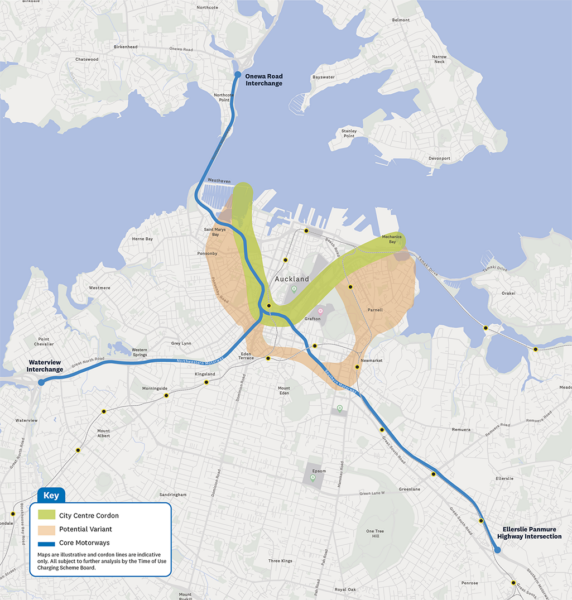
From Council’s announcement:
The options range from a relatively small city-centre charging area through to a larger scheme that would include key motorway corridors. Each option offers different levels of congestion reduction, different benefits and different trade-offs.
What they all have in common is the goal of helping Auckland’s transport network work better at the times and places where congestion is at its worst.
Following this initial engagement, councillors will decide on the preferred option and submit a Scheme Initiation in March 2027. Formal consultation, looking in detail at the final option, will take place late in 2027.
Our take: although Option C is likely to cop the most political pressure, it’s the highest-performing of the options based on Council’s own analysis and is likely to deliver the biggest benefits for Auckland overall.
Council’s supplementary materials note that Options A and B would have “limited” or “modest” net revenue, likely only enough to fund some extra capacity on public transport to offset the impact of the charge itself.
Option B delivers more benefits to drivers – important to get any scheme over the line – and addresses a perceived fairness issue for central city businesses, but yields about the same payback as the bare-bones Option A, given its larger coverage area and thus higher costs.
Only Option C is expected to bring in enough revenue to deliver wider enhancements to public transit across the region, meaning there’s the potential to offer something visible and aspirational, exciting even, in return for the coming bunfight that implementing any scheme will involve.
(And another thought: if it works, will it remove enough motorway traffic from Point Chevalier towards the city, that we could do the practical thing and reallocate lanes for a rapid busway – potentially saving billions of dollars? Wouldn’t that be great?)

Public engagement kicks off tomorrow (Saturday 14 November) with a Council stand at the Parnell Farmers’ Market, if you prefer to chat through your thoughts over a coffee.
Bin volume debate gets loud
Bins, mate: they’re part of the life of every city, a regular third rail in Anglosphere local politics, and Auckland councillors touched off some upset this week with a narrow vote to reduce the size of newly issued red-topped wheelie bins:
In a tight vote, Auckland’s councillors approved a more aggressive approach towards smaller kerbside rubbish bin sizes, with the aim of reducing the amount of waste being taken to tips.
It means 80 litre bins are set to become the default option and, after consultation, people could end up paying more for larger bins.
… The current bigger red bins would not be taken away from households, [Deputy Mayor Desley Simpson] said. However, if they opted for the smaller 80 litre bins they would pay less for rubbish disposal.
When new bins were delivered, residents would still receive three – for recycling, general rubbish and food scraps.
The contents of red bins had been analysed, and just under half should be going into people’s recycling or food waste bins.
The Post (paywalled) has aired some claims that the push for smaller red bins is an effort to bolster Council’s kerbside food scraps service. A council evaluation report on that service is still under wraps, but one Post source claims usage is “well below forecast levels”…
…although that may not be surprising, with councillor Julie Fairey noting on Bluesky that the forecasts were based on a proposed move to fortnightly rubbish collections, which was scrapped late last year before even reaching trial stage.
Also, Councillor Richard Hills noted long-term contracts for food scrap collections would continue to cost ratepayers, even if the service was pulled. So, on with the food scrap collections for now?
Amid acknowledgement of the limits of landfill, the debate also yielded insights into diverse food scraps practices around the region, with this one particularly outstanding in the field:
Franklin councillor Andy Baker agreed the city couldn’t keep “sticking rubbish into holes in rural Auckland”.
Baker said he “would love to have a food bin”, because “at the moment I throw most of my scraps in my neighbour’s paddock.”
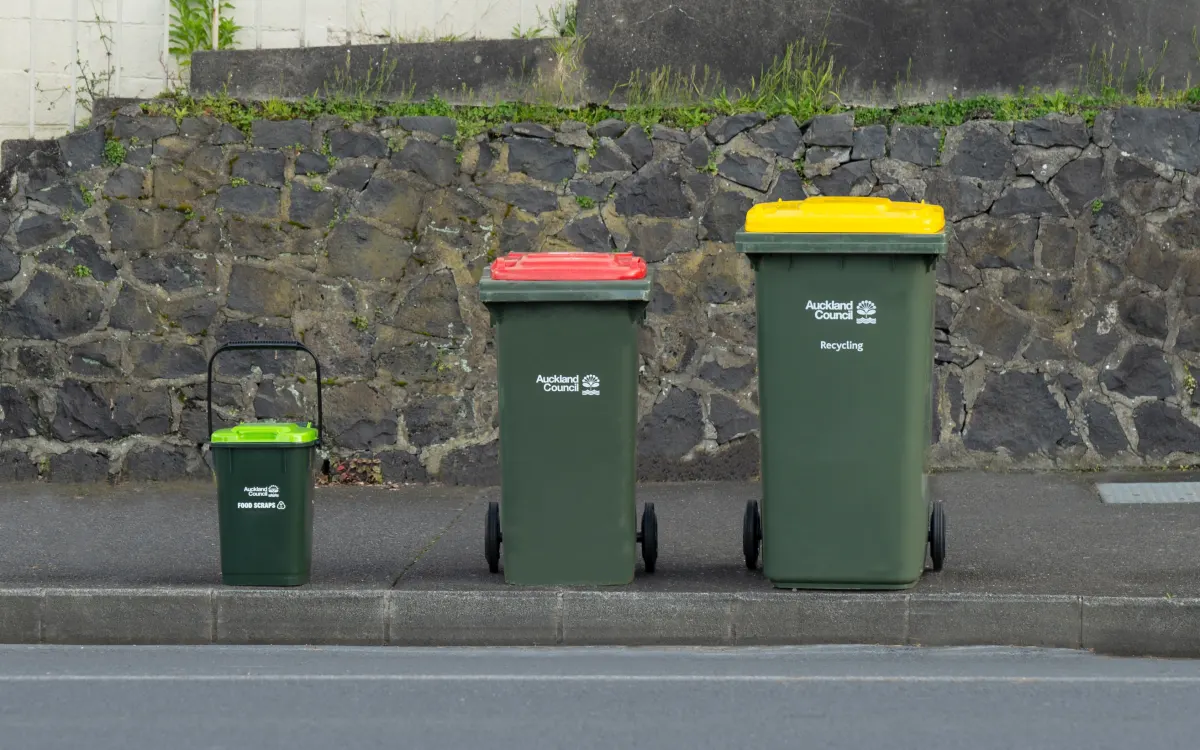
Auckland: your rubbish. (You’d never think of all this trouble, just to look at them!) Image: Auckland Council
Copper pilfering adds up for Wellington rail
Copper theft seems to be an escalating issue across infrastructure in Aotearoa, with thefts causing substation and fibre outages and six-figure cost associated with copper stolen from Wellington’s rail network:
Figures from KiwiRail showed cable theft from rail yards and laid cabling cost it $150,000 in 2025 and $187,000 this year. That figure did not include the cost of the disruption to commuters because that was difficult to quantify.
In Wairarapa, KiwiRail had laid 5km of replacement copper cabling, but it did not have distance figures for the whole Wellington region because it was not always recorded.
Greater Wellington regional councillor Tom James said copper theft was costing Wellingtonians “far too much” in delays, cancellations and dollars, and the disruption that criminals were causing was unacceptable.
… [James] was worried current enforcement was inadequate: “Our region deserves reliable rail services – there’s already too many delays and buses replacing trains due to the decades of deferred track renewals.”
Auckland’s top streetscapes
Worth taking a look or paying a weekend visit to your favourite local winner or highly commended entry in last week’s national landscape architecture awards:
Auckland Council Group awards and nominations by category:
He Iti Pounamu (small projects)
- Category Winner: Waka Moana, Daldy Street Taonga Toi
- Award of Excellence: Karanga Jump Platform
Research and Communications
- Category Winner: AT Blue-Green Infrastructure
- Award of Excellence: Designing Aotearoa New Zealand with nature: landscape regeneration of Western Waiheke Island
Transport
- Award of Excellence: Te Whau Pathway, West Auckland
Play Spaces
- Award of Excellence: Old Papatoetoe Stadium Reserve
- Award of Excellence: Kaipātiki Reserve and Playspace at Parakai
Parks, Open Spaces and Recreation
- Award of Excellence: Maungawhau Tihi Boardwalk (Stage 2)
- Award of Excellence: Te Rimutahi, Ponsonby
Civic and Urban Design
- Nominated: Takapuna Streetscapes

He Īti Pounamu (small projects) category winner “Waka Moana” by artist Graham Tipene, on Daldy Street in Wynyard Quarter. Image credit: Our Auckland
Another reason to give the car a day off
Climate Club Aotearoa supports “high-impact climate action for busy people” with a range of simple, empowering challenges and this month there’s an extra sweetener for Aucklanders looking to shake up their transport mix:
Sign up and pledge to challenge yourself to leave the car at home and instead walk, bike, or use public transport at least once every week this month.
If you live in Auckland and take the “I left the car at home” Challenge, you can enter our giveaway draw! The winner can choose either a $500 HOP card or a $500 voucher to spend at an EcoMatters Bike Hub.
To enter the draw, you can pledge online, or post on social media before 10 December.
Placemaking and mobility around Sydney’s Metro
From across the Tasman, an intriguing video from Building Beautifully looks at Sydney’s first Metro line and its interactions with placemaking, bikes and buses, and suburban form:
…and a Friday tune to round us off
As we wait to see where the chips will fall after last weekend’s election, an apropos message from The Clean – accompanied by some classic glimpses of seventies Christchurch at human scale, from the street-corner lovely to the landfill-gritty.
That’s it for us this week – have a great weekend and see you next week And as always, feel free to share relevant links and stories in the comments.

 Processing...
Big announcement?
Some other good news, a record month for Te Huia patronage.
I’d love to see a proposal to add an additional platform to Puhinui Station (it was designed with this in mind; which is a remarkable sign of cultural improvement for this country).
Combined with a safe long-term parking facility on the Waikato end; it could one day provide Waikastrians with an easy and dependable way to access Auckland Airport.
While I agree an extra platform at Puhinui would be good Te Huia already stops there so it’s a good option for international travel already.
I would imagine most people would prefer to leave the car at home and either get someone or a shuttle to drop them at one of the stations in Hamilton anyway.
You are right, however the number of Te Huia is limited by congestion on the lines (among other things) and an additional platform would help address this as it would utilise the new third railway line currently bypassing the station (meaning that trains could be scheduled for times that align with flights etc).
Agree, frequency will be the key to people using it for catching flights. The main limiting factor at the moment though is rolling stock, there simply arent trains to run every hour or two.
I plumped for Option C in the Time of Use Charging Consultation. It deals with the Newmarket problem, which is a regular bottleneck at rush hour (great for me cycling through there as I’m often faster), and bus users get stuck.
I’ve got nothing to add regarding these proposals, except to say that image scale being different for option C is annoying. I guess it needs to be a different scale to show the motorways, but it does distort things a little.
Hmmmm. Big announcement from Wellington – failed MP Chris Bishop’s promise to get “spades in the ground, before Christmas” on Wellington’s (unfunded) six billion dollar upgrade to Wellington’s stupid transport problems has actually started.
Yes, the totally un-needed upgrade for Karo Drive to go from 2 lanes, to 3 lanes and then back again to 2 lanes, thereby ensuring even more traffic snarlups at the very busiest point, has just started. Footpath widths are being reduced and trees are being cut down in order to squeeze this extra lane of traffic into Wellington’s already cramped roading infrastructure, just before the Terrace Tunnel – started the Monday after the election. Congratulations Mr Bishop, your legacy is now set in concrete. 200m of wasted time, money and concrete, crowning years of political grind. Was it all worth it?
The trees and pedestrians are selfishly getting in the way of the poor folk doing it tough who need to get to the airport faster
err, Karo drive runs westbound… away from the airport, .. there are no changes for the eastbound route (yet)
Incorrect. I did not mention east or west, but Bishop wants to widen both routes, and these include to enlarge Karo Drive to 3 lanes from the Arras Tunnel all the way along to the Terrace tunnel, where traffic will then have to squeeze back down to 2 lanes – but in 30 years time, the second Terrace Tunnel may relieve this.
In the mean time, the plans for the Eastbound is for State Highway 1 to be widened to 3 lanes from the Terrace Tunnel exit into the city, all the way down Vivian St, right down to Kent Tce, thereby bring motorway traffic right down through the city. This would, honestly, be a bit of a disaster for all the businesses down Vivian St, and would have effect of speeding up traffic (which is what he wants) but this would have a detrimental effect on lives along there (such as Cuba Street, which is already bisected by this traffic sewer).
Ironically, the only inner-city action actually achieved by LGWM in its miserable existence, was to make 2 kerb push-outs into Vivian Street to make the traffic a bit slower and make pedestrians lives a bit safer. Both of these will be removed under these plans.
These bin proposals – if implemented – will just lead to an increase in fly-tipping. Its the same pattern of behaviour that plays out in townhouse developments with inadequate parking.
Let’s hope that the council doesn’t take the route of pretending to solve a problem while encouraging individuals to make it worse.
There will be a predictable lack of nuance in the public square regarding this issue of course.
Council have to provide free rubbish bin collection or people will break the law? Do they also need to provide free food to everyone to stop people stealing?
As someone who uses the food scraps bin and has a mostly empty rubbish bin, I’m very keen to only pay for fortnightly collection. We are seeing the typical issues that come from subsidies over and over again.
Social welfare payments for precisely that purpose are nothing new.
So basically we need to use almost infinite landfill because people are too lazy to use their food scraps bin because their rubbish bin has to be big and free. What a great society…
Council does need to assist with soft plastic recycling. It’s probably about a third of what goes into general rubbish. Currently if you want to recycle it you have to take it to only a few participating places. Home pick up with enable regular bins to get smaller
Taking it back to where you bought the packaging seems to work. Just needs to be every supermarket.
I live in one of the majority of councils that have rubbish collecton once a fortnight. There’s no more fly tipping here than I ever saw in Auckland.