A few months ago I took a look at what was happening with ridership at train stations ahead of the CRL opening. I also asked Auckland Transport for data on Busway stations. So here’s a similar look at what’s happening with the Northern Busway stations.
To start with, let’s look at a bit of history the busway and ridership along it.
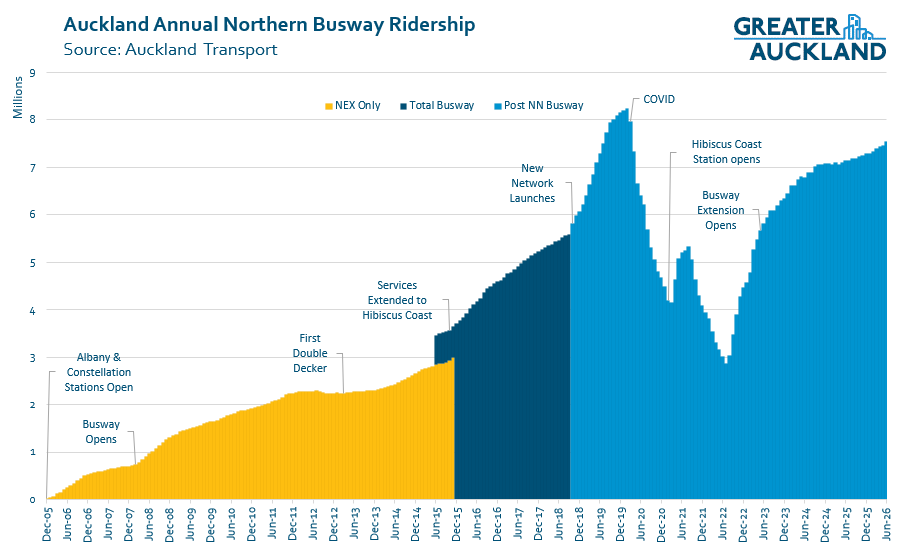
- In November 2005 the first busway stations opened – Albany and Constellation – with the new Northern Express (NEX) buses running along the shoulders between them and the city, much like is now happening with the WX1.
- Then in February 2008 the busway itself opened along with the Sunnynook, Smales Farm and Akoranga stations resulting in a surge in usage.
- In March 2013 Auckland’s first double decker bus was introduced – now a staple on many of Auckland’s bus routes.

- While the Northern Express is the main service along the busway, there are a number of other services that use it for part of their journey. A prime example of this is the 83 which runs along the busway between Constellation and Smales Farm and so can be used for trips between those stations. In Mid-2014 Auckland Transport started reporting on not just the NEX but all ridership along the busway.
- In late 2015 some NEX services were extended to the Hibiscus Coast along with one of the first rollouts of the new bus networks. Originally it was just some basic bus stops on the side of the road but in early 2021 a proper station was completed.
- October 2018 saw the launch of the new bus network for the North Shore and along with improved feeder services it came a major change for the busway itself a second Northern Express route, this time servicing midtown and the universities in the city centre. This gave us the routes we have today, the NX1 and NX2 with the NX1 being the busiest bus route in the country and the NX2 not far behind.
- In May 2022 an extension of the busway itself from Constellation to Albany occurred providing a 10km dedicated busway between Albany and Akoranga. It was originally intended that a new station would be built and open at the same time at Rosedale but it has suffered repeated delays and is has only just recently started construction and is not due to open until early 2028.
- Like all public transport, COVID knocked ridership around. Usage peaked in early 2020 at 8.2 million trips and as of June, ridership is back to about 7.5m trips or about 91% of pre-covid levels – far above rail recovery at that time which was at just 65% in June and only a little bit behind overall bus recovery which at that time was sitting at 96%, though that is in part due to new routes since covid, such as the WX1.
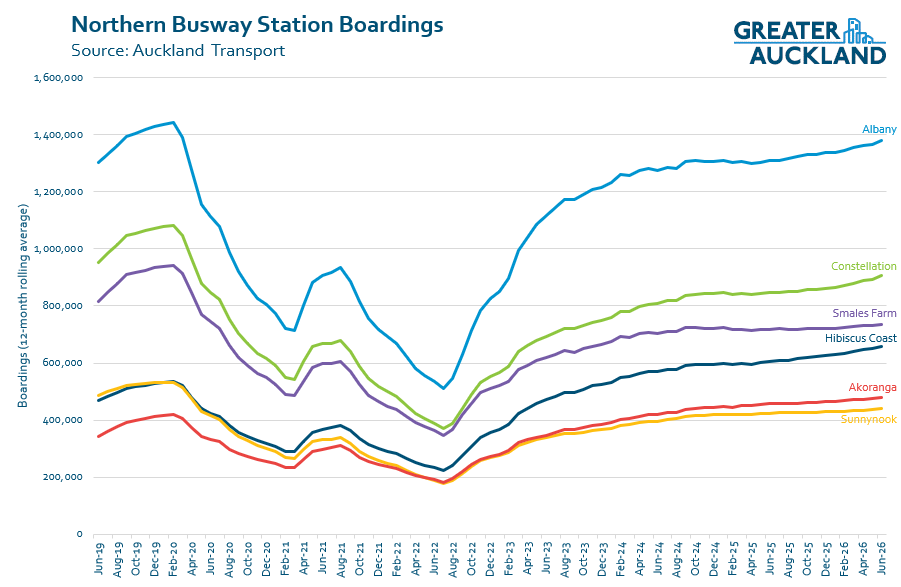
 The data AT provided allows me to break down the ridership by station and you can see below how it has changed over time – note: I’ve excluded boardings from the city centre as around 82% of all busway trips are to or from the city and including it completely overshadows the chart. A couple of things stand out.
- Just how much busier Albany is than all of the other stations. With over 1.35 million busway boardings last year it is head and shoulders above Constellation in second place with just under 900 thousand trips.
- The biggest mover is Hibiscus Coast which will largely be due to the proper station opening in 2021. As a result it is up 21% on pre-covid levels.
- Akoranga has also improved compared to before covid, up 13%. One of the key factors behind this is likely the upgrading of the 942 to become the 94 frequent service. Prior to covid the 942 carried 480k annual trips. It was back to over 460k when it was replaced by the 94 in July 2024. The 94 it is now carrying over 700k trips annually and a factor in that will also be the huge growth around Northcote.
- Smales Farm has had the lowest recovery at just 78%.
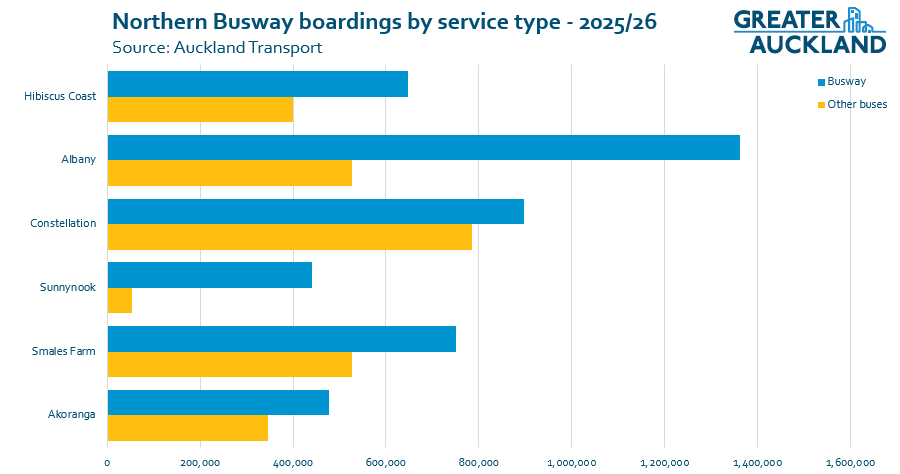
- The combined number of boardings at just the busway stations for people travelling on the busway is 4.58 million trips.
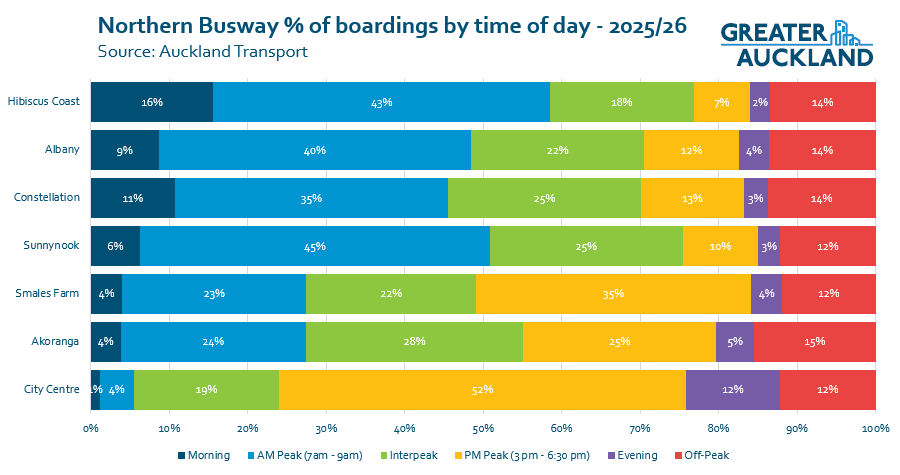
The data also allows us to see trips by the time of day. AT say the AM peak is counted as 7am to 9am and the PM peak from 3pm to 6:30pm, the off-peak figures include weekends and public holidays. A couple of things that stand out to me in this:
- Generally the further out you go from the city centre, the more early morning boardings there are.
- There is a marked difference in pattern for Smales Farm and Akoranga to the other stations. The latter are clearly much more commuter focused while Smales and Akoranga have much more balanced all-day usage. I suspect a large part of the Smales boardings being stronger in the PM peak is massive influx of students it gets in afternoons, most notably from Westlake Girls which is right next door.
A lot of focus often goes on the provision of car parking at stations – as Councillor Maurice Willianson complained about recently – so it’s interesting to consider is the impact of parking on station usage. Using the time-of-day data above I’ve taken just the morning and AM Peak usage for each station – in reality a lot of the interpeak usage will be just after 9am and should probably be counted too. Dividing that morning usage by the approximate 250 working days a year gives us an average number of boardings each weekday morning at these stations. This is shown below compared to how many carparks are provided.
| Station | Carparks | Est. Weekday morning Boardings | % of trips from Park & Ride |
| Hibiscus Coast | 604 | 1,541 | 39% |
| Albany | 1,210 | 2,670 | 45% |
| Constellation | 335 | 1,648 | 20% |
| Sunnynook | 0 | 896 | 0% |
| Smales Farm | 0 | 828 | 0% |
| Akoranga | 0 | 527 | 0% |
Another interesting angle is that all busway stations, except Sunnynook, are major interchange stations. As noted earlier, there are around 4.58 million boardings from the busway stations for trips along the busway but there are also another 2.59 million trips from these stations on local buses. While some trips on local buses to busway stations will be people visiting destinations around stations, many will also represent people transferring from busway trips.
Finally I added the busway stations to one of the charts I included in my rail stations post and as you can see, there’s quite a stark difference in boardings. I think there are two key reasons for this.
- The busway is six stations covering a large area so the ridership is more concentrated.
- The rail network was still in a recovery phase – as noted at the time it was at only 65% of pre-covid levels due in large part to all of the work on the network. We know there’s been huge growth in usage since the CRL opened in September with AT stating in a recent press release:
Waitematā remains the busiest station on the network, while key transport hubs including Panmure (+42%), New Lynn (+47%) Sylvia Park (+56%) and Newmarket (+17%) have also recorded strong growth, highlighting the benefits of a more connected network.
That would suggest that at least stations like Panmure and New Lynn are now likely back in line with some of the busier busway stations.
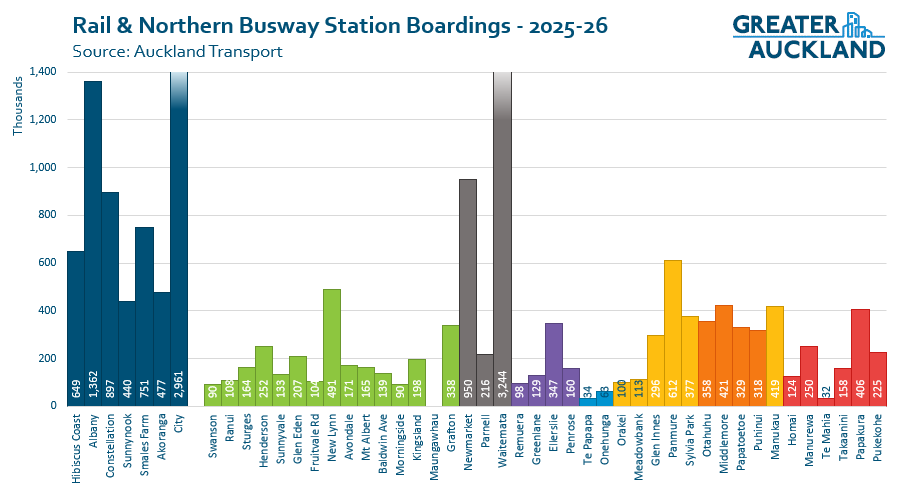 It will be fascinating to look at this again in a few years as I expect the CRL effect to change the results significantly. It would also be great to be able to add in the Northwestern and Eastern busways in the future.

 Processing...
A lot of the early patronage at Hibiscus Coast is driven by the Park and Ride. If you want to use the Park and Ride, you have to be there before 7:30, better at 7am to still get a spot. From 7:30 onward traffic also gets really bad around the area. It would be great to extend the busway all the way to Silverdale.
Very interesting how sunnynook – a mainly walk to type station – has more annual ridership than most train stations in Auckland.