The City Rail Link is being officially opened today – as in, a ribbon-cutting, with trains commencing from Sunday. So with passenger services just two days away, what better time to take a look at look at how the rail network has been performing, to help provide a bit of a benchmark for the transformation the CRL delivers.
To start with, let’s look at the overall numbers before diving deeper.
Just over a century ago, Auckland’s rail network was carrying around 6 million annual trips. But the shifting of the Auckland Station from its original site where Waitematā now is, to The Strand, reduced the use of the network, putting it into decline.
The original iteration of something like the City Rail Link – the Morningside Deviation – was intended to address this by providing better access to the city centre but as we know, it never happened. What followed was, with a couple of exceptions, a slow and steady decline in the use of the network before reaching its nadir in 1993, with the system carrying a touch over one million trips.
That was when Auckland brought Perth’s former diesel trains, which resulted in usage more than doubling. While the diesel trains revived the network, it was the 2003 opening of Britomart Station – now Waitematā – that returned trains to where they originally were over 80 years earlier, which really kickstarted the rail revival in Auckland. It turns out, making the network a lot more useful results in usage shooting up.
Further improvements to the network, such as station upgrades, double-tracking of the Western line, the opening of the Onehunga and Manukau branches, and eventually electrification, saw usage rise even higher – peaking at just over 22 million trips prior to the arrival of COVID.
Since then, a rise in work-from-home has changed travel patterns, and the network has been impacted by six years of disruption (for various works), which has taken a massive toll on ridership. In the 12 months to the end of August 2026, there were just 14.7 million trips, which is about 67% of the pre-COVID peak. The last time usage was at 14.7 million trips was September 2015.
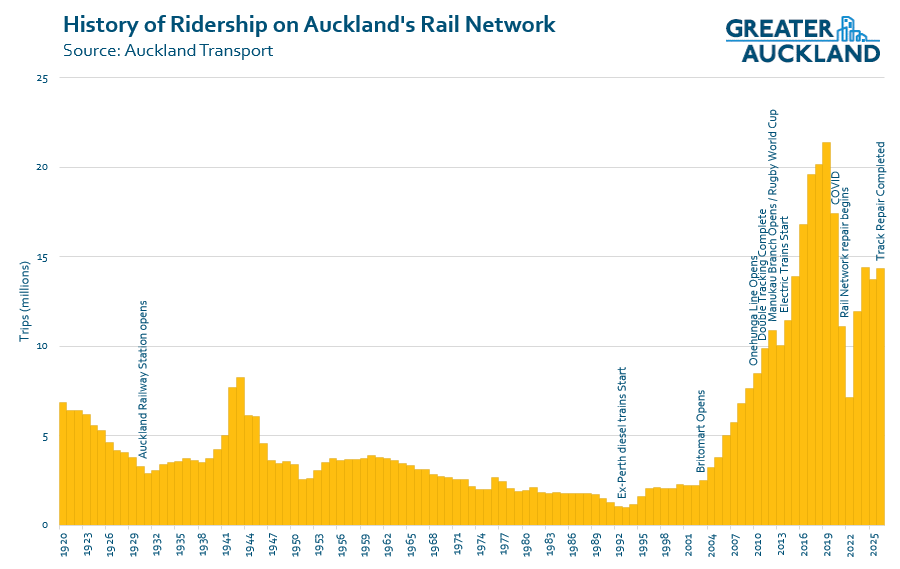
The growth of ridership post-Britomart was driven by numerous improvements to both the rail network and the wider public transport network. The version on the chart below looks just at the modern history a bit more closely, showing many of the improvements that contributed to the growth we’ve seen.

Notably, the years of disruption meant the rail network never recovered at the same rate as buses or ferries, and was stuck in the low-60% for years. It’s only in the last few months that we’ve started to see that change, pushing closer to 80% of pre-COVID levels. This is likely a combination of the reduction in disruptions, plus the impacts of fuel price rises.

Auckland Transport has also kindly provided me with station usage data. There are many possible stories to tell from this – too many for just one post.
To start with, here are the overall boardings. As you’d expect, even though usage overall is down, Waitematā continues to dominate, accounting for over a quarter of all boardings. At the other end of the scale, Te Mahia, at which AT have just built a large pedestrian bridge as part of their efforts to remove level crossings – is the least used station on the network with just 32k trips in the last financial year, not far behind Te Papapa.

And below is how station boardings compare to pre-COVID levels.
Only two stations are above what they were at in 2019: Puhinui and Parnell. The upgrade of Puhinui has clearly made a huge difference to its usage, a trend we’ve seen at other significantly upgraded stations in the past. Meanawhile, Parnell has benefited a lot from efforts to improve access, such as the underpass that was completed at the start of 2024.
The Onehunga line stations are the worst performing here. That will in large part be due to them no longer having direct access to Waitematā, like they had in the pre-COVID era.
Of the main lines, the Western looks to be performing the worst – likely a big part of this would be the ongoing network disruption due to the rail network rebuild works and the upgrade of Henderson station. As such, boardings at many of the stations are still down on even 2024 levels, with the outer stations down by as much as 20%.

However, that is just boardings, which actually accounts for around 52% of all trips on the network – something that will certainly start to change from next week.
If we extend the same logic to other stations, the top five are shown below. Note, a trip from one of these stations to another, e.g. from Panmure to Waitematā, will be counted in both, so the totals don’t add up to 100%. The results also highlight a few other interesting aspects:
- Panmure and New Lynn have continued to battle for the 3rd and 4th busiest stations. Panmure is now more clearly ahead, but as noted above, New Lynn has been disrupted more recently by network upgrades whereas Panmure saw that disruption more significantly in 2022-24.
- Manukau has continued to rise in popularity, with Middlemore only just behind.

Another interesting story using this method has been in the South. The closure of Pukekohe during electrification and the station upgrade clearly resulted in many users shifting to catching the train from Papakura and Takaanini. With Pukekohe reopened, those trips have shifted back. I imagine this picture will change a lot again with the opening of Drury and Paerātā, plus Ngākōroa next year.

The two stations with the biggest mismatch in boarding and alighting numbers remain Grafton and Waitematā. This suggests the ongoing presence of “down-hilling” – people are getting off the train at Grafton, perhaps catching a bus to areas like the University, then carrying on downhill in the afternoon, to board a homeward train at Waitematā.
If I rank each station by boardings and chart them all, I get what I like to call The Rug, due to its resemblance to a colourful woven rug thanks to all the movement.
For this version I’ve only highlighted the most dramatic changes. As you can see, most of the stations that have had big changes are those that have been through significant upgrades.

The data Auckland Transport provided me also included the rough time of day that trips occurred. Over half of all trips happen in the morning or afternoon peaks. Note: the off-peak figures include weekends and public holidays.

It will be fascinating to see how these numbers change over the coming weeks, months, and years.
For their part, Auckland Transport include their ridership targets – which are based off their modelled predictions – in their Statement of Intent (SOI) documents – the most recent one being signed off by Auckland Council just a few weeks ago and covering 2026-29.
The chart below shows the targets, including those from previous SOIs. It shows that Auckland Transport is expecting to reach 22 million trips again by the middle of 2028 and then only a slight increase to 23.3 million trips a year later.
In an interview with the Herald, KiwiRail CEO Peter Reidy mentioned that they’re preparing for 29 million passengers by the end of 2030. So I’ve added that too. As you can see, it represents a continuation of the trend predicted by Auckland Transport for the next few years, which does feel a bit more realistic.
Personally, these results feel a bit too low to me – but time will tell. It’s certainly something we’ll be watching closely.

What do you think will happen with ridership.

 Processing...
On Eastern Line most passengers are pretty slow to get off the train once it arrives at Waitemata/Britomart as it’s a terminus. On Monday it will be a through station. I guess it will take a while for people to get used to, but I wonder what preparations have been made for this. Will there be extra (audible!) announcements? Hopefully additional staff to remind people to either hop off quickly, or stay on the train e.g. Auckland Girls students will probably find it easier to get off at K Rd. I wonder if they know that? Although we’re all interested in CRL I think most passengers will be surprised on Monday when the doors close early and then they’re all of a sudden in a tunnel going to Panic Stations 🙂
Also, I expect Waitemata/Britomart will go down quite a lot within the first week as people switch to Te Waihorotiu and K Rd. Will rebound in the medium term as the whole network gets more popular, wonder how long that will take to get back to today’s levels? Not a bad thing as Waitemata can get quite full at peak.
Agree on the drop, but I don’t foresee Waitemata station getting dethroned from the top spot. So much more livelier in that part of the city. The Britomart regeneration and activation of the space is just amazing to see
Yeah, although it might take 6 months plus to settle down. A lot of existing and new riders will go to the new shiny stations for a while before they figure out what works best for them.
One possibility is that K Rd becomes the designated Uni station because of the downhill effect. TWH is closer but needs an uphill climb up Albert. Also because of general vibe of K Rd. And for East and South they might go to K Rd in morning, walk down to Uni, then walk down to Waitemata for home trip.
Re below, I mean an uphill climb up Victoria St East and then Albert Park
It’ll be intersting to see how the CRL changes travel patterns to/from the Universities. Have noticed a lot of students catch 70/27 from Waitemata up to the Univesties (and a bus down to Waitemata when leaving).
As someone commented in the previous rail ridership post, we need a colourful rail station rankings graph on a shirt or a blanket!!
Grafton is going to drop like stone.
You forgot to add buses partonage.
Grafton is going to drop like a bomb.
You forgot to add bus partonge.
Fare avoidance is a very big issue on the western from my personal observation. I bet (atleast) another fourth of ridership would come in if all of the people avoiding fares started magically paying them.
It’ll improve because instead of Grafton people will be choosing between K Rd, Mt Eden or Aotea, all of which are gated rather than Grafton Rd which is yet to be.
Realistically they should be prioritising gating Grafton/Parnell as people can (and will) still travel slightly longer to avoid paying fares.
Parnell been gated for probably a couple of years.
I haven’t stopped there I think ever – but good to know it’s just a single station they need to sort.
I don’t understand why they haven’t gated all the stations. The ones I use most often are, so when I go somewhere that doesn’t, I almost forget to tag off.
Fare evasion probably explains Te Mahia’s position, too. It’s noticeably much more heavily used than ever before, but it’s also clear that a large proportion of users don’t tag on or off. Similar at Takaanini, although to a lesser degree.
I wonder if these stats cover only Hop data, or whether there’s any correction undertaken by examining the automatic passenger counts on the trains.
Looking forward to a new era in mass transport for Auckland.
Pukekohe station upgrades stand out in your “rug” with near 2 years being closed.
The trains were still running, freight at least, just no people trains. We’re past it now and locals are shifting back from their cars.
Really hoping the “close it for years to upgrade” logic belongs to the smaller slower city planning era we’ve now left behind.
Now, to link up these new stations with walking and cycling paths – more than just road connections.
A century ago, every person must have caught the train. Post World War Two, every person drives a car.
The Central Rail Link is a project from more than a century ago, so it proves the longevity of train travel; particularly in regard to mass transit.
One hundred years ago our population was how many? In the tens of thousands? And still six million train rides. Now we have a million or so, and only a minority appear dedicated to trains.
The Central Rail Link is a fix for a problem imagined more than a century ago. It is our city’s chance to prove that we care about the people that live here; not about the awful private motor vehicles that are almost as big as the bus in some instances.
For our tamariki, mokupuna, supergold card holders especially, the Central Rail Link will make car travel seem silly, stressful, and a waste of time, space and life.
Trains are the lifeblood of every city in the world, they will be ours.
Also, if anyone knows how to make David Seymour stop saying horrible things for a few seconds, I do not believe that fascism should have any place in our motu, and what we have in NZFirst and ACT is very similar to AFD in Germany. Fascism was invented by the Italians, perfected by the Germans, but we do not need it hier!!!
bah humbug
He is a lot of things but he isn’t authoritarian or ultra-nationalist so I don’t think he is fascist. He is more in the mold of people can do what they want (if they are rich enough to have that choice).
Na, I’m with Matiu on this. Call it out where you see it.
To whoever made the Rail Boardings graphs…
Bravo on the colour scheme, I don’t think I have ever seen something that so clearly shows where lines merge and split without additional notes before. That is a thing of beauty.
It seems like the Kiwi Rail CEO let slip an internal target with AT insisting on a public target that will be easily met. Not sure i like this strategy. But if there is a more ambitious internal target that is at least better than if there’s only the soft official one.
Targets do get aimed at. So i would rather there is, somewhere, an ambitious stretch target for AT teams to focus on, have to get creative to meet, etc.
30m by 2030 looks good to me. 30 by 30!
A doubling.
A presentation of actual passenger journeys pre and post CRL opening would be very interesting. Particularly so for the trips where direct access has gone ie Western Line to Grafton, Newmarket and Parnell.
I suspect politicians are going to want to jump on the rail bandwagon assuming the CRL is a big success.
So if National get elected, and they want to build rail, and they don’t want to build LR because they are National, what projects could we expect? Will we see the Avondale Southdown designation used for metro rail? Or could they revive metro rail to the airport via Onehunga?
As if any politician knows how a mix of rail modes might be right for any given city in NZ.
I think that the downtown to airport via Puhinui is ok. I know lots of overseas cities have direct to airport rail/light rail setups, but the cost of extending from Onehunga to the airport might outweigh the good that same money could do elsewhere on the system.
There are big projects coming up, level crossing removal, harbour crossing and maybe the Southdown link.
All of those should rank ahead of an airport rail link IMHO.
Melbourne has, and is, making absolutely massive investments to upgrades and extensions to its already huge suburban rail network.
But connecting this huge network, to it’s airport, one much bigger then Auckland’s, still remains relitively low on it’s priorities.
In Brisbane there is a direct train from the city to the airport. It costs $AU23.50 one way. It is the same 1067 rail gauge as the QR system, but has rolling stock suitable for travellers with luggage etc.
But here’s the catch, it is contracted out to a private operator with something in the region of 10 to 15 years to run. I am guessing that politicians had their sticky fingers all over that deal. I contacted a relative who has used it regularly and he reports it is very lightly used, and never crowded. If it was run by QR it would be a 50c fare introduced recently on suburban bus and train systems, but even before that the fare would have been about $AU5.00.
Let’s hope any such arrangements in NZ (Christchurch maybe) are not so expensive that ridership is low.
Brisbane’s airport train runs using the same rolling stock as the rest of the network (the NGR) which doesn’t have any specific accommodations for travellers (such as luggage racks)
The price is a definite disincentive, especially if you’re travelling as a family, but it’s only 10 minutes slower than driving (before taking traffic into account!)
Auckland’s current train-bus connection usually involves a 30-40 minute penalty compared to driving/uber-ing. Not exactly flattering.
Next steps:
1) 3rd and 4th mains to Papakura and Pukekohe are probably next big thing. Prearations are evident in recent works and docs.
2) Fleet and depot expansion plans are ongoing. Perhaps far greater than most would expect.
3. Avondale – Southdown may find a head start in a partial Roskill Branch as once envisioned. This gives a new offline terminus to facilitate short running services in a way far preferable to turning back at Henderson, Morningside or Maungawhau. Would also leave LRT route options and/or give time to prepare the rest of the route to Southdown and to Northport.
4. I fear that the Onehunga Branch is doomed. If LRT or ASL happen, there’s no place for it. If the Onehunga-Airport extension happens, it’ll suppress the other two schemes.
5. Swanson-Huapai (or Waimauku) remains a distant, but tantalizing possibility if the SH16 deviation through Takapau goes ahead with adequate consideration for also rerouting the NAL. Going direct from Takapau to Waimauku would offer an opportunity to “unsplit” Huapai and Kumeu by lifting the rail line and replacing it with BRT or LRT connecting at Waimauku. Don’t hold your breath waiting for that one.
Largely agree Les.
1. Yes
2. Yes
Though I would add, at 3, at least a passing loop on the eastern for port shunts, south of the tunnel, not too difficult of expensive.
I used to be very keen on the Roskill branch but I now tend to think that limits frequency to the very valuable mid- and outer reach of the western line (esp all the bus users at New Lynn).
3. No. ASL won’t happen – too expensive for the benefit -doesn’t even bypass New Lynn.
Even if we get the Marsden link AND a whole lot of sea freight there, if that happens then will need to bypass New Lynn and Avondale incline too.
4. yes.
5. Yes, that would be great, re-routing on M’way alignment
6. Ideally 3rd and 4th south of Drury should be on new SH1 alignment with Bombay hills tunnel. Big ambition!
1/6. Yep, but I think it’s 3/4th main to Pukekohe (as they still will cap out capacity on the double track for metro service and it’s decades before they add the 5th/6th from Drury directly under the Bombay’s).
2. They should be focusing the new depots further out with cheaper land, e.g. Pukekohe or Swanson so they can minimise empty out of service train trips. But overall seems to be going great.
3. I think the Mt Roskill branch will probably happen because it’s the logical place to terminate the more frequent trains in the inner west, as the outer west removals to Henderson and further out won’t happen for many many decades.
4. Depends on whether they expand to the airport. If they do, then it should be fine, if they don’t, it’ll be reduced to either a shuttle or removed entirely as A-S will replace most of the travel functionality.
5. Do they have any plans to reroute the NAL there? Most I’ve heard is the freight hub that’s unbudgeted for. It’d be a good idea, but so many times (bar SH20) there are obvious long term improvements to other modes of transport that could be designated/planned for (although likely not built) that makes future projects significantly easier.
I work part of the week around Grafton. People I work with can’t come to terms with the fact you can either when coming from the west, time it right and change to O-W at Maungawhau for Grafton, or… just change at K-rd.
Oh no… you have to change trains…like…in a real city! They could also just take the INN link from K-rd or walk. Much whinging from the general populace who don’t really seem to understand how transit works. Or large infrastructure projects in general either. I imagine many of you fellow GA readers have similar discussions at work.
Well said.
In due course the OW line will be extended to cover more of the western line, more often and possibly more frequently as other upgrades and mitigations come to pass. The initial inconvenience won’t be forever.
I do have some sympathy – given the spikey nature of the EW line headways, a commute from Morningside to Newmarket will likely double in length if you have to transfer (i.e. every day, if you’re travelling at peak times.)
Asking people to switch trains is fine, but it’s a harder sell when you don’t have metro frequencies. Given Newmarket and Grafton’s popularity, if the stats bear out that they a significant number of people have had their commutes increased, I could see an argument for running some 6 car trains as shorts between Henderson and Newmarket at peak?
Enjoy all your info that you supply in your articles. How do you get people out of cars, we don’t have a huge population that gives enough support for the various modes of transports the likes of Europe.
Auckland is a big city for its level of transit in European terms. There a population of 200k means transit and trams etc.
We do not lack for people, we have lacked a supply of good enough services for people to use, that is being addressed. There are other factors such as urban form and pricing that also matter too. Change is happening.
Our battle in NZ is the inertia of a decades long car centric society that has permeated all aspects of transport. Much of our population growth and physical sprawl happened around the time personal vehicles were seen as essential for urban life. It takes a long time to reverse this trend. 1.5 million people is a fairly big city even by global standards and enough to support a comprehensive public transport network. I feel like we are still in the middle of the hard part of change, where big investment is being made but time is needed to see the payoff. Some pieces of the solution, like congestion charging, are still yet to be implemented. War in the middle east is doing its part although if the traffic is still bearable and parking still available people just adapt to higher fuel prices. Many who try good PT often change habits for good- eg go and ask people taking the Northern Express into the CBD and see how many would give it up and go back to driving.
Remember we are also building for the next generation who are, on the whole, less inclined to own cars. The question is not just ‘how to do we tempt people out of their cars?’ but ‘how can we best serve the next generation so they don’t even need a car in the first place?’
Auckland’s bigger than plenty of places in Europe. Plenty of places like Oslo/Copenhagen etc. we’ve got a similar population, far larger the city proper but I think Copenhagen has a few hundred k more than us in the wider area.
Also remember Auckland (and plenty of other places in NZ) supported far bigger PT networks in terms of ridership with far less than half the population. People choose what is in their perceived best option, if you make that PT, they’ll take PT. That’s why our rapid transit routes are so popular, and why our rail dropped off a cliff once KR decided to make it unreliable.
In terms of pedestrian bridges to reduce level crossings, why did they start with the modest Te Mahia station and patronage?
They’re focusing on lines. So priority #1 is Southern Line as that’s where KRs freight is. Now they’re reaching the point that essentially every crossing has been closed on the lines freight uses, they’re getting to the Western Line, first the bit to the Avondale – Southdown junction, then next to Henderson, then to the edge of the network. Last will be Onehunga (as we don’t really know the plans for it post Avondale – Southdown)
Correct – those southern stations were the last crossings in the busiest corridor.
KR’s adoption of ETCS on freight trains imposes fairly stern restrictions on operations through level crossings and especially pedestrian crossings close to signals. The biggest benefit in removing those crossings is in avoiding immense inconvenience associated with the failsafe nature of ETCS, eg; kilometre long freight trains having to slow to 15kph and crawl past a pedestrian crossing because some impatient pedestrian has pushed through the gate and activated a breach alarm. Not having those risks allows for much more frequent and reliable operations on that busy stretch.
Looking forward to reading about the post CRL stats.
Decided to take a look at what the Greater Auckland post from 10 years ago out of curiosity and its bang on about the CRL being imminent. Kinda ironic that it’ll open on the same day (a decade ago) that it was posted.
https://www.greaterauckland.org.nz/2016/09/13/city-rail-link-and-atap-imminent/
Very very excited about the CRL opening on Sunday. Hoping it’ll be the catalyst to more public transport projects similar to Waitemata station over 20 years ago.
How confident are we that AT made the right decisions deciding on the line routes for the ART? I have stared at that map for a long time wondering how things would be difficult if Onehunga line wrapped around through the city to take the Eastern Line on the other end. There’s probably other options AT must have considered. Do we have a study of the different combinations and the reasons AT went with the final configuration on the ART?
Any line connecting to the Onehunga Line is going to be limited to a 30 min frequency. The Eastern Line needs a much higher frequency.
I’m not 100% on board with the lines they landed on, but I think it’s one of the better options compared to others.
Any combination of the Onehunga line with another line through the CRL would entail short-terminating trains since the single-track OBL can only handle 2–3 trains per hour. This adds complexity to the network, and there are only so many stations suited to short-stopping trains – Newmarket being one of them
There was a lot of simulation and live testing done to come to this conclusion. I don’t agree that the starting arrangements are the best they could have done, but fortunately they intention is to update to superior schedules twice in the coming year. So basically it’s down to a few hard physical limitations: a. Onehunga Branch can only support 3-car trains and 30 minute frequency. b. Western line level crossings clog traffic up to dangerous levels if train frequency is too high or up/down services are out of synch. c. There are only a few places that trains can terminate and even fewer where it won’t clog the line at peak frequency.
These factors explain nearly all the weird choices. I think they could have made it far less complicated to start with, but I don’t know what they’re planning for the next phase or whether it’ll all make more sense in 12 months time.
I’m sure it would get Mike Lee up in arms but plenty have suggested that the O’Line is better as LRT. Or, given that’s poison at the moment, a busway starting at Avondale and down SH20 to Onehunga and beyond.
I guess the only issue is its really hard to get new rail lines built in this city/country. Tearing them up would seem counter-intuitive.
It should be a shuttle line as is normal across Europe and should have been from the day the line was exhumed from the grave. doing that would increase frequencies and usefulness.
At the end of the day rail projects like this are drain on govt. finances , they never make a profit. At least Auckland will be just like the Soviet Union now, overpriced rail, crappy apartments and bronco statues
Roads never make a profit either, nor hospitals or schools. Do you actually understand what government is and its purpose? You know it’s not a corner dairy, or a panel-beaters, or even a corporation or bank, right?
And while we are picking on crappy apartments, let’s lump it in with all the terrible housing quality. How can it be warmer outside than in, in some of these dumps?
See? We can play this game as long as you like…