Kia ora and welcome to our regular roundup of stories that caught our eye this week.
This Week in Greater Auckland
On Monday, Matt looked at options for solving post-event crowding at Kingsland Station. This story rumbled on for a few days, with the Mayor also weighing in (NZ Herald):
“Before anyone starts calling for uncosted and expensive new infrastructure, we need to establish the facts and make sure existing plans and procedures are being followed properly,” Brown added.
In this instance the post-match train travel shambles appeared to be an operational issue, not an infrastructure one. “The question Aucklanders should be asking is whether the approved plan was implemented properly, not whether they need to pay for another expensive piece of infrastructure.”
On Wednesday, Connor looked at who decided Auckland’s volcanic viewshafts – and why they’re due for reconsideration.
And on Thursday, we had a guest post from Kasey McDonnell on All Aboard Aotearoa’s Better Moves report.
Greater Auckland in the media
Connor’s work exposing the costs of the Roads of National Significance continues to get cut-through. It’s cited in Russell Brown’s column in this week’s Listener, aptly titled (in print) “Highway Robbery” (paywalled version here). Here’s a snippet, via Bluesky:
I ended up choosing a symbol of it all.
— Russell Brown (@publicaddress.bsky.social) October 16, 2026 at 8:39 AM
And our coverage can also be felt between the lines of this editorial in The Press headlined “Roads of electoral significance”:
One of the Press panelists speaks of “myopic election term syndrome”, which is a good description of the short-term thinking and flip-flopping that has hobbled our politics and turned planning into an arena for polarisation. We are seeing an increasing sense of disillusionment in the electorate about these tactics and a growing belief in consensus.
Greater Auckland’s research and advocacy is powered by hundreds of hours of work each month. Your support helps keep us going! We warmly welcome your donations, and are always open to offers of guest posts, practical help, and pro-bono expertise.
Another great way to support the kaupapa: Greater Auckland merch. Allow a week for delivery, and note these are print-on-demand (no returns), so double-check your sizing before ordering!
CRL Success Continues
Auckland Transport report that in its first month, the rail network has moved more than 2 million people.
More than two million trips have been taken on trains in the first month since the City Rail Link (CRL) launched, with two thirds of those journeys travelling through the new tunnels and stations.
Auckland Mayor Wayne Brown says it’s good to see Aucklanders making the most of the CRL and the investment that’s gone into it.
“The whole point of the CRL is simple. Move more people around Auckland, faster and more efficiently, it’s a fantastic result,” says Mayor Brown.
“Two million trips is a good sign Aucklanders are using it for what it was designed to do. The challenge now is to get the maximum benefit from this significant investment, support the city’s grown and make it quicker and easier for people to get where they need to go.
“When transport works well, Auckland works well. It’s good see the new stations are already changing the way people move around the city.”
Week four of the new rail network saw a provisional total of 520,688 trips on trains, making it the second busiest week on record. The week was boosted by thousands travelling to and from the sold-out All Blacks match at Eden Park and a significant increase in off-peak travel by children during the second week of school holidays.
Child concession data shows off-peak weekday trips increasing 268% compared with school term weeks. By comparison, the equivalent increase during the 2025 school holidays was 96%.
…..
Waitematā remains the busiest station on the network, while key transport hubs including Panmure (+42%), New Lynn (+47%) Sylvia Park (+56%) and Newmarket (+17%) have also recorded strong growth, highlighting the benefits of a more connected network.
Also, we don’t know exactly how many more than two million trips there were – but given the first month now contains the three busiest weeks on record, it’s likely to be a decent amount.
To put things in context, there have only been six calendar months in the past with more than two million trips, with the busiest single month being March 2017 when 2.15 million were recorded. The previous busiest September was in 2019 with 1.83 million trips. The official result for this September is 1.90 million, but that includes 12 days before the CRL was opened.
With the first round of timetable improvements planned for next month, these numbers should only get better.
Is the City Rail Link paying off? Karangahape says yes
The Spinoff asked retailers and hospo outlets along Karangahape Road how it’s going, now that their local station (with its two entrances) is open. All signs and sighs of relief point to yes! Do read the whole piece, but here’s a taste:
While it’s still early days, train usage is nearly double what it was a year ago, meaning foot traffic around its five new hubs has exploded. In turn, the businesses that managed to hold on through years of disruptions are enjoying their best trading in years.
“Thank fuck” might be the best way to sum up the gratitude and relief expressed by retailers across multiple interviews with The Spinoff.
“It’s honestly been amazing,” says Elie Assaf, the co-owner of Pitt Street’s Lebanese Grocer. “The extra demand at lunchtime has definitely put a bit more pressure on our little team, but it’s a very good problem to have … we have had some of our busiest lunches ever.”
Jack Young agrees. He opened his Pitt Street bar No.7 in the middle of 2021, enticed by cheap post-Covid rent. “Stupid me said, ‘Let’s do it,’” he says. “The carrot that was the train station kept me going. Somehow we scraped by.”
Since the CRL has opened, Young says his bar’s been “rammed”. He’s seen many new faces and has a full house on weekends. “It’s been pretty mad … we’ve been flat out,” he says. Soon, renovations will double his floor space, taking advantage of this boom. “It’s probably a little bit better than I thought it would be.”
Trains also feature in another Spinoff piece, about the ideal night out in Auckland:
“I think Tāmaki-maxxing means doing more than one thing in a night.” [Comedian Chris] Parker recommends a few city combos, but says the best night out starts with the still-novel City Rail Link. “I think despite Uncle Wayne’s best efforts to tell us that catching the train is normal, it’s not yet.
And a visitor from the capital also enjoyed our trains: Dave Armstrong, writing in The Press:
Aucklanders are very proud of their new CRL (Central Rail Link) network and so they should be. The trains are relatively fast, modern, comfortable and very smooth. I was able to travel from the south of the city to north, transfer at Maungawhau (Mt Eden) and then go from east to west Auckland in minutes.
Forget the long waits for some Wellington trains, the longest I had to wait was six minutes and there was no car congestion to worry about! People who think motorists won’t get out of their cars and start using public transport should visit Auckland. The late afternoon trains I travelled on were packed.
Our busy big city
Fun data-vis from the Melbourne-based Tompkins Studio:
View this post on Instagram
Have your say (on all sorts of things)
Worth bookmarking Auckland Council’s projects page, if you want to a) know what’s being planned, and b) have your say about it!
Current consultations include :
- lots of playground upgrades (in Māngere, Ōtara, Hobsonville, Albany, Massey, Half Moon Bay, Clevedon, Flatbush and more!
- some interesting projects in parks – including community-led mountainbike trails in Glen Innes, and a pump track in Glendowie
- and the project of transforming Downtown (we plan to cover this one in more detail soon).
All Aboard for saving the economy
Simon Wilson writes about All Aboard’s “Better Moves” report in the Listener (paywalled/ in print), under the headline “The billion-dollar costs of neglecting public transport.” He reiterates the point that investing in low-carbon transport options involves some big numbers – but the status quo will always cost us even more.
Transport (the way we do it now) is “an anchor on the economy”. Adopting the plan in full – passenger rail from Whangārei to Dunedin, plus all the bus services and cycleways – would cost about $336b. That’s $111b less than the $447b cost of not doing it.Each year on average, Better Moves would make us more than $2b better off. But we have to reallocate that street space.
On the sunny side of the street
Shared vehicles, shared equipment, and shared common rooms for social gatherings… these are already a thing in well-designed apartment buildings, along with bike sheds, laundries, and more.
The Guardian reports on an invention that enables neighbours in vertical villages to share solar power:
Melbourne-based Allume Energy won the 2026 Australian Good Design award of the year for its SolShare system. The product, which works like a “traffic controller for solar” enables power produced by a shared rooftop system to be split among several apartments without multiple installations, individual inverters and messy wiring. It also received the award for sustainability.
Dr Brandon Gien, chair of Good Design Australia, said SolShare was not only “an amazing piece of technology” but also a beautifully designed solution to a complex problem.
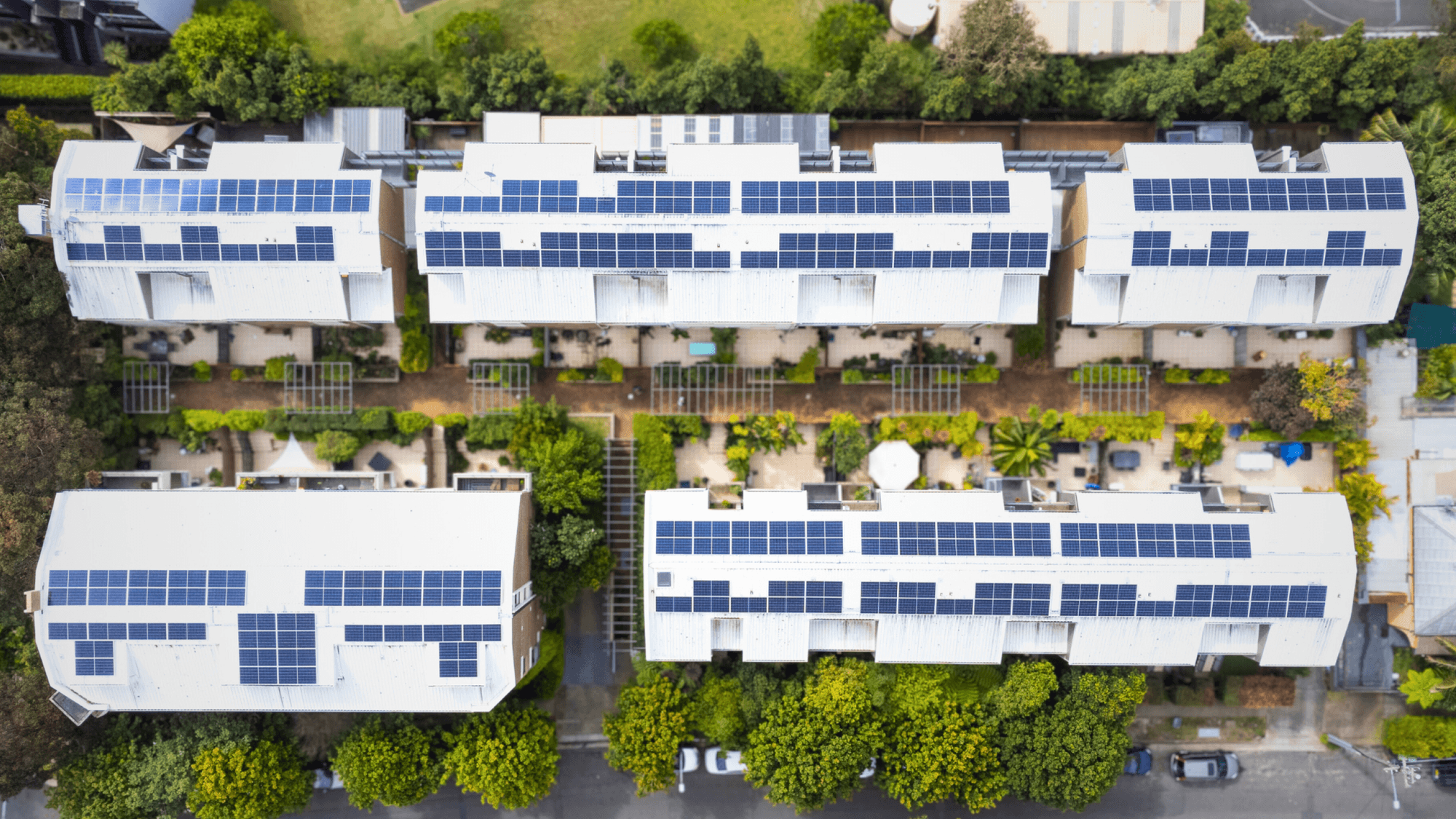
An array of solar panels on apartments. Image via Australia Good Design Awards 2026.
Does building more roads create more traffic?
“When it comes to reducing congestion, one solution almost instinctively comes to mind: build more roads or widen existing ones.” But the law of unintended consequences – and Jevons’ paradox – tells us you’ll get the opposite effect. This handy explainer by an Australian academic includes nifty visuals, so you can toggle the connector road open and closed, to see what happens to traffic over time.
Of course, the definitive illustration of “induced demand” also comes from Australia – the satirical but so-true-it-hurts series Utopia, and we’ll take every opportunity to post it again.
Ooh la la: the shape of Paris over time
This gorgeous data visualisation displays Paris, building by building, across time. You can explore by street, by arrondissement, by time period… see what Baron Haussman got up to in the 1850s and 1860s, by way of urban renovation, and more!

Good as gold: walking the Ginza line
A lovely story from Japan, about following Tokyo’s oldest subway line – the Ginza line, appropriately coloured gold on the schematic map we’re familiar with.
Beginning in Asakusa, the line taps into the city’s first modern entertainment quarter, a place where, in the late Meiji (1868–1912) and Taishō (1912–25) periods, crowds gathered for theater, sideshows, and the novelty of cinema.
At Ginza Station, one enters a more self-conscious stage of leisure: a district that has continually reinvented itself since the late nineteenth century, from a brick-lined showcase of Western modernity to a postwar consumer paradise and, later, a polished enclave of luxury.
By the time the line reaches Shibuya, the mood has changed again. Here, in the late Shōwa (1926–89) and Heisei (1989–2019) years, leisure fragments into youth culture, fashion tribes, and the restless churn of trends, where people no longer gather simply to watch or to stroll, and leisure becomes faster, more self-directed.
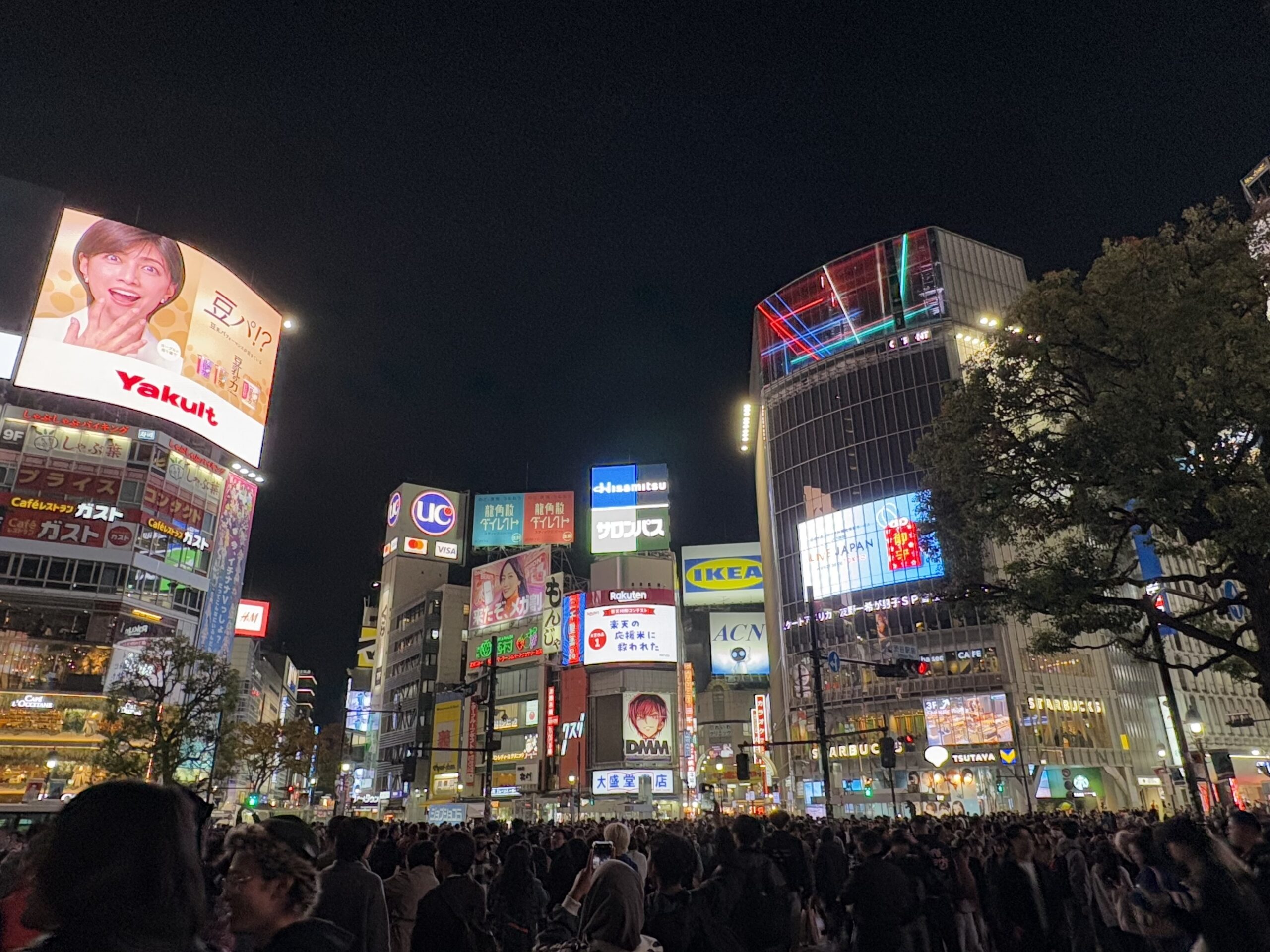
The famous Shibuya “scramble” crossing, November 2025. Photo by Jolisa Gracewood.
The outsize power of pocket parks
A nice story from Mother Jones on how a greater number of small parks in cities can bring more benefits to more people (and creatures!) than a few big parks, especially when they’re located within a ten-minute walk for nearby humans:
Over the past decade, scientists have found that when tiny green spaces are scattered across cities, their cumulative effects are greater than the sum of their parts.
Mini-parks can give migrating birds passing through urban areas a place to rest and feed, says Frank La Sorte, a Yale scientist who studies avian ecology and behavior. In a 2023 study, La Sorte found that cities studded with small parks have a greater number of bird species than those with just a few large parks.
That’s us for the week – as always, feel free to share links and stories in the comments below, and have a great weekend!

 Processing...
A Wellingtonian comparing Auckland’s trains positively to their own.
Things you could not have imagined 20 years ago.
I keep recommending Utopia to people, but satire sometimes cuts too deep when you see it play out in real life
I saw an interview with Simeon Brown where he denied induced demand, then posed with Chris Bishop wearing a hard-hat, hi-vis and carrying a shovel for a publicity shop.
The transport minister character in Utopia is supposed to be joke, not an actual NZ Government minister implementing policy
Labour transport ministers didn’t do well, mostly by underachieving and not getting stuff done, but I would still prefer that to getting the wrong stuff done