Today, Treasury is releasing the Pre-election Economic and Fiscal Update (or PREFU) ahead of the election. So I figured it was worth looking at a significant recent change to the way transport expenditure works – a change that has gone relatively under-reported.
Specifically, it relates to how the New Zealand Transport Agency (NZTA/Waka Kotahi) repays debt, and can be found in the changes between drafts of the 2024 Government Policy Statement on Land Transport and the final version.
In short, the repayments (aka cost) of debt are pushed out into the future. This frees up funding in the short term without making the government books look “bad”. Unfortunately, it exacerbates the unsustainability of the National Land Transport Fund, via large spikes in debt expenditure (due to backending the large expenses). It also puts future governments – and future taxpayers – on the hook for these costs.
Newsroom’s Oliver Lewis was one journalist who covered this change in 2024, see for example:
- Govt sets $22b transport plan, lowers debt repayment track
- NZTA debt projected to increase to $7.6 billion
But there has been less coverage of the long-term implications of these changes to debt repayment. Specifically, the apparent use of what is known as a “bullet loan”.
Why should this be raising alarm bells?
On 13 August 2026, the new Ministry for Cities, Environment, Regions and Transport (MCERT) released a Ministerial Statement on Land Transport Investment – a position paper that will inform the development of the draft Goverment Policy Statement on Land Transport 2027 (GPS 2027).
A key part of this document is a projection of Land Transport Revenue – which, crucially, is expressed as “Net Revenue”. As the footnote helpfully explains, “Net Revenue = NLTF Revenue (such as FED and RUC) minus any debt servicing that is required in that year.” Here’s the relevant section:
![The case for a more sustainable system Land transport investment needs a long-term, credible funding path. Major infrastructure takes years to plan and deliver, and councils, NZTA and the market need stable signals. But we cannot keep relying on deferred revenue decisions or Crown top-ups to sustain the programme. The National Land Transport Fund (NLTF) is expected to face significant pressure over the coming decade. GPS 2024 included $8 billion of Crown funding and financing, but that support will expire. Increases to Fuel Excise Duty and Road User Charges will take time to build revenue, while the National Land Transport Fund must also repay debt from the 2021–24 and 2024–27 programmes. [Graph showing Land Transport Revenue Actuals & Forecast] Over 2027/28–2036/37, NLTF revenue is likely to be enough only for continuous programmes (for road maintenance, operations and renewals, rail, public transport services, safety), critical resilience activities, debt repayments and projects already underway. New improvements will require savings, reprioritisation, higher user charges, or further Crown funding. These are hard choices. They either require the system to stop or defer lower-value work, ask users to pay more, or place further pressure on the Crown at a time when fiscal constraints are already significant. [Footnote attached to the title of the graph: Net Revenue = NLTF Revenue (such as FED and RUC) – any debt servicing that is required in that year.]](https://www.greaterauckland.org.nz/wp-content/uploads/2026/08/GPS27-funding-situation.jpg)
Now take a close look at the year 2034, above – it shows a significant drop in “Net Revenue”.
Why?
This goes back to the changes to how NZTA pays back its debts (as reported by Oli Lewis in July 2024).
Given the recent muddle with NLTF revenue, it’s really important to understand how much the coalition government’s GPS 2024 has screwed up the NLTF – because, instead of spreading out debt repayments over time, it has led to massive future spikes.
We can see this in the difference in repayment schedules, between Labour’s draft GPS 2024, the National-led coalition’s fresh draft GPS 2024, and the final version landed on by then-transport minister Simeon Brown.
Labour’s draft transport GPS 2024 outlined expected debt repayments for NZTA as follows:
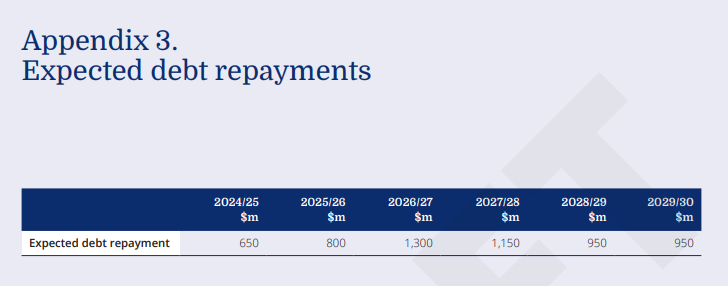
Expected debt repayments under the 2020-2023 Labour Government’s draft GPS 2024
When the National-led coalition took over at the end of 2023, they signalled drastic changes to the priorities for transport investment. But if you look at their initial Draft GPS 2024, the debt repayment schedule was not so different from Labour’s plan. The numbers were still spread out over time:
![The expected NZTA debt repayment schedule is tabulated below. These repayments are a ‘top-slice’ from the NLTF and sit outside of the activity classes. The debt repayment schedule aggregates the repayments associated with the formal debt arrangements that are currently in place for NZTA and are outlined in Table 5 - NZTA borrowing facilities. The bulk of these repayments are formed by the $3.144 billion loan facility provided to NZTA to deliver GPS 2024 priorities. In addition to repayments on NZTA’s borrowing facilities, the expected debt repayments include repayments on the Public Private Partnerships that have been used to deliver Transmission Gully and Puhoi to Warkworth projects included in the previous Roads of National Significance. As already indicated in Section 4, GPS 2024 represents a change in how borrowing is reported. The activities funded though borrowing (and any new PPPs) will be reported at the time of the investment as expenditure in the appropriate activity class. In practice this means that the repayments indicated in the below table will be ‘top-sliced’ from NLTF revenue outlined in Table 2 – NLTF Annual funding 2024/25-2029/30, before it is spent on activities included in the NLTP, reducing the NLTP expenditure targets in Table 3 – Expenditure targets and ranges. [Table 6. Debt repayment schedule]](https://www.greaterauckland.org.nz/wp-content/uploads/2026/09/National-DRAFT-GPS-2024-Expected-Debt-Repayments.png) However, the final GPS 2024 – i.e. the version that was implemented as policy under the direction of then-Minister of Transport Simeon Brown – took a different approach to the expected debt repayments. Notice how the numbers (up to 2029/ 2030) are significantly lower.
However, the final GPS 2024 – i.e. the version that was implemented as policy under the direction of then-Minister of Transport Simeon Brown – took a different approach to the expected debt repayments. Notice how the numbers (up to 2029/ 2030) are significantly lower.
![The expected NZTA debt repayment schedule is tabulated below. These repayments are a ‘top-slice’ from the NLTF and sit outside of the activity classes. The debt repayment schedule aggregates the repayments associated with the formal debt arrangements that are currently in place for the NZTA and are outlined in Table 4 - NZTA borrowing facilities. In addition to repayments on the NZTA’s borrowing facilities, the expected debt repayments include repayments on the PPPs that have been used to deliver Transmission Gully and Puhoi to Warkworth projects included in the previous Roads of National Significance programme. As already indicated in Section 4, GPS 2024 represents a change in how borrowing is reported. The activities funded though borrowing (and any new PPPs) will be reported at the time of the investment as expenditure in the appropriate activity class. In practice this means that the repayments indicated in the below table will be ‘top-sliced’ from NLTF revenue outlined in Table 2 – NLTF annual funding 2024/25-2029/30, before it is spent on activities included in the NLTP, reducing the NLTP expenditure targets in Table 3 – Expenditure targets and ranges 2024/25-2029/30. [Table 8. Debt repayment schedule]](https://www.greaterauckland.org.nz/wp-content/uploads/2026/09/National-Final-GPS-2024-Expected-Debt-Repayments.png)
So, after the public consultation period, and before the policy was finalised, the way NZTA was expected to pay back its debt was changed. Repayments were backloaded, i.e. pushed out into the future, thus significantly lowering earlier payments.
The difference between the debt repayment over the six years from 2024/25 to 2029/30, looking at the government’s draft GPS 2024, versus their final GPS 2024, is $1.4billion ($4.9billion vs $3.5 billion).
So $1.4billion has seemingly been pushed out to the future, with just $400 million owing in the 2024-2027 GPS period.
And if you compare this with Labour’s draft GPS 2024, the difference is $2.6 billion across those same six years (Labour had planned for $5.8 billion of repayments vs. National’s finalised $3.5 billion). In other words, National would pay $850 million less in the 2024-2027 period, i.e. the current parliamentary term – pushing that amount out to later years.
What’s the accounting mechanism at work here?
It appears this has been done through the use of “bullet loans”: an approach where only the interest is paid over time, with the loan principal being paid off at the very end of the loan term.
For example, a 10-year loan of $1 billion would only have interest repayments until the end of the term – at which point, the entire principal would need to be repaid in full.
This can be seen in proactively released advice about the 2024 GPS. In the tables on p180, you can compare loans repaid over time (in the first two tables) with the repayment schedule for a bullet loan (in the last two tables).
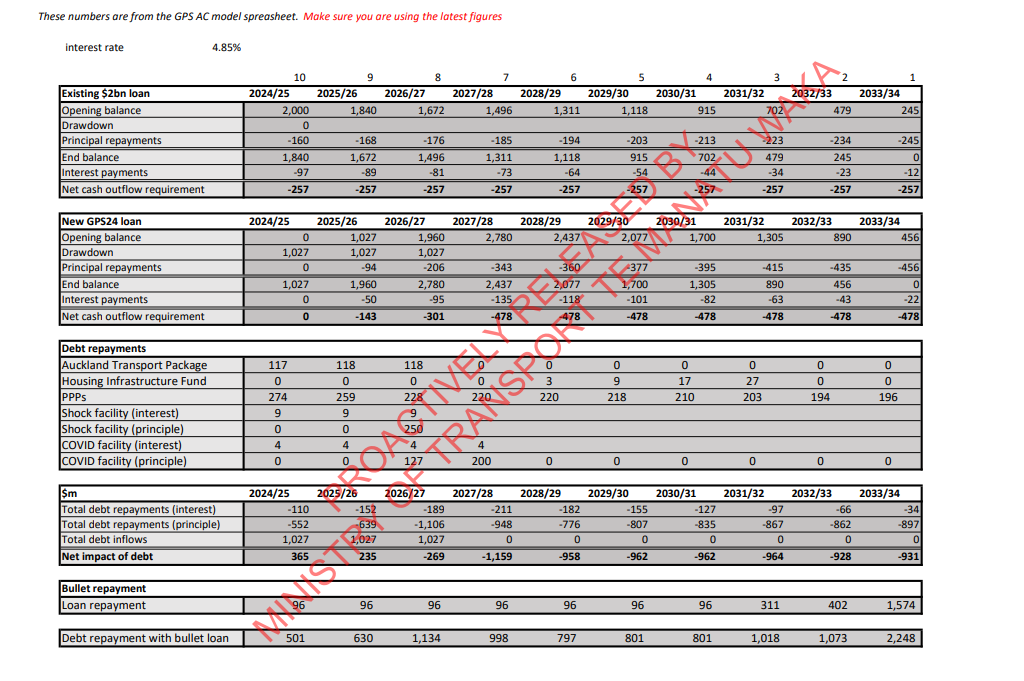 This has led to what we see in the graph from the MCERT Ministerial Statement we began with: in certain years, significant chunks of expenditure goes on debt.
So what’s the issue?
There’s a fundamental problem with taking this “interest-only loan” approach to transport investment.
The NLTF expenditure is premised on “pay-as-you-go” – in other words, it needs revenue coming in to pay off what it spends each year. And its core sources of revenue – fuel tax and road user charges – are generally consistent.
The problem arises when you compare estimated net NLTF revenue, with the expected expenditure, illustrated in the graph below.
The bars show expected expenditure. In blue are the continuous programmes, like maintenance, renewals and operations. In green are the “business as usual” improvements to the network. And yellow is debt repayments, bullet loans and PPPs (for giant projects like Roads of National Significance).
The lines show expected revenue, with and without the signalled increases to fuel tax and road user charges, including National’s recent workaround on fuel tax rises.
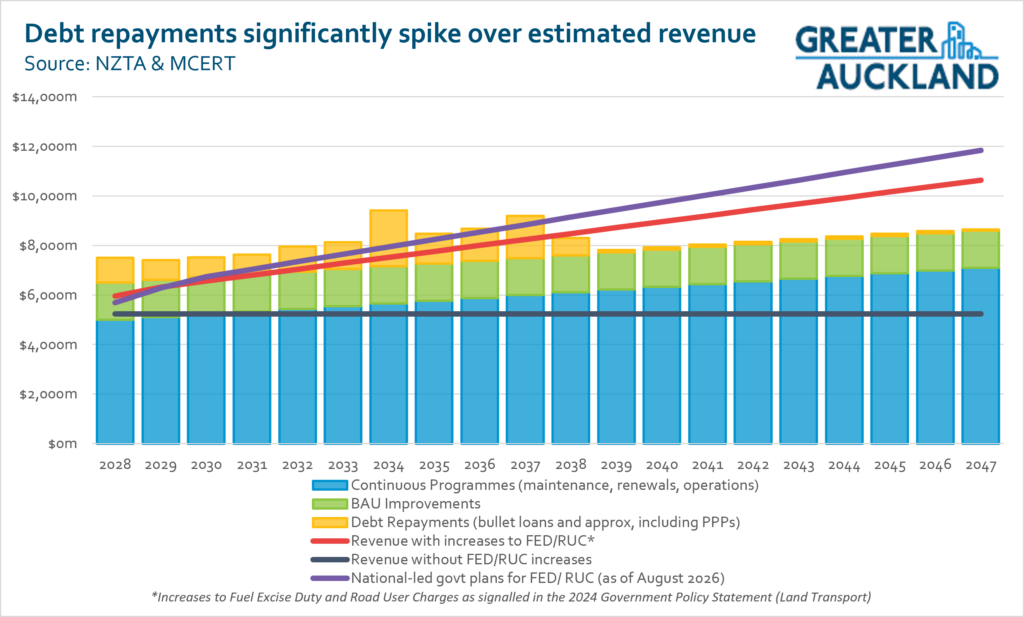
(Note: debt repayments after 2034 have been eyeballed from this Ministry of Transport graph, due to lack of specific numbers)
So what the GPS-mandated shift in debt repayment does, is stuff the future National Land Transport Fund even more.
As the graph above shows, even under the different FED/RUC increase scenarios expressed by political parties, the spikes in expenditure will be significant.
This likely means that from 2028 onwards, the government of the day will need to provide direct Crown funding to cover the repayments of the loans as they are currently set up.
Essentially, the government has already loaned NZTA funding to spend on transport, and will then find itself in the position of giving NZTA further funding to pay back those loans… to the government itself.
Moreover, the use of Crown funding – our shared wealth – to solve the transport repayment schemozzle, means we won’t be able to invest that resource in any of the other things we will need in 2028 and beyond.
Why would anyone do things this way?
The government has changed how debt is repaid, to push large costs onto specific years in the future. Implementing loans in this way means the Crown’s “books” are not impacted – a loan at commercial rates and paid back is considered net neutral.
The fundamental problem is, it further screws up what could (and should) otherwise be a self-funding system.
But not only has the overscoping of the Roads of National Significance programme – with gargantuan boondoggles such as Warkworth to Te Hana – utterly warped the National Land Transport Fund system.
The changes in the GPS 2024 freed up funding in the short term to push this government’s transport policies. But it has done so at significant cost to our future choices, in transport and beyond.
And it’s been done in a way so as to not show up on the government’s books…
…unless we know exactly where and how to look.
TL;DR: take any positive PREFU numbers today related to transport with a very large RoNS-sized grain of salt. There is an enormous problem hiding just around the corner, and we should all be asking questions about it.

 Processing...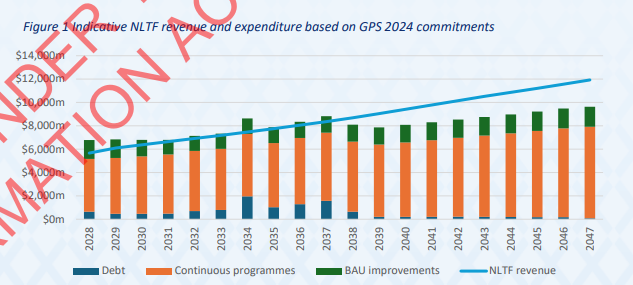
Thanks for this post. I still don’t think people realise just how harsh the “funding cliff” will be for transport next year. Not being able to fund a single new thing is not a place we have ever been as a country, as far as I can tell.
Since MCERT released that “sort of daft GPS” I have been trying to work out why transport funding is such a disaster, and I think you’ve hit on a critical part of the story – that a huge amount of NLTF over the next decade is needed to basically pay back loans which govt has used to avoid increasing FED/RUC for the past few years.
Add in the PPP payments for what will be three projects and that’s a huge amount of money sucked up for past projects that can’t be spent on future ones.
Thanks, Connor.
This was the opposite direction to how the processes needed to change. The only responsible way to approach the instability on its way (climate, geopolitical, economic, ecological) is by at least paying our own way as a generation. The next generations will be facing too many costs caused by our emissions and exploitation to have us load the costs of our regressive, high carbon transport decisions on top too.
We definitely need to invest in transport; indeed, in a transport system overhaul, but should do so by raising charges, taxes and rates. As the overhaul would substantially lower private household costs, and the taxes need to be applied to the rich, this would deliver equity and well-being.
It’s no wonder the emotional health of our children and youth is suffering.
Given the state of the world I would opine that transport projects need to be assessed on the basis of how much they will reduce our dependence on importing fuel. So a project to electrify rail and or buses would be at the top of the list. And good on Auckland Transport for having so many electric buses a recent visit to Brisbane showed we are streets ahead in fact after six days of wandering around I finally spotted one. I went for a ride on the rubber wheeled tram presumably that was battery powered quite nice and smooth not many seats but I assume they are designed for crush loads of standing passengers. But you can’t beat value for money though all public transport fares are 50 cents. I actually traveled from down town to Surfers and back for a dollar. Also went to the sunshine coast and back for another dollar. Not on the same day that would have been a bit much for me. Pity about the $23.50 fare one way to and from the airport.
Presumable the companies that run and own our bus fleet have considerable debt on their books. Probably this is better than having more Govt debt. But we all pay in the end.