Kia ora, and welcome to our weekly roundup of stories about transport, cities and housing. Our header image is by Scott Caldwell, and shows a celebratory banner over Karangahape Road this week: “We’ve got a new train!”
This Week in Greater Auckland
- On Monday, we reported on the sights and delights of Day One of the City Rail Link, great stuff all round!
- On Tuesday, we took a day off, to recover from the big weekend.
- On Wednesday, we shared a guide to giving feedback on Plan Change 120 (open until Thursday 24 September)
- And Thursday’s post was Connor’s latest op-ed for The Post, giving credit where due on CRL.
Plus, fresh content on our YouTube channel, including this video compilation from our June preview of the CRL stations. As always, thanks to Dallas Rabot of MARTIAN BUNKER for his work. Now we can visit these stations any old time, without hi-vis – and so can you!
We’re blushing:
Greater Auckland’s research and advocacy is powered by hundreds of hours of work each month, and your support helps keep us going! We warmly welcome your donations, and are always open to offers of guest posts, practical help, and pro-bono expertise.
Another great way to support the kaupapa: Greater Auckland merch. Allow a week for delivery, and note these are print-on-demand (no returns), so double-check your sizing before ordering!
CRL Ridership Soars
It’s been incredible seeing so many people share their experiences of using the CRL and it seems Aucklanders are flocking to give it a go with the early numbers showing a massive increase in train use.
Auckland Transport report that on the opening day over 70,000 people were recorded on the automated counters onboard the trains, at least three times higher than the previous Sunday and from what I can tell, was likely the busiest day since COVID. That was topped on Monday with the counters picking up over 92,000 boardings
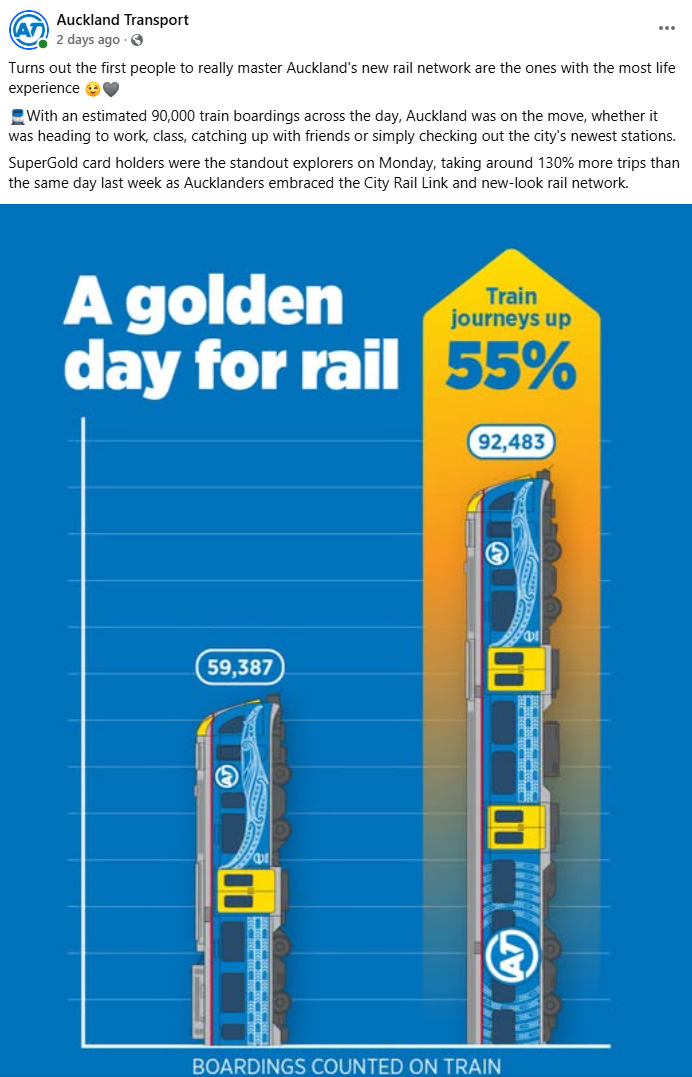
AT haven’t provided more specific details on usage but do say “estimated boardings up between about 40% to almost 60% compared to the same day last week“. This is impressive and puts usage at around some of the busiest we’ve seen the network, even pre-COVID.
Of course plenty of these trips will be people just checking out the tunnels and stations so will likely settle down a bit but many will likely be part of long term growth in the use of the network, which is fantastic.
Usage is obviously something we’ll be keeping a close eye on and will share more details when we get them in the future.
Upcoming changes to the road rules
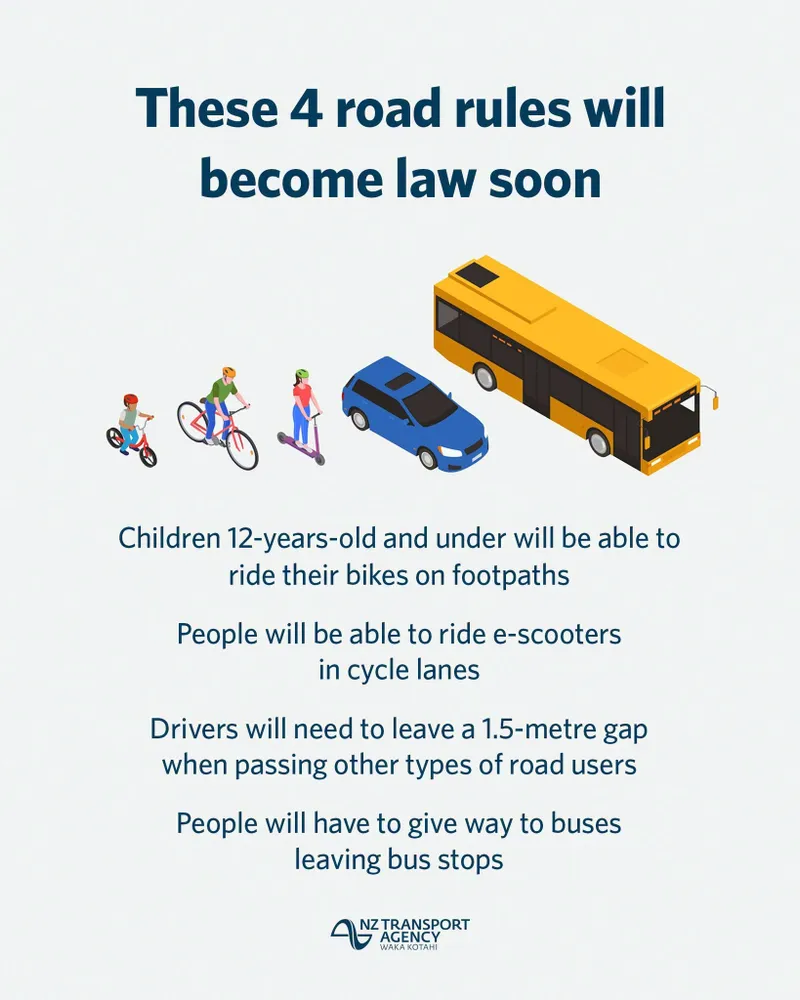
A handy reminder from Waka Kotahi the NZ Transport Agency, about upcoming changes to the road rules that will take effect from 1 October.
These have been working their way through the system for about six years – as part of a package known as “Accessible Streets” under the previous government, and now described as “changes to lane use”. More details here.
These changes will:
- allow children up to 12 years old to ride bikes on footpaths and allow parents or caregivers to ride with them.
- require a minimum passing gap of 1.5 metres when drivers pass other road users
- allow people to ride e-scooters in cycle lanes
- require road users to give way to buses leaving bus stops in areas with speed limits of 60km/h or less.
The changes will make lane use safer by making the rules clearer for people using bikes and e-scooters, footpath users, drivers and other road users. They respond to issues raised by road users, councils, and advocacy organisations and reflect how people currently use roads and footpaths.
Westgate Te Waiarohia
A new video from Waka Kotahi NZ Transport Agency:
Progress on the final stage of Te Ara ki Uta ki Tai, the eastern path
Good to see progress on this final section of the great eastern path, which when complete will provide an off-road connection from Glen Innes all the way to Tāmaki Drive. No confirmed opening date yet, but we’re all ears.
View this post on Instagram
No drama llamas
Did you know Auckland Council has farms, with flocks of sheep, and did you know the sheep are at risk from roaming dogs, and most of all did you know that llamas make excellent guard-animals??
As RNZ reports, the flocks at Ambury Park and Puhinui Reserve are in safe hands (hooves?), thanks to a team of “six protective llamas”:
[Auckland Council’s farming business manager Mozz] Trueman said unique security guards had been bought to protect the flocks of special lambs. He calls them Llama-guards.
This follows a horrific attack last January when three roaming dogs killed 142 lambs and injured another 86 in two attacks at Puhinui Reserve in Manukau.
At the time park rangers moved the surviving sheep to another site to keep them safe, and relocated others to a more visible part of the park. Trueman estimated the financial loss to be around $19,000.
“As you can appreciate we have a lot of roaming dogs. But since we have had llamas they have protected the sheep. We have a couple of incidents this year where we have lost seven lambs – as opposed to losing that 140 in one night.”
He said llamas would push the sheep into a corner to keep them safe and then go towards the dogs.
“They do stand up tall and make a weird bugle sounding warning noise. They can get really aggressive.”
Interestingly, the sheep in question are a relatively new breed that burps less methane:
Trueman said that the new rams also came from a special breeding programme called ‘Cool Sheep’ and were better for the environment.
The rams had been part of a trial for eight years and the data showed they literally had a lower carbon footprint, he said.
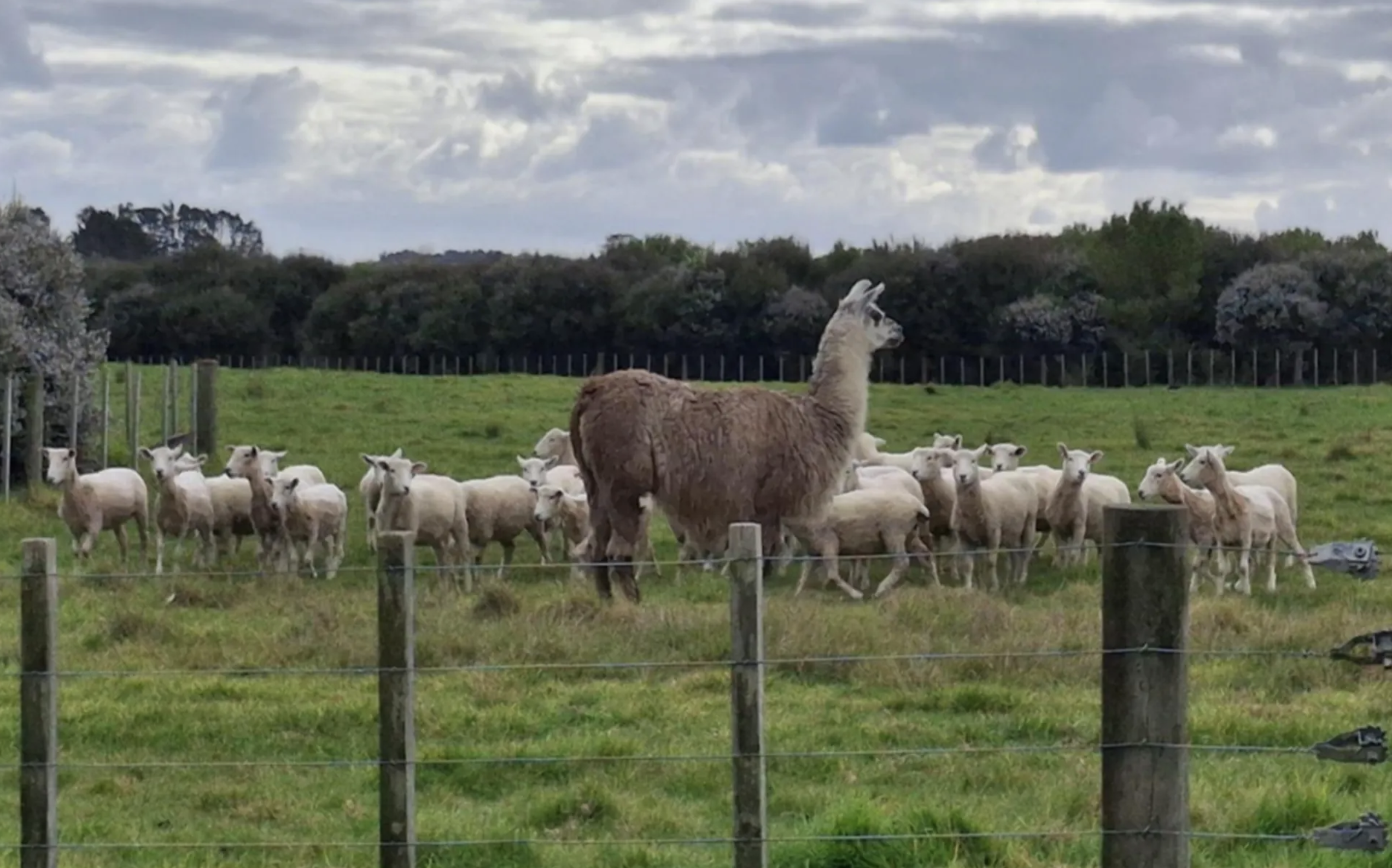
Llamas and sheep on an Auckland Council farm. Image: Auckland Council
What’s the worst that could happen?
From RNZ’s The Detail, news of a proposed repeal of the Building Research Levy Act, which is worrying those in the industry and has “raised fears a Grenfell Tower-type disaster could be in the making in New Zealand”:
Building industry leaders say that generally, this government’s moves to streamline processes and cut costs in construction are good ones. But this is the one cut they all seem to agree is a step too far.
It would strip our world-respected building research association of its secure funding and put research decisions in the hands of a government department that has not covered itself in glory lately – the Ministry of Business, Innovation and Employment, or MBIE. Projects would be contestable, and decades of institutional knowledge would be at risk of disruption and loss.
Builders say BRANZ is the cheapest insurance policy you can get – repealing the levy would save new-home owners $65 of a $500 levy, but for that they say they are getting products which have been tested for the New Zealand environment, that they can trust.
“It’s a minimal cost in the scheme of things,” says Building Industry Federation chief executive Julien Leys.
“It would fundamentally change how the science works, particularly in longitudinal studies. It’s breaking the chain of trust of research that builders put in the products they’ve tested.”
The race for bus lanes
A cute story from Seattle, where a year ago local transport advocates raced (on foot) a notoriously slow bus, to highlight just how useful bus lanes would be.
Fast-forward a year. A new Mayor – who made bus lanes a key plank of her campaign, and her first executive action when she won – helped paint the new bus lanes red. Cue a rematch race between buses and advocates. This time, the bus won!
With the new bus lane, Route 8 buses are traveling three times faster during the afternoon and evening peak period, according to preliminary data relayed by [Mayor Katie] Wilson herself Tuesday. Riders traveling between Dexter Avenue and Fairview Avenue saved an average of 3.5 minutes – a huge amount multiplied across all of the route’s riders – with the Route 8 recording its fastest travel times on Denny Way in at least seven years.
Racers saw even more dramatic bus acceleration in action Tuesday amid rush hour traffic. The bus took 21 minutes to complete the traffic-clogged half-mile race course back in 2025. On Tuesday, the bus took just four minutes – a staggering five times faster than the last race.
Best of all, the gloomily predicted Trafficmageddon – as always – predictably failed to materialise:
Just a few weeks after the bus lanes were installed in mid-August, the traffic grid seems to be adapting to the new normal on Denny Way just fine. Travel times to Capitol Hill or I-5 by car are not dramatically up, and stretches of the road often look deserted during rush hour compared to past years. The traffic model was wrong, a fact that should have broad implications for transportation planning in Seattle way beyond the confines of Denny Way.
Safe speeds hit the streets (in Japan)
When former transport minister Simeon Brown issued his blanket reversal of safe speeds in towns and cities across New Zealand, he (inaccurately) cited countries “such as Norway, Denmark, and Japan” as doing just fine with 50km/h speed limits in urban areas.
He may be interested to know that Japan has now brought in its own blanket speed rule, dropping limits to 30km/h on 70% of urban streets. The evidence-based policy is a response to ongoing deaths and injuries of children and elderly people on city streets.
The new limit, which went into effect on Tuesday, applies to residential roads with no centre line or maximum speed signs, media reports said.
Narrow roads with no centre lines or pavements are a common sight in crowded Japanese cities, with data indicating that children and older people are at particular risk of being involved in a fatal or serious accident.
The measures apply to about 870,000km of roads that are less than 5.5 metres wide and do not have centre lines or median strips, according to the Mainichi Shimbun. They account for about 70% of the country’s general roads, the newspaper said.
…
The introduction in 2011 of “zone 30” areas on a limited number of residential streets and along school routes resulted in a 30% reduction in fatalities and serious injuries, the Mainichi said.Police agency data show that the mortality rate among pedestrians is less than 1% in accidents involving vehicles traveling at or below 30km/h, with the rate rising to 2.7% at speeds of 30-40km/h, and to 17.4% at 50-60km/h.
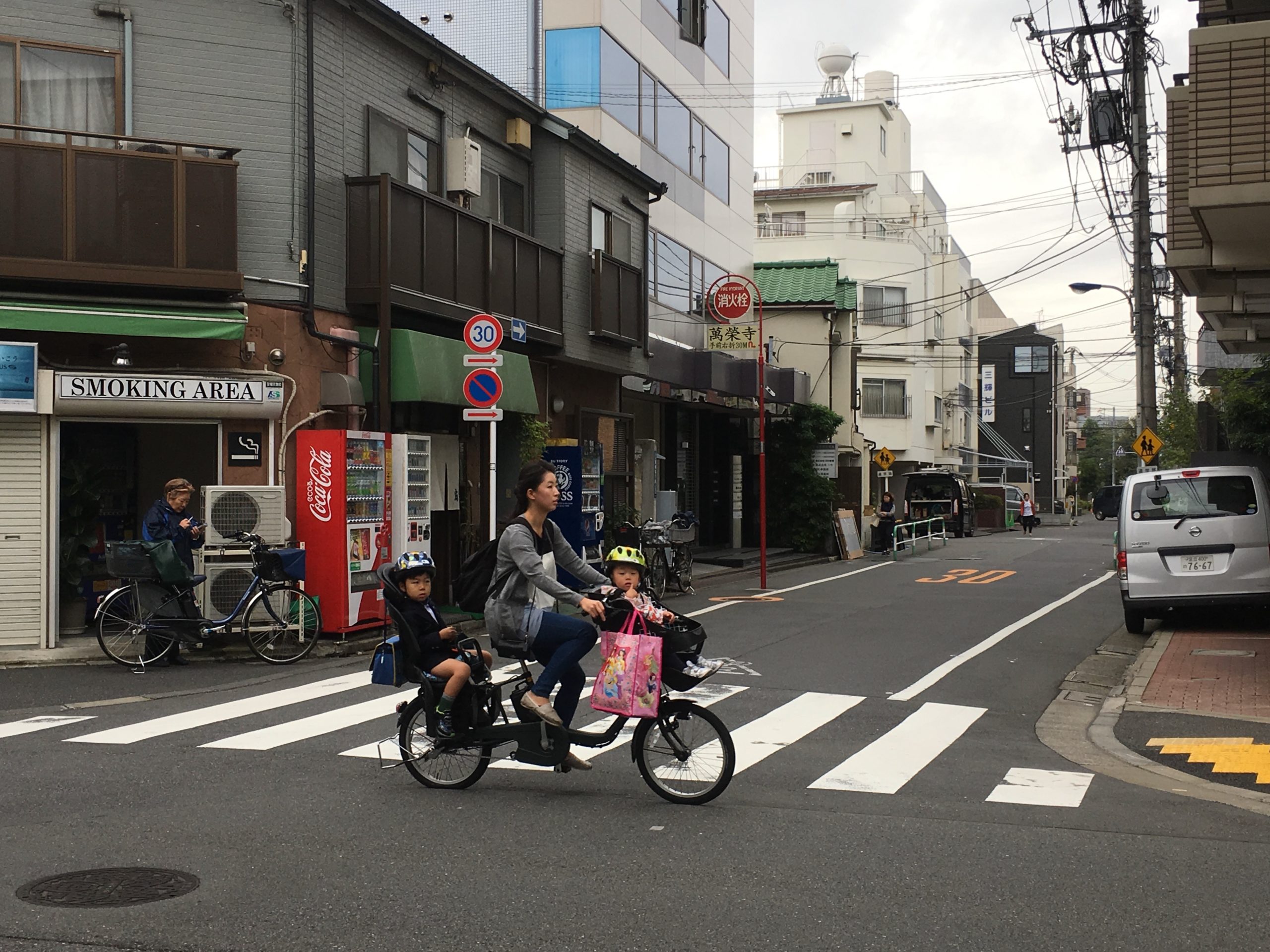
A typical Tokyo scene, showing a pre-existing 30km/h zone in Tabata. Image: Jolisa Gracewood
How to build transit quickly and affordably
An interesting article in the New York Times (gift link) on “how Delhi built a world class metro for a bargain“:
…when the Delhi Metro opened in 2002, there were few successful examples of public transit systems in countries at India’s level of development.
Today, the Delhi Metro is a global model. In March, the completion of a new line made Delhi’s subway system longer than New York City’s, for a total cost of roughly $10 billion — less than New York spent to build a 3.5-mile tunnel.
What to watch
No apologies, this section is wall to wall CRL content this week! First up, a “what to listen to”: the latest episode of The Urbanist podcast is all about how the City Rail Link will rewrite Auckland’s future, with special guests Gosha Haley, Ludo Campbell-Reid and Gyles Bendall.
And here are the two extremes of CRL emotion, in one clip…
View this post on Instagram
We expected enthusiasm from transport nerds. It’s been even more happy-making seeing all kinds of Aucklanders find their way around the new stations, and figure out the kinds of trips they can now make.
View this post on Instagram
View this post on Instagram
View this post on Instagram
That’s us for the week – as always, feel free to share your links and stories in the comments! Have a great weekend.

 Processing...
My wife commutes from west auckland to wynyard quarter so should be benefitting from the new waihorotiu station, but so it’s been hard to quantify due to…tardy trains! 15mins and 25mins wait at the platform destroys any time savings. Hopefully this improves as the new system beds in, and maybe now there will be more pressure on AT for reliable run times. As for me, I’m looking forward to my first ride in with the family tomorrow, hopefully the weekend timetable plays ball…
I’ve had the opposite experience, 7:41 train has been on time every morning, 15 minutes quicker into my midtown office.
Evening trains have been more of a lottery, due to the odd timetable, although I’ve still got home earlier than before. But I have learnt to check the sign on the train, they don’t always come through in the order on the station displays.
Do a post next week about wheather the Airport Rail be light rail or heavy rail. My opinion is that it should be heavy rail from Onehunga. Your old post doesn’t convince me
I think the present arrangement Downtown to the airport is ok.
The cost of extending from Onehunga to the airport ( heavy rail) could be better spent on smaller improvements over the whole system, likewise with light rail it would be a completely new route, and might take years to consent and build.
If Onehunga was extended the next station would be the airport, or would other stations be built, that could slow the whole route down?
Several correspondents have suggested that most cities round the world have a fast regular service to the international airport.
True most do, but many have far greater populations than Auckland. Even if Auckland breaches 2 million over the next few years, it would still be small compared to overseas.
Two major projects are looming: level crossing removal and second harbour crossing. There is not now, nor likely to be in the future the funding to do all.
Southdown link could be another major, which I would favour, how soon, how long is a piece of string?
If you believe Facebook comments, EVERYONE in the West was commuting to Grafton and is now coming after AT with pitchfork and torches
Big test with the Warriors game this weekend, Reddit already predicting catastrophe
You’ve got to stop reading Reddit and Facebook!
in fairness to them the Grafton station did appear to be very busy – isn’t there the Onehunga line they can take if they want a direct line? also… it has been pretty well known it was going to happen
Oh no… they have to…change trains one station away!! oh noooooooooooo
just like a real city. I work in grafton and regularly have had this “discussion” with people at work.
Also something to watch out going forward for anyone who reads this: 51% of the internet is bots now. Tons and tons of accounts exist to farm engagement and anger.
For something way cooler than Eden Park fluff around (no offense to TE WAHS), Karang a Hape has their first Art Weekend, so just the Beresford Station makes this an excellent destination this weekend! And you can join The March for Nature from Te Waihoritiu Station! So heaps of good train excuses for all ages: TE TOI & TE TAIAO