Or rather, to echo Patrick’s post from last week, what we can do…
…about the maybe imminent – but always possible – imported liquid fuels crisis.
We, in this case, being everyone except the government. Because leadership doesn’t always come from the top down.
As of yesterday, we’re being told we have approximately 46 days worth of fuel, both here and (hopefully) on the way. Some informed observers, here and across the Tasman, are taking a more pessimistic view. It’s a bit like the run-up to the pandemic, when public health modellers and data scientists would emerge pale-faced from meeting rooms… and quietly go and do a “big shop” just in case.
But don’t panic!
everyone seems to be pretending this is about the cost of petrol to drive themselves to work and not the diesel needed for the supply chain of literally everything you buy… What does it matter if I can work my email job from home if there's no bread at the supermarket?
The official number of “fuel days remaining” neatly echoes our other national-level response to an international crisis: six years ago, 33 days of Level 4 restrictions were followed by two and a bit weeks at Level 3. (It’d be interesting to see a comparative calendar, tracking government steps taken at points along the two timelines – although of course the relative unknowns of each scenario are different.)
So far, the government of the day seems mostly to have been taking things under advisement. Yesterday the Prime Minister promised a plan “in coming weeks” – while the Minister of Finance may announce “targeted, temporary” relief measures as soon as today.
There’s also a pre-existing fuel security plan with four alert levels, as explained by Robbie Nicol here – the fourth level of which involves pretty much lockdown, as explained by Jenna Lynch here.
One thing the government seems pretty sure of is that people don’t need to be advised what to do. According to the Minister of Climate Change and Minister for Energy, New Zealanders are already making “conscious decision[s]” to drive less, and try alternatives.
The invisible hand-waving of the market, as it were.
The government also appears quite keen to avoid the narrative approach that governments of all stripes traditionally rely on to help “bring the public along.” So, expect no stripy posters encouraging us to “Unite Against Oil Crisis 2026”, let alone “Drive less to save fuel”, or even “Be kind”, which is always pretty good advice under any circumstances.
Amidst the uncertainty, while we wait for official announcements, and in the absence of official advice – who else can we turn to, to understand what we can do?
So far, the main opposition parties are taking different tacks. The Greens offered to support the government to redirect transport funding away from massive road projects and towards a package of measures to help with travel costs, like making public transport free for three months, expanding school bus eligibility, boosting mileage rates for carers and support workers, and more. The proposal has drawn approval for its clever politics and practical good sense, including from NewstalkZB’s Kerre Woodham.
Labour, by contrast, looks to be sitting tight for now, on the grounds that the government has the wheel and it’s their job to navigate us safely through this. That said, it would still be quite useful to know what sorts of measures Labour would suggest, given their experience in running a successful emergency response that included limiting travel to essential journeys only. (Remember?)
Regardless: here we are. WE ARE HERE. And we’re soaking in it.
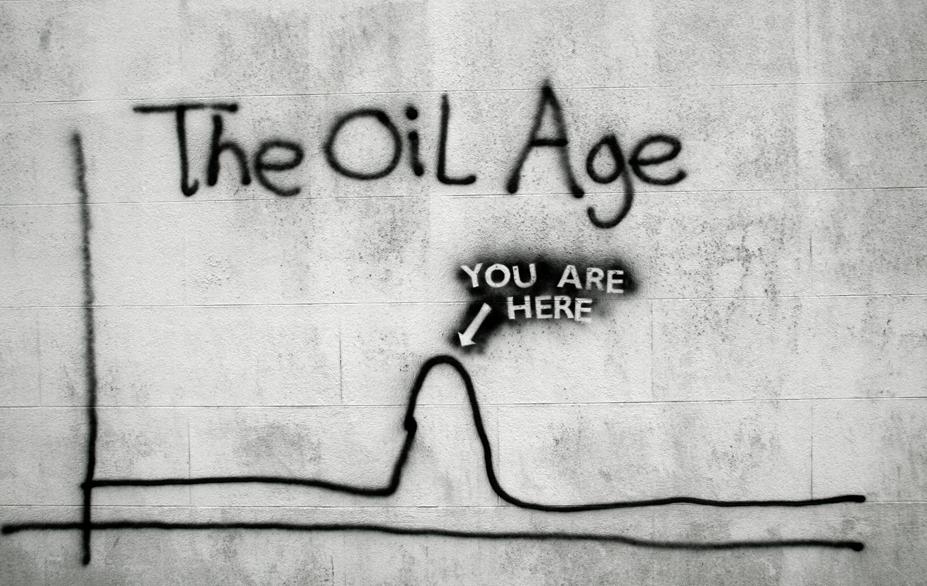
Image found floating around the internet: if you know the author, please get in touch!
And by “we”, I mean you, me, and everyone we know.
So what’s happening at ground level, amongst the common people? (Yep, sorry, I’ve still got a Pulp earworm from February, and now you do, too.) What are ordinary New Zealanders cracking on with, even without the benefit of concerted communications and tangible incentives? Because every bit counts, right?
Well, for starters, we’re already seeing hard evidence of some of those “conscious decisions”:
- “skyrocketing” public transport ridership – even without any official encouragement. 1New reports that as well as a seven-year high in Auckland, “public transport use [is] up 3% in Wellington, 2.2% in Christchurch, and 4% in Dunedin.” But as RNZ noted on Monday, cost is a significant barrier – and people they asked prefer affordable PT to working from home.
- a rush of enthusiasm for EVs – again, sans official incentives; no Clean Car Discount no more. (Although arguably, the future price of fuel will operate as a retroactive clean car discount, which will add up pretty quickly.) According to industry reports and anecdotage, electric cars are flying off the lots.
This kiwi car dealer only sells electric cars and all their inventory is gone. Never seen that before.
— Gavin Shoebridge (@kiwiev.bsky.social) 2026-03-23T04:46:49.128Z
- and inevitably, a bit of a bike boom, just as in the last upheaval. The Press notes that ridership in Christchurch “surged 13% last week as fuel prices hit $3 per litre, with bike shops reporting an unusual rush on electric commuter bikes and equipment.” Again, without official incentives – although the WorkRide scheme is surely coming into its own right now. You know what else would help? Rapid rollout of a safe bike network, and filling the gaps in the current offering.
I'm noticing more people out on bikes. Some of them look as if they haven't biked in a while and are a bit uncertain about how to do it on city streets. Can drivers of motor vehicles please be patient and kind while bikers regain skills and confidence. And can Cabinet Ministers please say this too.
— Barbarella Stormforce (@barbarasturmfels.bsky.social) 2026-03-21T07:17:50.168Z
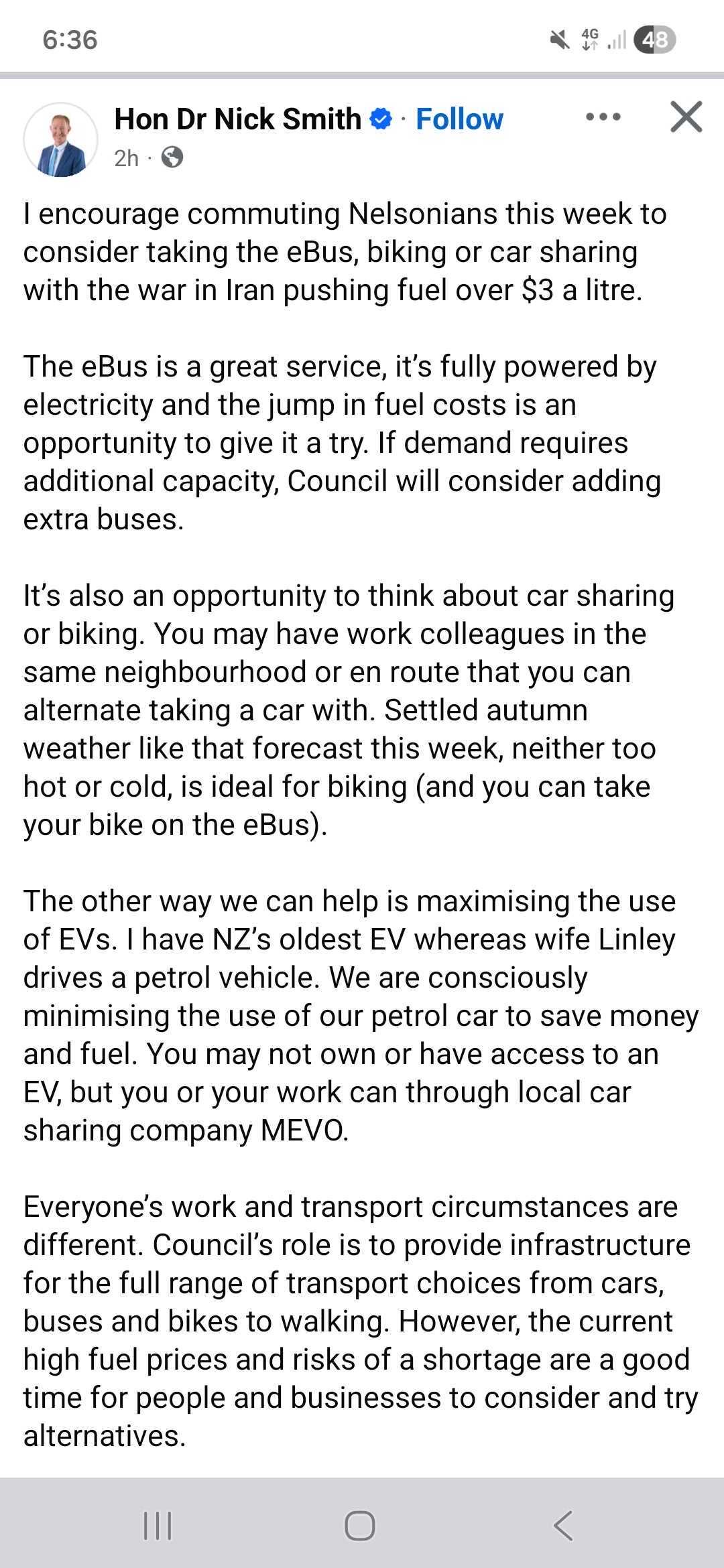
We’re also seeing local politicians step up to fill the storytelling gap. Former National MP Nick Smith, Mayor of Nelson, was quick out of the starting blocks with this encouraging message:
 And in Auckland, Councillor Richard Hills is singing a similar song about the power of public transport:
…Hills said Tuesday was Auckland’s busiest day on public transport since 2019, with Auckland recording 7000 more trips than the previous busiest day, which was two weeks ago.
“It’s great to see more people choosing public transport and trying it out. Even a trip or two a week can make a difference to your time and money and make a positive difference to congestion and environment in our city,” Hills said.
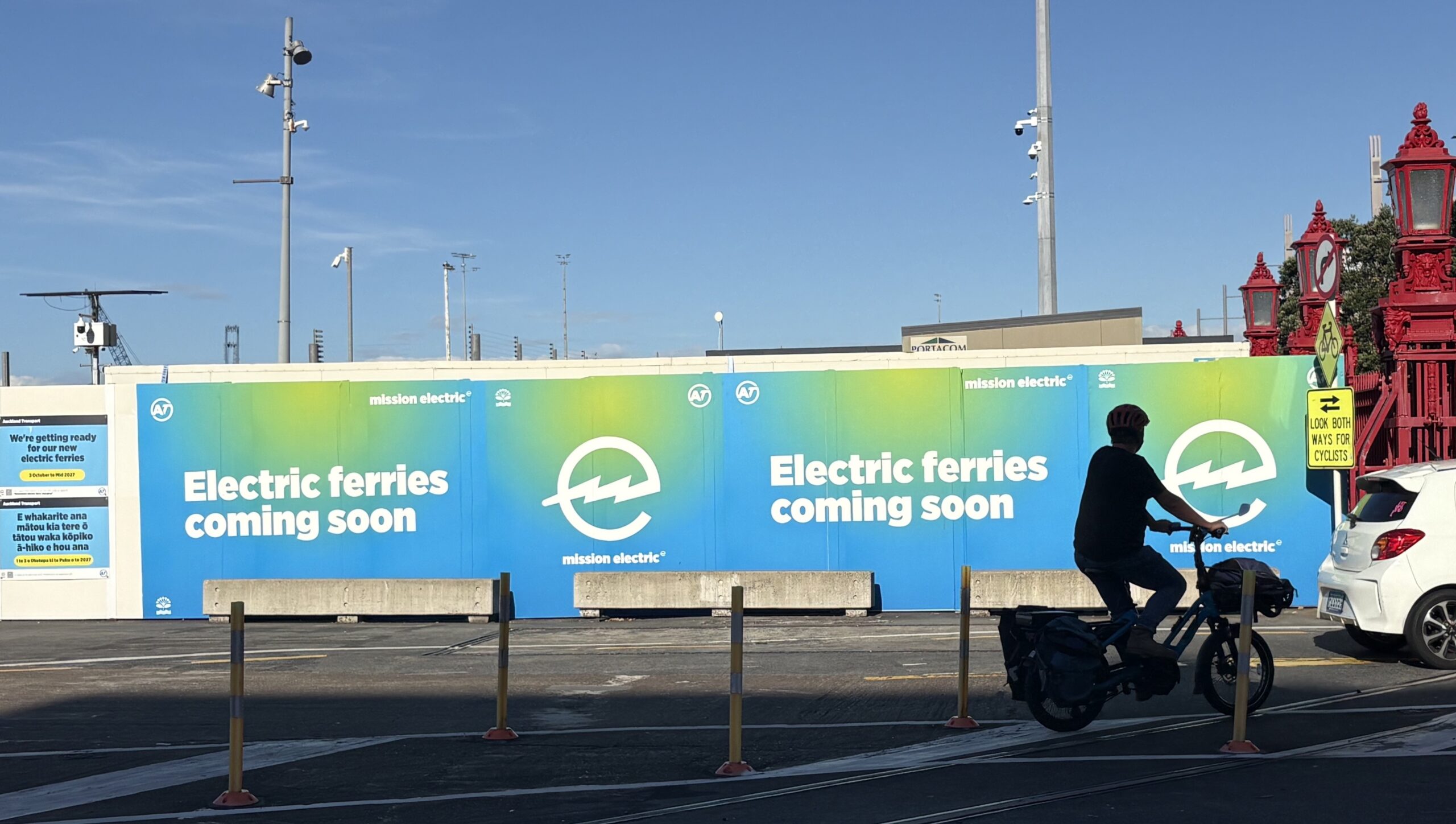
Swings and roundabouts: Auckland Transport is steadily electrifying the bus fleet, and electric ferries are “coming soon” – although in 2025 they also tendered for four new diesel ferries…
Local government surely has plans sitting around that could be quickly activated – and, we know from last time round that people are open to leveraging times of disruption to improve their options.
It shouldn’t take a fuel crisis, of course. Everyone knows cities thrive when people have great choices for how to get around without having to drag a whole car along everywhere you go. And as cities become healthier, they also become more resilient to shocks like the current one. It’s a virtuous circle, ours for the taking, any old time! How about now?
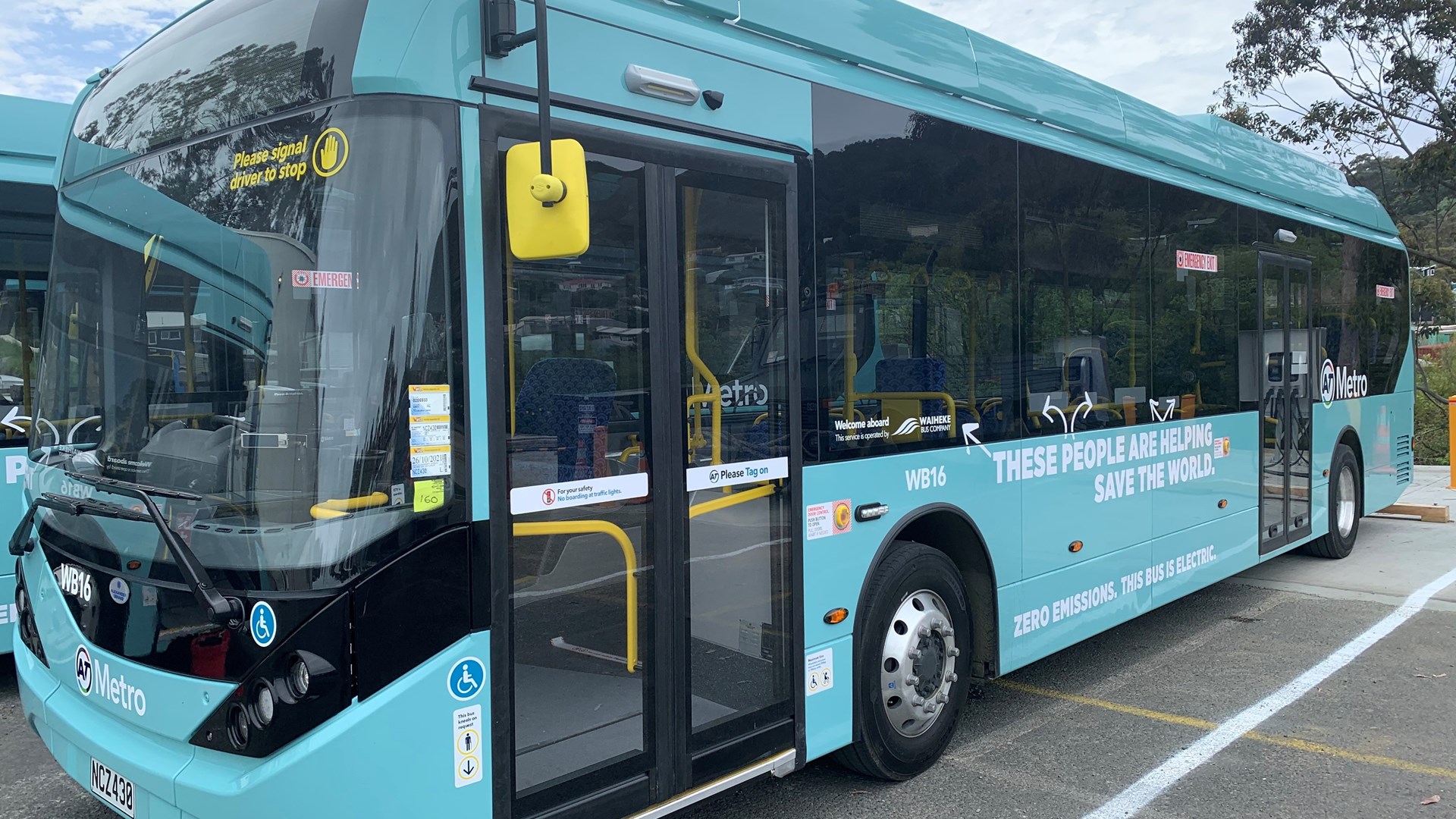
AT’s bus fleet on Waiheke is fully electric (“Great Green Waiheke Machines”) and the livery on this one sweetly notes the passengers are “helping save the world”. Image: Fullers 360
There’s also some cracking storytelling from many corners of the media, helpfully exploring what’s going on and what our options are. These are just some examples – and I’d love to hear of more:
- Verity Johnson on the shortage of long-term thinking about EVs
- David Slack on the power of future-proofing (paywalled, but you can enjoy this gospel for free)
- Jesse Mulligan on how to install solar panels, including the crucial step of convincing your spouse
- Hayden Donnell, on how we’d all be further along a path of resilience and ease if the current government hadn’t reactively cancelled a bunch of policies and funds aimed at accelerating the transition away from fossil-fuel dependence, without having meaningful alternatives.
- This handy guide to panic-buying an EV for around $30k (a sum that would also get you at least 5-6 really good electric bikes…)
Businesses can come to the party, as well. I was struck by a recent RNZ story on Waste Management and their proactive electrification of their fleet, which is coming in very handy as diesel prices rise.
As a company, Waste Management uses 10m litres of diesel a year; its sixty plug-in trucks have already driven 3 million kilometres, saving 5600 tonnes of CO2 compared to the diesel equivalent. Reportedly, too, the drivers love them, as they’re quiet and relatively vibration-free.
I’m curious to hear of more examples of industry having gotten ahead of this issue, and feeling somewhat relieved they’re less exposed than they’d otherwise be.
And of course our youngest citizens are getting in on the act. We’ve known for age that young people are ahead of the rest of us on climate. And on a purely practical level, we also know that many kids, given their druthers, would love to do the “school run” in a way that uses their actual feet.
As Stuff reports:
Many families are also changing how their kids get to school. Some have shifted to walking, public transport or carpooling, while others are turning to alternatives like e-bikes.
“We bought e-bikes and I’m using it more than my car now. 12 cents for a full charge and 100km range. Love it.”
For many schools with local catchments, shaking up the school run is a live proposition. Here’s a lovely and inspiring example from one inner-city TravelWise school in Auckland.
Over their first three weeks back at school (before the oil crisis was even a thing!), the kids of Room 15 walked, scooted and biked to school as much as they could. Then they made an awesome poster to show how many car trips they’d taken off the streets.
I don’t know about you, but I’d totally wear this on a T-shirt:
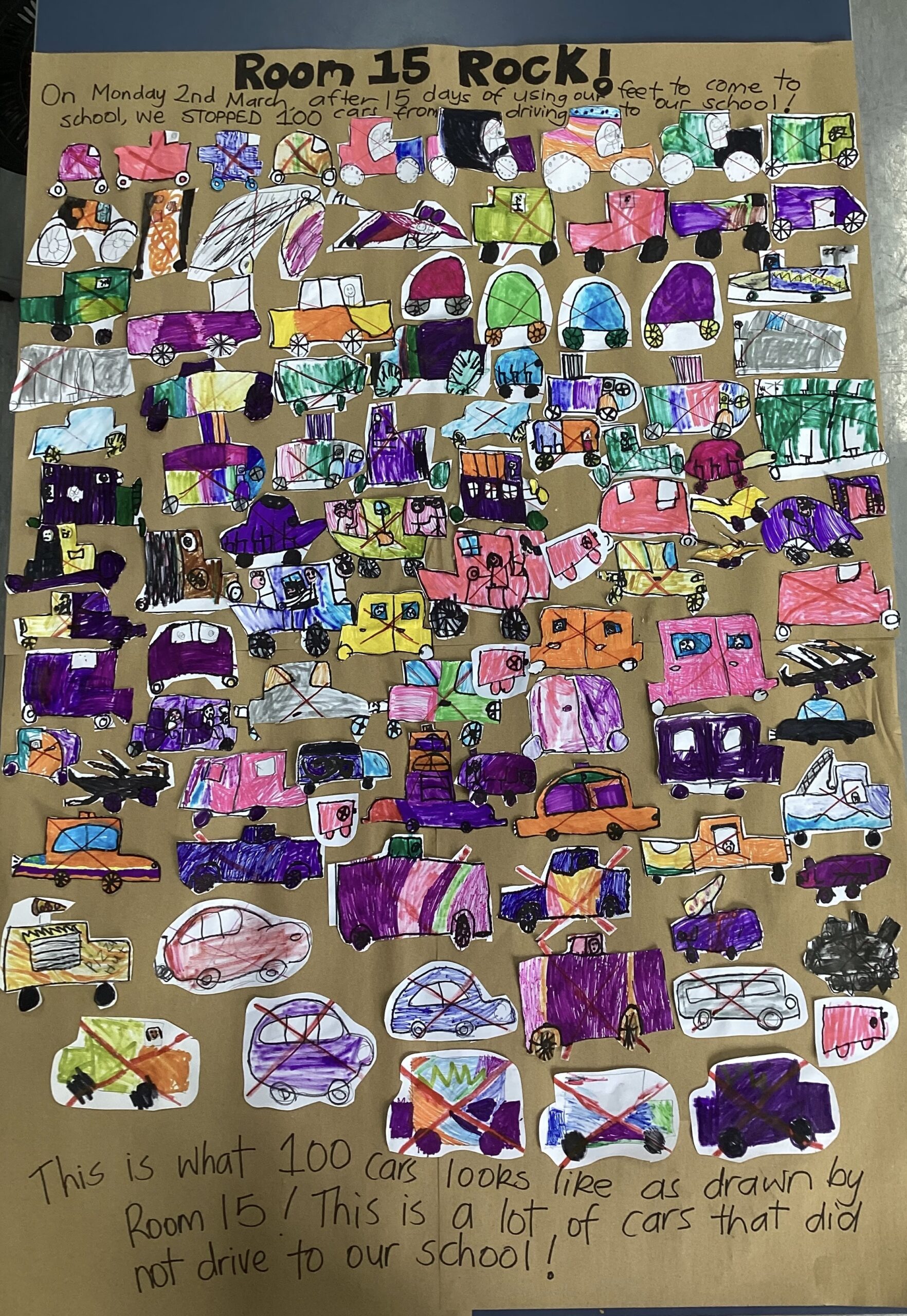
“On Monday 2nd March, after 15 days of using our feet to come to school, we STOPPED 100 cars from driving to our school! This is what 100 cars looks like as drawn by Room 15! This is a lot of cars that did not drive to our school!” (Image supplied)
Of course, “conscious decisions” like this would be far more achievable for more people with active support from policymakers – say, safer streets in neighbourhoods with schools; maybe flexible start times for work and schools so parents can accompany kids and get their own steps in?
Lots of options, lots of examples. Plenty of plans on shelves that can be quickly dusted off and rolled out.
For many of us, these options will be everyday choices we already enjoy, which we can build on. Batching up errands for the car; driving at moderate speeds; taking the bus or train.
I’ve written before about my love of e-bikes, and we’re considering adding another electric pony to the family stable. A handy runabout that makes even the dullest errand more fun, the e-bike has also been a magnificent mobility tool for me over three-plus years [correction: four, that’s brain fog for you!] of living with Long Covid constraints.
(As an aside: Long Covid is surely an energy crisis in itself, posing a quiet challenge to our society and adding to those already in the chronic fatigue realm who are deeply familiar with the challenges of getting by with less in the tank than you’re used to – and still tragically invisible to policymakers.)
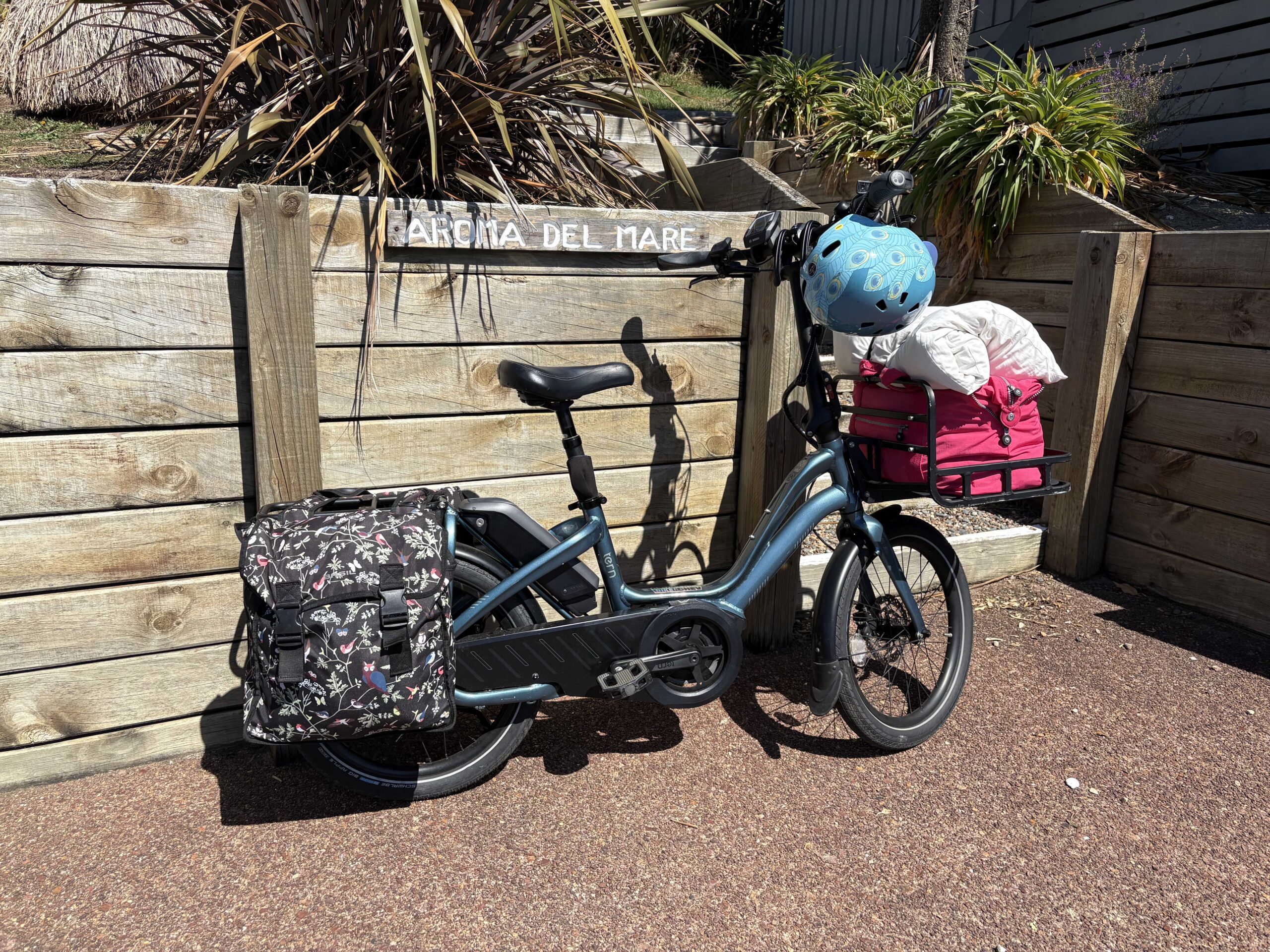
A little e-bike, fully loaded up for a weekend on Waiheke. A life-changing option for everyday travel, if it suits you, and if your city suits it. (Image: Jolisa Gracewood)
I know, not everyone can walk or bike to their everyday activities. And for sure, not everyone can afford an e-bike let alone an EV (or solar panels to power them). By the same token, not everyone can drive, and certainly not everyone can afford any kind of car.
And of course not everyone can easily work from home, or wants to. Likewise, not everyone who wants to work, can work. (And to be clear, you absolutely don’t have to be employed full-time or at all, to be an inherently valuable member of society. Just ask a baby, or a pensioner. Or me.)
The point is we are all in this together, for better or for worse, rocking in this largely fossil-fuelled waka, as it potentially sputters out of gas, for a short while or a long while. We don’t yet know the full size or scale of the challenge ahead. But we do know the impacts will likely be uneven, and stressful.
So for now, all eyes are on the government to put together a response that helps everyone through what’s coming – and Patrick’s list remains an excellent starting point.
Meanwhile, we are free to think about what we can do, individually and together. To help paint ourselves out of this collective corner. To be a little more resilient, on the whole. To be excellent to each other.
What’s on your list?
Greater Auckland’s work is made possible by generous donations from our readers and fans. We’re now a registered charity, so your donations are tax-deductible. If you’d like to support our work, you can join our circle of supporters here.

 Processing...
A futher significant increase in our costs of living are significant burden to us all.
But total lack of supply, like Cuba is experiencing at the moment, is catastrophic.
So saving fuel now defers that catastrophe. Here even a few days extra of eked out supply will make a huge difference.
And yet our Government seems paralysed. It’s reassurances are no more then words when actions are what will count.
There are a few obvious things that can be done right now to gain a few extra days of supply. They will require the government to swallow a few dead rats though.
A bit more Nanny State and less wroom wroom is required right now. Today:
Incentivise work from home.
Lower speed limits.
Bring in distance based road user charges for all vehicles, including currently exempt petrol powered ones, and adjust all the rates to deter non essential travel.
Adjust fuel import duties to reflect the criticality of each fuel type.
Increase concessions for public transport use, especially student concessions.
Facilitate and incentivise movement of freight onto rail as a fuel conservation measure, especially our critical diesel fuel supplies.
Incentivise and facilitate, intercity bus travel as an alternative to both car and air travel as a fuel conservation measure, especially the super critical aviation jet fuel.
Enable some flexibility in either our tax or benifit systems to support those who cannot meaningfully forgo fuel consumption to continue to function.
And incentivise bus travel by providing more bus lanes.
And incentivise micromobility by providing more facilities and bike/scooter lanes. A great time to free a lane on the Harbour Bridge.
If a lane across the harbour bridge is freed, it should be for buses. The number of cyclists within range of it is tiny compared with potential bus passengers.
People can get across the bridge by bus currently. They can’t bike across or walk across. An active travel lane would open up many opportunities not currently available.
In reality, we can do both. We just need to be clear about priorities instead of stupidly continuing with the destructive status quo.
“One thing our government seems pretty sure of is that people don’t need to be advised what to do. According to the associate energy minister, New Zealanders are already making “conscious decision[s]” to drive less, and try alternatives. The invisible hand-waving of the market, as it were.”
The invisible hand of the market is signaling to people that they should stock up on fuel and hoard it as it’s about to become much more scarce. That’s why consumption is actually going up, not down. Completely logical market response. Completely disastrous outcome. It’s literally why we have government and elect leaders to manage this type of scenario, unfortunately we elected foxes to guard the henhouse.
A national 80 km/h limit would save a lot of that diesel.
Also – most cars have 4/5 seats. Don’t leave home with less than three people in them.
The Government needs to be making greater use of rail for moving freight and passengers around the country, as rail is much more energy-efficient. Reopen lines to Rotorua and Whakatane, electrify the main trunk lines from Pukekohe to Tauranga, and build new lines to Taupo, Nelson, Marsden Point and Auckland Airport for forestry, freight and passengers.
Certainly rail can carry more freight . My pet cheap do it next week projects would be a container sidings at Kawerau and Te Kuiti. Reopen to Otiria would be another. If we are in for a major recession then Kiwirail maybe looking for shorter domestic freight hauls to replace import and export containers. The trick would be to convince trucking companies to drop off and pickup containers at regional hubs. Regulations could help but shortages of diesel and price might be enough. The other option would be for the govt to just ask them nicely
I think the government should be congratulated on one massive thing.
Not going out and subsidising liquid fuels.
Letting prices work, retaining the exposure to the price signal that is screaming, “don’t use as much” is pretty much the strongest tool we have available to manage supply and the current account.
A very small contribution without changing travel patterns will also be proper recycling and using the food scraps bin.
The lack of natural oil might lead to fertilizer shortages in the long run, and the food scrap bin contents are used to create fertilizer on our shores.
Annual vehicle registration costs in NZ:
Electric scooter : $458.14
Up to 60cc scooter: $442.41
Petrol car: $172.97
It costs more to register a 50cc scooter than you spend on petrol a year.
Bit different annual registration cost if you live in Queensland:
4 cylinder petrol car: around $A850
8 or larger cylinder petrol car: around $A1300.
How many commuters and students would be on scooters if the costs in NZ were flipped.
That’s the ACC cost for injury compensation, those scooters are horrifically dangerous. Making them cheaper would be a false economy.
Are they actually dangerous or is it the cars hitting them dangerous?
Genuine question.
It’s both, and in any case the burden of injury is still high.
Nice post, Jolisa, as always. The leadership the Greens are showing is both clever and wise. And yes, we certainly have the plans ready to go, should those in power suddenly grow some backbone.
“It shouldn’t take a fuel crisis, of course.” Yes, quite. We are indeed all in this together. The thing is, we were all in it together last year, too. The fuel supply crisis is simply one predictable element of the climate crisis.
The solutions you and Patrick have outlined have huge co-benefits and should have been delivered already.
What will I do? I will try to champion substantial reductions in aviation, calling both for the systems change we need – especially in our economic strategy – and for a new narrative about social and cultural values.
While aviation remains so heavily subsidised, regional rail will continue to be sidelined. Aviation’s use of fuel is both high, and highly inequitable. Due to radiative forcing, it has even larger climate impacts.
The Global Carbon Budget for staying within 1.5 is now very low. That is, the amount of carbon we can still emit, ever, and stay within 1.5.
At current rates of emissions, we’ll use it all up within three years – and only if we are happy to “flip a coin” as to whether we stay within 1.5 or not. Using a more responsible and typical risk percentile (eg P90), the Budget’s at zero already.
Either way, there’s no room for aviation.
Basically, continuing to fly is no part of “being excellent to each other”.
A blanket -10km/h off posted speed limits (enforced) would extend the current fuel reserve and improve road safety
Cool post. That school kids poster thing so good.