The following is an op-ed I wrote which ran in The Post on December 23rd 2025.
As we head into a long hot summer in Tāmaki Makaurau, people are flocking to the many wonderful places that have opened this year, and perhaps even getting there in new ways.
All across Auckland, a number of long awaited projects are now complete. Rail electrification and a station rebuild has linked Pukekohe to the rest of the electrified network. The Māngere connections have brought joy, equity, and transport choice, linking up cycleways from the Airport, to Māngere Bridge, Onehunga, and out to West Auckland and into the central city.
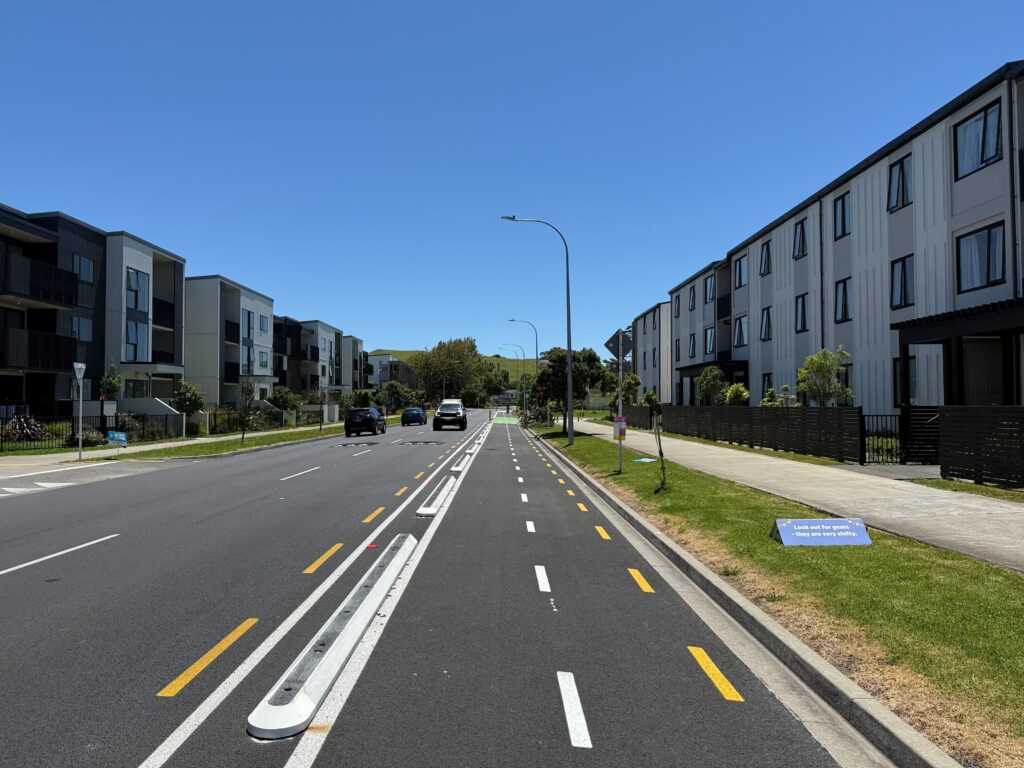
A brand new cycleway in Māngere West. Photo: supplied.
Fresh cycleways through Point Chevalier and Westmere have expanded the local bike network, and made it easier and safer to walk and catch buses, too. Work is well under way on the last stage of Te Ara Ki Uta Ki Tai, the path that will connect Glen Innes, Meadowbank, and Kohimarama with the City Centre.
Nearing completion are upgrades to Great North Road, boosting the bike network and making for a lovelier boulevard lined with apartments. And numerous flood resilience projects are completed, in progress, or beginning, creating blue-green spaces and pathways for a more absorbent and robust city.
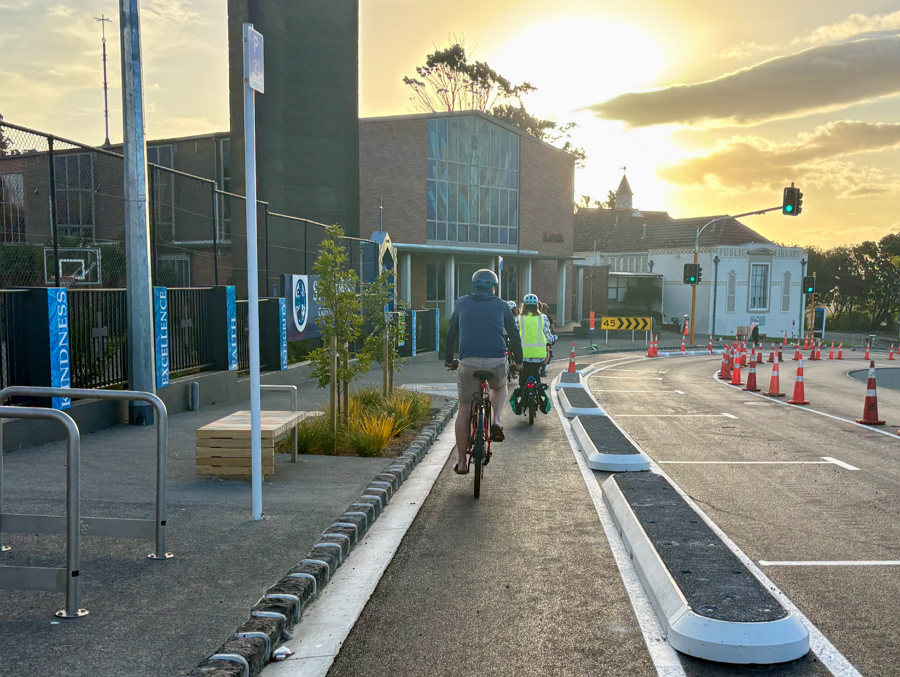
Test-riding the new layout of Great North Road, just before Christmas as the first layer of tarmac went down. (Photo: Jolisa Gracewood)
The bus network, too, is expanding thanks to the Climate Action Transport Targeted Rate, with rapid services on the North Shore, in the West, and South. As well as readying the city for City Rail Link and Time of Use Charging, this is leading Auckland to have the best bus network in Australasia. It’s also practical climate action, a boon for all ages accessibility, and a cost-of-living-friendly alternative to driving.
The City Centre is also opening up. Te Komititanga Square in front of Waitematā (Britomart) station is thronged with people day and night, and the station’s rear entrance has reopened, with a striking concrete artwork called Skylid designed by renowned artist Graham Tipene.
On Victoria St, the “linear park” Te Hā Noa is growing into a lovely green space enjoyed by people and birds alike. And buses have returned to Albert St, now open again after years of construction.
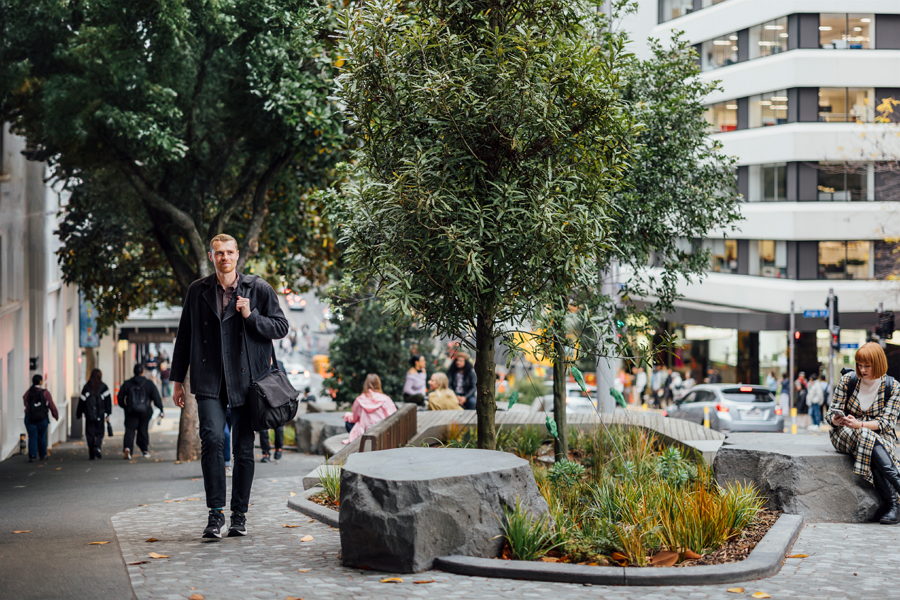
Victoria St East, Te Hā Noa linear park (Image: Auckland Council)
Up on Karangahape Road, Beresford Square is showing off its new public space around what will be one of two entrances to the new City Rail Link Station. The other entrance, on Mercury Lane, is almost ready, with “Project K” bringing a wonderful new people-focused design and new bike links to the famous Pink Path. The makeover extends along Pitt Street and Vincent Street, which both have better bus facilities and cycleways.
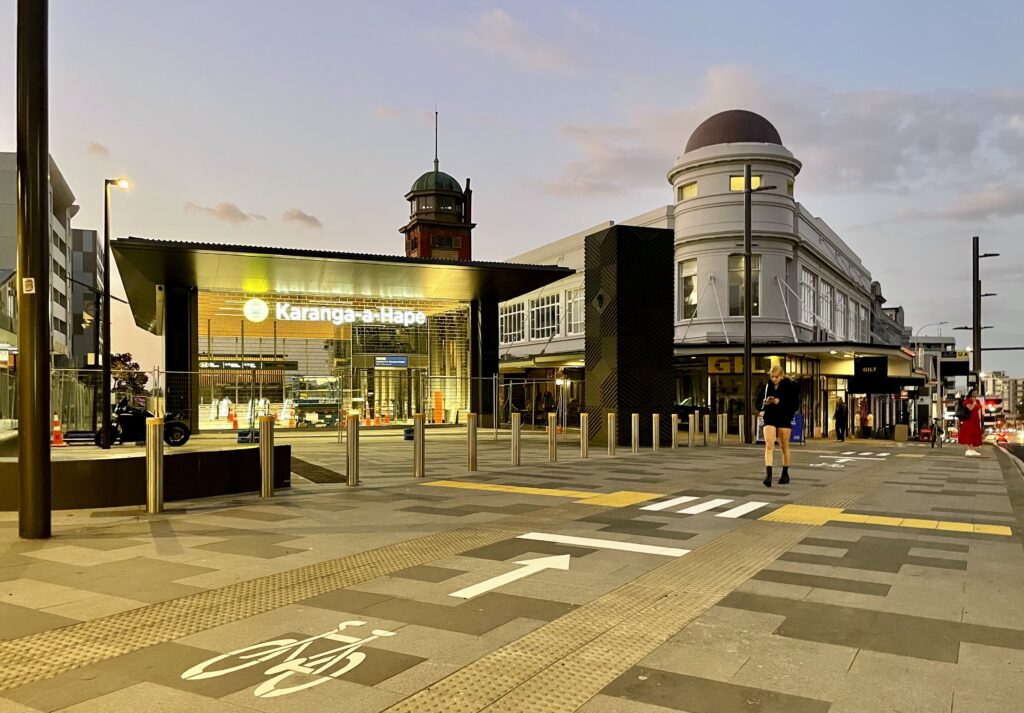
Karanga-a-Hape Station, almost completed, in a freshly reopened Beresford Square glowing at dusk (Image: Patrick Reynolds)
Summertime in Auckland is a Christmas cracker. Te Manaaki, the giant decorated tree returned this year, welcomed by thousands in Te Komititanga square. And scores of people have been taking a dip in the Karanga Plaza pool (nicknamed Brownie’s pool, by Mayor Wayne Brown) in Wynyard Quarter, which will be celebrating its second summer.
And there are still a few big presents under the tree, waiting to be unwrapped in 2026. City Rail Link will be transformational for the way Aucklanders get around. When it opens, so will numerous works in the City Centre, unleashing swathes of new public space. We’re all looking forward to an end to holiday train disruptions, as the rail network rebuild wraps up. And another less visible infrastructure project, the Central Interceptor, will do the grunt work separating stormwater and sewage, ensuring our beaches are more swimmable, more often.
We’re already thinking ahead to next summer’s Santa wish-list, which will make it truly the best summer ever. Celebrating what we have is important, but setting the next goals is vital, to maintain momentum and keep progress going.
One massive opportunity is the 30-year transport plan, which will take shape in 2026. This is our chance to tackle the big questions and seize the opportunity to make Auckland that much greater on every level. We also want a housing plan that makes sense, putting more housing where people want to live, close to shops, schools, work and transport.
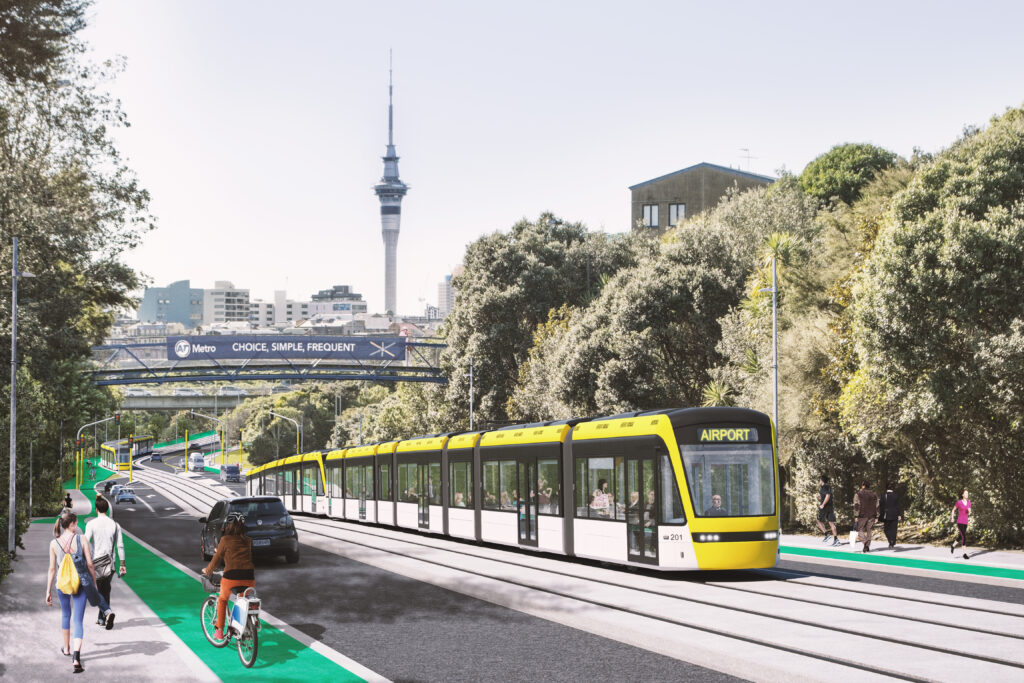
Should Dominion Road light rail be included in the 30-year plan? (Render via Auckland Transport 2017)
And we need to see far more action on our Climate Action Plan, including rapidly expanding and completing the bike network. Cities, and the people who live there, are brilliant at reducing emissions, given half a chance.
In 2026, Auckland deserves more local empowerment, and the funding to deliver on local visions, from local boards all the way up to the Mayor. We also deserve a government that gets it: as Auckland goes, so goes the rest of the country.
As we all enjoy a bit of summer breathing space, take a moment to celebrate the wins we’ve made so far, and set aspirations for the coming year. Whether you’re from here or just visiting, a citizen or a politician, an old-timer or a young up-and-comer, we can all agree that Tāmaki Makaurau is a beautiful city in a beautiful place – and we can make it even greater.
Greater Auckland’s work is made possible by generous donations from our readers and fans.
We’re now a registered charity, so your donations are tax-deductible. If you’d like to support our work you can join our circle of supporters here.
You can also follow us on pretty much every social channel, or find us on Substack.

 Processing...
Meanwhile in the northwest, major growth without the CORE infrastructure required, out of sequence development and 20% rates increases to help with revamps else where
Absolutely crazy growth out west with so little infrastructure investment.
Not to mention any regard paid towards flooding dangers (and the associated expense).
‘Should Dominion Road light rail be included in the 30-year plan?’ No, it should be prioritized
I wouldn’t support any major public transport development without an inquiry into why previous efforts turned out to be so expensive and time-consuming.
Otherwise, we risk another light rail fiasco.
“I wouldn’t support any major public transport development without an inquiry into why previous efforts turned out to be so expensive and time-consuming” You don’t need an inquiry. Phil Twyford ditched the original surface level LR plan to pursue a light metro PPP with the NZ superfund as this was not part of the original coalition deal (Surface LR had been) NZ first vetoed it right before the 2020 election. The Michael Wood also ditched the original proposal in favor on an underground light metro at about 10 times the cost of the original proposal. Those two attempts have nothing to do with the Stuttgart S Bahn type LR proposal that’s pictured and was originally planned by AT. If they had just funded the original AT proposal we’d be using the thing by now.
I agree – but we also need to look forensically at how our procurement and consenting settings unduly increase the expense associated with infrastructure (e.g. some of the upward cost pressures on the CRL project).
Its not all bad, I understand that the Central Interceptor project went over-budget; but that was against a (justifiable) scope increase and massive inflation.
It’s a combination of two things,
1) politicians who direct rather than consult their advisors, and large consultancies who are paid to keep the politicians happy rather than give them good information, and who are happy to keep churning through the business case contracts rather than deliver anything. Look at how many hundreds of millions have been spent on harbour crossing planning in the last twenty years without a single viable concept emerging.
2_ the business case process designed initially to justify highways, which focuses on “fixing” the “problem statements”. This means you get into a cycle of starting by defining every transport problem under the sun that you can think of, then designing a solution that fixes them all…. which ends up with things like “might as well build a 10km long giant monobore metro tunnel”. Then at the end, you work out the cost and feasibility… but by that time everyones already agreed on the big solution to everything and done all the design work, so effectively the process creates infeasible megaprojects and mega costs.
The solution is to set some basic project bounds and a budget up front, then let the planners and designers find the best fit to the budget (not the everything to everyone one at any cost). That’s basically what AT did the first time around.
Sorry meany Stuttgart U Bahn not S Bahn.
U Bahn in German context is quite literally Underground-Bahn, i.e. tunneled light or sometimes heavier rail. S-Bahn is heavy commuter rail (suburban but certainly not light rail). So don’t want to be negative but neither of the terms would seem to fit what was proposed initially (on-street light rail).
Max, look up Stuttgart U Bahn and you’ll see what I mean. It runs mostly at street level. As to why it’s called the U Bahn take it up with the people of Stuttgart.
Max, apologies its the Stadt Bahn in Stuttgart
https://en.wikipedia.org/wiki/Stuttgart_Stadtbahn
Actually the U was originally short for the Hoch- und Untergrundbahn, or elevated and underground railway.
These days it’s just a brand that means metro. Stuttgart’s is a Stadtbahn (literally urban railway) and the use both the U logo and the stadtbahn terminology at the same time.
Anyway, Stadtbahn is what Auckland Transport was planning and should have stuck with before NZTA went all metro bonkers. Dedicated light rail that runs mostly grade separated at the surface but can run in a median in the street corridor, through a transit mall or on tunnels or viaducts as suits.
Well, there’s no reason why light rail (especially once it matures) can’t have SOME sections run underground. We just don’t usually want to start with the most costly model when many decision makers question whether anything at all is needed. Thus my confusion as to the U- and S-Bahn monikers, which – having left Germany 20 years ago – just didn’t seem to fit with the “lots of bang-for-the-buck” solution we should be seeking for Dom Road…
But thanks for the extra context, it’s clear that Stuttgart’s terminology IS a bit confusing compared to many other parts of Germany…
John D (2) address the increased flooding risk caused by greater density, good point, you would think after 2023 this would be seriously being addressed. The majority of areas that flooded had been subjected to huge loss of permeable ground through intensification and intermittent water way destrustion
No chance the current central government will allow that. They control the purse strings.
Damn, the mob on r/newzealand *hated* this article. To hear that subreddit speak, central Auckland is pretty much Manhattan from _Escape from New York_ and the only people who will ever use CRL stations will be rough sleepers and meth dealers
Auckland will become an open-air slum if the new housing plan doesn’t:
(1) compensate the loss of backyards with public parks; and
(2) address the increased flooding risk caused by greater density (recent flood damage has wrongly been characterised as being caused by Global Warming when they’re chiefly due to the poorly designed Medium Density Residential Standards).
Auckland is more than a support system for a train set.
This kind of comment is an example of taking some truths, and then extrapolating them so strongly that we might as well not have a discussion, (but I will try, if only for fence sitters).
Backyards are nice if you can have them. They are however not needed by everyone, nor does their lack turn a city into a slum.
Nor does gradual intensification removing backyards mean ALL backyards disappear.
Parks are good, and more parks are needed. Not having more parks however does not suddenly turn a city into a slum.
Flooding damage is primarily caused by development in the *wrong* areas. This is being increasingly (but admittedly has often been ignored in the past). New developments also have to do quite a LOT to mitigate their imperivious area increases and stormwater flows (source: various developments I have been part of as a professional). Again, the quality of work is significantly better and the consideration of stormwater / flooding massively greater than in the past.
So as I said – there’s some points in your comment. But you hurt them by claiming we’re on a route to disaster. In fact, when considering that all cities are slow-moving giant ships steered by the necessities today, with only limited (political, financial) ability to consider the future decades from now on, I think Auckland is actually being steered reasonably well these days.
The course of this ‘ship’ in the your metaphor is one of total over-correction. Your conception of parkland as a ‘nice to have’ rather than an essential component in a liveable city shows the type of limited ambition that this City has suffered from for decades.
We are aiming for over two million residents in the central isthmus with no plan in place for additional infrastructure – ‘steady as she goes’ (your mantra) is going to have disastrous consequences.
How do you pave over more land: Bunch of single family homes with large driveway and maybe 10% land dedicated to a garden (which will often just be a lawn that does not capture water well) or the same number of people in decent apartments in a medium-rise and shared green space around?
Obviously, you can build really shitty apartments without any infrastructure and those have definitely been built in the past.
However, I think that for a city of its size, Auckland has a pretty good number of parks and reserves. If we can stop building outwards, more reserves might be conserved there as well.
There is constantly new parks/green spaces being opened or upgraded; think about recent works in Manukau, Onehunga and even the central city. And there are plans for big new ones, like Wynyard Point and the conversion of the Takapuna golf course.
But that’s not to say that we should not more diligently plan for green spaces – even pocket parks – in areas where we are seeing the greatest intensification.
But yes, I think Auckland does pretty well for its size and may that continue.
literally it could be as simple as the council buying a section and turning it into a neighbourhood park.
this would also be a lot easier if the unitary plan wasn’t allergic to seemingly anything other than two storey townhouses most of the time.
although retirement villages with 4+ storey apartments in a low density residential suburb don’t cause a fuss amongst nimbys…interesting…
We don’t get the comprehensive support for new build because there is no way of taking a slice of landowners’ and builders’ profits to invest in the support. Housing with minimal yards could be supported with green spaces if the land for those was available at less than high-density housing land prices. We have to rely on accidental opportunity rather than planned community neighbourhoods. When park space is “offered” at prices that the Council cannot afford, opportunities for planned spaces are lost to another bunch of tight town houses with no on-street parking or open space, to cover the developer’s land investment instead of being vested for free. How do we put that right?
Some good points here.
Exactly, more parks are required with increased density & loss of permeable ground not just for absorbing water but for recreation and human well being. Re flooding. New flood maps and olfp appear to be councils attempt to push climate change narrative while removing council liability when they allow more bad planning with continued removal of permeable ground and temporary water ways, provide inadequate storm water retention, detention and inadequate storm water infrastructure in general. Allow fill in inappropriate places, all backed up on paper with bogus flood modelling. Like the kuneu central development built in the olfp of the kuneu river, (over 7 hec and 67,000 cubic metres of fill). Backed by council ‘ experts’. A lot of these developments do not provide adequately for the permeable ground they have removed and run off they have created. Allowing fill to go in the olfp of a river that is a catchment for the waitakeri ranges and has a fall of about .50 cm is negligent.
Auckland has approximately fuck loads of parks and reserves absolutely everywhere, and they are all but empty and unused almost all of the time. You could have ten times as many people in any of them and not notice the difference.
Parks are not just about being filled up with people. Auckland has quite high rain fall at times, we need permeable ground. Trees and green space help clean the air. Also wild life to consider. Eco systems with many species not just homo sapiens make for a healthy environment.
Best not to cover all the land in single level homes with carparking and long driveways, reached by cul de sac roads and motorways then.
Riccardo. Agree, obsession with smothering everything woliyh concrete and tarseal has to stop. including future plan of putting a busway in the north west flood plain when there is railway line that can be used
Why are Aucklanders so obsessed with building a new surface rail network when we can’t maintain or improve our existing network? Our track record shows any new light rail network will be sold off to private enterprise and left to rot or torn up in 40 years.
*when we can’t maintain or improve our existing networks
Wynyard quarter and the zoo would also be great stops to add to this new light rail project, oh wait
“Looks around Auckland’s traffic jams” – Yes, I wonder why we are thinking about how we could do this differently. Why not leave everything as it is.
Oh, right. We ain’t quitters. And the issues of the past can of course appear again. But what is your alternative? Do nothing? Buy a few more buses? Cities need aspiration, or they might as well be museums.
Also, I am SO SICK of the idea that we will live in turbo-capitalism forever. The public sphere and the public good will not be sold off for profit forever. Work for a better world rather than expect the current era to be what will rule for the next couple hundreds of years as if it was a force of law. The West (and the East, and various other cultures, I just don’t consider myself an expert on any of them) had periods in history where government did consider public good as something to strive for, rather than follow a “the private sector will sort it” mantra – and we will get there again.
The trouble is that the public sector’s conception of the ‘public good’ is increasingly at odds with the conception held by the people whose labour actually pays their wages.
This state of affairs is ongoing, seemingly entrenched and is the reason there is widespread mistrust about the capabilities of (not to mention intentions of) the public sector.
I’m with Damian. The public sector does what it can, without the private wealth-grab motives of the private sector (I place not-for-profits in the public sector for this). When the public sector is directed by the private sector through lobbying and private interest, we have to work around as best we can and look for public-interest government sometime.
The public sector will not give up on the public good, just because funding rules hamper the plans and intentions that the people have supported.
Democracy has never been rule by everyone together – not even Athens. Try dividing the number of votes for any politician or party by the population. But I don’t want to stay glum. There are plenty of people working to do good things for the city and it certainly looks to me that it’s getting better step by step.
Also, the current rail network has been significantly improved over the last years with the results coming to fruition soon.
And how many light rail networks have been sold or torn up in Auckland in total? This reminds me of this xkcd https://xkcd.com/605/ …
Don’t forget Light Rail was never just an idea for a cool train set for SE Auckland. It was always about doing something that buses couldn’t. The trick is to generate enough benefits that make doing something affordable and sustainable (unlike the RONS that won’t leave any money for anything else and cost a packet to look after).
Hot-and-cold zoning policy and value capture ideas make ideas flash “Good/Bad” like a Belisha beacon.
What weak trolling is this? They are doing massive maintenance and improvements on the current rail network.
Auckland has four rapid transit lines and needs about eight to ten to create a proper network. Whether you build the missing ones with the old style of rail, with a new kind of rail, or some other mode is immaterial except for the cost of doing it.
Auckland has 2 existing light rail lines, the Council really should buy the operator(s?) and connect the existing lines together first.
You mean the MOTAT museum trams that are already funded by Auckland council? A few hundred metres of old trolley track in western springs and a few hundred metres in a loop at Wynyard that’s six kilometre away?
Yeah nah, joining up two antique museum trams isn’t a good strategy for building light rail.
Anon, sadly I agree. Council is running up huge amounts of debt = excuse to sell assets to cronies (economic hitmen, John perkins comes to mind)
Also a number of heritage buildings have been upgraded.
Auckland Town Hall exterior walls have been cleaned, the refurbishment of the art gallery is almost complete, Old Choral Hall on Symonds st has been fully refurbished and Custom House on Customs Street had been repainted.
“….this is leading Auckland to have the best bus network in Australasia.”
This statement whilst great in many ways also concerns me. It highlights the fact that similar cities have diversified into better heavy rail, metro and light rail while Auckland (and NZ generally) is still having to make do with a rail network that reached its zenith in the 1930s and has been suffering ever since.
The opening of the Britomart tunnel this year is one of NZ’s greatest achievements but after that there is nothing in the pipeline except possibly a meandering link to North Port as a freight only line.
Auckland and the rest of NZ needs major light and heavy rail investment now if we plan to evenly slightly challenge Sydney, Melbourne, Perth, Brisbane and even the Gold Coast as places to live, work and invest in!
Having the best bus network is like having the best coal electricity network. Nothing to boast about.
That is a horrible analogy. Buses are a great mode of transport and are the key backbone in cities like London or New York than you would think are just rail.
This is a very reductive way to look at transit.
Great cities have robust bus networks. Metro and light rail can’t serve everybody, they serve as spines for the most-used corridors. The rest is filled by buses, no matter where you are.
Your analogy more fits with having the best motorway network.
But isnt that the point Jimbo was making -I would say we have a poor network in general for a city our size. Sompe parts have access to heavy rail, some parts have a good bus network but many do not.
In my opinion the great cities have many people living within walking distance to rail stations that are close to the CBD.
Most of our rail stations are surrounded by motorways, sea, industrial areas, or low density housing. For example the southern line; the first 10km only has Newmarket and Ellerslie as worthwhile stations, while Parnell, Remuera, Greenlane and Penrose are almost pointless. The Eastern line is even worse.
Light Rail would have changed that with almost every station in the first 10km being in a good walkable location ripe for development in all directions.
Of course you can have nice things. You just have to find a way to pay for them or foist the bill onto people who haven’t been born yet who might not want your old stuff.
Another option is to have crappy old things and all the professional people move to better cities in Australia. That option probably results in higher rates for those that remain.
Yes. At least we can agree that most of this stuff is aimed at well-off people.
Yes I agree it is aimed at the well-off people despite the BS.
I guess it depends whether you believe in trickle down economics. Personally I do – to an extent.
some of us have had higher rates forced on us without the nice stuff, 20% rates rises in Rodney and Franklin and we dont benefit from this.It is unfair, we dont even get the core infrastructure we need and are paying for all the ‘ nice to haves’ in the city centre like the unnecessary grand stations
“and we dont benefit from this”
The Auckland CBD generates a lot of revenue for the council and GDP for the country. If there was no CBD investment and that revenue decreased because people and businesses moved elsewhere, your rates would probably go up, not down.
Cities need to compete with other cities. They can do that by being the best or by being the cheapest. The problem with being the cheapest is that you probably lose the better off households and businesses that pay the majority of the rates, so I suspect it ends up more expensive in the long run.
Excuse me? Franklin will have three rail stations with direct connections to Auckland city centre. Pukekohe will thus offer a rural lifestyle and a one-seat ride into Auckland. Talk about best of both worlds. It’s a bit rich to claim that this is a “nice to have”.
Good point Coatesville_Commuter.
The areas that get the least investment are actually the ones close to the CBD. Most of the central isthmus is almost exactly the same as it was when I moved here 25 years ago, except for SH20 I guess.
All the big money is spent in areas like Rodney and Franklin to encourage sprawl.
The City Centre subsidizes your entire existence out in Franklin and Rodney, so you’re welcome.
Coatesville_Commuter good point re RAIL, Rodney has 0 even though we have a rail line running through and have offers from a sponsor to pay for service for 5 years. We were also lead to believe a transport target rate was going to provide train service, we have been paying this for 9 years, still no service. The busway agenda pushers insist this is the way foward even though they admit it will increase flooding.
JimboJones money isnt spent in Rodney on infrastructure, pandering to developers who seem quite connected to people council (nudge nudge wink wink) allows the sprawl, north west has no storm water infrastructure (it all goes into the clogged water ways), a retro fitted sewerage plant in the flood plain where there is photographic evidence of huge amounts of fecal matter surrounding it after floods (also going into the river), no train service, mostly one lane highway in and out. We dont want this sprawl, its causes major flood issues. Please advise where all this infrastructure is? We arnt seeing it in the North West
The Matakana link road is an obvious example of council building infrastructure in the Rodney area. NZTA is also currently building Penlink.
Whether it’s the best spend of money for this area is up for debate.
Steve M not true, very little gets spent even on basic maintenance in Rodney. Most of Rodney rates are not spent in Rodney. our rates are siphoned into your over the top vanity projects, you dont settle for mediocre, its wreckless when rate payers are paying $1.4 million every day on interest for the debt alone. This amounts to about $503 million annually.. the city rail link will cost est 600-650k PER DAY to run, who is going to pay for all this? siphoned from areas that dont even get service and have had jacked up rates? more borrowing?
jezza yes that side does get some funding, they are also getting a new sewerage plant finally after oyster farmers were unable to harvest due to huge amounts of sewerage contamination from WC. Lucky them, some catch up infrastructure. I am more referring to what has happened in the North west
Yes those poor oyster farmers who have privatised a public area and now can’t make money off it.
Thomas – you started with Rodney and Franklin and have now narrowed it down to the North-west, a much smaller area. There are many areas of Auckland that haven’t had money spent on them recently, that’s the nature of infrastructure spending. The CBD went through decades of having little spent on it.
Jezza,yes, the n.w is an area that has suffered considerably, neglgent planning and lack of infrastructure is a major contributing factor in floods of 2021. 2x 2023 and people losing their hones (hopefully this will be exposed in. Court in near future, ones who were bought out were forced to agree to no further legal action being taken. There were buy outs on new developments incl ones built on huge amounts of fill in olfp of kumeu river) My gripe is more the no expense spared ‘ nice to haves’ vrs lack of CORE infrastructure in some areas. Auckland city has always done ok. Let’s hope plan change 120 gets things going up where all this money has been spent. Meanwhile, more sprawl Developments approved in n.w approved and in progress.
Miffy, good point re oyster farmers, never thought of it like that
Post: “We can have nice things”
also post: includes image of light rail.
That is a highly unfortunate juxtaposition. And sadly I have to confirm what a few other comments are saying, it is only a few 10s of thousands of people who can have nice things.