Happy New Year, and if you’ve had a break over the recent weeks, we hope it was great. We’re back with our first Weekly Roundup for the year.
There was so much to include that we’ve split out a bunch of articles for a separate post next week. So enjoy some of the collection of stories that caught our eye over the recent weeks.
Our header image shows John Campbell visiting the CRL, via 1News (as covered below).
This Week in Greater Auckland
- On Wednesday, Matt took a look at some things we can expect from 2026.
This roundup, like all our work, is brought to you by the Greater Auckland crew and made possible by generous donations from our readers and fans.
We’re now a registered charity, so your donations are tax-deductible. If you’d like to support our work – and, what better time of year to make a gift for a better world? – you can join our circle of supporters here, or support us on Substack.
What of the City Deal?
The Post reports on progress – or lack thereof – towards a “city deal” for Auckland:
A “regional deal” between Auckland and the Government is set to be a model for a national investment programme, but six months on secret negotiations appear stalled as powerful personalities trade public barbs, reports Jonathan Killick.
“Normally, they just dump on us,” Auckland mayor Wayne Brown told a public meeting on the sometimes strained relationship between central government and their local council counterparts.
But this year – a general election year – he told councillors that the balance of power had tilted in his administration’s favour, as holding sway with Auckland voters is critical for holding the country.
“At certain times a landlord has more power and at certain times a tenant has more power.”
His comments were made at the last official governing body of the year. The topic of discussion: how negotiations are progressing with government ministers on a 10-year regional investment deal.
…..
Some couldn’t help themselves before the meeting went into secrecy. Glancing at the draft deal in her information pack, councillor Lotu Fuli asks, “is that the best we could get?”
It was a blunt “yes” from council’s group strategy director Max Hardy, but mayor Wayne Brown was less willing to concede ground, interjecting with: “at this stage”.
“Nothing has been decided yet … And the others on the other side might be asking the same question,” Brown said of the Government.
…..
As the deal nears its second year of negotiations, still shrouded in confidentiality clauses, the question becomes: How far into campaign season will ministers let it get before a deal is struck? And what will they have to concede?
“Their rates cap is rates crap, and I interpret it as a voting cap,” said Mayor Brown.
City Rail Link News
Prior to Christmas, John Campbell enjoyed a trip along the City Rail Link. As he describes it for 1News:
And now (well, at some stage in 2026), Aucklanders will be able to catch a train that actually stops in the central city, doesn’t have to go via Newmarket to do so, and will get there roughly twenty minutes faster than the current service. In a city in which traffic can sometimes move at the same speed as the Southern Alps, that’s a pretty revolutionary public transport development.
We’ve canvassed the budget over-runs and the ever expanding time-frame at length, elsewhere. But now that it’s almost, almost, a train people will be able to catch, what’s it like?
I can answer that, dear reader, because, along with TVNZ camera people Rewi Heke and Zoe Madden-Smith, I’ve travelled it.
…..
So here we are, the first TV crew to do the full trip, on the platform of the Maungawhau Railway Station, where the CRL goes underground and heads down to the big Waitematā station, at the bottom of Queen Street.

John Campbell enjoying a sneak preview of CRL. Image via 1News.
You can also watch a video of the journey on TVNZ+.
Stuff also ran a story about the CRL with a sweet human interest angle.
Danielle and Vince Ah Kuoi are not just husband and wife, they’re two people who’ll play a key role in something that’s expected to transform Auckland this year.
They are both train drivers who have completed their training for the City Rail Link (CRL), as Auckland One Rail, which runs the city’s train network on behalf of Auckland Transport, gets around 280 drivers ready to deal with the intricacies of the 3.45km loop.
The Future of Te Huia
This year will mark the end of the initial five-year trial of Te Huia. City and regional councils in Waikatō (and surely in Auckland too?) want it to continue. However, as the Waikato Times reports:
The future funding of Hamilton’s Te Huia rail link to Auckland is now in the hands of the New Zealand Transport Agency (NZTA).
But any decisions coming from the NZTA’s board won’t be made until it meets again in February after the Waikato Regional Council voted unanimously to send it a letter asking for an extension of Te Huia’s trial period for an extra year with the same levels of funding.
…..
The service has faced “quite a few challenges”, meaning it only got to run for three years and nine months of its planned five-year trial, the regional council’s internal transport committee chairperson Angela Strange said.
She cited service disruptions caused by the Covid pandemic and multiple track closures as the main reasons for asking for an extension.
Money is key to the NZTA’s decision, as the current 60% FAR is set to drop to 51% from July 2026, which would increase the amount paid by ratepayers.
The council’s support is conditional on NZTA agreeing to maintain the 60% subsidy for a further year.
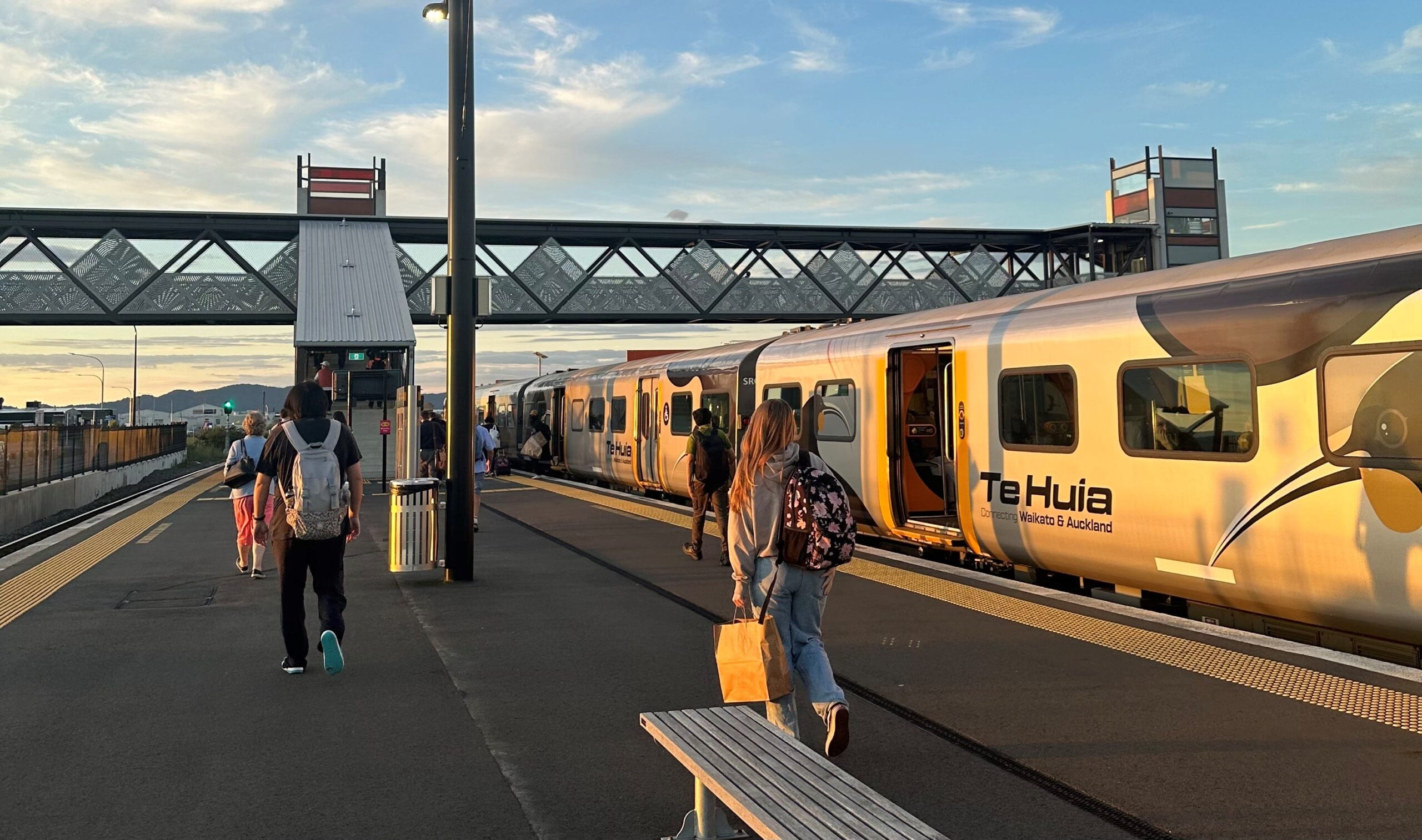
Te Huia at Rotokauri Station. Image credit Darren Davis
Spotlight on the Northwest Busway
On Monday, the NZ Herald ran a big front-page feature about the plans for the Northwest Busway, written by Bernard Orsman.
One thing that strikes us is the language in the article – notably, it calls the busway a “fix”, which is good, but it skips over the obvious point that widening the motorway did nothing to solve congestion and was the opposite of a “fix”:
A fix for Auckland’s heavily congested Northwestern Motorway is coming together, but it remains many years and many billions of dollars away.
The Northwest Busway, running 18km alongside SH16 from Brigham Creek to the city centre, builds on the success of the Northern Busway, the soon-to-open Eastern Busway, and City Rail Link.
But while it’s long overdue – arguably it should have been built when the last National Government widened the Northwestern Motorway a decade ago – there’s no clear delivery time.
…..
The problem
Bumper-to-bumper traffic in the Northwest is symptomatic of infrastructure failing to keep up with new housing developments and overloaded roads. The Northwest is home to 90,000 people and is expected to accommodate 100,000 more residents in 40,000 new homes by 2051.Most people in the Northwest do not have reliable public transport, 60% commute out of the area and more people travel to work by car than anywhere else in Auckland.
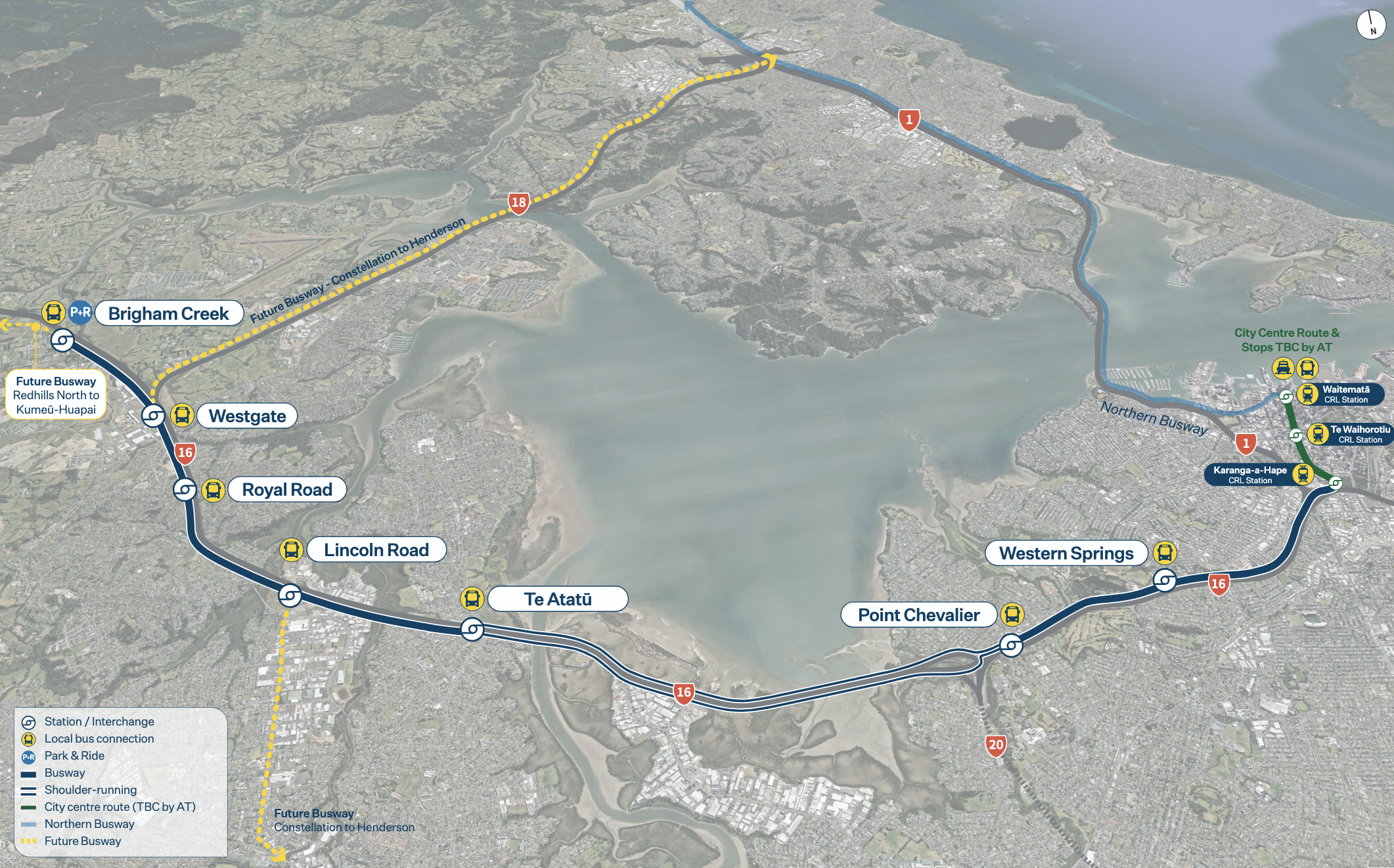
A high-level view of the plans for the NW Busway.
Also, did you spot the line that “arguably” the busway should have been built when SH16 was widened a decade ago? This is a point we’ve made repeatedly over the last decade, including in this 2017 post, where I wrote at the time:
The NZTA not building a Northwest Busway alongside the upgrades to State Highway 16 is already shaping up as one of the biggest in Auckland’s long and notable history of transport mistakes. While investigations have been underway since at least 2011, NZTA have continued to ignore the pressing need for this project in their [current] work to progress this part of the Western Ring Route. This is even the case on the parts under construction right now, which the NZTA appear to [have] deliberately designed to make a busway harder to build later.
A grim, grey example of status quo bias
NZTA is currently repainting the harbour bridge, and RNZ took a look at some of the technical challenges of the project:
The Auckland Harbour Bridge repaint project – that’s estimated to take 12 years – has been underway for more than a year, with works beginning at the southern end of the bridge in late 2024.
The New Zealand Transport Agency Waka Kotahi said the original paint coatings on the 66-year-old truss bridge had reached the end of its designed life and needed a full-repaint, which involved stripping down the existing coating and repainting it.
What particularly caught our eye was this bit at the end:
[NZTA’s manager of maintenance and operations for the Auckland and Northern regions, Jacqui] Hori-Hoult said a decision was made to keep the bridge grey as it always has been with the repaint, despite some internal discussions about a new colour for the bridge.
“The Harbour Bridge has been iconic – it’s 66 years old – so you want to keep it as close to its original colour as possible, because of its age and the mana it holds within our city,” she said.
Internal discussions only? Why not have a conversation with the public about this, like they did for Lightpath? Maybe even at a, shall we say, “city deal” with the place that’s home to this iconic structure? As we’ve suggested before, there are plenty of options other than boring mid-grey, like this example.
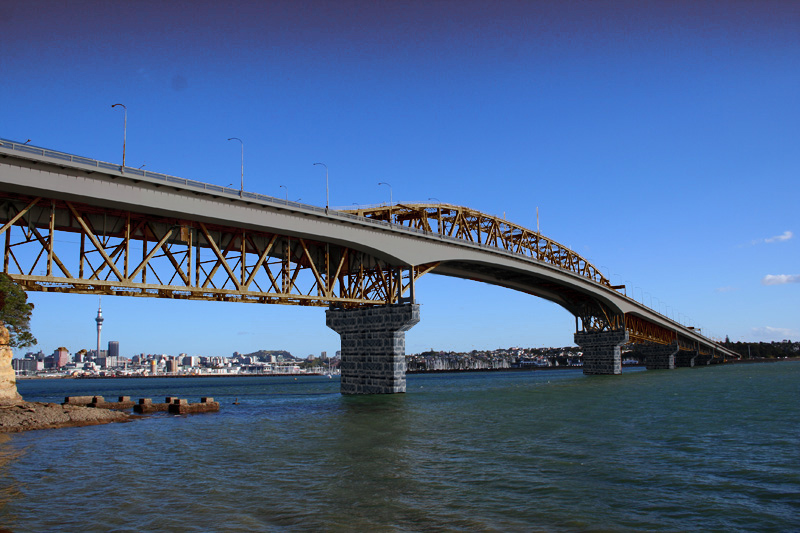
Just one example: a version of the Auckland Harbour Bridge with bright copper accents on the basket-like sections of steel. This wouldn’t just be more attractive, it could also tie in with the growing visual identity of the city as expressed in, for example, public art and design by Graham Tipene.
The impact of congestion pricing on New York City
The New York Times has a great article looking at the impact of congestion pricing (gift link) after one year of operation.
One year after the start of congestion pricing, traffic jams are less severe, streets are safer, and commute times are improving for travelers from well beyond Manhattan. Though these changes aren’t noticeable to many, and others feel the tolls are a financial burden, the fees have generated hundreds of millions of dollars for public transportation projects. And it has probably contributed to rising transit ridership.
The program, which on Jan. 5, 2025, began charging most drivers $9 during peak travel times to enter Manhattan below 60th Street, has quickly left its mark.
…..
Many findings from a Times analysis a few months into the experiment have held up. The program so far has met nearly all of the Metropolitan Transportation Authority’s goals, although more evidence is needed on some measures. And one question remains unresolved: whether a federal judge will decisively shield the program from efforts by the Trump administration to end it.
“Despite the threats to shut it down,” Gov. Kathy Hochul said in an interview, “the cameras are still on, and business is still up, and traffic is still down. So it’s working.”
The article provides evidence of these key outcomes:
- Fewer vehicles
- Faster traffic
- More transit riders
- Better quality of life
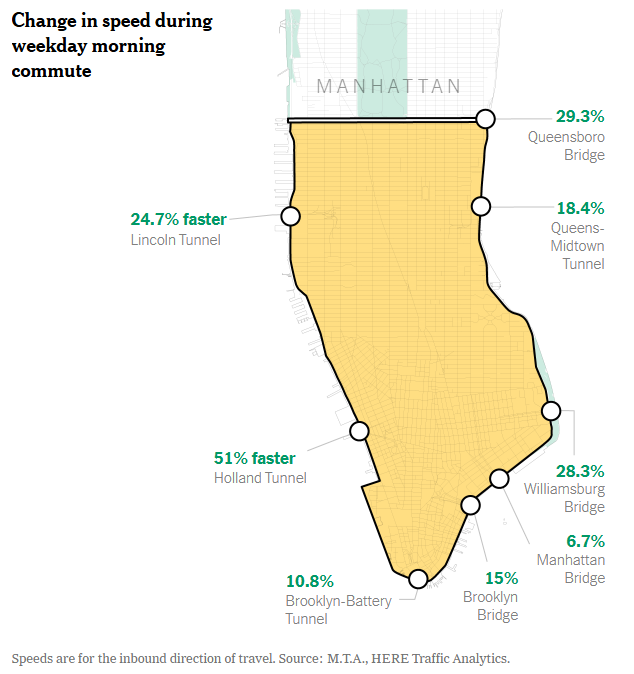 And here’s a similar analysis from Bloomberg:
Year 1 data on congestion pricing in Manhattan…* Vehicle traffic: -11%* Foot traffic: +3.4%* Storefront vacancy: -0.9%* Pollution: -22%* Revenue for mass transit: $548MSo YES this has been a huge success.
— Mark D. Levine (@marklevinenyc.bsky.social) 2025-12-23T14:00:36.620Z
Something for our politicians to remember this election
There may have been a silent majority in favour of windfarms and higher petrol taxes, but if there was, these people were mighty quiet. Essentially, all I ever heard from was people objecting to them.” That was the view of a former UK MP who took part in new research that reveals how significantly British and Belgian politicians underestimate the public’s support for climate action.
From solar power and energy efficiency to meat taxes and frequent flyer levies, the politicians consistently failed to appreciate people’s appetite for policies that tackle global heating. The misapprehension has real world consequences: those politicians were less willing to vote for or speak up for those policies, according to the study.
The good news was that when a group of the politicians were told the true level of polling support for some policies, this improved their estimates of support for other green policies. However, it did not correct the underestimates completely, indicating that the information the politicians used to form their views of public opinion are misleading.
“Based on recent research, I think some of these issues with the information environment has to do with a rightwing bias where the voices of conservative leaning members of the public tend to be overrepresented, for a range of systemic reasons,” says Lisa-Maria Tanase, an academic at the University of Cambridge who led the research. “They tend to be more privileged, educated and politically engaged segments of society.” Anti-climate disinformation from lobby groups also contributes, she says.
A huge 89% majority of the world’s people want stronger action to fight the climate crisis, studies have shown, but are trapped in a self-fulfilling “spiral of silence” because they mistakenly believe they are in a minority. Making people aware that their pro-climate view is, in fact, by far the majority could unlock a social tipping point and help push leaders into the climate action so urgently needed, experts have said.
For the rail fans
Some in-depth looks at rail overseas. First up, a review of the Melbourne Metro Tunnel
And a look at all things happening with passenger rail in Canada:
That’s us for this still very summer-holiday-ish week! Have a great weekend.

 Processing...
“Revenue for mass transit: $548M” – I wish we could have a discussion about congestion charging that didn’t involve the need for it to be revenue neutral.
City Deals – “secret negotiations”. Reeks of backroom dealing and corruption. No socioeconomic cost benefit assessment, no deals across NZ on a like for like basis providing the same improvements in wellbeing per capita, no transparency, no public input.
It reeks of politics. Our voters are prepared to pay for x and y but not z.
“holding sway with Auckland voters is critical for holding the country” – I wonder if LRT is in the discussion?
No chance in hell this government will be considering contributing to light rail.
I was amazed to learn that we are prepared to pay to subsidise Michelin Star residents, I guess it fits neatly into the government’s mantra of “entitled to entitlement.”
restaurants
Yeah we really need yet more bureaucracy before spending scarce funds! So long as the decision making is documented, including rationale that is sufficient. We need less junk economic analysis slowing everything down.
City Deals – it would be more transparent/equitable/better if central govt started paying rates on crown land across NZ rather than subsidising itself.
And if that isn’t enough to make Councils self-sustaining under rates caps (some have very low populations and/or very large asset maintenance backlogs) then some or all of the GST on rates could be transitioned over time to councils.
If rates were paid on hospitals and schools, etc. or if GST were diverted, the government would either have to cut its budget elsewhere, or increase taxes.
As an example, GST could be increased to 20%, with 5% going to local government. That would be about $9.7B p.a.
$8.7B is currently collected in rates p.a.
I’m more a fan of increasing petrol tax, as it would incentivise other forms of transport, use of more fuel efficient lower carbon vehicles, car pooling and change of driver behaviour. Government collects roughly $2.5 to $3.5 billion annually from the ~70 cents per litre fuel excise, plus additional GST and other levies. So adding about $2/L excise would gather similar money to a 5% increase in GST or current rates collected.
We need less taxes and more focus on what existing funds are spent (wasted) on at present. We need way less workshops and endless “consultations” and more evidence public funds are being used to plan, design and build the actual infrastructure.
Remember the $50m spent on analysing a cycling connection across the harbour. How is that even possible!?
ah the ACT perspective – how helpful. So what exactly will you slash from the biggie, the Social Welfare budget?
And why does ACT choose to subsidise the most expensive of drugs, apart from that they are a real burden on private medical insurers and therefore the heath insurance premiums of their voter base.
But yes let’s reduce spending that has marginal benefit. Out goes spending on regional airports, RoNS, free carbon credits and other spending that is of marginal benefit.
New Zealand central government has a real stranglehold on public funds and has always done so. Look at Auckland City Rail Link; approved in 1924 but not due for completion until 2026, largely due to the impossibility of prising money out of the Treasury for the entire 20th century.
I am expecting CRL to open in August and then close in September for 12 weeks of maintenance.
I am expecting trains to run at 10 per hour as they struggle to get dwell times under 5 minutes.