This guest post is by Tim Adriaansen, an advocate for accessibility and sustainable transport.
Te Ara I Whiti, or Lightpath, turned 10 years old last week.
This stunning photo has popped up all over the internet since it was first uploaded for royalty-free use by Dan Freeman in 2017. I’ve seen it on the home page of corporate conferences and consultancies, sitting in the background of influencer videos, and posted to travel forums as a drawcard – not just to Auckland, but a New Zealand top ten sight-to-see, rivalling Milford Sound, the Cook Straight ferry crossing, or a visit to Hobbiton.
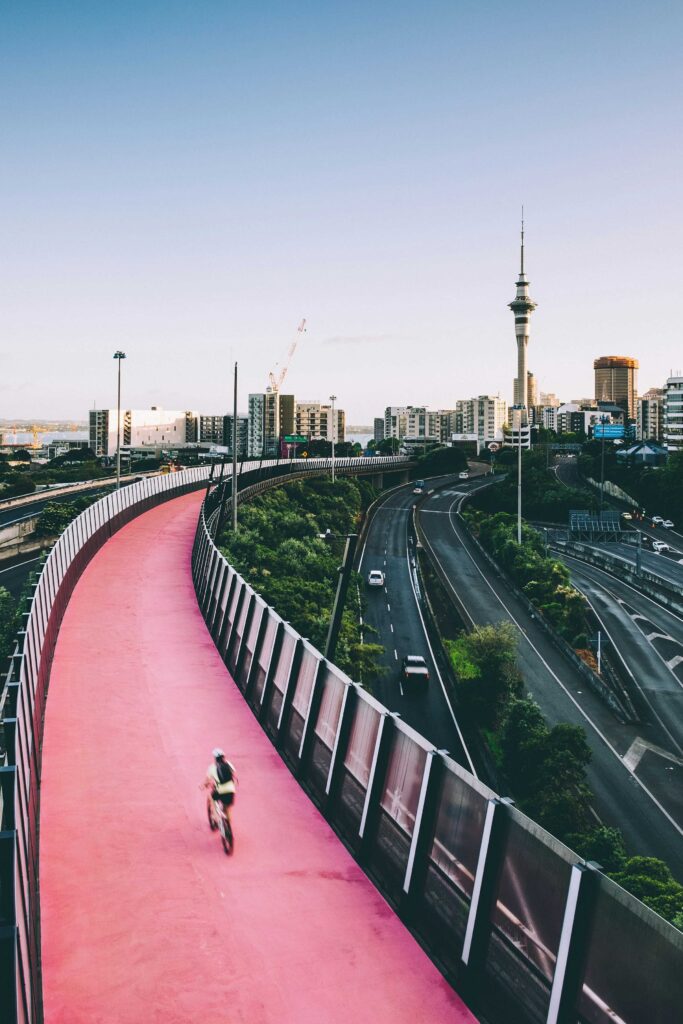
When Te Ara I Whiti opened, back in December 2015, Auckland felt exciting. Lightpath, and the Nelson Street cycleway which was implemented a few years later, were innovative, transformational projects that beckoned a confident, creative direction for a city that otherwise felt like it was still struggling to shrug off an awkward teenage phase.
In 2019 I had international guests come to stay with me, their first time in Aotearoa, a country they had dreamt of visiting for decades.
“What would you like to do first?” I asked them.
“The pink path!” they replied.
The bright, vivacious pink of Dan’s infamous photograph was 10 years ago. Today, Lightpath feels like a metaphor for a city that somehow lost its sense of direction along the way.
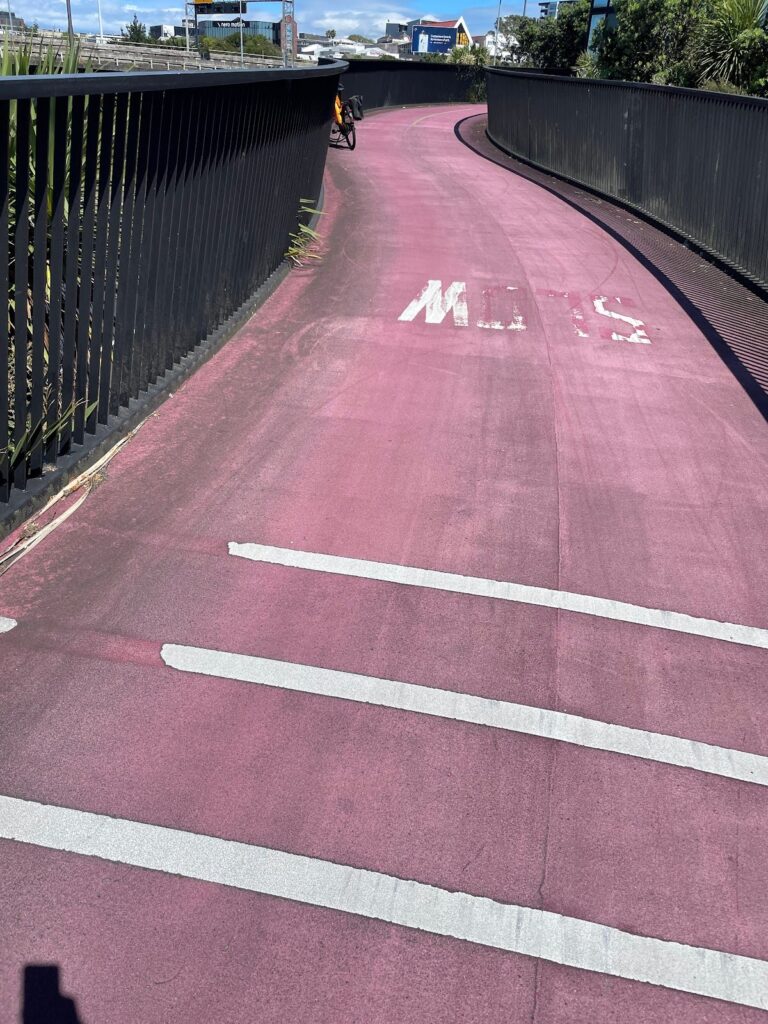
While still doing the rounds imagery-wise – and, performing well as a path for people, serving almost quarter of million trips last year by bike alone – Te Ara I Whiti itself is no longer an illustrious drawcard, a beacon of excitement to a shiny city in the south.
I’ve been informed that one transport agency is responsible for maintaining the surface, and another for maintaining the walls and panels. Whoever’s job it is, both elements of the pathway are currently in a dubious state of neglect.
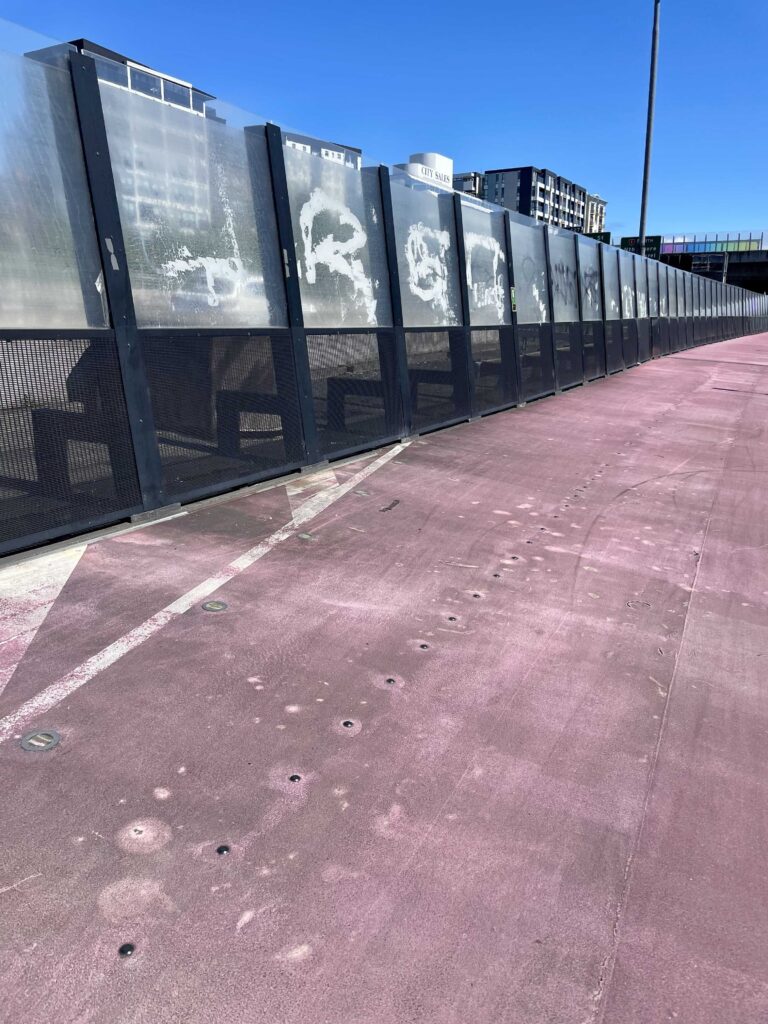
Our transport agencies haven’t been helped by those that should be civic leaders. Where once Auckland had vision, it seems there’s a now crushing chorus of “don’t waste our money” coming from people who couldn’t point a stick at where transport budgets are spent (they’d likely shake it in the general direction of anything that resembled a bike path). That includes a number of elected representatives who should be able to accurately point sticks at many things.
Here’s a question. What Auckland Mayoral slogans are you able to recite? What ambitions did the aspiring en-visioners of our great city tout, over and over, when they held office?
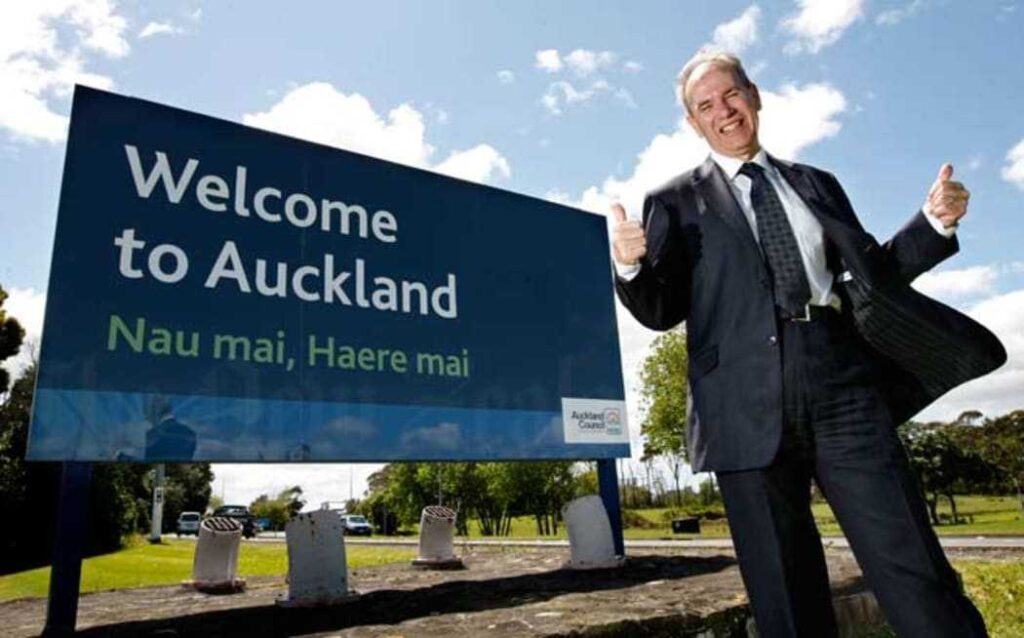
I’m willing to wager there are only two which most long-time Aucklanders can recall: “The world’s most liveable city”, from Mayor Brown; followed by “Fix Auckland”, from the other Mayor Brown. We went from “let’s be the best in the world” to “well, I guess we could make this a bit less bad”. What a leadership trajectory.
Auckland has lost its map and compass. What was once the city of sails finds itself in the doldrums. Far from a super city, Auckland can seem like a slumber city: sleeping on opportunity after opportunity to achieve greatness. Somewhere along the way we hit the snooze button on our sense of self.
“But Tim!” I hear the relentless optimists scream at their devices (some of the screaming happening internally), “Auckland has done loads of great stuff over the last decade. Maybe you could try being a bit less negative for once?”
To which I say “Yes, and–”
Of course, some successes stand out. The inner-Auckland cycle network is achieving critical mass, linking up different parts of the central city and out through some of the suburbs, notably the inner west, Grey Lynn to Pt Chev. Quay Street looks gorgeous, and Queen Street is much, much better than it was 10 years ago, even if the new look was done on a budget (achieving great value for money, I’d say).
Ngā Hau Māngere and the freshly opened Māngere cycle connections are a fantastic community asset linking through to the south. Heck, there are even some paths along the North Shore’s motorways, albeit most awaiting their necessary local connections.
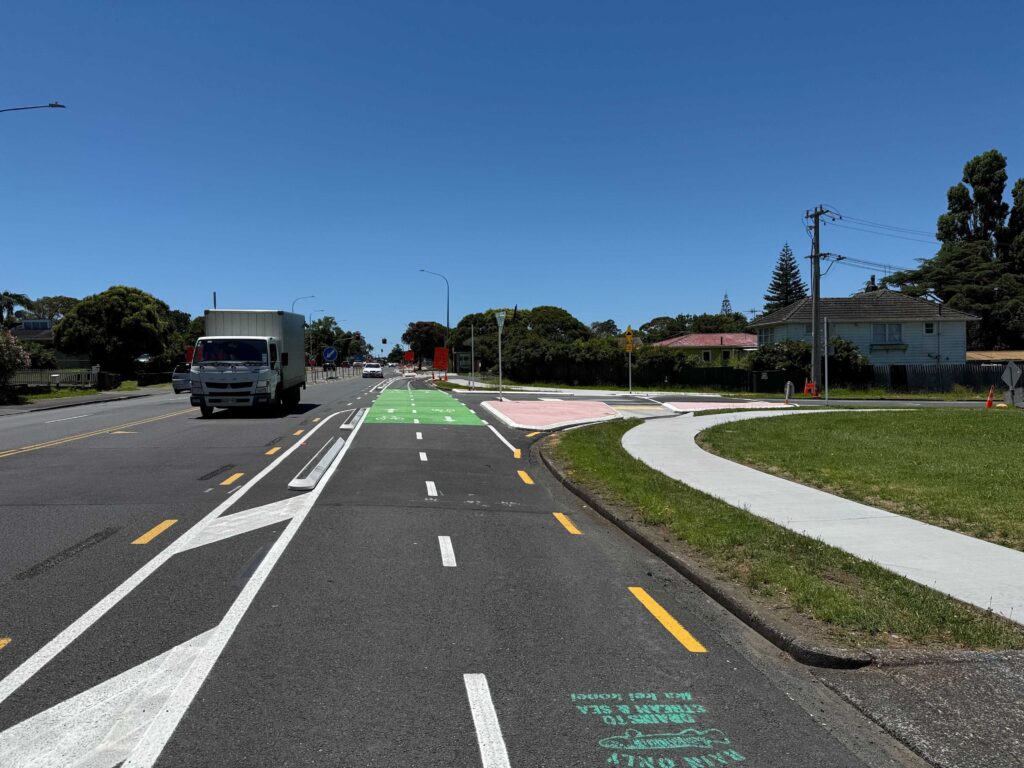
Meanwhile, the bus network has significantly improved and massively electrified across the region — along with the entire passenger rail network. Public transport patronage and user satisfaction has grown alongside these investments and improvements in service.
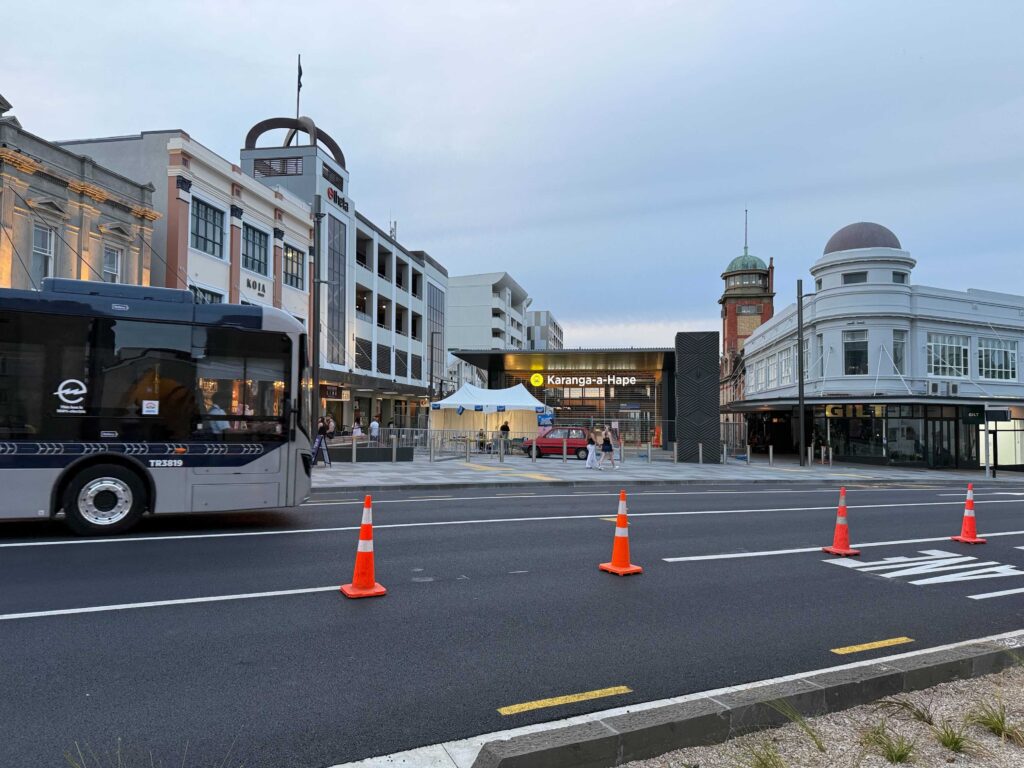
The CRL is starting to smell like fresh paint (or fresh pie on a windowsill) as the final touches are added, testing is completed, and we’re at least hearing about an “opening window” ahead of a formal opening date (likely September 2026). There’s much more that’s happened across Auckland, too, and I don’t want to downplay the progress.
And: I want to point out something very important. All of these recent accomplishments, every single visible win, took a long time from planning to polishing. While hard-working people of all types have been slogging in the trenches, fighting for every street improvement, every public transport dollar and every linear metre of bike path, the same forces that failed to keep a coat of fresh paint on Lightpath have dropped the ball on freshening up our city-shaping plans.
When it comes to “what’s next?”, there’s nothing in the war chest.
Largely unknown to many Aucklanders, there’s been an enormous amount of work going on behind the scenes to plan the region’s transport future. Some big acronymic schemes like ALR and SGA and ATAP and AWHC have all spent tens of millions of dollars on what in the industry is known as “crayoning” (the act of drawing colourful lines on maps ).
But all of these house-of-cards schemes eventually collapse for the same reason: They’re crafted within a system of conservatism, and as a result, they don’t actually deliver a better version of Auckland.
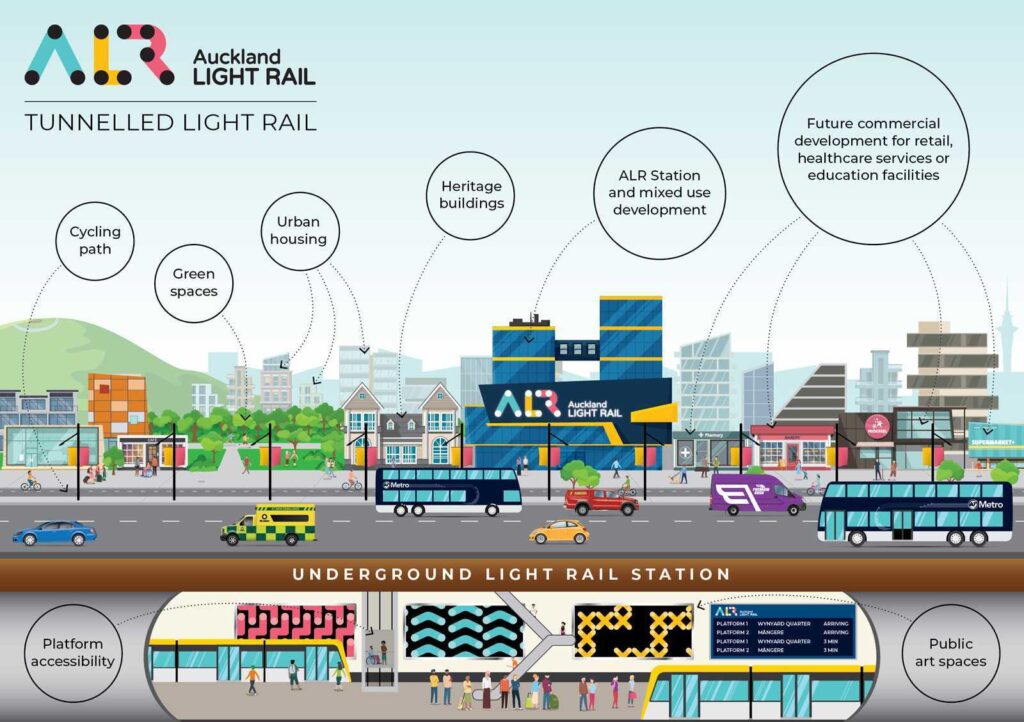
- Auckland Light Rail (ALR) planned to tunnel underground to avoid interfering with car parking on Dominion Road.
- Supporting Growth Alliance (SGA) was all about building roads to service sprawling suburbs.
- The Auckland Transport Alignment Project (ATAP) was supposed to align Auckland’s regional ambition with central government direction, but Auckland Council couldn’t ever get their own “Council Controlled Organisation” under control.
- To this day, the project to develop the next Auckland Waitematā Harbour Crossing (AWHC) doesn’t even involve Auckland Council as an equal planning partner, and it’s looking like what might be New Zealand’s biggest ever transport project will be determined by a mash-up of “what will make lots of money for the people who build it” meets “what will be popular for the government to announce ahead of next year’s election” (the same transport planning recipe used to design those tunnels down in Wellington).
These work programmes have something in common: they perpetuate a vision of Auckland as a city built primarily for and around private motor vehicles. That is, they continue to enable the very problems they are supposed to fix, inevitably meaning they’ll be expensive, ineffective and met with, at best, modest popularity.
They’re also lacking a compelling story. There is no clear messaging for how these very expensive schemes will change the direction Auckland is travelling in, let alone get us collectively out of the doldrums and put some wind in our sails once again.
This is the singular, common reason that they all fail — and why Auckland has few coherent projects in the pipeline. And it happens for the same reason Lightpath looks like a shabby, forgotten back-alley: In the absence of competent and visionary leadership, the collective weight of institutional path dependency is the only thing carrying transport in Auckland. It’s a gentle tide slowly dragging us towards the reef. If we want to change course, we’re going to need to hoist some sails and actually do something.
This is where the idea of Lightpath can help us out. Because Te Ara I Whiti wasn’t a project that came out of a 10-year pipeline, it was creativity that occurred in response to opportunity. It was advocate-initiated, community-powered and institutionally enabled. And if there’s something which never changes about Auckland, it’s that this is a city of opportunity.
If Lightpath were to get a good powerwash and a fresh lick of paint, it would quickly become iconic once again. It could shine as a beacon of Auckland’s vibrancy for a decade to come.
In the same way, Auckland needs to freshen up the city’s vision for the future. Do Aucklanders want freedom, a sense of community, and easy access to healthy outdoor fun built into our day-to-day lives?
Or do we want to be stuck in both debt and traffic (and increasingly stressful and unpredictable weather) for another 30 years?
With a recently elected Council and a shake-up of transport planning powers, now is the time to ask of ourselves and our elected representatives: What is the vision? What are we prepared to do to make it a reality? And importantly, how will we ensure we don’t get another decade of slowly fading away?
(Do you want to help make Auckland awesome but you’re not sure how? I don’t get paid by Greater Auckland, but I love what they do. You could consider giving the team a little Christmas gift by supporting them here).

 Processing...
I cycle in Auckland almost every day, I’ve clocked up a little over 10,000kms in the city year to date. Here’s my impression. People don’t want iconic, they want functional. That’s why Wayne won twice, people are bored of “aspirational”, they want delivery.
The change in government in 2017 put a hand break on progress. The Key government was the driving force behind a lot of the best cycle paths in the city. Labour came in with lots of aspiration and almost no delivery. When it had an absolute majority, it was too scared to use it to do anything.
The walking and cycling bridge over the harbour could have been built, focus groups didn’t like it, so they cancelled to pander to people that were never going to vote for them anyway. The entire light rail fiasco could have been avoided. Wasted years designing a gold-plated solution, when it was screamingly obvious the only way the project survived a change of government was to have lots of spades in the ground before the election. Needed to go hard and fast in getting something built, didn’t need to be perfect, but something.
It was a generational opportunity and it was squandered.
Completely agree Bluey. The harbour cycle crossing debacle is upsetting to think about, even now. Felt like we were so close!
Speaking as a longtime cyclist, regular Lightpath user & former lifelong Labour voter, I don’t think I’ll ever vote for them again. All talk, no do.
I wonder if this speaks to our need for systems change. Whilst Labour failed to deliver on their promise, how much of this was due to organisations resistance and some of the personnel within who have had years of practice in disrupting any changes to the car dominated system they support.
We shouldn’t make excuses for their failure nor blame “deep state” resistance. In any given scenario the simplest explanation is most likely. In this case it was lack of hard work and incompetence.
100% aligned. I was a lifetime labour voter until 2020, never again. The party isn’t run by serious people interested in delivering change. Twyford and Wood both dropped the ball badly.
i rode over the harbour bridge a while back, seriously the best day Aucklands ever delivered for me, which is a high bar.
It was a protest action, we broke the barriers and pedaled like we were naughty little coachroaches in lycra (newstalkzb reporting)
The bridge is a giant flag to Auckland – no can do. NZTA telling us to get back into our cars, and $51M is not enough consulting to make a footpath work.
John Key seems aspirational. It was a miserable government of the day, but it did kick of the billion dollar cycletrails, just not so much in our city. While winnie the handbrake dragged anything progressive through the slow lane, cities overseas got into the covid urban tactical path building mode. Not sleepy zeald.
Naughty cockroaches, heh heh. Agreed, they did some bad stuff (don’t get me started on their shutting down TVNZ 7, perhaps the greatest public broadcasting experiment in NZ history) — but the cycle trail stuff was nothing short of visionary.
Remember how much flak Key got in the media when he came out of the Jobs Summit in 2009 and announced one of NZ’s main responses to the GFC was going to be building a national cycleway? Now who’s laughing…
Skypath failed because the business case never stood up to fiscal scrutiny. There is no doubt that a cycle path over the harbour would be popular but a clip on to a clip on is a complete farce.
When the then Labour government wanted to build a billion dollar stand alone bridge, even this forum understood that was crazy.
As for ‘never voting for Labour again’, a vote for anyone else is a guaranteed of retaining the Luxon car crash.
All of these wonderful projects you reveal are great but no mention of the degraded Hobson St precinct. No public toilets, no usable green space. No public transportation ( al redirected to Albert St. graffiti etc.
That’s a result of the lack of visionary leadership Room is referring to. There’s a whole section in the CCMP on that part of the city, along with A4E which would assist delivering it… Neither Goff nor Brown had/have any sense of doing something about it. No sense of responsibility to run with what has been envisioned by experts and approved by successive Governing Bodies.
It’s undemocratic the way each of them have allowed actual mandates to lead to nothing.
Tim, not Room. Thanks, swipe. Sorry.
Thanks Tim! Ligthpath is indeed a metaphor for the city (except for the new shiny bits you pointed out).
Does any one out there have an indication of what a re-surfacing of the path would cost? Crowdfunding an option?
Answered my own question in part.
https://nzta.govt.nz/media-releases/lightpath-cycleway-to-get-coat-of-sunscreen
$115,000 in 2017 for a refresh….
$115K for a project in 2017 is likely be start north of $250K on the movements in Labour costs along (Min wage in 2017 was $15/hr, the living wage is now $29/hr) then there is the H+S and the Traffic Management plans and requirements ( pretty sure they apply to cycleways)
So you’re probably looking at $3-500K
I doubt it would be painted by hand.
“I doubt it would be painted by hand.” – I’ll do it for $115K with a roller. May take a few weeks.
Thank you for this. I have been moaning about the state of the Lightpath for a year but no-one will listen – and some of the light side panels are even out. Try and find out who has the box of light bulbs? It’s the old Auckland Council pass the buck game. Not us, maybe NZTA no Auckland Motorway Alliance or whoever runs the motorway maintenance, no try someone else. Maybe AT. No, no one knows or gives a damn. All the lights may go out and why does that matter.
Indeed this is a metaphor for Auckland. The whole city is grubby. Check out the neighbouring Rainbow Bridge bus stops on K Rd-although remarkably someone was cleaning the panels yesterday and the panels behind them that overlook the motorway . Graffitti goes unnoticed and when you report it no one cares. And people blast event posters all over. Check out the electronic AT boards. Some are unreadable because of crap on them.
If the mayor wants to fix Auckland adopt the once coherent Rudy Giuliani NY Mayor success when he insisted the small things mattered and get them right and the city will come to life.
AT and Auckland Council should hold their heads in shame after reading this.
There was some systematic lighting repair work being undertaken on those panels not that long ago… 18 months? 2 years?
I wonder what the on-going costs are compared to the budget for it.
Generally speaking, NZ doesn’t do lighting for paths well. It’s one of those critical pieces of active mode infrastructure that the car dependent system considers superfluous.
Probably anywhere where an appropriate level of lighting has been installed, the purse strings holders resist maintaining it.
“Lightpath looks like a shabby, forgotten back-alley”
You should have gotten someone to write this who actually uses the Lightpath on a daily or even weekly basis.
This has the tone of Viv Beck promoting Midtown shopping by continuously moaning about how Midtown is a ghost town full of knife-wielding meth-heads
Auckland will steadily get worse as its population increases.
It is not just roads becoming oversubscribed by the influx of people – it’s all infrastructure.
There will be no vibrancy, just growing squalor and balkanisation.
New Zealand – Auckland particularly – needs a breather from the unprecedented mass demographic changes that are being imposed on it.
Mass driver’s license fraud and the Ōtara-Papatoetoe Local Board elections are just the opening salvos in the fight for our civil society.
European and US style fearmongering isn’t going to cut it in a country uniquely positioned to avoid unauthorized migration.
Nobody is coming here in the back of a truck or on an overloaded rib.
Perhaps you should find another way to code your racial hygiene myth.
Please go away to help with our overpopulation then. The US is happy to have people like yours who feel that “others” are the problem.
Shouldn’t be the case in theory, more people is also more hands to do the work. (i.e. a bigger economy)
I just love how this article uses the pink path as a metaphor for a much larger issue, followed by comments that ignore the larger issue to focus on small scale outrage. Classic NZ
What we have had, from time to time, is visionary bureaucrats. But they get worn out having to fight their management.
What pisses me off most is when there is great policy or regulation or direction, yet the system manages to keep plodding resisting change.
It’s what I call the “sometimes mandates get lost” mentality. Which is a reference to one bureaucrat’s appalling excuse for unravelling and replacing a good strategy (by a far more visionary bureaucrat, now in private practice) that AT had belligerently refused to follow.
Sometimes the best leader may be a benign dictator… no one likes to acknowledge that, but it is true.
The thing is you don’t need a dictator. Just a passionate champion at high enough level. If senior management has your back, the middle managers who DO want progressive change can push for it. If senior management abandons you, or the leading politician in charge stabs you in the back once things become “controversial” (change always will be), then yeah – people eventually either learn not to champion change, or burn out.
Change from the status quo usually has more popularity than people think. But opposition, even though it often represents a minority view, tends to be *vocal*, or even abusive. So politicians and bureaucracies tend to play things safe rather than push through the pain. Doubly so when you get punished for following what your strategies claim you should be doing, but find out those strategies are just the cheap figleafs covering up business as usual.
Great post. Let’s have community action. First of all get a whole lot of cyclists and others to each try cleaning an area each and following that, recoat it with not sure what but I’m sure there are options. Could be fun! Then we have a picnic or party there to celebrate (or not) and plan the next step.
The lightpath is pretty useless as a cycleway since it doesn’t take you very far, and can only be accessed from 2 locations, and then to top it off one end of the path is stranded in the middle of the motorway on and off ramps. Something of a white (pink) elephant.
Yeah, nah. It connects the end of the northwestern cycleway and everything else south of the motorways to Nelson Street and on to the harbour.
As a motorway exit it was a dead elephant.
Agree it is a good and vital connection. It is compromised by poor phasing/timing for the offramp/Union St crossings, so bad many cross against the lights that are timed solely for motor vehicle priority.
What I could not believe, and fed back on, was how the proposed upgrades to Nelson St maintained an awkward ‘chicane’ where the bike path crosses the ‘Sugartree’ lane entry. They would not do that were it a high traffic motor lane, but thought ok on a high traffic bike lane because still give the limited vehicle traffic accessing it priority
Why not just bike down K Rd and Pitt Street?
Why go through a dozen lights, potential conflicts with drivers, and pedestrians stepping onto the path without looking when you can skip all of it?
Why do we build highway bypasses when the drivers could just use the local streets through towns instead?
Not saying it’s useless, just saying it’s not a markable improvement to biking through the city, even less so with new the cycleway past Karanga-a-hape station
Just re-read my previous comment, I did in fact say it was useless
Well there’s two things wrong with this bit of moaning.
Firstly cycling volumes across Auckland are up 8% and the rate of increase is accelerating. particularly since 2024. Sure it needs a coat of paint but let’s let the actual behavioral change we all wanted get a bit of sunlight.
Secondly after the writer’s had a moan about cleaning he goes straight into wanting another super-project as if it will cure everything. City Rail Link needs to be admitted as causing so much economic and social damage that it has already corroded years of its future benefits. Its construction has helped corrode the entire CBD economy. From the scale of rail timetable disruption it has caused, anyone who has gone through Primary, Intermediate and High School over the last decade could well be forgiven for never trusting Auckland’s trains ever again. And yet this author wants another mega-project of at least as high an impact much over a much larger area, and constructed over at least as long a time.
Before we launch into yet another heroic demolition of the city, we might just want to pause and let the current one actually see if it can gain passenger trust back in the rail system, help the CBD recover from the wreckage it has caused, and convince ratepayers and taxpayers that this one and any future one really was worth the money.
Take any piece of paper with the word “vision” on it outside and burn it. Instead just prove you can deliver.
Census says cycling isn’t increasing anymore.
govt says that was the last census…
Although I largely agree with the article and associated comments, I wonder what large projects are in pipe for future delivery.
Of course there’s the recently completed Pakuranga flyover and CRL is due to open in 2026. Then there the Eastern Busway.
I believe they’re developing a Western Busway too.
Lastly I’d note that there’s recently been a concerted effort around the Glenn Innes area to develop cycle paths. Unfortunately it’s also created dangerous conditions for vehicle traffic.
On Apirana Ave, the road width has been shaved down to a lane each way plus space to park buses. Trouble is that in order to work, buses must park exactly and lane widths leave no margin for error. I understand there’s already been a major accident there and the changes are only six months old.
I’m just waiting for someone to sue AT for creating a dangerous road.
You think things have moved slowly up to now? Just wait until transport is put back in the hands of politicians (council and local boards). You’ll be filled with nostalgia for the CCO days of AT.
Great post thanks.
Just about everything you espouse I disagree with. You I think are pretty selfish with the car being your number one enemy. As for electric vehicles forget it.
Another lesson learned is why Dutch bike lane are red. It is because you can produce red asphalt that doesn’t fade.
Great insights on how infrastructure shapes city life. It’s eye-opening to see the impact of delayed projects on Auckland’s growth and livability.
Maybe Cindy Ardern singing revolutionary songs over the taxpayer funded tannoy system linked into buses & trains would increase patronage & encourage users to clean it up. Bonus is that she would get royalties that she would distribute kindly.