The following is an op-ed I wrote which ran in the NZ Herald on November 3. It’s turning out to be even more topical than ever – read to the end for an update with recent events…
In July 2016, dignitaries geared up to ride along a brand new cycleway on Quay Street in Auckland. They included the Prime Minister himself, John Key, who proclaimed that one of the keys to Auckland’s growth was “making sure that it’s a place that people can get around and have fun and enjoyment, and part of that is the cycleways.”
Quay St is now one of the city’s busiest bike paths and, as an opinion piece suggested in 2017, “Sir John Key’s legacy may be his cycleways.” But the current National-led government’s transport legacy for Auckland will be the polar opposite of the pragmatic approach of Key and then Minister of Transport Simon Bridges.
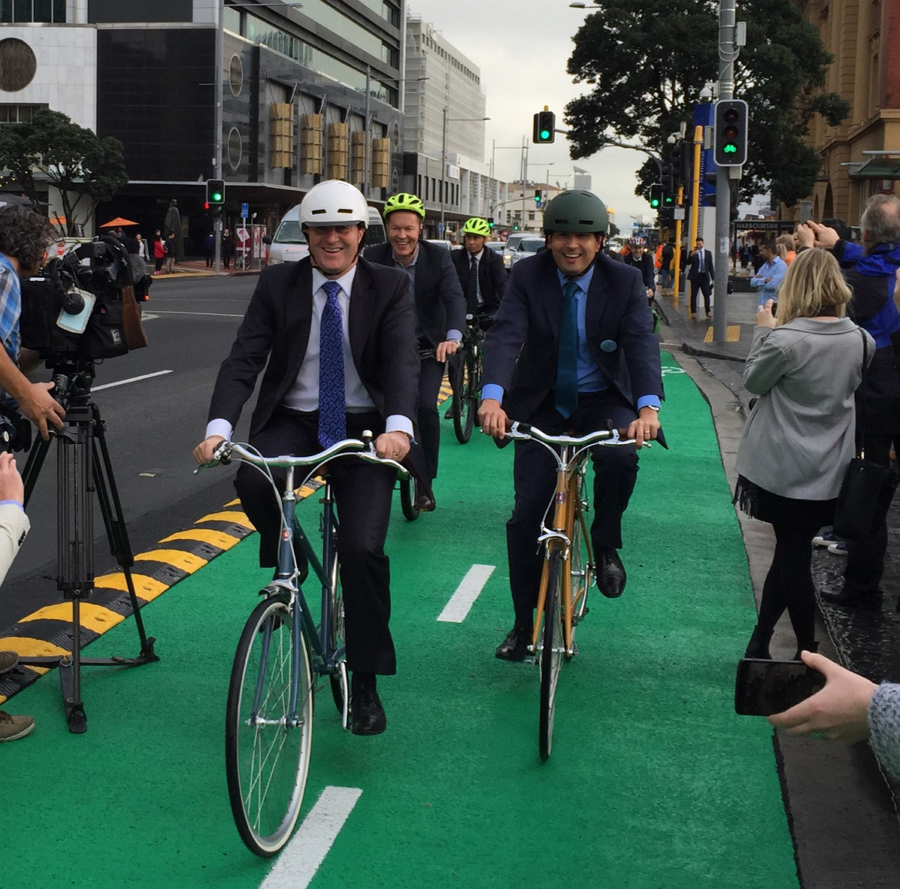
John Key & Simon Bridges on the opening of the interim Quay St cycleway the last National Government funded
Instead, this government is funnelling millions of dollars to consultants to design frankly unaffordable billion-dollar mega-motorways. Meanwhile, a struggling construction sector faces the ongoing collapse of the pipeline of smaller, smarter projects.
This is due largely to one person: Simeon Brown.
As Minister for Transport from November 2023 until January 2025, Brown rewrote the Government Policy on Land Transport (GPS), gutting all new funding for walking and cycling, and snatching funds intended for hundreds of shovel-ready locally significant projects to pour into a few overscoped expressways.
Worse, Brown imposed unprecedentedly detailed mandates against multi-modal design, such as forbidding ‘local roads’ funding being used for walking and cycling improvements.
In Auckland, as in other places, Brown’s diktats wreaked havoc on the pipeline of long-planned transport projects. One high-profile example: the long-awaited fix for “New Zealand’s worst intersection”, the dangerous Hill St crossroads in Warkworth in the National Party stronghold of Kaipara ki Mahurangi.
The Hill Street upgrade emerged from years of community co-design, and coordinated with water infrastructure upgrades in order to “dig once”. But in November 2024, NZTA declined Auckland Transport’s (AT) request for funding. Why? Brown decreed that because it included safety upgrades that contravened his GPS, the project needed to be re-designed to ensure funding. Locals were appalled.
Another highly-visible aspect of the Minister’s culture-war transport crusade: the blanket speed limit increases forced on towns and cities by his rewritten Speed Rule, with ratepayers footing the bill. Brown’s rewrite of the Speed Rule shocked expert observers, as a perverse swerve away from all evidence and official advice, which also repudiated his pre-election promises to raise speeds “only where it was safe to do so”.
A key part of the Speed Rule required cities to undo any speed reductions from 2020 that involved the presence of a school. To widespread dismay, AT obediently complied, reverting over a thousand residential streets from 30km/h back up to 50km/h, affecting more than a hundred schools – including a quiet cul-de-sac outside the Blind and Low Vision Network’s Manurewa campus.
In June, Councillor Shane Henderson quizzed an AT lawyer on the logic, or lack thereof, of Brown’s new Speed Rule. Let me get this straight, Henderson asked. “If we lowered speeds to protect children, it gets captured [by the rule] and the speeds [must be] raised. If we didn’t lower speeds to protect children, the safer speeds can stay. Is that correct?” AT’s lawyer agreed: “That’s how the rule is drafted.”
Based on AT’s evaluation of its Safe Speeds Programme, these reversals mean an estimated 564 people will be needlessly killed or seriously injured in our biggest city over the next 10 years. An added outrage is that even by Brown’s favoured measure of ‘productivity’, safe speeds were a huge success. AT’s economic assessment estimated that every dollar spent on safer speeds returned $9 in benefits. And a May 2025 AustRoads study enumerated the many wider benefits to the freight industry, local businesses, and traffic flow.

Editorial cartoon by Rod Emmerson for the NZ Herald September 2024
AT’s safety programme was world class, reducing deaths and serious injuries by over 30% where it was implemented. In December last year, the programme won an international award. Brown immediately retorted via media that the prestigious award was ‘woke’, reflecting the years he has spent, in opposition and then as Minister, as the tip of the spear in riling up culture war battles and spreading disinformation about lower speed limits.
Again and again, Brown shrugged off expertise and evidence. Although minister for scarcely more than a year, his tenure will likely be recorded as one of the most harmful in this country’s history. The greatest irony is that his petty culture-war legacy of cancelled projects, now handed to Chris Bishop to salvage, means the government will struggle to start, let alone finish, many transport projects before the next election.
Hence their endless reannouncements of the same old RoNS.
Whereas, smaller, faster transport projects win hearts and minds across the board. They also give you a chance to cut plenty of ribbons and give crowd-pleasing speeches. That’s something Key and Bridges clearly understood, when they jumped on their bikes back in 2016.
And here he goes again…
Coincidentally, Simeon Brown decided this week – just one month after a jubilant post on 1 October proclaiming “How good is the new Reeves Road flyover” – to lobby Auckland Transport for a last-minute redesign of Rā Hihi/ the Reeves Road Flyover intersection.
He’s claiming the brand new layout is poorly designed, on account of some current congestion in the evenings.
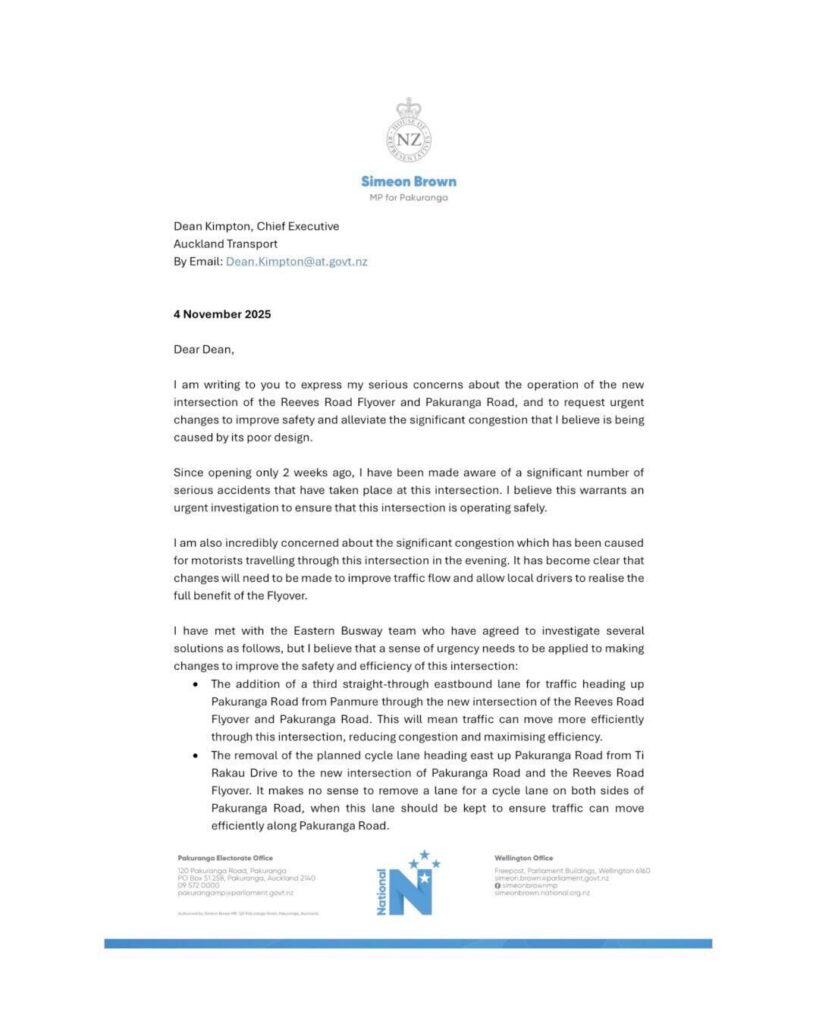
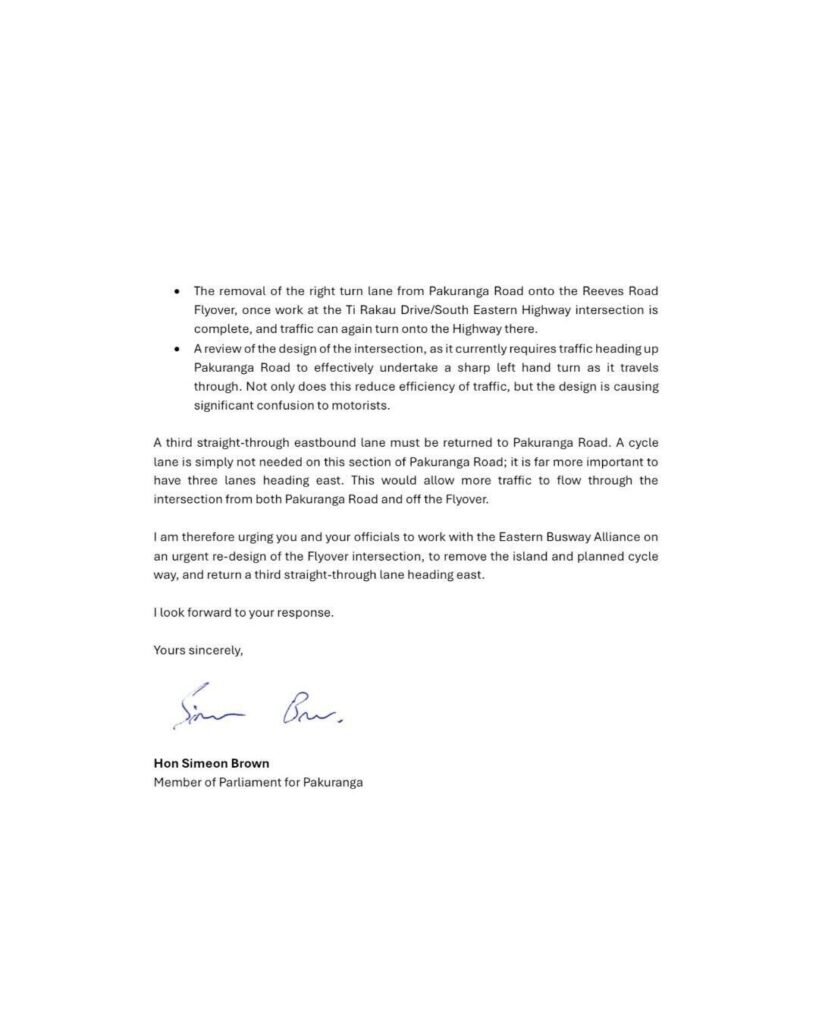
Of course, what’s happening is that the flyover is doing exactly what it was always going to do – move the main intersection (and thus the congestion) from Tī Rakau Drive to Pakūranga Road.
Which is exactly what AT stated was going to happen back in 2016, when announcing that the (previously scrapped) flyover was being revived after intense political lobbying:
“The Reeves Road flyover will not solve traffic congestion in the area. However it is highly effective at offering significant local congestion relief on the roads outside Pakuranga town centre. Shifting traffic off those roads allows the busway and cycle lanes to be built on them.”
Brown’s letter dives right into the details, pressuring AT to redesign the project at the last minute – something that always comes at great cost, but who pays? You can also see Brown ramping up one of his favourite culture wars, attempting to blame a (currently non-existent) planned stretch of cycleway for the traffic issues, and claiming the space is urgently needed for yet another traffic lane.
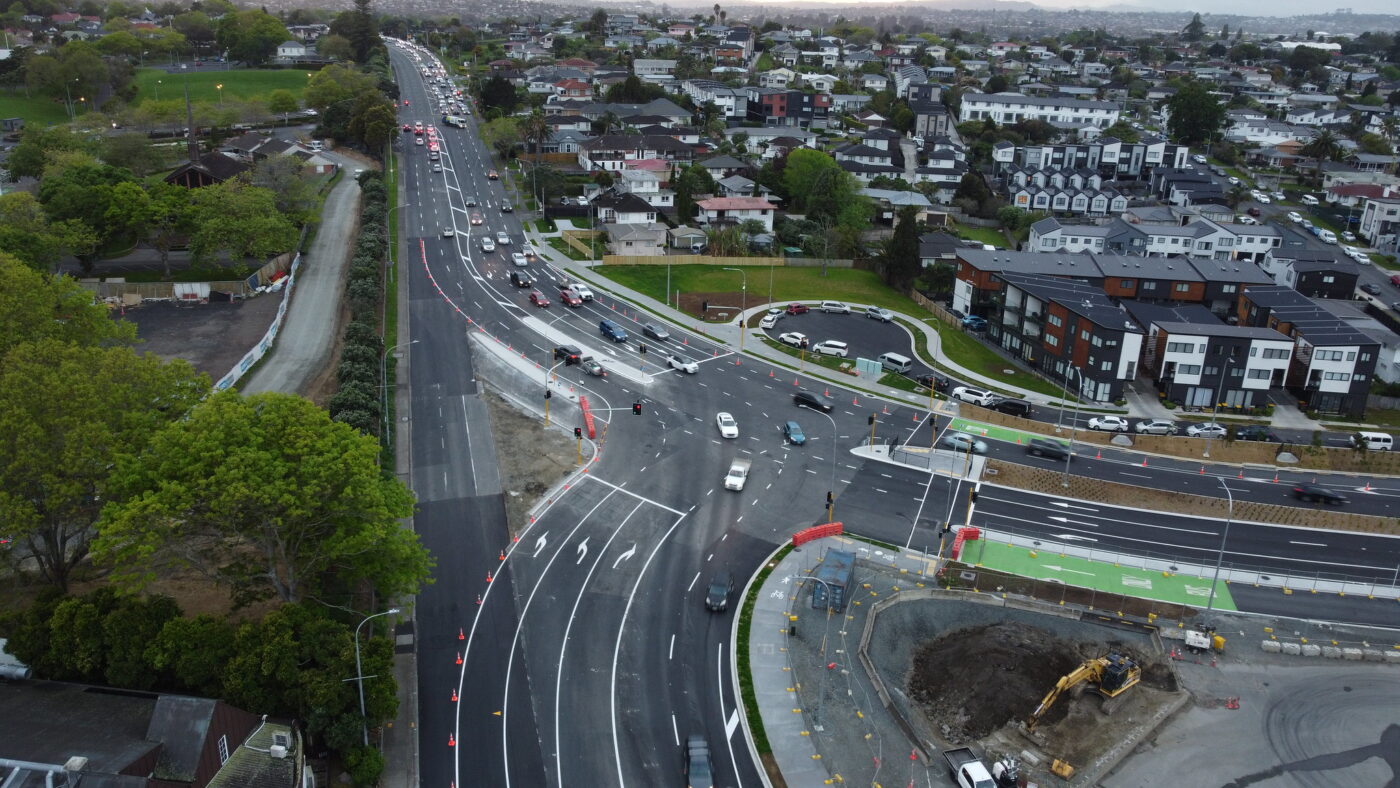
The intersection in question: aerial image by Anton Benadie, via the Eastern Times.
I’m definitely sure Brown’s culture war diktat for “just one more” traffic lane will totally work to reduce congestion this time.
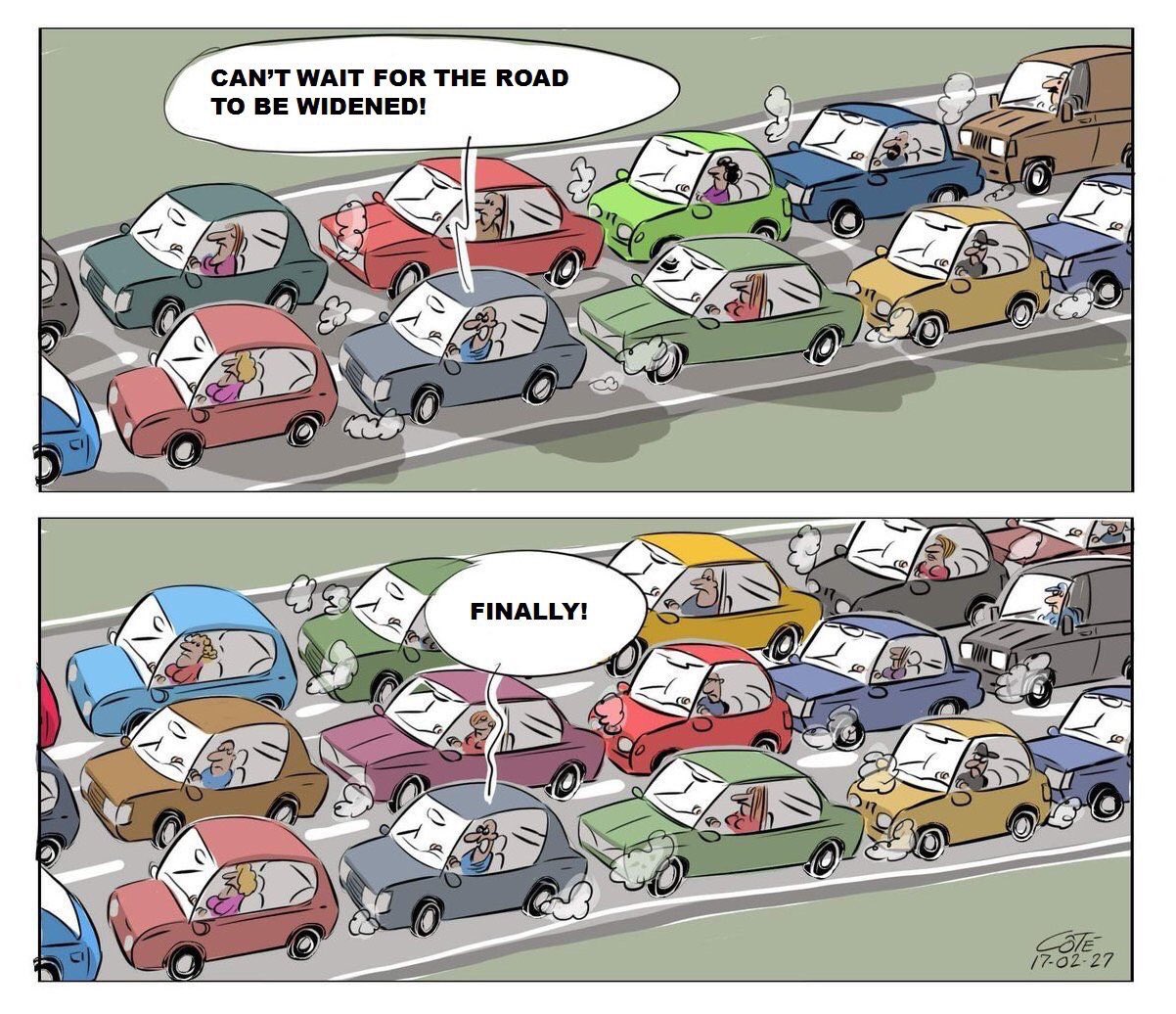
A widely shared (for good reasons) cartoon by Côte (2017)
So, it’s good to see (at least initially in this case), AT has put out a very sensible response.
“With tens of thousands of vehicles a day using roads in the area, a major change like this can have impacts on the wider roading network, particularly when further work on the Eastern Busway, to replace utilities on Tī Rākau Drive at the intersection with Pakūranga Highway, involves temporary traffic diversions.
“Integration of new major infrastructure can take several weeks to settle in to new patterns as user behaviours change.”
Small said Auckland Transport is taking a number of actions to sort out the issues, including reviewing the design of the intersection and a potential third eastbound lane on Pakūranga Rd.
A new layout, especially one that’s not yet complete, will always need time to bed in, as the people become familiar with it, and transport agencies work to optimise signal timings, and the like.
Brown’s attempt at preemptively reshaping this new piece of roading – based on a complete misunderstanding of how transport actually works – is incredibly counterproductive. Hopefully AT won’t take his direction in whatever review is happening.
We’ll aim to take a deeper look at the flyover situation next week. For now, suffice to say that this kind of hands-on-the-wheel takeover has been Brown’s modus operandi for the last few years, to the point that transport officials have started to pre-empt his meddling and try to proactively assuage his whims (with complete disregard for consultation outcomes, community preference, evidence, or indeed reality).
Regardless of what happens with Rā Hihi, and unfortunately for all of us, the compound legacy of Brown’s overreaching tenure will be felt across the years to come, even as more reasonable and pragmatic politicians try to get back to actually making progress on freeing people from traffic.
This post, like all our work, is brought to you by the Greater Auckland crew and made possible by generous donations from our readers and fans. If you’d like to support our work, you can join our circle of supporters here, or support us on Substack.

 Processing...
I don’t have a great deal of knowledge about East Auckland, but I am moderately surprised they didn’t put a “turn left anytime with care” from Pakuranga Rd -> Pakuranga Rd.
That would realistically mean only one left turn lane, in order to put in a zebra crossing though, so maybe I’m not surprised after all.
I have to agree with him, that intersection does seem woke. Why not keep the existing 3 lanes going straight ahead through that unused section (and allow two right turn lanes in the new section)?
Yes, Simeon Brown can only be understood n terms of psychiatric illness and disaster capitalism.
There’s more to be said about Ti Rakau Drive. The whole area could have been improved using right-sized road reallocation decades ago, albeit with an occasional pinch point that could have been fixed as small budgets allowed. Or, if the project was to be done in one go, reallocation would have reduced the cost by several hundreds of millions of dollars. Either way, Rā Hihi would not even be needed, the area would be far nicer for it, (and people would not have had to lose their homes.)
I strongly believe that had WK and AT been using best practice traffic planning, explaining it to the politicians as they demonstrated it to the public, the stage would not have ever been set for a maniac like Simeon Brown to get elected or elevated in the National Party.
Had the pull and push of advice, execution and politics enjoyed the quality of expertise one should be able to expect of professionals, we would not be in this mess.
8 – 12 years ago ‘woke’ was something to remember to be and combat your own prejudices, ignorance, and to keep a progressive mindset. Somehow that’s become a bad thing.
Yes I always thought WOKE meant to be awake /alert .
There’s no “somehow” about it. The only people who used to say “woke” all agreed with each other. Now the term is understood by people who disagree with that stuff. They have not magically come to think new things, they’re just switching from “PC gone mad” to “woke nonsense”.
Also, that is also a corrupted definition of woke. And that corruption has happened in exactly the same way, i.e. it’s due to a word used in one community (African-Americans) being co-opted by a second group (American progressives) to suit their (different) use case. From American progressives, the term spread through the American left and thereby came to the attention of the American right.
And as “woke” became a flashpoint in American political discourse, it spread in that form to the rest of the world. And the word in that form means “the cultural and economic policies of the progressive left”, which obviously a huge number of people don’t actually agree with.
Politically correct had a very similar thing happen to it. I’m not sure if it was the American left who did the co-opting but a criticism of Soviet policy became… I just checked. It was modified in use from the totalitarian critique by left wing thinkers seeking to criticise excesove ideological purity. The right then adopted that meaning essentially wholesale but, of course, they consider far more leftwing thought to be excessive than actual left wingers do. So, it’s not as similar to “woke” as I thought. PC was always a bad thing.
Social Justice Warrior/SJW is a second comparison. I can’t remember anyone ever unironically calling themselves a SJW until way after SJW became a pejorative meme, so that’s different (cf the subreddit r/neoliberal or maybe it’s r/neoliberalism which is a hive of people who looked at a pejorative description cooked up by South Americans, which turned into a still externally applied term by English speakers looking for a word to describe the coherent political reforms of the 1980s and went “we will self identify with this”. I do not know if the sub really is sincere or not, I got that impression when I learnt about it but I’ve looked at it maybe five times). What makes SJW similar to “woke” is that most of the time it’s used by people to characterise their ideological opponents (cf how neoliberal was coined) whilst being phrased in a way that seems positive (who is against “social justice”? Actually quite a lot of people… or at least their idea of social justice is fundamentally incompatible with what an SJW would call social justice, to the extent an SJW wouldn’t recognise that concept of social justice as social justice).
I’m just so tired of people pretending to act surprised that people who disagree with each other disagree with each. It’s performative. It’s exhausting. It’s boring. And it’s extremely unhelpful, mostly because it’s exhausting and performative but it’s also just unhelpful in its own right.
Maybe you really didn’t know any of this and I’ve just spent all this time explaining stuff you might have been interested in had it not been framed from the POV “come on mate, you know why it’s ‘somehow’ become a bad thing”.
I’m bwoke
While a previous issue with AT was with its unaccountable mandarins with technical preconceptions dating from the 1950s, the next issue will be the swing to control in favour of the responsible minister (which, for Auckland’s purposes, may as well be considered as unaccountable).
This is will play out in grotesquely broad strokes causing more problems than solutions as it goes (much like how the Minister for the RMA is attempting to cack-handedly impose his will on the City plan – to the bemusing delight of this blog).
Given the last coalition’s almost equally poor performance in respect of the City’s transport affairs, the only real hope is a genuinely devolutionary tax and governance deal granting us more autonomy.
Fat chance.
“One more lane bro. Just one more lane. It’ll fix everything bro.”
Seriously though, all the flyover did is move the point where traffic from the southeastern highway meets traffic from Panmure about 300 meters up the hill. A lot of the congestion here is short term, traffic coming from Panmure can’t access the southeastern highway for a few months. When this right turn is reenabled it will take away a lot of pressure from the flyover / Pakuranga Rd junction. Shouldn’t really consider changes until it gets to final state.
I cycle commute from Howick to CBD, a cycle lane would be nice, but an upgrade to the rotary path to make it better for cyclists would work just as well. The problem is the finding a way around the huge St Kents campus, no way through, so it’s either Rotary or hostile Pakuranga Rd.
Yes his office last I liked is just up that Pakuranga Rd. The flyover I was against but one thing is that it means one rather than two intersections SE H/way to Pakuranga Rd which should in time smooth things but still it will probably induce more traffic too.
The only way out if this mess of central govt meddling in transport is to change the structure.
a) Amalgamate local govt authorities into financially sustainable units (Ak super areas across the Motu)
b) Make NZTA a policy authority only, based on best practice.
c) State highways delegated to the new local authorities within their areas.
d) Fuel levy funding to each local govt based on $/capita
e) Local govts free to implement congestion charging
f) Local govts have to hypothecate parking revenue to transport
g) No more Crown funded transport projects, except emergency responses (e.g. cyclones)
h) Local govts have to fund opex ahead of capex
i) Local govts can toll new roads if their cashflow can’t handle the capex. Tolls don’t have to recover full cost only the capex shortfall. No PPPs.
j) Local govts have to agree funding split (%roads, %active transport, %rail etc) with community
k) Local govts have to rank & agree projects with community with projects listed and ranked by MCA & BCR.
l) All transport policy settings for transport have to be across all LGAs, either via NTZA or via LGAs all agreeing to a policy.
Can we please amalgamate NZTA and Kiwirail into a single land transport infrastructure agency too?
Yes +1
Agreed – excellent summary… plus
m) all roading projects should be reviewed for return on investment by an independent infrastructure accounting office to avoid boondoggles.
+1
It’s odd for the Minister of Health to be actively campaigning against cycling… Particularly considering we’re facing an epidemic of obesity and inactivity related health issues.
https://theconversation.com/dont-believe-the-backlash-the-benefits-of-nz-investing-more-in-cycling-will-far-outweigh-the-costs-181053#:~:text=Health%20benefits%20from%20cycling,becomes%20for%20all%20road%20users.
He doesn’t care at all.
Sadly, too many people in East Auckland have terminal car brain. They don’t think about consequences of their actions. Just “I want to drive from A to B in as little time as possible”
Anything related to Simeon Brown’s job that would be logical, assume he’ll go the opposite way.
One thing not mentioned is that Pakuranga station (and the bus bypass I’m assuming) won’t be opened until 2027 so buses going to/from Howick are caught up in the congestion.
The flyover was never going to reduce traffic because it doubled down on the reason why there’s so much traffic in the first place. The fact most East Aucklanders don’t have a viable alternative to driving.
Pakuranga town centre is transitioning into a motorway exchange in stealthy steps.
Smash it flat and turn it into a six lane turbo-roundabout, for the efficiency, innit?
Maurice Williamson and Andrew Bayly when in Parliament as MPs were instrumental in pressuring AT to actually implement the Reeves Road flyover as essentially a political condition of the Eastern Busway – in no small part because they got pressure from the mall owner that the flyover now surrounds. It had no transport benefit.
AT told them often enough that it would just shunt the congestion about 1.5km down the road, and they didn’t give a damn.
Williamson was incensed by this AT staff pushback and told then-Chair Lester Levy to make sure those staff had a hard lid put on them. So that’s what happened.
This is National’s fault from start to finish, and it is also a most colossal waste of our transport funding.
This sounds accurate.
True, except my recollection is the mall owner opposed the flyover. Which is likely as it steals value from that holding. Not only taking the land it crosses, for a one off sale, but at the cost of seriously reducing/removing the opportunity to build vertically on the site – who wants to live in an apartment with a traffic sewer at your balcony?!
Urban highways kill land value around them, for ever. This is not good for the mall.
I should add, of course the flyover is also a bypass – exactly a way of passing by the mall. It is the reverse of bringing shoppers there.
Unlike the both the busway and cycleway, both of which actively serve the mall as a destination.
This is one aspect that is so revealing in the letter from the minister. No comprehension of transport systems as access to local amenity, only as speed to elsewhere. A very monodimensional view and particularly harmful for the local representatives to be so angrily asserting.
They appear to only represent one type of constituent- the car driver leaving their area. The great car commuter.
Well to be fair that mall was quickly dying anyway just about every month another place had closed for the past few years. So what if it represents drivers leaving their area that’s where the jobs are? That’s probably what the majority want anyway it is a democracy after all noting that Pakuranga has one of the most pro car voting pattern of almost any electorates. Simeon said it himself “here I am driving on Pakuranga road and where going to reverse this speed limit back to 60kmh under this govt” and he did just that. And I guarantee Simeon brown will win his seat next election if he’s around so maybe just maybe it’s what the people there want.
They’re just going to have to figure that out the hard way.
Although everything in this op Ed is correct, Brown was much beloved as Minister of Transport. Considered the most effective Minister in one Herald Opinion piece and ranked second in 2024 Mood of the Board Room survey (2025 ranked 7 as Health Minister). Even the speed limit reversals legislation had a high support rate (pointing out that he called National supporters to make submissions is sour grapes). I fear that without more rebuke as this Op Ed does, he will be looked back on very fondly as a Transport Minister which could see others take similar positions in future
Might take a bit, and for the politics of it all to fade, but perception will change, esp with him doing the exact same approach in Health as he did in transport. While he was very effective, he was only effective at doing bad things and those chickens come to roost eventually because they don’t work.
My how untouched by reality the “Mood of the Boardroom” survey is.
In local government, in NZTA, and in the main NZ contractors, Brown was both loathed and ridiculed for the brittle, petty ideological adolescent that he is.
“brittle, petty ideological adolescent” is a great description of him.
I can guarantee you that he is not remembered fondly in the transport planning industry.
For a person with children, who has long been a supporter of public transport, safe biking, and walking; everything this government has done seems to be repetition of past mistakes.
We are a car obsessed nation, and cars are still sold as freedom and independence. Anyone who has ever been on a bike, knows that air on your face feels amazing.
What we need to do as a nation, is slow down. In every aspect of our lives, we are figuratively running around like chickens beheaded.
Air pollution is finally proven as a major health risk, even here in Aotearoa, but to add to that, this government wants people to drive their cars faster, basically increasing the risk to the lives of drivers, passengers, pedestrians, and humans in general.
It is almost a male teenage mentality, Live Fast, Die Young.
But these are men in suits, and we are in a world where tough guys are back in control (as if they ever weren’t).
bah humbug
I cycled past the flyover junction heading east this afternoon (on the pavement), I can happily confirm the cycleway is progressing fine, the framing for it is in place, and they are starting to lay the foundations for it. Probably open in 2 or 3 weeks would be my guess.
Yes, so in summary: Car brained Simeon can’t give up the fight that one more lane will fix things.
It is time for a change in Government policy requiring that all major projects exceeding $X million be made bipartisan. This would mean both Labour and National (and their coalition partners) must agree before funds are committed. Such an approach ensures that projects are considered from all perspectives, rather than pushed through on a single party’s agenda. Once funding is approved, it would also prevent costly reversals each time the Government changes, as both major parties would already have endorsed the project.
Currently, New Zealand wastes vast sums restarting, redesigning, or cancelling major projects following elections. At the local Government level, the Britomart redevelopment under Mayor Les Mills is a prime example—cancelled by Christine Fletcher’s administration at significant cost to settle existing contracts, only to be replaced with a more expensive and less effective scheme. Similarly, the East West Link was developed under National, scrapped by Labour, revived again by National, and now faces cancellation once more if the political pendulum swings back. This cycle is a preposterous waste of taxpayer money.
Projects of such magnitude must have bipartisan agreement. If consensus cannot be reached, the project should not proceed. That would prevent millions from being squandered on consultation and design for projects destined to fail politically. The savings could instead be directed toward smaller, more beneficial initiatives that either fall below the bipartisan threshold or have broad cross-party support due to their clear public value.
The East West Link in particular suffers from poor integrity and inadequate community consultation. It fails to consider related projects that should be assessed holistically—such as the future of Onehunga Port and the reintroduction of ferry services on the Manukau Harbour and integration with rail at this point. The economic and social benefits of opening the Manukau to commuter and freight ferries along with tourism opportunities are substantial. Yet successive Councils and Governments have ignored this opportunity, seemingly reluctant to do so, as such may highlight the larger issue of wastewater management from the Mangere Treatment Plant and the planned Clarks Beach discharge. The existing discharge consent for Mangere expires in 2032, leaving little time for meaningful reform. It would be unconscionable to simply renew it for another 35 years, allowing continued pollution of what should be one of Auckland’s most beautiful natural assets.
It beggars belief that this situation has been allowed to persist.
Great article Connor! It truly boggles the mind. I do despair at times that the general population of Aucklanders still don’t see any need to change their behavior and leave the car behind. They feel totally entitled to drive, and park, everywhere. I would have thought by now people would have a bit of an idea about climate change, as well as the quality-of-life issues that traffic brings. It’s disheartening!!
BTW, Northwestern Busway consultation dates/times are out (petrol project/peeve). Yes it’s for buses, but it’s also a huge behemoth that makes the NW motorway that much wider, cutting through neighbourboods, across green spaces and waterways, and it will funnell hundreds more buses into the same bottlenecks we contend with now. Plus the planned flyover at Te Atatu – we have horses there!! More info to come, I’m sure. Ngaa mihi for your work, Connor!
Maybe someone should sit The Minister down and make them watch 90 seconds of ‘Utopia’
https://youtu.be/xtO_rF-OQ7w?si=9E1LWaRnBclhtPRJ
Sounds like you have your own agenda….bike lanes much…anti cars in Auckland, but still want people to make their way there with broken down, under maintenance public transport. Read the room, we love our cars, and most pass through Akl to get from a to b. We hate the CBD, its archaic. Just give us a bridge and overpass so we can bypass the place in peace.
Governments built you a complete $4b bypass motorway from Manukau to Albany called the Western Ring Route. Feel free to use it next time. It even has a tunnel for added fun.
Utopia! Yes! Everyone esp Govt Ministers, should watch this show. It so captures the real political environment. Go watch
I believe that there are two acceptable ways for AT to respond to that opinionated little upstart.
1. Very politely thank him for his input and promise to look into it, while doing nothing (as Jane Small has done)
Or 2. As the mayors so eloquently pit it to the taxpahers union recently, tell him to beep off!
Can ratboy just shut up already? He’s not even Transport Minister anymore. You’ve made your mess, now go away.