The dust is settling on the local election and while we await the final results – now due Saturday morning – here’s a few things that caught our eye this week.
Header image is by Malcolm McCracken of Ockham’s Toi and Whetū development.
This Week in Greater Auckland
- On Tuesday, Matt (and co) explored the initial results of the Auckland Council election.
- On Wednesday we had a guest post from Darren Davis about electrifying the Golden Triangle.
This roundup, like all our work, is brought to you by the Greater Auckland crew and made possible by generous donations from our readers and fans. If you’d like to support our work, you can join our circle of supporters here, or support us on Substack.
Election Results delayed (with some under scrutiny)
We’ll have to wait a little bit longer for those election results. As reported by The Post:
A surge in last minute enrolments and votes prior to election day in the supercity has resulted in a delay to the official count for local council elections.
A spokesperson for Auckland Council said there had been an “unprecedented volume” of more than 10,000 “special votes” cast.
“Because of the extraordinary number of special votes, the process of validating these will require more time.”
…..
Instead of the final result being announced on Friday, the spokesperson said all would be revealed on Saturday, October 18, after 10am.
One set of results is under close scrutiny for election fraud. As reported by Simon Wilson in the NZ Herald last night, the chief electoral officer has reportedly filed a complaint with the police, of alleged “severe electoral malpractice”:
The result in the Papatoetoe subdivision of the Ōtara-Papatoetoe board was unusual. While the total number of votes cast fell in almost every other local board area, it rose in Papatoetoe.
Across the city, the average fall was 6.7%. In the Ōtara subdivision, next door to Papatoetoe and with similar demographics, the vote fell by 1%.
But in the Papatoetoe subdivision, the vote grew by 7.1%.
On the local board, Papatoetoe has four seats and Ōtara three.
The voter growth in Papatoetoe was not reflected uniformly through the result for the subdivision. Candidates who had stood in 2022 and stood again this year received very similar levels of support.
The Papatoetoe subdivision, like many parts of South Auckland, has traditionally been a Labour stronghold. This year, the successful candidates came from a new ticket: the Papatoetoe-Ōtara Action Team.
E-bike revolution
An in-depth piece ($$$) from The Economist exploring how much e-bikes are transforming the way people get around in cities.
Interestingly, these are the reasons highlighted as to why bikes are becoming so dominant:
The first reason for this two-wheeled renaissance was Covid-19. After the pandemic struck, sales of bikes soared as commuters tried to avoid public transport and governments introduced pop-up bike lanes to encourage social distancing. In one American survey 18% of respondents said they had bought a bike, many of them for the first time ever, contributing to a 16% increase in the average weekly number of bike trips between the summers of 2019 and 2020. In Tokyo 23% of businessmen switched to cycling to work to avoid crowds on the train.The second reason was the advance in battery and e-bike technologies, which made them cheaper and more fun to ride. By giving cyclists a pedal assist, these open up riding to people who cannot comfortably squeeze themselves into slim-fit Lycra. Workers can turn up at a meeting without breaking a sweat or needing to change. They are especially useful for transporting children and groceries, which is hard going if done by pedal power alone. E-bikes have also massively accelerated the use of local bike-share schemes, and made them profitable. With Chicago’s “Divvy” bike scheme for example, e-bikes are now ridden 70% more than “classic” bikes, despite being a lot pricier.[…]
The third reason is a spread of bike-friendly infrastructure. Bicycles mostly died out as a form of transport in the mid-20th century not only because cars were faster and cushier, but also because cars made cycling catastrophically dangerous. In 1950 no fewer than 805 cyclists were killed on the roads in Britain—ten times the number killed last year. In 1987 P.J. O’Rourke, an American satirist, gleefully predicted that cyclists would “go extinct” as they were run over by lorries. Alas for bike-hating motorists (though happily for everyone else), he had not anticipated the invention of the separated bike lane.Bike lanes create cyclists because they largely eliminate the risk of being crushed by careless or aggressive SUV drivers. Surveys show that rates of cycling are higher in countries where cyclists feel safest. And there are few things that make riders safer than lanes that separate them from cars. These are a lot cheaper to build than new subways, allowing cities to reduce traffic and save money by encouraging people to switch from four wheels to two. “If you build bike lanes well, and have a bike system that can compete with the car, then bikes can go a long way to mitigate congestion,” says Brent Toderian, a former Vancouver chief planner.
If Auckland had gone further during those early pandemic years on rapidly enabling bike infrastructure, instead of dragging its feet… how many more people would be currently enjoying the benefits of being able to choose to get places on wheels?
CRL testing this weekend
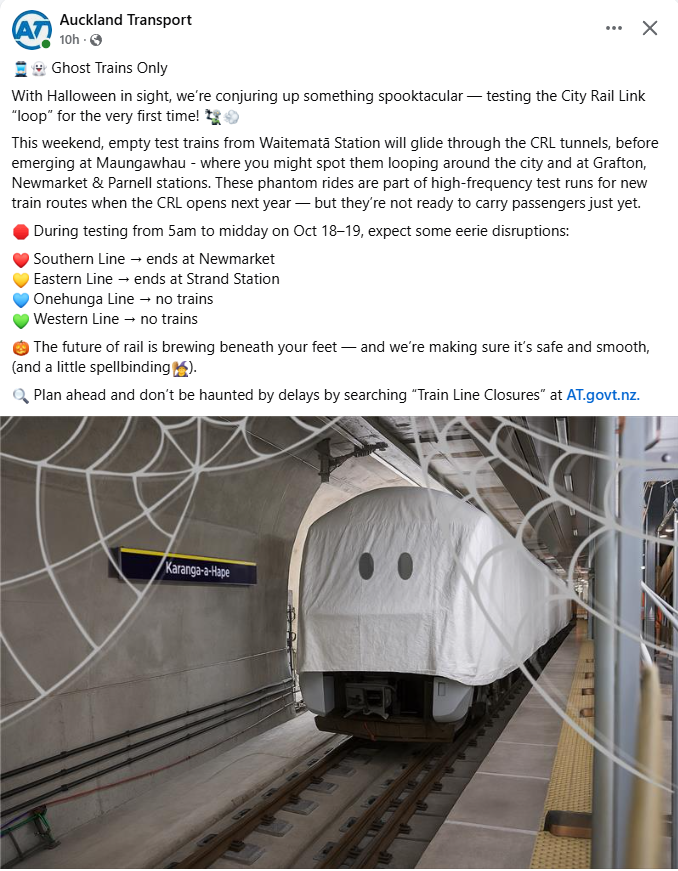
Note that trains will be impacted this weekend due to CRL testing. A week early for Halloween, but nonetheless pretty cute messaging from Auckland Transport:
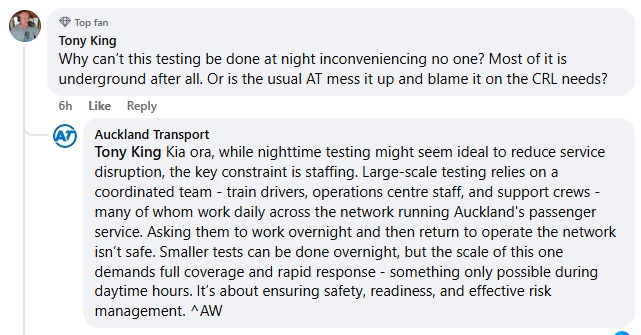
And, if you’re wondering why they can’t do this testing at night:
Rail connections to Northport
Northport recently got approval to expand their wharf – but if it’s to go ahead, it needs a rail connection.
The reverberations from a hard-fought Environment Court ruling to allow Northport to extend its docks into Whangārei harbour’s mouth could rumble up to the Bay of Islands, and down through suburban Auckland to Ōtāhuhu and beyond.
Rail Minister Winston Peters says he’s preparing to seek the Cabinet’s approval to build a 19km rail spur out to Northport at Marsden Point. And in the same pack on his desk, from KiwiRail, is an accompanying business case to reopen the main trunk link north to Otiria, near Moerewa in the Bay of Islands.
At the same time, Peters and KiwiRail say Auckland’s existing railway lines will become much more busy with frequent City Rail Link commuter trains; the existing network ultimately won’t have capacity for significantly intensified freight movements as well.
KiwiRail argues the forecast increase in freight trains may also require the construction of a new inland port to serve the expanding industries of north-west Auckland, and definitely its long-sought $10 billion-plus line from Avondale down through suburban Onehunga to Westfield Junction.
…..
He says the Northport expansion goes hand-in-hand with KiwiRail’s four-year project to build a rail spur from the main trunk line out to Marsden Point. The first phase of the container terminal extension, a 170-200m berth extension, could be built in as few as 18 months, for an estimated $70m – but there’s little point starting until they know the port will be connected by rail to the rest of the country.
Sampson argues the rail is “crucial”. While the port can handle other bulk cargoes, especially with an additional block of land behind it for storage, he says containerised imports will support growth and population in the Upper North Island, as well as being very important to the Auckland market.
One container ship might drop off 1000 to 2000 containers in one discharge – and importers want 80 percent of those in the Auckland market within 48 hours. “So rail’s really the opportunity, rather than putting 2000 trucks on the road.”
As for the Avondale to Southdown corridor:
By far the most vexed challenge is moving freight into, out of, and through the Auckland isthmus. The construction of the City Rail Link means all the lines through Newmarket and central Auckland will be required for passenger rail, almost all the time.
At present, says Dave Gordon, freight trains to and from Northland have to go through Newmarket in central Auckland, and even a smallish freight train takes up as much time and space on the rail schedule as two commuter trains.
…..
“We’re mainly looking at it through that lens, as another commuter loop,” Gordon says. “Until you get five to six trains per day each way between Auckland and Northland, you have enough capacity on those lines to not require Southdown-Avondale. And that’s quite a few trains. But the bigger driver will be the demand for passenger services as well. Both will play a role.”
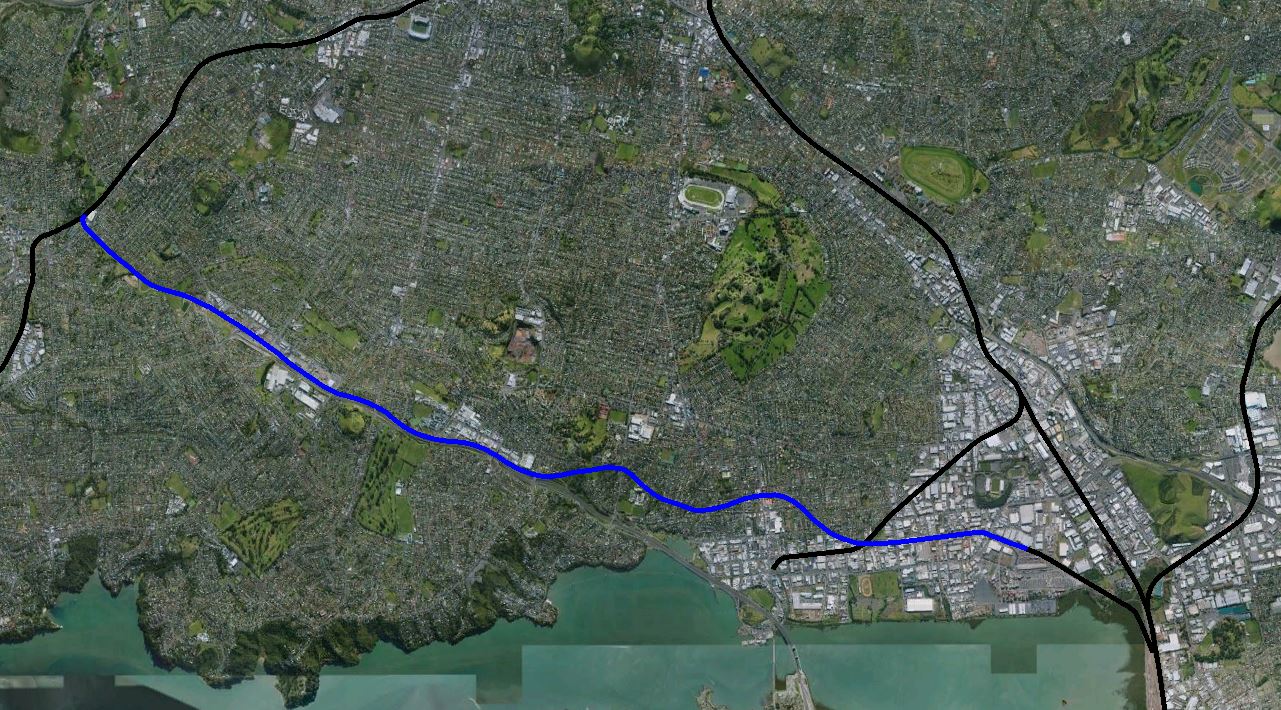
Building this as a “commuter loop” is likely to have little value, and this seems to be a case of KiwiRail trying to find a way to get someone to pay for it. Worse, by adding passenger-running services here, it will reduce capacity on the Western Line heading towards the City Rail Link.
AA calls for higher fines for driving offences
It’s good to see the NZ Automobile Association in the news advocating for changes in the fining system to improve road safety. Fines haven’t changed since 1999, so the value has been dramatically eaten away at by inflation in that time.
Interestingly, the AA is also pushing for changes to the type of penalty, depending on the offence. This is certainly something else that needs looking at.
“Our fines and penalties are well behind the times, and this is undermining road safety. The system needs a thorough review to make it relevant and effective at driving behaviour change,” he said.
“Most similar countries have tougher driving penalties than New Zealand and lower crash rates. Effective fines and penalties aren’t the whole solution, but they are an important part of it.”
He added that some offences also carry “sanctions which appear to be inconsistent with the potential harm they could cause”, such as an unregistered vehicle attracting a $200 fine and demerit points.
“Yet, other offences with vastly different safety implications are less severe – failing to stop at a red light and not wearing a seatbelt each incurs a $150 fine and no demerits.”
The government last year finally made some changes to parking fines, which also hadn’t been updated since 1999 – so hopefully they’ll catch up with updating these these ones too.
SH26A speed changes consultation
NZTA is currently consulting on some changes to Morrinsville Road just outside of Hamilton. This change is under the new Speed Rule instituted by Simeon Brown, and there looks to be a few hoops to jump through.
Note the “Cost Benefit Disclosure Statement outlining safety, travel time, and cost impacts”, now necessary to the government’s “balanced and targeted approach to speed limits” which puts economic impacts on the same level as safety.
If you’d like to have your say in the consultation you can do so here until Friday 28th November 2025.
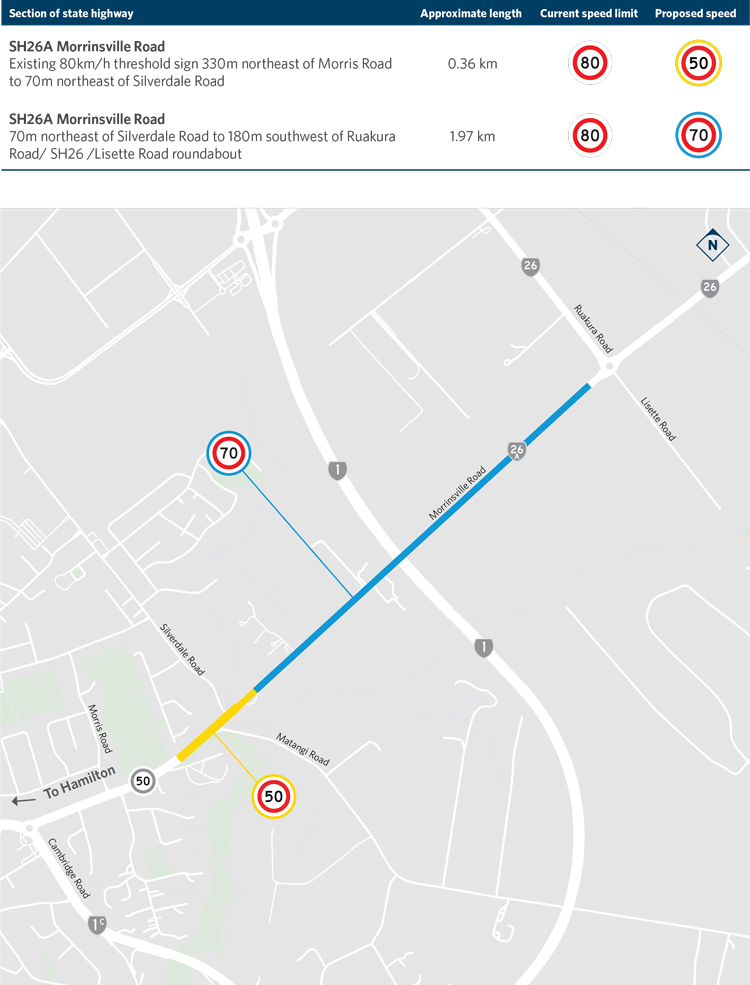
We propose lowering the speed limits as follows:
- From 80km/h to 50km/h from the existing 80km/h threshold sign which is 330m northeast of Morris Road to approximately 170m northeast of Silverdale Road.
- From 80km/h to 70km/h from approximately 170m northeast of Silverdale Road to approximately 100m southwest of Ruakura Road / SH26 / Lissette Road roundabout.
For the urban section where it is proposed to reduce the speed limit to 50km/h, the future roundabout will be visible from all approaches and so drivers will be able to adjust their speeds accordingly.
For the peri-urban length between the proposed new roundabout and Raukura roundabout heading towards Morrinsville, the proposed 70km/h speed limit is consistent with other similar local roads.
Speaking of speed limits…
A recent study from RMIT University looked at what switching from 50km/h to 30km/h speed limits meant in Melbourne. Lo and behold, here’s what they found (emphasis added):
Reducing residential speed limits from 50km/h to 30 km/h would protect cyclists from danger and make riding less stressful while not causing traffic delays for cars, according to new research.
Researchers from RMIT University rated traffic stress levels for every road in greater Melbourne and modelled the effect of lower speed limits on bicycle and car travel.
Reducing the speed limit to 30km/h across residential areas doubled the amount of bike travel on low-stress streets – creating a safer environment for children and less confident cyclists, said the study’s lead researcher, Dr Afshin Jafari.
“Slowing traffic makes bicycle riding less stressful, encouraging more people to choose bikes as a safe and viable mode of transport,” Jafari said.
Many existing cycle routes – narrow paths on 60km/h roads – were highly stressful for bicycle riders, which is one of the main reasons people choose not to ride, he said.
Our only question here in Aotearoa is: how long it will take to return to evidence in our speed limit policies…?
Could communal tables enable more social connection?
Can tables enable more than just private dining? Susanna Moreira writes on the role tables play in social connection.
Commensality often serves as a ritual for bonding, negotiation, and celebrating important events. In many Spanish-speaking cultures, the stretch of time after the meal when the entire family stays seated and talks is so present that there is a word for it: sobremesa — literally translated as “upon the table” (though in Spanish it more accurately means “dessert” or “after-meal conversation”). But, despite often being associated with sharing a meal, the table can be considered a flexible platform open to many possibilities for appropriation and interaction.
Whether it’s for putting together a family puzzle, for sharing a workspace with others, or for meetings, debates, and conversations, tables are capable of gathering groups and stimulating face-to-face interactions, strengthening bonds and meaningful exchanges. These are some of the reasons why communal tables, which aim to be a kind of invitation for a large group of people to gather, have been explored in temporary or permanent installations in public spaces around the world.
And there is of course, the sharing of food:
The Communal Barbecue (La Barbacoa Comunal) is an urban and landscape renewal project in the industrial area of Castell d’Aro on the Costa Brava. Inspired by the idea of collective meals as a social and revitalizing element for public spaces, the design features three key elements: a sculptural barbecue, a large zigzagging table seating up to 50 people, and the re-naturalization of the surrounding environment. This design actively encourages socialization and communal dining in a natural setting, offering flexibility and accessibility through empty spaces that adapt to various needs.
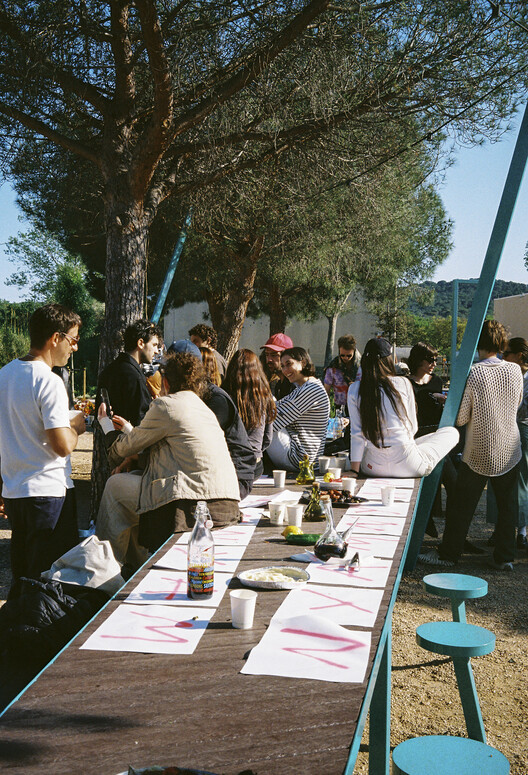 La Barbacoa Comunal (The Communal Barbecue) – Lluis Tudela
Māngere bus changes
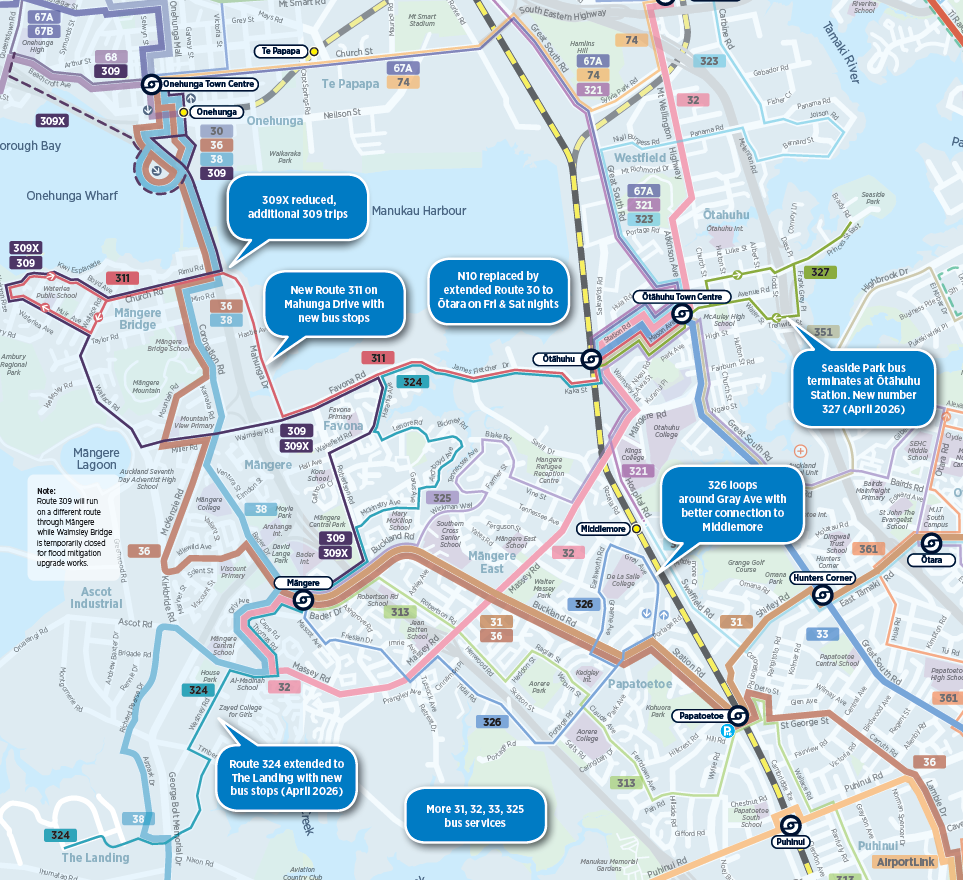
Last week Auckland Transport revealed a few changes coming to bus routes in Māngere. There’s a few more changes you can check out but here’s a noticeable one for the 309 route:
From 2 November 2025
Route 309X will be reduced to two morning and two afternoon trips on weekdays. These services will operate until the City Rail Link opens at which point they will be reviewed. These trips will depart:
- Māngere in the morning at: 6.55am & 7.33am. Arriving at Newmarket at approximately 7.35am & 8.18am. Arriving at the Civic at approximately 7.55am & 8.43am
- the city centre in the afternoon at: 4.57pm & 5.27pm. Arriving at Newmarket at approximately 5.10pm & 5.40pm. Arriving at Māngere town centre at approximately 6.12pm & 6.42pm
Route 309 will get more trips.
A new Route 311 will run between Māngere Bridge and Ōtāhuhu Station through Mahunga Drive. It runs from 5:15am to 11:45pm every 15 to 30 minutes.
A new route layout for Route 326 creates a better connection between Māngere and Middlemore. It will loop around Gray Avenue and sections of Portage Road where there aren’t any buses now. These streets will get new bus stops and pedestrian crossings. It will no longer travel on Māngere Road between Ōtāhuhu College and Ōtāhuhu town centre and train station but there are other options available nearby. It will now run until midnight.
We are making services more frequent on weekends and evenings on routes 31, 32, 33 and 325.
Interesting videos
View this post on Instagram
That’s it from us this week, enjoy your weekend!

 Processing...
Another comment by GA disdaining the value of Avondale Southdown as a passenger connection.
For the people in that area it would be vital as it links into the rail network which Mt Roskill does not have. All of the THAB zoning in Wesley will only succeed if something like this gets built.
The proposal has govt support, the land is there, its doable.
The operational plans can be worked on- sure a commuter loop may not be ideal, but can we please start looking at it as a positive instead of dismissing it.
Agree. It may not be ideal, but it’s not bad.
If the door opens, walk through it.
I’m with this.
Here the news item from January 2025 that came from 3news about the Line ;=
https://www.youtube.com/watch?v=MKG2R1ZhHBs
Remember Matt Lowrie lives in Swanson, hence “it will reduce capacity on the Western Line heading towards the City Rail Link” (only applies past Avondale).
I think it could balance the network nicely. Southern line could go to Swanson, eastern line to Mt Roskill. Not sure if it should be a loop, maybe terminate at Penrose. Would need to remove all level crossing between City and Avondale.
Sorry should terminate at Southdown
And when the spur to Northport is finally Built , it will become useful to avoid the Southern Line for the new Freight movements to/from the North .
But there are people in the Roskill area that are against it . Even though KR Own the Land/Route .
“But there are people in the Roskill area that are against it . Even though KR Own the Land/Route .” – and I’m sure in Onehunga where it goes through residential areas.
Also that designation may be better used for Light Rail.
I find it kind of ridiculous for anyone to be against rail when they have a literal motorway beside them. The noise change is negligible and all other negatives are nothing compared to the pollution from having SH20 beside them.
Onehunga are all lawyer-ed up and ready to fight. Even the local National MP is aganst it. But its on the fast-track list..
Onehunga being all lawyered up to fight it will just get some concessions/delays, and best case for them is moving part of the corridor. They’re not going to stop the project entirely, just add more cost/delays to it.
It’s also Onehunga, which lets be brutally honest, is not exactly the wealthiest or most politically well connected suburb, and it has already has motorway/rail lines cutting through, with plans for more of both. Pretty hard to argue against something that was planned and designated before all bar the oldest residents were born/moved there, and the last ones will have aged out in the next few years (or have moved).
And the other Suburb so I seen that is Lawyer-ed up is Mt Roskill as they also have the Nimbies there .
The route goes via the motorway in Mt Roskill, and only starts departing that at Hillsborough Rd. The motorway corridor already is essentially ready to lay tracks (I think they need to rebridge 2 places, Dom Rd and Hillsborough, but the rest already have the bridges in place). The area that winds through Onehunga is the main issue for neighbours – with KR needing to take more land than their existing corridor in parts (as I don’t think it’s wide enough for 2 tracks everywhere as well as retaining walls) and a bunch of road closures/separations. But the gov does a lot more disruption for a lot less, so don’t see it’ll be an issue.
Remember they bulldozed SH20 through entire suburbs in the last 20 years, and AT has just bulldozed an enormous number of homes for the Eastern Busway. It’s the price of progress.
Land wise they’ll compulsorily acquire anything needed (although if you look at the KR map they’ve got essentially everything already – https://gis.kiwirail.co.nz/maps/?viewer=kiwirailpropertyview), and bypass consenting with Fast track or equivalent, so there won’t be a lot of room for them to appeal. Votes wise, they’ll gain more than the few they lose.
How will they negotiate the heritage protected buildings on Selwyn St that sit on KR land?
The hurdle for ASL isn’t the designation, it’s the use case. Freight from north of Auckland will still be heavily constrained by capacity constraints between Avondale & Henderson.
Jezza ;- The way the Freight movements are operating right all are running outside the main Commuter times , train120 going North goes through , right now at Kingsland around 5am and train 129 hits Kingsland at around 10.30pm .
So any freight movements should not have any effects on Passenger services unless Northport gets their spur . and that’s if they decide not to run at Night .
David L – then why would you bother building ASL? If they’re operating at night they can just go through Newmarket.
This. With appropriate redesign of Avondale station (which needs it anyway when they shut St Judes) it can be a cross platform transfer, with no capacity taken from the Western Line if the Avondale-Southdown terminates there. It’s great for freight, great for passenger rail.
Avondale should be O.K as the ASL starts at Pak’n’Save and if you look at their building it has different shape to it compared to their other stores . To allow for the line to come off the NAL/Western line .
Yep, the connection to the Western Line is all good (KR has even built their new footbridge to handle it). But I don’t see them adding a station between Avondale/Mt Albert directly at the connection point to interchange, and the way the tracks face Avondale will have to be the interchange point.
Avondale needs a rebuild anyway due to the mess of St Judes crossing needing to be closed, and whatever they end up doing there will likely be used as part of the station.
Avondale – Southdown shouldn’t have direct service to the city/New Lynn etc. and instead terminate at the Western Line, but it’ll need an extra platform at Avondale and a few hundred metres of extra track from the junction to that.
Otherwise it’d take away from frequency on the Western Line, but that isn’t the end of the world, as the Western Line will have more capacity from Avondale – CBD than there is for it in the CRL tunnels.
That said, it’s more of an operational decision. As long as KR/AT build the platforms/tracks in a way that can handle everything (rather than skipping the platforms like they did at Mt Eden) they can change it to what they think is best at the time.
Ideally the tracks through Chalmers, St Jude St, Avondale Station and under the Blockhouse Bay Rd bridge would all be lower. Triple tracking to allow for freight movements would also be required. So another platform and transfers at Avondale could be done. It is probably also necessary, so that construction can be staged to keep the lines open. It will be a massive project, and very disruptive to the area.
The tracks have already been lowered under the Blockhouse Bay Rd bridge, so while there is a spare southern portal, I don’t think the foundation that was poured there during the lowering will allow for it to be used.
And here was Chalmers Street crossing Firday Morning ;-
https://www.youtube.com/watch?v=w84s9bIhVSY
One of the biggest complaints I hear from non-PT users is that PT “doesn’t go where I need to go”. Often that seems to be code for “I travel cross-town and there are only slow buses cross-town”.
Adding the Avondale-Southdown link offers the potential to make Auckland’s rail network much more of a real network. I believe it’s an essential link for passengers in the long term, and I think that to dismiss it is very short-term thinking.
“A new Route 311 will run between Māngere Bridge and Ōtāhuhu Station through Mahunga Drive. It runs from 5:15am to 11:45pm every 15 to 30 minutes.” – Neat, that doubles the bus frequency past work. I had noticed the work on stops and refuges on Mahunga Dr this week.
A on Monday this happened at the New Lynn Station , where a bus avoided someting and crashed into the Station Building ;-
https://www.youtube.com/watch?v=NLX_5Z6gbfs
And wth the Testing through the CRL this weekend , those that want to see it at Mt Eden the Test trains are doing the Full loop , but for those there is still the testing coming into Waitamata [Britomart] as when I was here 2weeks ago I caught when coming down the escalator ;-
https://www.youtube.com/watch?v=eutJFAFY9Q0
And then there was this at Matiatia , Waiheke Island , with a Woman in Her SUV going to pick up her Husband , and ending up in the Harbour by driving the Wrong way around the Keyhole where only Buses and emergancy vehicles are allowed ;-
https://www.youtube.com/watch?v=rc35_VFacXc
What really surprises me here is the car’s speed. I understand going into a bus-only lane because you are unfamiliar with the area or just lazy, but blasting through like that when coming to an obvious dead end?!
I should also have added She also was over the limit so everything that happened will make Her pension go straight to the Council for the repairs and hauling Her car out of the Water and Her insurer would have said no to Her claim .
I have heard She hit the Gas not the Brake .
It must be acceptable to put your arse on a table in Spain.
Ha Ha .I
t also could be the only way all those people can read their Phones possibly .
That ‘How Did The World Get So Ugly?’ video is terrible.
It’s as silly as asking “why was everyone in Jane Austen’s time rich?” – we ignore and fail to preserve ordinary things, and only bother to keep and focus on extraordinary things.
Comparing all of today’s things with only the enduring things from yesteryear has a name: survivorship bias.
Partially yes of course. But the main point of the video is also true. It is not considered valuable anymore to give new things an even somewhat dignified appearance. Go walk through through Ponsonby or Grey Lynn, and even though those old villas were hardly posh high end housing, someone still cared about their appearance. Those decorations were perhaps cheap tacky mass produced stuff, but someone still made it so that they are there. This is something we don’t really do anymore.
And yeah this is a big deal. Imagine how much more difficult it would be to pull off BS like this character overlay in central Auckland, if people wouldn’t intuitively expect that any new buildings will be god awfully ugly compared to what we build 100 years ago.
As an other example, what is the deal with tourists going to Bruges, Belgium? Did someone go out of their way to build a fancy city centre back in the day? No. This was just how people built stuff back then. (it also helps if there are no earthquakes.) Once upon a time Bruges was a busy sea port on a sea arm. But that sea arm silted up around 1500 and Bruges went into steep decline for a few centuries. There was no point in building new stuff. So much of the medieval city centre is still standing.
The twee heritage thing comes at a cost. Places like Bruges and Florence had lots of money to build expensive stuff and then they went into economic decline for a long long time. They are hardly an example any city would want to follow. Very few people visit Rotterdam but it is a very prosperous city. They had no choice but to build a modern city after both sides bombed the place in WWII.
“…If Auckland had gone further during those early pandemic years on rapidly enabling bike infrastructure, instead of dragging its feet… how many more people would be currently enjoying the benefits of being able to choose to get places on wheels?…”
and
“…Our only question here in Aotearoa is: how long it will take to return to evidence in our speed limit policies…?”
These are not just great questions, but the fundimental reason why Auckland will still be congested, crawling and muddling along in 20y time.
Please GreaterAuckland Transport Blog – do some reporting on mobility metrics – how mobile are we. Clear stats that support connectivity, mobility and benchmark us against our peers is needed.
We seem to have missed the eBike revolution to a large extent, and faster cars around schools means less walking and cycling, so more cars queues, without respite.
Well we can’t build bike lanes because Where Will People Park Their Cars.
Also known as oh no I will actually have to park my car on my driveway. How inconvenient.
And during that pandemic, people may not have needed to drive, but they still needed to park those cars. If there is a choice between on street parking and bike lanes, on street parking wins every time.
But otherwise. There’s people living on a few blocks of Hobson Street with a local density of 1,000 people per hectare. They could have used two of those lanes to give those people some breathing space during the lockdown. Especially since who is going to use all those car lanes during those lockdowns. But no. Most of those apartments were designed to warehouse students (as is quite obvious from some of those building names), but some of them are (or perhaps, used to be) home to families. Imagine sitting there with your kid, in your small apartment, and outside are 5 empty lanes reserved for cars. And two parking lanes. No wonder people ran for the suburbs.
This sort of thing is why following overseas urbanist channels is so weird. None of it actually works or makes sense over here.
Plenty of places in Auckland are built with rain gardens, separated bike lanes, transit lanes etc. – very easy to focus on what could have been done, but they’re doing great stuff as well. I live in Pt Chev, they’ve just rebuilt our main road to have a bus lane (technically T3), with bike lanes etc. and they’re going to expand it to the next suburb soon. Further out you can see most new developments are being built with various positive infra.
Papatoetoe and Otara have “similar demographics”. Really??
On the 2nd August an AT EMU AM144 was taken down to Wellington but only made it to Hamilton after an axle fault , but while sitting at Te Rapa yards this happened to it after 2days . and it was then brought back to Wiri to be repaired and clean and now is Wellington to finally to get a repaint ;-
https://www.youtube.com/watch?v=-yVvB_gfGSw
And on the Weekend of the 5th – 6th October Helensville celebrated 150yrs of Rail to it ,KR brought a Freight Train to it , but no passenger Carriages which would have made it perfect .
But there have been mentioned in a number of news items about GVR doing a service on that section of the western Line/NAL ;-
https://www.scoop.co.nz/stories/AK2504/S00477/kiwirail-collusion-with-at-to-block-community-access-to-the-railway-north-of-swanson.htm
And what KR showed that weekend ;-
https://www.youtube.com/watch?v=-5fryWvZ2Jc
And this at Pukekohe on a Sunday Evening 24th August with 5 different Passenger trains ;-
https://www.youtube.com/watch?v=7YE87mymFDs
2 new frequent routes coming to South Auckland next year. 37 between Highbrook and Manurewa and 39 (currently 361 but being made frequent). A few other minor improvements also happening (including the introduction of 364).
https://at.govt.nz/projects-initiatives/south-auckland-projects-and-initiatives/bus-changes-in-south-auckland
These are good too and some due to new housing areas but also the failed “AT Local” taxi service.
Nice to see those Mangere bus changes, just got my head around them.
Trains on the western line have reopened with minor delays after a vehicle and train crashed at Avondale this morning.
A roadworker, who wished to stay anonymous, watched the car drive around the barrier arms as the bells sounded and lights flashed.
https://www.nzherald.co.nz/nz/auckland/trains-on-auckland-western-line-cancelled-after-emergency-incident/EFZPOMHJSBBUXJ25INTG6UM6W4/
Influencers’ ‘worst’ Auckland train ride: AT defends delays for ‘once-in-a-generation’ upgrade works
And now we have this Twat who thinks he is an influencer Complaining about the Cost of a Train journey in in Auckland by paying with his debit/credit card instead of using a Hop Card which they could have bought at the Airport $10.00 for a $7.65 fare and then showing an app on his phone showing the wrong He was using with cancellations that He wasn’t using . And blaming AT for the works that are happening not Kiwi Rail .
Idiots like these need to get their facts right before going live .
https://www.nzherald.co.nz/lifestyle/influencers-worst-auckland-train-ride-at-defends-delays-for-once-in-a-generation-upgrade-works/XMDNBGXK7VAINIAAK243O5YUDA/
You’ll move to Australia if we reduce the speed limit?
Please go now, as you’re obviously a child who shouldn’t be allowed to drive. You’re Mount Colon in drag aren’t you?
If you feel emasculated by having to drive in a manner that considers the safety of all road users may I suggest you try Viagra, it’s cheaper than a Ford Planet Ra*er.
And your specious claims about “democracy in action” have been repeatedly debunked here.
Does it feel good being Simian Brow’s hand puppet?
AA calls for higher fines for driving offences.
The fines should be income based.