We now have our first glimpse of the shape of the new council following the local body election on Saturday. The results emerge in three stages: “progress results” landed on Saturday afternoon, and “preliminary results” on Monday afternoon, with special votes (and thus the final outcomes) to come on Friday.
We aim to dig into the results in more detail, but a few initial takes for now…
Completely unsurprisingly, Wayne Brown easily regained the mayoralty, with over 50% of the vote. Interestingly, this is actually the first election since Auckland was amalgamated in which a candidate has received over 50% of the vote. The previous highest result was Len Brown in 2010, with just over 49%.
This election set another record too, and not a good one. The general downward trend in voter turnout continued to a new low, with fewer than 29% of eligible voters actually voting as of Monday’s results. With special votes are still to be counted, that number may go up a little. At the last election, there were around 7,000 special votes in Auckland – so a similar number again would bring turnout up to just over 29%. That’s still low compared to previous years, as this chart shows.
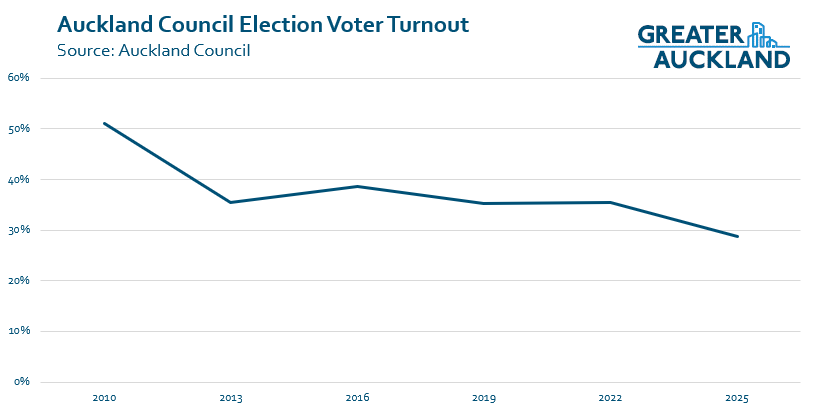
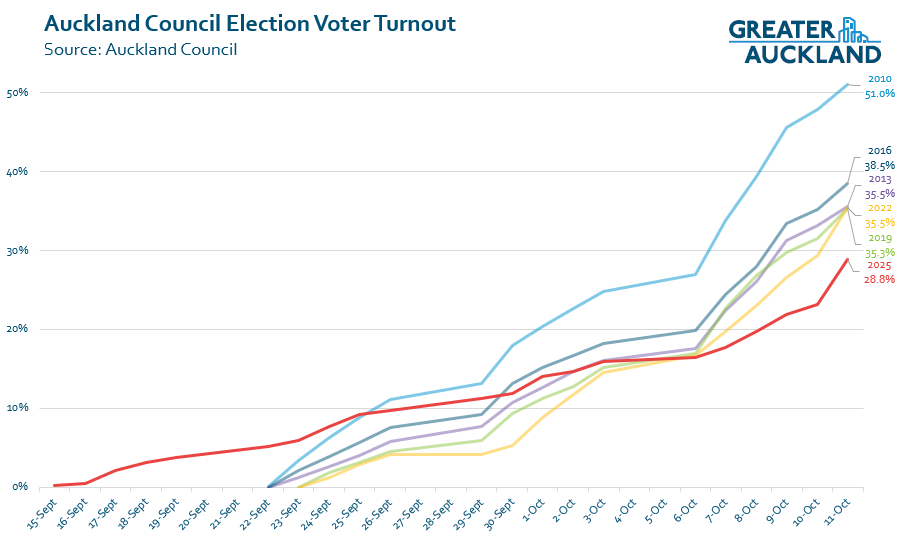
Moreover, voting numbers were down despite the voting period being extended this year. The red line on the chart below shows 2025, with an extra week of voting time compared to previous elections. Note too that 2010, the first Supercity election, had the highest turnout at 51%.
Why the low turn-out? No doubt there will be lots of post-mortems. Was it a case of people putting their voting forms in the “I’ll deal with that later” pile, and then forgetting? Or was it (more likely) related to this seeming to be a particularly boring election? With Wayne Brown seemingly a shoo-in, there was no high-profile ‘horse-race’ at the top. That said, several ward races were of key interest, as noted by Hayden Donnell for the Spinoff.
With a few good exceptions, it was also notable how little media attention this election had – in particular from the nominal paper of record, the NZ Herald. We understand that the Herald’s council-beat reporter, Bernard Orsman, was even on leave during the election period.
Whatever you think of the election outcome, that the question of who will (and who should) govern the country’s biggest and most important city isn’t considered important enough to cover in depth feels like a massive indictment of both the state of the media, and public attitudes towards our democracy.
By contrast, Wellington’s elections drew a lot more media attention, thanks to the Ray Chung scandal, and the ongoing attempts to foment opposition to things like cycleways. Paradoxically, this seems to have resulted in both the highest turnout since 2016 – and also in more people being elected who support things like cycleways. It’s also plausible that the STV approach to vote-counting is a stronger motivator, and something to be considered here.
Back to Tāmaki Makaurau: around our council table there will be five new faces, thanks to retirements and one sitting councillor losing their seat. As the Herald reported yesterday, from the Mayor’s perspective:
Brown said that apart from Victoria Short, who stood on his Fix Auckland ticket, and John Gillon (North Shore), he barely knew the three other new faces, Matt Winiata (Manurewa-Papakura), Bo Burns (Howick), and Sarah Paterson-Hamlin (Whau).
He plans to meet each one of them over the coming days and thinks the new council is a “little bit better” than last term.
By this, he meant he was pleased to see Short unseat one of the long-standing “Albanians”, Wayne Walker, and welcomed the defeat of two-time mayoral candidate and “keyboard warrior” Craig Lord, who lost to Paterson-Hamlin in Whau. As for Gillon, he said he plans to work with him, despite finding him “a bit negative”.
We don’t yet know how these new councillors will perform; but at first glance, the Mayor is probably right that he’ll have a little bit of an easier time getting policy delivered.
Of the new councillors, Sarah Paterson-Hamlin becomes the fifth person to represent Whau, with the seat changing hands almost every election
Coming back to the issue of media coverage, one sitting councillor who did get a lot of air-time in the last few months was Christine Fletcher, largely for her comments about housing policy. While she was re-elected, it was arguably the worst result of her six elections. As with Wellington, perhaps the lesson is that being constantly negative isn’t as appealing to voters.
Alf Filipaina also joins Fletcher in being elected six times, and they are the only two councillors who have been around the table continuously since amalgamation in 2010. Other long-serving councillors include John Watson and Mike Lee, who have each been elected five times (Lee returned in 2022 after losing his seat, promising one more term), and four who are now starting their fourth terms: Daniel Newman, Desley Simpson, Greg Sayers and Richard Hills.
In the coming weeks and months, we’ll learn what roles Wayne Brown gives each of these councillors, such as which committees they’re on – but at least one is already confirmed
There’s also what Brown called a coronation later this month, when councillors get sworn in at the Auckland Town Hall, and the “bollocks of setting up committees”, giving little away on that front other than “Richard Hills will still run planning because he does such a good job”.
A note from Patrick Reynolds
In my run for Councillor of Waitematā & Gulf, sadly I was not able to get ahead of veteran campaigner Mike Lee, and Friday’s special votes are unlikely to change this.
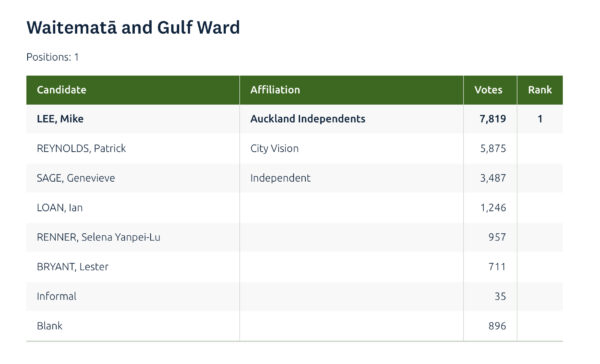
Preliminary results for the Council seat of Waitematā & Gulf ward as of Monday 13 October (special votes yet to come)
However, otherwise it was a great night for City Vision and its progressive kaupapa. City Vision runs council candidates in two wards – Waitematā & Gulf and Albert-Eden-Puketāpapa, where Julie Fairey was returned as Councillor, and now with more votes than the other returned incumbent, Christine Fletcher, whose usually massive majority was significantly lowered. CV also runs candidates in three local boards under those two wards. Of the three, City Vision looks set to control two: dominating the Waitematā Local Board 5-2, and a 5-3 majority in Albert-Eden. Whereas Puketāpapa Local Board currently has two City Vision candidates to four C&R; but if one more makes it through, which is possible, that’ll be a huge improvement on the last time across the board.
Local elections are of course not formal referenda on single issues; it is much more complex than that, especially with low engagement and media disinterest. However, there are still some interesting conclusions that can be drawn.
As with Wellington, where election issues received a great deal of coverage, no matter how vigorously the media platformed angry opponents of changes like safe streets and cycleways, the result was that proponents of progress did better in the election.
Wellington now has an even bigger Labour/Green majority around the council table. And up here, both City Vision local board teams have significantly improved their positions, a positive outcome for a large swathe of the isthmus (with further progressive wins in adjacent areas like Whau.)
In other words, despite a barrage of headlines over recent years, and relentless attempts at derailment (including by the re-elected councillor for Waitematā & Gulf), it seems that multi-modal street upgrades like Pt Chev, Meola Road, Great North Road, the Inner West links, Project K, and Victoria St, not to mention the so-called ‘destruction’ of the city centre via CRL works and Quay St, Queen St, Te Ha Noa, and Te Komititanga… are not all that “controversial” after all… and in fact may be popular?
The Waitematā & Gulf councillor vote is also pretty stark on another defining issue: you have to get all the way down to the fourth-placed candidate to find the first one who ran on a “low rates/ low services” platform. Clearly, as a policy plank, this is completely unpopular in Waitematā & Gulf, getting only about 10% of the votes at best (if you combine Loan and Bryant’s share).
It’s reassuring to know that voters value local services and understand they have to be funded somehow.
In terms of my result, I am of course extremely disappointed personally and for the city. I want to thank my fantastic team and supporters – we gave it our best shot. I will continue to work for the city I love and have so much faith in, in other roles.
– Patrick
Editorial post-script
Further to Patrick’s point about the popularity of supposedly “controversial” projects – it’s striking that, compared to 2022, City Vision not only held onto the Ōwairaka division of Albert-Eden, they extended their lead compared to last time.
This voting area is of course home to the Pt Chev/ Meola Road project, which was the subject of a significant number of headline-grabbing stories (as well as a successful Media Council complaint):
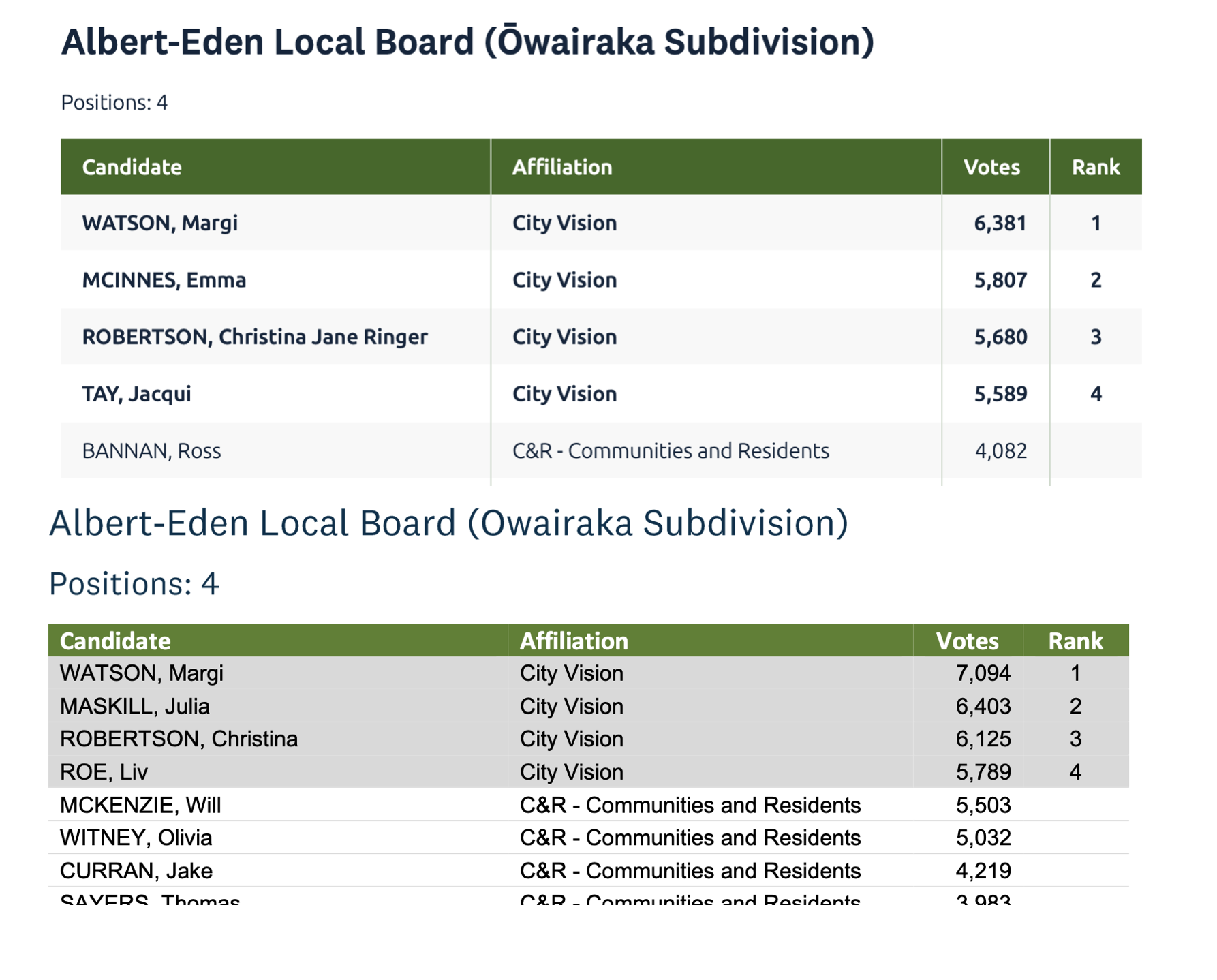 Albert-Eden Local Board (Ōwairaka division): preliminary 2025 results (top) and 2022 final results (bottom) show that City Vision not only retained seats, but widened the gap.
And, in the Maungawhau division of the same Local Board area, where the headlines have been more about housing, City Vision looks to have gained a seat (pending special votes) as well as closing the gap:
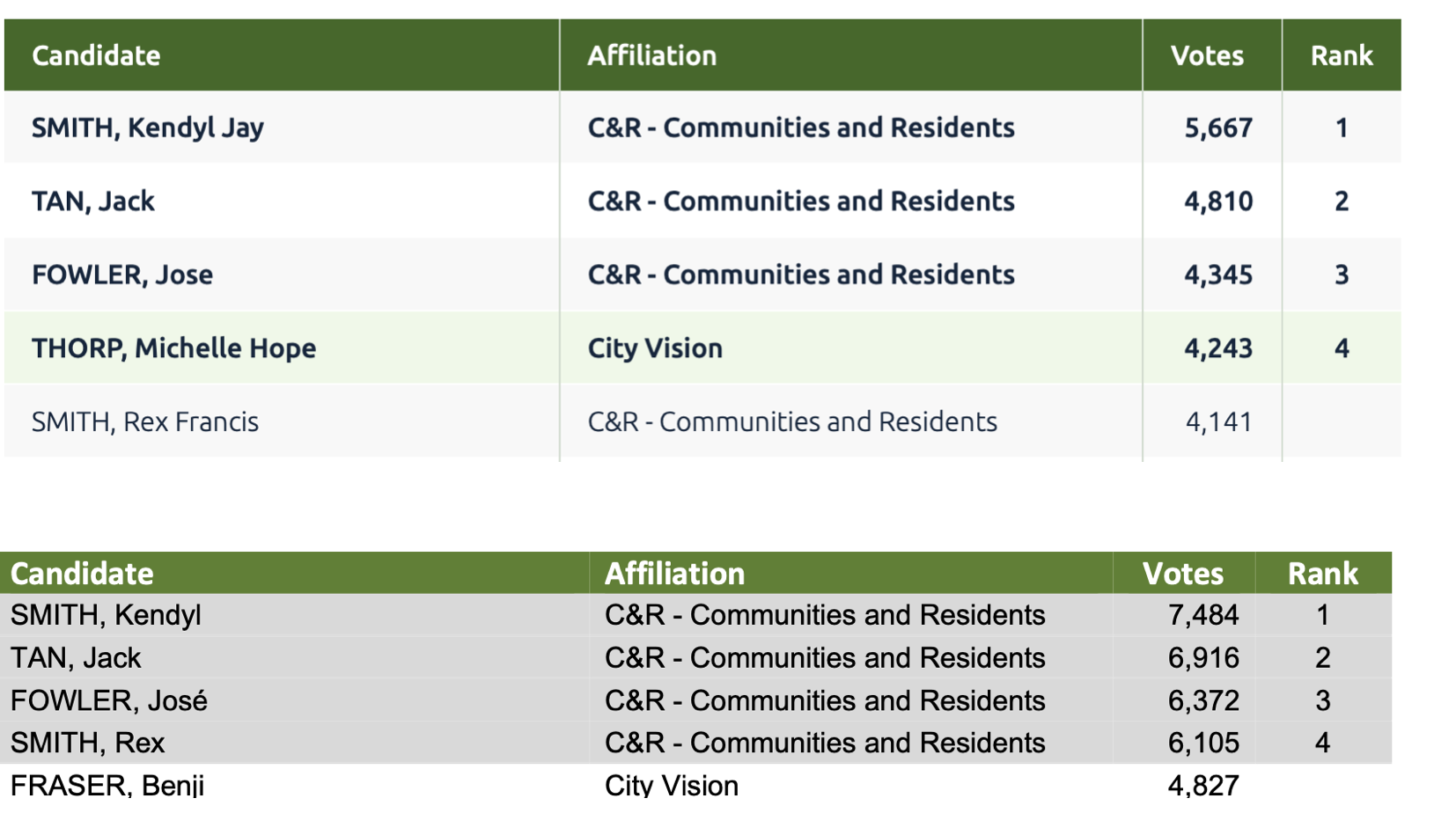 Albert-Eden Local Board (Maungawhau division): preliminary 2025 results (top) and 2022 final results (bottom) show City Vision potentially gaining a seat while also closing the gap.
Similarly, take a look at the results for Waitematā Local Board, in whose rohe sit a number of other headline-grabbing projects like K Rd, Queen St, Quay St, Victoria St (Te Ha Noa), Project K, Great North Rd, Westmere streets, and half of Meola Rd, and the almost-complete CRL works. Here, City Vision secured a clear majority of seats, with the two incumbent C&R candidates that were returned dropping way down the list. An especially impressive performance by three new City Vision candidates Wilson, Elliott, and Kennedy:
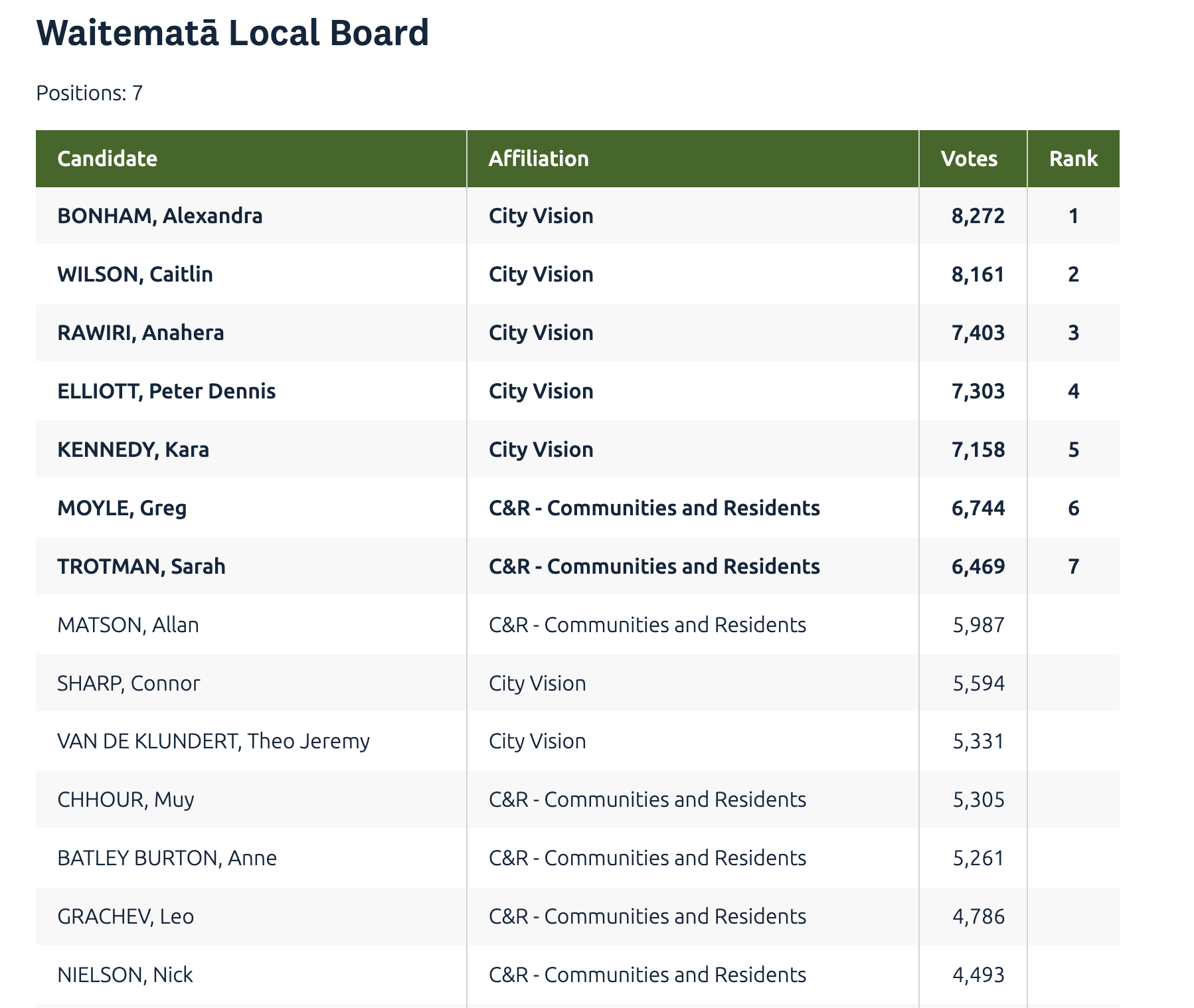 Preliminary results for Waitematā Local Board 2025, showing City Vision gaining five seats at the top of the slate, with two C&R candidates next.
Connor, whose advocacy was so instrumental in securing a better outcome for Project K, did well but alas did not quite make the cut.
And below are the preliminary numbers for Puketāpapa Local Board, to round out Patrick’s report above. If the special votes were to lift one more City Vision candidate above the line, this board would be equally split. When this situation has occurred before on even-numbered boards (e.g. Albert-Eden), the two “parties” have agreed to take turns holding the chair across the term… leading to interesting outcomes when the chair exercises their casting vote.
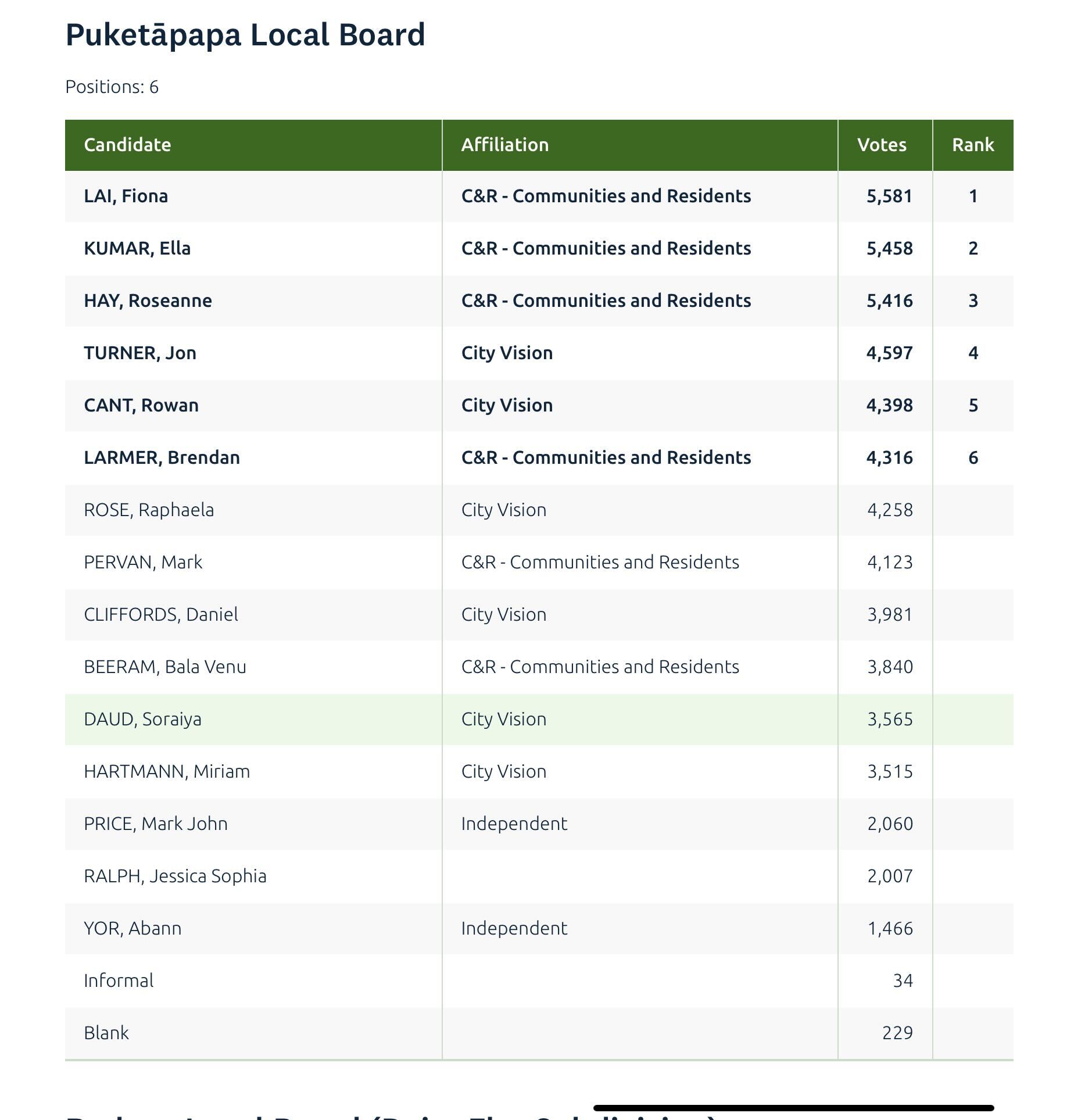 Preliminary results for Puketāpapa Local Board 2025, showing City Vision with two seats (same as last time), but with special votes yet to come.
Regardless of the results, kudos and our thanks to everyone who ran and raised the quality of conversations about what our city is, and what it can be.
In future posts, we’ll take a closer look at other outcomes, and reflect more on what this all means for the next few years. In the meantime, we’re very keen to hear your thoughts on what you see in the results from across the city. Lots to discuss!
This post, like all our work, is brought to you by the Greater Auckland crew and made possible by generous donations from our readers and fans. If you’d like to support our work, you can join our circle of supporters here, or support us on Substack.

 Processing...
I’ve seen no comment about the fact that I didn’t even know Genevieve Sage was standing in Waitematā. Whose idea was it to split the Non-Waiheke Sea Goblin vote?
Thought the same thing (maybe not the Sea Goblin part…).
It was entirely her idea, she announced after I was selected for CV and was public. It’s on her. Though of course we’ll never know how many of those votes may have come to me.
Same with the rest of the randoms, though as i say above Loan and Bryant’s supporters were unlikely to go to any of the three top contenders, as they seemed to be strictly far right fiscal conservatives, which none of Lee, me, or Sage are. Though Lee being all things to all people, of course.
The high number of blank suggests plenty dissatisfied with any option, though what they are looking for is very hard to discern.
Perhaps many of these just felt they had too little information to tell. Which is fair, especially with the Herald’s omertà on the whole business.
We need ranked-choice voting/STV in Auckland. Not only this, but you’ve got the ridiculous situation of many community boards (or wards thereof) which are one-party states. The “block vote” (4 votes for 4 councillors) is LESS democratic than FPTP because you can get a one-party state on about 30% of the vote.
It did not occur to me I could return mine blank, damn, wish I did that in hindsight. The candidates for Maungakiekie-Tāmaki Ward all appeared equally junk to me on the issues I think matter so felt it was irrelevant to those issues who got it.
Good point, and I really hope Patrick runs again next time. If there was no vote splitting he would have sailed in. Next time, with greater name recognition and hopefully without Gen Sage standing he should win (plus by then surely to God Mike Lee will have retired)
Yes I was sad Patrick Reynolds didn’t beat the Mike Lee dinosaur but that’s local politics for you. Try again next time I think you would get in it was a pretty good result still.
re comments about media cover in Auckland- how many local news outlets are left, either dead-tree or on-line and how much did they do for their local races?
AFAIK the main ones are:
The Eastern Times (which is owned by one of the Ward candidates Bo Burns who won…)
Waiheke has a decent amount of local media
Local Matters is around up in Rodney and Albany etc
I know theres a few local democracy reporters? Think they cover a bit more South Auckland though
Might be a lot I don’t know about though
There used to be 50 local newspapers in Auckland. Now there’s barely 4 or 5 shells. Not surprising there’s no stories on local candidates. Waiheke always being the weird exception to the rule of course.
There is the Devonport Flagstaff and Rangitoto Observer, both of which are against new housing. The Eastern Times is very pro-National and insular.
Poorer suburbs now don’t have free papers. The remaining free papers are published in high-income areas. The Eastern Times (Howick) is very dependent on columns by local MPs and councillors for content.
Its amazing how spread the votes are. I would have expected the top 5-6 in each ward to get 80% of the votes, but if you look at Puketapapa (for example), there is only 2000 votes between 1st and 12th. Similar in other wards, above.
From what I’ve gathered after campaigning is beyond the core base of voters (ie people who usually always vote City Vision, C&R, or X ticket), a lot of people will actually take it candidate by candidate, regardless of political leanings, and this is why you get quite big jumps.
So for example in the Waitematā Local Board, I don’t think I highlighted my ‘niche’ properly so to speak – so folks might of preferred other people (ie independents) even if they voted for others on the City Vision ticket.
There are of course a ton of factors that go into it but that’s one of my initial reflections
So does Wellington have STV and the others don’t?
I always thought STV made the Oz elections more interesting. That and compulsory voting (Federal).
New Plymouth where I live has STV and I believe Dunedin does as well.
Council will undoubtedly write a report for Councillors about the election, with recommendations. But will STV, and other electoral changes that would lead to fairer representation, feature? Will better behaviour from politicians, with the aim of restoring public trust, feature? Will actually delivering on policy for a better city feature?
Unlikely. The last report put our low voter turnout down to not having a Danish-style culture of treating voting as a civic duty. I suppose it’s not in Aucklanders’ DNA? FFS.
If you’re reading, Democracy Services, please do better this time. Perhaps ask the academics and groups like Makeit16 for their insights. if you can’t think of individual decisions Council made that disenfranchised people, I have a long list.
One example close to home: that box-ticking exercise Council did on the Significance and Engagement Policy. Where everything of real relevance was dismissed as potentially too complex.
Last time council voted on voting method only two of us (me and Darby) were keen on STV. It had been a long time since there had been a proper look at STV for Auckland. So we managed to wrangle a look at it from the Joint Governance Working Party (which I chaired) which should result in a better dicussion this time. Great idea about getting more folks from civic society to come talk to it as well. Given the v low turnout several things need to change and this could be seen as one of them.
I don’t think STV would make a blind bit of difference to turnout, however it is something Auckland should do to ensure votes are not split.
Based on voting habits witnessed in this election, the following would be no-brainers:
– Provision of voting booths on the last voting day (possibly last week of voting).
– Doing away with postal voting.
15 local or regional councils use STV.
Cities: Hamilton, Palmerston North, Porirua, Wellington, Nelson & Dunedin
Districts: Far North, Whangarei, Gisborne, Ruapehu, New Plymouth, Kapiti Coast & Marlborough
Regions: Wellington & Otago
I’ve said it before (and will continue to whinge about it petulantly for the next couple of years) but this low low voters turn out proves again how ridiculous it is to claim that they are destroying Auckland Transport because it was important to bring day to day transport controls decision-making back to democratic control. What utter nonsense to suggest that if local boards control where the paid parking is installed that people will vote the local board or council out if the public disagrees with the individual decisions.
They won’t even vote for the big issues they are going to strategically vote to exercise their democratic power over where bus lanes and cycle lanes are installed.
Face it AT has been the most successful, productive, efficient, prolific and expert lead road controlling authority the country has ever had. It hasn’t been perfect and should had been a bold as it was set up to be but it was vastly more effective than any council lead road controlling authority.
Your good points are lost amidst some not-so-good ones.
One thing that contributes to citizen disengagement is bureaucratic dismantling of democratic process.
We’ve had plenty of that from both AC and AT.
Judging by turnout across the country, civic disengagement is not limited to Auckland
This is true, although in Wellington there was a pretty high turnout (48% but still…), and the City Council probably got the most media coverage out of any election (not always for the best reasons tbh)
There isn’t one silver bullet for increasing engagement, but broadly speaking imo two things it really needs are:
Electoral system changes
Funded and engaging local media (including social media)
Transport is the #1 issue in Auckland, yet there was no democratic control over it. Therefore you cant be surprised that Aucklanders adopted a “why bother voting” mentality as nothing could change.
Contrary to you I think it is disgusting that more than 50% of rates money was being given to unelected bureaucrats to spend.
Good article, thank you.
There’s definitely a lesson in these results about delivery of change. (As if we needed yet another lesson… Sigh.)
Orsman’s campaign of misinformation to undermine the inner west streetscape projects did not convince the public in those local board areas. If anything, his work showed up which politicians were worth voting for. The political grouping that supported those streetscapes, City Vision, were rewarded.
OIAs show politicians and bureaucrats actually treated Orsman’s toxic drivel as if it represented the public. It did not. Changing course in response to his campaign – pausing, delaying, reviewing, and diluting those streetscapes projects, was undemocratic.
It was also unprofessional and unethical.
And more drivel today in the Herald from Tom Dillane (the new Orsman) moaning about how terrible the central city is. FFS this is the third big article in the last week, prompted by Heart of the City’s “survey” of business owners complaining about everything. Seems they actually want to terrify the elderly readers into driving to the mall instead.
Mike Lee is quoted today as saying he’s going to keep fighting to bring back the old Queen St. He reckons Marbecks is closing because you can’t get a carpark (obviously nothing to do with the demise of CDs). Ditto Smith & Caughey (nothing to do with the demise of department stores everywhere or the rise of Commercial Bay)
You never could get a street park down by Marbecks. Not anytime since the late 80s.
Interesting the Jon Turner came fairly close to Christine Fletcher (12,595 vs 15,271).
Jon’s a hell of a guy (and a hell of a campaigner)!
I recently moved out of Auckland so wasn’t a part of this election for my old ward area, but I was in Auckland for a family and friends gathering on Saturday evening. Because the local elections came up in conversation, about 4 out of the 6 people around the table said they didn’t bother voting. Because I’m a transport nerd I mentioned how important this election was for local representation – particularly for transport matters – none of them were aware of this. But they are all busy people with young children. But was an interesting anedote for me of how people feel about local elections.
It is unbelievable to me how little coverage the implications of the AT changes had in the media this election
My post last week came about because I was so annoyed nobody at all was talking about it…
I was at a course earlier this year which was a very different demographic to other courses I’ve done. I discovered there are people who don’t understand the word “policy”. I was so caught off guard by this I don’t know how I would’ve explained “policy” if this hadn’t been peak school lunches — the woman I was talking to is the mother of a primary school child. The concept of policy was kind of there but at a fundamental level the, er, coding regions of politics’ DNA isn’t part of how they think about the world.
Being on GA as either a contributor such as yourself or a reader like myself means we are in a bubble. Maybe there’s a whole bunch of little bubbles and my course accidentally caused two equally niche bubbles to collide but people who treat politics news as being like, I dunno, weather results — stuff they’re aware of but don’t think about — aren’t likely to be discussing politics. You can probably find them discussing road works but if I’m right, to them there’s no difference between road works and a thunderstorm — something that happens to everyone and which we have no influence over.
My mother has no discernible interest in politics but dutifully votes in every election anyway. One begins to suspect the difference in turnouts between local and general elections is composed largely of people who get the concept of democracy is something they should do but in their day to day lives are similarly disinterested.
And thanks to your post Connor – it gave me a few talking points to expand upon some local South Auckland issues I was talking to friends about. Agree re-media coverage, short of Wayne Brown having some sounds bites on getting rid of AT, there’s been a huge void of information about what that actually means for Council and Councillors.
Oh to have actually had worthwhile choices in voting in the local elections! I’m my area we had the mayoral vote (first time I’ve ever returned a ballot paper with ‘none of these’ written across it in protest); no vote for local councillor (incumbent elected unopposed), and local board with the majority of candidates C&R incumbents (to match the number of votes you got – at least one of who’s leading identified issue with cycleways is that cyclists ride fast on them, and he promisesto try and slow them down), 3 ACT Local alternatives (even less of an option – perhaps the one local cycleway could become a new motorway?!), and one independent who was actually worth voting for (plus a couple of the inevitable nutjobs that elections gather somehow). I can see why people don’t bother to vote… it really didn’t feel like a worthwhile exercise!
One quite interesting result is in Upper Harbour for the local board. This is an area that votes fairly strongly for the right in central government elections and forms one half of the Albany Ward that kept the NIMBY power couple of Watson/Walker in power from (pretty much ) council amalgamation until this election.
And yet the local board members that were just elected, while politically neutral, could pretty much all be described as fairly progressive and in favour of things like cycleways, public transport, and green spaces. Two members out of the six are also very young.
With local boards set to become more powerful and control things like cycleways, this could bode well for the next three years in Upper Harbour.
Indeed Colin, I was a little concerned about this as the Hobsonville Road cycleway has been delayed again and again by AT with construction set to happen post election which I had wondered if they were doing to let a new board cancel it… anyway, great to see such a strong mandate back there for more of the good work to continue.
A few comments dismayed at the lack of media reporting on candidates and policies. There wasn’t a great deal of it on this blog either…
Fair point.
There certainly would have been more if Connor and I weren’t candidates.
We work very hard to be objective and stick to issues so felt the only really credible way to do that when a couple of us are running is to not say anything at all.
I think that’s totally fair and the right thing to do. However Matt etc. could/should’ve written more posts re it. But that said, you’re all volunteers.
I think your comment Matt etc hits the nail on the head, it’s one person doing a lot already.
Patrick you ran a great campaign and have been an excellent candidate and team mate. I dont understand the result for W&G, but having a CV majority on the local board will help the city centre a lot – the division last term made it hard to get much done from a local board perspective (although a shame Connor you aren’t in there too). Keen to keep working together ❤️
Patrick, I’m so sorry about the Waitematā Ward result! You would have been a fantastic Councillor, and just who we need. I very much hope you do stick around and continue to work on this kaupapa!
Lots of reflections from me, but I just wanted to add one point to the general narrative in this article: In West Auckland, Ken Turner’s low rates/potholes only ticket Westwards was also not as successful as many may have expected. They were well-organised, ran full tickets, had a lot of very visible billboards and lots of flyers. And they had matching hoodies!!
But on preliminary results, they only managed to get one local board member each on the Waitākere Ranges and Henderson-Massey local boards, which I’m sure is a disappointment for them.
Just goes to show it’s not necessarily the loudest voices who have the most support.
Kind of sad to see you writing as cheerleaders for one candidate instead of as neutral observers.
That usually backfires. When it was the Auckland Transport Blog, and focused on transport issues, not politics, it carried weight, now its become more of a green and biking website and the impact and the ability to drive change is mostly lost. My opinion is that it has stopped being a force that through well argued points were able to convince right and left of transport solutions that benefited the city and instead become another echochamber. That we Aucklanders will rue because this website used to be a force that shaped our visions.
Strange take.