Big infrastructure projects are great if you only count the benefits and none of the costs. That seems to be the position of infrastructure lobby group Infrastructure NZ, based on a report they released last week about the big motorway projects built in Wellington over the last decade.
Transmission Gully and the Kāpiti Expressway are delivering major economic and community benefits for the Wellington region, a new report for Infrastructure New Zealand shows. Together the new expressways are saving millions of hours of travel time, significantly reducing deaths and serious injuries, and providing a combined benefit of $173 million during the last calendar year.
Infrastructure New Zealand Chief Executive Nick Leggett says the findings of the report prepared by Infometrics underline the importance of delivering modern large-scale infrastructure.
“Transmission Gully has not been without challenges, but the benefits are undeniable. This stretch of new road alone is saving travellers nearly 2 million hours a year, making journeys safer, faster and more reliable, and helping unlock growth across the greater Wellington region.”
The report highlights:
- Transmission Gully delivered a $79 million benefit in 2024, driven by travel time savings and improved safety, with no deaths recorded on the road since it opened.
- Across the three new expressway sections – Transmission Gully, Mackays to Peka Peka, and Peka Peka to Ōtaki – the combined benefit was $173 million in 2024, with 3.8 million hours saved for those who used the roads and significantly fewer deaths and serious injuries.
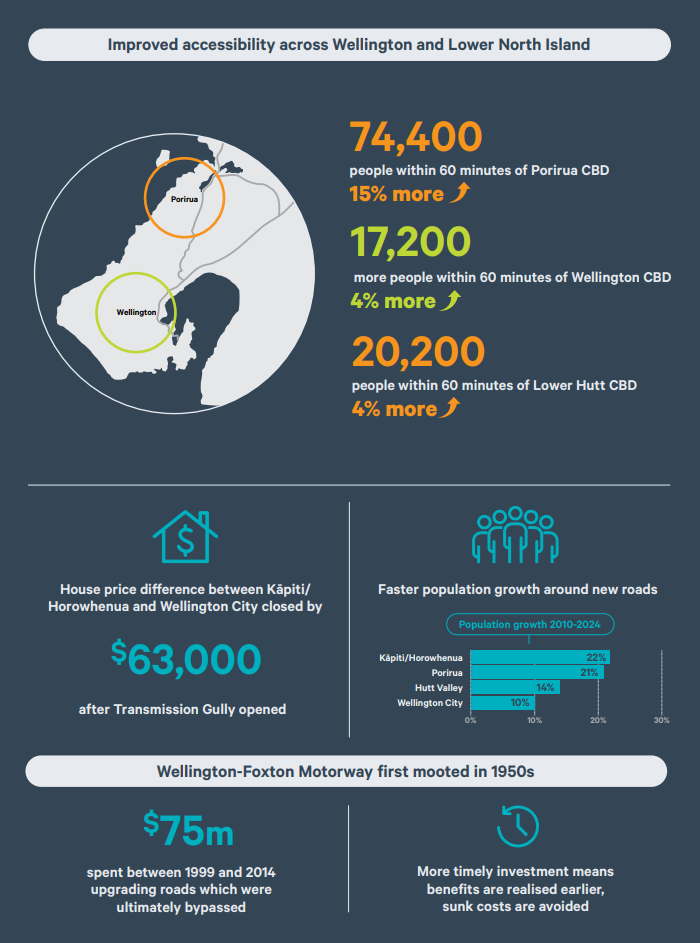
- Porirua has been a major winner, with 74,000 more people now within a 60-minute drive of its CBD. This stronger connectivity is supporting local growth and helping to close the housing price gap with Wellington City, which has narrowed by more than $63,000 since Transmission Gully opened.
“The fact is these three new stretches of expressway are building more prosperous, more connected communities,” Mr Leggett, a former Mayor of Porirua says. “This shouldn’t come as a surprise as these are the outcomes we must expect from major infrastructure projects.”
He’s right, we should expect big benefits from major infrastructure projects – but that is only one side of the equation, and when it comes to this report, that other side is completely missing.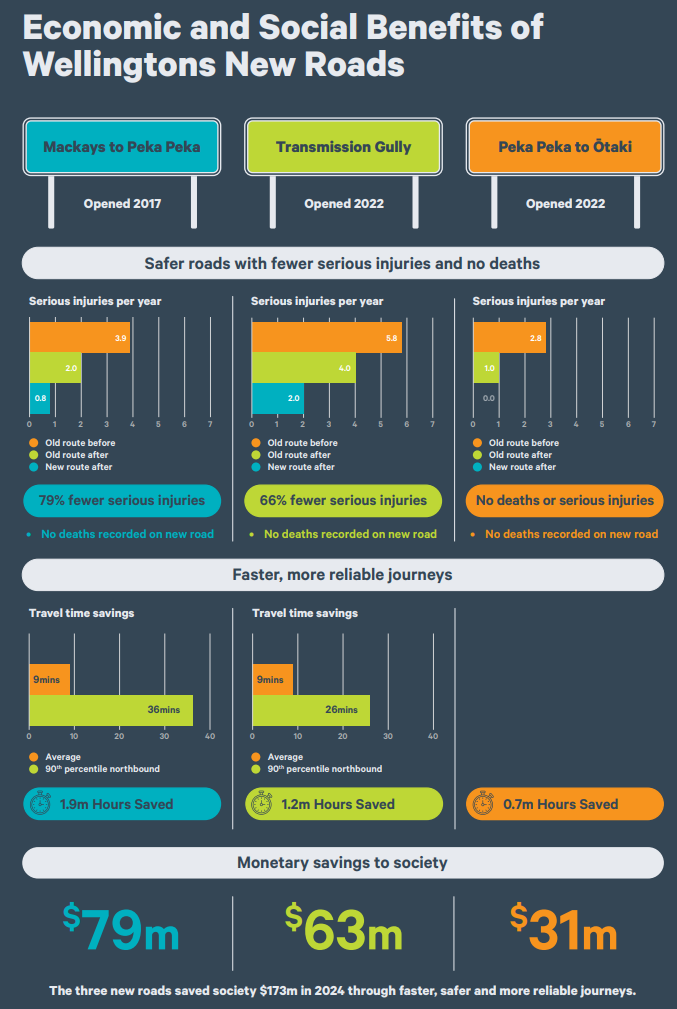
The average of 9 minutes of travel time savings for Transmission Gully is less than the 11 minutes originally promised, and the total monetary benefits for Transmission Gully don’t match what they say in their press release. I wonder which one is right?
It seems the real beneficiaries of these projects have been the existing home-owners, sprawl developers and real estate agents who have been able to bank some impressive gains thanks to taxpayers.
One thing that’s useful about this report is it uses actual measured outcomes to determine the benefits, rather than the seemingly made-up numbers last year of $500 million a year in benefits used to justify an expressway to Northland. A useful comparison, given there’s not all that much difference in the population of Northland and areas north of Wellington served by these expressways. There was also a lot more traffic on those Wellington roads prior to building the expressways than there is north of Auckland. So, if the Wellington expressways are delivering a combined $173 million in benefits it’s even harder to see those Northland numbers as realistic.
The real issue with this report is that it only looks at benefits. The benefits are only good if they are higher than the costs – and when it comes to Transmission Gully at least we have a really easy comparison.
Transmission Gully was originally meant to cost around $850 million to build, but ended up costing about $1.25 billion. Under the original deal we would be paying for the PPP from our state highways budget, starting at around $125 million annually but rising over time. With the construction cost blowout it is now reported that the annual payments are now at least $180 million, although the exact costs haven’t been disclosed.

The original PPP payment profile
I don’t know about you, but paying $180 million a year for a project that delivers an annual $63 million (or $79 million) in benefits doesn’t sound like a very good deal.
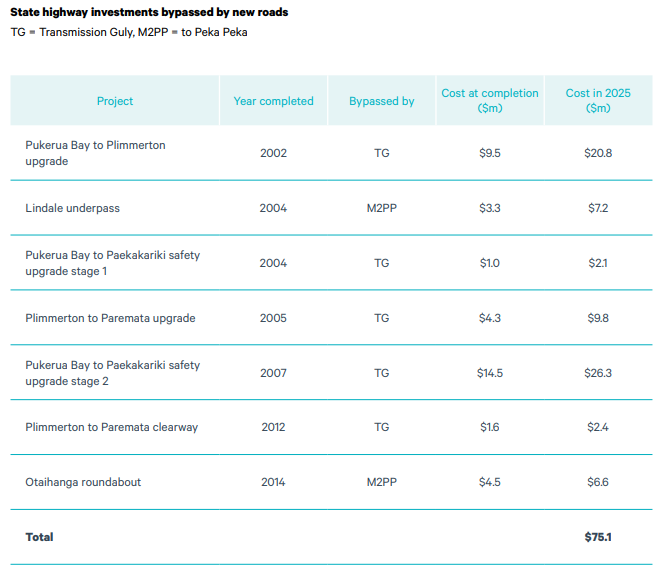
The only mention of costs in the report is criticism that New Zealand spent a comparatively small amount ($75m over 15 years) on upgrading the old route, which Infrastructure NZ argues could have instead been spent on bringing forward these expressways.
The $75 million noted is the cost inflated to 2025, whereas using the same criteria, these expressway projects (combined) cost about $2.4 billion. That small amount of money (Ed: just over 3% of the inflation-adjusted expressway budget) wouldn’t have made much difference to whether these expressways were built or not. But given it delivered projects like adding wire-rope barriers to parts of the route, it will be helping to keep the people who are still using the old routes much safer on their journeys.
The real purpose of the Infrastructure NZ report is to argue that we should ignore the costs and just build more big roads.
[Says Porirua Mayor Anita Baker]: “The next priority for the region must be Petone to Grenada.”
“When we look at future major projects for New Zealand, a second Mt Victoria tunnel and an additional harbour crossing for Auckland, while expensive, must be considered priorities of national importance,” says Leggett.
“The lessons from Transmission Gully and the Kāpiti Expressways are clear. Despite the well-known difficulties with the projects, they still prove that when we invest boldly, we can gain significant economic and social benefits.”
And this view – that we should just ignore costs – is also highlighted in an op-ed from Leggett.
They are the dividends of long-term investment in safe, resilient transport links. And yet, despite this mountain of proof, the national conversation continues to fixate on cost.
Transmission Gully’s price tag has been flogged in headlines for years, while its benefits ‒ now proven and immense ‒ rarely rate a mention. NZTA has struggled to tell the story, and successive governments have failed to champion the “why” behind these investments.
The result is a public debate distorted toward pessimism, rather than pride in what we have achieved and ambition for what comes next.
That brings us to the Ōtaki to Levin project, the critical next stage. Completing this link isn’t just about finishing a road. It’s about locking in the proven gains of safer, faster, more reliable journeys, and extending them into Horowhenua.
That Ōtaki to Levin project is now expected to cost $2.1 billion alone, for a road that currently carries fewer vehicles than the roads these expressways replaced. But if it’s now the case that money is no object, why are we not building the world’s best metro systems in our cities, linked up by high-speed rail up and down the country? That would certainly cost a lot, but there’d be lots of benefits too.
Notably, those who benefit most from a “cost is no issue” approach are the big infrastructure builders and financiers – the same ones who happen to be members of Infrastructure NZ.

 Processing...
Even worse are the local government boondoggles where they count the costs and claim they are benefits. ie “This impressive velodrome/sound-stage that also processes old batteries will increase spending in the area by $1billion and create 30 jobs for six months”.
If people want to vote in politicians to build them big shiny things, stadiums, convention centers, libraries, pools, and charge those in the general area to pay, that is one thing.
I don’t think there is much of a constituency (or justification) for shipping half the fuel tax and RUC collected in the likes of Canterbury up north to pay for big shiny projects that they’ll never see.
Problem is people want shiny things and they want other people to pay. Worse the elected people are complicit because they know very few vote and not all voters are ratepayers.
Incorrect all voters are rate payers .The thing is renters pay the rates on the property they rent every week .So in fact they are rate payers .
I really think you should not group stadiums and convention centers together with libraries and pools.
Absolutely agreed, those are dramatically different types of infrastructure delivering different kinds of services and benefits. It’s not a one-to-one comparison.
Nick Leggat the former CEO of the New Zealand Roading Lobby from December 2018 to April 2023 (~4.5 years), directly before becoming the head of Infrastructure New Zealand.
And we wonder why we are still getting non-evidence based, ideological infrastructure spending in this country.
They’re both lobby groups, so what’s the problem?
The problem is outlined in the article written above.
We should not confuse Infrastructure New Zealand – the lobby group which Nick Leggatt heads – with the New Zealand Infrastructure Commission – which is a government agency.
I’ve always thought aggregate time saved is a disingenuous figure that is quoted to simply get some big numbers floating around. The time savings are usually just a rounding figure in most people’s journey estimations, unless some of us are so hyper productive that 130 seconds makes a material difference to your day.
Indeed, 10 minutes saved on a truck’s run doesn’t mean it can do a whole extra run in a day’s duty, and 10 minutes saved on a holiday trip doesn’t mean an extra round of ice creams at the beach.
I’m also really skeptical about the “value” of the time savings given the decision that even a nominal toll of like $1.5 “would likely see more drivers avoid the road in favour of the current coastal State Highway 1” and “would compromise the safety, environmental and access benefits which the new road will deliver” – obviously people don’t value those 10 minute time savings that much…
https://www.rnz.co.nz/news/national/397738/nzta-rejects-advice-making-transmission-gully-free
It is. I once worked with some people who got a proposed stairway to a tube station moved to a side road and away from a fancy hotel by showing people would be better off by 2 seconds each. They then multiplied that by the number of people over many years and applied a time price. In reality nobody would even notice the saving.
There is no mention of the indirect costs from emissions, environmental pollution and health relayed issues of the 4 lane express way between Porirua and Otaki and future tax payer subsidies when private vehicle owner starts to decrease from 2040.
Unserious stuff. Gets even worse when you consider the equity side as well.
In spending such massive amounts in the Wellington and Auckland regions, we are doing enormous transfers from poorer regions to richer ones.
Re Auckland, it’s a third of the population/40% of the economy. It should receive 1/3 of the spending. The capital is continually overrepresented in spending, but Auckland not so much. The 4 places continually overrepresented in spending are Northland, Gisborne and West Coast (tough geology/geography with small dispersed populations) and Wellington.
Sssssh. Be quiet with your facts. Ours is a post-fact society.
If we only count the benefits and not the costs, why can’t we have full light metro to the airport?
Answer: because roads are Ideologically Correct and rapid PT isn’t
Yes indeed, there’s good infrastructure and there’s bad infrastructure.
Those people living in Porirua or Pukerua Bay will cut there commute time from 2 hours to 1 hr and 51 minutes a day.
They have less time to be involved in sporting and cultural events in the city and less time to read the news and keep up with what’s happening around the world. The costs for families and councils is too high.
The benefit would be larger if some of those $billions had been spent in the city on building light rail and bikeways
There have many studies around the world showing the the costs of building and servicing distant suburbs is up to 6 times higher than for inner suburbs
Subsidising spawl is a complete waste of public money.
One of the justifications for Transmission Gully was the resilience of the old route- particularly down the hill from Pukerua Bay. ..where parts of the escarpment have slipped away in the last few years. I understand police and emergency services had been concerned for some time about that particular spot- getting amubulances through and so on: my source is a former police officer.
If things were done properly we should now be planning a second series of RAIL tunnels down that hill where the single track runs very close to the slip area.
The media would have you believe the average NZ voter loves an expensive new road and doesnt want to subsidise public transport, unfortunately I suspect that seems to be the case.
People tend to prefer a) what they know and b) what they are told they prefer.
Thanks for writing and posting this! I have been wanting and hoping to see such an analysis somewhere, after the breathless and non-critical reporting that the numbers received!
Especially re Transmission Gully, it was noted to have a BCR of well less than one before it was built!
– there is no mention of the fact that fuel costs have increased due to Transmission Gully, it’s faster but not more fuel efficient as a route, so you save time but use more energy.
– there is no mention of the congestion issues that have simply been moved closer to Wellington and further North.
– the travel-time savings use a linear value of time ($/sec) while the value of time is empirically well-established to be non-linear (sigmoidal or s-shaped if interested). This tends to massively overvalue small time savings for shorter trips in large numbers of vehicles.
– the safety benefits (in terms of fatalities) associated with Transmission Gully were largely achieved by the simple expedient of putting a wire rope median on the coastal route. The fatality numbers above average out the before-median and after-median numbers for the old route.
As others have noted, the overall tone is hardly surprising given Nick Legget’s background, and previous comments on the joy of asphalt generally. I do wonder if some journalists in a hurry confused Infrastructure NZ with the Infrastructure Commission?
This article has an identical narrative to one from Stuff in 2022:
“Here’s what motorway extensions do for property values”
“It’s a pretty clear example of transit oriented development [WTF??] pushing property prices upward, which has knock-on effects for regional employment and economic growth.”
AND
“Wigglesworth points to Te Kauwhata in the north Waikato and Millwater in north Auckland as areas where motorway development has led to housing development, and contributed to population and property value increases.”
AND
“The motorway unlocks formerly rural land to be developed for housing, and this provides more affordable options for people who can’t afford the prices in suburbs closer to the centre of Auckland.”
In other words: 1) build motorways. 2) pave over the countryside. 3) get rich if you’re a landowner. 4) drive til you qualify. 5) repeat.
Here’s the link to the awful article. Read it and weep: https://www.stuff.co.nz/life-style/homed/real-estate/128511675/heres-what-motorway-extensions-do-for-property-values
I talked to an economist once about intangibles, things like the property price increases that projects like TM provide. They noted, on a national basis there is no NZ Inc increase, there is merely a transfer from one community to another as there is a fixed amount of capital.
Conclusion, ignore anyone who promotes a project on the basis of property price increases.
Another great article.
Fun fact – ChatGPT tells me that for PPP to be a better option than public financing for Transmission Gully (using the graph above) a 7.4% discount rate needs to be applied.
Fun fact #2 – This government recently changed internal guidance for discount rates on business cases from 5% to 2% for years 1-30.
PPP’s are weak.
This article effectively exposes the flawed cost-benefit analysis of New Zealands expressway projects, highlighting the ignored expenses and the ideological push for more spending on roads over other forms of transport.
I don’t know how much is ideological, rather then the soft corruption of rewarding donors. I remember some decades ago when NZ’s most prominent motor vehicle dealer at the time, at one Party fundraising function that he was hosting, proudly pointing out, that he was the National Party’s largest individual donor.
Since the donors have become very much more discreet.
“soft corruption”?
We voted in the lobbiest to be in cabinet. It’s not corruption when it’s government policy.
Leggett will get his next motorways funded despite all the reasons presented here
Where is RNZ reporting on this… Phil Pennington, this is your cue…
Building roads is relatively easy.
NZTA can work alone and only involve Councils when and if required.
Building PT improvements gets too messy and complicated, and put in the too hard basket as no one Govt department has true ownership of a project.
Local Councils, Regional Councils, NZTA, Kiwirail.
RONS roads of national stupidity…also firmly against the evidence. Luzon on the news carping on about the 15 minute time saving Taki to levin north…so you can spend more time with your families. Like he cares
It’s kinda ironic how people south of the Bombays complain about Auckland/upper North Island get this and that but the reality is that it’s the main engine room of the economy and most of the rates, RUC and taxes come from these places that need supercharged infrastructure.
The reason these motorways are so expensive and thus distort the cost/benefit ratio is simple. NZ has a weird habit of kicking the can down the road when it comes to long-term planning and implementation of these motorways. In other parts of the world they plan these roads long before they are actually required. Therefore the costs of land expropriation, construction, etc are a fraction of the cost. Everyone knows TG should have been built 50 years ago. Indeed, this goes for many other johnny-come-lately motorways. Cost/benefit ratios would be far more appealing if this had been done.
Shouldn’t the cost-benefits get better? modern earthmoving equipment, gps guidance, modern pavement science, new innovations like cheap rope barriers. Not to mention the number of beneficiaries of said infra is much greater today than it would have been 50 years ago.
How much would we be saving had we built rapid rail instead .$180 million per year is a massive amount to be paying after a spend of $1.2 billion to build the thing .And when a decent earth quake destroys it what then ?.