This is a guest post by Alex Bonham, who is a City Vision member of the Waitematā Local Board, which resolved unanimously to advocate for the prohibition of non-emergency helicopter movements in urban residential areas. She is writing here in a personal capacity.
The recent decision by the Independent Hearing Panel to consent a private helicopter pad in Westmere, against the recommendation of Auckland Council, sets an alarming precedent for our city.
38 Rawene Avenue Westmere – Decision [PDF]
Despite 1227 of 1397 community submissions opposed, and the testimony of those in Herne Bay who have suffered years of noise, vibrations, and draughts from private helicopters consented there, the commissioners made the extraordinary assertion that “there was nothing untoward, unacceptable, or significantly out of character with helicopter noise in an urban residential environment.”
Who are they kidding?
Many cities restrict private helicopter movements in residential areas, because of the safety risks and noise intrusion. A string of crashes in New York, most recently the deaths of a family of five when their helicopter fell apart and fell in into the Hudson last year, led the city to resolve to ban all non-essential flights.
Excessive noise is a killer too. In a recent European Environment Agency report, noise from traffic and aviation was found to impact the health of 110 million people. Effects include hearing loss, sleep loss, stress and mental health problems and leads to 66,000 early deaths a year. This is higher than for those exposed to second-hand tobacco smoke or lead exposure, and three times higher than the road toll.
Auckland Council thought they had done enough to stop any more private helipads being consented. Elected members and community leaders have been told repeatedly that helipads are non-compliant under the Auckland Unitary Plan. And yet the commissioners chaired by Kit Littlejohn decided helicopter movements are a permitted activity as long as noise standards are met, and if they don’t (as in this case) the consent can be granted as a restricted discretionary activity.
Did council get it wrong? Or did the commissioners? If this is a problem with the AUP, it needs amending. If the decision is unsound, it needs to be tested in the courts. Enabling private helipads in the inner suburbs is against the strategic priorities of council and government to reduce transport emissions and encourage a more compact city (which requires people to live in proximity without enraging each other). The commissioners should have considered this.
Instead they found that just because helicopters are not listed in an activity table doesn’t mean that activity should be restricted in residential areas. People can do what they like as long as they meet noise standards (and even when they don’t). In this way the decision leans into the narrative that people choosing to live in a city should expect to be disturbed.
It isn’t good enough.
People want and deserve high-quality living environments, and to be protected from excessive noise in residential neighbourhoods. Parks and beach reserves are vital for recreation, to connect with nature. Enabling helicopters in these spaces is unhelpful and thoughtless of most people who work and live there, some doing shift work, others with young children.
This precedent could impact anyone, anywhere in Tāmaki Makaurau.
This interpretation that ‘helicopter landings and take-offs are inherently a part of the residential use of a dwelling’ could lead to a swathe of private helipad applications across the city’s coastline. There are many sites with similar characteristics to the Rawene Ave property across the Inner West, Outer West, North Shore, Eastern Bays, and the Manukau.
Private helipads are currently deemed a ‘restricted discretionary activity‘ on Waiheke and other Gulf islands. In 2021, a Stuff article reported that Waiheke locals were ‘fuming’ at the prospect of a 49th private helipad. Four years on, there are now 64 helipads on the island.
Some argue that siren cars or overnight construction are worse, but there isn’t a quota of unpleasant experiences that must be distributed. Excessive noise is a problem whatever its source and can, and should, be tackled.
Swiss cities protect quiet times at night and on Sundays, and the country has some of the highest levels of social cohesion, life expectancy and GDP per capita in the OECD. Barcelona’s famous Superblocks were not created to reduce emissions, or to increase public space, though they do both these things. They came out of the desire to reduce noise where people live.
There is some good news.
After the Mowbray/Williams resource consent application for a private Westmere helipad was lodged in November 2021, the Waitematā, Waiheke and Aotea/Great Barrier Local Boards responded by requesting investigation into how well Auckland managed helipads, and subsequently advocated to council to adopt the National Planning Standard 15. In 2023, Auckland Council did so. This means that actual noise standards must be used to assess acceptability of proposals instead of using noise averages.
In February 2024, the three local boards called for plan changes to the AUP and Hauraki Gulf Islands Plan and Councillor Mike Lee put in a notice of motion to the Planning & Environment Committee a month later. His proposal to make private helipads a prohibited activity failed, but Councillor Julie Fairey’s friendly amendments – to review the more permissive Hauraki Gulf Islands plan and tighten compliance and noise monitoring – were carried.
Councillor Lee’s proposal seemed to fail for two reasons. Firstly, there was no budget in the Long Term Plan (out for consultation at the time) for an expensive and uncertain plan change. and the governing body, while in many cases sympathetic, had indicated they wanted to avoid adding further lines to the work programme on an ad hoc basis. The second reason may be that staff are wary of tackling helicopter usage.
Nothing to see here!
When the three local boards first requested tighter restrictions on private helipad consents in 2022, staff suggested a review of compliance to gauge whether private helicopter use was a problem. This sounds reasonable – except the Auckland Council website explicitly said that it was not council’s role to follow up on aviation complaints, directing people to the Civil Aviation Authority, which also does not handle noise complaints. (Following Waitematā Local Board advocacy, council now offers a pathway to make a complaint.)
Secondly, council is reluctant to monitor compliance of existing consents, citing the lack of resource to do so, even though consent conditions generally allocate the cost to the consent holders.
Finally, council staff have said that it would be too difficult to justify prohibition of helicopters in all cases, but no one has proffered an example of when helicopter movements in a residential suburb would be reasonable.
Prohibited activity status must indicate “where the relevant activities will be prohibited from.” Wouldn’t it be reasonable to restrict commercial helicopter operations for private hire in residential zones in defined metropolitan suburbs? After all, heliports in Mechanics Bay, Onehunga, and Albany are not far away.
Some way or other the position should be clarified, through the courts, a change to the AUP or through overarching legislation, the RMA and/or Civil Aviation Act.
Cities may be unequal places, but together we can make decisions to support holistic wellbeing for everyone.
That’s the Auckland we want.
The header image on this post shows a map of submissions on the helipad resource consent, from Quiet Sky Waitematā, a group formed in response to applications for private helicopter use in residential Tāmaki Makaurau. Quiet Sky is holding a public meeting this week – see details below from their website, and flyer here: PUBLIC MEETING FLYER-10 July 2025
Quiet Sky Waitematā is holding a public meeting at 7.00pm on Thursday 10th of July at the Hawke Sea Scout Hall, 55 West End Road, Cox’s Bay.
Mike Lee, the Councillor for Auckland, will talk about his upcoming Notice of Motion (NOM) to ban private use helicopters in residential areas at the next Auckland Council Planning Committee meeting on the 21st of July.
The NOM vote is important for anyone who lives in a coastal suburb – Pt Chevalier, Westmere, Coxs Bay, Herne Bay, St Marys Bay, Parnell, Birkenhead, Northcote, Takapuna, Howick, Te Atatū Peninsula, Hobsonville Point, Orewa etc.
The reason it is important that Auckland City Councillors vote for this ban is because three independent commissioners recently decided that “The use of a helicopter … in the AUP residential zones is a permitted activity …is inherently associated with residential land use”. This means anyone can land a helicopter in your neighbourhood, without a resource consent, as long as they claim they meet the noise standards. It will be up you to prove the helicopter doesn’t meet noise standards. And up to the council’s compliance team to do anything about it.
Good luck with that.
This is an extraordinarily permissive decision. Auckland (and any other city in NZ) would become the only modern city in the world permitting helicopters as of right in a residential area. Other cities like Sydney, New York and Los Angeles have long since banned private use helicopters.
We look forward to seeing you at the meeting to discuss how we convince Council that this must change.
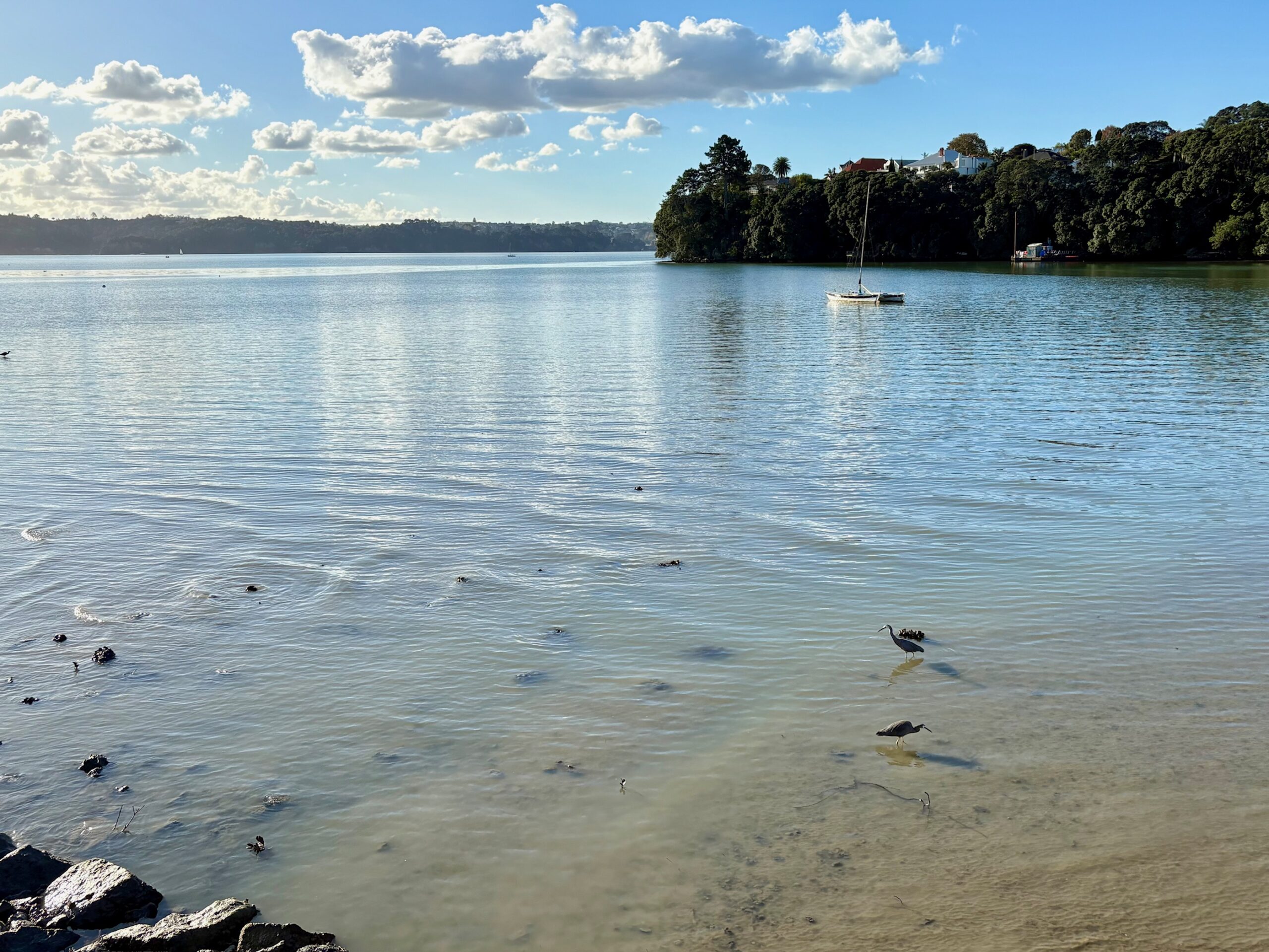 Herons dining at Cox’s Bay a couple of hours after high tide, late May 2025. Image: Greater Auckland.

 Processing...
We can’t build dense housing for all sorts of nonsense reasons made up by planners and commissioners yet a literal helipad is fine? Insanity.
There is a typo above (apologies). [GA Editors’ note: text of original post also updated for clarity] To clarify, the commissioners decided that just because helicopters are NOT listed in the activity table. It didn’t mean they weren’t allowed. “Table H4.4.1 makes no explicit provision for any of the many activities commonly associated with residential use of a dwelling, including how it may be accessed by its occupants12 and how it might be used on a day-to-day basis for living activities (subject to any relevant effects or activity standards). As such, the absence of any explicit listing of such incidental residential activities is understandable. Essentially, if the activity is inherently a part of the residential use of a dwelling then, provided it complies with any applicable standards, the AUP allows it as a permitted use and the fact that it is not listed in Table H4.4.1 does not mean it is not provided for13.”
I’m still puzzling over this part of the Commissioners’ response, see below.
With due respect, it suggests that *any* mode of transport is acceptable as long as it is part of the “residential travel needs” of a given dwelling… and is not expressly prohibited in writing?
If so, keep an eye out for my fine carriage drawn by four handsome horses (only ever parked on a berm if I can’t find a nearby spot big enough), and also my bespoke fleet of domestic microlights kitted out with siren speakers pouring forth the finest tunes of Mariah Carey.
Seriously though. This feels wrong?
“Most recently, in 2020 and 2022, Independent Commissioners appointed by Auckland Council concluded in two separate decisions(14) that *helicopter take-offs and landings by persons residing at the relevant properties were a residential activity as they were associated with the use of the dwelling and thus were a component of the residents’ household travel needs.* A similar conclusion was also reached in a 2016 decision of the Auckland Council.(15) In addition to the fact that at least two of these decisions were made by experienced and learned Independent Commissioners(16), they were also made following an interpretation of the same AUP structure and provisions as applies to the current application and Auckland Council, as the administrator of the AUP, appears to have accepted the correctness of the interpretations reached. (17) Although not binding on us, these decisions deserve due respect; consistent administration of the AUP being an appropriate objective of any decision-maker in this regard.”
(I mean, obviously correct me if I’m wrong, but what *doesn’t* this open the door to?)
Private helicopter use in or over residential areas has been a long-standing issue. I recall being involved in campaigning against two commercial applications some decades ago. Air New Zealand had a helicopter-shuttle service from the airport to Mechanics Bay which began in 1988 despite many objections from affected residents and Community Committees. Fortunately it did not last long as it was not a commercial success. A decade later came Oceania with a proposed heliport on the Rosebank Penininsula close to the NW motorway and a short taxi ride to the city. Again, despite numerous objections it was permitted (hearing in late 1999, decision to approve in early 2000) but although the heliport was half built, Oceania’s financial backers pulled out and the land was sold. But there have been numerous other heliport proposals over the years. I agree with Alex and Mike non-essential helicopter use in and above residential areas should absolutely not be permitted
Thanks Graeme. This history confirms that Aucklanders’ sentiment against helicopter use in residential areas conflicts with the commissioners’ beliefs.
Wherever public sentiment aligns with climate action and the promotion of wellbeing, any argument to allow the activity would have to be outstanding. That’s certainly not the case here. We need to ask why the system is appointing commissioners with warped values.
Thanks Alex, excellent post. And a very good example of the pandering to the super rich that taints almost every ‘controversial’ decision.
You’ve laid out the issues very well; elected members should use this to take action. Voters need to be asking candidates how committed they are to:
1/ establishing a Council strategy for how to replace the Independent Commissioners and to overhaul the system that leads these commissioners, repeatedly, to arch-regressive decisions.
2/ appointing CEOs who are leaders, not BAU-supporting barriers to change. Council CEOs need tKPIs in actually achieving the Council’s policy outcomes, including by managing their staff and legal advisors in an outcomes-focused way.
You need independent commissioners as elected reps are not capable of fulfilling that roll. Read any Local Board comments on a planning application and its very clear they haven’t got the fainest idea what’s going on.
Except the independent commissioners (who are generally a certain age and stage) often make worse decisions than incompetent reps who are at least answerable to the public.
Typically, independent commissioners are approving greenfields developments in areas Council doesn’t want development, after considering easily-refuted development applications that are opposed by excellent expert submissions by WK/NZTA, AT and Auckland Council.
The independent commissioners seem to be part of the whole kneecapping of science and evidence that NZ is suffering from.
So, while your point is valid that the role is important, we have a problem with the people chosen to be these independent commissioners. They are upholding the destructive wishes of the legacy high carbon industries (road building, fossil fuel, automotive, and financing of land subdivision). They do so because they are from a class of NZers who will not or cannot envision a better future, presumably because they are averse to changing the economic system that keeps their demographic well off and in power.
So, what needs to change is how we appoint independent commissioners (and board directors). We need climate competence and we need a focus on citizen wellbeing. Such competence and focus will need to come completely fresh blood.
Helicopter flights are ‘part of the inherent use of a dwelling’? I don’t think most of those dots on the map (or most people anywhere) find a helicopter inherent and necessary to their daily life. Forgive the reductio ad absurdum, but if someone decided a small fusion reactor in their backyard was the best way to power their house, would we have to accept that as ‘inherent use of a dwelling’ because houses gotta be powered somehow?
Once again we are under the delusion that planning can solve all our issues. This should be a health and safety legislation, noise pollution and nature conservation issue. Changing plans is too slow, unresponsive, and a very blunt tool and planners are poorly equipped to deal with these issues.
Yes!
Hi Ben, you’ve got me thinking. The decision was made through the consents process and draws on planning documents but yes, perhaps, this issue could be addressed another way. What approach do you suggest? For you are correct, this is a health and safety issue, and an ecological issue among other things.
The problem is that planning processes tend to trump health, safety, etc.
This shouldn’t be the case. And while the situation clearly exists because our law is centred on the private property rights rather than human rights, the question has to be asked whether NZ’s largest Council has fulfilled its responsibilities to do all it can within those legal limits, and to change the laws.
Have a word with the Minister, who can make rules under the changed Civil Aviation Act: https://quietskywaiheke.nz/2023/04/20/a-new-civil-aviation-act/
Our system is based on British law. That means the law was set up by wealthy people to protect wealthy people (with the proviso that the Crown gets anything it wants).
Parachute into Haiti or similar and tell us how you get on by comparison.
I do not even like the Westpac Rescue Helicopter. Helicopters are weapons of war, and the sound of them is frightening, despite knowing that this place is relatively distant from war.
I cannot imagine what it must be like for a refugee escaping from such violence.
Helicopters have no place in a city, that is why we need more buildings, buildings for people to live in, popularly known as apartments, which despite their name, are excellent community creators.
Then you can just walk to the train station or to the ferry terminal and find that you don’t really need to fly anywhere.
bah humbug
Yes, there are helicopter activities within the city that are essential (police, ambulance, defence, surveying, firefighting, construction). Private or charter heliports with reasonable access and flight paths can be considered – probably two on Waiheke to replace all those private helipads.
Best to build a business case, obtain funding agreements and progress projects, to support a ban on private helipads (use or construction) in defined areas.
All Council and Local Board candidates should be called on to commit to this – whichever area. Franklin and Rodney will have areas where use would be reasonable, and others where not.
Meanwhile the Jetsons in Westmere might rethink whether they should go ahead with building a helipad, when a boathouse should be enough.
Reducing (say) Waiheke’s helipads for non-emergency use to two would reduce overall use, as it would eliminate the trips of those people who’d only bother to use a helicopter if it gets them directly to their destination.
However, regardless of how well the route is chosen, there’d be some neighbours who would be excessively impacted by a shift to only two helipads.
The real question is why aren’t we shifting into a phase of discussing what actually needs to be done?: The stark truth is that helicopters are inequitable and destructive of the climate. Excessive emissions by these individuals; drought/ floods/ war/ abuse suffered by those.
Given no emitters in NZ are required to pay for their emissions to anything like the impact they are causing, should the profligate waste of carbon involved in helicopter use be ‘considered’?
Officialdom’s habit of aiming for (and rarely achieving) a middle position is not really necessary, when we could actually get a citizens’ assembly to decide.
Do you think they get upset every time they spot a Toyota Hilux as well?
Don’t be so patronising and give refugees some credit before claiming to speak for them.
More annoyed by the constant nighttime police helicopter. Does it really need to be flying around so much? Surely a quiet infra red drone or something would do a similar job.
Ukraine may be able to help our Police with this.
Blowing up criminals may be effective but would probably upset the neighbours
No no, we’re fine. Blow away, we really don’t want them.
Proceed.
Yes, bring in the drones, out with the noisy choppers…
the reality is that very few people will own thier own helicopter and keep it parked on thier personal helipad. in my experience one goes to the helicopter, gets in and flies to the destination/drop-off point. rather than allow up to [say] a dozen residential helipads in a neighbourhood wouldn’t it be smarter for council to pick some spots suitable for a public helipad and let people use those for a fee? westmere and Herne Bay could be served by a single helipad in Cox’s a bay (arguably those folk could currently drive to the one in Mechanics Bay – but I understand that one has a limit on take-off and landings. helipads could be situated on Pt Chev Park, or any one of the 18-hole Golf courses the council owns cross Auckland. of course, this would encroach somewhat on areas the council has set aside for passive recreation but if the council really believes the option for, or ‘need’ to helicopter hither and yon is important for Aucklanders they should make the facilities available (again, on a strictly user pays basis)
in some parts of Europes you can summon a ‘chopper’ in the same way you summon an uber, so there’s no reason it couldn’t happen here. personally i don’t think many people can afford totality in helicopters and I suspect the recent flurry of consent applications is just a fad, that will pass.
But No, I don’t think we’re living in the age of the Jetson’s where everyone should be allowed their own personal flying transport to their residence. Council needs a ‘reality check’.
Some people don’t like travelling on a bus or train with other commuters. Some will even stand in the aisle rather than sit with a stranger. I notice on public transport that there are not many well to do or 50+ year old people. Taking a helicopter to work means the users won’t have to be near strangers. People often talk about transport issues in Auckland and there are those who say they will never accept PT. In my years of experience and observations I notice that not many professionals use public transport. There are many very well dressed younger women. But rarely an older man in a suit with a briefcase. Hopefully this might all change with the new CRL as the well to do might want to be seen at our up market trendy stations.
There is SOME truth in what you say, I think, but also, from my experience in Europe, it’s simple comparative convenience that trumps everything. When I was working in Frankfurt, Germany, 20 years ago, lots of execs and professionals working in the banking and finance sector used trains. Despite those trains being often enough messy and the areas directly around the train stations being dingy and, lets say, filled with people not exactly in their wage or social bracket. Why? Because except for the very very rich, getting to work by car would have cost sooo much more (for parking) and taken so much more time (especially if you aren’t in the wealth bracket to have a driver) that they just sucked it up.
Maybe a little less glamourous, but the point is “make PT work well” remains the most important thing. Then safe (personal safety, PT is already very safe road crash wise), then clean. If you manage those three reasonably, all sorts of people will use your PT, even if they’d really prefer using a limo or a helicopter.
Agree. This is also the consistent message of Not Just Bikes. Most people are not “cyclists” or train nerds, they choose whatever works best for them to get to places. Some people might favour some modes for a variety of reasons (no strangers in your car, smaller environmental impact of riding a bike) but the vast majority of people choose what is most convenient at a reasonable cost.
Given your particular interest in ‘well dressed younger women’ it’s no wonder so many people feel uncomfortable sitting next to strangers on public transport.
Yeez, I don’t think there was anything creepy or misogynic in that statement. It was an observation. Ratchet down…
You forgot the bit about an older man in a suit with a briefcase…
I use the bus to commute to work – I’m over 50 and in a professional job. While the bus does have a lot of students, there are also other professionals on there. I used to catch the same bus with someone from my work who would have earned over $300k per year (he was very senior) and he used the bus to commute.
Nothing to stop people from feeding the seabirds near and around their house.
Crazy to consent to private choppers in a city. I’m looking forward to the day NZ Police replace the noisy Eagles with much quieter drones. It’s long overdue…
Barrage balloons. Worked fine in the last war….
There are apparently 17,600 homes in Auckland near the ocean.
Applying the panel’s logic, that means 17,600 homes may also be reasonably assured that they too may use a helicopter twice a day (it’s not clear if that means 1 return journey or 2 return journeys) for up to 10 days a month.
So that allows for 176,000 flights per month up and down the coast.
That’s just the coast.
Now… it may be “reasonable access” to a residential dwelling but … is it?
Maybe on The Jetsons, a private helicopter is a reasonable, everyday kinda activity but I don’t think we’re there yet.
I don’t know many people who think commuting in a helicopter is an “everyday kind of thing”.
Perhaps our friends on the panel can explain where their view of “reasonable” are…?
There are a lot of anti helicopter people out there who just make blanket claims about helicopter noise. Like tge one above saying this allows for 176 000 fkights per month!! The Airbus (previously Eurocopter EC range and the MD Notar have a very low noise signature, lower than your next door neighbour’s lawnmower and weekenderand the traffick on roads. The noise thst is heard is less than 30 seconds in most cases. Years ago we did a noise test with sound equipment then listed machinery, trucks, loud vehicles and home equipment that was in fact noisier and yet none complains about these like they do about helicopters. There are some noisier helicopters put there I admit and the police helicopter is one of them when doing circuits over an incident (I still think they could have gone for the much quieter helicopters)
I am a retired helicopter pilot and I was always thinking about safety and noise abatement when flying. Some of tye claims being made are not correct and without scientific evidence. It never cease to amaze me what people use to say to me about helicopters and how jeoulous they appeared even when i told them it was my job and that over the years have rescued many injured or lost people. They are extremely safe in general flyimg terms and yet they receive high publicity abut how dangerous they are. I flew for 40 years without a single accident.
Yee, the police one at times with that circulating nature, particularly, can be very annoying especially to houses without much sound insulation. Should be a quiet model. There is such a thing is mental health related to sound pollution. Sound issues and not just the volume but the nature of it, check out the council sound control law guidelines. Lol, speak of the devil, as I type this it goes over. If you live on a hill and kind of near its main paths it’s quite loud. More so, for example, on clear nights etc.
“the Waitematā, Waiheke and Aotea/Great Barrier Local Boards…advocated to council to adopt the National Planning Standard 15. In 2023, Auckland Council did so. This means that actual noise standards must be used to assess acceptability of proposals instead of using noise averages.”
Actually, the adoption of National Planning Standard 15 means that the noise of helicopter flights is averaged over 24 hours, instead of 72 hours.
But the planners, evidently the advocates, and no doubt the commissioners, just can’t seem to understand this. The actual volume of the helicopters is not 53dB, it is much higher. The ’53dB’ is what happens when five minutes of helicopter noise is combined with silence for 1435 minutes and an average noise level taken. It is written ’53dB Ldn’ to denote the averaging.
Many planning reports conflate the actual noise (dB max) with averaged noise (dB Ldn) and make decisions based on this misunderstanding. What will be the actual volume of the helicopter landing (dB max) for the neighbours at this site? I’m sure it will exceed any noise levels allowed in the AUP. It helipads are to be treated in the same way as other residential activities, then so should the noise they create be restricted in the same way as other residential activities. This decision has it both ways.
Actually, in this case, I believe that the helicopter noise averaging was done across a whole week in the application documents. And then compared to the background noise, also averaged across a whole week. The helicopter noise was predicted to be about the same as the background noise, when worked out like this. If you think about it, it’s quite damning, that all the noise that is experience at the site over a whole week (traffic noise, music playing, dogs barking, building work, overflying aircraft, etc.) amounts to the same as the noise added by the now-consented helicopter flights to this one helipad. It was framed as the helicopters not being louder than the background noise, but it should have been framed as the helicopters doubling the amount of noise in the weekly averaged soundscape.
Rod Duke was granted a helipad in Herne Bay by council, but that was overturned in the high court, on two grounds. One was the maximum (not averaged noise) effects must be taken into account. And that noise effects on the public must be taken into account, not just on the immediate neighbours. Yet the Mowbray-Williams decision says that they only took into account the noise effect on the immediate neighbours. What about neighbours further away? What about people in the reserve or in the bay?
These following points are from that Duke judgement. I think council needs to read it and apply for a judicial review of the independent commissioners’ judgements on the grounds that they have not accounted for things that a court has decreed they must.
[143] Second, Ms Chappell says the definition of “effect” in s3 of the RMA includes any temporary effect, regardless of the scale, intensity, duration or frequency of the effect. In other words, Ms Chappell submits that an effect is not necessarily minor because it is temporary or for limited duration.
[144] I accept the submission that in referring to the “proposed frequency and short durations”, the decision-maker has not taken into account the definition of “effect” as referred to by Ms Chappell.
[145] Thirdly, Ms Chappell submits although the decision refers to adverse noise effects “on the wider environment” and contains a reference to “those persons beyond land adjacent”, there was in fact no consideration of adverse noise effects that might be experienced by members of the public in the water or on the beach and who would not have the benefit of any “noticeable separation”. Bearing in mind Mr Styles’ report and its focus on neighbours as opposed to members of the public, the conclusion reached in the report that adverse noise effects on the wider environment will be less than minor is not a conclusion that reflects the preceding parts of the decision.
[146] In the paragraph that leads up to the conclusion that adverse noise effects on the wider environment will be less than minor, there is a reference to the information put forth by Mr Hegley (the Dukes’ noise consultant).
[147] In his affidavit filed in this proceeding, Mr Hegley deposes that his assessment points (as referred to in his letter which was before the Council) represent the most exposed locations on the adjacent beach and higher noise levels than will be received at any other public space in the area.
[148] On the one hand, it might be said that, in referring to Mr Hegley’s information, the decision-maker was taking into account adverse noise effects that might be experienced by members of the public.
[149] But the decision does not say that. The conclusion regarding “noise effects on the environment” links back to “persons beyond land adjacent that are afforded notable separation” and not to members of the public on the beach.
[150] I also note Mr Styles’ focus on the neighbours in his two reports. On 5 May 2017, he concluded, “it is my opinion that based on the measured noise levels, the noise effects on the closest neighbours will be at least minor”. Then, on 20 July 2017, in his “Assessment” section, he concluded, “… I consider that the noise levels will be reasonable at the properties from which written approval has not been obtained”.
[151] I therefore conclude that the Council has erred in its assessment of noise effects by taking into account mitigation measures that did not exclude adverse effects, by failing to take into account that the term “effect” includes temporary effects, and by failing to consider the effect of noise from the proposal on members of the public.
Another part of the Duke judgement – indeed the other key reason it was overturned – has also not been applied by the commissioners to the Mowbray-Williams consent: The health and safety of the public. The judgement found that council must consider this, as required by section 5(2) of the RMA. But the commissioners haven’t. In fact they stated that they were excluding consideration of health and safety, calling them “aspects of the application not within relevant matters of discretion”. No reason was given for disregarding the High Court’s decision.
In short, the very two High Court findings of proceedural/decision-making failure, that led the court to overturn the Duke helipad consent, and which are laid out clearly in the judgement (reference CIV-2018-404-152 [2018] NZHC 3306) were repeated here. So one could expect the High Court to find the same way again and overturn the Mowbray-Williams consent.
PS The case law around the New Zealand Coastal Policy Statement (King Salmon, etc.) would seem to suggest a strong possibility of success in the Environment Court, as an alternative route to annulling this consent.