Yesterday came news via RNZ and the Waikato Times, of a report from the Waikato Regional Council on securing the future of Te Huia, the intercity rail service that runs between Auckland and Hamilton.
Among the recommendations in the report: a new station for central-city Hamilton, hourly services between the two main cities, more stops in between, and electrified trains:
The preferred plan boasts a new above-ground terminus in central Hamilton, new stations at Ngāruawāhia, Te Kauwhata, Pōkeno, and Tūākau, new battery-electric trains, and eventually hourly trains to Auckland. [RNZ]
This all sounded very familiar. I’d made the same points in a 2024 post, Kirikiriroa Rising, reprinted below. And that post was itself an update on a very similar piece I’d written seven years earlier, in 2017: Hamilton: City of the Future.
The intervening years have only confirmed my speculations. The case for good and frequent passenger rail service between our biggest city and its fast-growing neighbour remains compelling.
In the post below, I offer a staged and proportionate way to deliver on this promise. Are we there yet?
Note: the header image shows Hamilton’s BNZ Theatre, which has opened since this post first appeared.
Three facts
1. Hamilton is growing
Hamilton is NZ’s fastest growing city, wrote the Waikato Herald in November 2024:
Hamilton has been crowned New Zealand’s fastest-growing city for the second time.
The city’s population rose by 3.1% since 2023, Hamilton City Council said, to an estimated 192,000.
About 75% of the population growth came from international migration, and 25% from natural increase (births minus deaths).
Regionally, the mighty Waikato was crowned the second-fastest growing region in the country, Statistics New Zealand said.
The region has grown by 2.2% in the year ended June 2024, only topped by Auckland’s 2.5%.
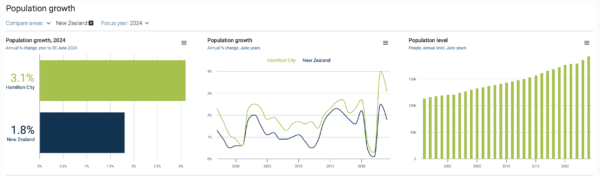
via: Infometrics
2. Hamilton city centre is developing in quality
Things are getting really interesting in what has been one of the country’s more depressed and hollowed-out city centres, new apartment projects along the river, a growing cafe and deli culture that these projects inevitably support, in a positive feedback loop.
The new regional theatre is due to open in 2026 – check out the video here [ed: it’s now open!] – creating a real arts precinct. It already has good things all within a reasonable walking catchment, the Te Whare Taonga Art Gallery and Museum, the cricket ground and rugby stadium. But still more than anything, a huge amount of potential.

3. There is demand for non-car travel between these cities
Te Huia has proven itself. Fight me. Despite its early years being severely messed around by pandemic disruptions, and it just being a slow and sub-optimally scheduled service, people have turned up to use it. In numbers greater than conventional transport planning theory says they should.
 Taking 2 hours 40 minutes, the Te Huia ‘start-up’ service is no contender for speed. Running from The Strand, on an isolated edge of downtown Auckland, to Frankton, also crucially a kind of nowhere, the train leaves riders close-but-too-far from any useful destination at either end, and distant from any connecting services.
It also doesn’t yet stop at many useful points along its route. It has no business being as popular as it is. And yet.
What is entirely supported by conventional transport planning theory is that a decent rail service between the two cities of the size and growth of Auckland and Hamilton is a valuable complement to other modes, and a key supporter of economic performance. So below I will look at what would it take to fix theses issues and make it decent.
For the purposes of this post, I am assuming operating subsidies will be maintained from central and regional governments – as they should be. Or, I am writing for a time when such normative processes are returned.
I have no interest in claims that subsidies are bad and proof of failure. All transport including driving is subsidised, subsidies are transfers used to unlock diffuse value.
Anyway, even the current startup is already comparable with other services by subsidy (here):
The farebox recovery target of 15 per cent is close to being achieved, noting the national average is 11 per cent and Te Huia has a 25 per cent lower subsidy per passenger kilometre than the Auckland metro network.
Of course this should be improved – and the key way to do so is by attracting more use, by improving the appeal and usefulness of the service.
So, what should be done to build on this success of this startup?
In the immediate term, every one of Darren Davis’ excellent proposed improvements should be adopted. You can read them in detail here:
- More stations in the Waikato
- More frequency
- Better bus connection at both ends
- A stop at Pukekohe
- Auckland paying its share
- More speed
Of the above, #4 has been announced to be happening by Waikato Regional Council, though I am unsure if it is happening yet.
Number #5 is shameful. Of course Auckland should also contribute to opex subsidy: around a fifth of riders are Aucklanders, and the train serves Auckland destinations.
However, it is #6 that really matters. So, outside of frequency and scheduling issues, adding some key stops (Pōkeno, Te Kauwhata, Ngāruawāhia), improving what’s on offer in the dining car, and other changes, the two big ones are:
- Journey time
- Termini location
With these issues in mind, I had a look at the 2020 business case and have a staged way forward that balances improvement against capital cost. Keeping cost reasonable means not considering true high-speed options on a new route, so will look at scenarios A + B only.
Before this, it is important to note that the performance of Te Huia, like every train service in Auckland, will benefit from the completion of the rail rebuild programme and especially the third main upgrade currently under way in Auckland.
This is the most congested part of the nation’s rail network, so speed and reliability through the most urban leg of the journey should improve dramatically by next year. I just wish KiwiRail would understand the importance of communicating with us all, and tell us by exactly how much. Come on, KiwiRail: what can we look forward to? (and yes, hold you account to!)
Scenario A
Scenario A, by closing the electrification gap, buying new electric trains, and building a new Hamilton central station, would see journey time coming down from 160 minutes to 113, a little under 2 hours.

Scenario B
Scenario B does the above AND also straightens out the worst of the track, to enable top speeds of 160kph – thus further reducing journey time to 88mins, an hour and a half.

Staged and cost-effective upgrades
Taking these two scenarios as stages, over time I would adjust Stage 1 to two key moves that can bring all of the benefits at a considerably lower capital cost:
- Instead of completing the overhead line between Pukekohe to Te Rapa first, buy the Bi-mode battery electric trains to cover this ~80km gap. This is proven and available technology. Target running speeds of up to 110kph on existing track* to achieve that sub-two-hour travel time.
- Build a sub-surface two-track Hamilton Central Station below Bryce St, integrated with the bus interchange, on a branch on the East Coast Main (shown below). This will enable direct service, city centre to city centre, transport hub to transport hub.
*Note that the slow single-track section at Whangamarino needs doubling and straightening under any future.
The cost of the recently completed 19km OHL extension in Auckland was $419m, so closing the remaining gap is likely to be in the order of $1.5-2b.
Instead, with battery bi-mode trains, we can defer the new overhead wire cost to the next stage, yet still reap the benefits of full electrification. Wellington is getting 18 four car tri- or bi-mode interregional train sets at a budget of $381m. Adding six more to this order can be assumed to be ~$127m, including stabling and some track and charging costs. Six sets would allow hourly service at peaks, and bi-hourly off peak.
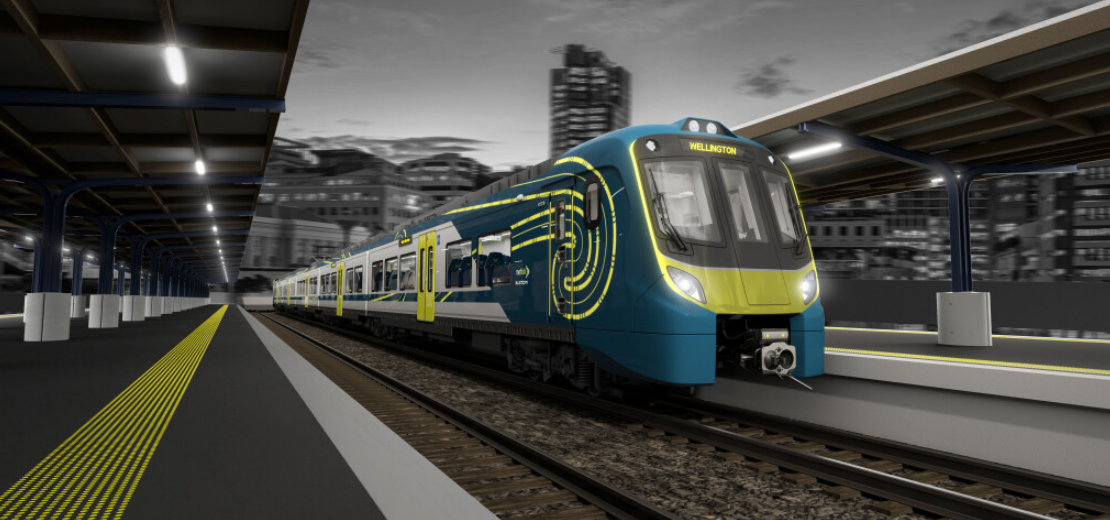
Tūhono bi-mode battery/overhead line inter-regional trains by Alstom for the Lower North Island
Getting directly into both city centres is a huge upgrade, and a relatively easy task. Electric power means being able to use Waitematā Station – and, once CRL opens, there will be two terminating platforms there, perfect for this service.
In Hamilton, happily both the city centre and the bus Interchange are very close to the East Coast Main, the rail corridor is wide and already heading below-grade. The new track required can be entirely below Bryce St avoiding property acquisitions.
Thus electrification and a new (and relatively cheap) Hamilton station solves the current lack of city centre to city centre service.
Terminating in these two city centre stations adds real travel-time savings on its own. Both are real destinations themselves, but also both are directly under each city’s biggest transfer hubs. Whereas the Strand and Frankton Stations are truly nowhere.
Electric traction also means faster acceleration and deceleration, enabling the service to add a few more useful stops while making up the time that would take by getting up to cruising speed between stations faster.
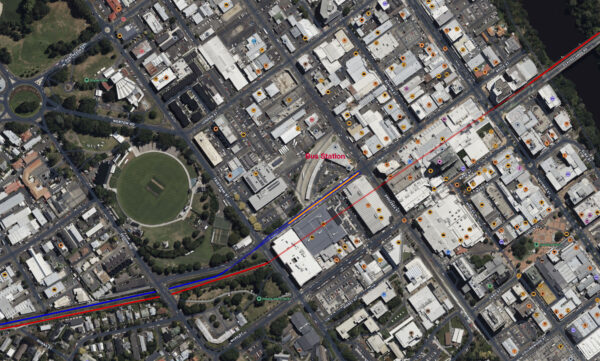
Hamilton Central, Stage I. Red: existing East Coast Main, and existing bus interchange. Blue: new track and subsurface station. Orange: platform between terminating tracks.

The key move to achieve this: Hamilton should add this station to its planning documents and Regional Land Transport Plan. Designate it.
For Stage 2, you’d build on these upgrades by straightening out the wiggly sections (as indicated in Scenario B above), and also now add the missing overhead line, for maximum speeds of 160kph:

 Or better still, realign the track south of Pōkeno as above, but to the north add a new twin-track electrified additional alignment under the Bombays and along SH1 to connect at Drury. Do this instead of quad-tracking the existing line to Pukekohe, for more capacity and a route that is both shorter (by ~10km) and faster. This would be an efficiency improvement for freight, too.
Run two service patterns: a local train on the existing track, stopping at all stations and linking Drury right through to Hamilton, and an express on the new alignment, stopping only at key stations for a really fast travel time. 
Oh, how I wish this option had been explored when KiwiRail designated this section for quad-tracking. Time to do it now. Always be planning.
Over time, add 3rd and 4th from Drury to Puhinui, and a 4th Puhinui to Westfield. A better way to quad the NMIT Pōkeno-Westfield.
This more direct line is around 128km. So to get to a 60min total journey time, you would need a 128kph average speed including stops. This is possible for an express, although 100kph yields a still-competitive 88mins, or less than 1.5 hours, from city centre to city centre.
That’s time-competitive with driving, so would be a really useful complement to the highway system – and the best way to keep the latter less clogged and freer-flowing into the future. A great choice for many city-to-city journeys, especially when the highway is under pressure, such as during regular holiday overload, or when delayed due to crashes or natural disaster outages.
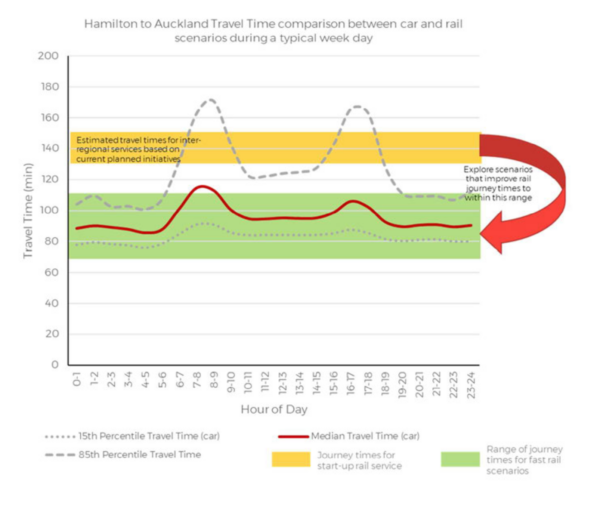
Travel times from the 2020 Indicative Business Case
In conclusion
Auckland-Hamilton passenger rail has value, but even greater potential, with surprisingly affordable ways to make it a faster and better, really appealing and well-used service. The urgent steps from here are to push hard on all possible incremental improvements, and plan and designate key step-change moves such as Kirikiriroa Central Station and new electric trains.
"But the preferred option comes with a price tag of more than half a billion."Oh no! We couldn't possibly run hourly trains between two of the North Island's three biggest cities for a price tag as steep as *checks notes* 1/7th the cost of a motorway to save a few minutes on the drive to Northland
— André Brett (@drdrehistorian.bsky.social) 2026-10-27T08:01:07.388Z

 Processing...
Pukekohe is definitely open, the Papakura stop is closed.
All good stuff!
The relevant WRC report is in the agenda for this week’s Transport Committee meeting, at https://core.opentext.com.au/pdfjs/web/viewer.html?shortLink=9d91a8c7b30d8e4d2cb5893be569e0cab0e9f8f4af7b3847, from p152.
Cheers for that Mike – we’ll add a link in the post.
Isn’t the real reason Auckland won’t shell out for Te Huia is that they don’t want to encourage long-distance commuting and thereby sprawl?
I think it is more so that Auckland is a city of ~2m and Hamilton is ~200k, so the service is perceived as being predominantly for Waikato residents. If the two cities were more equal in size I imagine there would be more incentive to split costs. I know people do use the train from Auckland to come and visit the Waikato, but not sure this is a huge proportion of riders.
I wonder the commuter focus of the service has shifted since it began. It was conceived prior to Covid and since then remote study and work has become mainstream.
The real reason must surely be, why pay for something when you’re getting it for nothing?
Why pay for something when the Wellington region gets it all paid for by the government? Some real Agency Capture on display there.
> He said they had land sitting there already in Ngāruawāhia, Te Kauwhata, Pōkeno, and Tūākau
Shame these places didn’t have foresight to keep their old station buildings. Rent them out as community halls in the meantime. Ngāruawāhia is still there isn’t it?
Imagine being able to take the train to Hamilton at the new station! I can imagine people who commute between the cities for work could find this very useful
Farebox recovery is a lie.
Kiwirail, Te Huia and the councils should be enabled to capture real estate and commercial value the way Japanese railways do. Land speculators here have benefitted plenty from publicly roading, so they can get off that ‘user pays’ high horse.
The flow of people created by the service is added real estate value that these providers aren’t allowed to touch. It’s like they are allowed to dig a mine, but not to pick up the gold nuggets.
We have only been able to use Te Huia once due to all the school holiday shut-downs over the years. Bee Card was diabolical to setup for kids concession and the service was 3 hours+ thanks to track work. But despite this, my family loved it and my kids have been hanging out to visit extended family in the Waikato by train. Perhaps this summer!