The road to congestion pricing (aka “time-of-use charging”) is certainly not a fast one. So far, we’re at nearly a decade of official investigations into the idea. (It’s also over a decade and a half since the question was first raised on our predecessor, Transportblog – and we’ve covered the topic regularly since then, again and again)
Granted, a decade still seems like quite a short amount of time compared to some transport projects. And that’s not to say there hasn’t been progress.
Late last year, legislation was passed by Parliament to enable congestion charging schemes to be developed and implemented, with Auckland the first city in New Zealand to be considered.
Even before the enabling legislation was in place, Auckland Transport has been working to come up with a scheme, including exactly where it might apply. In July last year, we highlighted how they’d narrowed thirteen location options down to six.
Just over a month ago, Auckland Council was asked to approve the latest round of work, which brings the shortlist down to three options for public feedback, with consultation set for mid-November (after the election).
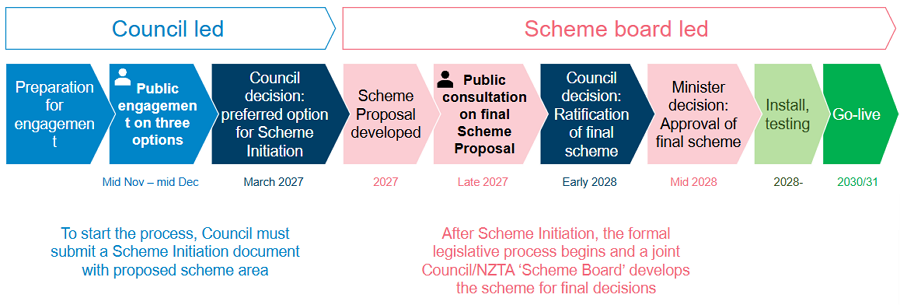
Even so, the image below highlights that there’s still a long way to go before anything goes live. We’re currently in only that first block and even if everything goes smoothly, a pricing scheme likely won’t be in effect until 2030/31.
There was plenty of media coverage of the three options a month ago, and I’ll go over them again in today’s post. But most of that coverage was based off a report released ahead of the Council meeting – and thus missed one key piece of information.
Before going into the options, it’s worth a reminder that the main goal of congestion pricing isn’t about raising money; it’s about using pricing to shift behaviour, and incentivising people towards optimal outcomes. As Auckland Transport puts it:
This charge encourages some drivers to shift to alternatives such as public transport, travel outside the peak period or not drive at all. These reductions in demand can have a significant impact in improving wider network performance, while providing those Aucklanders who decide to pay the charge with a faster and more reliable trip.
A key challenge in coming up with options is that the bigger the scheme, the greater the impact – but also, the harder it may be to get public and political support… unless the stakes are made abundantly clear.
The three shortlisted options vary in size and impact, so let’s look at them in turn, from smallest to largest.
Option 1: City Centre Cordon
The first option focuses on a pricing cordon around the city centre. This is relatively easy to delineate, as the motorway presents a clear barrier around the area. Moreover, this is the part of the city with the best public transport access – which has just become a lot better with the opening of the City Rail Link.
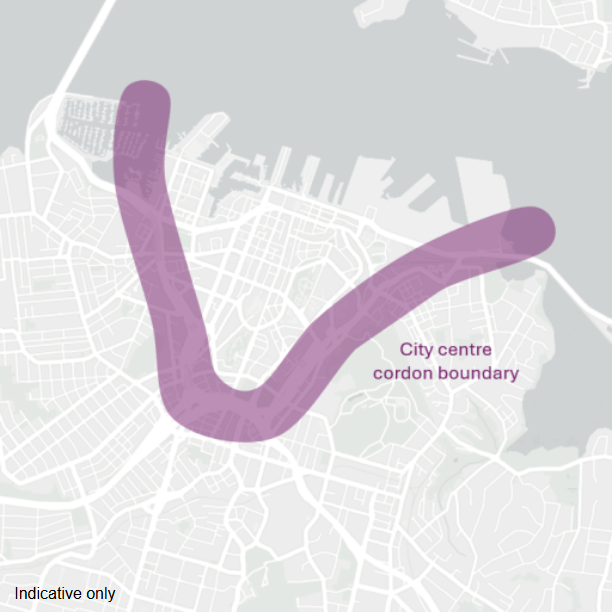
The final prices would be subject to review, but Auckland Transport offers an indication:
The illustrative charges needed to largely remove congestion at the cordon are in the order of $3-$4 during the morning peak and $2 to $3 in the afternoon.
In terms of results, they say this is what such a scheme would likely deliver:
- 3.1% of AM peak trips are charged
- Approx 4 mins saved for charged drivers, more reliable travel
- 21% of uncharged drivers get a faster, more reliable trip; 3% are slower
- 3.6% increase in public transport patronage
- 2-4% regional congestion reduction
- 1% to 2.4% average vehicle speed increase
- 1% average public transport speed increase
- 6,800 hours travel saved per day
- Very limited net revenue and long payback period
While the focus is on congestion reduction, these schemes do bring in revenue. And a clear message from previous discussions has been that any pricing scheme should go hand in hand with improvements to alternatives, especially public transport.
So the last bullet point is very important, and Auckland Transport notes that after paying to install and operate the system, there would be limited net revenue – meaning they could only fund “a modest level of public transport improvements“.
Option 2: City Fringe Cordon
A big concern that has been raised in the past is the fairness on city centre businesses, if a scheme only applies to that area. So the second option under consideration expands on the City Centre Cordon, by extending the boundary to cover Eden Terrace and Newmarket – and potentially Parnell and Ponsonby as well.
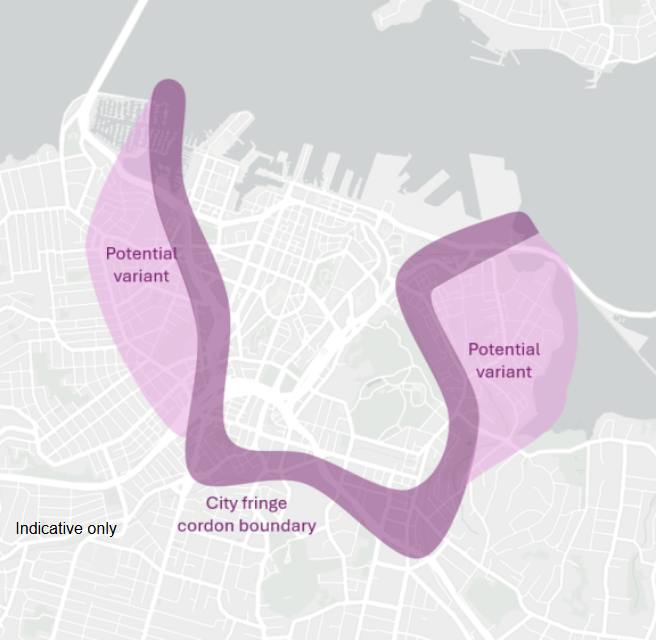 This option looks to involve a slightly higher charge to address morning congestion:
Illustrative charges needed to largely remove congestion at the cordon may be in the order of $5-$6 during the morning peak and $2 to $3 in the afternoon.
Auckland Transport notes that this option “offers significantly improved effectiveness compared to the city cordon, while still retaining many of the advantages of improved public transport alternatives and relative simplicity“.
This is reflected in the stats they provide, which show some big increases in performance:
- 5.1% of AM peak trips are charged
- Approx 5-7 minutes saved for charged drivers, morereliable trip
- 30% of uncharged trips are faster, more reliable; 5% are slower
- 6% increase in AM peak public transport use
- 3-6% regional congestion reduction
- 1.4 – 4% increase in peak average vehicle speeds
- 1.6% average public transport speed increase
- 9,900 hours travel saved per day
- Limited net revenue and long payback period
Note that last bullet point: because this is a larger scheme, it would cost more to build and operate. This means the payback (in revenue that can be reinvested into better public transport) is not too different from the city-centre-only option.
Option 3: Core Motorways & City Centre
The final option takes one of the options above, and adds charges to the core of the central motorway network; longer-distance trips would be able to use the Western Ring Route to avoid being charged.
At first glance, you might conclude this option would be the hardest to get over the line politically, in that the impact is broadest. That said, there’s a good story to tell about the benefits that would accrue to the city as a whole, and the much greater potential to pour investment back into improving alternative modes. A big swing, as it were.
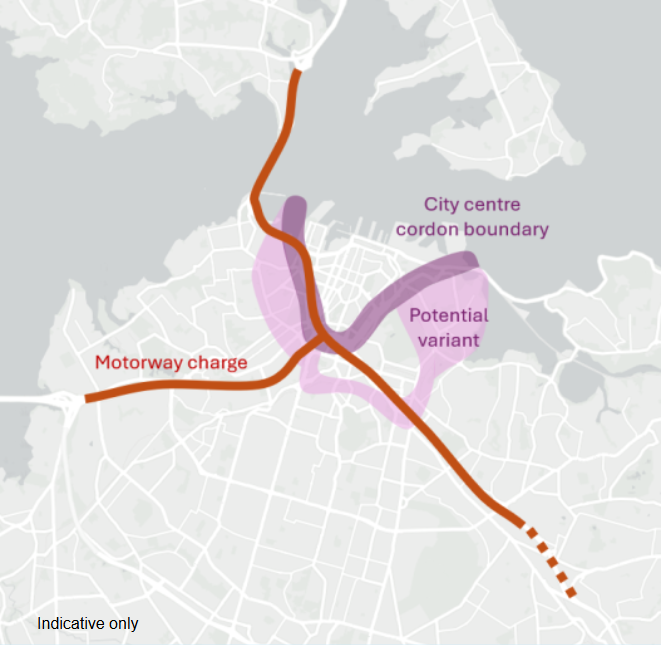
Auckland Transport says that a $7 charge would be optimal here, but that $5 still produces good results and is what they’ll use in the consultation. That’s a good move, as starting the conversation at $7 would almost certainly attract opposition, just because it’s a higher charge.
Importantly, this option provides potentially a big step-up in performance across the outcomes:
- 6.9% of AM peak trips are charged
- Approx 7-12 mins saved for charged motorway drivers, 5 mins over the cordon
- 31% of uncharged trips are faster, more reliable; 12% are slower
- 7% increase in AM peak public transport use
- 13% regional congestion reduction
- 4-6% increase in average vehicle speed
- 1.2% increase in average bus speed
- 18,200 hours travel saved per day
- Significant net revenue with fast payback period
The revenue generated by this option is said to be big enough to not only fund significant public transport service improvements, but would also have money left over for other investments.
The Missing Detail
A key part missing from previous reporting is just what else Aucklanders might see from the proposed investment. As noted above, Auckland Transport is suggesting not all that much for the first two options, but a lot of potential with the third option.
The map below shows the range and variety improvements Auckland Transport could make to services under Option 3: Core + Motorways. It suggests a wide range of fairly significant wins across the region, including what looks like a City Centre to Mangere route. Is surface light rail back on the menu?
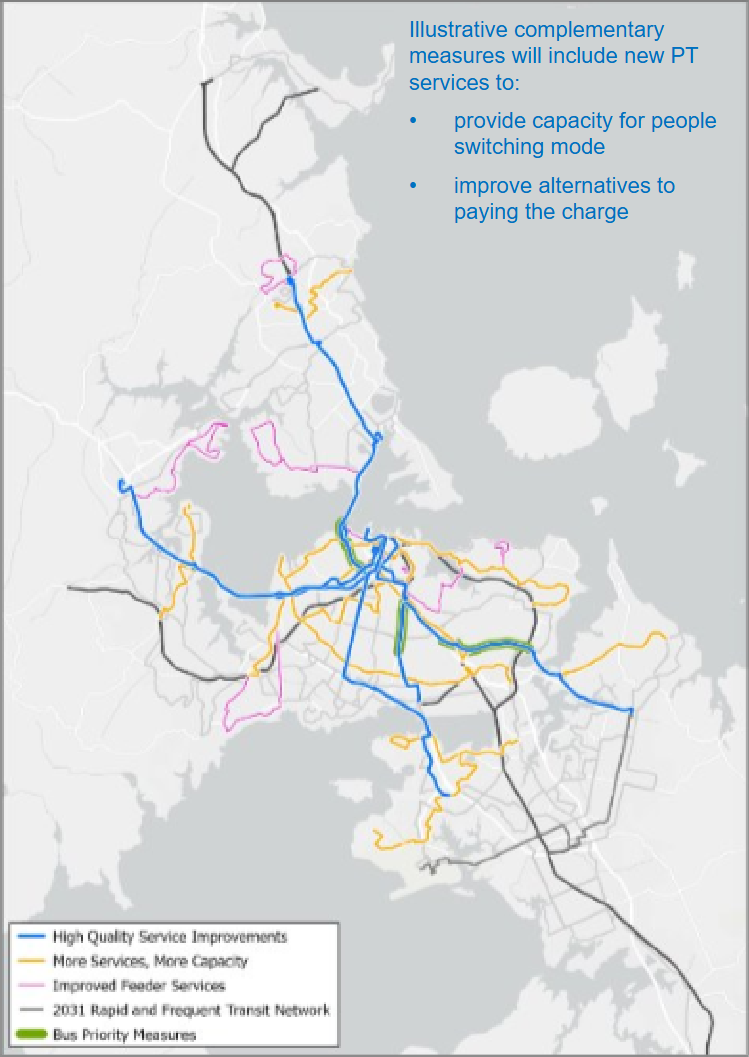 There are versions of this map for the other two options showing far fewer improvements – and which weren’t included in the presentation to council.
I did ask them if we could show all three maps, but Auckland Transport say they won’t provide me with them at this time. However, I hope they do include all maps in the public consultation, as I think that will really help to drive home that pricing isn’t simply a negative thing affecting only driving – it can underwrite major improvements across other areas too, rapidly expanding the transport choices available to Aucklanders.
When you put these improvements on top of the recent opening of the City Rail Link, and our existing frequent bus network, public transport starts to look increasingly more viable for many more people.
What’s more, AT say that even after funding these additional public transport improvements, there would still be money left over which could be reinvested elsewhere. They don’t currently have a view of what it would be used for but is no shortage of projects Auckland needs.
Lastly: if you want to see how Auckland Transport presented the three options to the council, check out the videos below.

 Processing...
This shows the problem with the idea of the city centre charge: just 3.1% of peak car trips charged. It’s not going to do anything if you let the other 97% carry on as usual… except create a lot of noise and upset.
Kia Ora, 1) could you please explain why the % of drivers charged is so low? 2) Are there any helpful experts on congestion charging in other cities who could talk about the long term results?
I was living in London when congestion charging was introduced but I don’t know what the long term impact has been – and there are other cities with CG now – what’s it like – the benefits and what are the downsides – perhaps impact on low paid workers, small businesses etc in the charge-zone? Generally thinking about this, I also wonder what you guys think about estimates like these about the impact of changes. Do you have any idea (on the basis of your hugely impressive long term experience) of how accurate they prove to be?
Its not % of Drivers,
The metric they are using is “trips” so bus users (and potentially train and walking) users are included in the denominator,
,… that’s why they have the “X of uncharged trips are faster, more reliable; “.. these are likely bus users …
How can option 3 even be an option? It’s charging drivers who go through though motorway network and completely bypass the city. It’s a ransom for those if us who live on the shore and need to go to work and never go through the CBD. I go 80kms an hour to work every morning. There is no congestion yet I’ll be charged 14 bucks a day to go to work. It’s a money grab. It even says in the article that this will generate excess money!
The most telling step in the process flow diagram is the 2nd to last real step; “Minister decision: Approval of final scheme” All this consultation and planning work is going to be done at great expense by public bodies and for free by advocates and groups like GA and it will all come down to a single Minister’s approval or not. How much confidence do people have in a wise decision being made at that point?
Yeah, good point. Sticking to the programme will be crucial so that the Minister will be making the decision in mid-2028 more than a year out from the election.
No new taxes if its National. How could they possibly allow this?
Kinda prefer option 3 but at only 7% of trips not sure if it’s worth it.
But even with only 7% of trips, they’re underestimating the impact of rat running and opportunistic parking through the rest of the isthmus.
At the moment they can’t even get parked cars off arterial roads, so not sure how they will be able to respond to the diversions. I think there’s an option D which is everyone entering the isthmus. More trips, more revenue, no rat running through the suburbs.
Ideally this would be paralleled by widespread Low Traffic Neighbourhood, strategic cycleway network, and an accelerated bus lane on arterials programmes.
As in London. These are not prerequisites, but all three, plus any pricing scheme, are all mutually reinforcing and supportive. All improve quality of the city and city life, and efficiency and effectiveness of our transport networks.
It’s hard to tell which if any of the options are of any use. Not enough info.
The key objectives should be:
a) to manage congestion and keep it flowing smoothly.
b) provide viable PT alternatives for commuters
c) provide viable park n ride PT alternatives for commuters
i.e. a simply shifting the time of day of travel (to an untolled period) is insufficient.
d) tolls should be varied to manage congestion levels, not a fixed arbitrary fee.
The motorway scheme fails on this basis. There will be numerous trips caught by the congestion tolls which currently have no viable PT or AT alternative. The Mway scheme could be a future add-on once PT services are ramped up.
I’m also sceptical the Potential Variant scheme will be able to achieve the key objectives.
Without more info the CBD scheme looks to be the best starting point and can be expanded in the future.
Singapore is best practice and is what Auckland should follow.
• Variable Rates: Tolls typically range from S$0.50 up to S$3.00 per gantry pass, adjusted dynamically based on traffic speeds.
• Active Times & Locations: Charges apply during peak congestion hours on selected expressways and arterial roads. Many traditional Central Business District (CBD) gantries are inactive ($0.00) outside of heavy traffic periods.
• Operating Schedule: Rates are reviewed quarterly by the Land Transport Authority (LTA) and are inactive on Sundays and public holidays
If it’s only for the city centre, wouldn’t a targeted rate on car parks (and an increase to AT’s parking cost) achieve most of the same outcome without all the hassle? If people are driving through the city instead of driving to the city, just block those through routes.
And if it is only the city centre, what does it actually achieve? I don’t give a toss if people stupid enough to drive into the CBD get stuck in traffic…
A new tax to drive mode shift behaviour.
Hard to imagine this will ever get implemented.
Easy to understand why it’s been talked about for 15y.
The two main parties have both promised no increase in FED which could imply more widespread RUC. I don’t understand why they are both being coy about this. If a universal RUC was included in the calculations, the results for the smaller cordons might be a little more favourable.
I haven’t watched the meeting so don’t know if RUC was mentioned.
Start with A, then expand it over time? Isn’t that what other places did? I don’t like the third option, as it will just divert traffic off motorways (where we want traffic) onto local streets.