With construction wrapping up and testing well advanced, we’re now likely only a couple of months away from the City Rail Link opening. As such, Auckland Transport is starting to get excited to show off the city’s new treasures, and last Friday invited us along to tour the new stations. Yippee!
We’ve been closely following the details of this project for almost two decades now, so in a way we weren’t expecting any massive surprises – and yet, it’s still extremely impressive to see it all firsthand.
And boy is it fantastic to see this project become a reality. The quality is so good that when you’re down underground, you actually have to remind yourself that this is in Auckland.
I think most people will be absolutely blown away by what has been built and once they pick their jaws up off the floor, they’ll be asking when we can get more like this.
Here are a few first impressions from our Friday tour. Thanks to Auckland Transport for the invitation, and to Kate and Ireland for herding a bunch of very excited cats.
Updated 14 September 2026: here’s a nicely edited video compilation of our visit – thanks to Dallas Rabot of MARTIAN BUNKER for his work!
Maungawhau
We started our tour at Maungawhau, the rebuild of the former Mt Eden Station. Of the three stations, it’s the most similar to what we already have on other parts of the network.

Out the front of Maungawhau Station. The new CRL line is under us, in the foreground.
Even so, with its striking weeping basalt feature wall (depicting a maunga) it is still one of the prettiest stations on the network.

Maungawhau station is adorned with atmospheric artworks by Tessa Harris (Waiohua, Ngāi Tai ki Tāmaki, Ngāti Mahuta, Ngāti Ruanui, Ngāpuhi). Read more about it here.
There are two lines running through this station, and after entering through the ticket gates at the front, most people will be turning right to head to the CRL platforms (which take you towards Karanga-a-hape and onwards into the city).
From those platforms, one thing you might get to see at Maungawhau that you won’t at any other station on the network is some train on train action: one train passing above the main platform.

Looking up from the CRL platforms at Maungawhau. The brown bridge is a pedestrian overbridge, so you might even see people above trains above trains.
One aspect that makes Maungawhau feel a bit odd is that, while it waits for the land around it to be developed, it has a bit of a box-in-the-middle-of-a-field feel to it.
An interesting feature to be spotted at all stations is the drinking fountains – not just at handy heights for both adults and children, but there’s also always one for dogs, too.
And speaking of facilities, we didn’t test them out but there were plenty of excellent-looking bathrooms, including cubicles with accessible features and handy details for parents with small children.

Drink up! Or, down.
And yes, we did test the bike parking at all three stations. It works – but it’ll fill up fast!

Testing the bike racks outside Maungawhau station. All the stations have a handful of racks right out front.
Karanga-a-Hape
Karanga-a-Hape is easily the best and most impressive of the new stations. It’s fantastic.

The facade of the Mercury Lane entrance shares a lot of stylistic similarities with Maungawhau

Just as well that Cross St upgrade went ahead, eh… (there’s now some fresh art along there).
A beautiful feature of the Mercury Lane entrance is this artwork on the ceiling, evoking kauri snails – which once lived in the area, in kauri trees along the ridge.
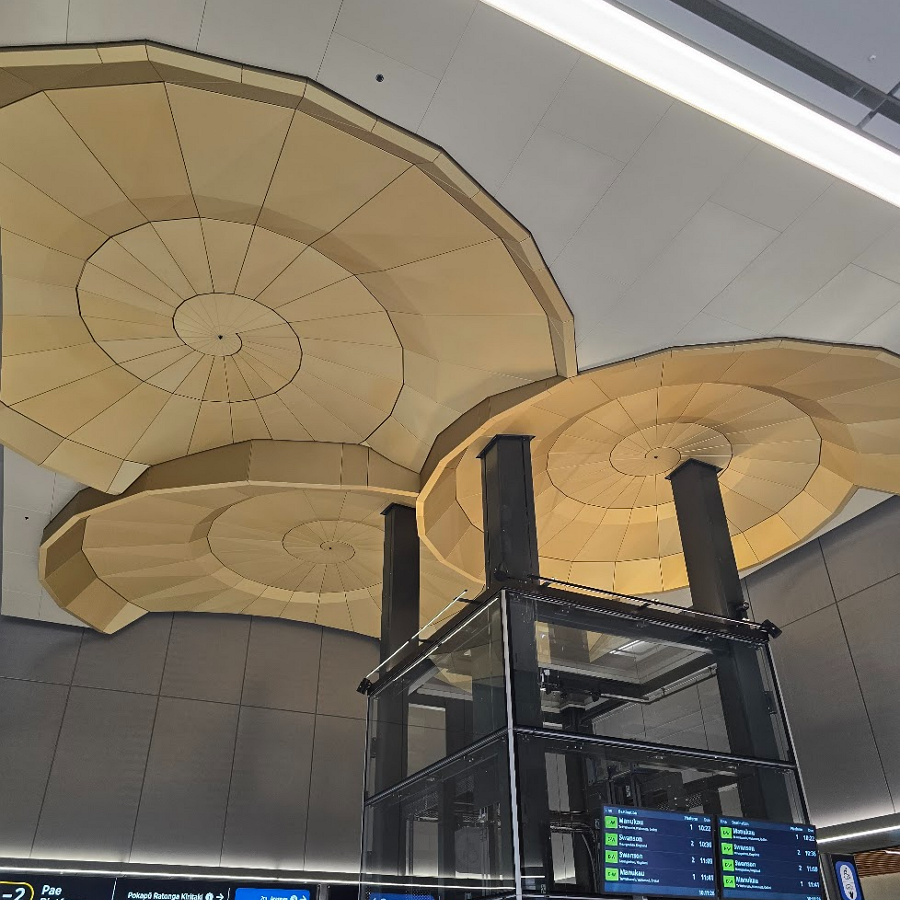
Artwork by Reuben Kirkwood, depicting the shells of pūpūrangi, native kauri snails, lights up the ceiling as you enter from Mercury Lane.
The real magic of Karanga-a-Hape is when you head deep underground, 33 metres to be exact. At first, it looks somewhat unassuming, a standard escalator to the next level down.

Heading down from Mercury Lane, on the first of three escalators to the platforms.
You then turn around and go down a second escalator… and then you do that again and head down a third escalator. And all the while, the space above you opens up, intersected only by a few beams and pillars. Here’s the second and third escalators. (The hissing sound is static coming through the PA system, as a result of some testing they were doing).
By the end of the journey you are six storeys underground. (There’s also elevators, for a quicker, more accessibility-friendly option).

Platform level at Karanga-a-Hape.
Ahead of you is a short tunnel to the southbound platform, or you turn around to access the northbound one.

How many TikTok dances will be filmed in these tunnels? Quite a few for sure.
This is the bit that feels like a true metro. You could be anywhere in the world, and amazingly, you’re in Auckland.
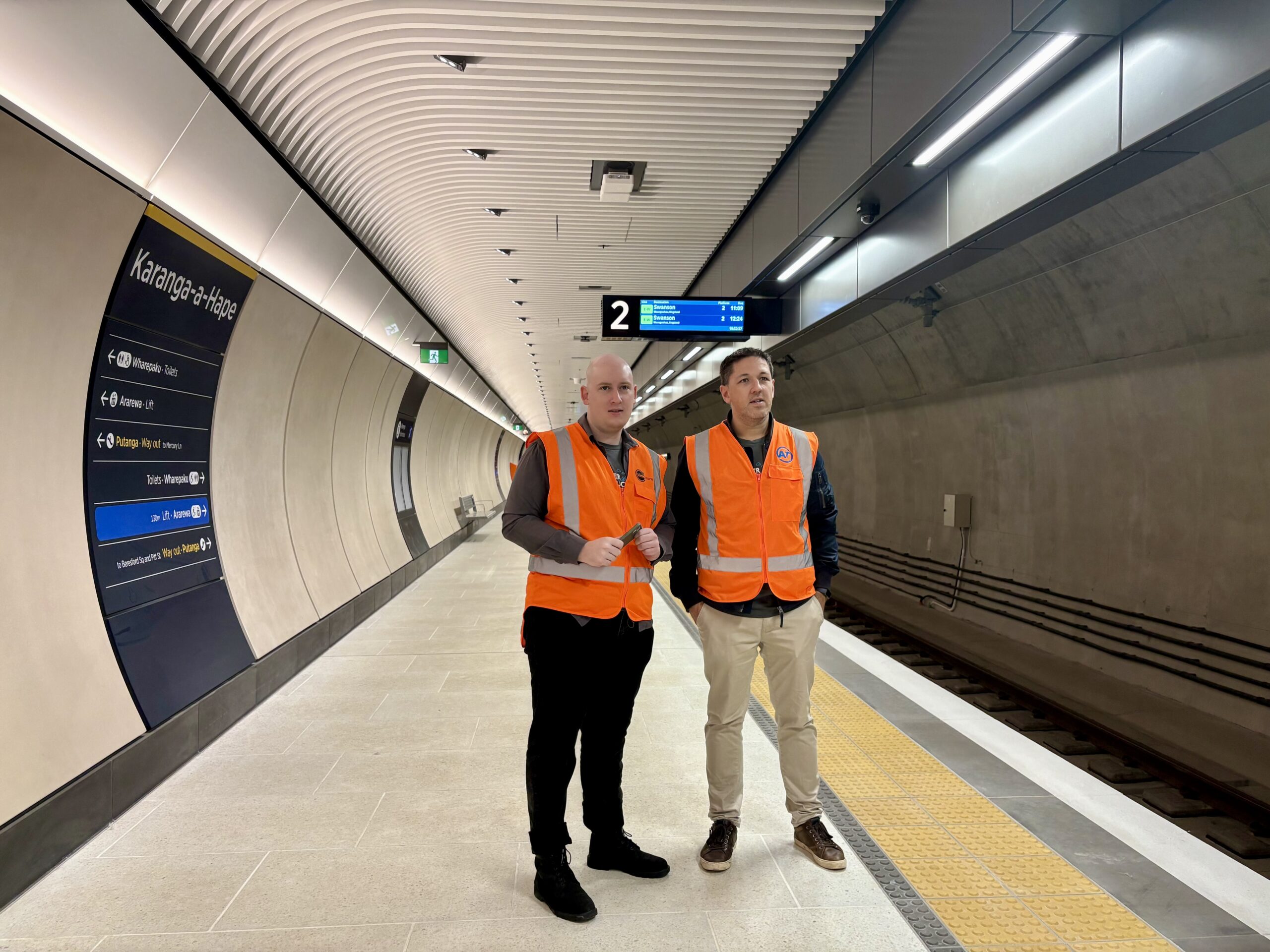
Scott and Matt: housing guy and train guy, awaiting developments…
It wasn’t planned as part of our visit, but we were lucky enough to see a few test trains using the tunnels – in this case, testing to see if the passenger displays would update correctly if a train was running on the wrong track.

“E-W Swanson”: a test train running through Karanga-a-Hape station
Here is that train heading back through the tunnel. Those who have used any metro overseas will recognise the telltale sign a train is coming, from the rumble/roar approaching through the tunnels. One thing that pictures and videos can’t capture is the gust of wind you experience as the train approaches and pushes the air through the tunnel.
And some more CRL ASMR as the train departs the station…
Readers will recall that the Beresford Square entrance was added as part of the future-proofing works that CRL’s former CEO Sean Sweeney was recently complaining about.
And honestly, the station wouldn’t have felt right without it. It’s way more accessible for all kinds of passengers, and already delivering a ton of value to the neighbourhood by making Beresford Square a destination in itself.

Space-age spaces at platform level in Karanga-a-hape Station, Beresford Square end.
The escalators up to Beresford Square from the platform level are the longest in New Zealand. At 44m long, they take just over a minute to ascend. Quite the ride! (Again, there are also elevators if you need or prefer.)

The longest escalator in the country! Up from the platforms towards the Beresford Square entrance of Karanga-a-Hape station.
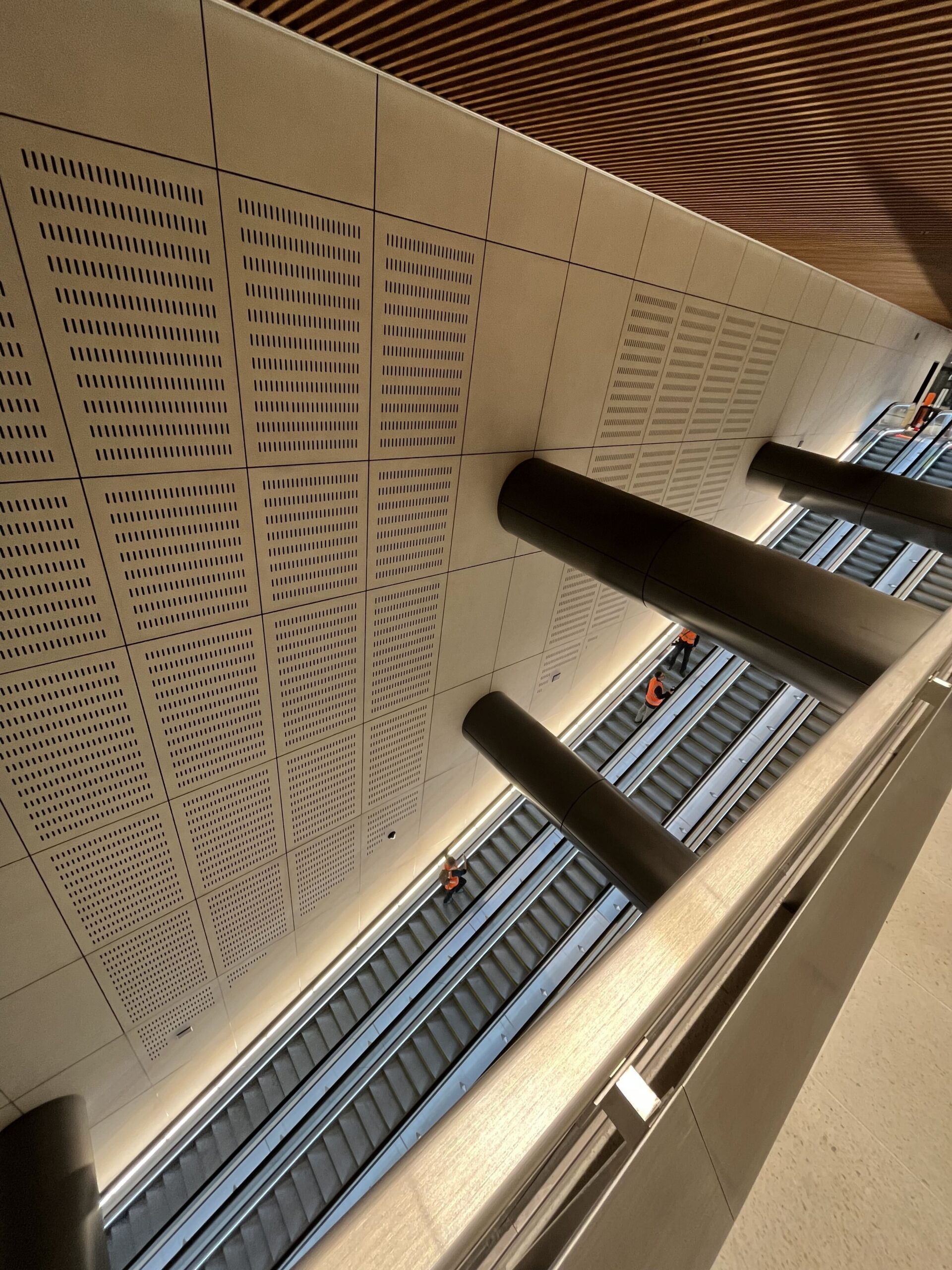
Tricky to get the whole escalator in one shot, but we tried! Photo by Scott Caldwell.
That long escalator ride brings you up to a concourse level, just below the surface – where the gate line is located – and then a second set of (shorter) escalators provide access up to the surface and out into Beresford Square itself.

Ticket gates below Beresford Square.
The artworks at Karanga-a-hape – produced by a team led by Reuben Kirkwood (Ngāi Tai ki Tāmaki) – are understated and elegant throughout, and bring a much needed localism to the design. As Patrick notes:
Architecturally, Karanga-a-Hape Station wears its London influences very strongly. The circulation levels are reminiscent of Norman Foster’s Jubilee Line Extension stations, and the platform level is very Elizabeth Line, with hints of Clockwork Orange.
Spectacular artwork at the Beresford Square entrance of Karanga-a-Hape station, depicting the phases of the moon. photo-PR
If there’s one small gripe about this otherwise gorgeous station, it’s that it’s a shame we couldn’t have one more cross-platform passage in the middle of the platform, to make transfers even easier for passengers.
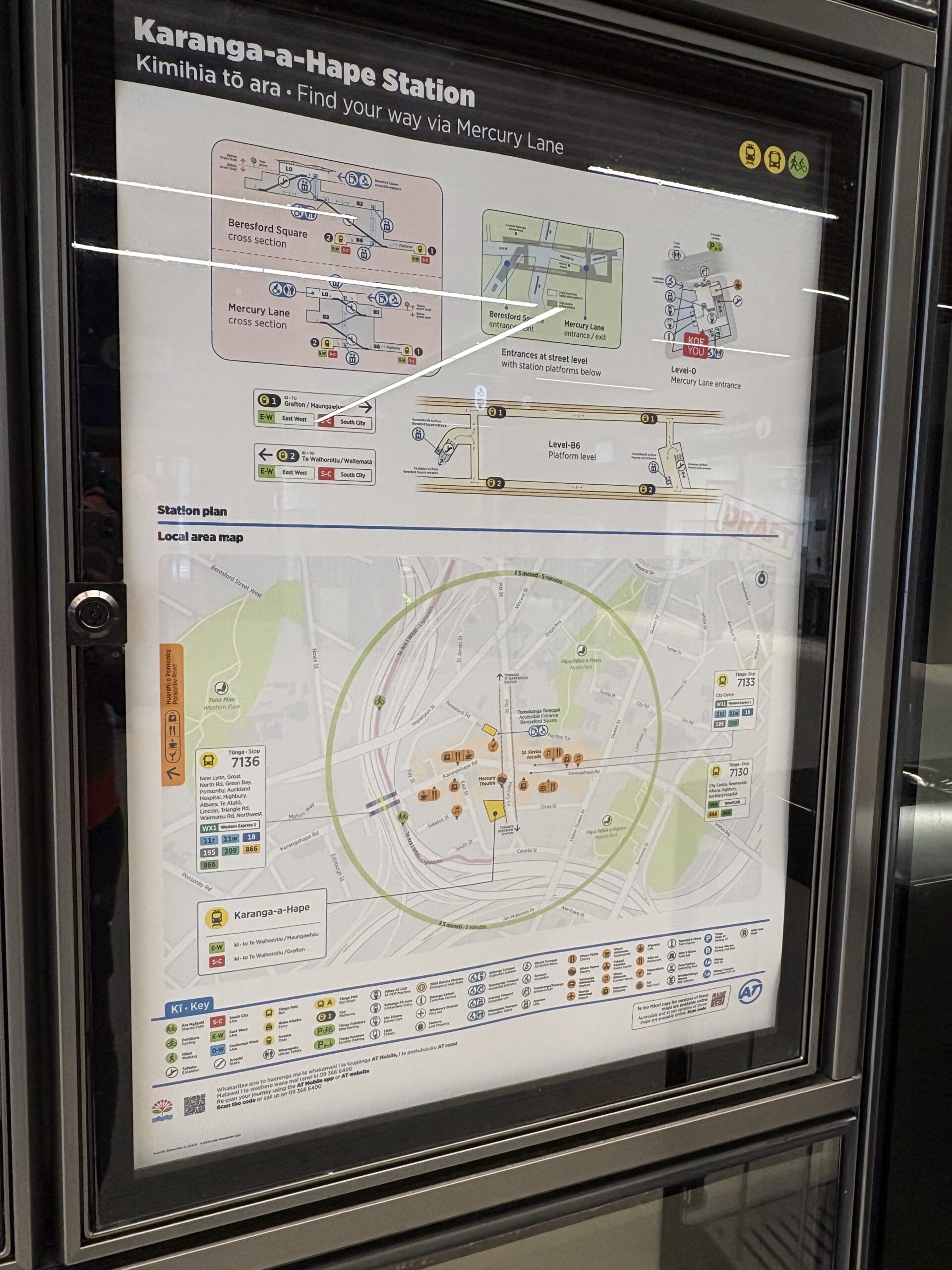
Some wayfinding posters in place already. Phwoar, check out those cross-sections of the station.
Te Waihorotiu
All three new CRL stations (four really, when you include Waitematā, formerly known as Britomart) have their own very distinctive feel. Moving from Karanga-a-Hape to Te Waihorotiu is like switching from standing up to lying down. It’s soooo long and horizontal, in contrast to the verticality of Karanga-a-Hape.
Karanga-a-Hape sure does bring the full glamour, while Te Waihorotiu feels – appropriately for midtown – much more business-like.
Of course, this is also the difference between our one and only true mined underground station, and the merely subsurface cut-and-cover ones.
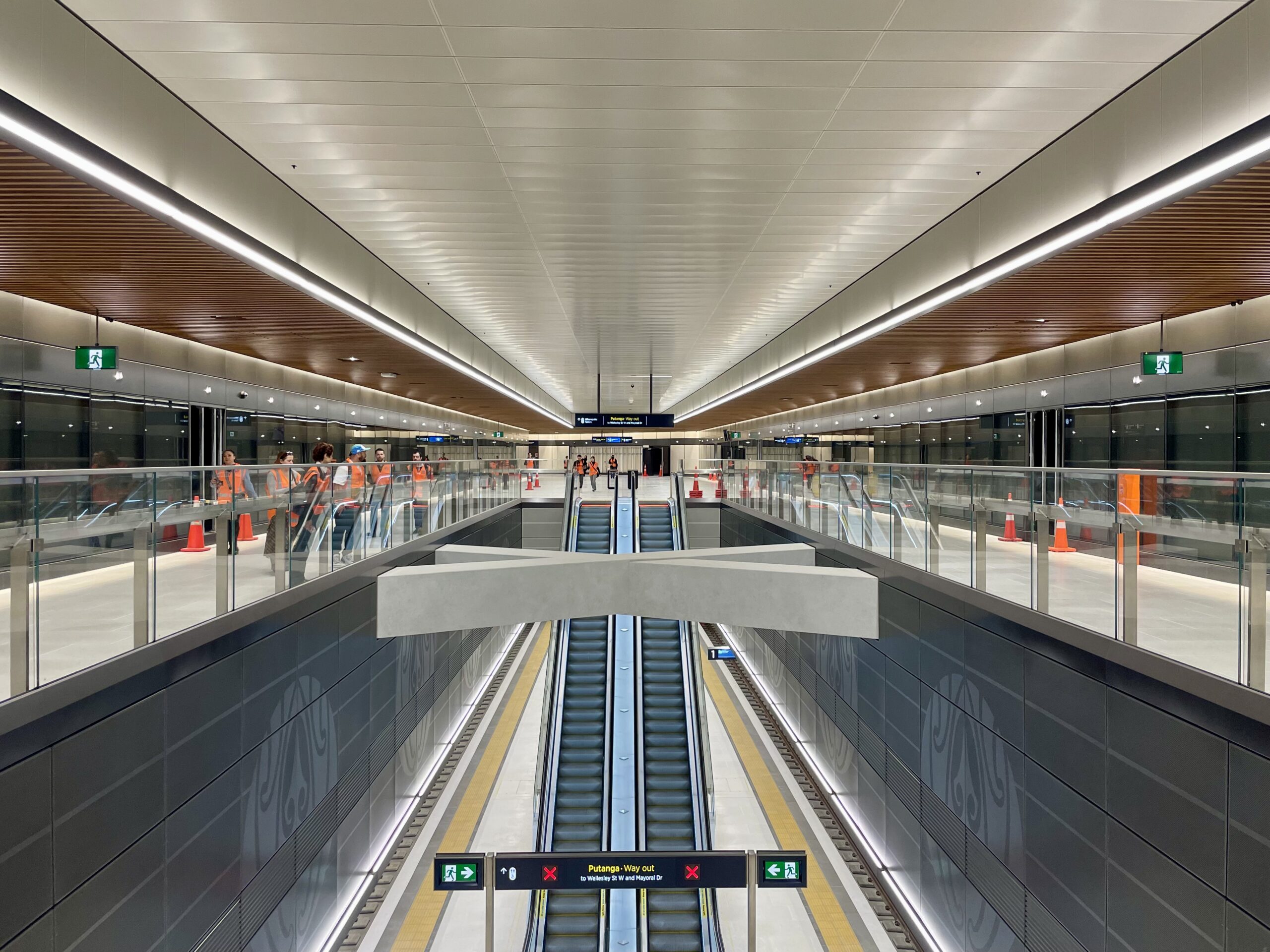
Looking down onto the platforms at Te Waihorotiu Station. (The glass-fronted spaces on the upper level will be for posters and art.) photo-PR
The concourse level of Te Waihorotiu is a bit relentless, with an airport feel to it. But down on platform level, it’s both intimate and more dramatic, a fairly narrow island platform with the great horizontal X-shaped structural elements above:

Straight lines and curving fronds as seen from the concourse at Te Waihorotiu Station. photo-PR
Each entrance has its own vibe, with nature joining in at the moment with the gold theme at Wellesley St. The hanging rods are by artist Graham Tipene, and evoke the raupo reeds that would have lined the original Te Waihorotiu, the stream that once enlivened what we now call the Queen St valley.

Ticket gates at the Wellesley St entrance to Te Waihorotiu, looking towards Queen St. photo-PR
In the middle of the entrance roof is a spectacular kauri carving depicting Horotiu, the guardian of the stream, made by Graham Tipene (Ngāti Whātua, Ngāti Kahu, Ngāti Hine, Ngāti Haua, Ngāti Manu) and Paraone Luiten-Apirana (Ngāti Hikairo, Ngāi Tūhoe, Te Arawa).
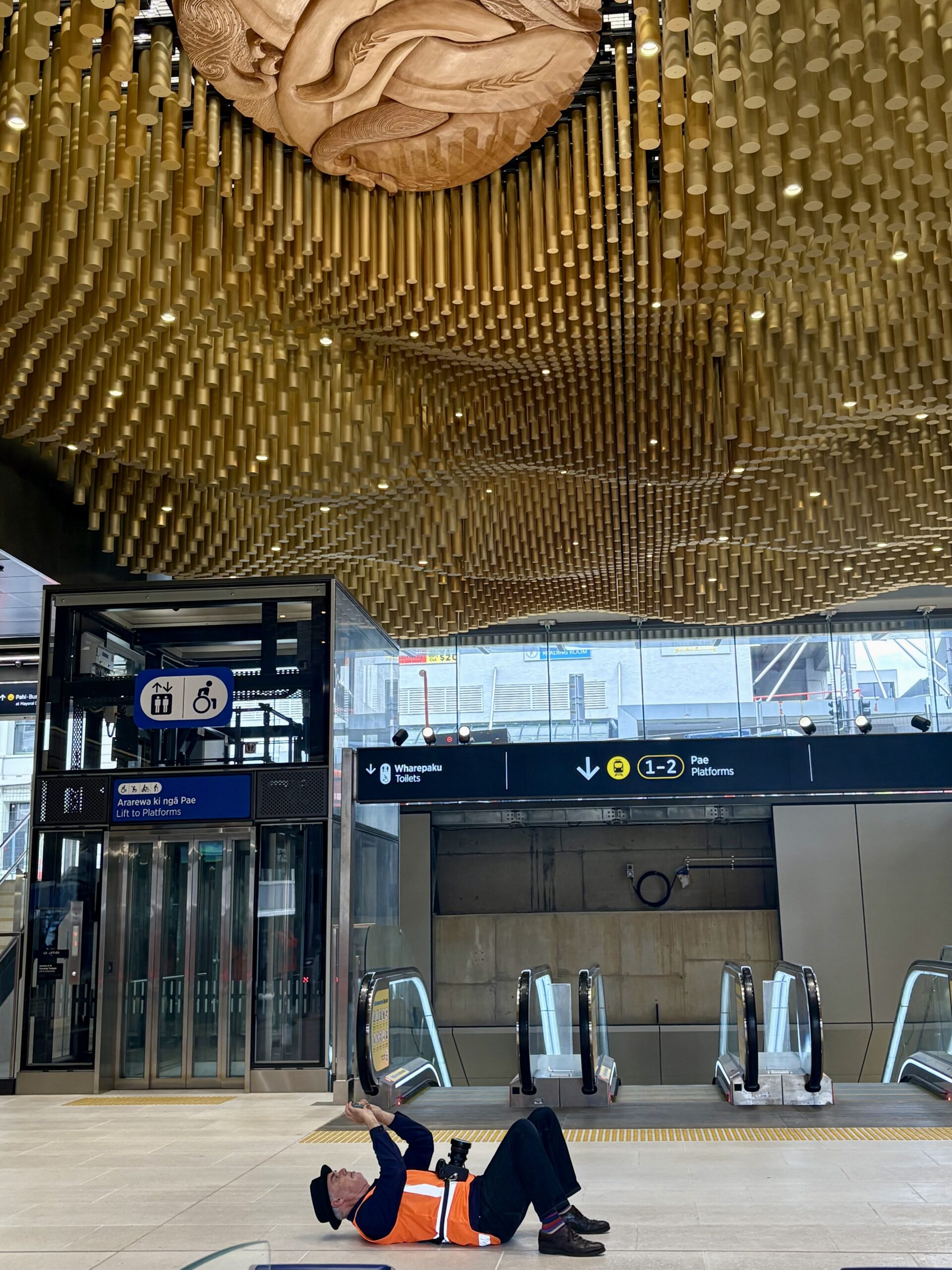
Patrick getting an angle on the artworks at Te Waihorotiu.

The ceiling of Te Waihorotiu station sparkles and delights, in a way that lets you know you could be nowhere else but here.
Meanwhile, at the Victoria St end, there’s a colourful wall of art created by children from all over the city, on the loose theme of “my dream train journey”. It’s adorable.

A wall of art by the children of Auckland, on the theme of dream train journeys.
Quite a few junior intercity rail fans out there. Maybe by the time they’re able to independently travel, we’ll have a proper passenger rail system across the motu?

Auckland’s children dream of catching the train all over Aotearoa. Make it so!
The easternmost exit at the Victoria end takes you towards Queen Street, and onwards to Albert Park. In other words, it’s the downhill entrance, but… first you go uphill to get to street level.

Te Waihorotiu station exit onto Victoria St, towards Queen St and Albert Park.
You do have to wonder how long it’ll be before we get a roof over this entrance – even in light rain, it will be a dampening experience.

Victoria St entrance, looking towards Queen St and Albert Park. A canopy will surely be needed soon.
An interesting difference between the two ends of the station is that the Wellesley St entrance is one big box, and once you enter it, you’re immediately going through the ticket gates – whether you’re coming from the lower gateway (just opposite Elliott St), or via Mayoral Drive. (Alas there’s no entrance further uphill, which is a bit of a bummer for those going to and from the Council building.)
Whereas at the Victoria St end, the gate line is off to one side at the entrance to the concourse. This means you can walk from the downhill entrance to the one closer to Sky Tower, without passing the ticket gates.

Looking from the eastern Victoria St entrance, with the gate line to the left (the concourse extends all the way to Wellesley) and the escalators up to the western exit on the right (which bring you up to street level between Albert St and Federal St).
In other words, pedestrians walking on the south side of Victoria St will be able to use the station as a covered shortcut to avoid having to wait at the Albert St intersection.
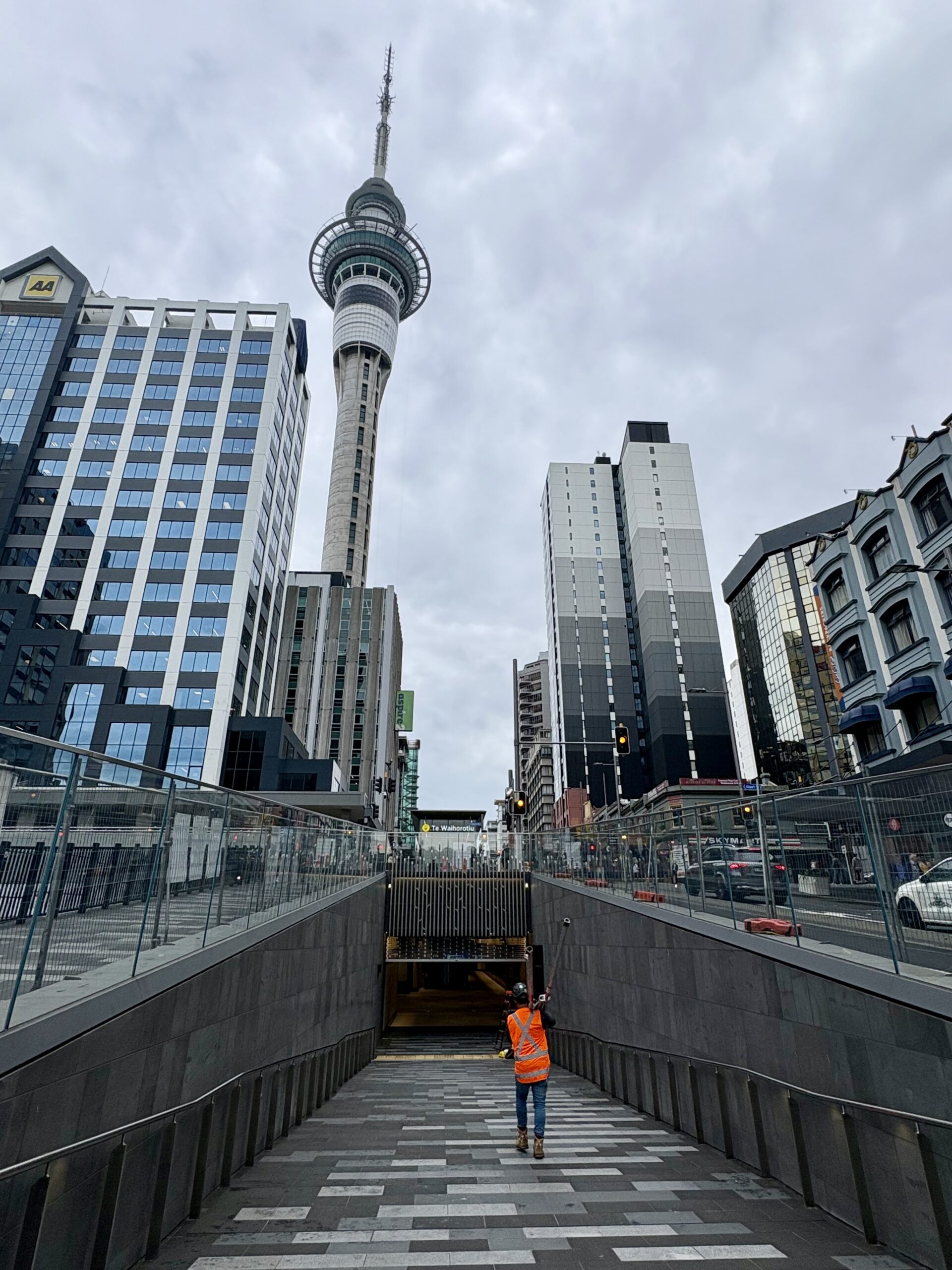
Victoria St entrance to Te Waihorotiu. If you’re just walking uphill and you don’t want to wait at the next intersection, you can cut through the station and pop out between Albert and Federal Sts.
And the question on everyone’s lips is…
So when will we all be able to ride the trains and enjoy these stations??
It appears that testing is largely going well, and Auckland Transport has said that once everything is signed off, there’ll be a 6-8 week lead time to change staff timetables, etc.
The common theme seems to be that it will be “within the next few months” – and one thing we do know is the first day will be a Sunday. So, when do you think the CRL will open?
We had a fantastic time on the tour. We’re sorry Connor couldn’t make it, although he had a great excuse as he’s off in Tokyo, train nirvana, getting his mind blown… hopefully he’ll be back!
And huge thanks to Auckland Transport for hosting us. It’s really looking fabulous, and we cannot wait to ride the actual trains through these beautiful stations.
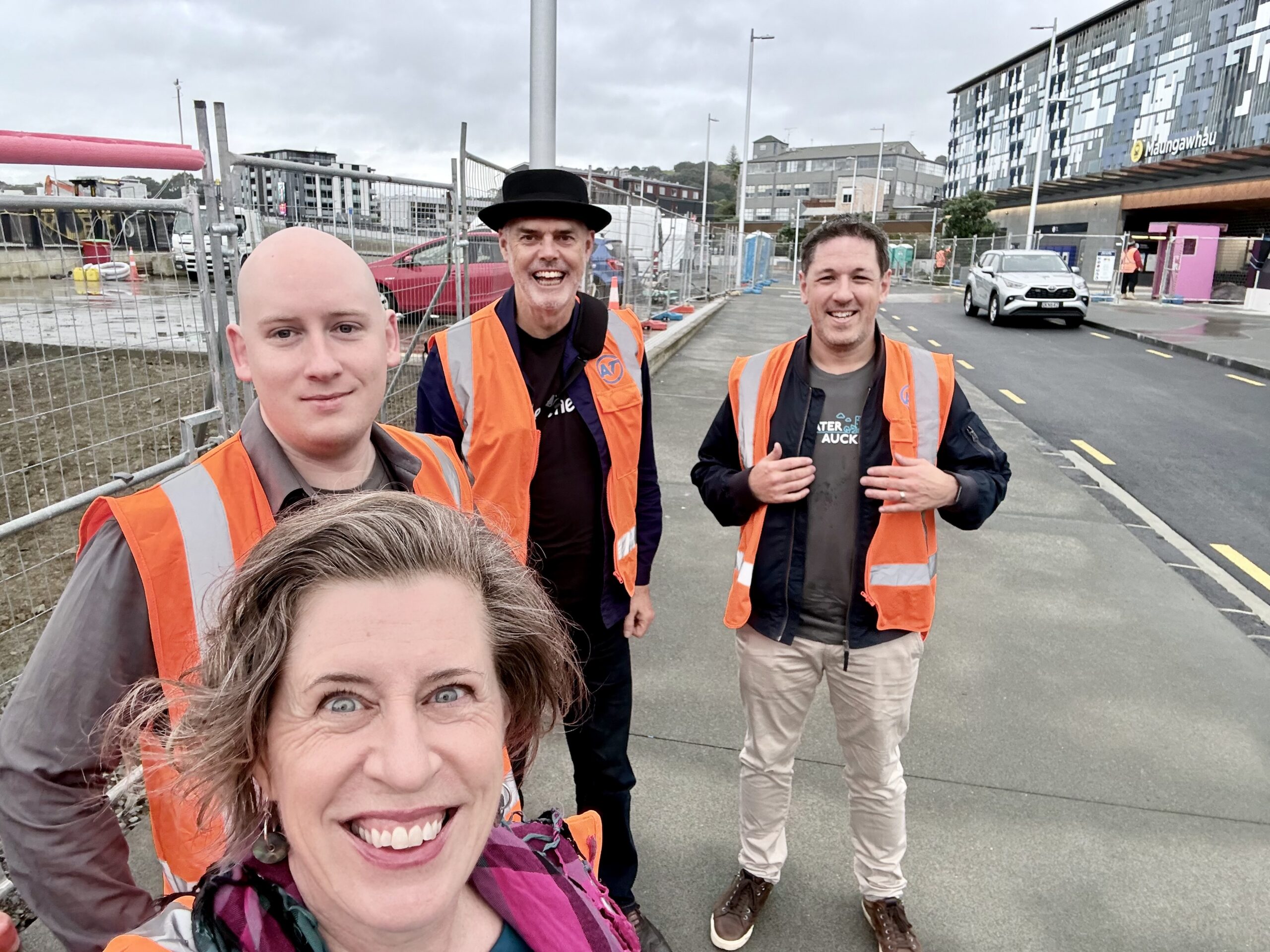
Scott, Patrick, Matt and Jolisa, feeling the fervour at the start of Friday’s tour.

Matt, Jolisa and Patrick, very happy campers.
Bonus footage: Also along for the tour with us were the clever minds behind Auckland Urban Diary, who make beautiful visual introductions to cool corners of our city:
View this post on Instagram
And the hilarious BarberKona:
View this post on Instagram
And the gals from Crushes department store on Karangahape Road, who absolutely understood the assignment!
View this post on Instagram

 Processing...
Is it confirmed you won’t be able to take bikes on the Crl?
No it’s not. Where did you hear that?
The CRL will be just be an add-on to the existing Auckland network. They’ll be using exactly the same trains which have bike capacity.
Except I believe e-bikes may be banned due to battery explosion risk in the tunnels. Question would be how train guards police this.
Source or it didn’t happen.
My family relies on ebikes and if – two months out from launch – you’re going to tell me that our very non-exploding means of transport are going to be banned, then that ruins the whole thing for us, and many other Aucklanders.
This sounds like rumor-mongering from other countries where “e-bikes exploding” is actually a thing because of low quality control (it’s not here)
That’s strange. It seems in the London Underground, you’re allowed folding bikes, including folding e-bikes. In the New York Subway copes, you’re allowed e-bikes as long as they are privately owned, and you don’t try to charge them. In Japan, I think you’re allowed e-bikes as long as they’re bagged and the battery is separate.
Is the decision being made on technical merit, ideological aversion to bike amenity, or political risk-aversion (with political risk considered equivalent to risk of triggering those with the political aversion to bike amenity)?
AT have confirmed to us that it will be the same as the rest of the network, so no restrictions on bikes or e-bikes but the recommendation to avoid them on trains at peak times
We have confirmed from AT the following:
Confirming that bikes/e-bikes in the new stations and on trains through the tunnels is the same as it currently is for the rest of the train network.
Below from our FAQs, noting that although there is the suggestion to avoid travelling with bikes at peak times I almost always see bikes at peak and other passengers make space if needed.
Are bikes permitted on the trains?
Bikes can be taken on trains free of charge provided there is enough space, and at the discretion of onboard staff if it is busy.
Note: Avoid travelling with bikes at peak times. Folding bikes may be taken on board at any time if folded and stored under a seat.
When taking bikes onto the train, board the middle carriage of each 3 car train (second and fifth carriage of 6 car trains)
To assist passengers with bikes, platform markings have been installed at stations to help you board the central carriages with automatic ramps.
Thank goodness for common sense. I couldn’t understand why they’d allow you to take an e-bike on a non-tunnel train, a ferry, or the NX1 if they really think they’re so prone to explosions.
(A quick Google says that there has been a recent rise in Li-Ion battery fires, mainly when being charged or disposed of incorrectly, which isn’t great but is a bit different from an e-bike being treated like a hand grenade.)
So much exaggeration about this from the usual quarters, of course internal combustion engines (It’s in the name!) are way more prone to fires than battery ones.
GreaterAuckland finally visiting the CRL stations. I never clicked so fast!
I, for one, appreciate the extra money spent on the artwork and design.
I would rather travel through a $5 billion architectural wonder than a $4.9 billion lifeless concrete bunker.
Its something Auckland can be proud of.
Great post and the stations are looking beautiful. A real credit to Auckland.
The type of people who moan about the cost of the artwork are the type of people who moan about the cost of the drinking fountains, toilets, bike racks, escalators, tunnels, trains, platforms….etc
Ignore the 5% of the population who are perpetual moaners. Think instead of the remaining 95%, who like nice things.
And they’re usually fine with no spared expense on road projects.
I’ve changed my mind and agree. A city’s central stations really should be spectacular. Anywhere else needs to be more cost effective.
Hopefully the Council votes to get the arterial housing density to use all of this.
Has anyone asked “veteran Leftie” Mike Lee what he thinks of the mayor of New York, the great hope of global socialism, name-checking Auckland as a place where intensification has made housing more affordable?
Most of you will know I have a whole analysis about how a swathe of “veteran Lefties” are now indistinguishable from New Zealand First because they can’t move with the times
Wasn’t it actually “Oakland”?
No because there has been no upzoning/intensification there. California is home of the NIMBYs in the US.
We should put the CRL in CaRnivaL and make it a month long celebration, with free weekend travel and events.
Absolutely! But do the miserabilist Councillors know how to celebrate?
Wasn’t there mention of station open days in the lead up to the opening? Hopefully they are made proper events, a bit like what they did when the electric trains began running
I’d love to see a big celebration, with free rides and activations! Showing people what they have been missing. Would be a shame if it’s just opened unceremoniously one day, without much notice. A free first month would be ideal!
The fact that the stations are so nice is of course exactly what Wayne Brown complains about. And to hear Redditors talk, in 6 months they’ll all smell of piss and be knife-fighting venues for homeless meth-heads anyway. I think Kiwis are deeply uncomfortable with having “nice things”.
I love how they totally ignore how Waitemata/Britomart Station is over 20 years old and none of those things.
To be fair, I worked around the berescourt area on K Rd for about 10 years (2009-19) and it was pretty disgusting at times. Hopefully the cost to maintain these new stations isn’t too excessive.
So was Britomart before the station. The least disgusting part was the army surplus store that sold nazi paraphernalia, so that’s saying something about what good public transport access can do for a place.
I kinda miss the grit. Britomart is polished, but quite sterile and bourgeois, in my view
As someone who regularly follows the Auckland subreddit, the people whinging about piss and knife fights tend to be in the minority.
I actually unsubscribed from the Auckland subreddit because it’s such a relentlessly negative place.
6 September would be my eldest’s birthday, which would be *wild* for them
Can’t wait to get on those trains. What a coup for our city. So beautiful and the art is what absolutely makes them sing. It’s only money Wayne! And we are the economy. Now we have to help those struggling businesses and cafes survive! So many empty shops. We could maybe have incentives to convert them into flats? Brilliantly described you lot! I hope they will open in August at the latest!
Great! One question about the underground platforms – I thought they were going to install transparent safety screens along the outer edge of the platforms as seen in some cities. Or is this to be a future upgrade?
Second question – I believe that the Waihoritiu station has provision for more platforms down another level to serve a future line connecting to the North Shore. Was this mentioned on your tour?
The platforms are future-proofed for safety screens, although there is no plan to put them in just yet.
would you have an answer for the second question re plans to expanding to the north shore in the future? cheers.
Very doubtful, it’d require the new harbour crossing shortly to be announced to be enabled for heavy rail, and the chances of that happening are basically zero.
think the ALR tunnelled light rail/light metro plan might have been intending to make use of that provision
The ‘provision’ is that the structure of the station section passing under Wellesley Street is designed in a way that it’s not entirely impossible to dig another train line perpendicularly underneath it.
All good then.
Yes it is essentially a ‘bridge’ structurally at Wellesley St. No piles below that section. That’s the full extent of the “future-proofing”.
Well also (maybe not intentional, but in effect) it’s futureproofed too in that the concourse level runs the entire length of the station so that those future North Shore platforms under Wellesley Street can be accessed from Victoria Street along the concourse (eg you will be able to access any platform from any entrance)
Platform barriers have never been in scope as far as I’m aware.
I think completing ETCS implimentation in Auckland, and expediting installing ETCS in Wellington, should be much further up the rail safety priorities hierarchy.
Thanks for sharing, GA! So cool can’t wait. Love your bonus content too!
Sitting on a western line train waiting outside Newmarket for a platform to open up for five minutes all I could think was the CRL can’t open up soon enough.
Wonderful photograph of the three of you.
And of the four of you! Great photos and videos all around. Thanks!
That wall of children’s art is fabulous. Nicely executed.
Except they will probably all cringe whenever they see it.. they’re all 18 now,
From: 2019 when the are was drawn
“We’ve chosen Year 6 children – 11-year-olds – because they will be leaving school when the project opens in 2024 “
Nah, they’ll have a chuckle with their friends.
Had a big city holiday in Auckland a couple of years ago and the trains(and ferries) helped make it fun so these new stations and the CRL will be mega. I’m a bit old and doddery so I preferred lifts to down escalators but otherwise. Kiwis from all over should consider an Auckland holiday when these open.
That’s great to hear.
While its great you can traverse Albert street underground via the Victoria St W Entrance, its a shame you have to “Tag on/Tag off” if you want to walk under cover through the station to travel through to the Wellesley St exit….
In a number of similar stations overseas there is often a passage way – usually with a glass wall/fence, that allows you to traverse between exits with out have to tag in/out (Sydney’s Town hall is a good example)
And won’t water flush down that Victoria St entrance in a heavy downpour?
I was thinking that too, My glass half full thought is that on the flat section about halfway down there is a big cross drain that will catch the flow…
Seems odd its not covered though… given what they’ve done on the uphill side…
Put a roof over it, allow people to walk onto it, put some plants on the roof, put some benches under and next to the plants, have a coffee cart nearby.
We’ve had some heavy downpours recently – if there was a problem we’d have heard. I expect that, being engineers and all, the designers thought about that…
I think if there was a heavy downpour and a heavy flow started coming down Victoria Street, most of the water would just continue flowing down towards Queen Street because it would have to do a 180 degree turn to enter the station. The station would only be affected by water that fell on the ramp itself.
Agreed, or the uphill areas of footpath maybe. I’d need to take a look.
Those traffic lights are terrible for pedestrians – I work near there and they always take ages before we can cross, even when not much traffic. Having a shortcut option would be great.
Parkville in Melbourne is like that too, with even a KFC, McDonalds and 7/11 on the free concourse lol.
So, let’s say I’m a deaf commuter, and I don’t read English; how would I know that I was in Te Waiohoritu over Karangahape from my seat in the carriage?
Well the fact that the platforms and concourse have completely different shapes and layouts ought to help? They’re very distinct, especially in comparison to metros in most other cities (Melbourne’s new metro tunnel has 3 or 4 notoriously indistinguishable stations)
Not really sure what else you could hope for, if you’re discounting the ability to hear or read.
Hopefully they do have different layouts. I don’t know. I’ve not been privileged to see yet! If they are different layouts, then hopefully it will be enough for a person to associate a layout with a particular station.
For instance, I used to live in Montreal, and artwork was used to distinguish stations from each other – I can’t forget the liberal use of yellow for Isle St Helene, or the brickwork of St Denis, or the sterile grey of Lionel Groulx.
Te Waihorotiu is an island platform in a long box, while Karanga-a-hape is two platforms in separate “tubes” that are linked by cross-passages.
There’s name signs on the platforms and walls, plus both stations would be distinct enough to tell from each other (central island platform vs side platform) and Waitematā station
When u get familiar enough with each it should be easy to tell from a glance where u are (assuming ur not just, counting ur stops and getting off at x number)
But if a person can’t read English or Te Reo, is there something else – some wall feature, some design feature that tells that person they are in Te Waihoritu versus Karangahape?
You suggest that one station has central island, and the other had side platforms – that would be enough for people to associate with that station – e.g. if Te Waihoritu had a central island, and Karangahape side platforms, then that would be enough hopefully for people lacking ability to read English or Te Reo to say ahh, central island, it’s Te Waihoritu.
Hopefully this is the case! If the two stations are identical, then we need visibly different identifiers e.g. colours, or wall design (using bricks on one wall as a decorative feature, using art tiles on another station wall, etc). Hope that makes sense.
Chris I’ve used metro all over the world including Russia.
I had no problems working out where I was irrespective of language. Even in Moscow and St Petersburg with Cyrillic everywhere, I was still able to work out which station and line I was on without the help of the awesome architecture and artwork at each stop on those two lines.
Your making a straw man arguement.
Chris each of the stations are unique even at platform level, because of the physical constraints at each site there was little opportunity to standardise anything.
For example K Rd has curved bored-tunnel shaped walls, is the only one that does.
BTW, these are false, there’s vertical structural walls behind the curved cladding, as the station sections weren’t bored, but mined. But I appreciate this fiction as K Rd is the only truly underground station on the network, nice design detail.
TK has a distinctive narrow platform, which will be easily recognisable from the train.
But anyway, even if you don’t understand a language it is usually easy to recognise the shape of the station name you’re setting out to get to. That’s how I used systems all over the world, even those with completely different alphabet systems.
Whether you read English or not shouldn’t affect your ability to read Māori signs
Same way you tell the difference between Remuera and Greenlane.
Am always puzzled by those that say the Te Reo names means no-one will be able to find them. When I get the chance I reply by asking how they have ever managed to get to Remuera or Takapuna- usually shuts them up (though of course doesn’t please them).
In the last 3 weeks I’ve used metro in Budapest and Vienna. Easy enough to recognize an upcoming station name without understanding the language. It’s just a string of letters.
I’m dyslexic and I have a lot trouble with some of the longer more complex names – remembering them, spelling them, pronouncing them. I have trouble when travelling overseas as well if the suburb/station names are longer or more complex. I’ll eventually figure them out – but it will probably take at least 3 months. Remember that some of us have disabilities and/or other challenges. I hope there is more seating than in the current Britomart station.
Te Reo Maori is written in the same latin script as English, with the difference that it’s much more phonetic and easier to pronounce… so uh, yeah. What’s the problem?
Oh, someone who is both profoundly deaf and also cannot read latin script, who is using the stations for the first time. Probably an edge case that can be managed I think.
That’s funny! Applies to Orewa too I reckon 🙂
Well your typing in English are you not?
I am so excited to both use the CRL for functional purposes, and also to take in the scale and beauty of these stations. Call me a sucker, but amazing spaces are what get me coming back to places I visit.
THERE ARE **TWO** BUS STATIONS SERVING WAIHOROTIU STATION: they are *BOTH* called ‘TE WAIHOROTIU’. This is CONFUSING if you are not in the know! Could they not at least be called ‘TE WAI HOROTIU SOUTH’ and ‘TE WAI HOROTIU NORTH’ or similar?????????
the bus stops serving Te Waitorotiu Station are already distinguished by letter designations: stops A through G
Star Wars vibes
Isn’t it disappointing that AT seem to have abandoned upgrading Cross Street altogether? I suspect they’re now going to leave it to Auckland Council to sort out (which might not be such a bad thing as long as none of the idiots get transferred over)
I’m sure when that road is rammed solid with pedestrians in a few months time, it will permanently close to traffic and be smartened up although it will probably take a pedestrian to be seriously hurt/killed before it does
Yeah, ain’t that the truth.
With a weekly cap of $20 I’m looking forward to using these stations and exploring the city soon.
Not the biggest fan of Labour in recent years, but I think this is fantastic policy. This alone might win my vote for the party
I think it’s a great policy – fits my PT should be cheap but not free ethos to a tee. Probably won’t influence my vote though.
—
Re the CRL preview, it looks great, can’t wait until it’s open.
Relative to the escalating cost of driving (and parking), $20 pw will be pretty compelling for many.
The CRL team dug too greedily and dug too deep. They uncovered a Balrog.
Love the post. And LOVE THIS FOR AUCKLAND – and for all of us! Can’t wait to hear when it’s open – Imma book some tickets to come visit! Yes, train tourism. Imma ride the trains and get all over Auckland in jig time, and check out all your se*y stations. (oh Also, superb content from the Crushes girls. Top marks)
Great excitement! But please don’t censor sexy, that hurts my head.
Thanks Greater Auckland! Wish I was on that tour. It’s great to see Auckland becoming a real metro city.
Te Waihorotiu is very Singapore style, reminds me of some of the new DTL or TEL stations.
Karanga-a-hape reminds me of Helsinki’s deep underground Airport commuter rail station or maybe Paris’ Saint-Denis – Pleyel hub built for the Olympics.
Maungawhau’s ‘train-on-train action’ and vertically complicated infrastructure is a nice Asia-Pacific touch, very Korean or Japanese.
However the station artwork and thoughtful design is pure Aotearoa and I am so proud of Auckland for this world-class place-making piece of infrastructure.
Keep it up GA and Auckland! Let’s build light rail to Mangere and the Shore next 🙂
⬆️ excellent comment, exactly.
Thank-you. Yes Particularity is valuable, the Te Reo and the art works do the heavy lifting of that mahi.
Superb pieces of architecture and engineering, my congratulations to the design team. One thing though – you say:
“Architecturally, Karanga-a-Hape Station wears its London influences very strongly. The circulation levels are reminiscent of Norman Foster’s Jubilee Line Extension stations, and the platform level is very Elizabeth Line, with hints of Clockwork Orange.”
Hmmmm. Incorrect. I think you are possibly thinking of the Westminster Station in London, which was designed by Michael Hopkins and Partners, with a very similar vibe to the Karanga-a-Hape station. Nothing to do with Foster, whose team only worked on one station, the Canary Wharf Station for Jubilee Line, and then decades later the Canary Wharf station for the Elizabeth Line. There were 10 different architects on the Jubilee Line, spread over the 12 stations.
Yes i am thinking of Canary Wharf
Its also very clearly reminiscent of the station at Canada Water, also on the Jubilee line.
Great call.
Does anyone know why there are no commercial businesses allowed inside the stations, like you might see in other countries?
Feels like it would be great for a little hole in the wall dairy somewhere in a couple of the new stations.
There are some retail spots in the station buildings, two retail tenancies in each station.
oh nice, that small cafe at Waitemata has good coffee, so looking forward to similar in the others.
Wine bars. Hole-in-the-wall wine (and beer) bars, in advance of the trip home in the evening…..
How about four small retail/hospitality units into a widened footpath at Te Wai. Could be a nice place to sit and enjoy one of the new stations. Having lunch or dinner after work just metres above frequent trains ready to take you home. With all the lovely new ebuses Ak/tm has now it will be a nice environment above ground around the new stations. A quick sketch-up I did which I think could have been incorporated from the beginning of the station design process to activate this whole side of the block at no real cost to the overall project. Would also have then provided an ongoing income to the city as landlord..
https://imgur.com/a/XFIqlOx
Great stations and pics/vids thanks. Long term I think the extra design and art effort is worth the cost. Still waiting on the govt to pay another 25%-50% though which would be fair like they treat big Wellington etc projects.
Hello! Great tour, thank you! Any intel on size of lifts please? From one photo I hoped they might be big bois like at Waitematā but I don’t want to get my cargo bike hopes up without confirmation.
Good question, I should have measured them! They felt big enough for bikes of size, maybe two at a time?
My only winge about all of this are the station names of Britolmart and Aotea Square.
They should have remained as is.
Both names are iconic, historic and areas people can easily associate with while the new names cover a massive body of water and a rapidly grown town just outside of Hamilton.
As someone who grew up in the Waikato very close to Horotiu, I can forsee issues arising in the future when we finally have Waikato suburban rail as the real Horotiu is growing quickly, is on the main line, and already has a platform (that was used by AFFCO employees back in the day).
The station name is Te Waihorotiu, not Horotiu.
We have,for decades had stations called Mt Eden and Glen Eden in the same city, on the same line, with no issues of confusion. Why would Te Waihorotiu and Horotiu over 100km apart in different cities be a problem?
Come on sailor boy Te Waihoritu is a stupid name. Aotea or Aotea Square was way better Maori name for the station. I agree it was stupid changing Britomart to Waitemata but we all know the reason because it wasn’t Maori enough. I wouldn’t be surprised if TWH gets changed back to Aotea as people will get confused. Mt Eden should’ve been changed to Eden Terrace but I guess that wasn’t Maori enough either.
It’s not a stupid name by itself. I note the anti-Te Reo warriors online call it Midtown. Maybe that might stick.
But I agree on Aotea. It’s a grand name that aligned with the notable sites around there. Shame.
wow, the fool who thinks $20 billion for an unnecessary motorway to a low-population rural region is fiscally responsible is also a rabidly anti-woke anti-Te Reo ideologue who supports the agenda of erasing our unique indigenous culture and language and making this country a generic anglosphere copy-paste indistinguishable from white Australia.
who could’ve seen that coming? (/s)
Aotea has absolutely no authentic connection with midtown – is the original name of Great Barrier Island, and means dawn, which is fitting to the region’s eastern most land mass, but not with the roof of a carpark in midtown. Was chosen by some committee with no consultation with Iwi, back in the day.
Let it go, we do these things better now. Particularity and authenticity matter, are valuable.
Sure “Midtown” would be ploddingly accurate, and I get that some prefer beige and grey, to art and beauty, but it is a mistake to plod when you can be poetic in city making. Higher ambition gets you on more maps, and attracts more visitors.
We have vast sweeps of dull suburbia with fanciful Anglo names that the threatened can remain in, if a little Te Reo is too real for them.
Burrower where did I say I’m anti Te Reo? I LITERALLY SAID IN MY COMMENT I LIKED THE NAME AOTEA/AOTEA SQUARE WHICH IS A MAORI WORD!
Why does it matter where Aotea is for the station name when you think Waitemata is ok when it could literally be anywhere on the harbour. The most accurate name would be Quay St or something but everyone still calls it Britomart hardly anyone uses the other name.
The station names should’ve been Britomart, Eden Terrace, Aotea Square and Karangahape. Notice how I approve of the use of 2 Te Reo named stations are you sure you’re not just anti English? I really think most people would support Aotea Square as the name over midtown even a few racists.
“…stupid name”? Wow. Incredibly disrespectful to the iwi who thought carefully before gifting these names.
They’re actually a smart and holistic group of names. Picture yourself arriving from the south or west. First, you reach the highest point on the line, Maungawhau. From there you pass under the ridge named for Karanga-a-Hape and down alongside the stream, Te Waihorotiu, before reaching the harbour edge at Waitematā.
All referencing the actual geography. Smart, elegant, attractive, unique and culturally relevant.
I stand by what I said Lindsay, Te Waihorotiu is too much for anyone who is dyslexic or learning impaired. It means nothing to anyone except for maybe the iwi which is not the majority of people.
I’m picturing myself arriving from the West, I see that Mount Eden station which is really closer to Eden Terrace has been renamed to Mangawhau I think in my head “that’s a little woke but I guess nothing changed except the language so I’ll live with it”. Then up to Karangahape “makes sense given it’s on K road”. Then on to Te Waihoritu “stupid name Aotea would’ve been better” and Waitemata “which bit of the Harbour, oh wait this is just Britomart”.
Yeah honestly that little story you provided did not change my mind one bit. Aotea Square which most of the population knows about and all the cultural events that happen there is much more relevant the Te Waihoritu ever will be. It doesn’t even roll off the tounge nicely like the other 4 Te Reo named stations. It sucks. I’m going to give feedback to AT the moment it opens I want it changed to Aotea Square. I think you’ll be surprised as to how much pushback this generates given a high % of train users Weren’t even born in NZ and they will not understand why they named it that.
I’m a bit confused with Burrowers white Australian comment as I’ve ridden trains throughout Aus and generally if the suburb has an aboriginal name the station is always named after that, off the top of my head on the way to Newcastle you pass Ourimbah and Mount Kuring-gai which are really cool aboriginal names. And on the T4 Caringbah & Kogarah. Either Burrower was just telling porkies or just trolling.
James – seeing as you’re too thick to get my point, I’m talking about the Anglosphere in whole – this copy-pasting of boring bland English culture onto colonised countries.
Without indigenous cultures and languages, New Zealand and Australia would be culturally indistinguishable. Pakeha culture particularly the rural farmer types is far more Aussie than those folks would like to admit.
Suck it up, snowflake. Waitemata makes sense, Te Waihorotiu makes sense, you can try a bit harder to exercise your brain and memorise a new word and I just know your sort wouldn’t be complaining about long-winded English placenames
Sorry Burrower I’ll probably live with Waitemata, I’m NEVER going to accept Te Waihoritu. There is nothing about it that makes sense. Is it named after a suburb or major landmark or even a geographical location in the city? NO. This is going to confuse locals let alone tourists. We don’t have to listen to the iwi everytime we name something and not everything has to have a Te Reo name for the sake of it I already said I would like 2 of the stations to have Te Reo names so don’t go round screaming I’m racist.
I know you don’t care about dyslexic people like myself but that doesn’t give you the right to call people with dyslexia or other learning disabilities thick. There is other people who will struggle if they don’t have the best eyesight thanks to AT putting the Maori words in big bold letters with the English words which the vast majority of the public speak in smaller letters underneath.
Notice how I literally do not complain about any other Maori station name that’s already there? Sorry Te Waihoritu is peak stupidity and the people who came up with and approved it shouldn’t be allowed to name anything else. I’m going to keep writing in to AT requesting a name change this is ridiculous.
Yup it is named after a geographical location
Aotea was renamed ‘Te Waihorotiu’ after the Waihorotiu Stream that flows below Queen Street.
James lets call it Britomart and Mid Town or Aotea. Also lets get the motorway built all the way to Whangarei!
Britomart is named after an English ship which in turn was named after a Greek deity. Don’t see how those have anything to do with NZ – Waitematā makes a lot more sense
Right on, Burrower. Britomart was always a stupid name plucked out of a colonial hat by a faceless bureaucrat who never asked anyone whether it was right. The area went a century without being called Britomart before then, so 20 years since hardly stokes the historical validity furnace.
Aotea even less so… Of all the locations people will be using that station for, Aotea Centre is probably amongst the least relevant day to day. Besides that, the station was never actually called Aotea. It was always a placeholder name and never consulted or approved outside of a council backroom.
Mt Eden station on the other hand is gone. I mean physically erased. Not a stone of it remains and the vast majority of Maungawhau station’s infrastructure is built on or under a different location than the old station was.
It’s long past time for the fabricated name debate to sail out to sea and be scuttled.
One thing I noticed overseas and to a lesser extent at old Britomart, was the difference between ‘just’ a functional transport station and something which is … more, more like a place you want to visit and dwell a bit and/or meet up with people
I like when shops co-exist with the stations, which have some sitting spots, or even just walking short cuts through a building, rather than just face a barrier of ticket gates up front
Maybe just the angles, but only pictures I didn’t really like were unfinished first external shot of Maungawhau. It looked like a dead end and not something I want to walk/cycle to, but hopefully will clean up.
The other one is the “Ticket gates at the Wellesley St entrance to Te Waihorotiu” ; that barrier seems to deter people from entering just to hang out
I suspect some of that design work might be to deter homeless
Not a CRL related question but about the train.
I noticed on the display on the ceiling which tell you the next station etc. I often wonder where did the temperature reading came from. It was quite cold this morning yet the temperature said 16 deg. is this the inside train temperature?
It seems to be around 3 deg higher than the actual outside temperature so the sensor is likely situated outside but just poorly located so it’s taking in some extra heat off something.
I think the sensor is located inside the HVAC duct. The temperature inside is usually around 19-22°C depending on outside temperature and how much heat the system can move to achieve the target temperature.
That lead up to the K’Rd station via Cross St could be awesome, in conjunction with that new art.
I can’t recall the plans, but a shared (or pedestrianised) space with cafes, restaurants and bars lining the right hand side, people and pints filling the street. The “George” building to the right – a lot of potential, at least from the outside.
Yeah there were plans to upgrade Cross St, but the NIMBYs and miserablists got them cut for now.