With the fuel crisis ramping up, all eyes are on the government’s response. Officially there’s a plan, with four phases. There are two relatively similar phases, Watchful and Precautionary – and then a quantum leap to quite serious measures at phases 3 and 4, Managed and Protected, both currently under consultation.
At each stage, there are notes on what individuals “can do”. As quite a few people are noting (with varying degrees of dark humour), the phases seem a little… discontinuous.
BREAKING: Here is more detail on the National Fuel Plan's four "phases". We are in phase one.
— henry cooke (@henrycooke.bsky.social) 2026-03-26T23:05:17.042Z
Of course the first step of confronting a problem is admitting there’s a problem, and this has seemed a bit of a stumbling block for the government so far, with a few exceptions.
Transport Minister Chris Bishop gave a speech last Friday to the annual conference of the New Zealand Automobile Association, which included a number of interesting comments. Here’s a snippet:
When global supply chains are disrupted, as they are now, that exposure becomes very tangible for families and businesses who feel the pain at the pump.
We are already seeing significant shifts in behaviour across the country, and as a government we are closely monitoring these changes so we can respond to their impacts if needed.
Using data from a sample of vehicles across the country, we can start to get a rough idea of how people are responding to this conflict.
Comparing the two weeks pre-conflict in mid-February against 7-day rolling averages for subsequent weeks, we have seen a reduction of approximately 20% in the vehicle kilometres travelled by cars. Not necessarily surprising when petrol prices have gone up 30%.
Also not surprising is that people are responding in a predictable way so far: they are using public transport more, with boardings up by more than 10% in Auckland and Wellington. MOT will be publishing updated data regularly, starting later today.
First, a caveat: it’s too early to say if the sample the Minister refers to is representative of the country as a whole, let alone whether these travel change trends will continue, and at what rate.
That said, a 20% reduction in VKT is massive. It’s particular striking because, in the past, many officials and ‘experts’ have claimed that reductions on this scale simply aren’t possible – or would be extremely hard to achieve. But if a sudden rise in fuel price alone can reduce driving by up to a fifth, then all previous bets are off.
So on that level, the current and developing crisis – while obviously stressful, inequitable, and still uncertain on many other levels – will be a valuable test of many long-held assumptions that sit at the heart of our transport assessment processes. It will also be incredibly useful for analysis and debate over transport planning in general, and policies like congestion pricing (more on that soon).
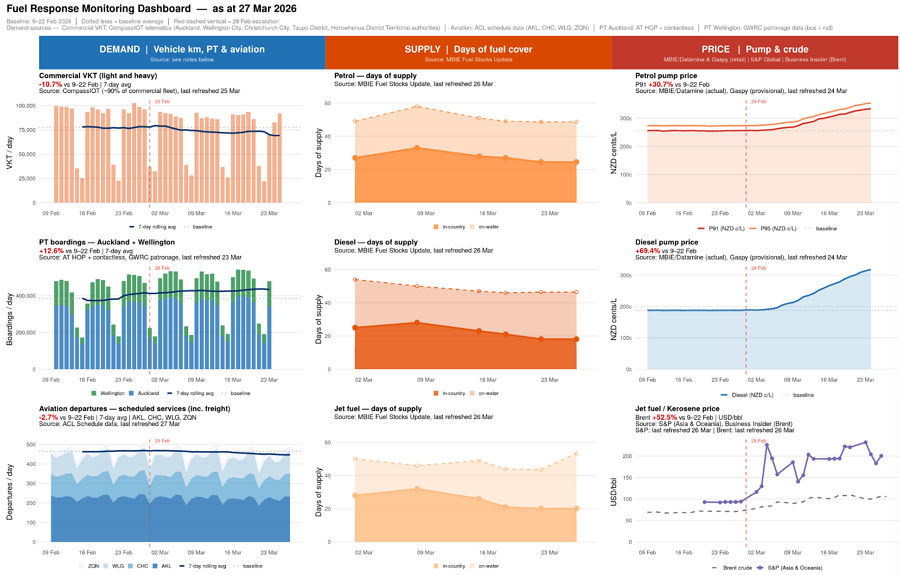
That data dashboard Bishop mentions can be found here, and this is how Ministry of Transport describes it:
What it shows
- Kilometres travelled by heavy and light commercial vehicles on a daily basis. We expect to include light vehicle data shortly.
- Passenger numbers on public transport in Auckland (bus, rail and ferry) and Wellington (bus and rail).
- The number of scheduled flight departures for passengers and freight in Auckland, Christchurch, Wellington and Queenstown.
- The number of days of fuel cover, sourced from MBIE, covering petrol, diesel and jet fuel.
- The changes in the prices of petrol, diesel and jet fuel.
And here’s the first iteration of the dashboard, as at 27 March 2026:
 In his speech, Bishop continued:
Interestingly, last week saw more than 1,000 electric vehicles registered, close to double the week prior. This makes it the biggest week in EV registrations since the end of 2023. Year-to-date registrations are nearly 2,000 higher than this time last year.
Heavy vehicles are also down around 5% over the last few days, despite an increase of 70% in diesel prices. This is expected – those who rely on heavy vehicles for freight or commercial use have far less ability to respond to these kinds of price shocks with immediate alternatives.
Gliding over “since the end of 2023” (which obviously correlates with the incoming government putting an end to the Clean Car Discount), it’s not surprising there’s been a sudden jump in EV sales. Those who can afford to make that call are taking quick action.
Perhaps the bigger question is how long it will take for dealers to get more stock in, especially as that stock will now be in extremely high demand in other countries.
While not directly related to the fuel crisis, Bishop’s speech also highlighted the scale of public funding subsidies that go into building roads.
The 2018-21 National Land Transport Programme outlined expenditure of $17 billion over 3 years, and was largely funded by road users, who contributed $13 billion.
Fast forward to the 2024-27 NLTP, and the total investment has nearly doubled at $32.9 billion, but road users are still contributing roughly the same amount, $14.3 billion.
The increased investment has come primarily from Crown funding, with around $12.8 billion of direct Crown funding provided over 2024-27.
A reminder: most of the “increased investment” from the Crown is required because road-building itself is aready getting more expensive (on top of which keep an eye on the price of bitumen, and multiply by four lanes), and/or because of the scale of the government’s Roads of National Significance programme.
In terms of helping to pay for transport projects, Bishop notes:
One option is to lift petrol tax and RUC.
Petrol tax has not risen since 2020 and has not kept up with inflation. In 2023, we campaigned on not increasing petrol tax in our first term. This was the right thing to do when there was a cost of living crisis, but we have to be honest about those consequences. It has deferred the issue until later.
Petrol tax is currently due to go up by 12c per litre in 2027, by six cents on 1 January 2028, and 4 cents in each year after that.
I have to be honest with you, the idea that we would put up fuel tax during a fuel crisis seems like a non-starter to me.
If the government is already looking at deferring the fuel tax increase, then it’s very hard to see them being willing to add congestion charges on top. Regardless, as noted earlier, this crisis is certainly going to give some fascinating insight into how effective such a move might be in reducing congestion, aka demand for driving.
Also on Friday, as noted at the top, Finance Minister Nicola Willis announced updates to the National Fuel Plan, including what kinds of restrictions might be used at different phases, should it come to that.
She also said that the Energy Efficiency & Conservation Authority would be running a campaign focusing on helping New Zealanders understand how to stretch every tank of gas as far as possible. By up to 20%, in fact.
From the EECA homepage: “Stretch every tank by up to 20%”. It adds: “Fuel saving tips. Your fuel will go up to 20% further with a few efficient driving habits, and staying on top of routine maintenance.”
The suggestions EECA makes are all the usual kinds of things that come up every time fuel gets expensive.
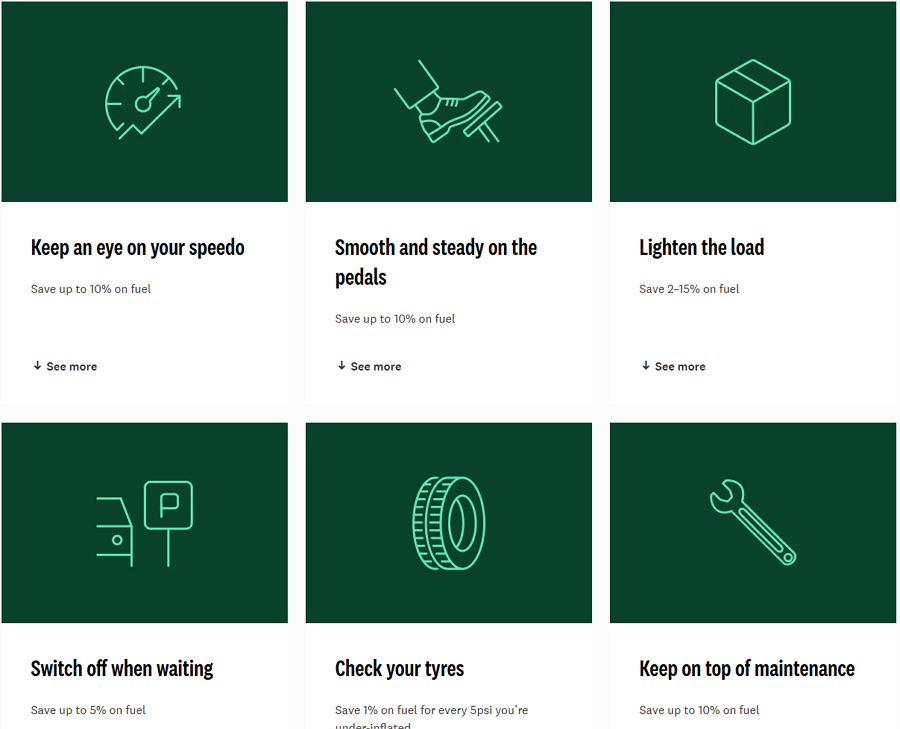
An EECA infographic laying out six options for saving fuel: keep an eye on your speedo, smooth and steady on the pedals, lighten the load, switch off when waiting, check your tyres, keep on top of maintenance.
What’s notable about these tips is what’s not there, such as:
- Does your trip even need to happen, i.e. is this an “essential journey”?
- Can you bundle together errands (or passengers) for greater efficiency?
- Can you consider when you travel – given idling in traffic at peak times is a waste of fuel?
- Can you consider how you travel – can your trip be made with a different mode?
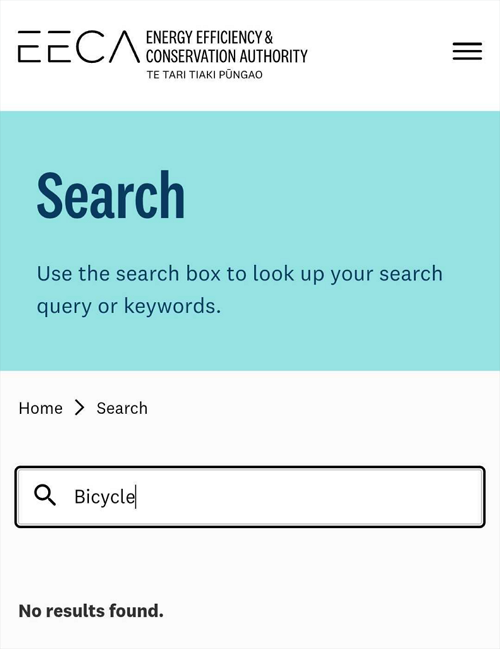
What happens if you search EECA’s website for alternative modes, like say, the humble bicycle? Full disclosure, if you search for “cycling”, you get a couple of hits, including a 2024 survey that says 38% of New Zealanders would like to cycle more, and when you look at the survey itself you see that half (48%) of those aged 18-34 want to cycle more, one in five (22%) of those who don’t currently cycle would like to start doing so, and that 21% of New Zealanders want to consider active modes for trips to school. Food for thought, and surely policy fodder.
Meanwhile over in Australia, two states are already making public transport free for a given time, to help get people out of their cars in order to reduce fuel use:
Victoria and Tasmania on Sunday unveiled a temporary fare reprieve as motorists continue to face price pain at the petrol pump.
Uncertainty and crimped oil supplies due to the Iran war have driven up costs and led to fuel shortages at hundreds of service stations.
In response, the Victorian government will make public transport free for a month from Tuesday to encourage people to ditch their cars and offset rising fuel costs.
The move is expected to cost Victoria $71 million (NZ$85.4 million) in lost revenue.
Here, I’d settle for even just reduced fares. But the government has repeatedly poured cold water on the very suggestion, noting that there are many people outside of our bigger cities who can’t use public transport.
Which is surely part of the point: the more people in cities who can and do use the available alternatives, the more fuel will remain available for those who can’t.
Notably, over in Australia the Victorian Farmers Federation is in strong support of free transit, saying:
Victorian farmers welcome today’s announcement by the Premier to make public transport free, following calls from the farming community.
“With fuel still under pressure, free public transport is one of the few practical levers available to help Victorians conserve fuel and save money.”
If Victorians make the switch, it can make a real difference. Every commuter who leaves their car at home frees up fuel for the essential, time-critical work that keeps Victorians fed, whether that’s ensuring livestock are fed and cared for, or getting crops in the ground.
We’re grateful the Premier has listened and acted. This is not a silver bullet and must be one of many levers pulled to navigate this crisis.
Back on our shores, on Sunday’s Q&A programme Jack Tame spoke with Mike Casey, CEO of Rewiring Aotearoa, about the scale of the challenge and the opportunity.
Among other things, Casey notes that our oil consumption is at a five-year high, which he says shows a distinct “lack of strategy” and that the government has unfortunately been “caught with their pants down.”
The “north star” is “New Zealand-made energy”, he says, along with accelerating the shift to rooftop solar and electrified transport. He offers tangible examples from the farming sector he hails from of how that move is already saving people money and increasing resilience.
It’s definitely worth a watch:
If you prefer a quicker and lighter read, Verity Johnson’s column makes some similar points:
Winston Churchill had it right when he said never waste a good crisis. And if there’s one thing we could get out of this mess, it’d be how to not to end up here again in another five years.
What’s your take on the most critical steps the government could or should be taking at the moment?
Today’s header image is the cover photo of this government’s 2024 Government Policy Statement on Land Transport (official document here)
Greater Auckland’s work is made possible by generous donations from our readers and fans. We’re now a registered charity, so your donations are tax-deductible. If you’d like to support our work, you can join our circle of supporters here.

 Processing...
Alongside looking at PT fare reductions now surely is the time to deliver some quick PT priority lanes.
Bike lanes plus bus priority measures and modal filters would be most effective.
Plenty of people use buses. So more bus lanes would be beneficial.
Bike lanes are a waste of money in most cases.
Plenty of bike lanes here in Manukau City and they’re deserted.
The city bike lanes have felt busier than ever. It takes time to build up though after they’re built. Maybe for Manukau that will be the next oil crisis in 5 years or so.
Manukau City’s sporadic bike lanes are not a network. Half-finished roads have little traffic too
The bike lanes in Manukau City aren’t well looked after, the one on Cavandish Drive in particular is full of glass.
Someone needs to get on the end of a broom. NZTA preferably. Either end of a broomstick will work fine with them.
So, Victoria is offering free public transport as one of their answers to the crisis.
The very same government that is in debt to the tune of $168 Billion AUD.
That means their initiative costs about 0.4% of their current total debt in a cost of living crisis. There might even be positive flow-on effects (increased PT usage when subsidies end/are reduced, better public health, more people able to spend money at other businesses), but of course it is hard to tell right now.
Seems like a good deal to me.
So set PT fares to recover all costs. Then private debt grows as people are faced with higher transport cost which causes the economy to slow, then less tax income for the government; or increase government debt to provide free PT in the hope that the economy keeps ticking over and keeps tax revenue flowing. Which scenario is best? Is there a maximum pay off for economy somewhere along this continuum?
“So set PT fares to cover all costs” – of course there are a couple of potential responses to this line of thinking:
1) Watch road congestion soar….; or
2) Also set fuel and other road related taxes to cover all costs, including those related to physical damage to infrastructure caused by each class of vehicle, medical costs post accident and health costs driven by pollution and see PT and active transport usage increase markedly.
Either of the above would have interesting impacts….
Try setting road user charges to cover all costs.
So their debt servicing costs are about 7% of their annual revenue ($95 billion). Doesn’t seem particularly out of whack for an entity that invests in physical infrastructure.
Indeed. But it also seems to recognise that stopping the economy due to a lack of fuel is a bad thing. Something that actually completely by-passed the current New Zealand Government.
Despite the “oil ban”, Labour recognised the issue of not having enough strategic reserve. While they had a price, they had not funded the project (it probably had to wait for the next budget cycle). The coalition quietly scrapped it, Shane Jones, the minister of pork barrelling gassed it in 2024.
The Victorians have realised that if you are catching a tram or a train to go to work, catch up with mates or to go to get that Latte, that there will be more fuel left to continue more “economically useful” uses.
This government just wants to buy votes in the demographic that swings.
This government won’t waste the crisis, but we have to remember what their goals are. Looking at the legislation they’ve introduced so far, they are not trying to serve NZers. Indeed they have gone out of their way to serve international corporate interests at the expense of our well-being and future.
There are a number of ways they might choose to continue in the same vein, while “not wasting the crisis” and none of them are pretty. Only the need to get re-elected could rein them in.
Who are these “international corporate interests” that you are referring too?
Employers maybe?
For a start, international industrial, agricultural, automotive, construction, fossil fuel, tobacco, alcohol corporations that can now make claims that new legislation or regulations requiring environmental or public health stewardship have reduced their profits.
Don’t tell me you haven’t kept up with the extremist ideology using toxic concepts of “takings” and “regulatory relief” and so on?
you need to get out more Vance.
* LNG terminals, when LNG shipments are in doubt
* AI Datacenters, when dry year power projects were cancelled
* Clean car incentives cancelled, leading to low EV uptake, high fuel burn
* Polluting car standards dropped allowing dirty imports
* Taranaki windfarm cancelled due conflict with seabed mining
* Seabed mining cancelled due to conflict with life on earth
* Seabed trawling not cancelled due to conflict with life on earth
* Hauraki gulf protection ammended with commercial fishing exceptions
* $60B RoNS boondoggle lots of happy corporate road builders.
Thats enough to convince you to vote less conservative.
I am not sure that the Government should spend money in the form of reduced price or free public transport; merely as a short-term response to this crisis (although it certainly seems like we don’t really acknowledge the wider benefits of public transport use that may justify improved subsidisation across a longer timeframe).
I would rather our limited resources be spent urgently planning and implementing infrastructure projects that will reduce our reliance on fossil fuels on a more long-term basis (looking beyond this crisis).
When undertaking this work, its absolutely essential that we don’t repeat the mistakes of previous projects where inordinate amounts of time and money are spent on unnecessary consultation with ‘interested parties’.
With strategic infrastructure projects it may be better to apologise later than ask for permission. Engineers first, lawyers second.
That said, the inflation Elephant has re-entered the room.
In terms of short term actions, the government will delighted at how this has played out.
Driving down 20%. PT usage on the up. EV sales through the roof. All without subsidies. All with them doing very little, if anything. The market in action.
The only thing they are probably disappointed with is that they needed to fork out $50 per family because its an election year. Though they managed to limit that.
Both can be done at the same time to achieve different outcomes. PT subsidy will reduce current fuel usage by diverting people to PT networks. Reducing reliance on foreign energy can be done at the same time or at least planning started, but the purpose will be to reduce the effect that future occurrences have rather than provide any immediate relief.
As long as its done with greater care than we’ve seen across Australia.
In government ‘care’ stands for Cover Ass Retain Employment
Ha, like anyone in government ever got fired for poor performance….
Maybe a controversial opinion: 3 years is just not enough time to get elected, understand the Government’s current state of affairs, recommend and consult on changes, make changes to policy and legislation, then campaign for the next election. Inevitable that corners get cut.
And there are now so many things we expect our governments to do, that I doubt any government actually can be on top of everything all the time. Unfortunately, that means whatever the issue of the day is, the Opposition can always find something to complain the Government hasn’t done and the Government can likely point to the Opposition having not done anything about it either.
There are so many things that could and should be done, or should have been done already. High fuel prices and overall inflation might make the general public come around to the ideas discussed here everyday.
I expect the govt to completely squander these opportunities.
Free public transport? No, pay people to use it! Like get $100 credit on your Hop card.
Bicycle discount vouchers.
Pop up cone based bike lanes on all school routes.
Bus lanes everywhere.
Send some bus fleets to small towns to fill the gaps.
Grass-roots campaigns with carrot and stick at schools for active travel. Well beyond the minimum effort “please don’t u-turn over your classmates” and “get a free milo if you don’t get dropped off right outside the gate to school today”.
Much of the discussion is about land based transport. But what happens if jet fuel supply gets short? In a worst case scenario, we could see a big drop, even a collapse, of international travel to and from New Zealand. But could we still move people around New Zealand using small amounts of diesel? We could if we had retained our passenger rail network and it was mainly electrified as in many other countries. Take our busiest route, Auckland to Wellington with about 2million trips per year. In an emergency how many could be carried by the infrequent, expensive tourist train the Northern Explorer? In a real emergency you could add more carriages, even have a sit up night train. The carriages could come from heritage operators such as Glenbrook Vintage Rail. There are carriages in the south island but with no rail enabled ferry operating until at least 2029 those cannot easily be used. Pity we didnt extend the electrification to the whole route when the middle bit was completed in 1988.
With my tongue firmly in my cheek, there’s also half a dozen working mainline steam locomotives kicking around in heritage collections, and we’ve got our own local supply of coal.
Not going to work so well for the international flights tho Para….
I’m not sure if we can stress how disastrous Simeon Brown was as Transport Minister.
Everything he did is making this fuel supply situation harder for people.
If the first step of confronting a problem is admitting there’s a problem, in this case, the second step must be to confront Simeon Brown, and admit his policies were all exactly wrong.
We could have been using the Dominion Road tram.
Remind us what happened with Labour’s light rail project?
Labour don’t exactly have a stellar track record when it comes to public transport.
Just to add that Shane Jones as Energy Minister is responsible for slowing down the delivery date for additional fuel storage (at the behest of the oil companies; and no doubt with cross Coalition support).
Perhaps if he had reached for a concise dictionary instead of a theasaurus when composing his letters, things could have started earlier?
That said, while the previous Labour government identified additional fuel storage as a critical need following the closing of Marsden; it also kicked the can down the road by failing to allocate any necessary funding to commence construction.
you won’t find many defenders of the Labour ALR proposal here, and rightly so, so I am not sure what your point is
We could have been using 24/7 buslanes and even trackless trams. But the current mob just cancel and provide no alternatives.
Chris Bishop – “I have to be honest with you, the idea that we would put up fuel tax during a fuel crisis seems like a non-starter to me.”
( in relation to further deferring planned tax increases, since cancelling inflation related taxation increases )
And there we have it – consumption vs sustainability
Keep fuel prices artificially low(er), and when we run out, keep them cheaper.
The market is great at sending signals (scarcity=expensive) but subsidies stop us from changing behaviors (and hating on Chris) and stop the upgrade to “clean” cars.
Regardless, the govt is on a win-win strategy with their not-covid fuel supply response
– Do little, if the war ends shortly – take the win and say we didnt over react..
– Do little, if the world goes post-oil apocalypse, then leave who wants to run that mess, leave it to the podium of truth folks.
The war ending shortly won’t un-destroy all the bombed infrastructure
Fast forward to the 2024-27 NLTP, and the total investment has nearly doubled at $32.9 billion, but road users are still contributing roughly the same amount, $14.3 billion.
That is absolutely obscene. A massive and irresponsible rapid move away from largely user pays to a heavily subsidised imported fossil fuel dependant transport mode. General taxpayers and ratepayers are now subsidising road transport nearly $2 in every $3 being committed at an ever increasing rate to lay down the bitumen.
This is just industry largesse, and total economic irresponsibility.
A fossil fuel supply problem was entirely predictable, not if but when.
But Government decisions made in the term of this government have significantly exacerbated our vulnerability. And the current Phase 1, look but no actions, is possum in the headlamps stuff.
It may be remembered that New Zealand’s first refinery was opened for business at New Plymouth in August 1913. By 1949, the refinery had all the oil it could refine and store but distribution of the refined product remained a major problem compounded by competition with the major overseas oil companies and post-war regulations and had to close.
By April 2022 the Marsden Point refinery had also closed “…in keeping with the wishes of its fuel-company shareholders [BP, Caltex, Mobil, Shell, and Europa] which argued it would be more cost-effective for them to switch to importing pre-refined fuels, such as petrol and diesel.”
“Critics of the closure expressed concern it could reduce New Zealand’s fuel security but that risk was played down by the former government [Labour] which argued the country was already reliant on crude oil imports.”
“A Cabinet paper revealed that former energy minister Megan Woods had floated the idea of saving the refinery by underwriting its operations for a period of up to 10 years but that the option did not get the support of her fellow ministers.” [The Post 28 November 2023]
And then there was the closure of the Strait of Hormuz…
Ever since oil was discovered in NZ we have known that local resources are finite. This has been bought home by the succession of depletion of firstly the New Plymouth field, then Kapuni, and then the off shore fields.
Our current problem is not the lack of refining capacity. That is a red herring. Through depletion we have next to nothing in indigenous feed stock. This inspite of decades of searching. So refining capacity, or not, our problem is almost entirely that a war, initiated by our so called “allies” has cut off dispatch of feed stock to refineries wherever they are situated in the world. Sure refining capacity may become more problematic as refineries have now become such strategic targets in war games.
The history of oil and gas in NZ is interesting (and its tantalising to imagine what our country would be like if we had more of both).
However there is surely no grand conspiracy as to why we don’t produce more – we simply don’t have it.
If there was money to be made, somebody would have made it.
“that risk was played down by the former government [Labour]”.
Labour have form when it comes to risk.
Remember Helen Clark saying we live in an “incredibly benign strategic environment”
That didn’t work out too well.
Helen Clark as Prime Minister was defeated in the 2008 election and finished up in our Parliament in April 2009, just under 17 years ago.
In that time Trump has been and gone, and then come back again.
The US has withdrawn from two Middle East wars, and has now started another. Next you will be quoting Holyoake.
“Seventeen years ago”.
About the time needed to stand up an air combat force.
Helen Clark obviously doesn’t understand the concept of insurance.
Perhaps she should have a look at what’s going on in the South China Sea and ask herself whether China has benign intentions.
what does that have to do with anything Vance?
So when is our Minister of Foreign Affairs going to call in the Ambassadors of USA, Israel and Iran in and express in no uncertain terms the country’s dissatisfaction with the hurt being inflicted upon New Zealanders as a result of this “little excursion” and our absolute desire they get around a table and sort it out?
And when after that, when things escalate, will he declare them persona non gratia?
It’s not at all good for us and the rest of the world.
But I am far more concerned at the innocent lives being lost across the Middle East.
Aside from being basically identical and extremely vague, I feel like Steps 1 & 2 are just outlining what the govt/MBIE is or already should be doing. Surely they are and have been doing things like “monitoring fuel stocks” and “working with key players to ensure even distribution of fuel.” It’s less a plan and more a list of placating buzzwords.
Hopefully someone in govt is doing modelling to try and estimate what our future supply will look like following the disruption 2-3 weeks ago. It seems like everything is still ok now because the Sth Korea & Singapore –> NZ pipeline has yet to be disrupted. We are still getting shipments of refined fuel on schedule but haven’t really seen any forecasts that include the disruption of the MIddle East –> Sth Korea/Singapore supply of crude. I guess it is a balancing act at the same time because we only have so much storage. A nightmare situation for any government would be to put in place rationing only to have to then turn away shipments because our holding tanks were full already.
This is the best fuel tracker I’ve found.
https://nz-fuel.netlify.app/
Here’s an explanation of how and why it was built. Note that the current display is rosier than the article due to some recent confirmed departures.
https://briankearneynz.substack.com/p/nz-fuel?utm_source=%2Fsearch%2FWhat%2520institutional%2520investors&utm_medium=reader2
I see RNZ is reporting Mayor Brown calling the Government “dumb” for not increasing PT subsidies.
https://www.rnz.co.nz/news/national/591007/fuel-crisis-auckland-mayor-says-government-should-promote-public-transport-over-driving
I waited about 45 minutes at Glen Innes for a train this morning. Lines issues. Same old shit. What a basket case Auckland is.
How can that be when they’ve spend years (decades?) upgrading them every summer?
Indeed, the government should immediately do a RFP for a nuclear plane, 3 reactors should suffice, somewhere on the North island. Logically it should be located away from the earthquake and Volcanic Zones (pity because Taupo would have been perfect otherwise). So now I guess its Waikato and I am sure a place like Huntly would love the jobs a nuclear plant brings.
Safe, clean and secure energy for generations. Sorts the North Island deficit and ensures the south island have almost unlimited hydro. Perfectly placed in the golden triangle ensuring the growth engine of our NZ economy has sufficient power to be competitive. Cant wait.
Add solar where its commercially viable and we are in a good position for the future, where the need for power is expected to increase with 300-400%.
Oyster Point on the Kaipara was previously identified by Muldoon.
We probably have more effective measures to spend money on though.
Nuclear only makes sense if you ignore the costs that occur after it ceases generating power.
Tautoko:
https://www.theguardian.com/environment/2022/sep/23/uk-nuclear-waste-cleanup-decommissioning-power-stations
https://www.iisd.org/story/the-united-kingdom-is-to-subsidize-nuclear-power-but-at-what-cost/
Why would we go anywhere near nuclear when geothermal achieves the same thing, can be built for about 1/3 of the price and doesn’t require us to import the fuel?
New Zealand should be Iceland South with all its geothermal energy. What a waste it is using so much oil like it’s 1950.
I actually think it would be funny if we ran out The fragility of fuel production and distribution has being obvious to me for a long long time New Zealand incorporated has had its head in the sand.
And as so much of fossil fuel production and distribution is far outside NZ control, this is why we should have been far, far, more active in reducing our dependence on imported fossil fuels. Increasing our independence instead of increasing our dependence.
Instead we have put our railways into “managed” decline, in favour of motorways to everywhere. We are proposing a LNG terminal, instead of increasing our solar and wind electrical generation and providing pumped hydro storage as a massive electrical battery for back up.
Vested dependent interests have been rewarded, instead of encouraging national energy independence.
Problem is solar and batteries are going to be in demand internationally as they are the best short term fix. Expect price rises.
If we could quickly restructure our freight delivery network giving rail a greater role.
So there are two quick do it tomorrow things.
Longer term geothermal power. Electrification of rail either by overhead or battery. Roll out electric town delivery vehicles. I am amazed by the electric buses which are appearing on our street if it can be done by buses it can be done for smaller delivery vehicles.
Completing the NIMT should be a priority.
Tuakau, Pokeno and Te Kauwhata are growing rapidly so it would be good to have them linked in to the Auckland metro network.
Auckland won’t pay. See Te Huia.
i think deserved, but definately not funny.
2020 introduced us to empty shelves at the supermarket.
Queues for flour. Toilet Paper. Lots of queues.
Something our grandparents lived through, and a very real outcome if the fuel tankers stop arriving.
Might encourage us to restructure the supply chain to benefit Aotearoa above foreign interests if the export market becomes less lucrative
For inspiration in these times, Cuba will always be the example.
When the Soviet Union collapsed, Cubans lost on average ten kilos and bikes became the favoured form of transport. Now Cuba is losing people faster than we are, but that is due to certain geopolitical conditions involving an Orange Guy.
Our train line is improving, but there are track faults that frustrate commuters. A bike train combo is still the most efficient way to move in our city.
This government is “big cars, big wheels”…continuing the neo liberal tradition begun in 1985. When the oil runs out, we will not be able to drive our silly little metal boxes.
We will have to use public transport.
Maybe we can make more friends?
The upside of this crisis could be phenomenal. Finally an excuse to stop using fossil fuels. Imagine the improvement to air quality, life expectancy, and congestion?
Ban the suicide machines and we can live the lives we should, with Free Public Transport for everyone, free education for everyone, free Kai for everyone, and the end of this division by age.
Gold cards for everybody!
bah humbug
NZ is reasonably well endowed with sunshine.
It is extremly well endowed with wind energy.
And it is extremly well endowed with short term energy storage in the form of its hydro lakes. These certainly can already buffer the day night variation in solar energy availability and most probably the variation in wind power generation.
And yet in spite of these natural advantages our installed capacity in both solar and wind generation is meagre in relation to comparable peers.
And whilst other countries are in full expansion mode, expansion here is pitiful.
And now geopolitics have left us incredibly exposed.
We have been spectacularly unsuccessful in getting our government to change away from hydrocarbon dependency.
So come November, hopefully we will be more succesful in changing our government to one more enlightened. Much more enlightened.
Come on opposition parties, tell us NOW what you will do if elected. In detail.
We are extremely well endowed with clueless politicians who’d rather keep guzzling petrol (Mad max guzzolene springs to mind) than actually try get people to do something different
Australian roof’s with solar – 1 in 3
NZ roofs with solar – 1 in 35
They are paying a lot less when they fill up their EV’s at home and at the charging station. NZ is over $1.15/kwh in some places
Don’t see the Greens pushing solar power for residential properties as they’re too busy pursuing social engineering issues.
Have you actually looked?
This is from there 2023 plans:
https://www.greens.org.nz/clean_power_payment
The Clean Power Payment
The Green Party’s plan will help bring warm homes, good jobs and cheaper energy bills to every part of Aotearoa, helping people to make ends meet and cut climate pollution.
Grants of up to $6,000 to cover the cost of installing solar power and making energy efficient upgrades
Interest-free loans of up to $30,000 to cover the cost of additional zero carbon home upgrades,
Tax deductible zero carbon upgrades for rental homes, so both tenants and landlords can benefit from energy efficient homes powered by clean, renewable energy
Our plan will also:
Scale up solar on Kainga Ora homes to 30,000 more households in the next three years
Expand Warmer Kiwi Homes to cover more zero carbon upgrades such as replacing gas heaters
Fund Community Energy providers and by Māori, for Māori, approaches to helping whānau keep their homes warm, dry and maximise their energy savings
The Government’s secret four step plan to deal with the crisis.
https://www.youtube.com/shorts/lvb_q_2dnlY
Apart from the English using Stage instead of Phase it is a very succinct summary of our current government’s strategy.
Indeed. But it also seems to recognise that stopping the economy due to a lack of fuel is a bad thing. Something that actually completely by-passed the current New Zealand Government.
Despite the “oil ban”, Labour recognised the issue of not having enough strategic reserve. While they had a price, they had not funded the project (it probably had to wait for the next budget cycle). The coalition quietly scrapped it, Shane Jones, the minister of pork barrelling gassed it in 2024.
The Victorians have realised that if you are catching a tram or a train to go to work, catch up with mates or to go to get that Latte, that there will be more fuel left to continue more “economically useful” uses.
This government just wants to buy votes in the demographic that swings.
The government is so f$&%^@! stupid to not subsidise public transport more because oh “that’s what Labour and Greens would’ve done”.
As an aside it relevant, interesting article on recycling or lack thereof currently for car batteries in NZ:
https://www.aa.co.nz/membership/aa-directions/driver/end-of-life-options-for-ev-batteries/
a friend responded to facebook marketplace wreckers offer of Atto3 battery for free – they just wanted it gone as it voided their insurance rules. He ripped around with this trailer and brought it home. The very low km car had light damage, the battery none.
He offered it to me (for a fee) i declined as i’d like 63KW/h of home storage, but know enough to stay away from 400+ volts.
This story must play out over and over – with these batteries now selling for approx $10K nz and the software now understood well enough to unlock them (if the airbags went off) and read the SoH, and integrate into your home solar controller and inverter.
With chargenet increasing its prices, due to energy price increases, due to inflation from chargenet prices increasing… getting off the money-sucking-grid must be a priority. Recycled Chinese car batteries are so the way.
Nice, yes could be a good use of them. A good recycling system setup locally ahead of needing it would be good too.
Waikato Regional Council have just unexpectedly and without consultation announced the sudden ending of the only public transport link to Taumarunui, the Monday to Friday 25 bus route. Might be to save on diesel usage?!
Meanwhile, KiwiRail are about to remove 46 locomotives from their active fleet and sell them to South Africa, who has ambitions to use them to grow rail freight volumes. I wrote to the minister asking why we are not growing rail volumes in NZ with them instead, and he just obfuscated with “we need to modernize the fleet” etc. In reply to my pointing out that KiwiRail has not grown volumes since it was formed way back in 2008 he simply replied that “we would like to see volumes grow” but failed to explain why they don’t have any incentives or targets, nor why volume growth is not a KPI.
“But the government has repeatedly poured cold water on the very suggestion, noting that there are many people outside of our bigger cities who can’t use public transport.”
There’s lots of things the government funds that I don’t use. Doesn’t mean they should stop funding it…