This is a guest post from Wellington-based Kasey McDonnell, which originally appeared on their blog threesixtysix,. It is republished here with kind permission.
Which year saw the most public transport passengers in Wellington’s history? You might think 2019, before the pandemic put public transport in crisis. Or maybe 2024, as our bus lines benefitted from more dedicated lanes.
The answer is 1943.
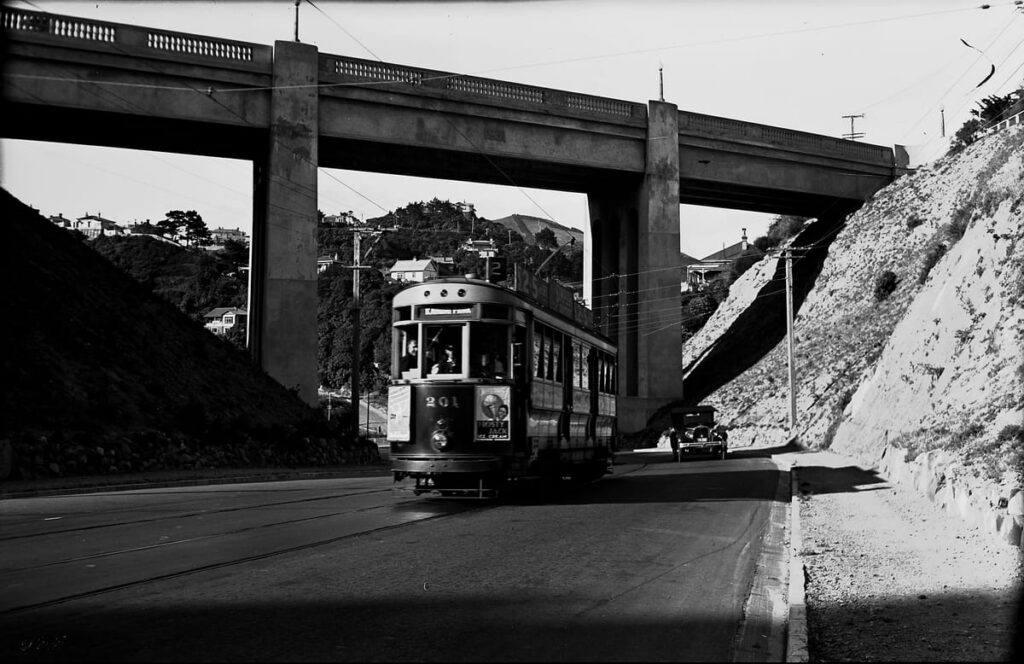
That year, Wellingtonians took over 64 million tram journeys in Wellington City alone. That doesn’t even count trains. Today, we only manage 37 million journeys across all buses, trains and ferries combined. That’s with a population four times the size.
1943 was a Wellington transport nerd’s dream because electric trams crisscrossed our city streets. They ran every 10 minutes, offering women, children, the elderly, and workers a way to traverse a growing city efficiently.
It has been a long time since the trams traversed our town. The history of our tram system and its demise is complex and gnarly. Politics, lobbying, regulation, changing attitudes to transport, even World War II played a part in its downfall.
Passionate people across the world are demanding tram tracks return to their streets. Trams and light rail are coming back in cities sick of the unsustainable land-gobbling nature of car-based planning.
Wellington can and should bring our trams back. Done right, it could make our public transport the best way to get around, full stop. It could help us in the quest to slash pollution, and help more people live in our central city without it costing the earth.
Our city holds traces of an extensive system built quickly to support a rapidly growing capital. In the first of a two part series, we’ll explore the bright and vibrant history of the tram lines that made Wellington, and why we lost them.
Wellington grew along the tram lines
The colonial settlement of Wellington was shaped and propelled by tramways from as early as 1878.
Private companies laid tracks along streets to carry more people efficiently as the city rapidly grew. At first, the vehicles traversing our terrain were pulled by horses. Steam trains were trialled but weren’t beloved by people living in the city. The noise, pollution, and the tendency to scare the shit out of horses was a PR nightmare. Steam lost its steam… but the colonial council saw an opportunity.
Growing the city couldn’t be done on horseback alone, and there was farmland to the south and east which could house more Wellingtonians. They just needed transport connections. There was an opportunity to use newfangled electric trams to bypass the need for hooves and offer a great way to move many people from work and home.
It just so happened that running an electric tram service could be a fantastic money maker for the Council too. Some believe that’s why the Council chose wider tracks rather than the narrow tracks our trains run on. If they had chosen the same tracks as trains, the trams could have been nationalised, and the Council would lose revenue.
In 1902, Wellington City Council purchased the existing tramways, and started building a network of electrified trams that expanded from Karori to Seatoun, Island Bay to the Railway Station.
The age of electric tramways in Wellington had begun.
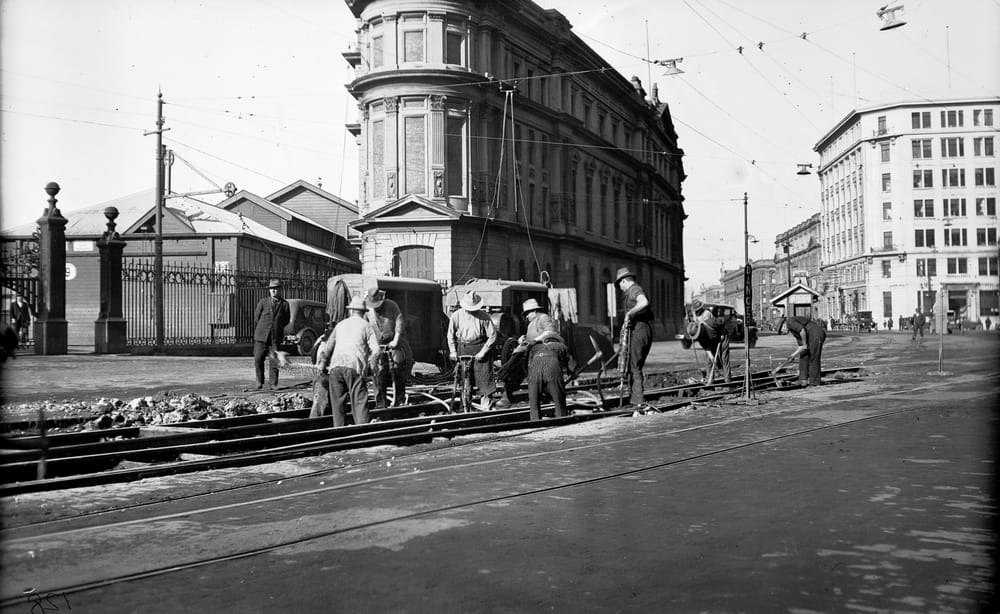
The system was built at pace. Workers laboured under backbreaking conditions from 4am to 11pm every day to lay tracks along Cuba Street, Courtenay Place, the Harbour Quays, and more.
The rapid and gruelling rollout delivered a 10 minute tram service from the railway station to the Basin Reserve two years after the Council approved it.
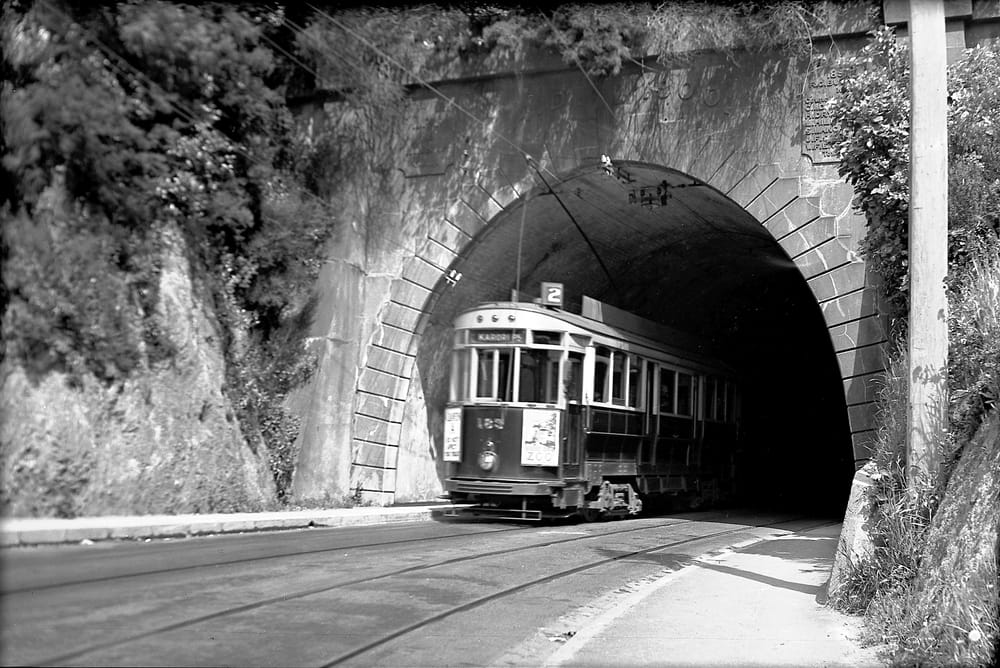
More lines were built in quick succession. They connected Lyall Bay, Brooklyn, and Northland. Tunnels were carved into the maunga surrounding the central city, which we still depend on for buses and cars today.
The city grew quickly with the investment. More people started neighbourhoods connected by frequent tram service, and came to depend on them for everything.
Trams shaped daily life in ways that are hard to imagine now. When rugby games were held at Athletic Park in Newtown, special trams queued to ferry thousands of fans home. The trams ran so frequently you never needed to check a timetable. Women, children, and older people benefited from a system that could move them around the city at modern speeds.
On average, a Wellingtonian in 1943 would take 521 tram journeys annually. Today, the average Wellingtonian takes 71 journeys across all forms of public transport. The capital used to be a public transport darling. Today, it is woefully car-dependent.
What changed?
The death of trams
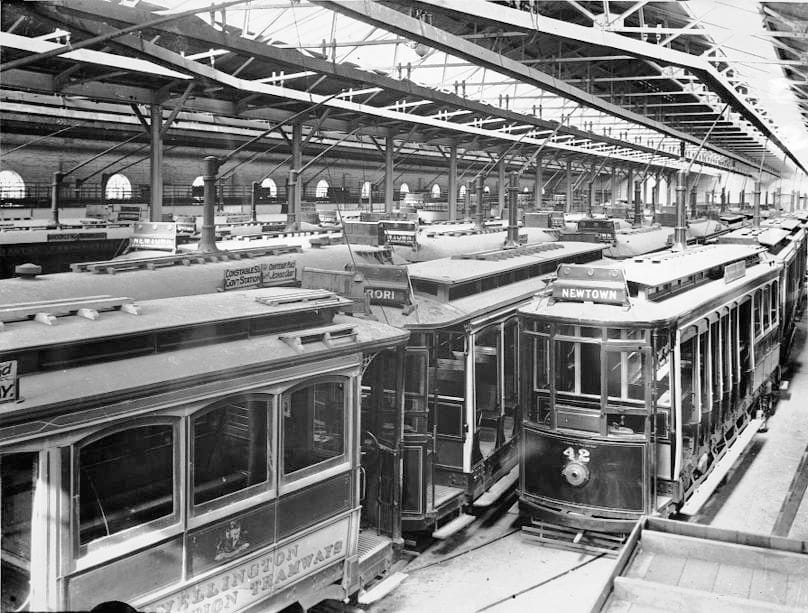
Our tram lines were first neglected, then shrunk, then closed all together. World War II rationing, car advertising and suburbanisation all contributed to the decline and disappearance of the tramways.
World War II was a double-edged sword for our tram system. When New Zealand was fighting the Nazis, resources were in critically short supply. Citizens rationed the basics like food, and commodities like rubber, steel and precious fossil fuels were constrained to put everything we had into manufacturing army tech.
The rationing was a boom for tramways. Trams caused less road wear than cars, ran efficiently, and didn’t need tyres. People were pushed to leave private vehicles at home and take the tram instead. 1943 was the peak of the tram system for a reason: the war constrained resources.
That rationing also had a corrosive effect. Every scrap of steel needed to be put to the war effort, meaning that once the war was over, the tramways were in a sorry state. Lines were degraded and desperately needed repair.
Everything else in the economy was also screaming for maintenance. The bills were stacking up to build and repair neglected infrastructure. So leaders had to make a choice: restore the tram system or let it wither and die.
A street fight was brewing, and tramways were caught in the crossfire.
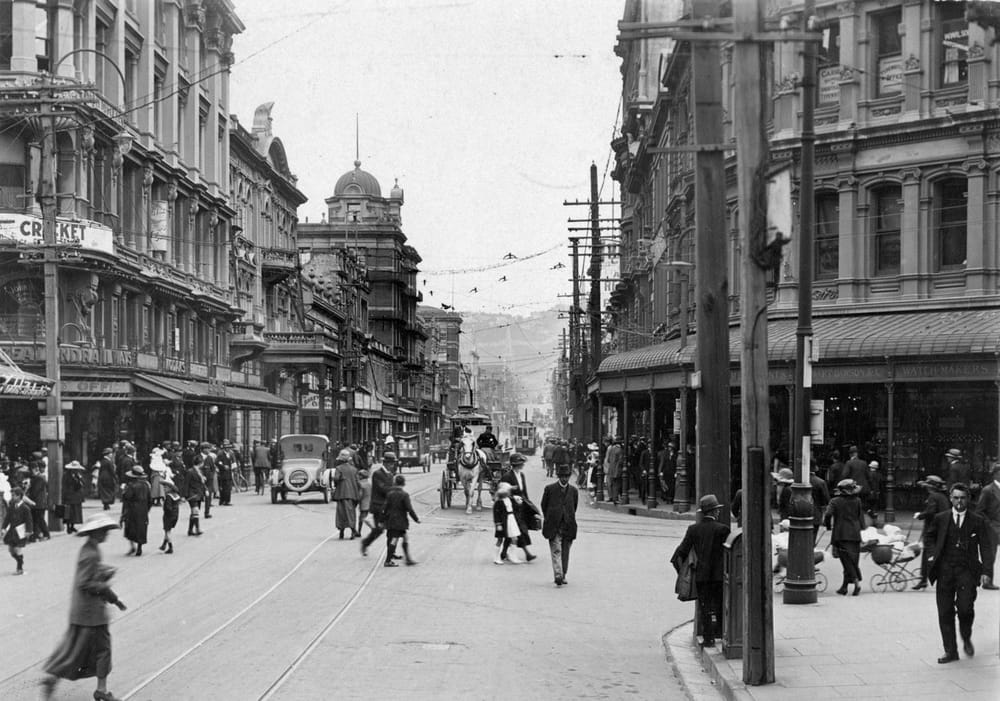
Streets have always been a point of contention in modern cities. Where people can and can’t be is about as political as it gets. For a while, roads were the domain of horses and humans, cars and carriages. That was changing, with more space being offered to faster, more dangerous vehicles.
Giving more street space to vehicles brought wear and tear, and annoying policy choices meant tramways got the short end of the stick. The Tramways Corporation was responsible for maintaining the roads around the lines, just as much as the steel they actually used. More cars on more streets meant more wear on the roads that the tramways had to repair, while losing revenue as passengers switched to cars.
Some drivers hated waiting behind trams when they stopped for passengers. Lobby groups for oil companies and car manufacturers wanted cars to get top priority, rather than the systems which carried 100x the ridership per vehicle. If cars had to slow or stop, how could manufacturers advertise the dream of speed?
All that lobbying was working worldwide. In the States, cities like Los Angeles were ripping out their tramlines and demolishing iconic buildings in favour of car parks. Trams were presented as old fashioned, from a bygone era that technological advancement has left behind. Wellington did the same: banning central city housing and incentivising suburban sprawl along the Hutt and Kāpiti Coast, designed to be driven.

The council had made its choice: rebuild Wellington for tyres, not steel wheels. Lines closed to make way for cars along tram tunnels. Rail was demolished to build the airport. Trolleybuses were used instead, even though they were far less popular than trams. Passenger numbers plummeted and have never again reached their peak. Meanwhile our carbon pollution started to rise and rise and rise.
The shift to car-dependent planning didn’t just increase pollution. It also locked out entire groups of people from taking part in our society. By choosing to build our city around a mode designed to serve working-age men, it denied women independent transport, it deprived children a community play space, and it deprived the elderly of social connection unless they could drive.
To this day, trams offer agency to people left behind by cars. Modern trams offer quality journeys to our disabled, our children, and our older generations. Yet, we’re investing billions into entrenching a car-focused system that reduces the independence of those groups. Meanwhile, projects to make other methods of transport as appealing as cars are cut and delayed, even under Labour and Green local leadership.
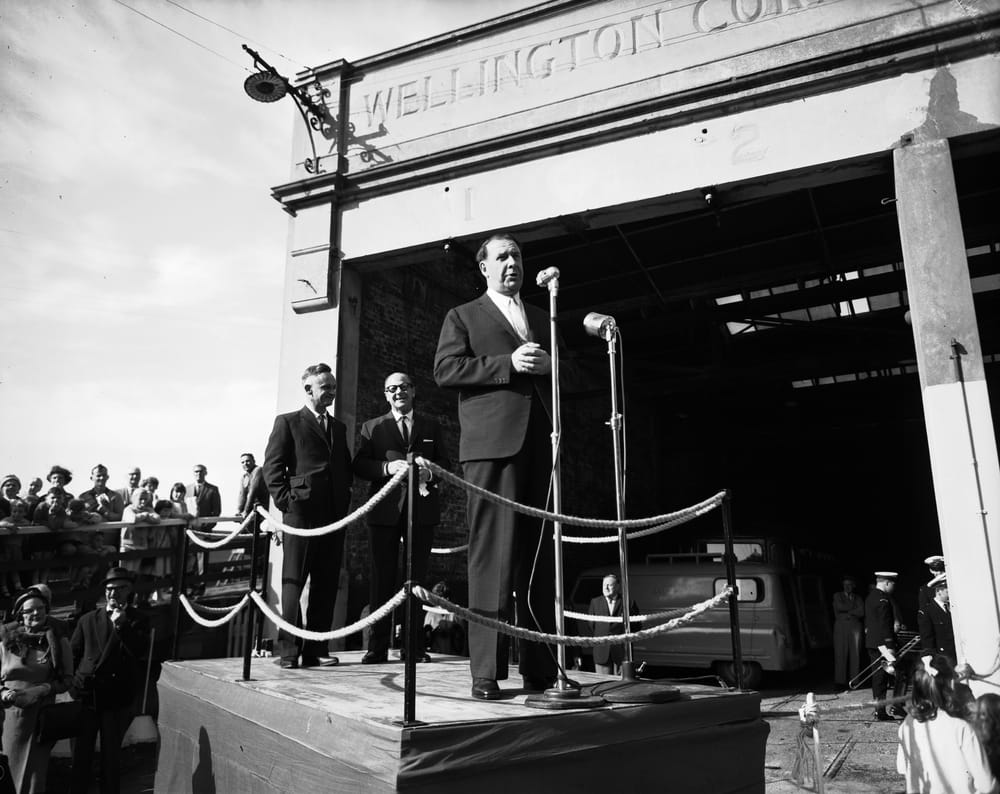
As the last tram in New Zealand departed to Newtown in 1964, Mayor Frank Kitts expressed a nervous feeling that maybe our city would regret the loss of the tramways. He was right.
Almost as soon as the trams were ripped from their lines and asphalt covered their tracks, the English speaking world realised that more lanes don’t solve traffic. It turns out the trams did more than keep our pollution low and our communities connected. They were also congestion-killers. And we had just mothballed them.
Though Wellington has forgotten its golden age of trams, their traces are all around us. When people take the bus to the airport, they’re using a tram tunnel. Wallace Street is a gentle grade because tramways ran along those lines. There are intricate bus stops in Oriental Bay because the trams took people to the beach. Some of the rail remains, buried under asphalt and bitumen.
The trams offered an alternative to many who, by age or circumstance, could not or did not want to drive. We lost a system that can help move us around without costing the earth through ever growing pollution and sprawl.
Wellington is still set up to restore a world-class tram service like you’d find in Europe. We are a tight-knit, compact city designed for trams because we were built by trams. Our streets are dormant, waiting for rail to restore them to their former glory.
By bringing back a modern tram system, we can improve our transport and make Wellington a modern, bustling city of the future.
In part two, the vicious fight to bring trams back in cities worldwide, and how Wellington could take note from an innovative German city to make the most of a new tram system.
Sources
This was only possible with fantastic sources like “Wellington Tramway Memories” by John William Frank Lawes and Graham Stewart’s “Around Wellington by tram in the 20th Century”. On top of that, the City Archives provided fantastic insight with tramway annual reports. I’d thoroughly recommend setting up time with them once they’re moved into Te Matapihi.
Greater Auckland’s work is made possible by generous donations from our readers and fans. We’re now a registered charity, so your donations are tax-deductible. If you’d like to support our work you can join our circle of supporters here.

 Processing...
I am doing some work to try get the budget and approval to extend Whanganui’s sad <200m tram line, and there are some major hurdles we need to first get over.
First, the existing tram line is owned by a private trust, and the trustees don't like/trust Council who they need approval from to build in the streets and ideally help with or provide funding. Then, there is the fact very few NZ companies are set up to be able to efficiently design and build these systems because we haven't built them in so long (Christchurch being the exception). The contractors Councils are in bed already have the approved budgets and contracts for road building and have spent lots of money on tools and machinery to build roads. And to top it off, ratepayers are (rightfully so) angry about seemingly endless rates increases, so suggesting major transport infrastructure projects will draw a lot of ire from ratepayers if they don't have convincing investment cases to prove their worth.
And, the central government’s transport and infrastructure budget mostly goes to NZTA, which is a direct descendant of the Main Highways Board. Maybe Kiwirail would help fund these projects, but unlikely NZTA will do it as they didn’t subsidise Christchurch’s recent track extensions.
The article touches on the loss of independence suffered by women and children as public transport was degraded in favour of the motor car.
As a child growing up in suburban Hutt Valley we had fantastic freedom, very much anchored by our freedom to take ourselves around.
Short journeys were by bicycle, and longer journeys by catching “The Unit” the suburban trains into Wellington and then “The Tram” to Cuba Street, or onto the Zoo.
We took ourselves to sports practices and to scouts and guides, even wolf cubs, after dark, on our bikes. We did not need to wait to be ferried around, and really did not need or even ask permission for our journeys, although to be fair we did normally give our parents some idea of where we would be.
Now approaching the other end of our life, where ongoing ability to drive a car safely is no longer a given, ready access to public transport is of increasing importance.
Gareth Morgan totally lost my support when he advocated for taxing the elderly out of cities and into provincial centres to free up city housing.
Provincial centres that mobility is totally dependant on the ability to drive.
Great tram and pt story thx. Yeah harken for the glorious age of steam! We have been so betrayed and failed by our corporate corrupted governing class. 60billion++ for Ron’s yeah right
Younger citizens will continue to leave in droves as long as NZ keeps doubling down on car dependence. Four lanes to the planes will not stem the flow.
New Zealand can be very dull and expensive for the young.
If we want more well-planned density we will need to work out how to balance the interests of (an increased number) of residents with the interests of people who wish to enjoy things like nightlife.
More people = more of the NIMBYs that people on this blog dread.
I think a tram to Newton and on to Island Bay makes a lot of sense.
Newton and Island bay are in different cities, so this probably doesn’t make sense.
Newtown, Wellington
While the loss of Wellington’s trams was indeed regrettable – its worth noting that the suburbanisation of place like the Hutt, Porirua and Kapiti improved the lives of thousands of people (mostly the working the poor).
Thousands of the working poor (many returning soldiers and their families) were given the opportunity to live in spacious and sanitary housing that provided amenities that they previously could only have envied (e.g. space to grow vegetables, functional plumbing, bedrooms for children etc).
Indeed, most of these new suburban communities were connected to the same sorts of necessities as the occupants would have enjoyed in the inner City (the Naenae Shopping Centre provided access to both shops and civic services; for example). Not to mention good rail links ‘back’ into Wellington.
The real shame is that there was clearly the potential for cars and trams to compliment each other. Unfortunately NZ’s financial position following the supreme sacrifices of WW2 and the optimism of the new future that would follow it made such an outcome very unlikely.
(great article)
It is bikes that complement trams. (And trains, etc). Cars never did.
There was only a brief time when the number of cars was low enough (to prevent their congestion slowing trams down, and to prevent their cumulative need for parking spaces from ruining the form of the city). In that brief period, the impacts of those early cars and early drivers on the safety of everyone else, and on the public’s enjoyment of the street, was extreme.
Bikes also complimented trains.
For many in the Hutt Valley and working in Wellington their 1950’s commute would start by an early morning bike ride to “the station”, where their bike would be left all day leaning against the station building, or a nearby fence awaiting to be ridden home. The first edition of park and ride
Describing the 1950s Hutt/Tawa as car driven sprawl is deeply unfair…. Its streets are clearly laid out to make access to the new rail lines convenient ,
The rail stops were at roughly 1km distances meaning it was never much more than a 10 min walk to the station (which is pretty much the same definitions urbanists are demanding be used as walkable catchments for upzoning today)
The biggest reason for improving access to Kapiti for the 1950s was that Wellington Airport as it is today didn’t exist,
Between 1952 and 1959 all flights to Wellington landed at Paraparaumu while the Rongatai reclamation was proceeding.
Prewar (late 1930s) Many cities in NZ were replete with inner city areas that would today be described as slums,
Large gardens, which were only sometimes used, could make for lonely suburbs. Even in the 1960s suburbia often seemed quite lonely. Politicians like David Lange have noted new suburbs, like Mangere, increasingly lacked any facilities, and were largely advocated for by people who wanted the poor, especially Polynesians, living somewhere else.
This is a comparison to between Wellington’s post-War suburbs and the slums that preceded them (not a comparison with a notional urban model tailored to the perceived cultural needs of migrants).
Do you really think that incoming polynesian migrants would be better off in the old Victorian era slums?
It might have been better to intensify Auckland in the 1970s, rather than push new development further out. Many Pacific Island migrants who ended up in Ponsonby found it worked quite well for them. Some of my friends live in Te Aro and find it quite livable.
There is a literature on how policy makers consistently think people want flasher housing than they would select given a free choice. High housing and commuting costs mean people have less to spend on everything else.
Admittedly some Wgtn suburbs in the Hutt are quite high density, and involved intensifying existing suburbs. Lower Hutt had a large population and good amenities in the 1940s, and well before then also.
The Hutt Valley and Porirua basin post WW2 suburban developments were not that deprived. The new, then, electrified suburban railway with their connecting NZR Road Services provided excellent connections into Wellington, and interconnectivity along the railway lines.
Far better then we are now providing in our outer fringe new housing,
The time to get from Island Bay into the city by public transport would get you to about Taita. The Western Hutt Road was an unforgiving drive, being unlit, narrow and winding.
What was different then, was that if you bought a new house then, that, and no more, was what you got. A house plonked in a former paddock connected to a water supply and the power wires, and either connected to sewerage, or with a septic tank. No fences, paths, driveway crossings or driveways.
But one thing that does standout now, was the scale of that post war housing build. That inspite of material shortages and labour shortages a phenomenal number of houses were constructed in each year.
This was because increasing housing supply was a prime objective of the government’s of the day, and they put a huge effort into providing the resources to achieve it. Rather then the more recent, protecting householder privilege. So those inner city run down properties were worth very little at that time.
The same dunderheaded thinking that saw the demise of the trams also accounted for the visionary plan of then Auckland mayor Dove Meyer Robinson to introduce rapid rail to the city in the 1970s. Now we await the completion of the CRL links. How slow are we to get the picture
One of my memories of the Auckland trolley bus era is a trolley bus driver with a rope trying to reconnect a trolley pole to the overhead wire, while the trolley bus is stopped in the middle of the road.
Some of the tram incidents in Melbourne make interesting reading. Considering there are 500 trams; accidents do happen. 2 days ago car versus tram resulted in 14 on the tram going to hospital. The tram tracks in the road cause ankle and other injuries. Quite often tram systems are paired with an underground/ subway or other passenger train system in geologically friendlier places. ‘Taitset’ on youtube has Melbourne trams, ‘A quick video about a broken down tram’ illustrates a quick resolution to a non-functioning tram en route. Other broken tram cases have been more problematic.
Incidents with the Melbourne Tram overhead electrical system happen. High cargo on trucks pulling wires. What are future Public Transport systems that might work in NZ in places as the battery tech & vehicle autonomy improves. China has made ev buses that are 26 metres long (the 18 metre long articulated bus can carry 120 plus passenger). Might be useful if the road is strong enough. Suburbs might use semi/ autonomous shuttle mini-buses (e.g Yutong Yiaoyu & Karsten e-jest etc) as lighter ev buses to collect passengers to take to larger ev buses on main roads. The aging population is perhaps less likely to want to walk longer distances to buses. Offer minishuttle journeys to & from home door to & from main bus stops for females only. The shuttle autonomous ev mini buses would also be useful in towns/ cities with limited inner city parking at busy times, transporting people from/ to satellite carparks frequently. Install pepper/ fog devices in the minibuses for vandals.
For Wellington I see there are 32K inner city parking spaces and articles have been written about car pooling versus car sharing in the past.
I see the ‘North Wairarapa Rail Line’ is ‘mothballed’ as mentioned in the ‘KiwiRail 10 Year Turnaround Plan’, surely spend some money on this line (raising bridges etc) before the new rail enabled ferries & new regional passenger trains turn up?(and the Kapiti line has storm problems etc)
I used to take the Wellington CBD trolley buses home when working there in 1999. The connection to the wire always seemed to come off when turning right through a busy intersection, at peak, in the rain.
This was an issue with the later Wellington ‘trolley’ buses – however one that diminished over time.
Modern tram systems don’t seem to have this problem their catenaries (they function in the same way as catenary-powered heavy rail systems do).
Its a lot cheaper than installing underground wires and is therefore the system we should adopt if we ever get a light rail system in NZ.
By coincidence, on the weekend I stumbled across this ABC Australia program:
https://www.youtube.com/watch?v=o1R6Aq19A6Y
The main premise is that we plan for the future badly and are susceptible to black swan events. The episode starts with air travel but a decent chunk covers Australia’s decision – influenced by car manufacturers and others – to rip up 11 of its 12 tram networks. Sydney had 1500 trams running daily but plenty ended up at “Burning Hill” where trams went to die. And what followed? The oil crisis and then car congestion.
There is some great old footage and interviews, including those wanting trams done away with (“they block the road and hold up the cars”, “their time is done”) to those wanting to keep them (“the appetite for more and more roads for cars is unfathomable”).
A great watch.
Great post, thanks.
Yes, cities’ transport systems change drastically at times, in response to different pressures. Climate change and all we know about health, access and safety, point towards electric trams or light rail being a large part of how we transform our cities (interwoven with bike, footpath, bus and train networks).
As long as we don’t continue to waste our wealth on roads.
Some points:
* As the AA pointed out many years go, even by 1939 New Zealand had one of the highest rates of car ownership in the world, on a par with Australia or Canada, and around twice as high as the UK’s.
* In 1950, New Zealand had about 130 cars per thousand people. By 1980, this had increased to about 400 cars per thousand people. Before the pandemic this had then increased to about 600 cars per thousand people (=private motor vehicles, but excl light commercials).
* The trouble with these discussions is that they forget that New Zealanders *like* their cars and *like* to use them. And while that post-war decline in public transport and rail demand could have been delayed, I very much doubt that it could have been prevented.
That said, there is a lot more that Wellington could do, even with buses. I live in a fairly wealthy UK city (Edinburgh), with a tram line, where the bus-based public transport system handles 125m passengers per year, and the tram an additional 12m passengers/year. So, a use rate of 250 trips/resident/year – mostly by bus, an increasing number of which are electric. What makes it work? A very strong network of bus priority lanes, simply … and very expensive car parking.
Do they really like to use them? So many people are more interest in looking at their phones than paying attention to the road.
Im sure most people would “like” a comprehensive rapid transit network across their city, too.
Plenty have done both.
To add to that: Driving can be fun when the roads are empty and you are under no stress to get somewhere, e.g. a leisurely trip to the beach. Add congestion, stress, poor visibility, inclement weather, health conditions and it suddenly becomes less appealing.
Quite right, car ownership isn’t going anywhere (and is a phenomen that has not only improved lives but has also contributed to the massive increase in economic activity that occurred over the 20th C).
The chief driver of the problems associated with this is New Zealand’s reckless population growth. Roads don’t magically manifest thousands of additional cars each year.
How do you measure improvement to quality of life? The time I spend stuck in my car ranks pretty low on the enjoyment scale.
I don’t think you seriously believe that I am arguing that the mere experience of driving is what drove improvements to our quality of life.
I disagree that ‘our’ lives have improved, maybe yours has. My life outside the car is also worse for having cars in it, as I have to have my ears abused every time I walk anywhere along a road, and god forbid I want to ride a bike anywhere. But I can’t avoid roads because they take up such a massive surface area in literally every town. And, cars have priority on roads, so as a pedestrian you are effectively a second-class citizen when trying to travel anywhere while not in a car.
Research in France suggests the average lifespan is shortened by 10 months due to traffic noise alone. In the noisier suburbs, by 3 years.
Car-oriented sprawl has led to cities that are unaffordable to service and maintain, which we’re responding to by pushing the costs onto future generations.
Add in climate destruction, traffic trauma, air pollution and all the other harms, and yeah. The car’s impact on quality of life has been comprehensively negative.
On God what is the Doctor smoking cars suck
https://www.greaterauckland.org.nz/2018/09/13/induced-demand-101/
The argument should never be extrapoled to the extreme of, Cars or No Cars. We have cars, and by and large they are useful. Infact where there is no public transport, they are extremely useful.
In highly urbanised areas though, the space requirements of in excess of 150m2 of scarce land for moving traffic, and a slightly lesser amount of land at both ends of every journey, to move on average 1.2 people is unsustainable.
In order to provide more living space, more green space, and more space for commerce, in any any given area, we need to continue to provide more and more spacially efficient alternatives to cars, for an ever increasing proportion of our journeys.
Cars will remain in the foreseeable future as part of our transport systems. The arguments are just about, by how much, given that there are, or can be, very viable alternatives for most journeys.
And there is the very convincing parallel argument that we should be making our urban areas more dense by building on more stories.
This preserves more of the surrounding green space for agriculture and recreation. And gives opportunities to increase urban greenspace. Density actually reduces average trip lengths, thus the required road paving areas, and infrastructure pipeline, and cable run lengths. Thus reducing both capital outlay and ongoing maintenance liabilities. We need to reprioritise people over cars.
“The argument should never be extrapoled to the extreme of, Cars or No Cars. I was about to post on this point.
No one said cars did not add value. No one said they should be done away with. But some people jump into these statements whenever PT is proposed. It says a lot.
The cities with the highest GDP (according to https://en.wikipedia.org/wiki/List_of_cities_by_GDP) and car ownership (googled):
1. New York City, car ownership about 45%
2. Tokyo, about 30%
3. LA, about 90%
4. Seoul, less than 30%
5. Paris, about 33%
Yeah, I guess car ownership is required for economic activity.
” The trouble with these discussions is that they forget that New Zealanders *like* their cars and *like* to use them”
How would they know, 90% of the population have no viable alternative and no option but to use them.
Well, even when New Zealanders did have “viable alternatives”, both locally and inter-urban, they still went out and bought cars. Between 1950 and 1980 the rate of car ownership increased by a factor of three. Between 1950 and 2000, a factor of four. This led the decline in provision of services in other modes; not the other way round, as Andre Brett’s otherwise very good history implied.
Note also:
* Historically, the cost of owning a car was quite expensive, in today’s terms.
* In 1988 the Labour Government of the time relaxed the car import rules and from that single action alone, the cost of new cars fell thirty percent; second-hand cars, by fifty percent. For the majority of trips, cars are simply far too convenient.