The governance reforms of transport in Auckland are set to become law early next year. A great deal is changing, but to most people it likely feels all very abstract and distant. So, in this post I want to take a look at a tangible, practical example of the positive potential this law change could unleash.
First, here’s a summary of the proposed changes, from the Ministry of Transport website:
The reforms aim to bring greater democratic accountability to Auckland’s transport decision-making and ensure long-term strategic alignment between Auckland Council and central government.
The [Local Government (Auckland Council) (Transport Governance) Amendment] Bill aims to deliver these goals through a range of key changes:
- establishing an Auckland Regional Transport Committee (ARTC), with voting members comprising Ministerial appointees and Auckland Council elected members, as well as an independent chair jointly appointed by the Minister of Transport and the Mayor of Auckland
- providing for the ARTC to prepare a 30-year transport plan for Auckland, the Regional Land Transport Plan (for approval by Auckland Council) and to undertake other functions as delegated by Government or Auckland Council
- moving most transport functions, including policy and planning functions as well as Road Controlling Authority status, from Auckland Transport to Auckland Council
- re-establishing Auckland Transport as a transport Council-Controlled Organisation (the transport CCO) focused on providing public transport services in Auckland
- allocating some specific transport decisions to Auckland Council’s local boards.
And here’s a screenshot of those “key changes”, for posterity:
 I want to home in on the implications of the very last of the “key changes”: granting decision-making rights to local boards.
Deep in the proactive release of discussion documents (see p19 of 72 pages here) is this observation:
- In allocating functions to local boards, the LGACA [Local Government (Auckland Council) Act 2009] contains a useful overarching principle that states that decision-making should sit with local boards unless the nature of the activity is such that decision-making on an Auckland-wide basis will better promote the well-being of communities across Auckland.
The details of the key change are still unclear, but it’s likely that local boards will gain Road-Controlling Authority (RCA) status over minor roads – while decisions about arterials (roads that carry higher volume and longer distance traffic, and bus routes) will be in the hands of the Governing Body, i.e. Council.
In my view, this change makes a great deal of sense, and has the potential to be really good. Of course, results will vary hugely across the city, and will depend on things like:
- the quality, interests, and skills of the elected local board in question, and
- how well local boards are funded, and
- the resources local boards have available from Council and Auckland Transport – including the quality of the advice available to them.
But overall, the reason I’m hopeful about this change is that it should lead to a re-balancing of the criteria for better local streets across the city.
You see, under the current model, it’s traffic engineers alone who have the final say over every detail of our streets and footpaths. Their point of view controls the shape of the huge collective public realm that exists between property lines, all over the city.
This has led to the poor quality of public realm we see all around us today – or rather, that we don’t see, because it’s the water we swim in: the tarmac we drive on, attempt to cycle along, walk through, etc.
Minor streets – the majority of streets in our city, the ones where we live, that connect us to local parks and schools and shops and so on – have huge potential to help us face the challenges and opportunities of our current age. They just need a little love and a fresh perspective.
And this new governance model offers the possibility of better quality-of-place outcomes on local streets, more often, in more parts of town.
Our streets play a crucial role, not just as transport corridors, but as conduits for the necessities of life. We all need our streets to work harder, especially as we intensify land use to make room for more people close to the things people need.
We need our streets to house smarter storm-water management, to soak away floods. To host more trees for shade and beauty and birds, to keep us cool in hotter weather. To accommodate more opportunity for local businesses and community events – pavement dining, street parties, neighbourhood gatherings. To enable other ways to get around and see each other than just driving and parking.
Over the last 75 years, the relentless rise of the private car as Auckland’s chief means of transport meant that we slid into shaping our cities to squeeze more cars in and through. Like designing houses only with corridors and cupboards, but no living rooms, no porches, no patios, no gardens.
The Victorians who laid out the city (and who constructed the little building I discuss below) certainly didn’t think like this. For them, place and design quality were as intrinsic to their practices as engineering efficiency.
We can re-balance this situation, and return to streets that are beautiful as well as useful. Let me unpack this proposition with a tangible example from my ‘hood.
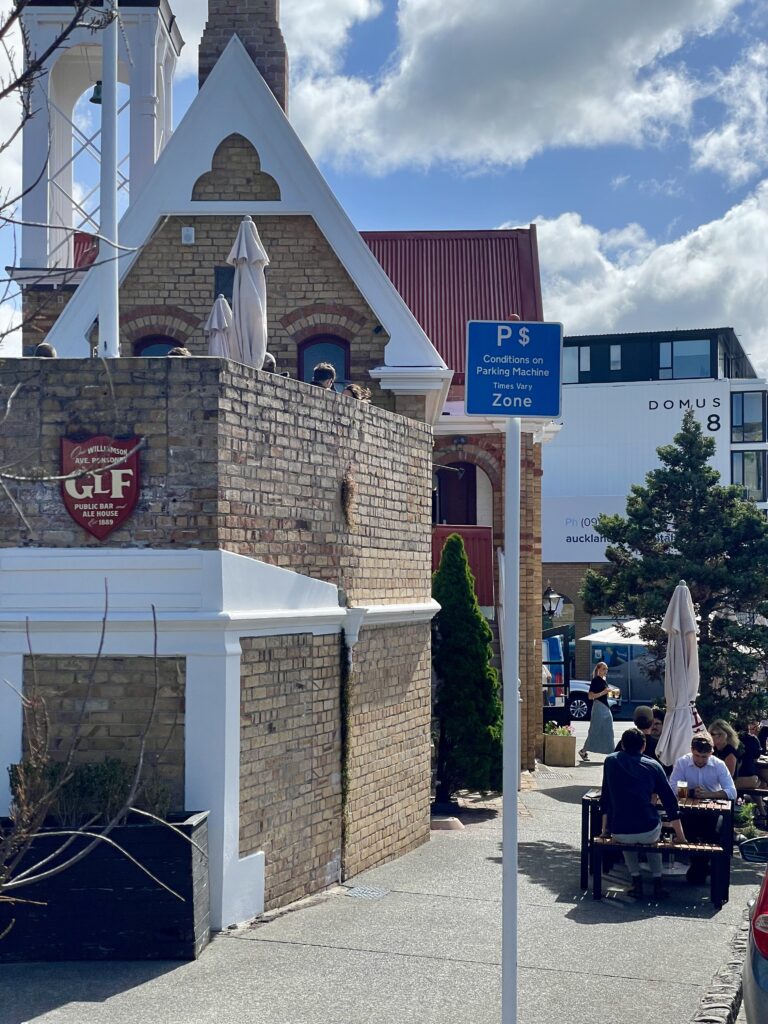
Here is the 1889 Grey Lynn Firehouse. It perches prettily on a “flatiron” triangle demarcated by Williamson Ave, Rose Rd and Pollen St, right where Grey Lynn turns into Ponsonby.
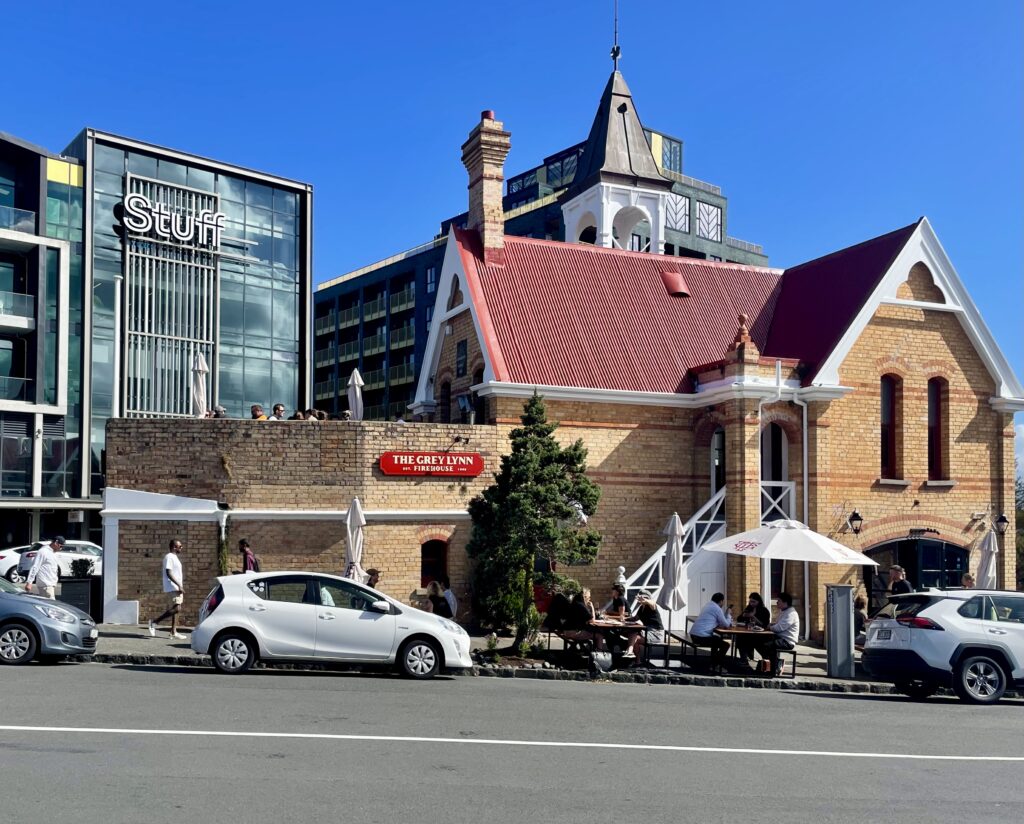
The Grey Lynn Firehouse building, as seen from Rose Rd looking towards Williamson Ave.
It is a very cute piece of Victoriana: bricky, bijou, as if borrowed from a life size model-train set.
I’m very pleased we still have it, stranded safely on its little island. Its history, outlined here, pretty much contains the whole story of the urbanisation of Grey Lynn (Surrey Hills) – excepting pre-settlement history, of course.
To keep and maintain heritage buildings like this one, unless there are huge public funds to preserve them as museum pieces, we need to find successful new uses for them. This close to Ponsonby Road – and even better, with new apartment buildings increasingly going up nearby – the obvious use is hospitality.
I remember being taken here as a child, the first time it opened as a restaurant, last century. In happy news, yet another operator is having a go at making the building work today; the latest in a number of hospo iterations to occupy this little space.
My casual observation is that these places last for a while, then fail, and someone else moves in. Hospo is a cut-throat business; maybe it’s the usual problems of tight margins and a fickle public
But my long held view of this tiny little building in particular is that it may be too compact for a viable operation. In a space this small, there’s inevitably a trade-off between having enough back-of-house room for efficient operation, and plenty of attractive space for customers.
So it is no surprise that a splashy feature article about the new operation immediately homes in on the potential of the space outside the building:
Wander through London or Sydney when the clock strikes five on any given day, and you’ll be swept along with crowds of revellers spilling out onto pavements clutching frothy pints.
Damn right: and look, there’s a quiet cul-de-sac on the north side of the building that’s just screaming out to be colonised in this way, in order to make a viable operation out of this little treasure. An absolute ocean of tarmac, just begging for a better use.
And yet it’s currently just sitting there. Cooking on sunny days, or flooding our over-burdened pipes with on stormy days… all so just three (3) cars can snooze alongside the old fire station. What a colossal waste of space.
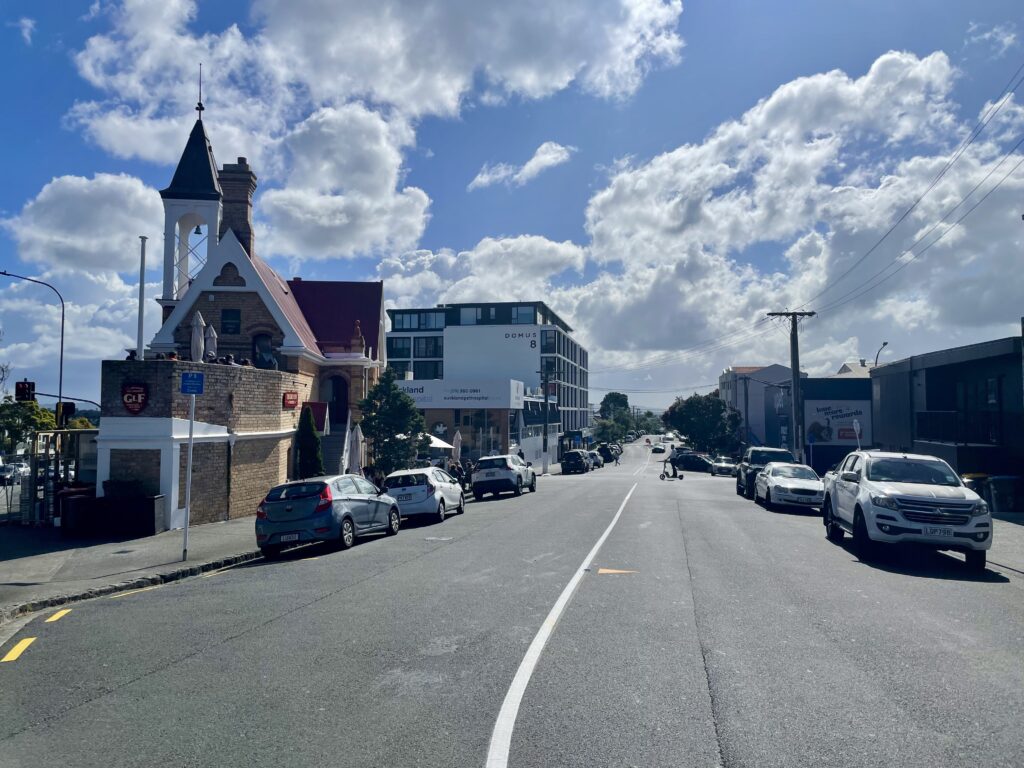 What’s especially relevant about this situation is that when the supermarket building across Williamson Ave opened, Auckland Transport “refreshed” the surrounding streets. They added new signals, repaved the tarmac, even painted some suboptimal bike lanes here and there.
No doubt the supermarket operators had to submit a transport plan to AT as the Road-Controlling Authority (RCA), and they’ll have hired transport consultants, who will have modelled traffic movements.
But neither these consultants nor AT clearly gave much thought to any other opportunity offered by this street space, aside from traffic movement and car storage. Or if someone did, they don’t appear to have been sufficiently in control for such thoughts to mean much in the outcome. With the exception of the three rather bedraggled specimens on the new concrete island, and a few very lonely Nikau palms across the road completely dwarfed by the new building.
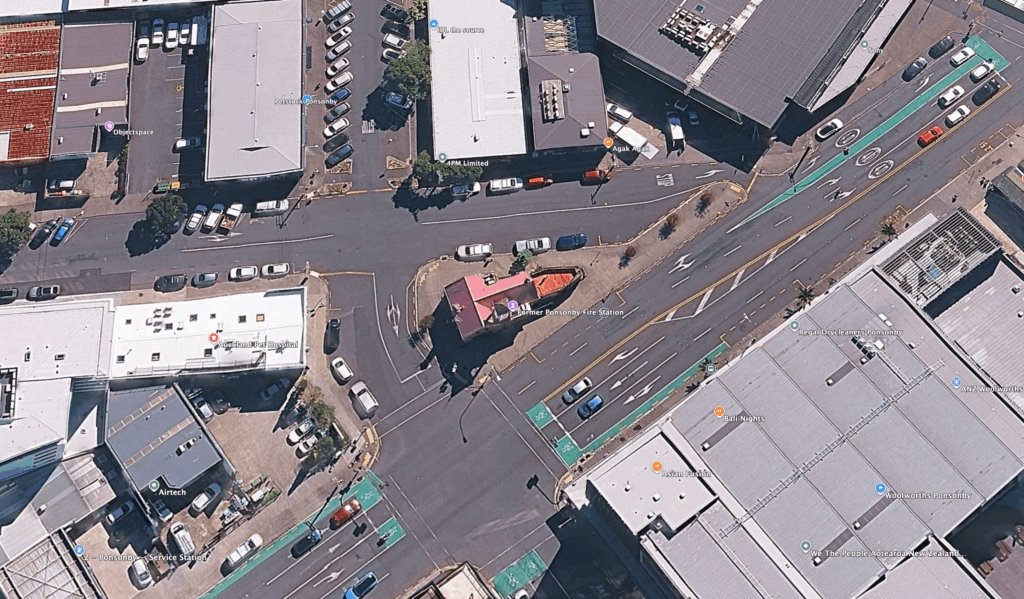 For no doubt very good traffic-flow reasons, AT did do one (half) good thing: partially closing the top of Rose Rd. Although they couldn’t bring themselves to do the job properly, and have left an irritating (to everyone) and mostly useless (to drivers) slip lane.
Look especially at the space along the right hand side of the firehouse island below, taken up three (3) carparks and a bunch of dashed yellow lines:
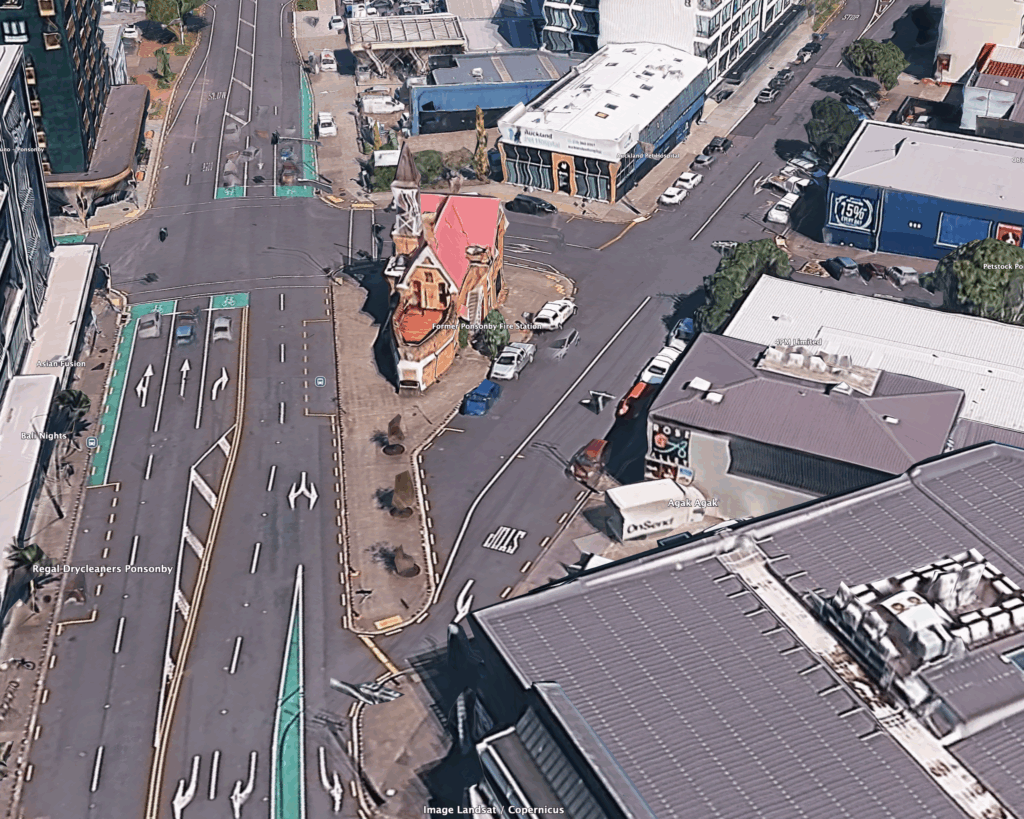 Very different outcomes are clearly possible here, especially if you had a Road-Controlling Authority that, while informed by traffic expertise, takes a much wider, more thoughtful, and longer-term perspective.
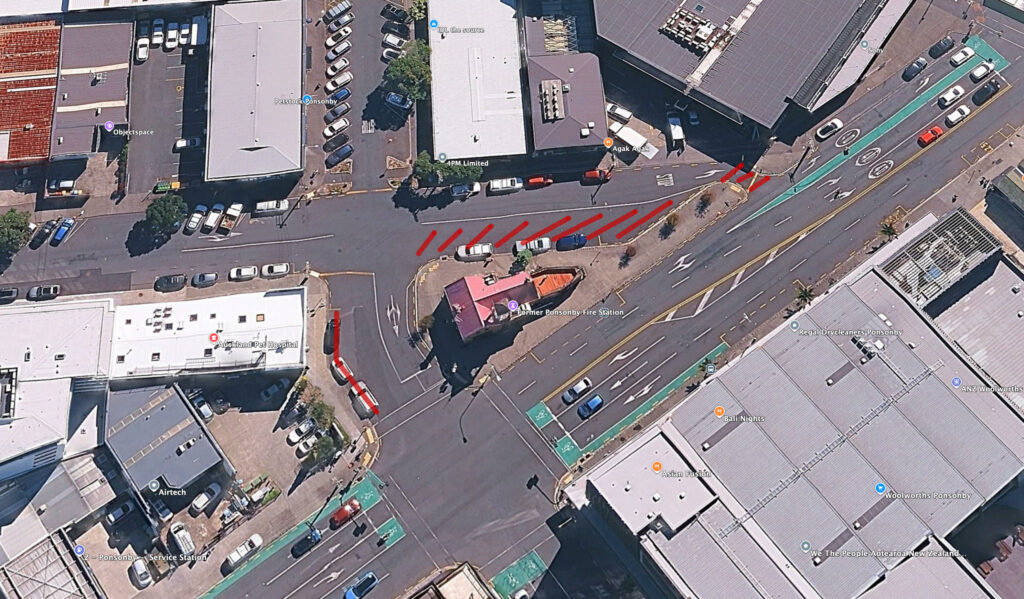
For example: you could liberate the areas in red below, rescuing them from being just underused tarmac, runoff-maximising, heat-absorbing, land-smothering dead space. Create more people-space for outdoor dining, obviously – but also, introduce rain gardens and trees, and perhaps even play space.
The idea that three or even six on-street parking spaces are a more valuable use of this precious stretch of public realm is frankly laughable. Especially as all of the new buildings in the area – including Ockham’s eyecatching Greenhouse, and the apartment building on Rose Rd – have come with carparking, as of course has the supermarket with its vast public parking garage.
 The north-facing area directly alongside the Grey Lynn Firehouse would be great for more outdoor dining space, a boon for any business lucky enough to occupy the building.
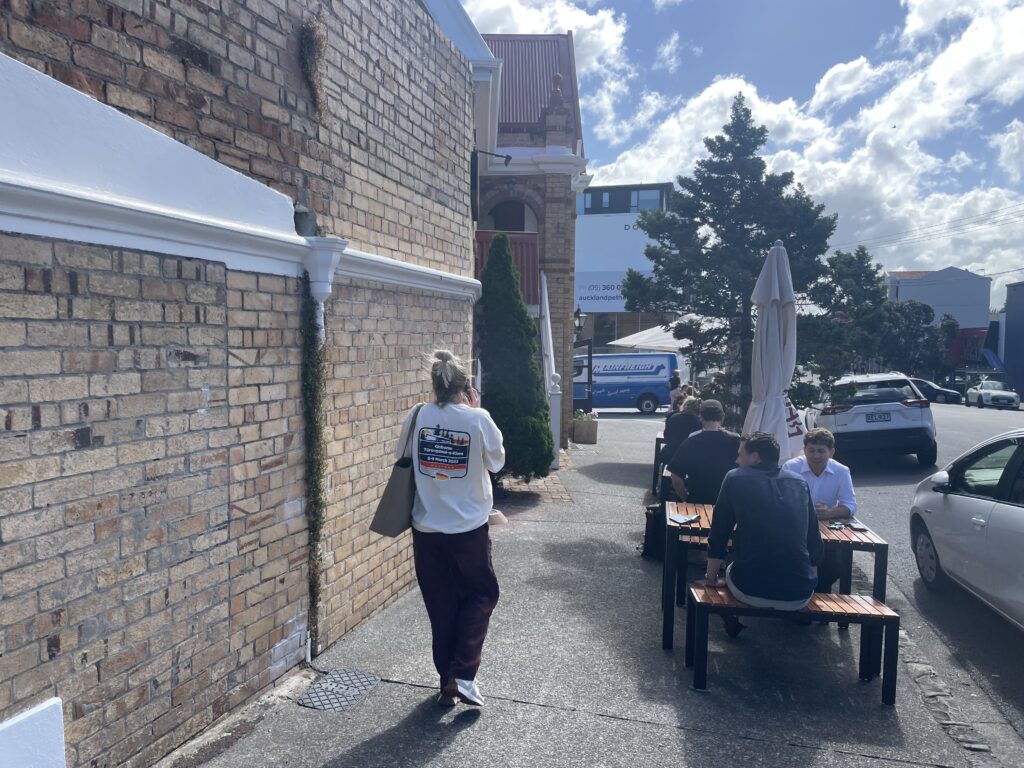 It is very hard to argue that the best and highest-value use of this public real estate is a swathe of publicly funded tarmac that’s empty all the time, and three (3) car parking spaces.
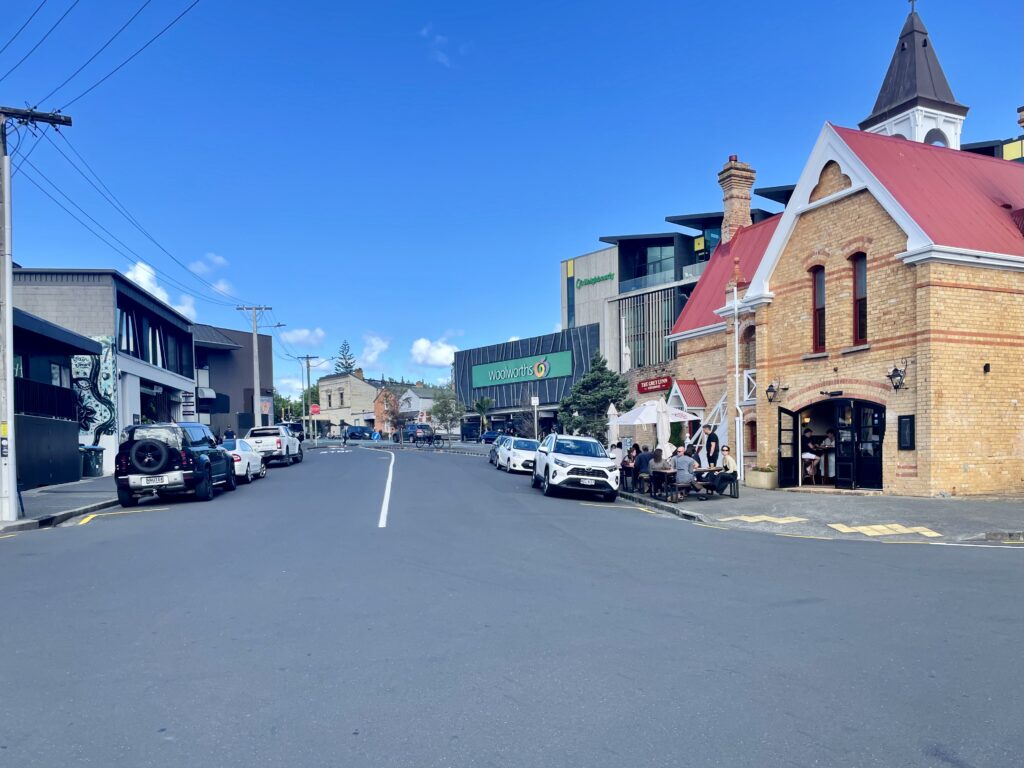 The other thing missing from this currently grim flatiron space is trees! Whatever the question, the answer is always more trees. And a street tree will always be preferable to an Auckland Transport sign.
This is just one example of what the potential available to any attentive local board, the minute they’re officially the RCA for local streets. They’ll be able to choose way better outcomes for local placemaking, for local people, for local businesses, for local stormwater management, and local quality of life.
After all, this is why we set up local road boards and other public institutions like Auckland Transport – for the broader public good.
It’s not surprising that this sector-for-people got out of control and became a narrowly focussed system that largely serves vehicles (and one type of vehicle at that), given the limitless appetite of these space-hungry machines. But it doesn’t have to continue this way.
With this governance change, there is a great opportunity to put the genie back in the bottle – at the very local level at least.
Traffic management will remain important, and likely dominant, and the expertise of traffic specialists will always be an important and valued part of the discussion about how we live now.
But it’s just one of many uses of the public space we call roads and streets. And in my view, we will have far better outcomes for everyone, when that one voice is not the sole and final arbiter of every square millimetre of this valuable shared resource.

 Processing...
Excellent article Patrick and a great example of how re-imagining “wasted” spaces could give a much better outcome for all
Before the supermarket arose opposite the old fire station there was the proposed Soho over-development 20 years ago with its huge underground car park and 40,000+ square metres of new buildings above. As the “last man standing” in the environment court appeal against the over-size Soho scheme, I raised the deleterious effects of all the extra traffic that would be generated in local streets only to have my expert evidence thrown out on a technicality. Part of that related to the top end of Rose Road and advocacy for down-sizing the road and widening of the footpath on the South side making room for an outdoor dining space right next to the fire station. As Patrick observes, this would have improved the economic viability of the restaurant which has seen a number of operators fail over the last 30 years. So, let us hope that the concept may eventuate under “new management”.
PS – although my expert witness was rejected- some non-expert photographic evidence from a resident proved that the Soho expert was wrong to assert that the local streets could handle the expected traffic flows and led to them having to withdraw and seek a delay which effectively killed the project as they were overtaken by the GFC (global financial crisis) which stuffed up their debt-financing. So while the developers won in court they lost out financially and had to sell the site at a significant loss and much of their huge excavation had to be filled back in.
So you fought to force less development and less intensification, help mothball a major project and still we have wide roads full of cars and parking anyway. Thanks Captain NIMBY, great job.
I am and always have been a strong advocate for intensification but not the sort of over-development and over done car parking planned for Soho. The community was appalled that a base-level 40,000+ Sam plan for Soho was approved “non-notified” so our only grounds for objection was to the extra 13.000 Sam sought by the developer. Our objections were never to intensification as such but to an over-the-top proposal that would have distorted and blighted the whole Ponsonby Road strip. One by one all submitters had to withdraw in the face of threats from Judge Newhook to apply considerable court costs against us.
So you support intensification, just as long as it’s somewhere else that doesn’t affect your community?
I think there’s a word for that…
Excellent description of a positive pathway forward. I especially like the corridors and cupboards analogy. It now becomes even more important for Aucklanders to get involved in the selection and election of Local Board members to get positive outcomes. The risk is that low voter engagement and turnout means local areas (like Entrust) only elect the risk advise and conservative bypassing the opportunity this new legislation gives them.
“You see, under the current model, it’s traffic engineers alone who have the final say over every detail of our streets and footpaths.”
Patrick, we’ve argued strongly about this before, and I remain of the opinion that this is unfair and simplistic blaming. As a transport engineer (a subtle distinction), I DO NOT – and have never – had the final say in design decisions of roads, even in my own projects. It always comes down to project managers, and ultimately politicians to make the important calls.
When Simeon Brown recently made it essentially illegal for me to design an arterial road intersection with traffic calming, where was my final say? In fact, stuff like that forces me to act (or accept outcomes that are) against my ethics. I don’t know that Simeon is a traffic engineer is he? Or Luxon, when he slips anti-bike lane comments even in rants about expensive loos.
Sure, our profession has a lot to answer for. But can you please stop reflexively (or even casually) blaming us please?
Small point in fact: That Williamson / Rose road design for the supermarket? That is MY design. I did that design.
And before you start saying “Aha, point proven!”, you should know that every little bit of slight cycle and pedestrian improvement over the standards / guidances / “social license” limits of the day (was were all pretty shit, no question) was my suggestion.
I added the cycle lanes on Williamson (protected cycle lanes didn’t exist in AKL yet). I said “that Rose Road gap is huuuuge and makes pedestrians walking along Williamson need to cross 25m. How about we propose to make it one-way and really narrow it up? We could get that across the line”.
Without me, I seriously doubt any of that would have happened. There was no expectation that these things would be added by the general public, by my clients, or by (most) politicians. If I hadn’t suggested them, the designs would very likely have been accepted w/o such changes.
But the decisions in the end weren’t mine. There was some politicial support – I think Pippa Coom for example supported the changes from memory. But the push for the improvements came from a transport engineer. We’re not all the same, and we’re not the enemy.
Max, thank-you. Yes this re-up could have been much worse, that closure of one lane of Rose Rd is indeed the thing that makes these observations even more, well, obvious. Indeed we are all grateful for every Transportation Engineer as enlightened as you.
However this is about a systemic situation, we should not have to hope for especially exceptional practitioners in a system that does not incentivise them.
This is no attack on any individual, least of all you!
As when we look around the city we see upgrades and renewals that embed last century’s priorities again and again, because that system leans that way. Yes there are exceptions.
The purpose here is to daylight an opportunity, especially for Local Board members.
Some careful attention to the unknown scope of Local Board responsibilities under the Bill is needed. For example, Ponsonby Rd and Williamson Ave are both arterial roads, so will come under ARTC, not Local Board. This is almost certain to include effects of any change to local street intersections with them. We actually want more Local Democracy, not less. These responsibility interfaces will become very important in a short while. Local Board influence on funding allocation for the transport system will be difficult to navigate. Council’s submission on the Bill tried to address this.
Backing the local voice against the Wellinton Boot may become more difficult, not less, unless we are careful.
Yeah I can see why his phrasing would piss you off. Traffic engineers at project level don’t get the final say.
Yet the chief engineer of each organisation (AT, WK, etc) and their teams, have certainly worked consistently to prevent the needed transformation of the transport planning system.
Where traffic engineers as a body should be criticised, is in their failure to hold these more powerful engineers to account, professionally.
10/10 totally agree with your viewpoint. People should really be asking each other why they’re agreeing to push the National and ACT party’s ideas on roads and public transport control.
Who’s the politically nihilistic right-wingers in the room and why would these people really be in your corner?
The structural problems with councils will be amplified, not subdued.
It’s almost certain that progressive action will become slower, not faster.
this is in no way defending Auckland Transport, but seems like a lot of people in the room have some really poorly placed optimism and idealism about this stuff
“You see, under the current model, it’s traffic engineers alone who have the final say over every detail of our streets and footpaths.”
Under the new scheme, no decisions will be made as there will be lots of Local Board committees arguing for months about every proposal. These committees will be loaded with “experts on everything”, similar to how the Mayor is an expert on all things transport. Think of his wacky plan to push a motorway through the centre of Pt Chev.
– should that Act be renamed the Baldock/Prager Act?
– Ouch, preservation of sub-optimal outcomes for just three carparks. A glaring waste.
– here’s where Bike Auckland and Greater Auckland, and all interested people could create courses specifically aimed at Local Board Members so that at least they can start to understand how to create great living environments. You could even charge them so you at least get some return.
Waitematā Local Board is strongly progressive, I don’t think Baldock/Prager will get much say in what’s to come
I hope they get laughed out of the room. Certainly not given column space in the local suburban magazine.
– should that Act be renamed the Baldock/Prager Act?
– Ouch, preservation of sub-optimal outcomes for just three carparks. A glaring waste.
– here’s where Bike Auckland and Greater Auckland, and all interested people could create courses specifically aimed at Local Board Members so that at least they can start to understand how to create great living environments. You could even charge them so you at least get some return.
how does allocation of funding to the local boards for local roads work? has there been any indication? how will it be equitably distributed and how do we avoid poorer suburbs ending up being shafted through lack of funding?
Each Local Board will now have to hire their own traffic engineers and consultants, plus a room full of PR people to respond to the hundreds of complaints that they will start to receive from “concerned ciitizens”, not to mention the numerous public meetings that these activists will be calling to complain about every decision that their Local Board ( or any Local Board across Auckland ) makes. Under this new governance experiment, nothing will get done. Within three years there will be calls for a centralised road traffic entity to take over.
Excellent pice by Patrick Reynolds; even for a non-Jafa, it explains things well!
Dave Macpherson
+64 21 477 388
dave.macpherson7@gmail.com
Thanks Patrick for highlighting the positives of the reforms.
I think the greater transparency will be good as elected members will no longer be able to hide behind AT and AT won’t be able to play internal political games to stall projects they don’t like.
There’s a bit more to the Rose Road Plaza project (as it is known). It first featured in the Ponsonby Road masterplan 2014 with a concept drawing
https://www.aucklandcouncil.govt.nz/en/plans-policies-bylaws-reports-projects/our-plans-strategies/place-based-plans/area-plans/ponsonby-road-plan.html.
The opportunity came about because the supermarket development’s traffic plan required the closure of the top of Rose Rd (the trade off for super sizing the Pollen St/ Williamson Ave intersection and adding a traffic lane).
The developer initially closed the road just before the supermarket opened but it was quickly discovered that no one had told the developer about the road stopping process – the compromise was to narrow the exit and make it one way out.
I got the 3 tree pits retrofitted in the widened footpath between Rose Rd and Williamson thanks to a can do maintenance friend at AT.
Over the years the local board has tried to keep the plaza concept alive but it has stalled due to a lack of funds.
Since then, a law change has made it possible to close public roads to vehicle traffic (modal filters) without Stopping Up. If only we had been able to that then. You might be amazed at how desperate AT people were to make this corner better (page 25 of the Masterplan). But sadly, it does come down to (a) how changes can be funded – developer funding or Council un-budgeted contributions and (b) what the community can agree to (losing three parking spaces!!!).
What remains necessary is access for service and delivery to properties off the street and the ability of vehicles that need access to turn and leave. The rest of the space really does need to be given over to community activity, including outdoor dining under the trees I(or just out of the ‘drip’ line.
The Transition to new organisation can, we hope, strengthen the way Local Boards and Council professionals can work together with the community to move improvement of the environment on.
Thanks both for additional info.
Yes funding and advice are surely the two biggest concerns with this governance change.
“But sadly, it does come down to… (b) what the community can agree to (losing three parking spaces!!!).”
The reason we can’t have nice things is not because the public don’t support them. It’s because the public’s support gets buried by senior staff or politicians who want something else. And who are happy to elevate the voices of a few vocal NIMBYs in a pretense that these oddballs represent the public.
The bigger threat to the success of the Grey Lynn Fire House (and similar businesses) comes from the draconian requirements of the Sale and Supply of Alcohol Act and the (ever increasing) rates of excise on our drinks.
All these extra overheads end up getting spent on Crown-owned quangos which exist as employment agencies for school prefect-tier wowser ‘experts’; whose only function is to make New Zealand a duller and less appealing place than it needs to be.
I wish the owners of this new pub every success and congratulate them on their thoughtful utilisation of a lovely piece of Auckland’s built heritage.
Readers of this blog should pop in for a pint if they get the chance.
Absolutely. I think it must be very hard to run a pub in New Zealand; the barriers to entry are high, as are the excise duties on drinks and the myriad licensing requirements. It’s a pity because it disincentivises going out in the evening.
The purtianical rules against al fresco drinking also need to be abolished. Go to London and see how pub goers spill into the street. Auckland has a nicer climate than London and we could/should make much better use of it.
Great piece Patrick, love the house analogy!
Keen to find out more how the transport budgets for local boards will work – I worry that any money will be needed for routine maintenance, and there will be little room for any real improvements. Here’s hoping!
Yet there was even more tarmac around that building in the 1940s aerial, some 20 years before there were traffic engineers. I don’t know a single traffic engineer who would care whether those 3 parking spaces exist or not. I worked with a traffic engineer at Auckland City Council who was involved in the Landmark trust and who helped save that building. But whatever traffic engineers bad, architects good, bah humbug.
Matiu would be proud.
The change that’s coming is to move the final decision point to elected Local Board members, away from a technocratic level. I agree this comes with all its own fraught possibilities, but it is not about moving it from one set of technocrats to another.
It is shifting the final decision to the strategic level. Where in theory, it should be. With, ideally, all the appropriate technocratic advice and input feeding into the final outcome.
-transportation engineers, stormwater engineers, urban designers, arborists, geomancers, whatever … plus of course locals, local businesses, school kids, etc, the whole mishpoca
Thanks for the post, Patrick. I’ve been enjoying your writing.
“the resources local boards have available from Council and Auckland Transport – including the quality of the advice available to them.”
Under the new regime, with all of the planning and strategy work moving from AT to AKL Council, there will be no advice available to local boards from AT. Each local council will need to hire their own roading and traffic consultants to provide quality advice, or they will need to rely on a local board member who is an expert on everything. Each local board will also need to hire their own PR and consultation staff to deal with the hundreds of questions, objections and feedback from “concerned” local citizens, about each roading decision.
This ×100.
Local boards will have much more to do, but no resources to handle technical advice, designs, decisions, etc. It will definitely change the outcome, but will it actually improve things?
No, Local Boards should be able to access even more support from AT staff moved into AC. The partnership between local governance and professional support should only grow from where it is now.
Interesting how we are to have a 30 year traffic plan while we are supposed to (be able to) plan for 100 years of housing
Two very different things.
A plan allowing capacity (ie for all sorts of unknown possibilities unfolding over time) for future growth on private land, is completely different from a plan on what to actually build publicly with public money in the public realm.
A 100 year transport plan would be useless, would consist of the vaguest of things, and be 100% wrong.
30 is about right, with an eye further ahead, and always iterating, and actual concrete projects over 10 and 3 years.
This post is delusional. Other than 1 or 2 progressive Local Boards every project with a carpark removed will stop dead in its tracks. There is way more political capital to be spent fighting for cycle or bus lanes than there is for defending car parks. A ‘Mission Bay’ type project for example has no chance.
Do you mean the Mission Bay type project where the businesses requested AT remove the car parks and convert them to outdoor seating?
I think it will be much much easier for these types of projects to get across the line if the decisions sit with the LBs. LBs can be lobbied directly by businesses and it will be clear where the accountability for declining or accepting will reside. Unfortunately many of those types of projects will not sit with the LB as many of our main streets are on arterials and it seems they will sit outside LB control and are likely to be prioritised for regional vehicle movement and throughout over local placemaking.
Great article & good example of a wasted space alright.
I was pleased to see Pippa and Inside Looking Out challenge your assumptions on this intersection. There was a desire to block off this road but back then it was not legally possible without a massive process.
An important point that your article (and many opinions from armchair experts) completely misses. AoNZ’s transport laws are not fit for purpose and this often leads to poor outcomes – like this one.
But I say there is another problem with this example. You are talking about an intersection with an arterial road – so the local board won’t have anymore control over it than they do at the moment. Remember that this stupid idea is to give the region 22 road controlling authorities (instead of the seven the Royal Commission proved was a terrible situation that was fixed by having AT). This intersection will be controlled by the governing body not the local board. In fact no local board will have control of the main shopping streets in their town centres and villages – those all have arterial roads running through them. You are being sold a lemon in this con job by the Brown Boys. Local boards will really only control the truly minor roads – the ones that have almost no traffic controls on them.
This undefined concept of democratic accountability could have been gained by imposing further consultation requirements onto the transport legislation but then the Browns wouldn’t get their extra votes by proving they destroyed AT – with no real plan for how to do road controlling authority after they did so
You’ve alway come here to say you haven’t been able to do anything positive cos reasons, well soon there will be other people to maybe try. And yes that will likely be difficult, especially with regards funding. But at least some may actually try without a self-limiting RCA blocking them.
Also I do not follow your logic about not being able to change a local road because it’s adjacent an arterial. Well I did not suggest changing the arterial, just the local road. Every place is adjacent other places. It is just your assumption that action is not possible in this case. Wild place to start from.
This, it seems, is your superpower – finding reasons to not act.
It’s not about being adjacent to the arterial it is about being an intersection with an arterial. The RCA for the dominant road obviously will get to determine the nature of the intersection not the RCA responsible for the minor road of the intersection.
I also refute and reject your assertion that nothing positive has been done. I reiterate that AT has been the most prolific, most successful, most innovative RCA the country has ever had. Despite the unhelpful legislation and risk adverse legal team. No council has come close to doing as much and under the fractured model now proposed the rate of change ge and improvements will slow down immensely. AT’s focus was always on producing what was seen as the best transport outcomes overall. Once politicians are back in charge of the decisions the only purpose behind the designs or lack of decisions will be what approach is likely to appeal to the greatest number of people who vote in local government elections.
@Translex I was providing more context rather than challenging Patrick’s assumptions (he is correct in his assumption that someone did look at the opportunity but didn’t have enough control to see it through). Rose Road will come under the control of the local board (the intersection of Pollen and Williamson is where Rose Rd is intended to connect to an arterial) but whether they can progress the plaza concept will come down to funding.
I think fair it is to say that AT achieved a great deal and there have been positives but when it comes to active transport and placemaking the majority of local successes have been despite AT ( I can give you hundreds of examples). Councils with direct control over transport have made far more progress.
Careful what you wish for Patrick, any traffic engineer in any council which is still an RCA will tell you that parking removal is stopped by elected members, not engineers.