This is a guest post by Tim Jones, President of Living Streets Aotearoa. By profession, Tim is a writer, editor and anthologist, and his latest book is the poetry collection Dracula in the Colonies.
New Zealanders are choosing to walk more and drive less as a way to get around, according to recent research released by the New Zealand Transport Agency Waka Kotahi. In 2024, 82% of people walked for transport at least once a week, a significant increase from the 64% who did so in 2023.
This is fantastic news for our planet, for our health, and for our communities. Walking for transport offers us so much. It reduces congestion, is pollution and emissions free, and plays a key role in connection to public transport. In a world that is full of fitness memberships and miracle cures, walking offers a cheap, easy and accessible option for keeping ourselves physically and mentally healthy. Walking also connects us to our communities, allowing us to pay more attention to our surroundings and the people we pass by on the footpath.
Alongside the economic benefits from reducing congestion and increasing retail footfall, there are also economic gains from the significant health benefits associated with this active form of transport. Everyone benefits from communities and spaces that encourage walking.
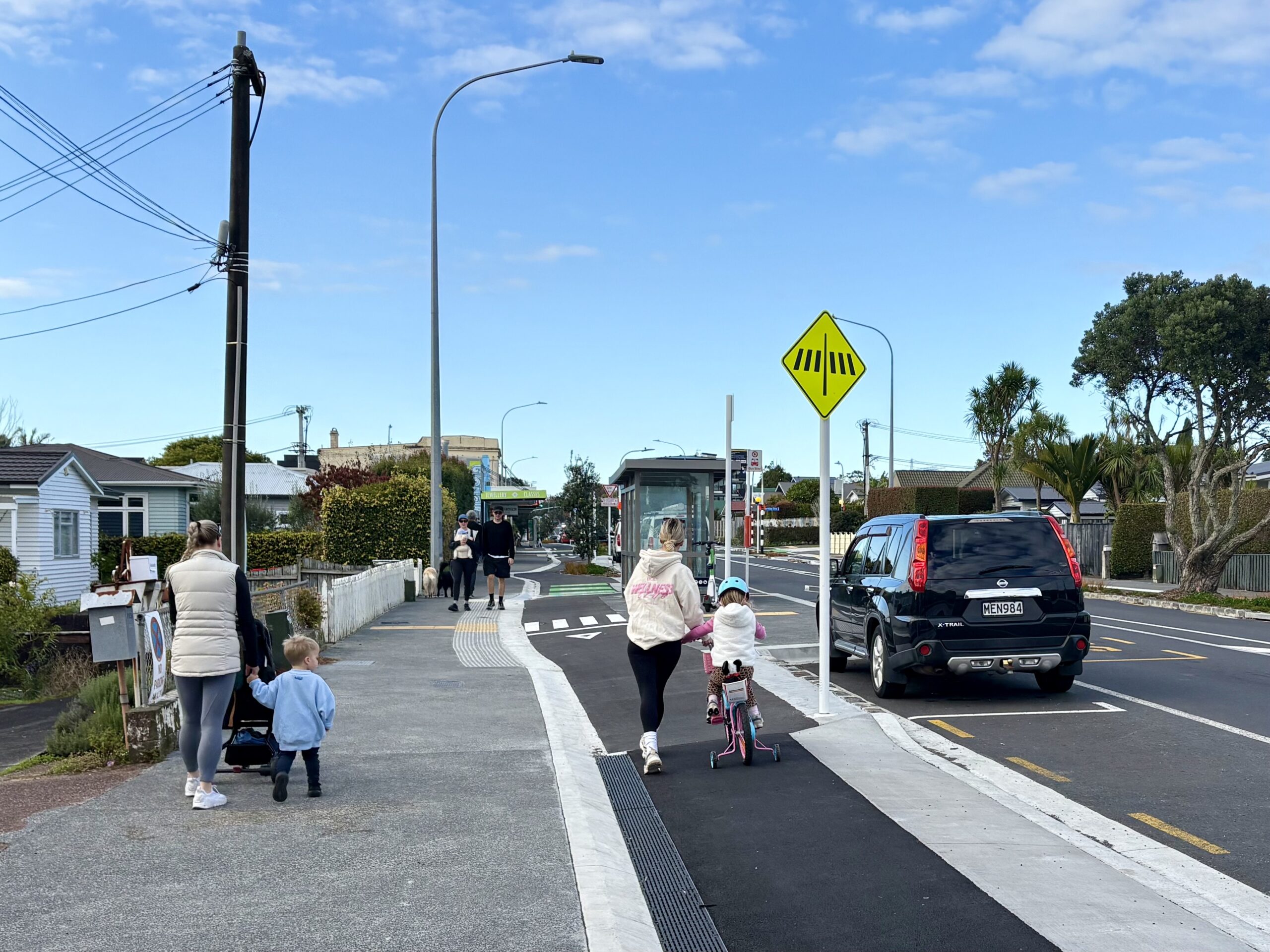
Parents with kids walking and strolling on Pt Chevalier Road
However, while walking can give us so much, we are giving it very little back. The newest government proposal for the Roads of National Significance shows the package of projects may cost $40-50 billion dollars. In comparison to private vehicle travel, walking is severely underfunded. Walking is officially at the top of the sustainable transport hierarchy, but in practice it is frequently relegated to last place and regarded as politically expendable. This has been true for decades, but the 2024 Government Policy Statement on land transport restricted funding even more and made it much more difficult for walking improvements to be included as part of wider transport projects.
The lack of funding has worsened the existing situation that streets, public places, and transport policies are designed with cars in mind first, making it faster and more convenient to hop in the car as a default. Plus, recent research found that several motoring trade organisations in New Zealand lobby with tactics similar to those used by the tobacco industry to further entrench car dependence and limit the infrastructure that is built for other transport modes.
It’s difficult to make the choice to walk when there isn’t a footpath to walk on. Indeed, the average number of barriers to walking that people face has increased. What’s clear is that we need to invest more in addressing these barriers and creating places that are walkable, which must also be wheelable for people using low-speed mobility devices such as wheelchairs
Living Streets Aotearoa, the national pedestrian organisation held the recent 2025 Walking Summit to provide a much-needed space to talk about creating walkable communities and putting pedestrians first. Attendees included people from councils and central government, researchers, consultants, and community advocates, in addition to Living Streets Aotearoa members.
Summit speakers presented a number of examples of putting pedestrians first including a car-free street trial near a Wellington school, safety improvements and a new community space at an intersection in Hamilton, and advocates who fought to retain a safer speed limit in their community near Nelson.
With more people walking and widespread support for walking in New Zealand, we are ready for more change to make communities walkable. We need to keep pushing for places where pedestrians matter and walking matters. A walkable community is a liveable one, and we must invest in walkability for the health, safety, and wellbeing of our communities in Aotearoa.
If you’re interested in joining us to improve walkability in Auckland, Living Streets Auckland is a new branch of Living Streets Aotearoa that is in the process of being set up, so keep an eye out for that.
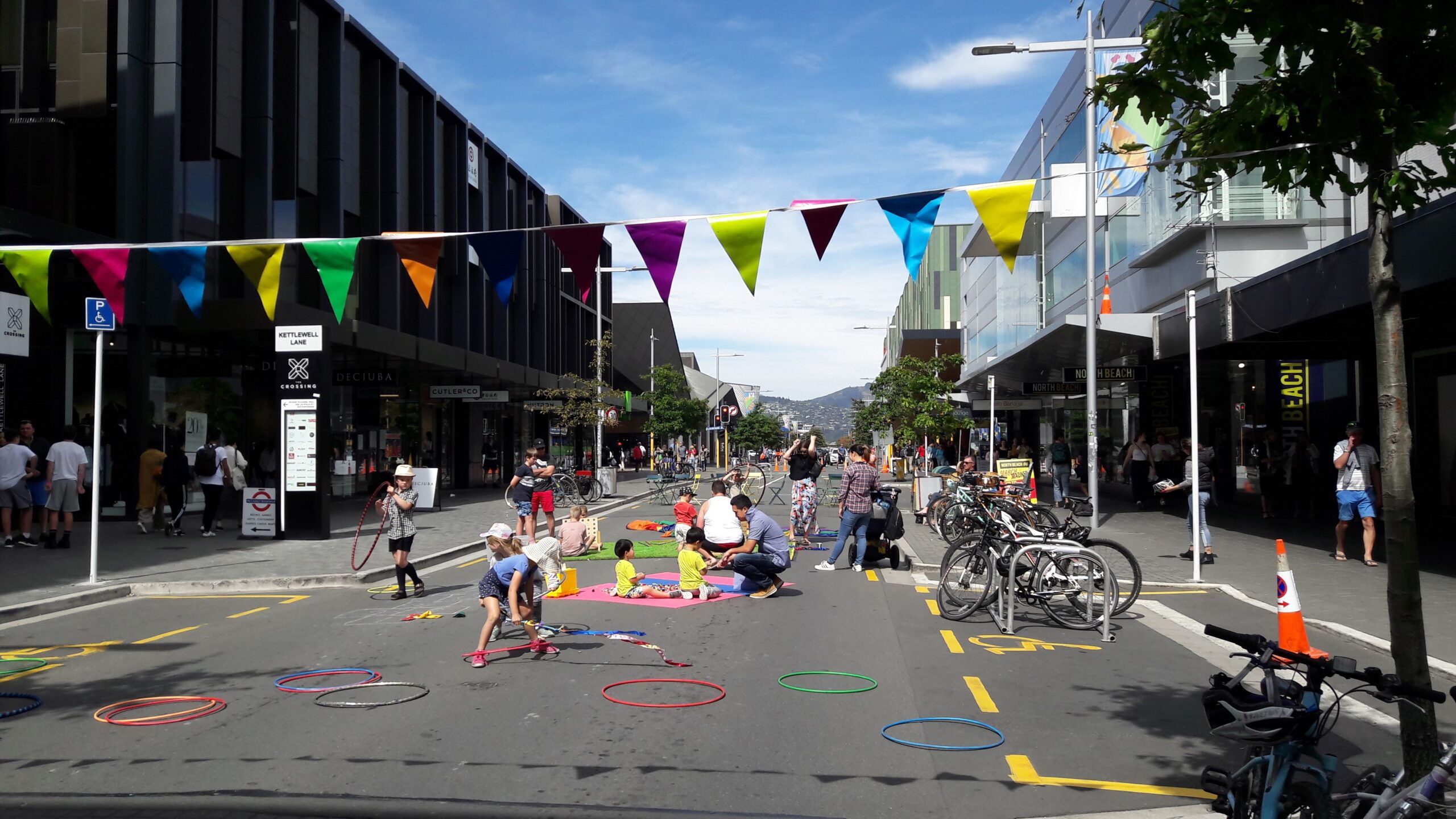
Open Play Street event that was organised by Transportation Group NZ in 2019 in Christchurch
Living Streets Aotearoa is New Zealand’s pedestrian charity, working to improve conditions for pedestrians so that more people, of every description and ability, choose to walk or wheel more often and further to get to or from work or school, to do errands, for exercise or leisure or just for the sheer pleasure of it.
This post, like all our work, is brought to you by the Greater Auckland crew and made possible by generous donations from our readers and fans. If you’d like to support our work, you can join our circle of supporters here, or support us on Substack!

 Processing...
Tim, a great post and a positive reason (there are few others) to live in Auckland
Walking provides minimal business oportunities compared to supplying the cars and roads for private transportation.
In fact provision for alternative transport modes subtracts from business oportunities.
And we elected an unashamably business enabling government.
Any business, good or bad for us.
Walking and cycling is better for local businesses than cars. A lot of business owners think most of their customers arrive by car when in reality most (in urban settings) arrive by foot or bicycle, or a combo of walking and transit.
Yeah sure next to a train station maybe but that’s not “most” local business. And I’m sure it might be true some places overseas but the reality is in NZ a majority of their customers do likely arrive by car then drive back home with said takeaways etc and especially in winter the car dominance climbs even higher. Evidence again cars are better for business is the misery in the CBD with limited car access a lot of businesses are struggling meanwhile the urban mall with 4000 carparks is humming. Now important to note I know we need to use cars less I’m just stating facts about doing business since that is the topic.
“Evidence again cars are better for business is the misery in the CBD with limited car access a lot of businesses are struggling meanwhile the urban mall with 4000 carparks is humming.”
There are plenty of carparks in the CBD – carparking buildings. And they are just as near/far a walk as it would be from one end of a mall to the carpark.
As per usual, Colah/Sam is wrong. Queen Street seems to have recovered to pre-COVID food traffic. Te Komititanga Square is bustling for most of the day and the nice done-up bits of Quay Street are also busy.
If you “know we need to use cars less” Colah/Sam, why do you show up to be a dick about how idiocracy and made up imaginary numbers that we let rule our lives are somehow more important than humane urban design and a liveable planet that can sustain human civilisation. You offer zero alternatives, every one of your comments is literally just “haha suck it triggered environmentalists”
i hope one day the consequences of car addiction come and hit you with a good wallop. oppressors need a taste of their own medicine.
oh and don’t give me the “who’s Colah” schtick again. You have the same speaking patterns, the same provocative gloating, and remember conversations you would not have been present for if you were a separate person. Occam’s razor – there cannot be more than one maggot troll out there with the exact same spiteful ideology.
When I arrived in Auckland just over a quarter of a century ago from Wellington I could not get over how little foot traffic there was on Queen St.
At the lower end there was a Two Dollar tat shop some where Gucci is now. The transformation to just prior to Covid was immense whilst Lambton Quay in Wellington lost a lot of it’s foot traffic. Work from home has impacted Queen Street, but the reduction of peak traffic demand is overall benificial to cities, as transport infrastructure is more efficiently spread between peak and off peak.
Burwood – Try visiting the central city, maybe not by taking a car, see how your perception may change. I hadn’t been into Auckland city for almost a year until the weekend just been, and wow, I was blown away by how many people were there, both out on the streets and in buildings (shops, restaurants etc). It certainly wasn’t miserable (well to me anyway).
I think your comments are valid for a lot of suburban areas though, low density land use and car centric transit infrastructure has resulted in some people driving 100-200m to the local dairy or fish n chip shop.
There’s research out there to show people will walk further in a mall than they will on a typical high street, mainly because they have less interaction with cars.
Cars literally suck the life out of town centres, yet if you banish parking and through traffic to the periphery, the same way a mall does by design, everyone throws their toys out the pram.
The first thing we can do is fix the bafflingly backwards right-of-way situation in New Zealand. In urban settings there’s zero reason cars should get priority over pedestrians, whether it’s turning cars or at a 4-way stop. Catch up to the rest of the developed world.
After 25 years living in various different cities in Europe, I now live in central Wellington. I haven’t adjusted my attitude towards right-of-way at all. I would say that 90% of motorists choose to give way to me. The 10% that don’t and drive towards me aggressively are all, 100% of them, driving huge, late-model luxury SUVs.
Just pointing out that the statement “In 2024, 82% of people walked for transport at least once a week, a significant increase from the 64% who did so in 2023” is not supported by the report.
As the report notes: “To ensure a more accurate measurement from April 2023 respondents who indicated they had not walked 100 meters or crossed a road in the last year were asked a follow up question confirming this was the case. Due to a lack of direct comparability with past data, only a single point has been shown from the 2024 period”
*furiously tapping the sign*
https://wrongsideofmycar.blogspot.com/2021/02/pedestrian-give-way-rules-were-thinking.html
Every New Zealander should live within walking distance of a pub selling affordably priced beer and wine. Without this, all statistics from so-called ‘experts’ are meaningless.
promoting alcoholism, eh Doc?
I like it.
Everyone says you can’t compare NZ with Europe. What we miss.
Sure do need to improve NZ’s walkability. I’m all for this.