The Police have been in the news a bit recently and for the wrong reasons. One of those was a few weeks ago where it was revealed that there were issues with breath testing:
More than 100 police officers are under investigation after 30,000 alcohol breath tests were “falsely or erroneously recorded”, RNZ can reveal.
Acting Deputy Commissioner Michael Johnson says the numbers are “incredibly disappointing and concerning”.
About 120 police officers now faced “further scrutiny under a disciplinary process which is underway”.
That’s a serious issue and a lot of tests, but also a small amount compared to how many were done in total.
In response to questions from RNZ, Johnson said a review of 5.3 million alcohol breath screening tests conducted by police between 1 July 2024 and 30 September 2025 30,961 tests were “falsely or erroneously recorded”.
…..
Johnson said that despite this, Police’s obligation to deliver 3.3 million tests for NZTA and Ministry of Transport had been met and was not compromised.
…..
“We are confident the required number of breath tests agreed upon with New Zealand Transport Agency – Waka Kotahi, Ministry of Transport and Police, noted in the Road Policing Investment Programme 2024-27, has been surpassed despite the number of falsely or erroneously recorded tests.”
Breath tests and all other forms of enforcement on our roads play a critical role in helping to reduce deaths and serious injuries on our roads with the Government Policy on Land Transport (GPS) stating:
Police play a significant part in helping to make New Zealand roads safer through rigorous enforcement of the traffic laws including alcohol/drug and speed regulations, promoting good driving practices, and road safety education. The Government expects Police to provide sufficient enforcement levels of traffic laws to achieve specific, as well as general, deterrence aims.
This is why some of the funding for road policing comes from the National Land Transport Fund (NLTF) though what is now called the Road Policing Investment Programme (RPIP) but was previously called the Road Safety Partnership Programme (RSPP).
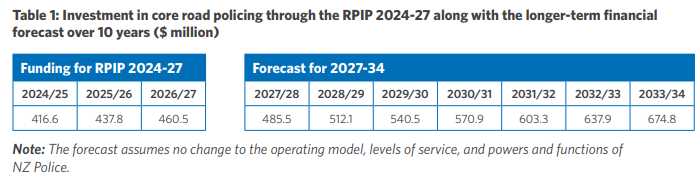
One major change compared to previous programmes is that $72 million of that funding is dependent on police meeting set targets for breath testing and other enforcement activities.
As per the GPS a small portion of this funding is dependent on delivery of speed and alcohol road policing activities described in the outcomes framework.
Some targets, including breath-testing, had originally been introduced by the previous government in 2019 but the current government have expanded it.

Let’s take a look at how police are performing against those targets, based on their Road policing driver offence data, starting with those breath tests.
As you can see below, before the first targets were introduced in 2019, breath testing numbers had fallen from around 3 million to less than 1.3 million. Since mid-2022 it has increased substantially and it is now up to 4.3 million.

In May Transport Minister Chris Bishop and Police Minister Mark Mitchell praised the increase in testing and indicated it was responsible for the reduction in road deaths.
“The whole point of roadside breath testing is to keep New Zealanders safer on the roads – and it’s working.
“It’s really encouraging to see an almost 40% reduction in the number of road deaths where alcohol was a contributing factor, from 92 alcohol-related road deaths in 2023 down to 57 in 2024.
With the increase in testing I’d have thought we’d have seen a spike in the number of people caught driving drunk but that doesn’t appear to have happened. I wonder if other factors are at play in these results, such as the impacts of the wider economy meaning people just aren’t going out as much?

Speeding is another regular hot topic, and there have been some major changes in this space with NZTA taking over the operations of speed cameras and are increasing how many there are, including adding cameras on trailers. As always, media take a revenue generation angle.
Mobile speed cameras in SUVs have generated more than $900,000 in fines in their first four months of operation.
The New Zealand Transport Agency (NZTA) rolled out the new SUVs in May, which has replaced the fleet of vans police have traditionally used.
There are 34 mobile speed cameras operating from SUVs across New Zealand.
Some 67,308 offences were detected, including activation notices, infringement notices and traffic offence notices, from May 12, when enforcement began, to August 31, according to NZTA figures.
I’m not sure if NZTA are publishing stats on tickets directly yet but here are the numbers from police before they handed them over. In the same four months last year the police mobile cameras issued nearly 150k tickets.


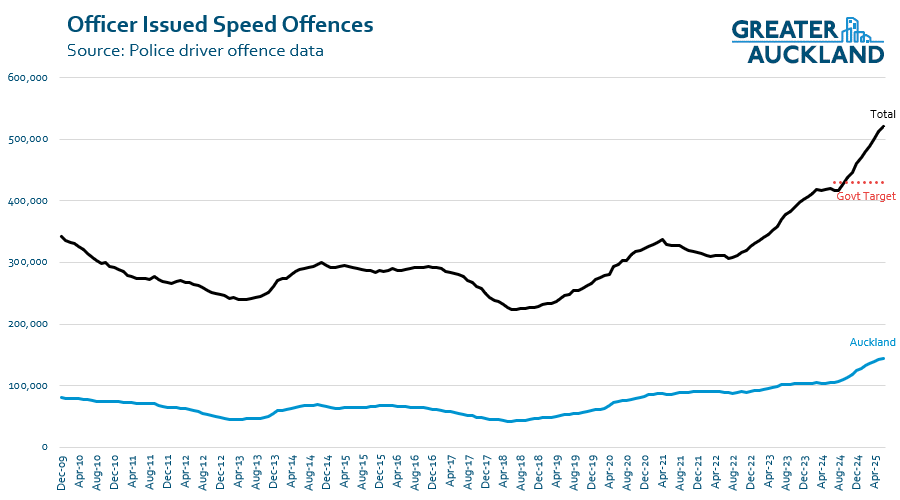
Coming back to the targets, one is around how many tickets officers issue for speeding and police have well exceeded it with over 520k in the 2024/25 year
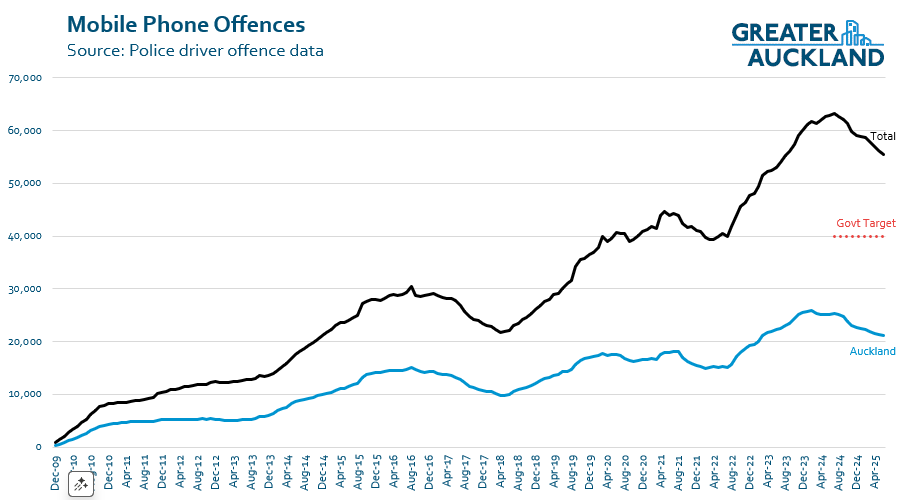
Mobile Phone targets have also been easily exceeded with over 55k issued.
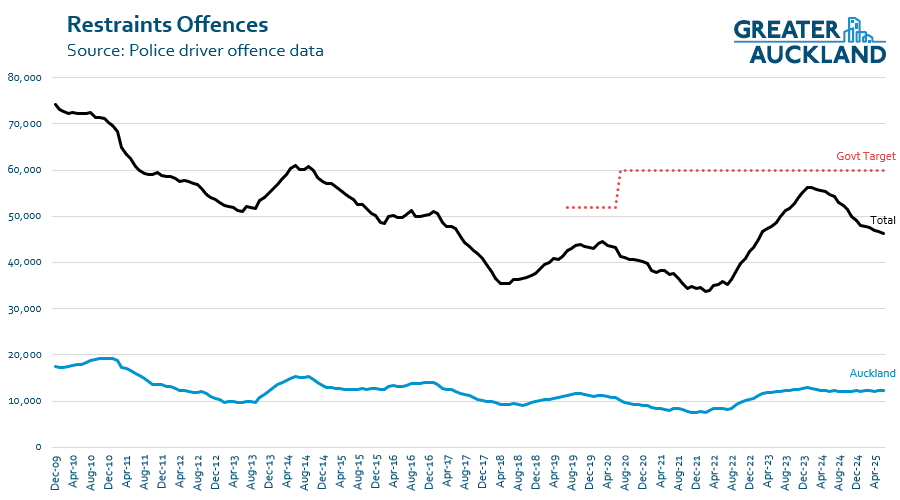
Of the targets that can be tracked with this police data, the only one not to exceed the target is for seatbelts with only 46k being issued compared to the target of 60k.
In an interview about the breath testing issues, there were a couple of useful replies from both the NZTA and police on the question of whether the targets (for breath testing) should stay:
Asked whether NZTA believed the targets should still be in place, the spokesperson said there was “clear evidence” that increased levels of enforcement lead to “better road safety outcomes”.
…..
[Acting Deputy Police Commissioner Jill] Rogers earlier said police would not be reviewing the targets or how they were applied. She said police were planning its approach to the RPIP.
“Police will support the retention of this measure and how it is currently applied”.
Rogers said “global evidence” showed that high levels of breath testing saved lives.
“The most effective way to deter this behaviour is with high visibility of police on the roads and high levels of breath testing. In 2024, police recorded the lowest level of alcohol-related deaths in recent history.”
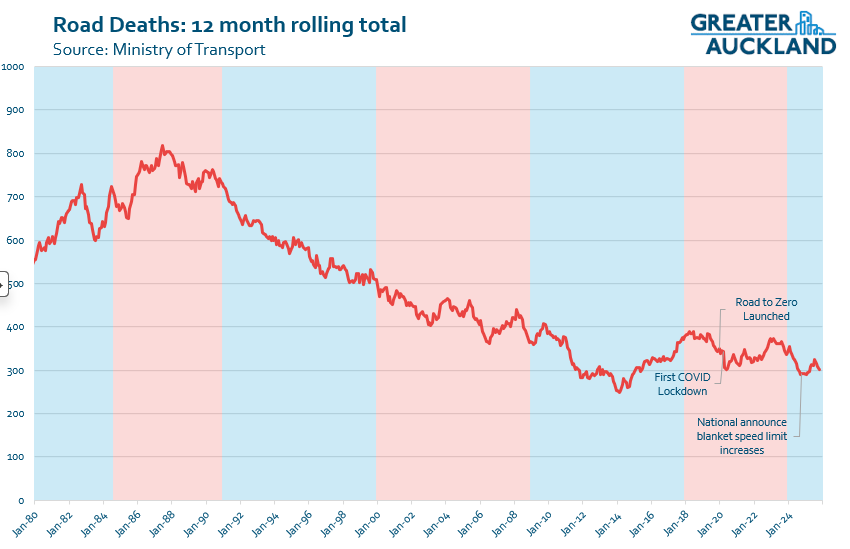
Finally what is happening with road deaths?
After a very bad July the last three months have been the lowest 3-month period ever which is great and helped to bring the 12-month rolling total back down close to 300 again.
This post, like all our work, is brought to you by the Greater Auckland crew and made possible by generous donations from our readers and fans. If you’d like to support our work, you can join our circle of supporters here, or support us on Substack.

 Processing...
Completely insane that NZ Police or NZTA don’t stump up for a dashcam portal like the UK, leave the work to the public and just have a handful of staff to process. The most cost effective form of road policing available. You only need to see how many kiwis use their phones while driving to see how little enforcement people perceive there is
https://www.itv.com/news/2024-10-18/portal-for-uploading-dashcam-footage-saves-more-than-a-century-of-police-time
Is it really insane? We live in an age of artificially generated videos and images; who is to say how much public-uploaded content would even depict real events?
We live in a strange time where advances in technology are undermining the benefits of advances in technology.
The real problem here is political interference in the Police force – particularly from do-gooders from the Labour Party (who appointed this current bunch of based on superficial political credentials).
What a bunch of rambling nonsense
‘What forest? All I see are trees!’
+1
As far as I’m aware they have AI in the UK as well but appear to be able to make this work without significant legal hurdles.
The main reason is likely that generating a fake video that looks realistic isn’t that simple.
Ummmm, you aren’t keeping up with the tech news, are you? Ignoring the political asides by the other poster above, I totally agree that AI is getting to the point where it is respectively will soon be easy to fake videos well enough to fool most people all the time. In a few years we will be at a stage where with enough effort in production, even experts won’t be able to identify the difference anymore and identify “truth” . Especially if you use real footage of a given location and then just tweak the content a bit.
And even while you still CAN identify fakes, do you think police would have the resources to properly check every “good enough” quality dashcam video?
So yeah, I would totally see the potential for abuse, and it would only get worse over time. This (the public policing other people’s road behaviour…) isn’t what we need. Certainly not as a simple measure like you describe.
Damian – I work with AI quite regularly. While I agree videos that are convicing to the untrained eyecan be made, to fake a dashcam video with the right vehicles with the right number plates in the right location would not be simple.
If someone was charged as a result of one of these a defence lawyer would quickly find holes. A decent punishment for uploading fake videos would ensure they were rare.
Incidentally, it was not an idea that I suggested, just I don’t think AI is a reason not to do it.
“with the right vehicles with the right number plates in the right location would not be simple.”
And my point – acknowledging that I am not an expert – was that we already reached point A (sufficient to fool non-experts) and that I expect we will reach point B (sufficient to fool experts) in some years. While the technical load to do either decreases all the time. So even if you are totally right – you may well be – on the technical assessment of how things are now, I don’t feel this is something we should spend time and effort on. I feel that practical and legal aspects and the level of impact on road safety it would have would not combine to a sufficient return, and it would get worse over time. I think that summarises our disagreement, lets move on…
Yes, of course Police have been using video’s (including dashcams) for evidence for years and will have to (and probably already are) grapple with the issue of AI generated videos.
This discussion is specifically about a public portal, which with AI or no AI, requires resource to filter through what looks like it could be used for a prosecution.
My guess would be even without AI there are a number of videos they would get sent that are just a waste of time.
You could have a uniform, government approved black box riding in your vehicle, periodically verified at your WoF and required to be produced in the event of a complaint or incident.
They could log interactions with each other, so number plates would not be your only way to ID the other party in an incident.
You could even query the system to find hit and runs.
Cue screams from ‘law abiding’ motorists.
Kraut, that would assume that there is a general desire to hold New Zealand motorists accountable for their actions.
Judging by the standard of driving one sees everyday in this country and the near non-enforcement of mobile phone use, headlight use and antisocial behaviour behind the wheel, it is clear that no-one in charge really gives a shit.
They absolutely do respond to dashcam videos/complaints. I got pulled up once in the south island by a very polite officer who told me I had been accused of a ‘dangerous overtake’ and that they needed my contact details to send me a fine once they had reviewed the dashcam footage which was being sent in.
Only issue was the overtake was completely legal and it was just some smarmy do-gooder git with no ability to perceive distance complaining because he saw me on his side of the road from well over 200m away. So the cop had to call me up and say no worries, and got a few hours of his (and my) day wasted.
Most of the dashcam submissions are just gonna be footage of ‘aggressive undertaking’ submitted by gormless goons who drive at 90k in the right hand lane of the Southern Motorway.
The real question is just: would a Dashcam Portal save officer time using those same videos? Still a matter of dismiss/ war/ prosecute, with prosecution requiring a reasonable level of reliability of evidence.
Don’t bother complaining to the Minister. We now know Mark Mitchell doesn’t read his emails. He doesn’t even bother reading the subject lines. But he is good at pretending anger when things go pear shaped.
The issue for Restraints Offences: Difficulty of evidence or improved compliance?
At least with Alcohol, you can see Tests rising and Offences dropping, supported by the reduction in Contributing Factor.
Customer surveys on “If I drink and drive, I’ll get caught” do support the conclusion that this target for testing is making a difference.
More detailed examination of DSI on roads with increased speed limits is needed.
“ With the increase in testing I’d have thought we’d have seen a spike in the number of people caught driving drunk but that doesn’t appear to have happened.”
Targets (while necessary in this case) often create perverse incentives. When and where were these breath tests carried out? From what I’ve seen anecdotally, the locations and times have made sense (e.g. Friday after work) but is that true nationwide?
More visual presence of the testing would deter drink driving i wood think. But after Covid so many just drinking at home as so much to drink out.
Harder for the rural pubs as not PT but city stuff no excuse for drive drunk.
Maybe all the figures are made up and maybe the number of deaths havw gone down because medical care has saved the injured.
Here’s a neat alternative to speed cameras for the fine adverse.
https://substack.com/home/post/p-177559625
4.3m tests per annum is astonishingly high for the size of population. How many traffic stops don’t involve one? Or is the presumption that any stop will result in a test?
As a high mileage driver in the UK who sees countless cases of poor/reckless/dangerous driving across London and the SE of England, I can assure NO ONE reports bad driving or driving behaviours.
Half of the mini cabs and scooter riders with L Plates here would be off the road if that were really the case.
When I have filmed dangerous driving with individuals in fast cars racing on the M40 and provided it to the police with an indication of my own speed, they have shown ZERO interest.
Maybe use another country as a better example.
Are we really surprised this was going to happen as they set police an unrealistic target. Police have always had “quotas” just under a different name so yeah they do revenue raise, most officers don’t like issuing tickets for less than 10ks over but sometimes they have to to meet their “targets” or “quotas” to most normal people. How are they surposed to keep up the “open road” offences when open roads keep disappearing thanks to unelected bureaucrats like AT? https://www.nzherald.co.nz/nz/quota-just-a-matter-of-definition-says-police-union/BKL2IJD64TIXT3CCGVN677W2WY/