Connor stood on the City Vision ticket in the latest local elections, in a personal capacity.
This ran in The Post on October 21 2025.
Despite the lowest ever local election turnout, this was perhaps Auckland’s most consequential election so far. That’s because the impending Auckland Transport reforms will grant increased responsibility to the freshly elected Councillors and members of Local Boards. So what do the election results mean for the Super City’s transport future?
Progressive or conservative? Constructive or unproductive?
In contrast to the oppositional party-political set-up in the Beehive, Auckland Council’s Governing Body is a group of disparate individuals ostensibly working together to make progress.
Moreover, as distinct from the left-right filter at national level, local politicians can be understood on a scale of ‘progressive’ (those keen on transformation) to ‘conservative’ (those more cautious). They also sit on a spectrum from ‘constructive’ (doers and celebrators) to ‘unproductive’ (delayers and grumblers).
At first blush a ‘conservative’ (as a self-described proponent of reducing ‘wasteful spending’) Mayor Wayne Brown discovered early in his first term that several of his supposed natural allies around the table were far keener on stopping things happening, than on finding solutions and getting things done.
For this election, Brown ran a ‘Fix Auckland’ ticket, aimed at removing perceived roadblocks. This paid off in the Albany ward, breaking the stranglehold of a contrarian pair of long-serving councillors Brown had dubbed ‘the Albanians’. The Mayor’s pick Victoria Short outpolled John Watson, and unseated Wayne Walker who had held power since 2010.
Short, who is likely to be more constructive than the oppositional Walker, joins four other new faces: fellow conservatives John Gillon, Bo Burns and Matt Winiata, and progressive Sarah Paterson-Hamlin.
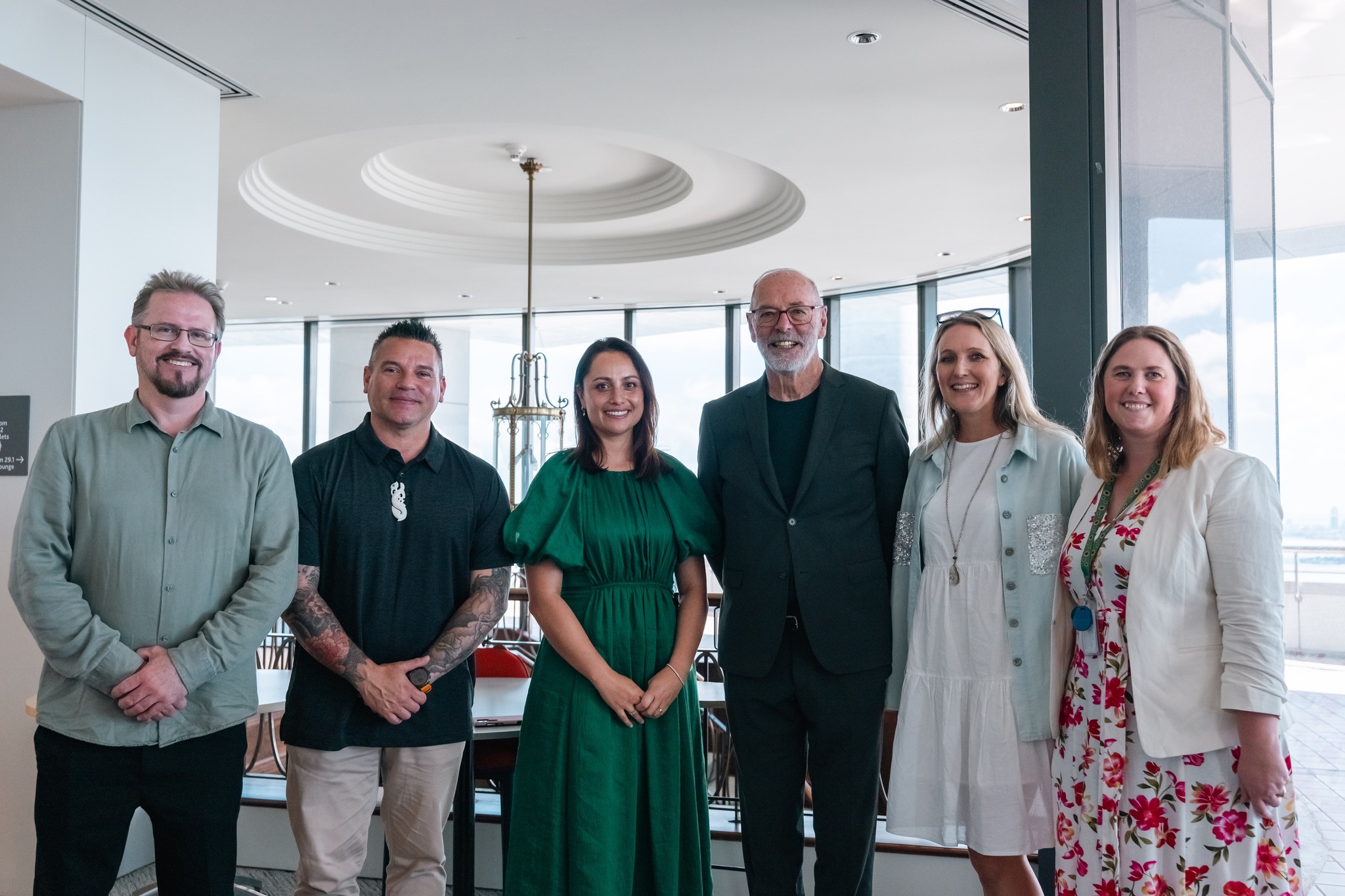
New councillors and Mayor from left to right: John Gillon, Matt Winiata, Victoria Short, Mayor Wayne Brown, Bo Burns, Sarah Paterson-Hamlin
What does this mean for transport?
While on balance the new council appears slightly more conservative, that doesn’t mean it won’t deliver what Aucklanders want – which, as repeated polling tells us, includes great public transport, with consistent support for walking and cycling. Conservatives (including the Mayor) like to talk about delivering this infrastructure more cheaply, but rarely dispute its value.
Of course, the Mayor will still need the support of progressives to advance his overall agenda. This opens up opportunities for hard-working councillors who’ve developed productive relationships with Brown, such as Richard Hills, to maintain progress on the transport options that free Aucklanders from traffic.
What’s the role of Local Boards?
Beyond the council table, a highlight was the soaring success of progressives on local boards in key areas of the city, contradicting conventional wisdom that low turnout favours conservatives.
The central-city focused Waitematā Local Board was soundly retaken by the City Vision alliance of Labour, Greens, and community independents (5:2). And, for the first time since 2016, City Vision has a majority on the Albert-Eden Local Board, home to the headline-grabbing Meola Road rebuild.
In other words, voters in areas that endured disruption and enjoyed ‘nice-to-haves’ opted for a platform of more local investment in climate action, cycleways and road safety. This progressive agenda, antithetical to central government’s current culture-war rhetoric, delivered victories across a swathe of the isthmus, albeit counterbalanced by the success of loosely conservative ‘action teams’ on the periphery.
With enhanced transport decision-making powers coming to local boards, expect more local focus on bike networks, traffic-calming and road safety features like crossings and speed tables – although the outcomes will be a postcode lottery depending on who’s at the table.
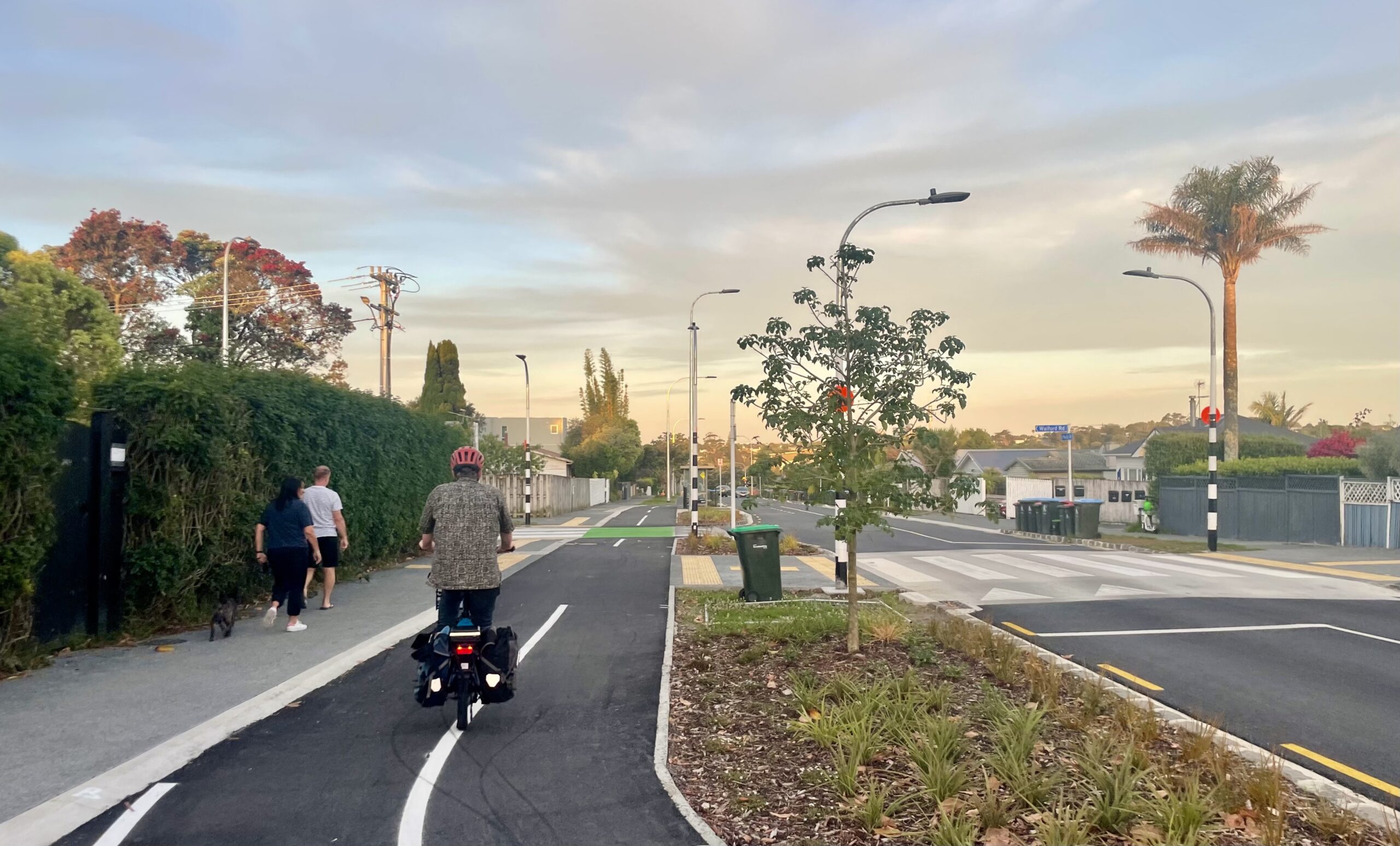
Meola Road near Walford Road – mid December 2024
What will Brown’s big transport legacy be?
Zooming back out: what’s the next big thing for Auckland? The first two Super City mayors secured transformative infrastructure projects: Phil Goff with the Central Interceptor wastewater separation project, and Len Brown with the City Rail Link.
Wayne Brown, so far, has been more focused on policy. But if he wants to make a tangible mark on the city, there are two top contenders: getting a new harbour bridge off the ground, and getting light rail on the ground.
There are practical and affordable proposals for both, which just need a champion. The Mayor has voiced support for surface light rail and has waxed eloquent about international examples. And, while his fantasy bridge option would demolish suburbs at both ends (and is frankly unbuildable), he’s absolutely right that a bridge makes way more sense than the unaffordable tunnel the government seems bent on imposing on Auckland.
The fly in the ointment here will be central government’s control over appointments to the proposed Regional Transport Committee – which will determine the direction of Auckland’s future – potentially taking major decisions out of the city’s hands.
The Super City turns fifteen next month, a feisty teenager emerging into its full potential (represented by a rebellious, unfiltered 79-year-old), with central government as its helicopter parent refusing to hand over the decision-making and resources it needs to truly flourish.
If Brown wants to see a tangible transport legacy in his lifetime, he needs to start now and fight like hell. And with the biggest personal mandate of any mayor in the country, if he can’t, who can?
This post, like all our work, is brought to you by the Greater Auckland crew and made possible by generous donations from our readers and fans. If you’d like to support our work, you can join our circle of supporters here, or support us on Substack!
Header image is of Wayne Brown on election day at Wynyard Quarter – Jessica Hopkins RNZ

 Processing...
2 bridges is a lot less resilient than 1 bridge plus tunnels for Auckland’s future. Please refer to Sydney for a nearby case study of where the bridge and tunnel combo works well.
100 tunnels would be even more resiliant. But at some stage cost has to be part of the equation.
We’ve got away with one bridge for 66 years, and there is a reasonable alternative around the harbour. Assuming the current bridge will survive another 50+ years, the only thing we need is a light rail / walking / cycling bridge at a fraction of the cost.
It’s not whether the current bridge will survive another 50 years, it’s in what condition it may survive in considering it has already been retrofitted to massively increase carrying capacity with the clip-on lanes.
Yup, it’s a real worry as you can see from Sydney where their bridge is 30 years older than Auckland’s and they are……oh yes, nothing, they are doing nothing to their harbour bridge because there is no need
https://www.transport.nsw.gov.au/projects/community-engagement/sydney-trains-community/sydney-harbour-bridge#:~:text=weekend%20rail%20closedowns.-,Key%20benefits,be%20completed%20in%20March%202025*.
Lucky we need to halve traffic volumes, and have the tools to do so.
Heidi you know full well traffic volumes are going to increase not decrease. Sydney is a great example of this again lol. You can make the tolls as expensive as you want and make the public transport as good as you want but the traffic volumes are still increasing. Auckland big issue is we have no real “arterials” like in Sydney I mean the 3 lane 70kmh+ roads as the alternative to the motorway so most of the growth is going to be felt on the motorway network. That’s the harsh reality of the truth we need to build more roads AND more public transport there’s no way around it.
I do know full well that traffic volumes are going to increase if the current policies, and transport sector culture, are retained.
Halving traffic is necessary if we don’t want to impoverish the city and make every future decision more difficult. Luckily, Auckland Council has already done the work on what’s required, as well as on the enormous economic benefits of doing so.
Change is scary for many, and those that make money from destroying the climate use fear to their advantage. But we can rise above that, for the good of all.
Well the current policies and transport culture are going to be retained it’s NZ not Europe sorry. So therefore the traffic volumes will increase and so will PT demand. So therefore we need more roads it’s not that hard to work out. The moment we start being more honest we can actually see where we need to build more PT capacity and where we need more roads.
Disappointing to see carbrain thinking infecting the Greater Auckland blog. Roads are inherently expensive to build and maintain, and a big part of the equation people miss is the massive surface area roads require to only support a fraction of traffic and freight volumes rail is capable of (relative to the transport corridor width).
“3 lane 70kmh+ roads” That’s a motorway in all but name to me. Well, a much less safe version of one.
At least in the way New Zealand would design it, and prioritise speed and throughput.
Anon stop trying to shut down genuine debate by making it seem like I only support roads. I support roads and PT (especially trains) and I know the huge benefits of getting more freight onto rail. I agree roads are expensive to build and maintain (see it’s not hard to be honest).
Max- sorry for some inconvenient facts (I’ll assume you’ve never been in a car round BNE or SYD). Much of the driving is done exactly on that sort of road that prioritises speed and throughput and it’s all at grade. I’m thinking roads like Penant Hills road, old Windsor road, or state routes 21,22etc in Brisbane (mix of roundabouts or traffic lights). These generally have a minimum speed of 70ks up to 90 then pretty much all driving outside of those roads is done on 60kmh arterials you only have to slow down to 50 for the last mile or two. Now based off what we’re told speed=bad the road deaths must be higher but inconveniently they are actually LOWER than ours despite most of our driving never being on a road higher than 50.
Now I believe the east-west link is a massive waste of money because in my opinion fix Neilson street so it’s 2 wide lanes the whole way (ban the parked cars) then raise the speed to 70kmh and problem solved. Before someone jumps in and whinges about that being unsafe we could give countless examples in Australia where this is the norm and again lower road tolls. Auckland will need a few critical arterials like this I doubt they will be any faster than 60 but we will need some decent alternative to a tolled motorway. 60 sounds crazy but it’s only because we have a weird obsession with letting cars park on major arterials they should be for moving traffic NOT parking it. Without the parked cars like many roads in Australia you actually feel safer travelling at 60 because you know there is no parked cars hiding pedestrians etc.
we know it’s you, Colah. nice to see you’ve finally learned not to name yourself after NSW towns and suburbs.
fyi 50km/h is the recommended maximum urban speed limit under VisionZero because it is a speed that allows for a high chance of surviving a side-on collision, say, at a T-intersection. Impacts past 50km/h see an exponential increase in the likelihood of severe injury or death.
The same reasoning for why 30km/h is the ideal speed limit for town centres, residential areas, anywhere with heavy foot traffic. Shorter stopping distance, 90% survival chance if a pedestrian does happen to get hit by a car.
So, yes, unless it’s a motorway, no street or road in a city should have a greater-than-50km/h speed limit.
Even though they are a bit of a troll they are correct I have driven over there and what they are saying is true unfortunately. I wouldn’t exactly say Australians are better drivers than us either. Maybe it’s just luck that their road toll is lower idk?
@Efficiency I ain’t reading all that tbh
That is so weird, I was just thinking this morning that Wayne Brown hasn’t actually started anything of note. I’m sure he will want to have something he’s remembered for other than cost cutting.
But the pool!
I really like your framing of progressive/conservative, constructive/unproductive. Wayne Brown has surprised me and I suspect a lot of people by not being doctrinaire. I’m starting to think that for local government the constructive attitude is the most important aspect to look for in a candidate. Within that is the willingness to listen and be swayed by evidence.
As for legacy or big projects he should sponsor, I think it may turn out to be Plan Change 120.
Yes I agree Trev. Constructive/Obstructive is the key scale for evaluating potential councillors.
Of course veteran obstructive incumbents are extremely good at grandstanding their way back into power by stoking fear of change, as we have just seen. Victoria Short’s victory is the only one where an incumbent was defeated, respect.
Victoria Short the reformer who wants to keep free parking at the Park and Rides.
A Wellington-dominated committee is more than a fly in the ointment, it’s a bank vault locking the ointment up.
Thought the same thing. It’s dire.
Has W. Brown dropped his plan to shift the Port to Whangarei?
The new Auckland Regional Land Transport Committee is a bit of a worry. Not only will the Minister of Transport get to appoint half the members – they are then required to “take direction” from him. And although Councillors will get to make decisions on Transport projects and programmes, they will be required to follow the Long Term (30 year) Plan set by the RLTC, which will also set the spending priorities. Some of the fine print details are also a worry – there is no requirement to publish the draft plan for public consultation – as written the Amendment Bill only requires them to publish the Plan AFTER it has been adopted – so how exactly do Aucklanders get to know what’s in the Draft Plan in order to make sensible comments on it. The Amendment Bill is open for public submissions (closing date 8th November) but so far there has been no real debate on it – not even amongst our Councillors. Very few Aucklanders realise that the proposed changes will result in them having less say about their Transport system than residents in any other region – this system of Regional control has existed for 26 years – indeed it used to exist in Auckland as well up until AT was foisted on us in 2010.
Yes. This doesn’t bode well at all.
With the current MoreRON Transport Minister appointing half the board then yes this bodes very badly for anything that is not a motorway. Has Wellington ever understood AKL’s real transport needs? Funny how W.Brown pitched it as restoring local democratic accountability as he handed 50% control to the Minister – some would call this bare faced lying. Really need Coalition out 2026 for auckland/planet
oh wow. They really are into “trying to get things done” no matter what this means for democracy.
What do you mean by this, Connor? : “great public transport, with consistent support for walking and cycling. Conservatives (including the Mayor) like to talk about delivering this infrastructure more cheaply, but rarely dispute its value.”
The mayor disputed the value of basic infrastructure for:
– walking. He made building raised crossings for safe walking very hard. His legacy is that AT changed the guidelines so it’s now harder to put them in and when they do, the height is now ineffective.
– cycling. He claimed it’s fine to just cycle on footpaths. And where separated cycle lanes are being built, they suffer from the lack of raised crossings, too.
As for public transport. If he was interested in improving it in a low-cost, high-value way, he would have listened to advice about how to reduce traffic to improve bus amenity. This would be saving hundreds of millions of dollars on our projects, and creating a better city.
Terms of the ‘support’ was meaning public, rather than politicians.
As for disputing the value, I do agree that the Mayor doesn’t support many of the things that should happen and are valuable (ie Meola Road style changes etc), but has shown support (or at least comments in favour of), cycleways and the like.
But the point I wanted to get across is unlike the many in council who are unproductive culture war warriors, there isn’t an intractable opposition to W&C infrastructure. So even if its not a priority, it can still happen. It’s why the role of progressives like Richard Hills is very important in the next 3 years, which helps get the key stuff over line line.
Hard to fit every nuance into 800 words!
Tunnel is a Heavy Road.
Mostly long and flat to service Heavy Transport, Trains and Sewer / Storm water services etc.
The Auckland Harbour Bridge is nothing but a Broken Back!
Moving divider walls, overhung extension lanes with many weather related restrictions or closures.
Two new bridges are required plus a Heavy Road Tunnel where the harbour bridge curranty stands. New 6 lane bridge beside the old harbour bridge. New tunnel for heavy transport, trains etc. Then demolish and re-build a second 6 lane bridge beside where the old harbour stands today.
Allow 20 years for this planning to be built and completed.
The old harbour bridge has done the job and paid for itself economically etc
Seawater will first flood the northern side of the harbour bridge motorway approach.
Same will happen on the viaduct harbour side with sea levels rising.
I see high tide levels worrying already on the northern side.
Storm surge and climate warming raising salt water levels by metres?
Auckland harbour bridge and motorways need to be built much higher above high mark tidal levels.
I spoke about this stuff over 25 years ago.
Very little has been done to date.
Too many Dr Do-Littles eh!.
The only chance Light Rail has is if this coalition is thrown out in favour of a Red-Green one and I can’t see that happening.
Auckland LRT is doomed for at least a generation. But we can move forward with Busways everywhere.
Talk! Talk! Talk! Talk! Talk Talk!
More money wasting?
Constructive Town Planning? (Basic Services)
I want to know things like when is a full public sewerage network being built in all new and old areas, including populated rural?
When are the un-sealed roads and half sealed roads being sealed?
When do we get local public water tanker filling stations and or fire hydrant mains?
When is the potable water main planned to be built in missing areas?
When are the public footpaths being built if only on one side?
It is probably not a good idea to build a lot of the things you are demanding.
These are the things that encourage the dispersal of our population, and the retirement of even more good agricultural land into lifestyle blocks.
Mechanisation will continue to require less labour for agricultural production, imposing increased servicing costs for infrastructure on those required to remain.
Dispersal means building, and maintaining long thin supply infrastructure, at a very considerable ongoing extra cost per connection then more densely populated urban areas.
Something very evident already to many of our rural councils and electrical supply authorities right now as that are really struggling with how to fund storm damage repairs , from their very limited customer and ratepayer bases.
Or are you advocating that the Government should subsidise lifestyle choices for the better offs, for their second homes, and rural lifestyle blocks?
Auckland Super City?
Greater Auckland PR Crock!
Millions of dollars collected from Waitakere water dams weekly.
Two potable water treatment stations in the area also.
No public water main exists 1.5 km from Swanson water treatment filter station in our local area.. Live in a fully populated street of 72 housed properties.
Drainage?
Council and Auckland Transport can’t even fix the disgusting pot hold, pond fill mud/clay fouled carpark outside the Waitakere Water Dam road side carpark along Scenic Drive.
Visitors and tourists are shocked to see such a water and dust nuisance mess year in and year out.
New million dollar luxury bus coaches park and stand in the filth Waitakere Dam roadside carpark.
Have tried for the last six years to get these problems fixed.
Even all the roadside parking bays along Scenic Drive need road metal filling to correct drainage and road safety issues.
All land owners must pay council rates.
Only non-rateable relief would be the building valuations.
Side Lined / Ring Fenced / Silenced
Main Route Scenic Drive, Titirangi to Swanson:
Short off road sections un-sealed many years.
Road seal Tawari Road (Fairy Falls access).
Road seal Brabent Road.
Road seal 489 – 481 Scenic Drive paper road extension.
More short sections need upgrading?
I’m not saying seal all roads.