Patrick Reynolds is deputy chair of the city centre advisory panel, a previous director of NZTA, and is running to be Councillor for the Waitematā and Gulf ward in October.
This ran in the Herald 1 July 2025
What is a good model for Auckland’s Queen St? For me it’s the main streets of the cities so many young Aucklanders are moving to right now: George St in Sydney, Bourke St in Melbourne, Queen St in Brisbane. The hearts of these main streets are car-free. Why? Because cars don’t shop, people do, and streets full of traffic do not make for seductive and compelling city centres.
We know this works, because it already is working here. Right now by far the busiest part of Queen St is the new completely car-free Te Komititanga Square, between beautiful Britomart and vibrant Commercial Bay. This completely rebuilt area, along with changing work patterns, is why the pedestrian counts in midtown are down a notch compared to before the pandemic – yet employment numbers are up.
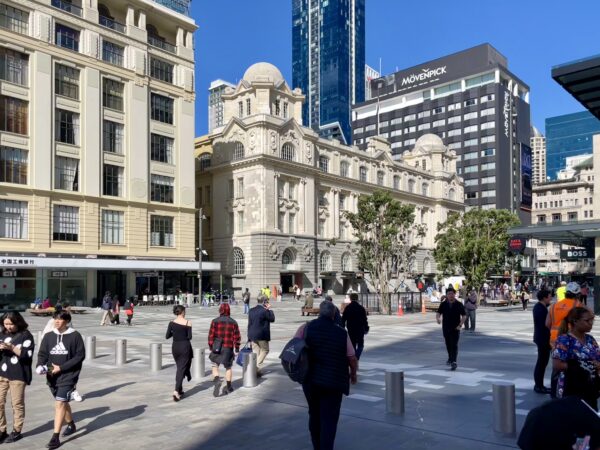
Te Komititanga
There are 15,000 more jobs in the city centre now than in 2019, and the GDP is 24% higher, faster growth than elsewhere in the city. Work patterns have changed, coming into the office is less regular, more shoppers and diners are staying in the new traffic calmed and upgraded downtown.
This is also where, for now, the majority of our public transport lands; ferries, buses, and of course trains. We are nearly at the end of ten years of work to spread that love up the rest of the Queen St valley, all the way to Karanga-A-Hape Rd and beyond, with the City Rail Link.
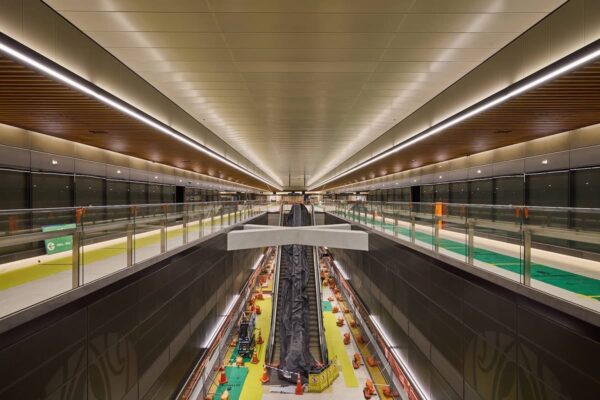
Te Waihorotiu Station via CRLL
This is a huge, once in a lifetime transformation. At last we are getting the kind of infrastructure that successful cities are built on.
Wisely we are also preparing the city streets around these stations to get the most value out of this huge investment. Giving them the quality that is already working so well downtown – more pedestrian space, more trees, more compelling reasons to not only visit the city, but also to linger there.
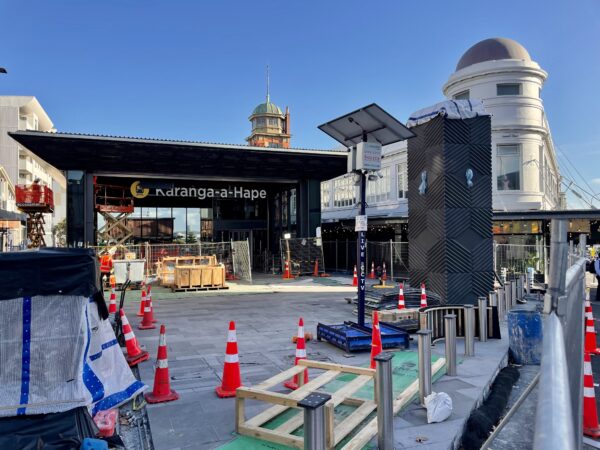
Karanga-A-Hape Station
Good design is more than just aesthetic or functional, it is strategic: beautiful is valuable. Now people don’t have to come in to work so often, cities have to actively draw them in. The successful 21st century city is not shaped around the twice daily commute of office workers. Instead it is a magnetic hive of action and interest. With unique arts and events, compelling shopping experiences, great little parks, laneways, and places both vibrant and calm.
This is the prize: the CRL doubles the number of people within 30 minutes of the biggest concentration of employment, education, and entertainment in the country -our city centre. It delivers through-journeys on the urban rail system for the first time, for connections beyond it. And it re-shapes the city centre in order to better compete in this new world
Only stagnant cities are unchanging; great ones re-shape with the times. Even Paris, with surely the world’s most complete city centre, is radically transforming its streets to increase appeal.

Paris via emmanuelSPV.bsky
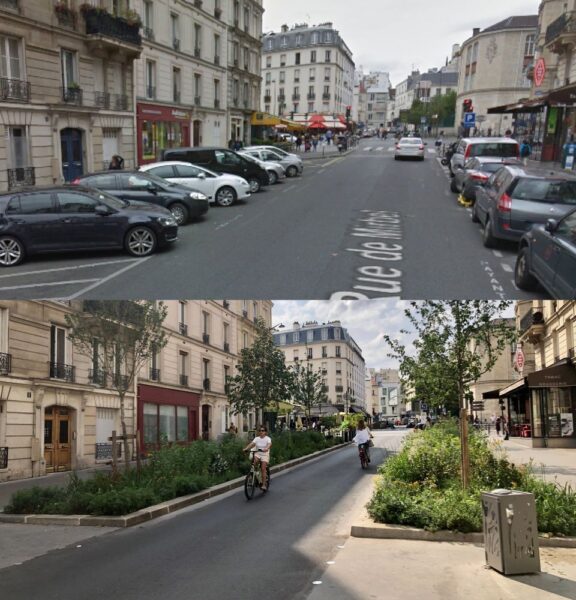
Paris via emmanuelSPV.bsky
Not since the harbour bridge opened 65 years ago has Auckland undergone a transformation this significant. Change is disruptive, it’s been tough, but while street works are highly visible, there are other more powerful forces at work too.Everywhere traditional retail is struggling, money is tight and the intenet is a massive disrupter. Last month several long standing fashion stores on Ponsonby Rd closed down (Wixi, Carleton, Zambezi). Ponsonby Rd has no construction, no cones, no bike lanes. It remains six lanes for traffic, and a poor footpath. It has new parking garages. Like Broadway in Newmarket. One of those stores, Zambesi is keeping its bricks-and-motar store downtown, in Britomart.
I am as sad as anyone that the venerable and unchanging Smith & Caugheys is going from Newmarket and Queen St. The last department store, it was really impressive how long it held on, seeing off all its competitors from the previous century, but couldn’t compete with its newer rivals in this one.
Beware of wistful harking back to last century, when Auckland had a fraction of today’s population, and patterns were so different. Those outdated musings are as relevant now as a rotary dial-up phone.
Auckland is blessed with the most amazing natural setting, a great resource of many different peoples. Only a failure of vision, courage, and leadership can hold us back from shaping these raw materials into the world’s greatest little city, here on the shores of the sparkling Waitematā.
The city centre is close to completing a well designed once in a generation glow-up. The street changes are completing this year, and we’ll be riding through the tunnels in 2026, but come into the heart of the city now, and see what’s already new.
To get here there’s already many great public transport options, also more than 50,000 secure and affordable carparks. Here you’ll find a world class city in the making, becoming one I hope you’ll be proud to call yours.
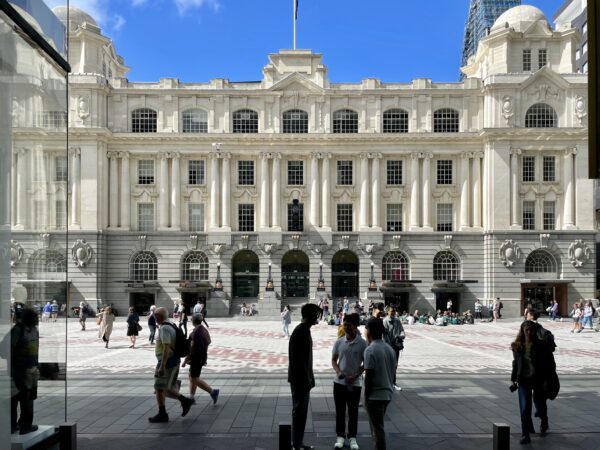
Te Komititanga
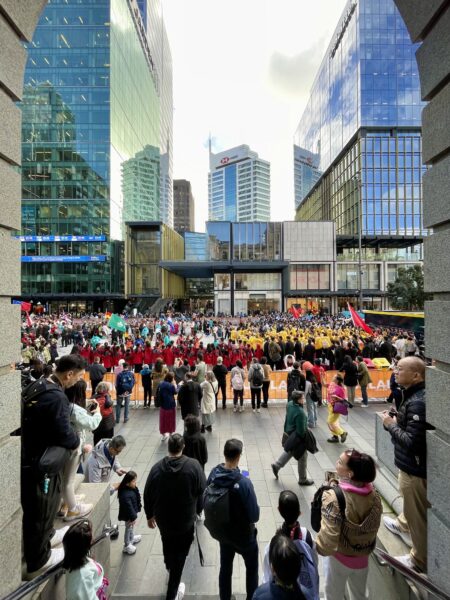
World Choir Games 2024
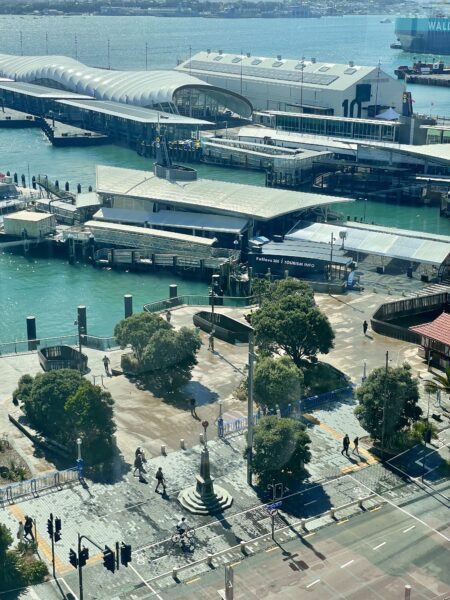
Te Wananga

Takutai Square -kapa haka at Tiffanys
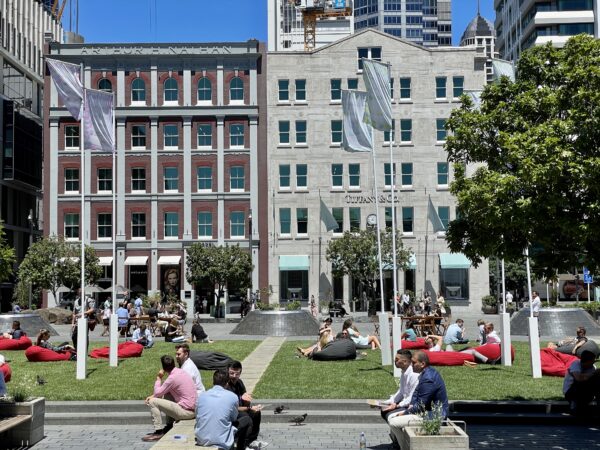
Takutai Square
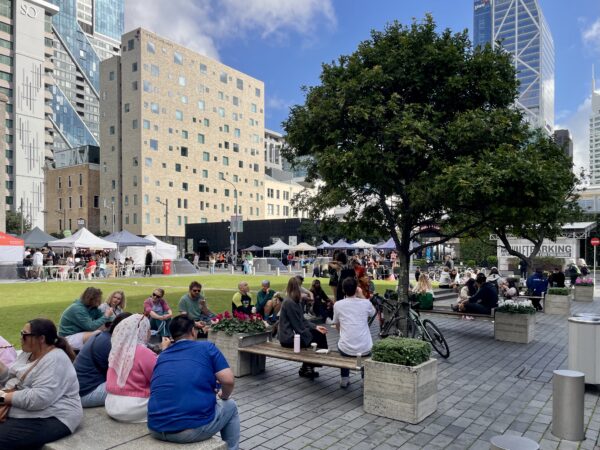
Britomart Market
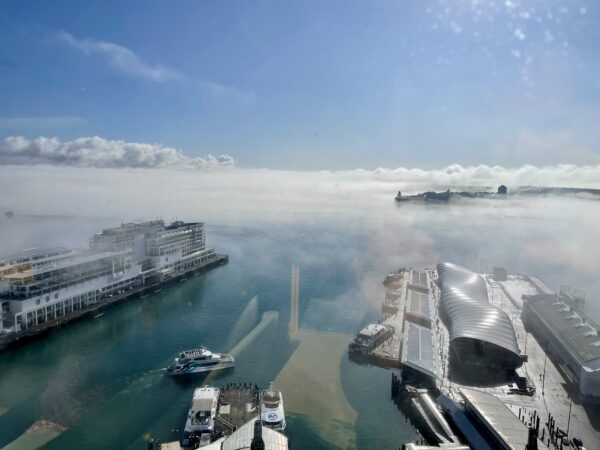
Ferry basin
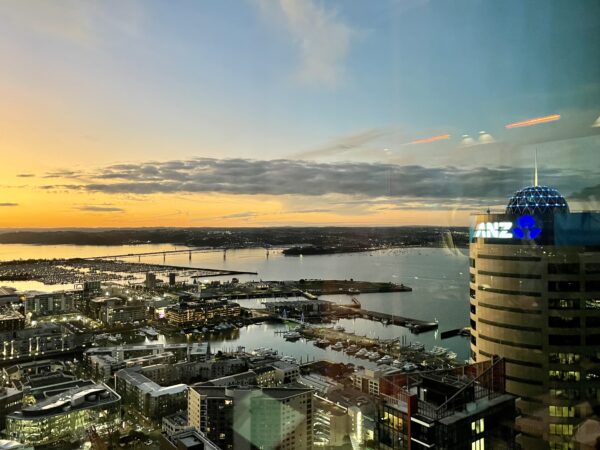
Rooftop bar view
This post, like all our work, is brought to you by the Greater Auckland crew and made possible by generous donations from our readers and fans. If you’d like to support our work, you can join our circle of supporters here, or support us on Substack!

 Processing...
Yes if you have been to Sydney, George Street there looks absolutely cue from the same cloth as Auckland’s Queen Street.
*cut from the same cloth
I worked in Sydney in the early 200os and visit probably every other year.
If people could see the before-and-after, I doubt we’d see the arguing about what Queen St should be. Light Rail would be seen in a new light too, though that shouldn’t stop us from bus and cycle priority on that route.
George St is clearly the model for Queen.
They are the same vintage, role, and purpose.
Both are long, plus Queen gets steep, so need a high quality, attractive, frequent form of pedestrian assist.
Even better if this then goes on to connect to a key suburban community. Double purpose. So a long route is preferable to the circulating City Link.
Queen St and Dom Rd are in a near perfect straight line, connected by a barren overly wide road. Perfect pair, and of course both were shaped by trams doing this.
Modern low floor Light Rail (the most seductive of street surface transit) is ideal for our city’s regal corridor. These plans are already worked on and need reviving and promoting.
Meantime let’s optimise single level electric buses, eg the City Link, on this route.
I also saw the back end of what the original Sydney light rail did for the inner west through to the Casino and Haymarket. That paved the way for George St.
Auckland won’t know how catastrophic the LR debacle was until we eventually have it.
Was there much resistance towards pedestrianising George Street Sydney, compared with what we have been witnessing in Auckland in Queen Street’s case? I keep an eye on Australian news feeds daily and I have never heard anyone claiming it was a bad decision closing off George Street.
Yes, George Street had all the usual gripes about how the economy would collapse and the sky fall in if they took the cars out. They actually designed in a bunch of traffic lanes and turning pockets and stuff because of it, these were there when it first opened but removed in short order when proved they were unnecessary and crappy for the street.
And it did have a protracted construction period with lots of griping because they were overly ambitious about service relocations.
Reynolds is right to signal that the pressure facing businesses in Auckland has more to it than traffic disruption. The ongoing closures in Ponsonby are largely down to high overheads (e.g. rent, insurance and power).
Readers should pause for a moment before dismissing local business’ traffic disruption complaints as misguided. The fact is that our retail businesses are vulnerable – even if profitable, margins will be thin (and therefore the motivation to continue trading acutely low). In such circumstances it doesn’t take much to send a business into a tail-spin. Lessons on how to mitigate this must be taken from the CRL and applied in the future.
As an aside, it’s a pity that we’re facing Auckland Council elections at a time when the city is on the cusp of gaining greater autonomy through ‘City Deals’ for funding with the Crown.
It would be great to hear candidate’s talk about the opportunities that an Auckland ‘City Deal’ will create. Unfortunately, we all need much more information about the extent of the changes that are hopefully coming.
aS WESTERN Bay of Plenty has found out City deals WILL ONLY WORK IF GOVERNMENT STUMPS UP AND SPENDS .Other wise they are a disaster and fail all involved in those developments .
Yes, as far as what’s been made public, there is zero money being allocated to these ‘deals’ …
As an immigrant, a proud Aucklander and a ratepayer, i sure do love the change underway – its starting to feel like a world class city with decent PT and walkable streets in CBD even though i live in the suburbs. Yes, not everything is pretty just yet and there is impact however having travelled all over the world, the look and feel is starting to take shape and CRL opening will only help fill the canvas.
Downtown Square or Te Komititanga Square as it now seems to be called was vehicle free from the 1970s until 2000s when it was opened up to busses… its much better as pedestrian only and yes there is an international air around the quality street scape and waterfront revival leading through to the village and wynyard quarter… mid town is a mess but good to see money going into St James at last – hopefully it comes together after all the road works associated with CRL are completed. Queen Street was once a vibrant place in part because of the traffic- especially Friday nights. Now it’s sorely lacking in vibrancy or ambience up from Shortland Street… maybe some kind of loop tram public transport to link Queen Street with Wynyard Quater via America’s Cup village? Cost considerations to build and proposed ticket prices… shouldn’t be so expensive that people don’t want to board. Uptown link to KRd is on the CRL… or maybe an escalator at the south end steps of Meyers Park? An escalator was proposed to link Albert Park/ University with High Street or thereabouts, back in the 1990s.
I’ve often thought that Auckland and Wellington could have done with a few strategic installations of long escalators, Hong Kong style.
Do we really think boy racers and general gridlock on Friday nights was a vibe?
I def think Auckland has lost some edge in terms of nightlife, music and arts – but I don’t think that has to do with street layouts. The culture is just evolved, not just demographically but generationally – and what people like to do.
With a reasonable chance that apartments will finally become logical to construct, we could see true transformation. A city is not about who works in it, it is about who lives in it, and the more residents, the safer it becomes. The sooner we can banish private motor vehicles to the outer suburbs to elevate our urban space to the stature it deserves, the better.
More apartments will mean less cold, leaky villas for us to suffer climate change within, and at a scale and quality that will house so many more people than our silly little houses that our backwards little motu loves.
And the coloured girls sing….
bah humbug
The main thing holding back apartment construction is the almost total lack of demand.
While construction and consenting costs are a large factor in this (and should be addressed), the main one is the oversupply of poorly built townhouses around the City fringes. Isolated and poor performing shoe-boxes with little access to either direct amenities or the means to access them (no carparks and poor public transport).
This is thanks to the Medium Density Residential Standards – which for some reason remains much celebrated on this blog (despite amplifying everything that is dreadful about NZ suburban living).
The main thing holding back apartment construction is zoning that makes apartment construction unviable. The THAB zoning limits apartment buildings to four or five storeys, which is about the worst possible limit (all the costs of a tall building without enough homes to divide it amongst), and two or three short of when an apartment building becomes viable.
So what we get is two and three storey townhouses and terrraces being built in the “apartments” zone instead, because those are economically viable to build and sell.
You’ll notice the few actual apartment buildings getting done have mostly been in excess of the height limit.
You’re over-fixating on one supply-related issue (among many) and ignoring those relating to demand.
I should be in the market for an apartment next move, but will do all I can to avoid them due to the number of people I know who have been destroyed by dodgy build + body corporate costs. That’s the real killer of apartment sales.
I don’t think it has residential, but it is a kick start (along with Symphony) of the rejuvenation of mid-town, courtesy of the CRL.
https://www.nzherald.co.nz/property/quattro-group-buys-four-interconnected-auckland-cbd-office-buildings-for-104m/J4TV3SOVZFDL5NGQHKCWPBSWW4/
There shouldn’t be a need for more new apartment buildings.
There are plenty of empty office buildings around Auckland that could be re purposed.
It’s a more sustainable option.
World class town maybe, the CBD can’t be compared to the likes of Paris.
I’ve previously lived in re-purposed office buildings.
I can’t say that I recommend them.
A mate owned one in Sydney. Old corporate HQ, looking down the Harbour Bridge. Was one of the most expensive apartments around at the time.
I certainly would have lived there. Quality finishing everywhere.
Ideally yes but in practice repurposing office buildings into residential is very difficult and expensive. Also usually office buildings are “chunkier”, so unless you want windowless units you’ll have a bunch that are bowling alleys with a window at the end.
Sorry to rain on your parade, but,…let’s acknowledge some realities. Any dreams of a truly “international city” need to be balanced against the reality of NZ’s isolation,..last bus stop before Antartica. We cannot realistically compare ourselves with almost anywhere. Also NZ’s dire economy needs acknowledgement, and particularly Auckland’s position as a significant player in the GDP stakes but a huge consumer being remarkably small in real productivity, productivity that is, which brings in hard currency.
I am a born & bred Aucklander and yes we do enjoy a great setting, but progress needs to be grounded on practical, achievable, ideas if the plans are to be more than mere fantasy. For example, I suggest the renewal of
central Auckland’s sewerage, finally stopping the discharge of untreated waste into the Waitemata is more pressing than any light rail.
I see a good future in small scale, organic improvements, rather than trying to wow with major projects.
I take some heart that we finally have a grumpy, (semi-inarticulate) mayor, but one with the engineering nouse to sort the achievable from the day dreams.
“I suggest the renewal of central Auckland’s sewerage, finally stopping the discharge of untreated waste into the Waitemata”
Well you’ll be pleased then that the Central Interceptor is nearing completion because it does exactly that. Once fully complete, all the way to Pt Erin, it will at last ensure that the Victorian sewers of inner Auckland are fully connected all the way to Mangere, with more than enough capacity to handle storm events and inner isthmus housing growth.
The two big tunnels being completed now, CRL and CI, finally catch up on capacity constraints for older Auckland after decades of focusing on outward spread. We absolutely can now focus on quality with these two ‘drains’ built and functioning in the years ahead. Dare to dream a little.
This picks out the issue at hand, major infrastructure takes seven to ten years to go from concept to operation. We have the sewers and the rail tunnel underway, but what we don’t have is a pipeline for anything in the transport sector since it all went tits up a few years back and everything except rural highways got delayed, embiggened and stopped.
If they’d just built ATs rail plan we’d be finishing the first stage already and ready to reap the benefits in a year or two. Now its a couple more years to clear the air, and then seven to ten more to start again.
Lovely bit of boosterism thankyou Patrick
As a pass through visitor to Auckland I see two problems .Get rid of the cars and build attractive apartment blocks .The current apartment blocks are bloody ugly with no contact with the outside world .Hell you cant even open the windows and look out to see what is happening out in the real world .All should have a decent balcony where a couple can sit and enjoy the vibe of life going on around them .Currently you are building people farms ,not unlike feed lots for fattening beef cattle .As for the cars ,dump them in the harbor and get people walking and biking with light rail for the ones less mobile .A win all round with a great life style for the folk that choose to live in the city is what will make a great place not the focus on profit for the few .Retail will need to adjust to the new or crash and burn to be replaced with forward think customer focused operators .Gone are the days of you will live and shop how we tell you to .
World class? Not even have proper public transport.
Wellington already has a form of private-public short haul transport. Not escalators, but at least four or five lifts which many people use to travel the short but steep journey between Lambton Quay and the Terrace. Some are even open until mid-night or 1 am.