I had quite a few interesting suggestions in the comments section of a post I made a couple of days ago asking for a bit of feedback into what readers thought of this blog, and in particular what they wanted me to blog more about. One particularly good suggestion was that I do a series of posts on other cities around the world and what they’re doing in terms of public transport investment. So, the first city I’m going to look at is Vancouver.
Vancouver is a particularly useful city for Auckland to model itself on I think. Sure, its population is about 50% more than Auckland’s – 2.3 million versus 1.4 million. However, both cities were developed around the same time (over the last 150 years) and both are quite constrained in terms of the characteristics of the area around them – by water in Auckland’s case, and by water and mountains in Vancouver’s case. It also helps that I’ve visited Vancouver, back in 2005, so I can speak from some experience on the city. For a start, here’s a map of the city:
 What seems immediately obvious to me is the comparatively low number of freeways/motorways the city has. There are a few in the southern area, but apart from that it seems there’s a single main freeway that runs through the city. That’s not very much for a city of 2.3 million. I remember when visiting Vancouver in 2005 doing an interesting comparison between it and Seattle. Seattle had masses and masses of freeways – yet suffered terribly from traffic congestion. Meanwhile, Vancouver had only built one freeway (excluding those ones in the south that don’t go anywhere near the CBD) yet I never noticed any congestion at all in Vancouver. It’s almost like they’ve achieved more for less, certainly worth exploring further.
The wikipedia article on Vancouver has an interesting extract on transport as well:
Successive city councils in the 1970s and 1980s prohibited the construction of freeways as part of a long term plan. As a result, the only major freeway within city limits is Highway 1, which passes through the north-eastern corner of the city. While the number of cars in Vancouver proper has been steadily rising with population growth, the rate of car ownership and the average distance driven by daily commuters have fallen since the early 1990s. Vancouver is the only major Canadian city with these trends. Despite the fact that the journey time per vehicle has increased by one third and growing traffic mass, there are 7% fewer cars making trips into the downtown core. Residents have been more inclined to live in areas closer to their interests, or use more energy-efficient means of travel, such as mass transit and cycling. This is, in part, the result of a push by city planners for a solution to traffic problems and pro-environment campaigns. Transportation demand management policies have imposed restrictions on drivers making it more difficult and expensive to commute while introducing more benefits for non-drivers.
So it seems clearly possible to avoid the increasing auto-dependence that Auckland has experienced over the past few decades. By focusing development around the public transport network, there has actually been a reduced need for travel, especially into the CBD. Vancouver is an excellent example of why integrating land-use planning and transportation planning is so critical. You can get it right.
One of the most interesting things about Vancouver’s transport system is that the rail system isn’t huge. It’s not like we’re comparing ourselves with London or Tokyo here – as can be seen on the map below in fact the rail system in Vancouver is not that much more extensive than what we have in Auckland:
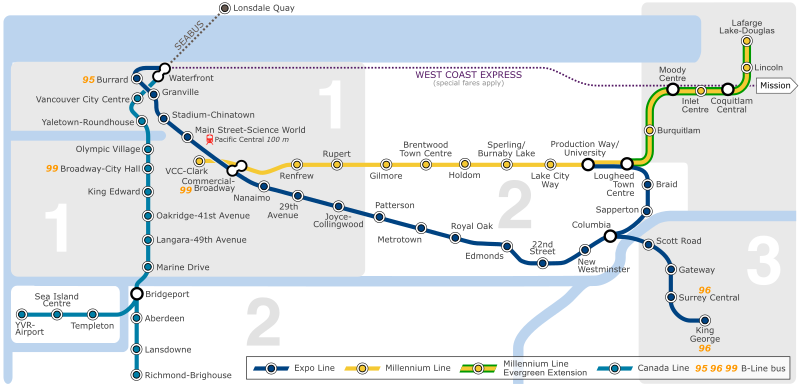 However, what is key is that Vancouver have invested in their rail system over the past few years – and in fact the whole of the SkyTrain system (which makes up almost all the above map) has been constructed over the past 20 years. The SkyTrain is quite fantastic actually, with driverless trains coming at 90 second frequencies throughout the day. The newest line in the SkyTrain system, the Canada Line, will open next Monday in fact. This line provides a high-quality public transport link between the city’s airport and the downtown. The photo below provides an insight into what the Canada Line looks like (although much of it is underground at its city end):

Vancouver is often rated as one of the best, if not the best, city in the world to live in. They’ve managed this without spending squillions of dollars on a motorway system (or possibly, because they haven’t spent that money). Vancouver continues to invest in expanding their public transport system – with future plans for another SkyTrain line being rapidly developed. The city also has excellent bus services – no doubt helped by its grid layout. We can certainly learn a lot from what’s happening there – which is not a lot of road building, that’s for sure!

 Processing...
What sort of observations have our governments and councils made of overseas rapid transport systems? If major PT projects get put off any further, I believe it is up to the people (yes, us) to motion for a major study to be undertaken. Shove the facts in the faces of the decision makers. We’re capable of so much better in our city!
ARTA has done a number of studies which site these types of examples and have some great plans for the city (CBD loop etc). The ARC has been trying to acheive something like this for some time. This is not the issue. The issue is funding, to expand and improve our current rapid transit network to somtething as effective as this requires assistance from central government because they have the money to do it. At the moment they won’t.
They consider roads more important and i suspect they are ideologically opposed to investing in public transport because it requires a subsidy where they see roading as a user pays situation. They are also heavily supported by road transport and tend to push their interests.
That’s the problem as i see it as opposed to a lack of studies or looking at overseas examples. The plans and studies are all there ready to be actioned but are unlikely to be because they are starved of funds.
while Vancouver is a fine example its more in the catagory of ‘what could have been achieved 20-30 years ago’. I would look to Seattle or Portland as examples of cities reversing transport policy and investing heavily in public transport. They have been down the same road. Portland is particularly impressive in its set up and what it has achieved, something I would like to learn more about.
Portland, Perth, Brisbane and even LA are cities that I plan to do future posts on.
And Cam, yes 100% agree on the funding problem. Have you read this post: http://greaterakl.wpengine.com/2009/08/02/the-transport-funding-farce-and-how-to-fix-it/
This is great Jarbury… There are many cities, even in the worlds most car crazed country America, which are starting to get it about PT, eg. Austin, Texas might be another one to look at… The longer Auckland waits the further we’ll fall behind and the news only gets worse looking into the future…
Charlotte, North Carolina?
I had a good look at the map of Vancouver and there are HEAPS of what I assume are freight lines throughout the city too… I guess they see the value in keeping freight on heavy rail and people on light rail…
It is also amazing how far away the motorway is from their CBD…
I think the SkyTrain was built along some old rail corridors too. So they didn’t have to acquire new lane. For the Canada Line things were a bit trickier, and I think the line is elevated or underground for most of its route.
The West Coast Express runs along a track that’s used for freight for most of the day – as it only runs at peak hour.
Yeah I had a read about the Skytrain on Wikipedia, most of it is elevated, seems like all three phases had funding help from the federal (i.e. central) government… Sigh, enough to make me join the Mounties…
I think the first SkyTrain line was built for some 1980s expo – to help get people around the city better. The most recent one has clearly been built with the Winter Olympics in mind too. And yeah, both got significant provincial and federal funding.
Looks like Canada realises that tourists don’t bring cars with them on the plane when coming to big events. Meanwhile, Auckland’s going flat-tack building motorways for the Rugby World Cup.
You’re just not thinking about it like our minister of transport… You see the last time his big businesses mates came here they complained about how long they had to wait in their cab to get over the Mangere bridge and that the cab ride cost $55 dollars… This time they’ll sail over and it’ll only be a $40 cab ride and Steven will be the belle of the RWC ball…
To be fair to him though he did ask those mates if they wanted to travel to the CBD in a brand new electrified train with overhead luggage compartments but unfortunately they said, “Train, you mean one of those things for poor people and containers..?”…
But surely most visitors will be coming from Europe and/or Australia. Those countries have far superior public transport to us.
But trains and busses are only for proles. For rugby supporters in the rest of the world where it is a game of ‘gentlemen’ using public transport would be far, far, far below their station. I’m glad Steven Joyce recognises this and is working accordingly.
*koff* tongue firmly planted in cheek *koff*
I don’t know about you trickster but after I’ve been boozng at an international rugby event in a foreign country I love never better than stealing a big engined car and driving along some new motorways… Really makes those tours to sporting events a hoot..!
The one time I’ve caught a train after a cricket or rugby match, the train was so packed that I got a free ride, which I thought was pretty sweet. I wonder if we’re planning on offering free rides before and after games at the RWC – I presume so.
Go to the rugby sevens in Wellington… If you pick the right girl (nurses uniforms seem to work) you might get a couple of free rides…