Today’s guest post is a book review by George Weeks, of Rethinking Parking: Planning and Urban Design Perspectives by Dr David Mepham.
George Weeks is a transport adviser, planner and urban designer based in Auckland. An earlier version of this review originally appeared in Roundabout Magazine, the newsletter of the Transportation Group NZ. This review is written in a personal capacity.
You can check out past book reviews here. The header image shows a surfeit of parking in Panmure.
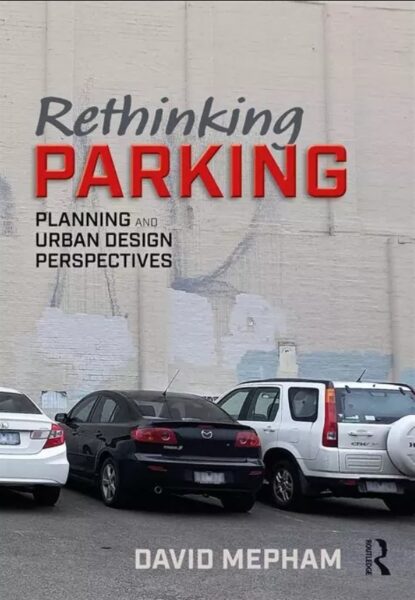
Rethinking Parking: Planning and Urban Design Perspectives by David Mepham seeks to explain the complex relationship between car parking and urban outcomes.
Car parking policy is a subject that, like religion or politics, should not be discussed in polite company. Not that it’s dull (it really isn’t), but car parking is a topic on which almost everyone has tiny, focussed, personal perspectives that, when extrapolated to a macro-scale, deliver absurd outcomes. “I shouldn’t have to pay for parking”, we say. “But everyone else should”.
Is car parking a matter of transport planning? Or highways engineering? Or urban design? Or politics? The answer is that it is all of these disciplines…and many more.
Dr Mepham is an academic and also a planner. Rethinking Parking reflects this. Its key point of difference – and one that all transport professionals would do well to follow – is taking an outcome-based approach to car parking. What kind of a city do you want to create? How does car parking need to be designed and managed to support this outcome?
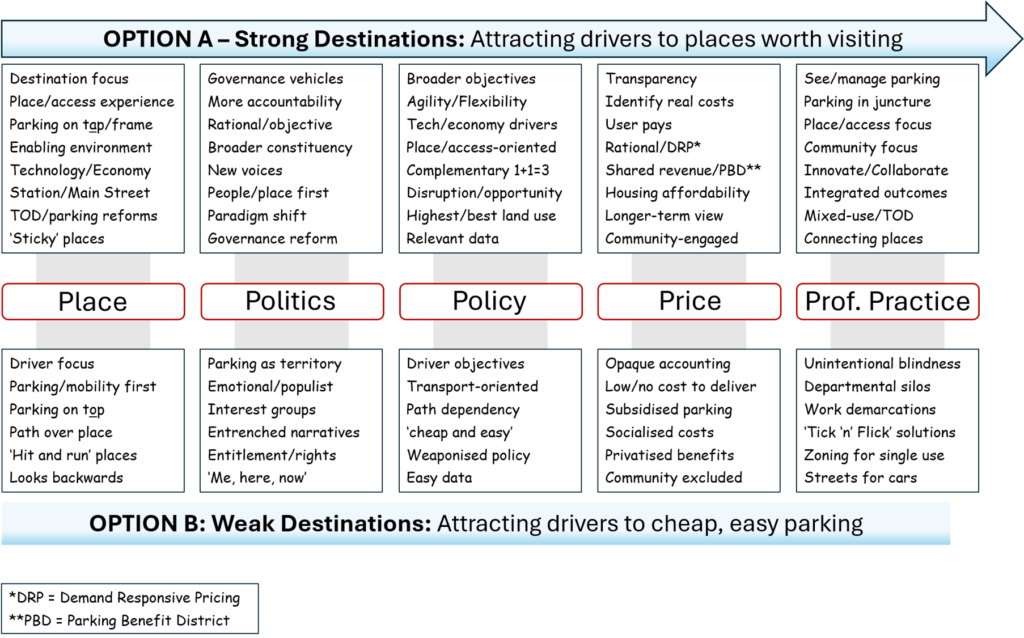
Rethinking Parking identifies two basic outcomes:
- Strong Destinations: Attracting drivers to places worth visiting
- Weak Destinations: Attracting drivers to cheap, easy car parking
The book examines these two outcomes through five perspectives: Place, Politics, Policy, Price and Professional Practice. These are summarised in the table below:
Following a fact-filled introduction, each perspective is covered in its own chapter; a logical progression.
Chapter 1: Place and Parking explains how parking is itself a shaper of places. We all know of places with copious car parking, but few attractions. Similarly, the qualities of successful walkable space are well understood. Does the parking design support these outcomes? We cover parking anxiety, the hierarchy of access, the driver’s-eye view, ‘sticky places’ and the ways in which car parking can support – or detract from – a sense of place.
Chapter 2: Parking is Political takes a historical perspective, diverting into the history of cars and motoring, with appearances from the first parking meter (1935) and Norman Bel Geddes’ Futurama diorama (1939). We learn that GM’s William Knudsen held a senior position in the 1940s White House, wielding unprecedented political influence (albeit focused on military production). With parking inseparable from car-based transport systems, we are advised to understand the technical aspects, linking them to the emotional perspective.
There’s a logical progression into Chapter 3: Parking Policy. We learn that land use and transport are part of the same system, yet professional specialisation separates these professions substantially. Car parking is treated as an extension of the road, as opposed to the city-shaping power that it truly is. We look at car parking minima, maxima, parking cash-out, permits and enforcement, as well as the flaws of park and ride.
Chapter 4: The Price of Parking deals with the real cost, the rational price and the “why” of subsidised parking (over $100bn per annum in the USA alone). Shorter than the previous chapters, we hear from JK Galbraith about ‘private affluence and public squalor’ in 1950s New York. This is consistent with the Option A/B destination types set out in the introduction. Over-prioritising private transport can spoil the public realm. A contrast could be made here with George Monbiot’s treatise on Private Sufficiency, Public Luxury.
Chapter 5: Professional Practice urges built environment professionals to understand car parking in relation to urban outcomes. As traffic engineering rapidly emerged from the 1940s to become a dominant discipline, it ignored the complexities of the human environment. Successful cities recognise the human dimension and take an urban design-led approach to car parking, accepting that it is complex, with the ability to shape long-term urban outcomes.
A huge amount of material is included in this book, ranging from elite projection to organised lobbying and street design. While demanding to the reader, this breadth emphasises that car parking cannot be simplified. Sensibly, Mepham uses ten case studies, from the USA, Canada and Australia to provide lessons for rethinking parking. Each case study occupies a chapter, developing the themes explored in the first five chapters. All case studies have lessons (positive and negative) relevant to New Zealand.
An important thread throughout is the emotional aspect of car parking. This is frequently overlooked (“surely parking is a technocratic practice?”) but an anxious, stressed person unable to find a parking space at the airport would beg to differ. The same goes for any official seeking to introduce paid parking to a place where it was previously free.
Rethinking Parking is consistent with the parking literature from Birkbeck, Donovan, Grabar and Shoup and urban designers like Gehl, Mumford and Littman, plus organisations like the Parking Reform Network. It has some great turns of phrase (“parking on tap, not on top”) and its emphasis on looking beyond the transport planning profession is welcome.
This is a timely book for Auckland. As our city becomes denser, its streets need to work harder. Car parking, which may previously have worked as a free-for-all, must now be managed deliberately. How do we enable it to support those Type-A Strong Destinations; the places that are worth visiting? Rethinking Parking helps us to understand parking as part of a bigger picture, not just a problem to be solved.
While cities have existed for millennia, car parking is a recent arrival. Rethinking Parking thus takes a multidisciplinary approach to a complex subject. It covers political science, philosophy, history, economics, anthropology and psychology.
The inherent tensions of accommodating it into urban design highlights the need for books like this. Mepham’s book is thus a welcome addition to the canon.

 Processing...

Remember the time AT suggested removing some car parking spaces…
Mayor Phil Goff’s response quelled the notion that AT had any say in transport in Auckland.
https://autotrader.co.nz/news/mayor-slams-auckland-transport-for-bloody-arrogant-parking-scheme
Until younger cyclists and bus users start voting, the older folks in their cars who vote in local and central elections will vote for more carparking candidates and parties.
Current mayor seems a bit more fired up about street space reallocation – for buses, at least: https://www.1news.co.nz/2026/10/06/mayor-wayne-brown-paints-out-aucklands-dumbest-car-park/
Although making room for bikes AND buses along the Great North Road ridge seems to be working just fine?
Great North Road makes space for bikes AND buses AND car parking (short-stay, with restrictions). Also trees. It’s a good example of a design that thinks about car parking as part of the overall outcome; enable kerbside uses, but don’t confuse this with long-term storage.
Have a look at Google Streetview: https://tinyurl.com/217-Great-North-Road
Similar outcomes also evident in Point Chevalier (Gogle Streetview hasn’t been updated – go and see it for real)
The post world war two military complex had to find stuff to do, so it gave us highways, motorways, fossil fueled metal boxes with rubber sheeding wheels. Perhaps not quite as destructive as war itself, but certainly has become a recognised health problem to he Tangata, and he Taiao.
Parking is the stupidest part of car ownership. We NEED a car to move; so why does that car waste most of its life parked?
Look at WILSON and how they can intimidate and basically laugh in the face of anyone who challenges their aggressive business style.
The Central Rail Link is the great connector, and the great disconnectors. My parents’ generation will struggle to give up a private vehicles (they are in their sixties and seventies). But our younger folk, the persons we really need to vote, the persons we really need to feel heard, would rather move around in ways that do not cause further damage to us, and our environment.
I am in my forties, but I share this collective conscience, by hurting the natural world, or other people, I hurt myself.
There is now decades of scientific studies about the harm that fossil fuels cause, much of it repressed by the fossil fuel industry, (big tobacco being their best mates).
Wilful ignorance is what the government in Poneke has been practising for the past term, and the general mental health of the nation has deteriorated.
We are angry, we are violent, we are impatient with other humans.
Stop driving a private motor vehicle. Stop sitting in congested traffic, stop complaining about the price of a carpark. Then perhaps we can start getting along again?
Ram Raiders are unhappy persons, who find an outlet for their unhappiness, in an often highly destructive manner. Let us recognise that his motu breeds isolation.
Now we are being told that Invercargill’s economy is going well, and the South Island is saving our economy. No one lives in the South Island. We live in the North, with other humans. Cows do smelly farts and are crap conversation. We cannot learn human decency among non humans.
bah humbug
What is this no-one lives in the South Island nonsense about. Christchurch is the only city in NZ other than Auckland that has more than 1/2 million people. That is the opposite of no one.
Please don’t categorise all boomers as all being car reliant!
There are so many of us that ride bikes, use public transport etc. I would rather not have a car, but things like lack of a bike lane on the bridge don’t help!
BTW what generation is that drives the ford rangers? It is certainly not mine.
Please don’t be ageist!
“An important thread throughout is the emotional aspect of car parking. This is frequently overlooked (“surely parking is a technocratic practice?”) but an anxious, stressed person unable to find a parking space at the airport would beg to differ. The same goes for any official seeking to introduce paid parking to a place where it was previously free.”
The emotional / personal aspect is vital to many aspects of planning. People keep blathering on about ‘evidence bases’ and that’s fine and important, but emotions, politics and all these other less tangible things are huge.
We are humans, not robots
We humans like to pretend that we’re rational beings seeking to maximise utility.
We’re really not! We’re much more likely to make decisions on an emotional basis and then engage in a series of post-hoc rationalisations.
I explored what this means for planning in Auckland in my review of ‘How to Fly a Horse’ by Kevin Ashton. Have a read:
https://www.greaterauckland.org.nz/2025/02/13/book-review-how-to-fly-a-horse-by-kevin-ashton/
exactly! I’ll have a read
that’s a great article, and the book sounds interesting
Thanks 🙂 Yes, ‘How to Fly a Horse’ is a fascinating read. You can get it from Auckland Libraries and I recommend it highly.
We humans like to pretend that we’re rational beings seeking to maximise utility.
We’re really not! We’re much more likely to make decisions on an emotional basis and then engage in a series of post-hoc rationalisations.
I explored what this means for planning in Auckland in my review of ‘How to Fly a Horse’ by Kevin Ashton. Have a read:
https://www.greaterauckland.org.nz/2025/02/13/book-review-how-to-fly-a-horse-by-kevin-ashton/