The City Rail Link being a smash hit from day one should be a positive thing, right? It seems not, if you’ve always been opposed to it. I recently came across an opinion piece from current Auckland Councillor (and former Transport Minister) Maurice Williamson.
Normally, it’s probably best to ignore these. However, in a few months, Cr. Williamson will replace Mayor Wayne Brown as one of six members of the new Auckland Regional Transport Committee, whose functions include:
providing long-term strategic direction for Auckland’s transport system, delivering a 30-year transport plan for Auckland and preparing the Auckland Regional Land Transport Plan.
So it’s unfortunate, then, the piece is filled with inaccuracies and logical fallacies; especially for a politician who presents themselves as a fiscal conservative.

Councillor Maurice Williamson
The short piece covers a range of grumbles, from timing to costs to access, but Williamson starts off by complaining about the news coverage the City Rail Link has received:
Well, the City Rail Link is finally open (around five years late), and it is being claimed to be a game changer by many of the main news outlets and has been given almost saturation cover.
The project had certainly had a lot of coverage in the opening few days. How outrageous that the media would look to report on the outcomes of the *checks notes* largest transport project the country has ever built.
Arguably, if anything, it’s felt like at least a few outlets were hoping the project might fail in some way, so they could put that in big headlines.
That the launch has gone so smoothly is a testament to a lot of hard work put in over many years, not just to get it built, but to upgrade the network too – as painful as it all was at the time.
But the result of all that hard work is not, as the first line of Williamson’s op-ed claims, “five years late”.
That would suggest completion was due in 2021, which is the year Len Brown initially wanted it open by – and that date was based on construction starting in 2013, which didn’t happen.
Ironically, there’s a good chance that a 2021 opening date could have been met, had the then National-led government – in which Williamson was a minister – got on board sooner. Regardless, when the government finally came to the table and funded half of the project, they stated “The CRL is expected to be completed by 2023/24″.
When the project did finally get underway, a global pandemic wasn’t on anyone’s cards as a risk. But it happened, heavily impacting the CRL project and many others. That unforeseeable and unprecedented event both pushed out the completion date and added at least $1 billion to the cost of the project.
Moving on, it seems at least some of Williamson’s disgruntlement is because there are no trains in East Auckland:
In the last census only one per cent of east Aucklanders said they use the train as their main form of transport, so it’s hard to see how it could be a game changer for most of us.
So he’ll be proposing a new rail line for the East any day now right?
In reality, every project is located somewhere – and in a city the size of Auckland, there’s not a single project you could build that every person could use or benefit from. There are about 1.6 million Aucklanders who don’t live in East Auckland that will likely never use the Eastern Busway – but that doesn’t mean it shouldn’t be built.
Note too, the very selective use of statistics in that statement. He’s almost certainly using the travel to work data from 2023 census to come up with that “one per cent”: a time when overall rail usage was close to its lowest point, due to the impacts from COVID and the network disruption happening for the upgrades.
Yes, the census data showed that only 1% of people living in the Howick ward listed train as their main means of travel to work, down from 2% in the 2018 census. That 1% represents about 1000 people from the Howick Ward primarily catching the train to work, out of the roughly 81,000 who stated a means of travel (including those working from home). By comparison the overall Auckland average in 2023 was 2% taking the train.
But the census journey-to-work question is a weak data-set for many reasons. One example: you have to choose a “main” mode of travel. So how does a person living in Howick who catches the bus to Panmure Station for the train to the city choose one mode box to tick – train or bus?
And, in the age of increasing work-from-home, how do you answer the question about your usual travel habits?
Another point to make here is that trains are used for more than just travelling to work. It is generally accepted that journey to work makes up only about 20% of total travel demand (maybe even less now, in the age work-from-home).
The census also captures travel to education which comes in a little higher, at 2% of trips from Howick. That proportion is even higher if you exclude younger children, who will almost all of whom will be travelling to local schools.
Frankly, it’s amazing that an area without a train line at all registers any number above zero in this survey.
Looking at the details: the two stations people from the Howick ward are most likely to use to access the rail network are Panmure and Sylvia Park.
Since the City Rail Link opened, Panmure is now the fifth busiest station in the city – only beaten by those in the city centre as well as Newmarket – while Sylvia Park is the 11th busiest. Furthermore, trips between Panmure and Waitematå are the single biggest origin/destination pairing on the entire network.
Williamson’s piece focuses on a yearning for more park and ride facilities. While the is some park and ride at Panmure, it is also said to be one of the busiest stations for bus to train transfers.
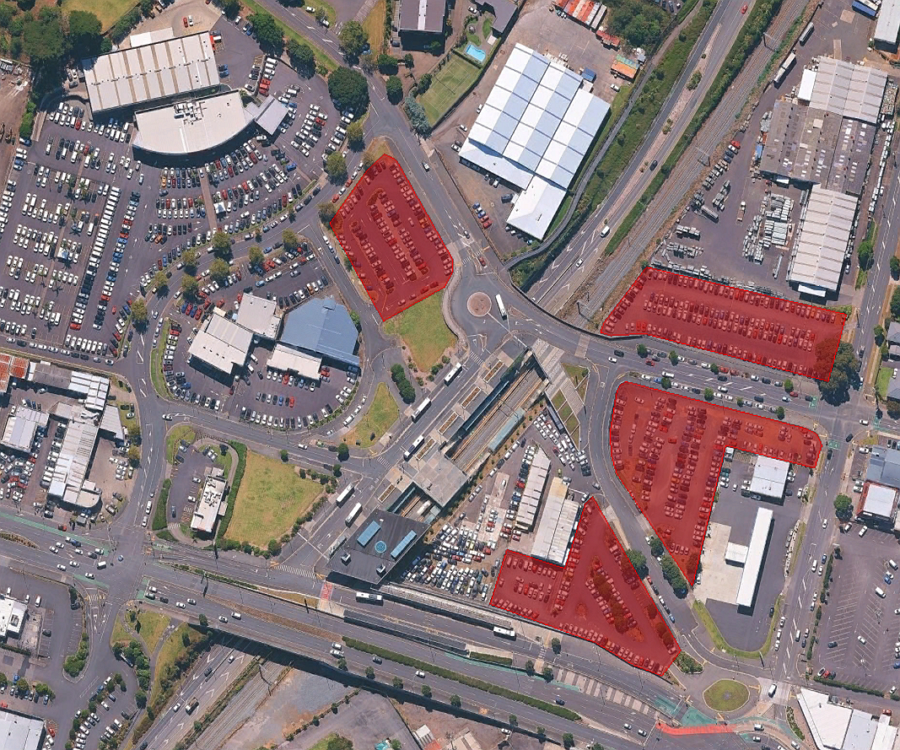
Panmure with existing park & ride facilities in red
The two services from the east that offer interchange with Panmure are the 70 and 72C/M/X, and there are some other local and connector routes too. The 70 travels all the way into the city, so it’s hard to know from publicly available data how many trips will be from the Howick ward area.
On the other hand, the 72C/M services and those other local routes all terminate at Panmure, so a decent proportion of their ridership will be people transferring to a train. Collectively they carry over 4,500 trips a day, and a decent chunk of those will likely involve a transfer to the train.
The high ridership at Panmure station is in fact the strongest evidence we have for the success of the transfer-based public transport model. The good people of Howick and Pakuranga are way out ahead of their representative in understanding how cities and networks successfully function.
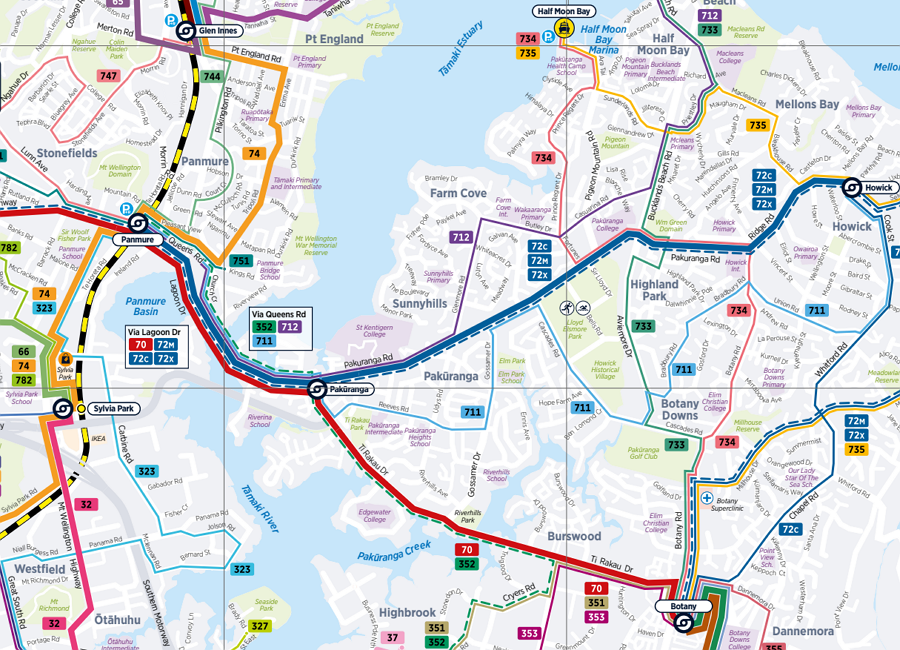
We don’t know exactly how many people transfer from Eastern buses to trains at Panmure, we have heard that since the City Rail Link opened, that number has risen, with hundreds more people doing so every day. Increasing the bus to train transfers even further is a key expected outcome of the Eastern Busway.
While an increasing number of people are evidently comfortable with transferring, it seems Cr. Williamson would prefer we built lots more park and ride facilities.
I’ve always held the view that if public transport cannot come to you then you should be able to go to public transport.
That is, we should be investing in Park and Ride facilities for both the Eastern Busway and the Panmure railway station.
But sadly, Auckland Council has a reasonably firm policy of no longer investing in any more Park and Ride facilities.
A few councillors and some council managers simply believe park and rides encourage you to use your car and therefore believe we should not build any more.
…..
I get very cross when we are almost commanded to be using public transport way more than we do but then make it almost impossible to use.
If your nearest bus stop is more than say 500 metres from your house and particularly if it’s up a steep slope, then you’re going to simply just revert to using a car.
And just how much of your hard-earned ratepayer’s money has and will be spent on this CRL project?
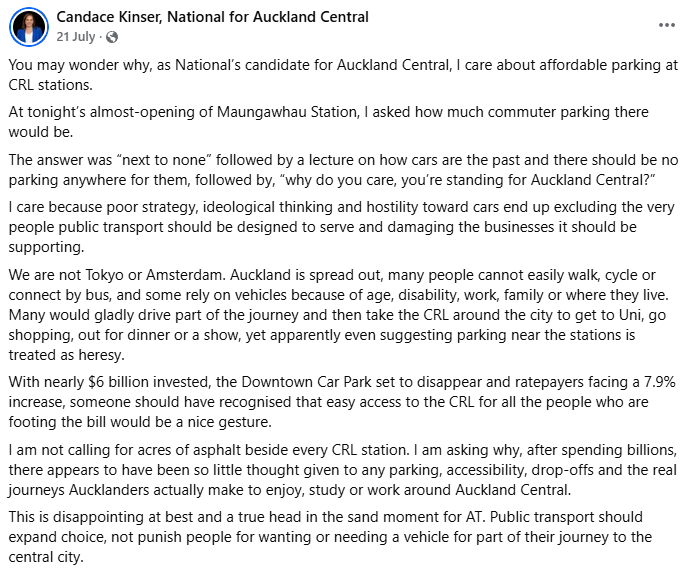
This is where his logical fallacy as a fiscal conservative comes in. It’s one that’s not restricted to Williamson; for example, a few months ago the National party Candidate for Auckland Central Candace Kinser made a similar comment, effectively suggesting we should have also built carparking around CRL stations.
This isn’t about forcing people out of cars, it’s about resources. In both examples, the fundamental issue is the practical question of what this costs and who’s paying for it – and, can we do something better with that money and space. There’s some pretty simple maths behind it all.
Let’s say we wanted to double the number of people from Howick who use rail, and we decided to do so by providing more park and ride. Say we’d need about 1000 more car parking spaces. There are no empty fields just sitting around near the stations, so we’d need to build a multi-story carpark.
Some recent examples of multi-story carparks in the city:
- The Toka Puia car park in Takapuna, which opened in 2020 and cost $36 million for 420 spaces, so about $86,000 per space.
- A proposal that hasn’t gone ahead for another multi-storey carpark at Auckland Hospital, which in 2019 was estimated to cost $88,000 per space to build.
Both of these sites have unique challenges which might inflate the costs. But even if costs in these locations would normally be lower, since 2020 we’ve seen massive inflation in construction costs, so something in the range of $90k per space is still probably a reasonable assumption.
This means to build 1000 new carparks for East Aucklanders, it would cost about $90 million. And these are carparks that will probably only be used for one car per day on weekdays, meaning they result in about 2 trips per day overall, for each of the approximately 250 working days per year.
Even over 30 years, that works out at a cost of about $12 per car per day or $6 per trip. And all of that cost would just increase overall train ridership by around 2%. That’s quite the subsidy.
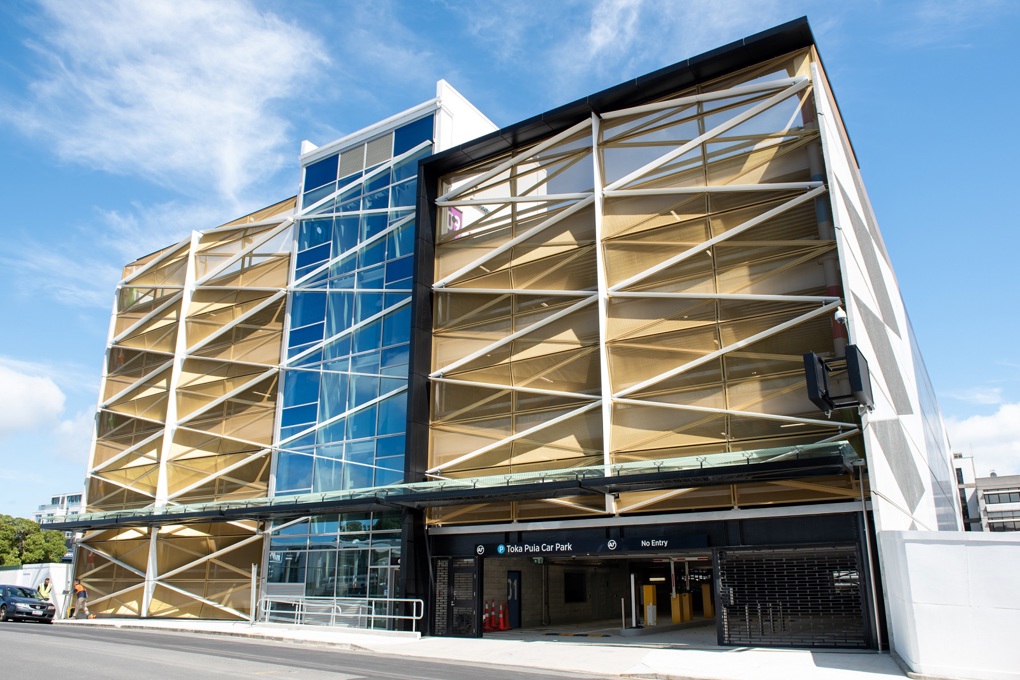
The Toka Puia carpark in Takapuna
Ideally, we want to more than double the overall usage of the rail network compared to its pre-COVID high of 22 million trips. To do that through just providing carparking could cost $4 billion or more.
Is that really the best use of ratepayer and taxpayer money? Especially concerning coming from someone who is already upset with money being spent on the public transport network.
It would cost far less to further improve feeder bus services and improve bus priority so buses are more plentiful and reliable, making transfer trips easier and smoother. We’ve already seen in Auckland that people will indeed transfer if it’s easy and convenient.
This is exactly why the focus of park and ride has been on the very edges of the network, where land values are cheaper, and it can provide options for people who live more rurally who don’t have as many alternatives for getting to stations.
Park and rides in urban and suburban ares are simply a very poor use of public funds So perhaps it’s no wonder Williamson tries to frame his argument in culture terms, rather than with facts:
A few councillors and some council managers simply believe park and rides encourage you to use your car and therefore believe we should not build any more.
Ultimately, he does return to trying to argue along cost lines, on the subject of level crossing removal – but entirely ignoring the primary benefactor of this, of which is drivers:
Because the trains will be running at so much higher frequencies the road crossing safety barriers will need to be deployed way more often at intersections across the city.
So, another $2.9 billion is having to be budgeted for to remove the level crossings and build grade separation so cars can carry on crossing over the railway line even when trains are operating.
Will he be voting to just save that money by simply closing all level crossings to road traffic, then? That would be the logical position.
This may be just one op-ed in a local newspaper, but all of this is pretty concerning for someone who is about to have a significant say in the future of transport for the region. We look forward to more logical arguments based on evidence.

 Processing...
Wait so is Wayne Brown, and by extension any future Mayor, never going to be on the Auckland Regional Transport Committee? Or is this a temporary appointment?
Cr. Williamson’s expressed views suggest he is going to act as a ‘Peters-like’ boat anchor on the Auckland Regional Transport Committee. Surely there is a councilor with a more informed view of urban transport strategy & functions who could be appointed or has he sought this position.
There needs to be an age limit on local / national government
+1
(as a boomer myself)
Panmure doesn’t want to become a traffic sewer for East Auckland drivers. That wasn’t the objective of the Eastern Busway. Those Park and Rides were supposed to be developed by Council who have been holding them since 2014. This is partly why I think an all-of-isthmus option is needed for time of use charging – to stop inducing rat runners into the isthmus.
Cr Williamsons disappointment over the CRL being 5 years late is understandable, was he hoping for more ?
Andy Bakers – “parking minimums are a failed experiment” quote I keep hearing on RNZ whenever parking is topical talks also to a more cars outcome from whatever experiment he was referring to.
Andy and Maurice have made strong statements around our cities missing TERP program, (Emissions Reduction Pathway) which CEO Phil Wilson promised to rectify with a subsequent report – which now appears like TERP to be AWOL.
Cr Andy Baker, Cr Maurice Williamson and Cr Shane Henderson have a huge job ahead that will shape our cities next century. Andy and Maurice have both made strong statements supporting more car-parking, park and rides which will put them in a good position to support our sprawling development focused regional transport solutions.
Anyone seen the missing TERP report ?
Does Auckland do Climate Action…
Does our new Regional Wellington/Auckland Transport Committee have a lot of regional development sprawl planned for our city ?
We have a generations of young Aucklanders itching for a glimpse of what our next half century will look like, and how far we can travel in 15 minutes.
If you’re going to have park’nrides in this area , wouldn’t it be better to have them on the ends of the busway , where it may allow alot bigger catchment area of low density that don’t suit bus routes?