Yesterday, with the fuel crisis as a rationale, the government announced an intention to allow heavier vehicles on New Zealand’s roads. This includes letting freight trucks carry heavier loads, and giving them more access to more of our road network, more of the time.
Why? Ostensibly, to “boost fuel efficiency”, as reported by Stuff.
This immediately raises a bunch of questions. Especially as the government is currently pointing citizens towards EECA’s fuel-savings advice for stretching a tank by up to 20%… which include “lightening the load” by removing roof-racks, and not carrying heavy gear in the boot.
Safety was touched on in RNZ’s coverage of the announcement, so you might also wonder about reduced speed limits, given heavier vehicles require longer stopping distances and already pose safety issues on local roads, (Also, as EECA reminds us, “fuel economy drops quickly above 80 km/h.”)
And then there’s the fact that heavier vehicles cause exponentially more damage to our roads. So we could expect to see even more potholes – and an even higher bill for road maintenance (over and above the cost of bitumen).
Ironically, there is a solution for moving freight that would result in far less damage to our roads, while reducing the use of fossil fuels, and lowering emissions, too. As aptly explained in today’s guest post – it’s trains.
The post below is by Kasey McDonnell and originally appeared on Welly Climate Nerd. It is republished here with kind permission.
Potholes. Aren’t they a bastard.
On city streets, they’re a pain. On highways, they’re dangerous. Potholes are so infuriating to the average driver that National tried to win power by promising a 24/7 pothole hotline.
Potholes are a fact of life. Roads get used and over time, need repair. Like all infrastructure, maintenance is half the battle.
Every pothole can be traced back to a transport system that chooses to use roads for things they’re not suitable for.
Thankfully, we have what we need to vanquish the pothole dragon. Our mighty steeds in this battle? Trains. Let’s explore why.
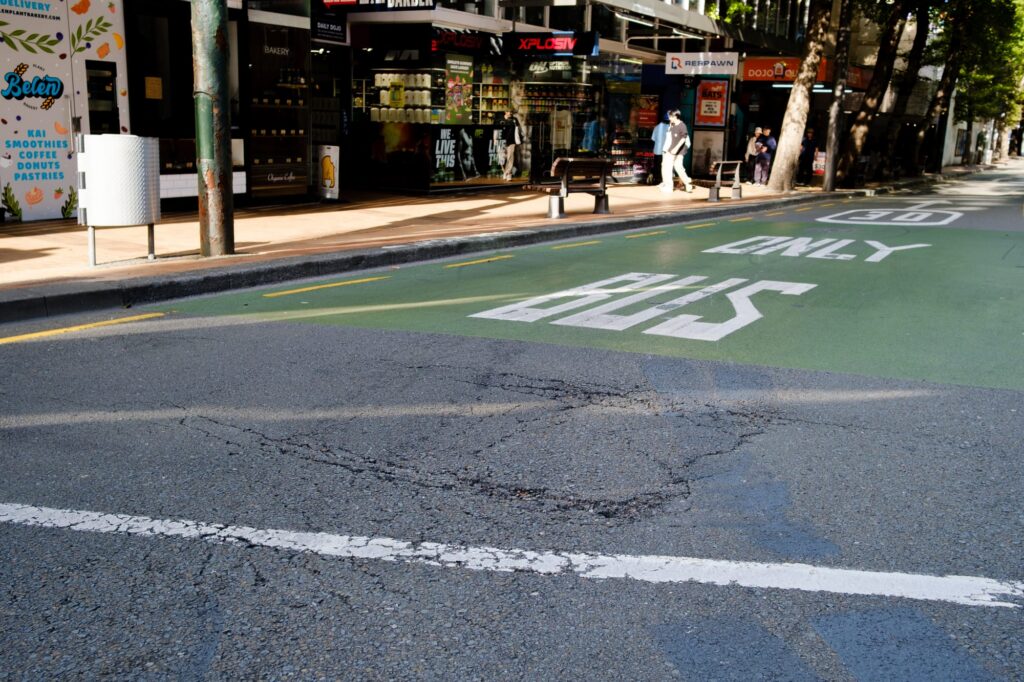
The heavier the vehicle, the more damage it does to the road. Buses face this problem too. Maybe we could switch them for trams???
What causes potholes
Simply put, potholes pock local roads and highways because when roads wear down from use, water gets in. That water breaks down the layers of the road and destroys the road surface.
Vehicle weight is one of the biggest causes of potholes forming. As a vehicle gets heavier, it creates exponentially more damage to the road.
Take, for example, my ass on a bicycle and someone in an average car. Me and my bike weigh about 120kg, and the average car weighs two tonnes. Each axle of the car carries nearly sixteen times more weight than my bike’s, but that weight does 77,160 times the damage. Transport engineers call it the Fourth Power Law.
Damage escalates further with trucks. One 50 tonne, nine axle truck does the same damage to a highway as 952 average cars.
Even though trucks account for just 7% of the distance travelled by vehicles in Aotearoa each year, trucks are responsible for 80% of road maintenance cost.
According to Greater Wellington Regional Council, two thirds of the cost of building new highways goes to making them strong enough to withstand heavier trucks. Roads of National Significance probably wouldn’t be bankrupting the nation if New Zealand didn’t use ultra heavy trucks for everything.
Smaller trucks are useful for local delivery and connecting uncommon routes. Trucks have an important role to play, but shouldn’t be carrying over 90% of freight.
If only we had a better way to move goods across the country? Won’t someone please invent something?
Oh wait. We already did. It’s called a train.
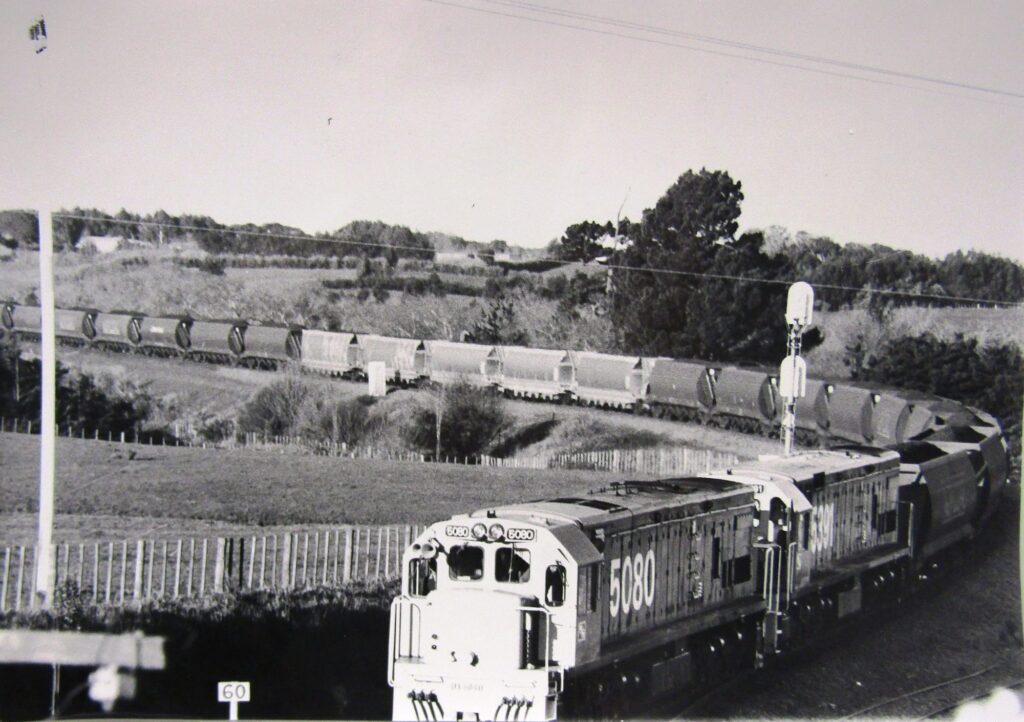
Trains have been efficient goods movers for centuries. Courtesy of Archives NZ
The tilted transport system
Trains are remarkably energy efficient. Diesel trains are nearly four times more efficient than a linehaul truck – and fully electric trains are even better. We have train lines that are available and abundant across the country – connecting Auckland to Wellington or Picton to Invercargill.
So why do we move so much by truck rather than train? In the mid 20th Century, trucks were highly regulated by Government. You couldn’t move freight long distances on highways, which kept freight on efficient rail. This was intentional to make the most of New Zealand’s different forms of infrastructure.
Then, Labour deregulated the whole system in the 1980s. Instead of government ”picking winners”, the market would. The deal was that road users would pay for all road maintenance, and rail would compete.
The playing field wasn’t leveled, it was tilted in another direction. You’d expect a 50 tonne truck to pay for all the damage it does to roads. They don’t.
According to The Future is Rail, the trucking industry will get a $1.4 billion annual subsidy next year. They want to see these subsidies go. It would incentivise freight to move on efficient diesel trains, or even electric trains. This would slash our diesel dependence, cut our carbon pollution, and save our highways from dreaded potholes.
In this system, trucks would bookend freight deliveries, connecting places where rail doesn’t reach.
Government has a responsibility to use every highway, rail line and shipping route for its strengths. Subsidising trucks to damage our roads when rail is right there just ain’t it. That’s the strategy that damaged our highways in the first place.
Potholes are a weeping asphalt sore symbolic of our tilted transport system.
Government already tried a hotline. They need a pothole killer.
Luckily, there’s one waiting at the station.
PS Where’s KiwiRail in this? We really need to bring back the attitude of these early 1980s railway ads.
Greater Auckland’s work is made possible by generous donations from our readers and fans. Support our work by joining our circle of supporters here and setting up a reoccurring donation.

 Processing...
Does the train driver licencing scheme need to change? Get your driver’s licence means you can drive on any road in Aotearoa, not so with driving trains
Our pretend economic fundamentalist government seems to have a complete blind spot when it comes to road user charges. Already we are facing increasing ratepayer and taxpayer roading costs, because of the shortfall in road user charges income.
The costs of roading provision come down to supplying two basic components.
The space, the required lane kilometres.
And then, The required strengths of both the pavement and structures.
Lane kilometres are required, to firstly achieve access, and then to keep congestion within acceptable limits.
For our cars and trucks this is largely independent of vehicle size because of safe following distance requirements.
So a rational economic response to supplying the required lane kilometres would be a combination of access charges,via property rates, licence fees, tolls, and time of use, congestion, charging.
Providing the required structural strength of our bridges and roading pavement, and the wear on these components, is hugely dependant on the loads carried. Overall vehicle mass, and individual axle loading.
There is a huge amount of evidence that our heavy vehicles are not paying their way.
In both the costs, in initially providing the required strengths, and then the costs of maintaining, and repairing, the damage, that high pavement loadings are causing.
In repairing pot holes light vehicle road user charges, ratepayer funds, and now general taxation, are hugely subsidising our heaviest trucks. This cross subsidy is going to get hugely larger, under any new proposals to increase weight limits.
This is not rational economics, but rather industry capture of our political system.
We need a fundamental reappraisel of our freight movement systems, and it’s related publicly supplied infrastructure and their funding. Including reevaluating our increasing dependence on road haulage.
DonR – The national rail network, being the New Zealand’s second strategic, national land transport infrastructure asset, currently connects 13 (14 once Gisborne is reconnected to the network) of the 16 region in the country with a catchment of 85% of the country’s population can do the job of moving freight and people in an environmentally, friendly way, as a 40 wagon freight equates up to 20 double trailer MAX50 B-Train trucks and a 220 seat intra/inter-regional passenger train set equates up to 220 cars per journey.
Yes, trucks are important in the country’s freight network’s for urban metro. local and up to short haul freight and for special needs but rail freight does the heavy lifting for medium to long haul freight.
If heavy truck transport paid it’s full road wear costs and the construction costs for providing heavier bridges, both rail, and sea freight would become more cost competitive.
Road haulage is the one most vulnerable to fossil fuel pricing and availability. Fossil fuel resources are both finite and geo politically incredibly strategic. The Strait of Hormuz is not going to become politically less strategic any time soon.
Much easier to electrify more of our rail system then our line haul trucking fleet.
HT RUC’s already reflect this extra wear and tear. The far larger component of roading costs relate to consenting, land purchasing, infrastructure (such as lighting) and signage.
$4billion over 3 years, an increase of about 85% over the previous years, just to fix potholes on NZ roads suggests that RUCs for the heaviest trucks are inadequate to pay for the damage that they are causing.
“Heavy vehicles will receive a direct annual subsidy of $1.4 billion dollars per annum by 2027, mostly attributable to maintenance costs. They will receive a further indirect subsidy of $8.4 billion dollars per annum by 2027, due to pollution costs ($7.2 billion) and social costs ($1.2 billion) associated with deaths and injuries. Collectively, these numbers represent a massive subsidy for heavy road vehicles, relative to rail and coastal shipping.”
From: Review of the draft 2024 Government Policy Statement on Land Transport; 2024-2034: Mark Gasson
https://drive.google.com/file/d/1wroegkdxfkrE4hkhu5XfU_rwg_Qbw8sy/view
Via: The Kaka substack chat
Quickest action to save fuel would be to drop the truck speed limit to 80 km/hr. This would also make rail more competitive.
I think what we are seeing is the road transport companies donations to NACT been paid back .
And reduce road damage.
As David Benton says, the obvious question is how much are the roading companies paying the National Party and ACT and NZ First? This government also has an obvious ideological commitment to roads and speed but the two will go together.
I thought it was the ACT party’s Richard Prebble and Roger Douglas who deregulated the transport system back in the 1980’s.
It will be interesting to see if these heavy truck “productivity and efficiency improvements” will be timely, targeted and temporary, and remain in place for up to 12 months, or until the price of diesel falls below $3 per litre for four consecutive weeks.
Whens the election?
Transporting New Zealand has been vocal for a while about the road transport industry wanting to use heavier MAX70 B- Train trucks to increase medium to long haul freight movements on major freight ‘road’ routes. The recent announcement of using increased weight trucks allowing for ‘fuel savings’ is a ‘back door’ attempt to allow this to happen.
The ‘above and below wheel’ national rail network, being the New Zealand’s second strategic, national land transport infrastructure asset, currently connects 13 (14 once Gisborne is reconnected to the network) of the 16 region in the country with a catchment of 85% of the country’s population can do the job of moving freight and people in an environmentally, friendly way, as a 40 wagon freight equates up to 20 double trailer MAX50 B-Train trucks and a 220 seat intra/inter-regional passenger train set equates up to 220 cars per journey.
Yes, trucks are important in the country’s freight network’s for urban metro. local and up to short haul freight and for special needs but rail freight does the heavy lifting for medium to long haul freight.
Great post. How long would it take to switch long-haul freight to rail if it were mandated?
The following got my attention:
“One 50 tonne, nine axle truck does the same damage to a highway as 952 average cars.” This is contrary to the statement in MOT’s introduction to RUC* that says
“Vehicles weighing less than around 6 tonnes do almost no damage to roads…”
Since most cars weigh less than 3,500 kg, it is fair to say that they do not damage our roads, but the impression persists that they do. Unless of course the MOT is misleading us.
*https://www.transport.govt.nz/assets/RUC-CAM.pdf
It says they do almost no damage. So in isolation a car does cause very little wear on the road. But in aggregate cars do cause wear to roads. Of course heavy vehicles cause orders of magnitude more even on an individual basis vehicle to vehicle let alone in aggregate.
Heaven forbid that the MOT should should mislead us!
Yeah if that was the case there wouldn’t be any potholes in the majority of non-arterial roads in Akl. The better way to look at it is if light vehicles do “almost no damage” and yet the roads are still so bad, imagine what the heavy trucks are doing!
Non-arterial roads carry trucks to take out your rubbish. Those that are paved with gravel and black paint (chipseal) do get damaged over time by cars as well.
Ruts and potholes come from elastic-plastic deformation, including the crushing of aggregate below asphalt layers. As soon as cracks are formed, rain gets in and the surface breaks up.
And it is not like we do not see large heavy trucks outside the freight routes – so many are parked up in small residential streets in West Auckland.
So importantly, this means that truck owner should be paying 952 times what a car owner pays towards maintenance. Car charges should come down and truck charges should go way up.
In the short term, any extra cost to business will get passed straight to consumers.
What you save in RUC/Rego will get tacked on to your groceries.
Eventually, companies that use cheaper alternatives will win out, perhaps by having distribution centres on the railheads, perhaps by localizing supply chains.
So long as government is using the extra revenue to smooth the transition, and not fund a dollop of partisan tax cuts…
The more important question is what proportion of the annual money spent on roads simply for maintenance of the road surface?
The figures that I see bandied around all tend to lump in vehicle weight agnostic costs (lighting, signage, earthworks, consenting, land purchasing etc).
There is no serious justification for treating trucks different from ordinary passenger cars in respect of these weight-agnostic expenses.
To the extent that vehicle wait does impact on road maintenance fees, we alreadys see these reflected in elevated HT RUCs.
Transporting New Zealand claims increasing the allowable truck weight will save several million litres of diesel.
Transporting New Zealand does not put this in the context that average daily usage of diesel is 10.7 million litres.
I wonder why.
One of the reasons the small government brigade loves a truck based system is that it is really hard to shift the capital requirements of railfreight onto other people. We tried that once and the asset strippers had a hey day.
The trucking system is a cascade of contracts, sub contracts and sub-sub contracts that pushes the capital cost of truck ownership onto a whole networking of small to medium business owners who stump up the capital and carry the risk. If we moved all that freight back onto rail someone would have to provide a mountain of capital for lots more wagons (& engines etc). There is no way in the world a coalition hell bent on reducing our public debt are going to do this. Nor are they going to stump up to buy out all the small businesses that own these big rigs that will simultaneously be put out of business.
The only solution I can see it to open up the rail freight network so Mainfreight et al. can access it directly with their own engines and wagons. Over time as the majors switch from road to rail, railfreight’s lower energy & labour costs will ruin the economics of big rig freight for many goods and routes.
ALWAYS FOLLOW THE MONEY!
What is actually stopping Mainfreight, etc, from accessing the rail network today?
Auckland One Rail is operating trains on the rail network in Auckland. Transdev Wellington is operating trains on the rail network in Wellington. Dunedin Railways and Midland Rail operate tourist and charter services in the South Island. The various Vintage Rail groups operate trains all over the network, though on no particular fixed schedule.
Seems possible enough to access the rail network for passenger services. Is freight treated differently?
Kiwirail making it impossible for freight operators to access it’s rail network.
Yes rail could be more efficient, but under Kiwirail it simply won’t be (see Mainfreight CEO Don Braid’s recent comments on how disinterested Kiwirail is in operating its own network).
For the same reason, we can’t simply look with nostalgia at the old NZ Railways Department Era (error?) as anything resembling a model of efficiency. It was an unaccountable organisation, where freight frequently went missing and customers were routinely treated with contempt (‘I’ve Been Thinking’ – by Richard Prebble was a pretty damning diagnosis- even if his prescriptions were a medicine that nearly killed the patient).
Obviously the Corwn ought to have a critical role in strategically improving the Country’s freight and logistics network (including the rail network itself), however private enterprise needs to be given a stake in it (i.e. the right to use it) in order for there to be any likelyhood of rail having an equal footing to our roads.
“Why don’t we run more rail freight services?” Oh, Kiwirail cut a whole bunch of locomotive operator jobs last year.
“Why doesn’t Kiwirail want to maintain the rail network?” Oh, their current investment plan is to keep the network in a state of ‘managed decline’ due to budget cuts, and they had a 200m budget cut earlier this year.
“Why does the Government keep cutting Kiwirail’s budget?” Oh, businesses aren’t moving freight by rail because of Kiwirail’s bad reputation.
I notice they also looking at:
“Bringing some license class weight thresholds for zero emission vehicles in line with similar diesel vehicles. For example, some electric utes are heavier than diesel ones, pushing them into a different weight threshold. This means people need a higher-class licence to drive them, which prevents uptake.” – I would think this is a good idea.
Don’t understand this one though:
“Relaxing time and access restrictions for over-dimension vehicles, enabling travel during off-peak time, shorter trips, and fuel savings.” – surely they don’t currently travel during peak time? wouldn’t it be late at night or something??
Overall though, flip they allowed heavier trucks to be used way back and it’s really damages our roads.
The only thing that will wake this country up is if we run out of diesel then we might see some change. We have already seen the govt look a bit stupid over the proposed LNG terminal now the are doubling down on bigger trucks. Of course kiwirail doesn’t help you think they would be advertising how they could benefit the country in these difficult times. And we are coming onto there low season as winter comes on. They will have the capacity. I suppose they are to scared to have to much spare capacity it’s just like the gentailers if there are shortages then they can keep the prices up. But fair go if the Government can’t keep the food in the shops they will be toast in November. They need to rethink how Kiwirail operates now even if it’s only for the duration or longer if there is no fix for the current geopolitical mess which is highly likely.
Alright here’s the plan. Kiwirail calls for expressions of interest from freight companies for container slots on new services operating from Auckland and Wellington to Napier and New Plymouth the more slots which are filled the cheaper the rate. Then the freight companies all pile on to get the discount. Kiwirail commits to having container lifting equipment available to unload the containers in a timely fashion at agreed points if there is enough interest. A similar service could run from Auckland to Whangarei. The Government would underwrite the cost after all they are already on the hook for $50 million for extra storage at Marsden point so what’s the difference also heavier trucks cost more in road maintenance this is the alternative. The offer is for new traffic existing contracts for freight from Auckland to Palmerston north for example wouldn’t be eligible. Generators would be available for refrigerated containers. The new services would run for four months by which time normal seasonal traffic will pick up with the coming of spring.
Kiwi Rail is caught in a dilemma.
Their operations are totally dependant on the amount of funding the government gives them. And two parties in the coalition are ideologically driven to oppose public funding of anything that could compete with private interests. So upsetting the coalition could reduce their funding regardless of public benifit, when for the coalition, private benifit is king.
Currently the government builds the roads and if you have a code of compliance and a certified driver you can operate a freight business on virtually any road.
Whilst the government builds the rail system only one freight operator can use the rail system
Imagine if that system was reversed.
What is required is to permit a system like we use with our roads. Allow private enterprises to operate on rail if they have the appropriate rolling stock and licenced drivers.
Large heavy trucks, at speeds too high for safety, damaging roads, leading to high taxes.
It’s violence.
Good post.
y increasing as the 4th power of x is not y increasing “exponentially”. That would be y increasing as k^x, which is much faster.
Some comments about this.
* Comparisons of the fuel consumption between rail and trucks seem to compare only the fuel used on the train journey with the fuel used by trucks on the equivalent road journey. There is still the last-mile issue to consider, of how to get the freight from the railhead to its final destination. And at that point, the relative fuel economies start to vary a lot less.
* There is a category error in comparing the rail network as a whole with the highways network as a whole, where, I grant you, trucks do not pay for the costs they impose on the road network. The better unit of comparison is to compare the rail network as a whole with *only* those parts of the state highway with/to which they are parallel. So: most of SH1, much of SH2, SHs 3,4,5, 73 and 8. Then, SHs 16 and 73. On *that* basis, my theory is that the level of RUCs paid by trucks over those roads will meet the marginal costs, and likely the total costs, that they impose on the road network. On the rest of the network, likely trucks do not cover their costs – but rail does not run there.
* The reason for this has to do with relative pavement strengths. A heavy load run on a lighter-strength road with a thinner pavement will impose a lot of maintenance, but the same load run on any urban motorway will not impose much net maintenance cost at all. This is because pavement strength follows a second- or third-power rule, analogous to what heavy axle loads impose on the road network.
*Finally, the nature of the New Zealand freight task means that there is not really a lot of scope to shift traffic from road to freight. In the days when the old Tranz Rail had a separate truck operation, it carried quite a lot of freight which, *in theory*, Tranz Rail should have directed to rail freight. Any guesses as to why they did not?
The real problem with wanting to change the loading limits is that it will make it even easier for trucks to compete with rail than what it is currently.
Widespread deregulation in the 80s (not just in NZ but all over) has led to so many of the problems we face today. If a genie appeared and offered a mulligan going back to the late-70s you’d be a lunatic to not take it.
Yeah, but you’re forgetting *why* we deregulated in the mid1980s – there were too many aspects of the pre-Rogernomic regime which really didn’t work, at all. To date me, my first job out of uni was in 1985.
In the case of road haulage, the market had been shifting away from rail from at least the 1930s, and the reason why that happened, has everything to do with long-term secular change in the economy – that is, away from making things which are well-suited to carriage by rail. This needs to be remembered in the terms of any discussion as to why we stopped the protection of rail, in the early 1980s.
Yeah except containerisation happened too, and transshipment for line haul freight consolidation happens with trucks too.
The only real difference is that roads trucks run on are subsidised by rate and taxpayers while the railway is somehow supposed to be paid for by rail freight revenues.
Yes. And it’s not just the cost of building and maintaining the roads.
The externalities of road freight are far larger than the externalities of rail freight. If the social impacts on all the towns these trucks move through, as well as the climate and local environmental costs, had been costed and charged to trucking, we wouldn’t have seen a big shift.
No one should be under the impression it was somehow a “natural” development.
The spindly giraffe in the room is there are many road bridges around NZ that are not rated to take the heavy trucks. Even recently built bridges require heavy trucks to leave SH1 to detour around them. Heavy trucks cannot leave SH1 in other places as there is no suitable alternative route, a problem up ahead results in trucks waiting in place until the problem is resolved.
Good/ bad news – there has been a 30 percent reduction in forest logging in NZ with the increase in the diesel price. The smaller woodlots that use public roads for log transport are shutting the gate, so the regional public roads are likely to have fewer loaded log trucks over them.
There is a battery electric truck around the lower North Island doing 460km/ day at up to 42 tonnes (all up?) loaded. There is an estimated 30K-40K haul delivery trucks in NZ (the stats department should be nailing down the large truck numbers better). One chinese large truck brand has made 15K large battery trucks already. The scope of the the chinese electric truck builders will be there to replace every diesel powered OTR haul truck in NZ, if the EV chargers can be added & powered. The battery trucks are likely to have 2nd lives on shorter routes.
Aurizon is scheduled to commence battery electric tender (BET) trials in the 2nd half of 2026 in Western Australia. This tech is possibly one of the future options for KiwiRail.