Here the Pope is arguing that our communities have been spoiled by all our cars:
The quality of life in cities has much to do with systems of transport, which are often a source of much suffering for those who use them. Many cars, used by one or more people, circulate in cities, causing traffic congestion, raising the level of pollution, and consuming enormous quantities of non-renewable energy. This makes it necessary to build more roads and parking areas which spoil the urban landscape. Many specialists agree on the need to give priority to public transportation. Yet some measures needed will not prove easily acceptable to society unless substantial improvements are made in the systems themselves, which in many cities force people to put up with undignified conditions due to crowding, inconvenience, infrequent service and lack of safety.
In short: The Pope, formerly and famously a transit rider himself, knows that Metro is constantly overcrowded and breaking down, and that this reality complicates political battles to improve it.
Free parking may sound like an unalloyed good, but the refusal of Americans to pay for—or indeed charge for—parking has created all sorts of bizarre incentives, says Donald Shoup of the University of California. People choose to drive when, if they paid the real cost of parking, they would walk or take a bus. And congestion is made worse. In some cities, Mr Shoup estimates, as much as a third of traffic consists of people searching for a space to park.
In Adams Morgan, a bustling part of Washington, DC, the problem is immediately apparent. The streets are clogged and drivers circle, looking for spaces to come up. Residents pay just $35 a year for a street-parking permit, but since demand outstrips spots, finding a space can be fiendishly difficult. Time-strapped commuters often don’t use their cars for fear of being unable to park when they return home.
The (unweighted) mean and median of the 14 house price indices are shown in Figure 1. Adjusted by the consumer price index, house prices in the early 21st century are well above their late 19th-century level, and increased in all advanced economies in the long run. Yet their trajectory is distinctive. Using the new dataset, we are able to show that they follow a hockey-stick pattern – real house prices remained broadly stable from the late 19th century to the mid-20th century, and increased strongly in the following decades. Real house prices have approximately tripled since 1900, with virtually all of the increase occurring in the second half of the 20th century, as Figure 1 shows.
We also find considerable cross-country heterogeneity in long-run house price trends. While Australia has seen the strongest, Germany has seen the weakest increase in real house prices. Moreover, in the paper we also demonstrate that urban and rural house prices as well as farmland prices display similar long-run trends.
Figure 1. Mean and median real house prices, 1870–2012
Note: CPI-deflated nominal house prices for 14 economies.
[…]
What explains the fact that residential land prices remained stable until the mid-20th century and increased strongly thereafter? Our explanation focuses on the different dynamics in land supply in these two periods. From the 19th to the early 20th century, the transport revolution – mostly the construction of the railway network, but also the introduction of steam shipping – led to a massive and well-documented drop in transport costs (Jacks and Pendakur 2010). An important side effect of the transport revolution was to substantially augment the supply of economically usable land.
In the paper, we develop a model with land heterogeneity to demonstrate how a sustained decline in transport costs endogenously triggers an expansion of land, such that the land price may remain low despite continuous growth of income and population. We also show that this land-augmenting decline in transport costs subsides in the second half of the 20th century, so that land increasingly became a fixed factor.
This is really interesting stuff. In particular, I found their observation that farmland prices have followed the same trend as house prices – see Figure 22 in the paper – surprising.
Tenants need to feel as if their rental really is a place to call home while they are there. Along with that comes flexibility to decorate, feel secure that (provided they meet their obligations under the tenancy agreement) they cannot be given short-term notice.
This security, however, is balanced with some responsibilities. For example, USA tenancy agreements include the need for tenants to organize and pay for all repairs under $150. The property is to be handed back to the landlord in the same state of repair it was rented.
On the flip side the landlord needs to give tenants the opportunity to settle down without the potential for a tenancy to be terminated with as little as 45 days notice.
The common culture of using periodic tenancies can be updated to take advantage of the security offered through fixed term contracts. Landlords can consider suggesting this option and prospective tenants seeking a more permanent place to stay should feel confident proposing a fixed term.
New research from the Urban Institute shows that the supply of housing for extremely low-income families, which was already in short supply, is only declining. In 2013, just 28 of every 100 extremely low-income families could afford their rental homes. Than figure is down from 37 of 100 in 2000—a 25 percent decline over a little more than a decade.
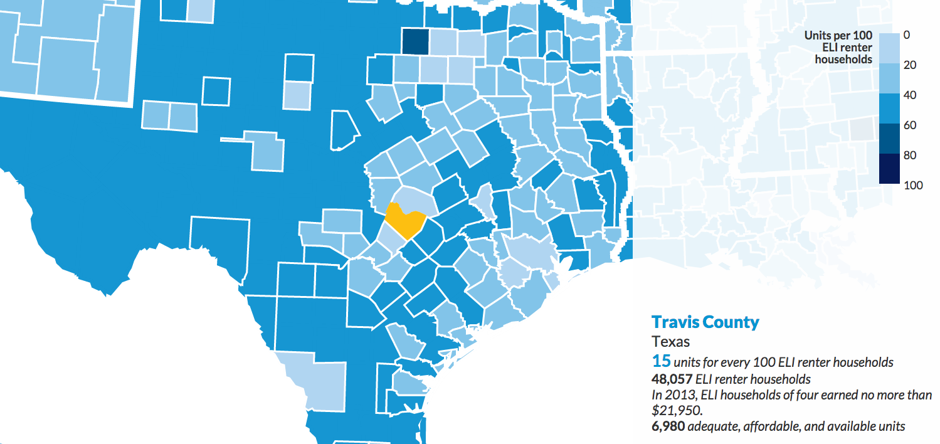
Using data from the Census Bureau and the U.S. Department of Housing and Urban Development, researchers built an interactive map to illustrate the nationwide reach of the problem. In no county in the U.S. does the supply of affordable housing meet the demand among extremely low-income households. (Families who made no more than 30 percent of an area’s median household income were considered “extremely low income.”)
A closer look at affordable-housing access for the extremely poor in Travis County. (Urban Institute)
In Travis County, Texas, for example, the extremely low-income cutoff for a family of four is $21,950. There are about 7,000 safe, affordable rental units to meet the needs of these poor Austin families. But there are more than 48,000 extremely low-income families living there.
Dylan Cleaver, “Lost playgrounds“, NZ Herald. A great bit of local history on sports grounds like Carlaw Park that have been redeveloped or paved over:
In many respects, the disappearing parks and sports ground shuffles shine a light of Auckland’s uniqueness, or what historian Professor Emiritus Russell Stone calls “exceptionalism”.
A century ago, Auckland’s population was 134,000, about one-tenth of what it is today. After WWII in particular, it started growing at a rate that was far outstripping the rest of the country.
“One of the fundamental problems was always where to distribute the people and where to locate the sports grounds,” Stone said.
Sport was no less popular than it is today, although it was far less of a business. For many Aucklanders, there were only three reasons to leave the house in the weekends – church, the movies or sport. All three had comparatively far higher attendance in the days before television and home-entertainment systems.
They didn’t mind walking. Auckland was, says the professor, a pedestrian city, so those in Ponsonby, on the city’s western fringe, would have thought little about walking 8km to Potter’s Paddock to see the All Blacks play their first test in Auckland, against the Anglo-Welsh in 1908.
And now for a rural version of the same phenomenon:
Sooner or later, every road comes to an end—but not in Vermont. In other states, a road that goes unused for a reasonable period of time is legally discontinued; in Vermont, any road that was ever officially entered into a town’s record books remains legally recognized, indefinitely. It doesn’t matter if the road has not been travelled in two hundred years, or if it was never travelled at all, or if it was merely surveyed and never actually built. Any ancient road that exists on paper—unless it has been explicitly discontinued—is considered a public highway in the eye of the law.
As a result, over decades and centuries, Vermont has become filigreed with rural roads and pathways that hardly anyone but the law can see. In 2003, a couple in the town of Chittenden was denied permission to build an extension onto their home when an independent researcher, hired by the town, discovered an ancient mail route passing right through their property. In the tiny hamlet of Granville, a survey revealed a long-lost, invisible throughway passing through the wooded front yard of a mountain home; a pending lawsuit may open the road to traffic from timber-company trucks. In 2006, prompted by a groundswell of complaints from Vermonters unable to obtain title insurance for their properties or to keep snowmobilers out of their flowerbeds, the state government passed Act 178, which aimed to brush away the infrastructural cobwebs. The act gave the towns until February of 2010 to identify and map any potential ancient roads within their borders; these would then be reviewed by the state and added to Vermont’s official highway map over the next five years. Any ancient road not added to the state map by July 1, 2015, would be considered discontinued.
The Act’s passage inspired a kind of statewide archive fever. Interested citizens, outdoors enthusiasts, industrial forestry advocates, and concerned homeowners began visiting town-records offices and poring through vaults, shelves, and filing cabinets stuffed with yellowing and re-bound handwritten notes, property transfers, mortgage deeds, and step-by-step narrations of particular routes across the landscape dating back as far as the seventeen-nineties. In a few cases, the ancient road under review actually predated Vermont’s statehood.
Share this
5 comments
Too bad we can’t replace Simon Bridges with Pope Francis.
“Higher rural land prices” does not explain the fact that decades after the UK Town and Country Planning Act, the price of land in UK cities has been found by the LSE to be 100 to 900 times higher than benchmark US cities with no fringe constraints.
Rural land outside the urban zones, in the UK, might be as much as double the rural land price in the US cities. Hardly an explanation for a difference factor of a few hundred inside the urban zones.
The Knoll, Schularick and Steger paper suffers from an inappropriately crude “aggregation” of statistics that conceals the vital outlier data necessary to draw the right conclusions.
Furthermore, Figure 1 drawn from Thomas Piketty, in this Economist article, completely contradicts Knoll et al’s assertion about rural land prices:
I wouldn’t be so quick to write off Knoll et al’s conclusions, but then again I’m a multiple working hypothesis kinda guy. They seem to have been reasonably careful about collecting data – at least, as careful as one can be when working with long-run time series.
I also think that you’ve misinterpreted their point about transport technologies. The 19th century saw a number of technological improvements – railroads, steamships, telegraph cables, etc – that made mass migration and economic globalisation much, much more feasible. This was one factor leading to a mass migration out of Europe and into Oceania, North America, and South America.
In 1850, there were around 200 million people living in Europe. Over the next 50-70 years, roughly 50 million Europeans emigrated to regions where land was cheaper. (Wars of extermination against indigenous peoples guaranteed the availability of cheap land.) The result of this was a massive one-off shock to the land-to-people ratio. Then came a world war, a great depression, and another world war, all of which held down living standards and the demand for land.
It shouldn’t really be a surprise that land prices have been rising as the effects of these shocks subside.
Thanks for signing up for news from Greater Auckland! Keep an eye on your inbox for regular updates.
Processing...
STAY IN TOUCH
We love being able to keep you in the loop - it means we know theres a community of like-minded people who are keen on making Auckland better on bikes. Sign up for updates about what's happening, and how you can be part of it.


 Processing...
Too bad we can’t replace Simon Bridges with Pope Francis.
Yep, the pope gets it. Not much chance of our leaders coming up to his level of thinking, though.
Clearly the Pope isnt a proper catholic, as expressed in this relic of the true faith:
Hail Mary full of grace
Help us find a parking space
Here is my critical comment on the paper “Home prices since 1870: No price like home” by Katharina Knoll, Moritz Schularick, Thomas Steger
http://www.voxeu.org/comment/105237#comment-105237
“Higher rural land prices” does not explain the fact that decades after the UK Town and Country Planning Act, the price of land in UK cities has been found by the LSE to be 100 to 900 times higher than benchmark US cities with no fringe constraints.
Rural land outside the urban zones, in the UK, might be as much as double the rural land price in the US cities. Hardly an explanation for a difference factor of a few hundred inside the urban zones.
The Knoll, Schularick and Steger paper suffers from an inappropriately crude “aggregation” of statistics that conceals the vital outlier data necessary to draw the right conclusions.
Furthermore, Figure 1 drawn from Thomas Piketty, in this Economist article, completely contradicts Knoll et al’s assertion about rural land prices:
http://www.economist.com/news/briefing/21647622-land-centre-pre-industrial-economy-has-returned-constraint-growth
I wouldn’t be so quick to write off Knoll et al’s conclusions, but then again I’m a multiple working hypothesis kinda guy. They seem to have been reasonably careful about collecting data – at least, as careful as one can be when working with long-run time series.
I also think that you’ve misinterpreted their point about transport technologies. The 19th century saw a number of technological improvements – railroads, steamships, telegraph cables, etc – that made mass migration and economic globalisation much, much more feasible. This was one factor leading to a mass migration out of Europe and into Oceania, North America, and South America.
In 1850, there were around 200 million people living in Europe. Over the next 50-70 years, roughly 50 million Europeans emigrated to regions where land was cheaper. (Wars of extermination against indigenous peoples guaranteed the availability of cheap land.) The result of this was a massive one-off shock to the land-to-people ratio. Then came a world war, a great depression, and another world war, all of which held down living standards and the demand for land.
It shouldn’t really be a surprise that land prices have been rising as the effects of these shocks subside.